Representation Conditioning for Generation
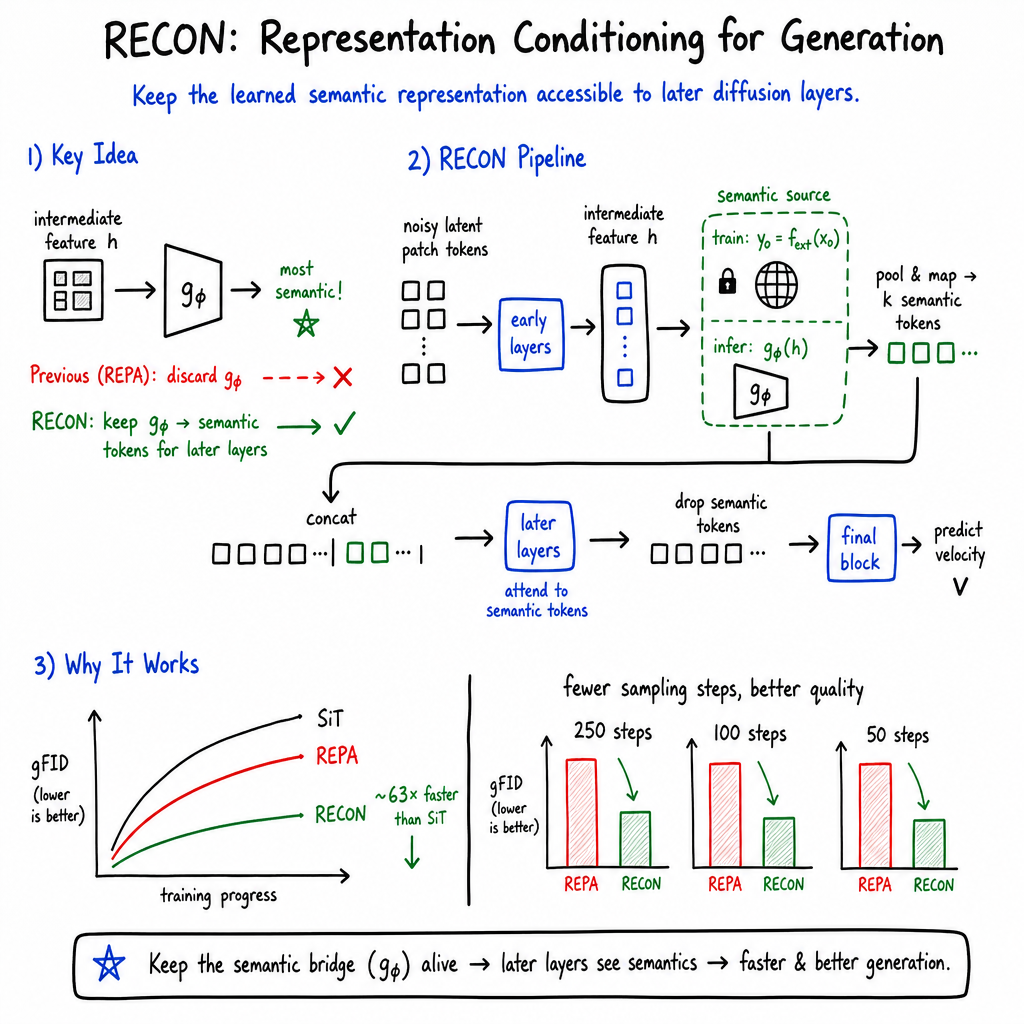
Abstract: Representation-alignment methods effectively accelerate the diffusion transformer training. REPA, for example, uses a pretrained vision encoder to supervise an intermediate layer through an MLP projection head which is discarded after training. It aims to import semantics from the vision encoder to the diffusion backbone. While this objective is achieved at early layers by back-propagating the alignment loss, there is no guarantee that later layers, supervised by the velocity prediction loss alone, can well access such semantics. We propose a simple solution, representation conditioning (RECON), to improve semantics in later layers. During training, we feed the pretrained vision encoder tokens into later layers; during inference, because we no longer have the clean image, we reuse the MLP head (as a proxy to the vision encoder) and project its output tokens to the later layers. Our method adds no parameters and leads to much faster convergence: RECON is faster than SiT and faster than REPA. Code is available at https://github.com/saeidrazavi/RECON
Paper Prompts
Sign up for free to create and run prompts on this paper.
Explain it Like I'm 14
1. What is this paper about?
This paper introduces a method called RECON for training AI systems that create images from random noise.
These systems are called diffusion models. They begin with a noisy, unclear pattern and slowly turn it into a realistic image. The paper focuses on making this training process:
- Faster
- More accurate
- Better at understanding the meaning of images, such as objects, shapes, and layouts
RECON improves an earlier method called REPA. The main idea is simple: REPA learns useful visual information but throws away part of what it learned. RECON keeps and reuses that information.
2. What questions does the research ask?
The researchers wanted to find out:
- Can RECON make image-generation models learn faster than existing methods?
- Can it help the model understand image meaning better?
- Can it improve the quality of generated images?
- Does it work for different model sizes, image encoders, and types of image generation?
- Can the model create good images using fewer generation steps?
In everyday terms, the researchers asked:
If an AI learns useful information from a very knowledgeable vision system, why not let it keep using that information later?
3. How does the method work?
Diffusion models in simple terms
A diffusion model is like an artist learning to repair badly damaged pictures.
During training, the researchers:
- Start with a real image.
- Add different amounts of noise to it.
- Ask the model to predict how to remove the noise.
- Repeat this with many images.
Eventually, the model learns how to start with random noise and gradually produce a realistic image.
The model used in this paper is a diffusion transformer. A transformer is a type of neural network that looks at many pieces of information and learns how they relate to one another. For images, the picture is split into small pieces called patches, similar to cutting a photograph into square tiles.
The vision encoder
The researchers also use a pretrained vision encoder, such as DINOv2. A vision encoder is another AI system that has already learned useful ideas about images. It can recognize information such as:
- Where objects are
- What shapes look like
- Which parts of an image belong together
- Broad concepts such as “dog,” “car,” or “tree”
The diffusion model is trained to make some of its internal information resemble the information produced by this vision encoder. This is called representation alignment.
A representation is simply the way an AI stores information internally. For example, the AI might represent a picture of a cat using numbers that describe its shape, position, and visual features.
The problem with REPA
REPA uses a small neural network called a projection head, written as . This projection head translates the diffusion model’s internal information into a form that resembles the vision encoder’s information.
However, after training, REPA throws away this projection head.
The researchers argue that this is wasteful. The projection head contains some of the most meaningful visual information learned during training.
The RECON solution
RECON keeps the projection head and gives its output to the later parts of the diffusion model.
The process works like this:
- During training: The model receives visual information directly from the vision encoder.
- During image generation: There is no clean image available, so the projection head estimates this visual information instead.
- The estimated information is compressed into a small number of semantic tokens.
- These tokens are added to the image-patch information.
- The later layers of the transformer can then use both kinds of information.
A useful analogy is a student solving a difficult problem:
- The early layers learn basic facts from a teacher.
- REPA lets only the early layers benefit strongly from the teacher.
- RECON also passes helpful notes to the later layers, so they can use the teacher’s knowledge when completing the answer.
The method adds almost no extra model size. In most cases, it uses existing parts of the model rather than adding new ones.
4. What did the researchers find?
Faster training
RECON learned much faster than the comparison methods.
The paper reports that RECON was:
- Up to 63 times faster than SiT
- Up to 25 times faster than REPA
This means RECON could reach a similar image quality using far fewer training steps.
For example, on ImageNet images, RECON achieved a gFID score of 3.25 after 400,000 training steps. The gFID score measures how similar generated images are to real images; lower is better.
Better image quality
RECON produced better images than REPA in several experiments.
For class-based image generation, such as generating an image from a label like “goldfish” or “mountain,” RECON achieved:
| Method | gFID after 400,000 steps |
|---|---|
| REPA | 5.90 |
| RECON | 3.25 |
Lower scores indicate better image quality.
RECON also performed well for text-to-image generation, where the model creates an image from a sentence. On the tested datasets, it generally produced:
- Lower FID scores
- Higher CLIP scores
- Higher image-quality scores
This suggests that RECON followed text instructions and produced realistic images more effectively than REPA.
Better understanding inside the model
The researchers measured whether the model’s internal features contained useful information about images.
They found that RECON improved the semantic information in nearly every layer of the diffusion transformer. In the later layers, it increased one measure of visual similarity by about 21.2% and another image-classification measure by about 4.9%.
In simpler language, the model became better at representing what was actually in the image.
Images become organized earlier
The researchers also examined how images develop during generation.
With RECON, important parts of the image—such as the main object, its position, and the overall layout—appeared earlier in the generation process.
This allowed RECON to create good images with fewer generation steps:
| Number of generation steps | REPA gFID | RECON gFID |
|---|---|---|
| 50 | 10.8 | 3.3 |
| 100 | 8.4 | 3.2 |
| 250 | 7.9 | 3.2 |
This is important because each generation step requires the AI model to do more work. Fewer steps can make image generation faster and less expensive.
The method worked in several settings
RECON continued to improve results when the researchers changed:
- The size of the diffusion model
- The system used to compress images
- The pretrained vision encoder
- The type of image-generation task
This suggests that RECON is not useful only in one special experiment.
5. Why are these results important?
The main lesson is that learning useful visual information is not enough; the model must also be able to access that information when it creates an image.
REPA helped the model learn semantic information but discarded the projection head that carried much of that information. RECON keeps it available and passes it to the later layers.
This has several possible benefits:
- Image-generation models could train more quickly.
- Training may require less computing power and electricity.
- Images could be generated faster.
- Models may understand object identity and image layout more clearly.
- The same idea could improve text-to-image systems and other generative AI tools.
There is one important limitation: RECON depends on the model already being trained with a representation-alignment method such as REPA. It cannot simply be added to a model that never learned from an external vision encoder.
Conclusion
RECON is a small but useful change to diffusion-model training. Instead of throwing away a projection head after it has learned meaningful visual information, RECON reuses it to guide the later layers of the model.
The experiments show that this can lead to faster training, better image quality, stronger visual understanding, and fewer generation steps. The broader message is straightforward:
When an AI learns something useful, it should not only store that knowledge—it should keep the knowledge easy to use when making decisions.
Practical Applications
Immediate Applications
- Faster commercial text-to-image model development — software and creative industries. Existing diffusion-transformer pipelines that already use REPA-style representation alignment can retain the trained projection head and add RECON-style semantic-token conditioning to later layers. This can reduce training time substantially—reported as up to 25× faster than REPA and 63× faster than SiT—while improving FID and CLIP-based results. Potential products include faster image-generation APIs, advertising-content systems, game-asset generators, and design-prototyping tools. Dependencies: the backbone must already be trained with an external vision encoder and an alignment loss; reported results are primarily based on ImageNet, MS-COCO, and BLIP3-o rather than broad production distributions.
- Low-cost model fine-tuning and domain adaptation — enterprise AI and research laboratories. Organizations can use RECON when adapting diffusion transformers to a specialized image domain, such as retail catalogs, industrial inspection, architecture, or scientific imaging. The method introduces no additional trainable parameters for most Base, Large, and Extra Large configurations and can reach useful quality with fewer training iterations. Dependencies: a suitable pretrained vision encoder, compatible latent tokenizer/VAE, and carefully tuned parameters such as alignment depth, semantic-token count, and the injection threshold are required.
- Reduced image-generation inference cost — cloud AI and edge deployment. RECON can support inference workflows using approximately 2.5× to 5× fewer network evaluations than REPA while maintaining nearly stable reported gFID. Providers could use this to reduce GPU-hours, latency, and energy consumption for batch image generation or interactive generation services. Dependencies: the reported sampling efficiency was measured on specific SiT-XL/2 configurations and samplers; production deployment would require validation across resolutions, hardware, quantization schemes, and safety-filtering pipelines.
- More responsive interactive image editing — creative software. Earlier emergence of semantic layout and improved recovery from corrupted images make RECON potentially useful for image-to-image editing, sketch completion, masked editing, and rapid preview generation. An editing tool could generate a low-cost semantic preview first and refine it only when the user accepts the composition. Dependencies: the paper evaluates perturbation recovery and generation trajectories, but not complete user-facing editing workflows. Identity preservation, precise masks, and controllability would need separate evaluation.
- Faster class-conditional image synthesis — media, education, and prototyping. RECON can be integrated into class-conditional generators for producing synthetic datasets, visual teaching materials, product concepts, or game references. Its improved intermediate semantic representations may yield more class-consistent outputs at early checkpoints than conventional diffusion transformers. Dependencies: class labels alone may not provide sufficient control for detailed applications; the method’s effect on diversity, rare classes, and distributional bias must be assessed.
- A practical training recipe for diffusion-transformer researchers — academia.
Researchers can reproduce the workflow by combining:
- REPA-style alignment to a frozen vision encoder,
- retention of the MLP projection head,
- pooling its output into semantic tokens, and
- concatenating those tokens with patch tokens in later transformer blocks. This offers a relatively low-complexity baseline for studying semantic representations in flow-matching and diffusion models. Dependencies: implementation details such as teacher forcing during training, inference-time use of , and scheduling semantic-token injection are important; simply appending tokens without matching the train–inference distributions may substantially reduce performance.
Representation diagnostics for generative-model development — machine-learning tooling. CKNNA, linear-probe accuracy, and semantic trajectory measurements can be incorporated into experiment dashboards to monitor whether intermediate diffusion layers are acquiring useful visual semantics. Teams could use these metrics for checkpoint selection, architecture comparison, or early stopping instead of relying only on final FID. Dependencies: these diagnostics depend on a reference encoder and may measure alignment with that encoder rather than complete perceptual quality, factual correctness, or user preference.
- Reuse of discarded projection heads in existing model repositories — model engineering. Checkpoint-maintenance workflows can preserve projection heads that are normally deleted after REPA-style training. Existing models may be upgraded by modifying later-layer inputs and retraining or fine-tuning the conditioning pathway, potentially without increasing the core model’s parameter count. Dependencies: RECON cannot directly be applied to models trained without representation alignment, and retrofitting a fully trained model may require additional fine-tuning to prevent distribution mismatch.
- Policy and infrastructure planning for generative-AI efficiency. Cloud providers and public-sector AI programs can treat semantic conditioning as an energy- and compute-efficiency intervention. Benchmarking should report not only image quality but also training steps, network evaluations, GPU-hours, and energy per generated image. Dependencies: the paper reports convergence and sampling improvements but does not provide a full carbon or total-cost-of-ownership analysis. Energy savings may be offset by the cost of running the external vision encoder during training.
Long-Term Applications
- High-resolution text-to-image and multimodal generation — commercial media and content production. A scaled RECON architecture could improve high-resolution advertising, film previsualization, game environments, and product visualization by giving later denoising layers direct access to semantic representations. The same idea could potentially extend to video, 3D, audio-visual synthesis, and multimodal diffusion transformers. Dependencies: the current evidence is concentrated on image generation. Longer sequences, temporal consistency, higher resolutions, and text-image alignment may require different pooling, token-placement, and memory-management strategies.
- Domain-specific medical and scientific image generation — healthcare and research. Vision encoders trained on radiology, pathology, satellite imagery, microscopy, or materials data could serve as the external semantic targets. RECON might then improve conditional synthesis, reconstruction, augmentation, or simulation while reducing the cost of training domain-specific diffusion models. Dependencies: clinical deployment requires validation for demographic bias, privacy leakage, hallucinated pathology, calibration, and regulatory compliance. Generic encoders such as DINOv2 are not sufficient evidence for medical use.
- Robotics and embodied perception-generation systems — robotics. Semantic tokens could condition generative world models, scene-prediction systems, or robot-imagination modules, allowing later layers to preserve object identity, spatial layout, and task-relevant structure during prediction. This could support manipulation planning, simulation-data generation, and visual foresight. Dependencies: the paper focuses on static images. Robotics requires temporal representations, 3D geometry, action conditioning, uncertainty estimates, and reliable behavior under distribution shift.
- Controllable image editing with semantic-token interfaces — creative and design software. Future systems could expose semantic tokens as editable controls: users might alter object identity, layout, style, or scene attributes before the later diffusion layers generate the final image. This would turn the retained projection head into an intermediate control interface rather than merely an internal feature. Dependencies: current RECON uses pooled tokens, typically , which may not preserve enough spatial detail for precise editing. More tokens increase expressive capacity but can amplify projection errors and degrade generation quality.
- Adaptive or token-level guidance for diffusion sampling — generative-model infrastructure. Because RECON makes semantic information explicit, future samplers could apply guidance directly to semantic tokens rather than only to velocity predictions. This could produce more accurate prompt adherence with less classifier-free-guidance overhead and potentially reduce sampling steps further. Dependencies: the paper identifies semantic-token extrapolation and projected autoguidance as promising but preliminary. Stability, controllability, and failure behavior require systematic study.
- Unified semantic interfaces across vision encoders — model portability. The reported gains across DINOv2, I-JEPA, MoCo-v3, SigLIP2, and WebSSL-DINO suggest a possible abstraction layer in which different pretrained encoders provide interchangeable semantic supervision. This could enable organizations to select encoders optimized for domain privacy, language alignment, robustness, or licensing constraints. Dependencies: encoder features are not inherently compatible; dimension matching, token geometry, preprocessing, licensing, and domain-specific semantics can all affect performance.
- Efficient generative models for mobile and edge devices — consumer electronics and embedded systems. Combining RECON’s reduced sampling requirements with quantization, pruning, distillation, and compact VAEs could enable image generation on phones, laptops, cameras, or embedded devices. Applications include offline creative assistants, privacy-preserving image tools, and low-connectivity content generation. Dependencies: the projection head and semantic-token operations must remain efficient after compression. Memory bandwidth, thermal constraints, model licensing, and robustness to quantization are not evaluated in the paper.
- Synthetic-data pipelines for machine-learning training — healthcare, autonomous systems, and industrial AI. Faster generation could make it more practical to produce large synthetic datasets for rare visual classes, simulation pretraining, defect detection, or perception-system stress tests. Earlier semantic stabilization may also allow automated filtering of low-quality samples before full sampling completes. Dependencies: improved FID does not guarantee useful synthetic data. Applications require downstream-task evaluation, control of label correctness, diversity audits, and safeguards against reproducing private or copyrighted training examples.
- Theory and benchmarking of semantic accessibility in generative models — academia. The paper motivates a broader research program on whether representations learned during training remain accessible to later generation stages. Future work could formalize semantic accessibility, compare token routing strategies, and relate representation alignment to sample quality, robustness, and controllability. Dependencies: CKNNA and linear probing are indirect measures. Stronger causal tests are needed to determine whether semantic alignment itself causes improved generation or merely correlates with other training advantages.
- Policy standards for efficient and auditable generative AI — public policy. RECON-like methods could inform evaluation standards that require reporting convergence speed, inference network evaluations, energy use, semantic alignment, and model behavior under corruption—not just final FID or visual quality. Such standards could support procurement decisions and sustainability reporting. Dependencies: benchmarks must cover diverse datasets, model families, hardware, and real-world workloads. Efficiency claims based on a single architecture or dataset should not be generalized without independent replication.
Glossary
- Alignment depth: The transformer layer at which representation-alignment supervision is applied. “We call the alignment depth”
- Autoguidance: A sampling technique that uses a weaker model or prediction to guide generation. “we use Autoguidance”
- Classifier-free guidance (CFG): A method for conditioning generation without requiring a separately trained classifier. “We use no classifier-free guidance.”
- CKNNA: Centered Kernel Nearest Neighbors Alignment, a metric for comparing the neighborhood structures of two representations. “CKNNA compares the nearest-neighbor structure of two representations”
- Cosine similarity: A measure of similarity based on the angle between two vectors. “ is the cosine similarity.”
- Diffusion backbone: The principal neural network that performs the denoising or velocity-prediction computation in a diffusion model. “It aims to import semantics from the vision encoder to the diffusion backbone.”
- Diffusion transformer: A transformer architecture adapted to model diffusion or flow-based generative processes. “we parameterize with a diffusion transformer”
- Distribution gap: A discrepancy between the distributions of data used during training and inference. “Using perception model features for training and projected features for inference creates a distribution gap.”
- DINOv2: A self-supervised vision encoder that produces semantically informative image representations. “such as DINOv2”
- Encoder–decoder decomposition: A division of a model into an early feature-extraction component and a later prediction component. “one can view the diffusion model as a composition of two functions ”
- Exponential moving average (EMA): A running weighted average that gives greater importance to recent parameter or output values. “, EMA”
- Feature alignment: The process of making representations produced by one model resemble representations produced by another model. “REPA speeds this up by supervising with a frozen pretrained vision encoder”
- Flow matching: A generative-model training framework that learns a vector field transporting noise to data. “Flow matching trains a network to transport noise”
- Flow-matching loss: The objective that trains a network to predict the velocity along a prescribed probability path. “Trained with the flow-matching loss”
- Frozen encoder: A pretrained encoder whose parameters are kept fixed during subsequent training. “a frozen pretrained vision encoder”
- gFID: A generative version of the Fréchet Inception Distance used to evaluate generated-image quality. “we report FID = 3.25 at 80 epochs using SD-VAE”
- In-context conditioning: Conditioning a model by including additional information as part of its input sequence rather than modifying its parameters. “which serves as in-context conditioning for the later diffusion layers.”
- Inception score (IS): An image-generation metric combining predicted class confidence with diversity across generated samples. “We report gFID, inception score, precision and recall over 50K samples”
- Interpolant: A mathematical path connecting source and target distributions during generative modeling. “the linear interpolant of rectified flow”
- Latent diffusion: Diffusion or flow-based generation performed in a compressed latent representation rather than directly in pixel space. “As in latent diffusion”
- Latent space: A learned or encoded feature space in which images are represented more compactly. “we work with its latent”
- Linear probing: Evaluating learned representations by training a simple linear classifier on top of frozen features. “linear probing accuracy to measure semantics in each layer”
- MLP projection head: A multilayer perceptron that maps one representation into the dimensionality or feature space of another. “through an {MLP projection head} which is discarded after training.”
- Marginal distribution: The distribution of a variable at a particular point in a stochastic or generative process, after other variables are integrated out. “an SDE with the same marginals”
- Multimodal diffusion transformer (MMDiT): A diffusion-transformer architecture designed to process multiple modalities, such as images and text. “we train MMDiT”
- Noise schedule: A rule specifying how noise levels change across diffusion or sampling timesteps. “Time-dependent scheduling for semantic token injection.”
- ODE sampler: A numerical procedure for generating samples by integrating an ordinary differential equation. “Samples are drawn with an ODE sampler at 50 steps.”
- Patch token: A token representing a spatial patch of an image or image latent. “concatenates them with the patch tokens”
- Perception model: A model trained to extract meaningful visual features rather than directly generate images. “Using perception model features for training”
- Projection head: A trainable mapping from model features into a target representation space. “We use interchangeably with ``projection head''.”
- Rectified flow: A flow-based generative method using an approximately straight transport path between noise and data. “the linear interpolant of rectified flow”
- Representation alignment: Training a model so that its internal features correspond to features from an external or target encoder. “Representation alignment. REPA”
- Representation conditioning: Conditioning later model layers on semantic representations produced by an encoder or projection head. “We introduce a very simple fix, named REpresentation CONditioning (RECON).”
- Semantic token: A token encoding high-level visual information used to condition later transformer processing. “We pool them into semantic tokens”
- Semantic Token Extrapolation: A guidance technique that modifies semantic tokens during sampling to improve generation. “Semantic Token Extrapolation”
- SDE sampler: A sampling procedure based on numerically solving a stochastic differential equation. “drawn with an SDE sampler at 250 steps”
- Self-supervised learning: Learning representations from data without manually supplied labels. “Learning Robust Visual Features without Supervision”
- Teacher forcing: Training a model with ground-truth inputs or representations instead of its own predicted outputs. “This is the same teacher forcing method as LLMs”
- Token injection: The insertion of additional tokens into a model at selected layers or timesteps. “Time-dependent scheduling for semantic token injection.”
- Velocity field: A function specifying the instantaneous direction and rate of transport along a generative path. “The velocity along this path is ”
- Vision encoder: A neural network that transforms an image into visual feature representations. “uses a pretrained vision encoder”
- Zero-padding: Extending a vector with zeros to match a required dimensionality. “it is zero-padding if ”

