GRPODropout: Less is More for Online Reinforcement Learning Rollouts
Abstract: Reinforcement learning (RL) methods such as GRPO substantially improve LLM reasoning but often suffer from policy entropy collapse: the loss of sampling diversity weakens exploration and limits further improvement. Existing methods address this issue either through algorithm-level interventions, such as reward modification and entropy/KL regularization, or through token-level reweighting. We investigate a complementary perspective: entropy collapse can also be mitigated by changing which generated rollouts contribute to policy updates. Under the same sampling budget, not all rollouts contribute positively to an update, and selectively excluding some can improve learning. To address this, we propose GRPODropout: before the standard update, we use a simple strategy that selectively removes a small number of high-probability positive-advantage rollouts and recenters the retained advantages. To motivate this design, we develop a rollout-level theoretical analysis that guides method design and threshold selection. The method changes only rollout usage, and adds negligible computational overhead. Experiments show higher accuracy than original GRPO and higher actor entropy while using fewer rollout samples for updates, illustrating "less is more." This work provides insight into RL rollout usage: removing some rollouts can improve performance. Code is available at https://github.com/hexuandeng/GRPODropout/.
Paper Prompts
Sign up for free to create and run prompts on this paper.
Top Community Prompts
Explain it Like I'm 14
1. What is this paper about?
This paper studies how to improve the training of LLMs, especially when they learn to solve difficult problems such as mathematics.
The researchers focus on a problem called entropy collapse. In simple terms, this happens when a model becomes too predictable. It keeps using the same answers or reasoning paths instead of trying new ones. This can make the model stop improving.
The paper introduces a new method called GRPODropout. Its main idea is:
Sometimes, a model learns better when it ignores a small number of training examples instead of using all of them.
This is why the paper’s title says “Less is More.”
2. What questions are the researchers asking?
The paper mainly asks:
- Are all the answers produced by the model equally useful for training?
- Can removing some answers help the model keep exploring different possibilities?
- Which answers should be removed?
- Can this improve both accuracy and the model’s ability to try different reasoning paths?
- Can this be done without greatly increasing the cost or complexity of training?
The researchers are especially interested in answers that are:
- Likely under the model’s current behavior, meaning the model already often produces them.
- Better than the model’s average answer, meaning they receive a positive training score.
The paper argues that repeatedly rewarding these answers may cause the model to become overly confident in paths it already knows.
3. How did the researchers approach the problem?
Reinforcement learning in simple terms
The model is trained using reinforcement learning, which is similar to training a student with feedback.
For each question, the model produces several complete answers. These are called rollouts. For example, given a math problem, the model might generate eight different solutions.
Each rollout receives a reward:
- A correct or useful solution receives a high reward.
- An incorrect or less useful solution receives a low reward.
The model then changes its behavior so that highly rewarded answers become more likely.
The problem with using every rollout
The researchers noticed that using every generated answer may not always be helpful. Suppose a model already produces one type of correct solution very often. Rewarding that same type again and again might make it even more likely, while making other possible approaches less likely.
This reduces the model’s entropy.
In this paper, entropy means how many different choices the model is willing to consider. A model with:
- High entropy is more open to different answers and reasoning paths.
- Low entropy is more certain and repetitive.
An everyday analogy is choosing a route to school. A model with high entropy may consider several routes. A model with low entropy always takes the same route, even if another route could sometimes be better.
The GRPODropout method
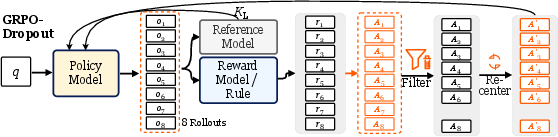
GRPODropout has three main steps:
- Generate several answers for each question.
- Remove some high-probability positive rollouts. These are answers that the model already strongly prefers and that received above-average rewards.
- Recenter the remaining advantages before updating the model.
The word advantage means how much better or worse an answer is compared with the average answer for that question.
“Recentering” means adjusting the remaining scores so that removing examples does not accidentally push the model in an unfair direction. It is similar to recalculating a class average after some students are absent, rather than pretending the original average still applies.
The method does not change the main reinforcement-learning loss. It only changes which rollouts are used and how their scores are adjusted.
Theoretical analysis
The researchers also developed mathematical analyses to predict which rollouts are likely to reduce entropy.
They examined:
- How likely each rollout was under the old model.
- Whether its reward was above or below average.
- How these two properties were related.
Their analysis suggested that highly likely, positively rewarded rollouts can reduce entropy especially strongly. These rollouts are already familiar to the model, so rewarding them again may teach the model very little while making it less willing to explore.
4. What did the researchers find?
The researchers tested GRPODropout on:
- Three model sizes: approximately 1.7 billion, 4 billion, and 8 billion parameters.
- Ten benchmarks involving mathematical reasoning and general question answering.
- Comparisons with the original GRPO method and several other entropy-related methods.
Better average performance
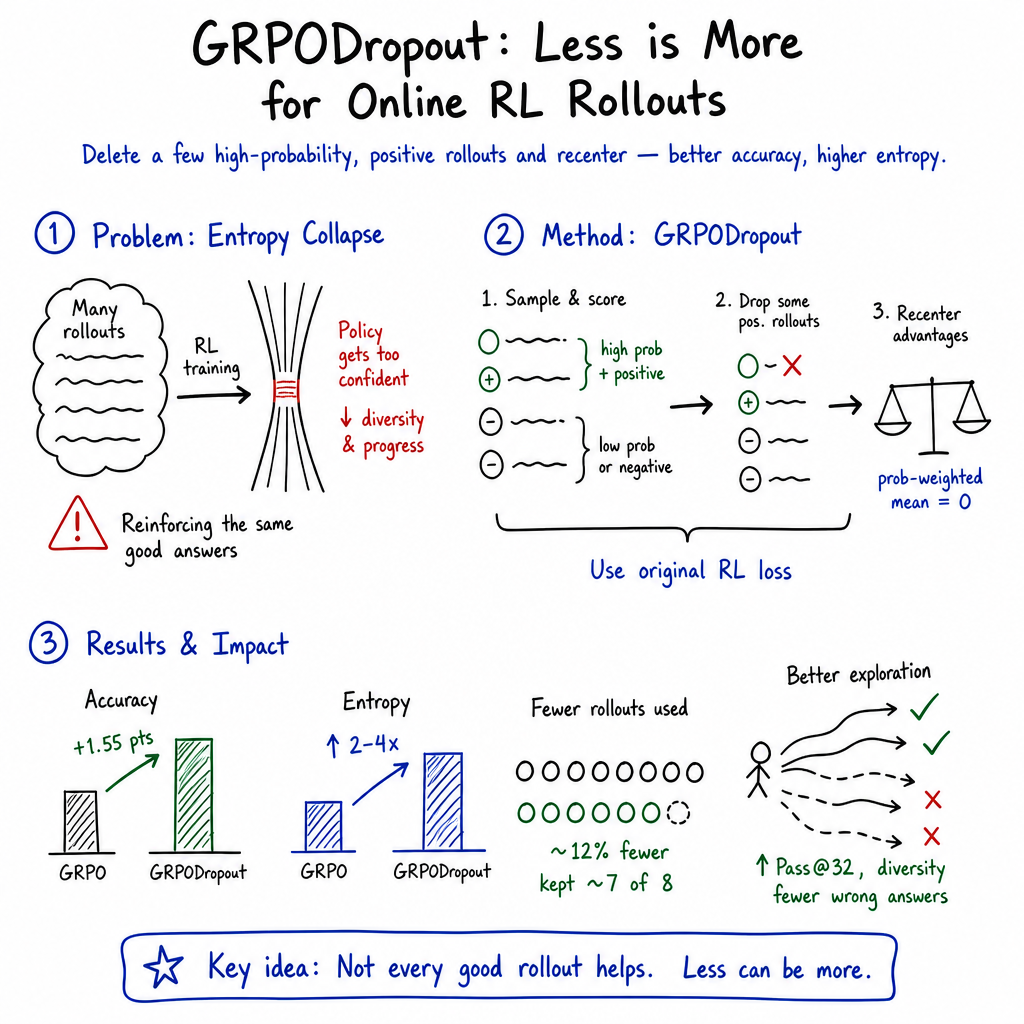
Across the three model sizes, GRPODropout improved the average score over original GRPO by about 1.55 percentage points.
The method did not win on every individual test, but it generally performed as well as or better than the original approach. It also performed competitively against other methods designed to reduce entropy collapse.
Much higher entropy
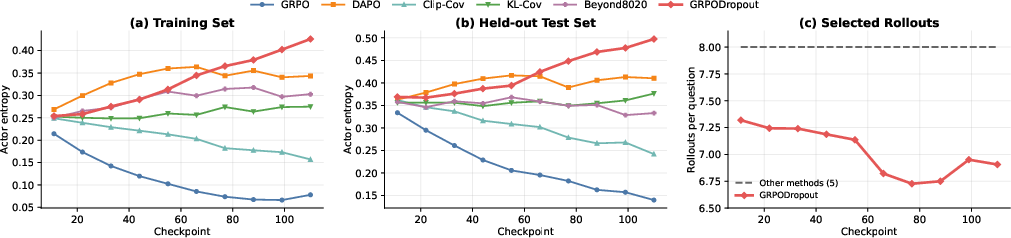
The method greatly reduced entropy collapse in the main experiment.
For the 4-billion-parameter model, the paper reports that, at the end of training:
- Training entropy was about 446% higher than with original GRPO.
- Held-out evaluation entropy was about 256% higher.
This means the model continued to consider many more possible token choices instead of becoming extremely predictable.
It used fewer rollouts
The original method used eight rollouts per question for updates. GRPODropout kept about 7.03 rollouts on average, or approximately 12.1% fewer.
Even with fewer training examples being used, the method achieved better or similar accuracy. This supports the paper’s main message that carefully chosen data can be more useful than simply using all available data.
Recentering was important
The experiments showed that deleting rollouts without recentering the advantages could cause training to fail badly.
This means the two parts of the method work together:
- Dropout removes potentially harmful or repetitive examples.
- Recentering prevents the remaining examples from creating an unintended bias.
More diverse reasoning
The researchers also checked whether higher entropy actually led to more varied reasoning.
GRPODropout produced:
- More different reasoning paths.
- Better coverage of possible solutions.
- Fewer repeated incorrect final answers in several settings.
- Strong performance on both single-answer and multiple-sample evaluation.
This is important because simply making a model more random would not necessarily make it better. The goal is to preserve useful exploration while maintaining accuracy. The results suggest that GRPODropout often achieved this balance.
5. Why are these results important?
The paper challenges a common assumption in machine-learning training:
More training examples are not always better if some examples repeatedly push the model in an unhelpful direction.
A model can become too focused on answers it already knows how to produce. By removing a small number of these examples, the model may retain more curiosity and continue discovering new strategies.
The method is also relatively practical because it:
- Uses information already available during training.
- Does not require a separate value model.
- Adds very little extra computation.
- Leaves the main reinforcement-learning objective mostly unchanged.
6. Implications and possible impact
If the findings are confirmed by further research, GRPODropout could help train reasoning models that are:
- More accurate.
- Less repetitive.
- Better at discovering alternative solutions.
- Less likely to become overconfident in one strategy.
- More efficient in how they use generated training data.
The broader lesson is that reinforcement learning should not automatically reward every successful-looking example equally. Some examples may be correct but still unhelpful if they are already too common.
However, the method also has limitations. It needs several rollouts for the same question so that the model can compare them. It may not work directly when only one rollout is generated. The paper also admits that its mathematical theory is mainly a guide for designing the method, not a complete explanation of everything that happens during real model training.
Overall, the paper presents a simple but surprising idea: a LLM may improve more when training carefully ignores some examples rather than learning from every example it produces.
Knowledge Gaps
知识缺口、局限性与开放问题
- 理论与实际训练 dynamics 之间仍存在明显差距。 论文的熵分析依赖局部 KL-proximal 更新、独立序列 logits、固定采样组和一阶近似,而实际训练使用共享参数、token-level 梯度、裁剪、参考策略正则化及多步优化;这些因素如何改变 rollout 删除的熵效应尚未被严格刻画。
- 尚未证明高概率正优势 rollout 在一般条件下必然有害。 论文只在特定假设和条件比较下显示其一阶熵贡献更负,尚未给出适用于一般策略网络、奖励分布和优化器的充分条件或理论保证。
- 熵增加与任务性能提升之间的因果关系尚未确立。 实验显示 GRPODropout 同时提高熵和部分准确率,但尚未通过控制熵变化、保持更新方向不变等实验确定性能提升究竟来自更好的探索、较小的更新偏差,还是其他训练效应。
- 删除规则中的关键估计存在较大噪声。 使用组内平均 surprisal 估计全策略熵,并用有限样本估计协方差;该估计在 rollout 数量较少、输出分布高度偏斜或序列长度差异较大时的偏差和方差尚未分析。
- 长度归一化的理论影响未被解释。 实际实现对 log-probability 进行长度归一化,但主要理论结果基于完整序列概率。长度归一化是否改变候选排序、熵贡献判定和 recentering 的有效性,尚未得到理论或系统实验验证。
- 贪心删除算法不一定求得全局最优保留集合。 论文将“删除最负贡献 rollout”的贪心过程用于求解集合选择问题,但未证明该过程能获得原优化问题的最优解,也未量化贪心近似误差。
- 最终方法与理论筛选目标并不完全一致。 理论筛选首先允许删除正、负优势 rollout,随后恢复所有非正优势 rollout,因此最终规则是启发式组合,而非直接优化一个严格定义的目标;这种设计为何在不同任务中稳定有效仍未明确。
- recentring 的有效性依赖未经充分验证的代理模型。 概率加权 recentering 消除的是辅助分布空间 proximal 更新中的一阶归一化偏移;在共享参数网络中,它是否真正保护未采样路径、是否会改变有益的泛化更新,尚未被直接测量。
- recentring 可能改变原始 RL 目标,但其偏差尚未量化。 删除样本并重新计算优势后,更新不再是原始组优势目标的无偏估计。论文未分析这一目标偏差、重要性采样修正是否必要,以及该偏差与最终性能之间的关系。
- 没有系统研究组大小对方法的影响。 论文明确指出方法依赖组内多 rollout 的优势和概率差异,但仅报告固定设置;当 很小、组内奖励几乎相同或优势符号严重不平衡时,筛选稳定性和性能仍未知。
- 单 rollout 或近似单 rollout 训练缺乏适用方案。 GRPODropout 不能直接用于 single-rollout RL,但论文未探索跨 batch、跨 prompt 或历史 rollout 的替代统计量来扩展该方法。
- 删除比例和阈值缺乏可迁移的选择原则。 论文报告平均删除约 12.1% 的 rollout,但没有系统研究删除比例、协方差阈值、最小保留数和不同训练阶段之间的关系,也未证明当前规则在其他设置下仍接近最优。
- 训练早期、后期和熵崩溃临界阶段的行为尚未区分。 过滤规则是否应随训练阶段、当前熵水平、奖励尺度或策略与参考模型的距离动态调整,论文没有进行阶段性分析。
- 奖励模型或奖励函数的适用范围尚未验证。 实验主要围绕数学正确性奖励和 RLVR 展开;对于偏好奖励、稀疏奖励、连续奖励、噪声奖励或奖励模型存在系统偏差的场景,哪些 rollout 应被删除仍是开放问题。
- 负优势 rollout 始终保留的策略可能并非普适最优。 论文基于条件理论分析优先删除正优势 rollout,但在不同奖励噪声、优势估计误差或策略分布下,低概率负优势 rollout 可能同样重要;其保留是否会限制性能或探索尚未系统评估。
- 方法对优势估计误差的鲁棒性未知。 rollout 的正负分类直接依赖 native advantage,而价值基线、组均值和奖励噪声可能导致符号误判。论文没有分析优势误分类对过滤、recentring 和训练稳定性的影响。
- 与其他熵控制机制的组合效果尚未充分研究。 论文仅将 GRPODropout 与若干独立基线比较,尚未系统评估它与 KL 正则化、温度调节、Clip-Higher、token-level masking 或自适应熵目标联合使用时是否互补、冗余或产生冲突。
- 实验覆盖范围仍有限。 评估仅涉及三个 Qwen3 模型、数学训练数据和十个基准,缺少不同架构、预训练语料、上下文长度、训练规模、语言、代码推理和非推理任务上的验证。
- 性能提升的统计显著性和跨随机种子稳定性不充分。 论文主要报告单次结果和平均分,未提供多随机种子均值、置信区间或显著性检验,因此 1.55 个百分点的平均提升是否稳定尚不确定。
- 与基线的训练公平性仍需更细致核查。 虽然采样预算相同,但 GRPODropout 使用更少的 retained rollouts 更新策略;论文未系统比较相同有效梯度样本数、相同计算量、相同 token 数和相同 wall-clock 时间下的性能。
- “计算开销可忽略”的结论缺少完整成本分析。 论文未报告不同组大小、序列长度和模型规模下,概率计算、候选排序、recentring 及额外存储带来的实际训练时间和显存开销。
- 熵指标与探索能力之间的对应关系仍不充分。 主要熵指标是 token-level conditional entropy,不能完全反映完整 reasoning trajectory 的有效多样性;其与状态覆盖、解空间覆盖和长期探索能力之间的关系尚未建立。
- 推理路径多样性指标存在评估器依赖。 Summary distance 和 Vendi 依赖 GLM-5.2 生成摘要及 bge-m3 嵌入;摘要质量、模型偏差和语义压缩可能影响多样性结论,尚未通过人工评估或多个独立编码器验证。
- held-out entropy 的泛化意义仍有限。 论文在 MMLU-Pro 上测量 held-out entropy,但未评估熵提升是否能迁移到更广泛的未见任务、分布外问题或实际交互环境,也未说明高熵是否始终对应有用探索。
- 删除 rollout 对最终策略分布的长期影响尚未揭示。 当前分析主要关注单次更新的一阶熵变化,尚未研究反复删除同类 rollout 是否造成模式遗漏、奖励覆盖不足、策略偏移或长期探索空间缩小。
- 尚未识别哪些“正确 rollout”最可能有害。 论文按概率和优势筛选 rollout,但没有进一步分析其推理长度、错误可修正性、答案置信度、路径结构或与其他解的相似度;这些特征能否改进删除策略仍是开放问题。
- 对多解任务和非唯一答案任务的行为不清楚。 在数学任务中,多个 reasoning path 可能导向同一答案;对于开放式生成、偏好对齐或存在多种等价解的任务,删除高概率正优势 rollout 是否会误删重要模式尚未验证。
- 尚未建立性能—熵—样本使用量之间的统一优化目标。 论文分别报告准确率、熵和 retained rollout 数量,但没有形式化三者之间的 Pareto 前沿,也没有说明在不同应用中应如何选择最合适的权衡。
Practical Applications
Immediate Applications
- LLM reinforcement-learning training optimization — Industry/Software
- Integrate GRPODropout into existing GRPO- or RLVR-based training pipelines for mathematical reasoning, code generation, and other verifiable tasks.
- The method can be implemented as a preprocessing stage between rollout generation and policy updating:
- 1. Sample multiple responses per prompt.
- 2. Compute rewards, advantages, and old-policy probabilities.
- 3. Remove selected high-probability, positive-advantage rollouts.
- 4. Recenter the retained advantages using old-policy probability weighting.
- 5. Apply the original policy loss without changing the optimizer or model architecture.
- Potential products/tools: a
GRPODropouttrainer module for frameworks such as TRL, DeepSpeed, Megatron, or custom RLHF/RLVR stacks; rollout-selection dashboards; entropy-collapse monitoring plugins. - Expected benefit: fewer rollouts are used in policy updates while preserving or improving accuracy and substantially increasing policy entropy. This may reduce update-time memory, gradient computation, and communication costs.
- Dependencies/assumptions: the training system must generate multiple rollouts per prompt and expose rewards, advantages, sequence log-probabilities, and old-policy probabilities. The reported gains were obtained primarily on multi-rollout mathematics training and should be validated for each target task.
- Entropy-collapse monitoring and training control — Industry/Academia
- Use rollout-level covariance between advantages and surprisal as a diagnostic for detecting when reward optimization is reinforcing already-likely behaviors.
- Training systems could trigger GRPODropout dynamically when:
- actor entropy falls below a target;
- advantage–surprisal covariance becomes strongly positive;
- high-probability positive rollouts dominate a group;
- held-out response diversity begins to decline.
- Potential workflow: add entropy, rollout-retention rate, advantage distribution, and reasoning-path diversity to standard RL training telemetry.
- Dependencies/assumptions: entropy estimates based on sampled rollouts are noisy, and the paper’s theoretical criteria are local first-order approximations. Thresholds therefore require calibration against task-specific validation metrics.
- Compute-efficient reasoning-model fine-tuning — Industry/Cloud infrastructure
- Use selective rollout retention to lower the effective number of sequences entering each policy update. The paper reports approximately 12.1% fewer retained rollouts on average while improving average benchmark accuracy over standard GRPO.
- This can be useful in large-scale reasoning-model training, where rollout generation and policy-update processing are major cost components.
- Potential tools/products: adaptive batch compaction, rollout filtering services, GPU-memory reduction modules, and distributed-training schedulers that transmit only retained rollouts.
- Dependencies/assumptions: savings depend on whether rollout generation or gradient computation is the dominant cost. If all discarded rollouts must still be generated, direct generation-cost savings may be limited, although update-time savings remain possible.
- Improved sampling-based inference for reasoning models — Software/Knowledge work
- Models trained with GRPODropout may offer a more favorable trade-off between accuracy and diversity when using self-consistency or best-of- inference.
- The reported results suggest higher pass@32, greater reasoning-path diversity, and fewer distinct incorrect final answers than standard GRPO in some settings.
- Potential applications: mathematical assistants, code-generation systems, theorem-proving agents, and question-answering systems that sample multiple candidate solutions before selecting one.
- Dependencies/assumptions: the paper evaluates training-time effects rather than deployment-time guarantees. Inference benefits should be tested separately for answer selection, calibration, latency, and safety.
- Open-source RL training baselines and reproducibility — Academia
- Researchers can use the released implementation as a low-overhead baseline for studying rollout selection, entropy dynamics, and exploration–exploitation trade-offs.
- Experiments can compare:
- standard GRPO;
- positive-only rollout deletion;
- deletion with and without recentering;
- equal-weight versus probability-weighted recentering;
- token-level entropy interventions.
- Dependencies/assumptions: reproducibility requires matching model checkpoints, reward definitions, rollout-group sizes, sampling temperatures, and benchmark protocols. The paper reports that omitting recentering can cause severe degradation, so the filtering rule should not be transferred without this correction step.
- Training-data efficiency for educational and coding assistants — Education/Software
- Apply the method when fine-tuning models with automatically verifiable feedback, such as algebra answers, proof steps, unit tests, compiler results, or structured exercises.
- Correct but highly probable responses can be downweighted or excluded from updates, allowing training to focus on less-redundant successful reasoning paths.
- Potential workflow: generate several solutions to each exercise, verify them automatically, filter redundant high-probability successes, and update using the recentered retained set.
- Dependencies/assumptions: a reliable reward or verification function is required. Incorrect reward signals could cause the method to preserve diversity around bad solutions rather than useful ones.
- Practical exploration–exploitation control in agent training — Robotics/Software
- In language-based agents or simulated robots, use rollout filtering to avoid repeatedly reinforcing trajectories that are already highly likely while retaining alternative successful trajectories.
- Possible uses include web-navigation agents, tool-use agents, game-playing systems, and simulated decision-making environments.
- Dependencies/assumptions: the method is currently formulated for complete sampled sequences and group-relative advantages. It may require adaptation for continuous control, long-horizon environments, off-policy data, or trajectories with state-dependent rewards.
Long-Term Applications
- General-purpose entropy-aware RL fine-tuning framework — Industry/Academia
- Develop a unified trainer that combines rollout-level filtering with token-level masking, KL regularization, temperature control, or adaptive clipping.
- GRPODropout is described as complementary to these methods, so a future system could decide at both levels:
- which complete trajectories should contribute to learning;
- which tokens or decision points within retained trajectories should be updated.
- Potential product: an adaptive RL optimizer that chooses the least redundant training evidence while preserving exploration.
- Dependencies/assumptions: interactions among filtering, clipping, KL penalties, and token-level interventions are not established by the paper. Joint optimization may produce unstable or task-dependent behavior.
- Adaptive rollout-budget allocation — Cloud infrastructure/Finance/Operations
- Use the entropy and advantage diagnostics to allocate additional sampling only to prompts whose rollout groups are ambiguous, low-diversity, or poorly explored.
- Easy prompts with many redundant high-probability positive responses could receive fewer update rollouts, while difficult prompts could receive larger groups or targeted exploration.
- This could reduce the cost of training and potentially improve compute allocation in large model-development pipelines.
- Dependencies/assumptions: reliable online estimates of prompt difficulty and diversity are required. Adaptive allocation may introduce sampling bias and would need importance weighting or other corrections.
- Exploration-preserving autonomous agents — Robotics/Healthcare/Industrial control
- Extend the method to agents that must maintain multiple viable plans, such as robot manipulation, warehouse navigation, clinical planning simulations, or industrial process control.
- The underlying idea is to avoid over-reinforcing a single already-likely successful trajectory when alternative safe trajectories could improve robustness.
- Potential systems: planners that retain diverse successful trajectories, safety-aware policy-learning pipelines, and simulation-to-real transfer workflows.
- Dependencies/assumptions: the paper’s analysis concerns discrete sequence policies and language-model rollouts. Continuous actions, safety constraints, stochastic dynamics, delayed rewards, and real-world exploration require substantial theoretical and engineering extensions.
- Robustness and failure-mode discovery — Safety/Policy/Industry
- Preserve diverse reasoning paths during training to make models less dependent on a single dominant solution pattern.
- In high-stakes domains, retained diversity could support adversarial evaluation by exposing alternative model behaviors, failure modes, and incorrect reasoning patterns.
- Potential workflow: train with rollout filtering, then audit retained and discarded trajectories for systematic errors, bias, unsafe advice, or reward hacking.
- Dependencies/assumptions: higher entropy does not automatically imply better safety or factuality. Diversity must be paired with verification, red-teaming, uncertainty estimation, and domain-specific safeguards.
- Theoretical foundations for data deletion in policy optimization — Academia
- Extend the paper’s rollout-level entropy analysis beyond its local approximations to derive finite-step, finite-sample guarantees for biased rollout selection.
- Important research directions include:
- characterizing when deletion preserves or changes the policy-gradient objective;
- deriving variance and bias bounds for probability-weighted recentering;
- analyzing the effect of group size and reward noise;
- developing principled deletion thresholds rather than greedy heuristics;
- studying convergence under repeated adaptive filtering.
- Dependencies/assumptions: the current theory relies on simplified local update models, fixed sampled groups, and assumptions about support and advantage normalization. These assumptions may not hold in practical neural-network training.
- Extension to single-rollout, small-group, and off-policy settings — Academia/Industry
- Generalize the method to settings where only one trajectory or very few trajectories are available per prompt.
- Possible approaches include maintaining cross-batch statistics, using replay buffers, estimating counterfactual entropy effects, or selecting trajectories across related prompts.
- Dependencies/assumptions: the current method depends on within-prompt comparisons among multiple rollouts. Its effectiveness with very small groups was not evaluated, and off-policy use would require importance-sampling corrections.
- Domain-specific reasoning models — Healthcare, law, finance, and science
- Apply rollout filtering to models that generate multiple candidate diagnoses, legal analyses, financial scenarios, or scientific hypotheses, retaining diverse high-quality reasoning paths rather than repeatedly reinforcing the most probable one.
- A downstream verifier or expert review process could score candidates, while the policy update uses GRPODropout-style selection.
- Dependencies/assumptions: these domains require reliable expert or executable reward signals, strict privacy controls, auditability, and calibrated uncertainty. Increased exploratory diversity must not be interpreted as clinical, legal, or financial reliability without independent validation.
- Interactive personal assistants and daily-life decision support — Consumer software
- Future assistants could use models trained with this approach to generate multiple useful options for planning, troubleshooting, learning, or creative work without collapsing onto one stereotyped response pattern.
- Examples include diverse study strategies, travel plans, household troubleshooting procedures, or alternative code fixes.
- Dependencies/assumptions: this is an indirect, long-term application. The paper concerns training dynamics rather than end-user interaction, and practical deployment would require response ranking, latency controls, privacy protections, and safeguards against presenting low-probability but unsafe alternatives.
Glossary
- Advantage: A measure of how much better or worse an action or rollout performs compared with a baseline expectation. “let denote advantage relative to a baseline”
- Advantage recentering: Adjusting advantages by subtracting a weighted mean so that the retained advantages are properly centered. “recenter the retained advantages using old-policy probability weights”
- Actor entropy: The uncertainty of the policy model’s action or token distribution. “training and held-out actor entropy are 446.1\% and 256.0\% higher than original GRPO”
- Argmax: The operation that returns the argument, such as a set or parameter, that maximizes an objective. “\mathcal I_{\mathrm{keep}\in\arg\max”
- Baseline: A reference value used to compute an advantage by comparison with an observed reward. “let denote advantage relative to a baseline ”
- Calibration: Adjusting model outputs or training signals so that they more accurately reflect desired probabilities or behaviors. “These methods exploit differences in token importance to mitigate entropy collapse.”
- Candidate policy: The policy being optimized or evaluated relative to the policy that generated the sampled data. “The probability-ratio identity assumes that the candidate policy is supported within the old policy”
- Conditional entropy: The entropy of a distribution conditioned on previously observed information, such as a prompt and preceding tokens. “we report token-level conditional entropy averaged over valid response tokens”
- Covariance: A measure of how two quantities vary together; here, it links rollout advantages with surprisal. “the proximal update decreases entropy to first order when rollout advantages and log-probabilities are positively correlated”
- Credit assignment: Allocating responsibility for a result or reward among the actions or tokens that contributed to it. “HAPO reallocates advantages toward high-entropy positions through capacity-guided credit assignment.”
- Data distribution shift: A change between the distribution from which data were sampled and the distribution represented by the retained or updated data. “may make their distribution depart from the old policy”
- Detached soft position mask: A differentiability-preserving token-selection mask whose construction is treated as detached from gradient computation. “PAEC combines normalized entropy with top-two competition to construct a detached soft position mask.”
- Eigenvalue: A scalar associated with a matrix that characterizes a direction preserved up to scaling by that matrix. “Vendi measures effective diversity as the exponential of the entropy of the eigenvalues of the Gram matrix”
- Entropy collapse: A reduction in the uncertainty and diversity of a model’s output distribution during training. “policy entropy collapse: the loss of sampling diversity weakens exploration”
- Entropy derivative: The rate at which entropy changes with respect to an update parameter or training step. “the proximal update has entropy derivative”
- Entropy gating: Restricting or modifying updates according to the entropy of tokens or distributions. “combines entropy gating, reasoning progress, and final outcomes into token-level advantages.”
- Entropy polarity: The direction in which an update changes entropy, such as increasing or decreasing it. “regulates opposing entropy polarities by training phase.”
- Exploration–exploitation trade-off: The tension between trying uncertain alternatives and repeatedly using actions already believed to yield good results. “This highlights a fundamental challenge in RL: the exploration--exploitation trade-off”
- First-order approximation: An approximation based on the linear, first-derivative term of a function’s local change. “Its additive first-order entropy contribution to the whole-group update”
- Gradient ascent: An optimization procedure that changes parameters in the direction of increasing an objective function. “we additionally analyze one gradient-ascent step on independent sequence logits”
- Gradient update: A parameter modification determined by the gradient of a loss or objective. “Under ordinary gradient updates with a shared learning rate”
- Gram matrix: A matrix of pairwise inner products between vectors, often used to measure similarity among embeddings. “the entropy of the eigenvalues of the Gram matrix normalized by the number of summaries”
- Importance ratio: The ratio between the probability assigned by a new policy and that assigned by the data-generating policy. “the ”
- Independent and identically distributed (i.i.d.) sampling: Sampling in which observations are mutually independent and follow the same probability distribution. “sample a training group of complete rollouts from this space according to the old policy”
- Jensen–Shannon divergence: A symmetric, smoothed measure of dissimilarity between probability distributions. “large Jensen--Shannon divergences”
- Kullback–Leibler (KL) divergence: A measure of how one probability distribution differs from another. “ denotes Kullback--Leibler divergence.”
- KL-proximal update: A policy update constrained or regularized to remain close to a reference policy according to KL divergence. “we analyze a local KL-proximal policy update”
- Logit: An unnormalized score from which a probability distribution, typically through softmax, is computed. “we consider gradient updates of logits ”
- Monte Carlo approximation: An estimate of an expectation obtained by averaging over randomly sampled observations. “The arrow denotes Monte Carlo approximation using sampled group of rollouts and advantages”
- On-policy reinforcement learning: Reinforcement learning in which data are generated by the current or immediately preceding policy being optimized. “Online RL relies on newly sampled rollouts for subsequent updates”
- Policy entropy: The Shannon entropy of a policy’s action or output distribution, quantifying its uncertainty. “To identify which rollouts decrease entropy”
- Policy optimization: The process of adjusting a policy’s parameters to maximize expected reward, often with regularization. “\paragraph{Policy optimization.}”
- Probability-weighted mean: An average in which each value is weighted by a probability, rather than treating all values equally. “we subtract the probability-weighted mean advantage”
- Proximal policy update: A policy update designed to make progress while limiting the change from an old or reference policy. “the local update model and assumptions”
- Reinforcement learning from verifiable rewards (RLVR): Reinforcement learning in which generated outputs receive rewards from automatically verifiable criteria. “Entropy Collapse in {RLVR} with On-Policy”
- Rollout: A complete sequence generated by a policy for a particular prompt and used as a training sample. “A rollout is a complete output sequence generated by the policy for a given prompt.”
- Rollout-level analysis: Analysis performed on complete generated sequences rather than individual tokens. “A rollout-level analysis of data importance.”
- Sampled surrogate objective: A sample-based approximation to an expected reinforcement-learning objective. “we write the advantage objective with reference-policy regularization and its sampled surrogate”
- Shannon entropy: A measure of uncertainty in a discrete probability distribution, computed as the expected negative log probability. “For this fixed prompt, its Shannon entropy is”
- Softmax: A function that converts a set of real-valued logits into a normalized probability distribution. “”
- Surprisal: The information content of an event, defined as the negative logarithm of its probability. “let be the surprisal”
- Temperature control: Adjusting the sharpness of a probability distribution to influence sampling diversity. “temperature and sampling control”
- Token-level intervention: A training modification applied selectively to individual tokens rather than complete generated sequences. “Token-level entropy interventions.”
- Variance reduction: A technique for making stochastic estimates more stable by reducing the variability of sampled quantities. “set advantages to zero if the reward standard deviation is zero.”
- Vendi score: A diversity measure based on the entropy of normalized Gram-matrix eigenvalues. “Vendi measures effective diversity as the exponential of the entropy of the eigenvalues of the Gram matrix”
- Zero-advantage sequence: A sequence whose adjusted training signal is zero and therefore receives no direct advantage-based preference. “Invariance condition for zero-advantage sequences”

