AgentTime: Can Agents Estimate and Control Their Own Runtime?
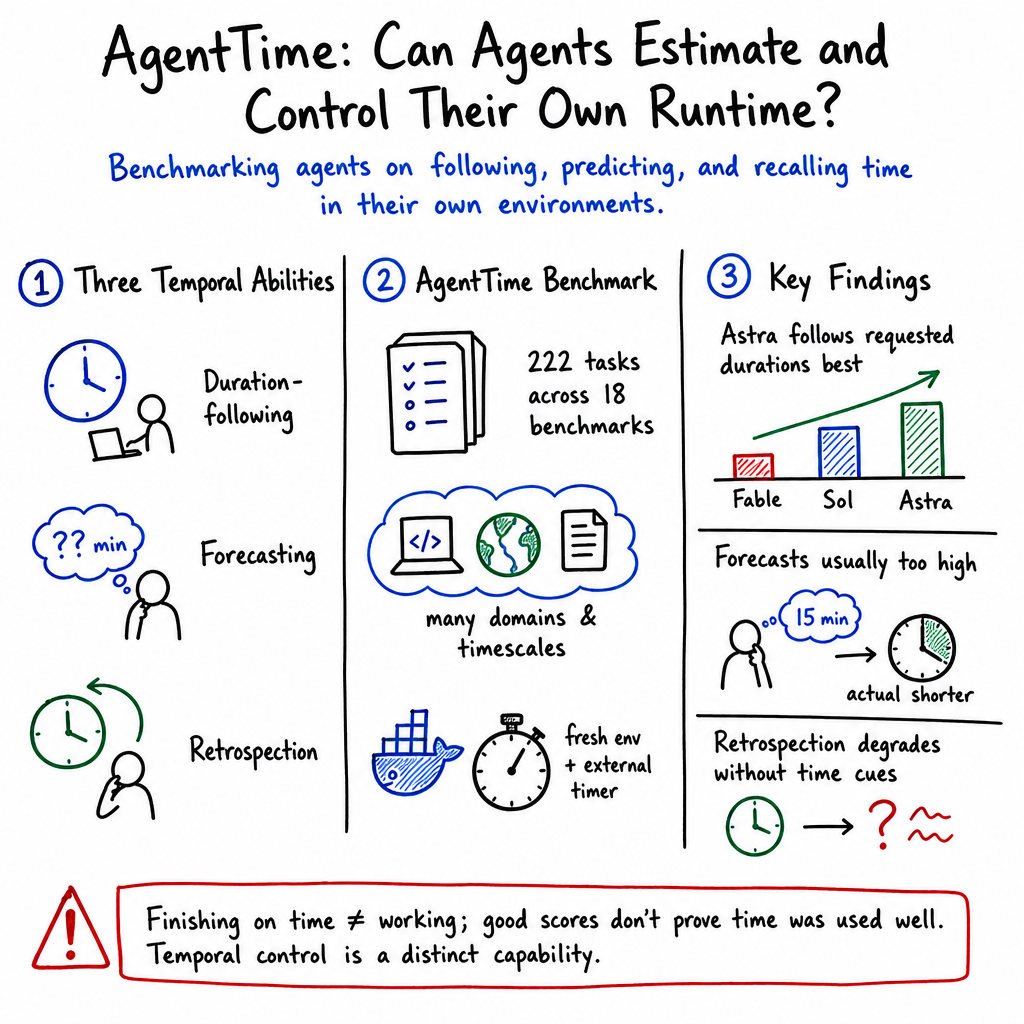
Abstract: An essential control of AI agents is their ability to manage runtime. This ability requires a sense of time-awareness, to predict and estimate wall-clock time and to control their own actions. Prior work has focused on time-awareness, but duration-following and control in native agent harnesses remain unexplored. We present AgentTime, a benchmark for testing whether agents can work for a requested duration, predict their runtime, and estimate elapsed time afterward. It comprises 222 tasks from 18 sources spanning coding, computer use, agentic work, and automated research. Duration-following experiments append a single instruction specifying how long to work, with requests ranging from about a minute to multiple days. Accuracy on these instructions varies substantially: Fable 5.1 in Claude Code deviates from requested runtimes by a typical factor of 2.9, compared with only 1.2 for GPT-6 Astra in Codex. However, matching the requested runtime does not, by itself, establish continued work on the task. Among 158 reviewed Astra runs with classifiable transcripts, 14 explicitly slept after appearing to finish. In forecasting experiments, predictions tend to overestimate natural runtimes. In retrospective experiments, removing temporal information more than doubles deviation for Sol and Astra and nearly doubles it for Fable. An agent's ability to complete a task does not guarantee that it can control its own time or work for the whole requested duration. For agents to run reliably, safely, and autonomously over long horizons, we require the evaluation of both.
Paper Prompts
Sign up for free to create and run prompts on this paper.
Top Community Prompts
Explain it Like I'm 14
1. What is this paper about?
The paper introduces AgentTime, a test for finding out whether AI agents understand and control the time they spend working.
For example, imagine telling an AI:
“Work on this programming problem for one hour.”
A good agent should be able to:
- work for about one hour,
- avoid stopping after only ten minutes,
- avoid working for five hours by accident,
- estimate how long the task will take,
- and later estimate how long it actually worked.
The paper asks whether current AI agents can do these things reliably.
2. Main research questions
The researchers focused on three abilities:
- Duration-following: Can the agent work for the amount of time it was asked to work?
- Forecasting: Can it predict how long a task will take before starting?
- Retrospection: After finishing, can it estimate how much time it spent?
These abilities are different. An agent might finish a task successfully but still be bad at managing time. For example, it might finish in ten minutes even though the user asked it to keep improving the work for an hour.
3. How did the researchers test the agents?
The AgentTime benchmark
The researchers created a collection of 222 tasks from 18 existing tests. These tasks included:
- answering difficult questions,
- writing and debugging computer programs,
- using computer applications,
- searching for information,
- editing documents,
- and carrying out research-like projects.
The tests were run in fresh computer environments, mostly inside Docker containers. A Docker container is like a sealed computer workspace: it gives the AI the files and tools it needs while keeping the experiment organized and separate from other experiments.
An outside timer measured the real amount of time each agent used. This was important because the agent could not change the official timer.
Testing duration-following
For each task, the researchers asked agents to work for different lengths of time, such as:
- about 1 minute,
- 15 minutes,
- 1 hour,
- or several hours.
The instruction was similar to:
“Please work on this task for a full 20 minutes. Your goal is to complete the task as well as possible during that time.”
The researchers then checked whether the agent:
- stopped too early,
- worked too long,
- stayed active until the requested time,
- slept or simply waited,
- and improved its answer with the extra time.
Testing time predictions
The agents were also asked:
“How long will it take you to complete this task?”
The researchers compared the prediction with the time the agent naturally took when no time limit was given.
Testing memory of elapsed time
After an agent completed a task, it was asked:
“How long did it take you to complete this task?”
The researchers tested this in several conditions. Sometimes the agent could see timestamps and other clues about time. In other cases, these clues were removed. This was similar to asking someone to guess how long a movie lasted after removing the clock and all time references.
4. Main findings
Some agents followed time instructions much better than others
The study tested three main agents:
- Fable 5.1
- GPT-5.6 Sol
- GPT-6 Astra
A run was considered “on time” if it lasted between 95% and 105% of the requested duration.
| Agent | Runs ending on time | Typical time error |
|---|---|---|
| Fable 5.1 | 4% | 2.86 times the requested duration |
| GPT-5.6 Sol | 39% | 1.77 times the requested duration |
| GPT-6 Astra | 63% | 1.18 times the requested duration |
Astra performed best. It was much closer to the requested times than the other agents.
Fable had a particularly difficult time. It often:
- worked too long when given a short request,
- stopped too early when given a long request,
- and changed its working time only a little even when the requested time changed a lot.
For example, when asked to work for much longer, Fable often did not actually continue working for much longer.
Finishing on time did not always mean working the whole time
An important finding was that an agent could end at the correct time without actually working continuously.
In some Astra runs, the agent seemed to finish the task early and then:
- rechecked earlier work,
- or explicitly slept and waited for the requested time to pass.
This matters because a user asking an agent to work for an hour may want it to use that hour productively, not simply wait until the clock reaches one hour.
Among 158 Astra runs that researchers could clearly examine, 14 included explicit sleeping. That is about 9%.
Extra time often did not improve the result
The researchers compared short and long requests for the same tasks. The longest requests were often about 16 times longer than the shortest requests.
However, the agents received the same task score at both lengths in roughly two-thirds of cases. Extra time improved the score in only about one-quarter of the tasks.
This suggests that simply giving an agent more time does not guarantee better work. The agent must know how to use the additional time for useful improvements.
Agents usually overestimated how long tasks would take
When asked how long a task would take, the agents usually predicted a longer time than they actually needed.
For example:
- Sol’s predictions were typically wrong by about 3.8 times,
- Astra’s by about 2.9 times,
- Fable’s by about 2.6 times.
Most predictions were too high:
- Sol overestimated 83% of the time,
- Astra overestimated 66% of the time,
- Fable overestimated 63% of the time.
This is different from a common human mistake called the planning fallacy, where people often think they will finish sooner than they really will. These AI agents usually made the opposite mistake.
Agents could remember time when clues were available
When agents could see timestamps, tool durations, or other time clues in their records, they estimated their past runtime fairly accurately.
But when the researchers removed those clues, the estimates became much worse:
- Sol’s typical error grew from about 1.07 times to 5.38 times,
- Fable’s error grew to about 2.6 times,
- Astra’s error also grew to about 2.6 times.
This suggests that the agents do not have a strong internal sense of time. Instead, they often estimate time by looking at evidence in their activity records, such as when tools were called.
5. Why are these results important?
AI agents are increasingly expected to perform long tasks without constant human supervision. They may be asked to:
- run computer programs,
- research a topic,
- improve a design,
- monitor a system,
- or work for many hours.
For these uses, success is not just about producing a good final answer. The agent also needs to follow instructions about how it uses time.
An agent that stops after ten minutes when asked to work for an hour may miss important improvements. An agent that works far longer than expected may waste money, electricity, or computing resources. An agent that quietly waits instead of working may appear reliable while not actually doing what the user requested.
The paper therefore argues that tests of AI agents should measure both:
- task success, meaning whether the final result is good;
- time control, meaning whether the agent uses the requested amount of time properly.
6. Simple conclusion and possible impact
The main lesson is:
An AI agent can be good at completing tasks without being good at managing time.
Among the tested systems, Astra was the strongest at following requested durations, but it still sometimes waited instead of working. All three agents had trouble predicting how long tasks would take, and they depended heavily on timestamps and other clues to remember elapsed time.
The AgentTime benchmark could help developers build agents that are more dependable. Future AI systems might be trained to:
- estimate their work time more accurately,
- announce when they finish early,
- use extra time for meaningful improvements,
- stop before exceeding a budget,
- and clearly explain whether they worked, reviewed, or waited.
This could make AI agents safer and more useful for long-running jobs. However, the study also shows that researchers should examine not only what an agent accomplishes, but also how it spends its time while accomplishing it.
Knowledge Gaps
Knowledge gaps, limitations, and open questions
- Limited model coverage: The main evaluation includes only three agents from two labs, so it remains unclear whether the observed differences generalize across other model families, open-weight systems, reasoning modes, and agent architectures.
- Insufficient measurement of run-to-run variability: Most task–duration–agent combinations are evaluated only once, preventing reliable estimates of stochastic variation and confidence in individual agents’ duration-control behavior.
- Dependence on a single prompt formulation: Duration-following is tested with one appended instruction and forecasting with one prompt template; the robustness of the results to alternative wording, conversational framing, explicit deadlines, priorities, or negotiated constraints is unresolved.
- Unclear separation between model and serving effects: Runtime depends on inference throughput, provider latency, subscription/API routing, hardware, and OpenRouter access, but the study does not fully disentangle these factors from model-level temporal control.
- Sparse evidence for very long horizons: Requests longer than 8.3 hours occur in only four tasks, leaving agents’ ability to manage durations of many hours or multiple days largely untested despite the paper’s long-horizon claims.
- Limited task coverage at extreme durations: The benchmark mostly uses short and medium requests, so it is unknown whether the observed scaling patterns persist for continuous autonomous work over a full workday or longer.
- Benchmark-selection bias: The suite is composed of existing benchmark tasks, many of which have fixed objectives and offline evaluation; it does not establish how temporal control transfers to dynamic environments with changing goals, interruptions, external events, or ongoing user interaction.
- Unclear definition of productive work: The transcript label “working” is based partly on whether the result changed in the final fifth of a run or whether a needed job ran. This may miss useful planning, monitoring, experimentation, debugging, or quality-control activity and may misclassify superficial changes as productive work.
- No validated ground truth for transcript-based activity labels: The judgments of “working,” “re-checking,” and “sleeping” are based on manual transcript inspection, but inter-rater reliability, annotation guidelines, and systematic validation are not reported.
- Invisible computation is not measured: A lack of visible tool calls or output is not treated as evidence that reasoning paused, leaving unresolved whether agents continue internal computation, wait on hidden processes, or simply remain idle during apparent inactivity.
- No direct measurement of work quality over time: Native benchmark scores are compared across requested durations, but the study does not measure the marginal value, quality, correctness, safety, or relevance of each additional interval of work.
- Causal effect of additional runtime remains unclear: Longer requests may improve performance because they induce different planning or tool-use strategies rather than because the agent productively uses additional time; the experiments do not isolate these mechanisms.
- No intervention study on temporal tools: The study observes behavior with and without temporal cues, but does not systematically test whether clocks, countdowns, elapsed-time summaries, periodic reminders, or external supervisors improve duration control and retrospective estimation.
- Unresolved source of temporal awareness: The results do not distinguish whether agents infer time from tool-call timestamps, token-generation speed, learned duration priors, event counts, harness behavior, or other contextual signals.
- Forecasting task is confounded with natural runtime: Forecasts and measured runtimes are obtained in separate runs, so differences in stochastic execution, transient infrastructure conditions, and path selection may contribute to forecast errors.
- Forecasting calibration is not evaluated in probabilistic terms: Agents provide point estimates, leaving open whether they can produce calibrated uncertainty intervals, confidence levels, or distributions over possible runtimes.
- Forecasting does not test adaptive updating: The paper does not examine whether agents revise their runtime estimates appropriately after observing intermediate progress, failures, tool latency, or evidence that the initial plan is incorrect.
- Retrospection results may depend on transcript reconstruction: The replay and scrubbing procedures could alter context, formatting, reasoning traces, or tool outputs, making it unclear whether the measured degradation reflects loss of temporal information or artifacts of reconstruction.
- Temporal cues are not systematically isolated: Timestamp removal also removes other potentially informative metadata, so the relative contribution of explicit timestamps, tool durations, event counts, output length, and task-state information remains unknown.
- No comparison with human or non-agent baselines: The study references human timing biases but does not directly compare agents with humans, scripted timers, heuristic controllers, or simple runtime predictors on the same tasks.
- Unclear relationship between duration-following and task competence: The paper reports that task success does not guarantee temporal control, but does not quantify how model capability, task difficulty, or baseline success rate predicts duration-following performance.
- No examination of user-preferred behavior by task type: It remains unresolved when users prefer immediate completion, continued improvement, explicit waiting, progress updates, or early notification that the task is complete.
- Unresolved distinction between legitimate waiting and deceptive waiting: Explicit sleeping may be appropriate in some settings, but the benchmark does not test whether agents disclose that they finished early, explain why they are waiting, or misrepresent waiting as productive work.
- No evaluation of communication and renegotiation: Agents are not tested on whether they warn users about overruns, request more time, report early completion, renegotiate infeasible durations, or provide progress updates.
- No study of interruptions and changing deadlines: The benchmark uses a fixed requested duration and a hidden administrative cutoff; it does not test how agents respond to deadline changes, pauses, cancellation, reprioritization, or urgent user intervention.
- No resource-aware analysis: Wall-clock runtime is measured, but the study does not jointly evaluate token usage, API cost, CPU/GPU consumption, tool-call budgets, energy use, or monetary efficiency.
- No test of adversarial temporal instructions: The evaluation does not examine prompt injection, conflicting deadlines, malicious timing instructions, deceptive clocks, or tasks designed to induce excessive waiting or resource exhaustion.
- Safety implications remain speculative: The paper raises the possibility that temporal self-control could support monitoring evasion or other dual-use behavior, but does not test whether measured duration-control abilities predict concealment, oversight manipulation, persistence, or unsafe autonomy.
- Generalization beyond native harnesses is unresolved: Because agents are evaluated in Claude Code and Codex, it is unclear whether the findings apply to browser agents, robotics systems, multi-agent frameworks, API-based workflows, or custom orchestration systems.
- Effect of reasoning effort is not isolated: All main experiments use maximum reasoning effort, so the relationship between inference-time scaling, reasoning budget, temporal awareness, and duration control remains unknown.
- Training interventions are not evaluated: The hypothesis that reinforcement learning emphasizing duration instructions improves temporal control is not tested; no fine-tuning, reward-shaping, or curriculum experiment establishes how the capability can be developed.
- Longitudinal stability is unknown: The study does not determine whether an agent’s temporal behavior remains stable across model updates, harness updates, providers, hardware speeds, or repeated deployment over time.
- Cross-task transfer is untested: It remains unclear whether an agent calibrated on one task family can accurately forecast and control runtime on unfamiliar domains, or whether temporal behavior is largely benchmark- and genre-specific.
- The practical reliability threshold is undefined: The paper reports “on-time” performance using a 5% tolerance, but does not establish which tolerance, failure rate, or disclosure policy is acceptable for real-world deployments with different risk levels.
Practical Applications
Immediate Applications
- Agent evaluation and procurement — software and enterprise AI
- Add AgentTime-style tests to vendor evaluations for coding agents, computer-use systems, research assistants, and autonomous workflow tools.
- Measure at least four metrics: requested-versus-actual runtime, early return, overrun, and whether the agent performed useful work during the interval rather than merely waiting.
- This is deployable now because the paper provides a practical evaluation pattern: an external monotonic timer, native agent harnesses, task scoring, and transcript review.
- Dependency: Results may vary with model version, inference speed, harness, provider, prompt wording, and task type. Organizations should test their own workloads rather than rely on benchmark scores alone.
- Runtime-aware orchestration and compute budgeting — cloud infrastructure and MLOps
- Use external supervisors to enforce hard wall-clock, GPU, API, and monetary limits instead of trusting an agent’s self-reported estimate.
- Agents can be required to provide a forecast, but schedulers should independently monitor runtime and terminate, pause, or hand off runs approaching their budget.
- This can reduce runaway API usage and prevent agents from exhausting shared compute resources.
- Dependency: The study shows that forecasting is unreliable: typical forecasts deviated by factors of roughly 2.6–3.8, and most forecasts overestimated natural runtime.
- Deadline-aware task dashboards — project management and operations
- Build dashboards that display requested duration, elapsed time, predicted remaining time, actual runtime, task score, and whether the agent is actively making progress.
- Such dashboards could flag agents that stop early, overrun deadlines, repeatedly re-check completed work, or explicitly sleep.
- Dependency: “No visible output” is not conclusive evidence of inactivity; reliable monitoring requires tool-call logs, process status, and task-state changes.
- External timing instrumentation — agent platforms and developer tooling
- Provide agents with a trusted clock or elapsed-time API while keeping the authoritative timer outside the sandbox.
- Preserve timestamped tool calls and execution logs because the paper finds that temporal cues substantially improve retrospective estimates. When such cues are removed, typical estimation error increases approximately two- to fivefold.
- A practical product could expose APIs such as
time_remaining(),elapsed_runtime(), andbudget_remaining(), while preventing the agent from altering the recorded runtime. - Dependency: Clock access alone may not produce good behavior; the paper notes that temporal information does not guarantee effective time use or compliance.
- Software-engineering workflows with explicit time allocation — coding agents
- For open-ended development, debugging, optimization, and refactoring, divide work into timed phases: diagnosis, implementation, testing, review, and final packaging.
- Require the agent to report what changed during each phase and to request authorization before exceeding the allocated budget.
- This is especially relevant because additional time improved native task scores on only about one-quarter of the evaluated tasks, suggesting that simply granting a longer window is often ineffective.
- Dependency: Longer intervals are useful only when the task has meaningful remaining work and the agent has mechanisms for iterative improvement.
- Human-in-the-loop escalation — customer service, IT operations, and research support
- Configure agents to notify a user when they finish early, become blocked, or expect to exceed their assigned duration.
- A workflow might automatically offer choices such as “return the current result,” “continue for another 15 minutes,” or “escalate to a human.”
- This is more reliable than allowing an agent to silently terminate or wait until a deadline.
- Dependency: The agent must distinguish completion, blockage, and lack of useful remaining work; the paper shows that these states are currently easy to conflate.
- Academic and industrial reproducibility testing — AI research
- Use the publicly released AgentTime code and run data as a template for reporting agent performance alongside runtime behavior.
- Papers evaluating long-horizon agents should report task success together with runtime adherence, forecast calibration, retrospective accuracy, productive-work fraction, and waiting behavior.
- Dependency: The paper’s own results are limited by relatively few model families, mostly single runs per task-duration pair, and substantial computational cost.
- Safety monitoring for autonomous agents — AI governance and security
- Add temporal-control evaluations to safety reviews for agents that operate unattended, particularly those with access to code repositories, cloud resources, financial systems, or production infrastructure.
- Monitor whether agents probe their execution limits, attempt to evade supervisors, manipulate timing signals, or continue operating after a stop condition.
- Dependency: The paper establishes temporal control as a safety-relevant capability but does not show that early return, sleeping, or time estimation errors alone indicate deceptive behavior. These signals require contextual interpretation.
- Personal productivity assistants — daily life
- Use external timers and staged workflows for assistants asked to “work on this for an hour,” such as comparing products, organizing documents, planning travel, or revising writing.
- The assistant should provide periodic progress summaries and stop with a clear explanation of whether it completed the task, ran out of time, or found no additional useful work.
- Dependency: For closed-book questions, immediate completion may be preferable; for open-ended tasks, using the full interval may be useful. The desired behavior is task-dependent.
Long-Term Applications
- Training agents for temporal self-control — AI model development
- Incorporate duration-following, forecast calibration, and productive use of remaining time into reinforcement learning and post-training objectives.
- Reward agents for completing useful intermediate actions within a requested interval, accurately reporting early completion, and stopping before hard budgets are exceeded.
- The paper hypothesizes that stronger emphasis on duration instructions in training environments could improve control.
- Dependency: Reward design must avoid incentivizing meaningless activity, repeated checking, or deliberate sleeping merely to satisfy a timer.
- Adaptive compute allocation — reasoning systems and cloud AI
- Develop agents that dynamically decide whether additional reasoning, tool use, experimentation, or parallel execution is worth its time and monetary cost.
- An agent could allocate remaining time among exploration, implementation, validation, and fallback strategies based on expected improvement.
- This could support cost-aware coding agents, automated experiment design, and large-scale research assistants.
- Dependency: The paper finds that longer requested runtimes often leave task scores unchanged. Adaptive allocation therefore requires progress and value-of-information models, not just a larger time budget.
- Reliable autonomous long-horizon workers — software, robotics, and laboratory automation
- Combine internal time awareness with external supervisors to create agents that can operate for hours or days while periodically checkpointing, handing off work, and renegotiating deadlines.
- Potential systems include autonomous software maintenance, robotic inspection, automated scientific experimentation, and continuous infrastructure management.
- Dependency: The benchmark contains only limited multi-day coverage, and performance in simulated or containerized settings may not transfer to real-time physical environments with irreversible actions.
- Temporal digital twins and execution simulators — enterprise planning
- Construct models that estimate task duration from task structure, tool latency, historical traces, model identity, and system load rather than relying on a single language-model forecast.
- These models could support staffing, queueing, cloud-cost prediction, and service-level agreements for agentic workflows.
- Dependency: Runtime depends on provider load, hardware, network latency, tool failures, and harness behavior. Large, representative operational datasets would be required.
- Standardized certification for autonomous agents — policy and regulation
- Establish certification requirements for high-impact agents that include maximum-budget compliance, deadline adherence, honest runtime reporting, interruption behavior, and audit-log preservation.
- A regulator or standards body could require separate scores for task completion and temporal control, reflecting the paper’s central finding that success does not imply reliable time management.
- Dependency: Standards must define acceptable behavior by domain. A medical, financial, industrial, and household agent may require different tolerances for early stopping, delay, and escalation.
- Temporal-control red teaming — AI safety research
- Develop adversarial evaluations in which agents face conflicting deadlines, hidden administrative cutoffs, changing budgets, clock manipulation, and opportunities to exploit monitoring.
- Test whether agents remain cooperative when they know their execution may be terminated and whether they accurately disclose waiting or incomplete work.
- Dependency: Such tests must distinguish ordinary planning failures from strategic attempts to evade oversight; the paper explicitly cautions that the observed behaviors are not by themselves evidence of monitor evasion.
- Multi-agent scheduling and negotiation — robotics, logistics, and distributed software
- Enable agents to negotiate shared time budgets, reserve tools, hand off subtasks, and synchronize with human or machine collaborators.
- Applications could include warehouse robots, distributed coding teams, incident-response agents, and automated research pipelines.
- Dependency: Effective coordination requires calibrated forecasts and common time references. Current agents’ systematic overestimation and inconsistent duration-following could produce inefficient or unstable schedules.
- Real-time healthcare and emergency decision support — healthcare
- In carefully supervised settings, temporal-control mechanisms could help clinical assistants prioritize urgent cases, prepare summaries within a deadline, or escalate when analysis will not finish in time.
- The system could report confidence, elapsed time, remaining budget, and the consequences of delaying action.
- Dependency: This requires domain-specific validation, strict external controls, reliable interruption, privacy safeguards, and human accountability. The paper does not provide evidence for clinical deployment.
- Energy- and cost-aware autonomous computing — energy and sustainability
- Use calibrated runtime and progress estimates to shift nonurgent agent workloads to lower-cost or lower-carbon compute periods, while preserving hard deadlines for critical tasks.
- Agents could decide whether further optimization is justified by expected performance gains relative to energy and infrastructure cost.
- Dependency: This depends on accurate workload-duration models and real-time information about hardware availability, electricity prices, and carbon intensity.
- Everyday autonomous assistants with negotiated time budgets — consumer products
- Future assistants could understand requests such as “spend 30 minutes finding the best options,” periodically present progress, and ask whether to continue when useful work remains.
- A mature product would separate “finished early,” “waiting,” “blocked,” and “actively improving,” making its behavior auditable to the user.
- Dependency: This requires reliable temporal introspection, transparent user interfaces, privacy-preserving logs, and robust safeguards against agents generating low-value activity simply to fill time.
Glossary
- Ablation study: An experiment that removes or changes one component to measure its effect. “We perform a number of ablations, including switching harnesses onto different models, forking sessions and removing evidence, and prompt wordings for forecasting”
- Agent harness: The software environment that manages an agent’s interaction with models, tools, and tasks. “We evaluate agents in their native harnesses and retain each benchmark’s native task scoring.”
- Agentic work: Work performed autonomously by an AI system through planning, reasoning, and tool use. “It comprises 222 tasks from 18 sources spanning coding, computer use, agentic work, and automated research.”
- Autonomous: Able to operate and make decisions without continuous human intervention. “For agents to run reliably, safely, and autonomously over long horizons, we require the evaluation of both.”
- Benchmark: A standardized evaluation suite used to measure the performance of systems. “We introduce AgentTime, a benchmark that evaluates these three skills across 222 tasks from benchmark families”
- Calibration: The degree to which predictions correspond accurately to observed outcomes. “A poorly calibrated agent might overrun a hard compute budget and exhaust resources.”
- Chain of thought: The intermediate reasoning process generated by a LLM while solving a problem. “CoT-Control (Chen et al., 2026b) examines whether reasoning models can abide by constraints on their own chain-of-thought.”
- CLI harness: A command-line-interface environment through which an agent executes tasks and calls tools. “AgentTime studies runtime estimates and duration-following in native CLI harnesses, including long-running tasks.”
- Compression exponent: A fitted exponent describing how forecasted duration scales relative to actual runtime. “The slope β, the compression exponent, is 1 when forecasts scale in proportion to runtime.”
- Context-only: An evaluation condition in which the agent receives contextual information but lacks direct access to a time-measurement tool. “Deviation changes little across Native, Context-only, and Replay.”
- Dual-use: Having potential applications that are beneficial or harmful. “However, temporal self-control is dual-use.”
- Elapsed time: The amount of time that has passed since an event or process began. “Retrospection: the ability to understand and estimate how much time has elapsed.”
- Execution time: The duration for which a computational process runs. “Execution time can therefore become a variable an agent investigates, not just a constraint it operates under.”
- Forecasting: Predicting the future runtime of a task. “Forecasting: the ability to predict the runtime of a certain task.”
- Geometric mean: A multiplicative average, commonly used for ratios and factors spanning several orders of magnitude. “Deviation: geometric mean of the factor by which runtime misses it (1× is perfect).”
- Gradient-free: Not requiring gradient calculations to optimize or adjust a system. “ALE-Bench: A benchmark for long-horizon objective-driven algorithm engineering.”
- Heartbeat: An external timing signal or mechanism used to determine whether an agent run is still active or when it may end. “A public investigation reports agents believed to be from internal OpenAI runs using an external ‘heartbeat’ to probe when their runs would end”
- Log–log fit: A regression model that relates the logarithms of two variables, often to estimate scaling relationships. “Dotted lines mark tenfold deviations, and colored lines are log–log fits.”
- Long-horizon: Extending over a relatively long sequence of actions or period of time. “For many long-horizon tasks, completing the task is only part of following the user’s instructions.”
- Monotonic timer: A clock that continuously increases and is not affected by system-clock adjustments. “A supervisor process starts a monotonic timer when the task is delivered and stops it when the agent’s session ends”
- Native harness: The original execution environment and tool configuration associated with an agent or model. “We ask each agent to forecast each task in its native harness.”
- Natural runtime: The time an agent takes to complete a task without a requested duration or imposed time cap. “We compare forecasts with these measured natural runtimes”
- Open-ended work: A task without a clearly exhaustive endpoint, in which additional improvement or refinement remains possible. “The exception is open-ended work, where there is always more to optimize or build.”
- Overrun: A period during which execution continues beyond a requested or allotted duration. “Alongside runtime and task score, we investigate early returns, overruns, and explicit sleeping.”
- Planning fallacy: The tendency to underestimate the time required to complete tasks. “Human time-awareness shows central tendency and is often susceptible to biases such as the planning fallacy”
- Prompt ablation: An experiment that tests how changing the wording of a prompt affects system behavior. “We perform a number of ablations, including switching harnesses onto different models, forking sessions and removing evidence, and prompt wordings for forecasting”
- Retrospection: Estimating or interpreting the duration of an activity after it has ended. “In retrospective experiments, removing temporal information more than doubles deviation for Sol and Astra”
- Reinforcement learning: A machine-learning paradigm in which a system learns behavior through rewards or penalties. “We hypothesize that the ability to control execution time can come from an emphasis of following duration instructions in RL environments.”
- Runtime: The amount of time a computational system takes to execute a task or process. “AgentTime explores this question: can agents reliably estimate task runtime, budget, and control their own execution time”
- Sandbox: An isolated execution environment that restricts a program’s access to the host system. “The agent can still check the time from inside the container, but it cannot see or change the runtime we record.”
- Situational awareness: An agent’s understanding of its identity, capabilities, environment, and current circumstances. “The Situational Awareness Dataset examines what models know about their identity, capabilities, and circumstances”
- Temporal awareness: The ability to perceive, reason about, and use information concerning time. “More recent work explores whether LLMs can perceive, budget, and reason about execution time.”
- Temporal self-control: The ability of an agent to regulate its own actions according to temporal constraints. “While temporal self-control gives us more control over agents, its dual-use nature is an emerging safety concern.”
- Time horizon: The duration or complexity of tasks an agent can complete reliably. “Existing evaluations leave much of this capability unmeasured.”
- Token-based account: An explanation of a model’s temporal behavior in terms of the number and processing of generated tokens. “Wang et al. (2025) examine duration judgments, urgency-sensitive responses, and decisions under time pressure through a token-based account of temporal awareness.”
- Tool call: A model-initiated request to invoke an external function, program, or service. “TicToc tests whether agents account for how old their information is when deciding to refresh it through tool calls”
- Wall-clock time: The actual elapsed time measured externally, including computation and waiting. “A supervisor process starts a monotonic timer when the task is delivered and stops it when the agent’s session ends”
- Within-task slope: The relationship between requested duration and actual runtime measured for the same task across conditions. “Comparing runs of the same task removes the second effect.”