PhoneBot: A Low-Cost Open Humanoid Robot Platform Reusing Smartphones
Abstract: The adoption of humanoid robots in education and research remains limited by high hardware costs, complex sensing systems, and substantial computational requirements. This paper presents PhoneBot, a low-cost, open-source humanoid robot platform that repurposes commodity smartphones as its primary sensing and computing unit. By using a smartphone's integrated inertial measurement unit (IMU), camera, wireless connectivity, and onboard processing capabilities, PhoneBot reduces hardware costs and simplifies the system architecture. The robot combines a modular lower-body structure driven by 13 low-cost actuators with a torso-mounted smartphone that supports perception, control computation, and user interaction. We describe the mechanical design, software architecture, and real-time communication framework that support stable locomotion and capabilities including vision-based human following, conversational interaction, filming, and mobile telepresence. Experimental evaluations demonstrate reliable walking, perception-driven interaction, and straightforward deployment using off-the-shelf consumer smartphones. With fully open-source hardware and software designs, PhoneBot provides an affordable, reproducible platform for education, research, and rapid prototyping. More details are available at https://phonebot.dev.
Paper Prompts
Sign up for free to create and run prompts on this paper.
Top Community Prompts
Explain it Like I'm 14
1. What is the paper about?
This paper introduces PhoneBot, a small humanoid robot that uses an ordinary smartphone as its “brain” and main set of sensors.
Most robots need expensive special computers, cameras, and motion sensors. PhoneBot tries to avoid this by using parts already built into a smartphone:
- The camera helps the robot see people and its surroundings.
- The motion sensors, called an IMU, help the robot know whether it is tilting or moving.
- The phone’s processor runs the robot’s control programs.
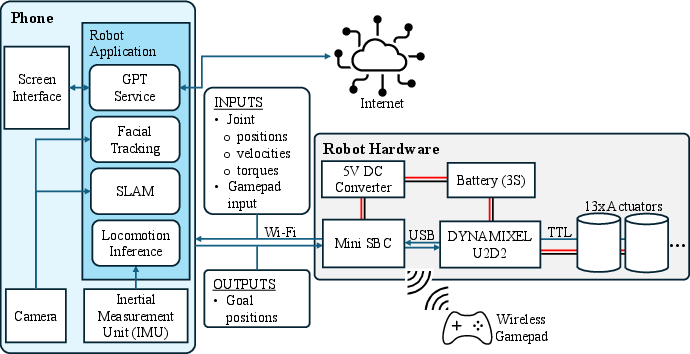
- Wi-Fi sends instructions between the phone and the robot’s motors.
- The touchscreen, microphone, and speaker allow people to interact with the robot.
The robot’s body costs about $400, not including the smartphone. Its designs and software are open-source, meaning that other people can study, copy, improve, and build it.
2. What questions did the researchers ask?
The researchers mainly wanted to find out:
- Can a cheap smartphone control a walking humanoid robot?
- Can the robot walk reliably using inexpensive motors?
- Can the robot use the phone’s camera and sensors to interact with people?
- Can a special training method make the robot learn to walk faster and more symmetrically?
- Can old or inexpensive smartphones perform the necessary robot tasks?
The researchers were especially interested in making humanoid robots more available to schools, students, and laboratories that cannot afford expensive platforms.
3. How did they build and test PhoneBot?
The robot’s body
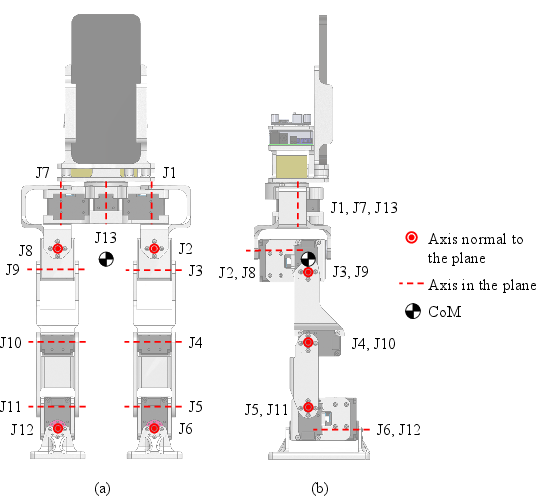
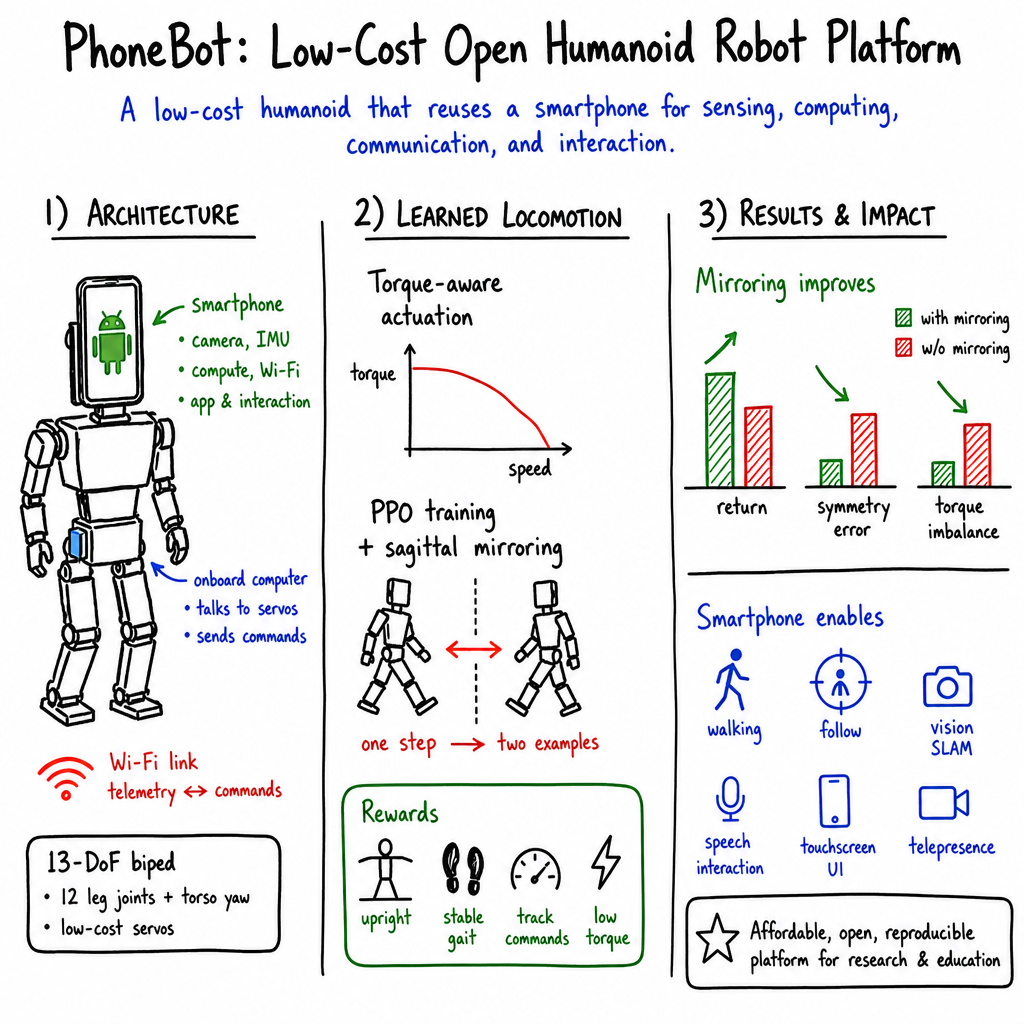
PhoneBot is about 48 centimeters tall and weighs about 1.8 kilograms. It has:
- Two legs
- Six moving joints in each leg
- One extra joint that turns the phone’s upper body
- A total of 13 motor-controlled joints
The motors are inexpensive servo motors. A servo motor is a device that turns a joint to a chosen position, much like the motor in a remote-controlled car, but with more precise control.
The smartphone is attached to the robot’s torso. It is not physically plugged into the robot. Instead, it communicates with a small computer inside the robot using Wi-Fi.
Teaching the robot to walk
The researchers used a method called reinforcement learning. This is similar to training a dog with rewards:
- The robot tries an action.
- If it walks in the correct direction, stays upright, or avoids slipping, it receives a better score.
- If it falls, moves badly, or uses too much motor power, it receives a worse score.
- After many attempts in a computer simulation, the robot gradually learns useful movements.
The researchers trained the robot in a physics simulator before testing it on the real robot. A simulator is like a video game version of the robot, where researchers can safely try millions of walking attempts without damaging the hardware.
Modeling the motors realistically
The robot’s motors are not very powerful. The researchers therefore created a torque-aware model.
Torque means the turning force produced by a motor. For example, opening a heavy door requires more turning force than opening a light door.
The researchers made the simulator account for:
- The motors’ limited strength
- The fact that motors become weaker when moving quickly
- Small errors in motor positions
- Mechanical looseness, called backlash
- Differences between individual motors
This made the simulation more like the real robot.
Using symmetry to improve learning
Humanoid robots have two similar legs. The researchers used this fact through a technique called sagittal mirroring.
In simple terms, whenever the robot practiced a movement using its left side, the researchers also created a mirrored version using its right side. This is like teaching someone to throw with one hand and then showing them the same movement reversed for the other hand.
This gave the learning system twice as much useful training information without requiring twice as many physics simulations.
Testing smartphone abilities
The researchers tested the PhoneBot application on four phones:
- One older phone from 2017
- Three inexpensive phones costing about $50–$90
They checked whether the phones could:
- Read motion sensors
- Run the walking program
- Detect people
- Estimate human body positions
- Build a map of the surroundings
- Communicate with the robot’s motors
- Support human–robot interaction
4. What did the researchers discover?
PhoneBot could perform several useful behaviors
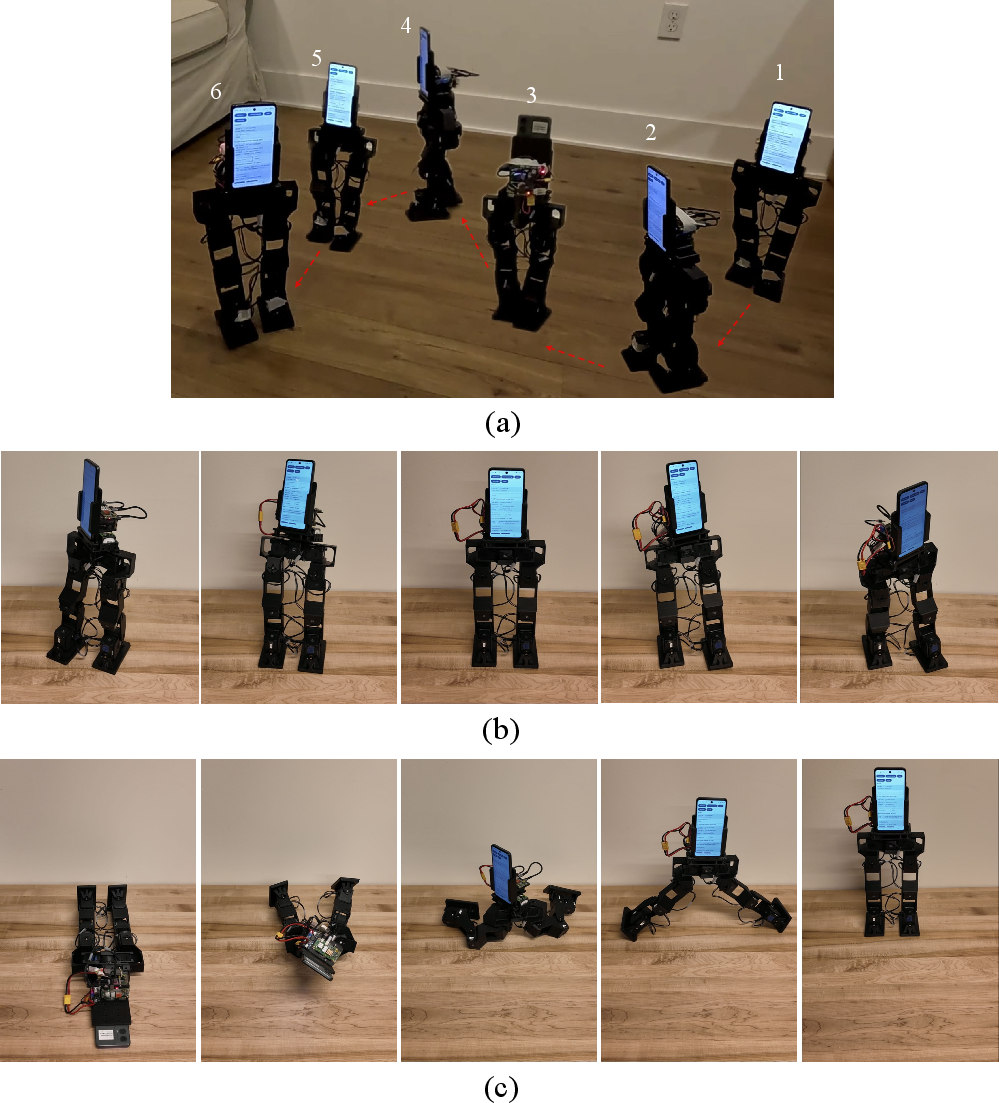
The robot was able to:
- Walk
- Stand up after falling or starting on the ground
- Turn its upper body and camera toward a target
- Follow or track a person using its camera
- Support speech-based interaction
- Film or provide mobile telepresence
- Use the phone for sensing, computing, and communication
This showed that a smartphone can replace several separate and expensive robot components.
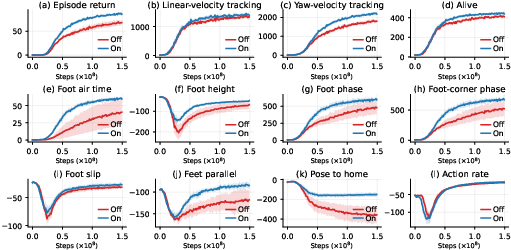
Mirroring improved walking training
The researchers compared two learning systems:
- One trained with left–right mirroring
- One trained without mirroring
The mirrored version generally:
- Learned to walk faster
- Followed movement commands better
- Fell less often
- Produced more balanced walking
- Slipped less
- Kept both feet flatter
- Used the two legs more evenly
- Worked more consistently across different training attempts
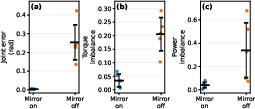
The measurements showed a large improvement in symmetry. For example, the average difference in joint movements between the two sides decreased from about 0.254 radians to 0.003 radians.
The robot also had much smaller differences in the amount of motor force and mechanical power used by its left and right legs.
Cheap phones were powerful enough
All four tested phones could run the main robot functions. Even the old phone and the low-cost phones were able to process:
- Motion data
- Walking commands
- Camera-based vision
- Human interaction
One phone could not use the mapping feature because it lacked access to certain Google services, but this was a software compatibility problem rather than a failure of the robot design.
There are still limitations
The researchers also point out that PhoneBot is not yet a complete human-like robot. It currently:
- Has no arms
- Cannot carry much weight
- Uses relatively weak motors
- Was trained mainly to walk on flat ground
- May struggle on uneven surfaces
- Cannot yet perform complex object manipulation
5. Why is this research important?
PhoneBot could make robotics much easier and cheaper to study.
In the past, a robot might need separate parts for its camera, motion sensors, computer, wireless connection, and user interface. A smartphone already includes all of these in one small device. This reduces the number of parts that must be bought, connected, and programmed.
Because the hardware and software are open-source, PhoneBot could be useful for:
- Robotics classes in schools
- University research projects
- Student competitions
- Learning about artificial intelligence
- Testing new walking algorithms
- Building robot companions or telepresence systems
- Quickly trying out new robot ideas
The main lesson is that useful humanoid robots do not always need expensive, specialized computers. A common smartphone, combined with a simple robot body, may be enough for many sensing, walking, and interaction tasks.
Conclusion
The paper presents PhoneBot as a low-cost humanoid robot that reuses everyday smartphone technology. The robot can walk, sense its surroundings, follow people, and interact with users. The researchers also showed that training with left–right symmetry helps it learn a more balanced and reliable walking style.
PhoneBot is not yet strong or flexible enough to do everything a human can do, but it provides an affordable starting point. In the future, the researchers hope to add arms, teach it to walk on uneven ground, and allow it to understand spoken instructions and complete more complicated tasks.
Knowledge Gaps
Knowledge gaps, limitations, and open questions
The paper leaves the following issues unresolved:
- Real-world locomotion performance is not quantitatively characterized. Hardware demonstrations show walking, standing up, and tracking, but the paper does not report physical-robot metrics such as walking success rate, fall frequency, velocity-tracking error, traversal distance, energy consumption, or recovery time.
- The sim-to-real transfer is insufficiently validated. The locomotion comparison is primarily conducted in simulation, while the real-robot results are presented qualitatively. The contribution of each modeled effect—torque saturation, backlash, gain variation, offsets, noise, delay, and pushes—to real-world robustness remains unknown.
- The torque-aware actuator model is not experimentally identified in sufficient detail. The simulator uses manufacturer specifications and assumed parameters such as friction loss, armature, passive–active ratio, braking torque, and damping, but the paper does not report measurements from the actual XL430 actuators across speed, load, temperature, voltage, or direction.
- The validity of the common actuator model across all 13 joints is uncertain. Manufacturing variation, gearbox wear, cable routing, joint loading, and thermal conditions may produce joint-specific behavior that is not captured by a shared model.
- The effect of sagittal mirroring is not isolated beyond the reported baseline. The comparison uses only training with and without mirroring. It does not establish how mirroring compares with alternative symmetry losses, data augmentation methods, architectural equivariance, better initialization, or explicit bilateral regularization.
- The reported training-efficiency improvement lacks a normalized computational analysis. Mirroring doubles policy samples per physics step, but the paper does not report wall-clock training time, GPU utilization, memory cost, or performance per unit of computation. Thus, its practical efficiency advantage remains unclear.
- The generality of sagittal mirroring has not been tested. The method is evaluated on a symmetric robot and flat-ground walking. It remains unknown whether it improves behaviors involving asymmetric payloads, uneven terrain, turning, obstacle avoidance, manipulation, or deliberate one-legged support.
- The policy’s robustness to commands outside the training distribution is unresolved. Training commands are limited to and , but performance near and beyond these limits is not evaluated.
- Terrain generalization is not demonstrated. Locomotion policies are trained on flat terrain, and uneven surfaces, slopes, stairs, gaps, compliant ground, loose surfaces, and obstacles are explicitly left for future work.
- External disturbance robustness is not quantified. Although pushes and disturbances are referenced in the simulation setup, the paper does not provide systematic results over disturbance magnitude, direction, timing, frequency, or repeated impacts.
- Fall recovery has not been evaluated across diverse failure states. The standup policy is demonstrated from face-down and sitting-like configurations, but its success rate and coverage for arbitrary orientations, entanglements, partial joint failures, slippery surfaces, or falls during walking are unknown.
- The safety of the learned policies is not systematically assessed. The paper does not report collision forces, joint-limit violations, actuator over-temperature events, current spikes, battery undervoltage, emergency-stop response, or failure behavior during communication loss.
- Wi-Fi communication reliability is insufficiently characterized. The system depends on wireless transmission between the smartphone and SBC, but latency, jitter, packet loss, disconnection recovery, interference tolerance, and behavior under network congestion are not reported.
- The consequences of communication delay for stability remain unclear. No latency-ablation study establishes the maximum tolerable delay or whether the policy remains stable under variable round-trip delays.
- The smartphone’s IMU is not evaluated under robot-specific vibration conditions. The paper assumes that the phone IMU can serve as the body IMU, but does not quantify bias, vibration-induced noise, saturation, orientation drift, or mounting-induced resonance during walking and impacts.
- Phone mounting and calibration sensitivity are unexplored. The effects of mounting angle, mechanical compliance, phone motion within its holder, camera/IMU extrinsic calibration, and replacement of the phone with a different model are not measured.
- Smartphone thermal and battery performance are not evaluated over sustained operation. CPU usage percentages do not establish runtime, thermal throttling, battery drain, charging requirements, or degradation of policy inference, vision, or SLAM during long experiments.
- The application’s real-time guarantees are unclear. The paper reports CPU utilization but not end-to-end sensing-to-actuation latency, inference frequency under simultaneous workloads, scheduling jitter, frame rate, or missed control cycles.
- Cross-device compatibility is only partially demonstrated. Four Android phones are tested, all in a narrow set of devices and operating environments. Compatibility with other Android versions, iOS devices, different sensor APIs, camera configurations, and unsupported Google services remains unresolved.
- The vision system is not evaluated quantitatively. Human detection, pose estimation, following, and heading behaviors are demonstrated qualitatively without precision, recall, localization error, tracking failure rate, latency, or performance under occlusion, poor lighting, clutter, and multiple people.
- ARCore SLAM performance under bipedal motion is not measured. The claim that SLAM remained stable is based on qualitative observation; trajectory error, relocalization rate, scale drift, motion-blur sensitivity, and performance across environments are not reported.
- Human–robot interaction is not evaluated with users. Conversational interaction, telepresence, and person following are demonstrated as capabilities, but no user study assesses usability, intelligibility, perceived safety, accessibility, or task success.
- Dependence on a laptop-based language backend limits the claimed onboard autonomy. Speech recognition and language-model processing are not performed entirely on the smartphone, and the effects of network availability, backend latency, privacy, model failures, and cloud/local deployment choices are not analyzed.
- The full system cost is incompletely specified. The reported approximately $400 price excludes the smartphone and does not clearly include the SBC, battery, charger, fabrication, wiring, fasteners, tools, replacement actuators, or assembly labor. A reproducible total-cost breakdown is needed.
- Manufacturing reproducibility is not experimentally established. The paper releases designs but does not report assembly tolerances, print-material requirements, build time, calibration procedures, failure rates, or performance variation across independently constructed units.
- Long-term reliability and maintenance are unknown. There are no endurance tests addressing gearbox wear, backlash growth, actuator failures, structural fatigue, repeated falls, connector degradation, or smartphone-holder durability.
- The platform’s payload and interaction limits are not quantified. The conclusion notes limited torque and lack of arms, but the maximum safe payload, external force, carrying capacity, and ability to maintain balance during physical contact are not measured.
- The absence of arms substantially limits embodied-interaction claims. The paper proposes future lightweight arms, but the effects of added mass, altered center of mass, actuator requirements, balance control, and whole-body coordination remain unexplored.
- Energy efficiency is not compared with alternative platforms. The paper emphasizes low cost but does not compare power consumption, operating duration, or energy per meter with other small humanoids or with a dedicated embedded-computing architecture.
- The comparison with other platforms is not controlled. The table compares height, weight, degrees of freedom, price, and broad capabilities, but does not normalize locomotion speed, payload, battery, compute resources, manufacturing method, reliability, or experimental performance.
- The reward design has not been subjected to ablation analysis. It is unclear which reward terms, weights, torque-utilization penalty, gait scheduling terms, or privileged observations are necessary for successful locomotion and symmetry.
- Privileged-critic training may conceal deployment-relevant estimation difficulties. The paper does not test how performance changes with different levels of actor noise, IMU bias, joint-state delay, missing sensors, or imperfect gravity estimation.
- The policy’s behavior under sensor faults is unknown. No experiments examine camera failure, IMU saturation, corrupted joint telemetry, dropped observations, inconsistent timestamps, or partial actuator feedback.
- The current evaluation does not establish statistical significance for physical demonstrations. Simulation uses five seeds, but the number of hardware trials, independent robots, phone replacements, environments, and repeated tasks is not reported.
- The environmental and ethical implications of repurposing smartphones are not addressed. Smartphone reuse may reduce cost but involves battery safety, electronic waste, device security, personal-data handling, and the sustainability of frequent hardware replacement, none of which are analyzed.**
Practical Applications
Immediate Applications
- Low-cost robotics education platform — Education, academia
- Universities, schools, and maker programs can use PhoneBot as an affordable teaching platform for robot kinematics, bipedal locomotion, reinforcement learning, embedded systems, computer vision, SLAM, and human–robot interaction.
- The open-source CAD, software, torque-aware simulation model, and Android application support reproducible laboratory exercises such as:
- assembling a 13-DoF humanoid;
- deploying a TensorFlow Lite locomotion policy;
- modifying gait rewards;
- testing sagittal mirroring;
- comparing simulation and physical behavior.
- Dependencies: access to 3D-printing or equivalent fabrication, Dynamixel XL430 actuators, Android-compatible phones, safe laboratory space, and instructor-maintained software versions.
- Rapid prototyping of humanoid locomotion policies — Robotics research
- Researchers can use the platform to evaluate model-based or learning-based walking, standing, heading, fall recovery, and balance algorithms without purchasing a high-end humanoid.
- The torque-aware actuator model is particularly useful for testing policies under realistic motor limits, speed-dependent torque reduction, backlash, friction, and parameter variation.
- The sagittal-mirroring method can be incorporated into other symmetric robot training pipelines to reduce asymmetric gait solutions, improve seed-to-seed consistency, and generate additional policy samples without doubling simulation cost.
- Dependencies: policies remain constrained by the robot’s 13 DoF, low actuator torque, flat-terrain training assumptions, and the accuracy of the simulation-to-hardware model.
- Benchmarking platform for sim-to-real reinforcement learning — AI, software, robotics
- PhoneBot can serve as a standardized benchmark for comparing:
- PPO and other reinforcement-learning algorithms;
- domain randomization strategies;
- privileged-critic methods;
- symmetry augmentation;
- actuator and backlash models;
- phone-only versus external-compute perception.
- A practical workflow would train policies in MuJoCo/MJX, export the actor to TensorFlow Lite, run inference on an Android phone, and send joint commands via UDP to the onboard SBC.
- Dependencies: benchmark results require consistent actuator calibration, timing, network conditions, policy update rates, and evaluation protocols.
- Affordable vision-based human-following and camera-tracking robot — Service robotics, research
- The smartphone camera, MediaPipe or ML Kit perception, torso yaw joint, and heading policy can support demonstrations of:
- person following;
- face or human-pose tracking;
- look-at behavior;
- camera reorientation;
- interactive robot demonstrations.
- Potential products include a classroom demonstrator, museum exhibit, laboratory assistant, or mobile camera platform.
- Dependencies: current capabilities are best suited to controlled indoor environments. Detection accuracy depends on lighting, occlusion, camera placement, and phone-specific Android support.
- Mobile telepresence and remote-operation prototype — Telepresence, communications
- The phone’s camera, microphone, speaker, touchscreen, and Wi-Fi connection can support a low-cost telepresence workflow in which a remote user:
- views the robot camera;
- issues walking or heading commands;
- communicates through speech;
- uses the phone interface as a control dashboard.
- The platform could be used for remote classroom demonstrations, laboratory observation, or simple indoor inspection.
- Dependencies: Wi-Fi latency and packet loss directly affect command responsiveness. The robot should remain supervised because the paper does not establish safety for autonomous operation around people.
- On-device robotics computing with recycled smartphones — Sustainable computing, embedded systems
- Organizations can repurpose older or inexpensive Android phones instead of purchasing separate cameras, IMUs, GPUs, wireless modules, and user interfaces.
- This supports a modular replacement workflow: the phone can be upgraded independently of the mechanical robot, while retired smartphones can be reused for experimentation.
- The experiments indicate that phones costing approximately $50–$80, as well as an older 2017 handset, can run IMU sensing, policy inference, vision, and human–robot interaction.
- Dependencies: performance varies by processor, Android version, camera drivers, thermal throttling, battery health, and access to services such as Google ARCore.
- Low-cost SLAM and indoor mapping demonstrator — Robotics, computer vision
- Compatible phones can run ARCore visual–inertial SLAM while simultaneously supporting locomotion and vision tasks. This enables classroom or research demonstrations of:
- visual–inertial localization;
- mapping;
- camera-motion estimation;
- perception-guided navigation experiments.
- Dependencies: SLAM availability is device- and operating-system-dependent; it was unavailable on the tested Honor 9 because Google services were not supported. The experiments were qualitative and did not establish navigation accuracy under all walking conditions.
- Conversational human–robot interaction prototype — Education, software, accessibility research
- The microphone, laptop-based speech recognition, language-model backend, and phone speaker form a readily deployable conversational interface.
- A prototype workflow can use
whisper.cppfor speech-to-text, a local or networked LLM for response generation, and Piper for speech synthesis. This can support: - spoken commands;
- question answering during demonstrations;
- voice-triggered locomotion or camera behaviors;
- interactive educational activities.
- Dependencies: the current system relies on a laptop AI backend for speech and language processing. Network availability, language-model reliability, API security, and safeguards against unsafe commands are required.
- Open-source experimental platform for policy and control software — Software engineering
- The separation between phone application, SBC actuator interface, and robot firmware creates a useful development architecture for testing:
- UDP robot middleware;
- Android sensor pipelines;
- real-time policy inference;
- actuator telemetry;
- remote gamepad control;
- hardware-in-the-loop testing.
- Researchers can substitute phones, policies, or SBCs without redesigning the full robot.
- Dependencies: Wi-Fi is not deterministic enough for safety-critical control without buffering, watchdogs, command timeouts, and local emergency-stop mechanisms.
- Policy and procurement model for accessible robotics — Public-sector education and research policy
- Universities, public schools, and community laboratories could use the platform as evidence for funding programs centered on open hardware, recycled electronics, and reproducible robotics education.
- Standardized PhoneBot kits could reduce dependence on proprietary humanoid platforms and enable multi-robot classrooms.
- Dependencies: large-scale adoption would require validated assembly instructions, spare-part supply, safety certification, teacher training, and long-term maintenance support.
Long-Term Applications
- Affordable humanoid research fleet — Robotics industry and academia
- The design could evolve into a fleet of inexpensive, interchangeable humanoids for large-scale experiments in locomotion, multi-robot learning, human–robot interaction, and collective behavior.
- A laboratory could equip every student or research group with a robot rather than sharing one expensive platform.
- Potential products include standardized body kits, phone mounts, actuator modules, calibration tools, and cloud-based experiment-management software.
- Dependencies: fleet deployment requires improved manufacturing repeatability, mechanical durability, battery management, network coordination, and automated calibration.
- Uneven-terrain and outdoor mobility — Inspection, logistics, field robotics
- Extending the torque-aware reinforcement-learning pipeline to uneven terrain could enable low-cost humanoids for stairs, ramps, thresholds, grass, and cluttered indoor environments.
- Possible applications include lightweight inspection, educational field demonstrations, and navigation in spaces designed for humans.
- Dependencies: the published locomotion policies were trained on flat terrain. Uneven-ground deployment would require terrain perception, contact-state estimation, stronger actuators, improved fall recovery, weather-resistant hardware, and substantially more sim-to-real validation.
- Humanoid manipulation with lightweight arms — Manufacturing, healthcare support, education
- Adding lightweight arms could transform PhoneBot from a locomotion demonstrator into a platform for whole-body manipulation, such as:
- picking up classroom objects;
- pressing buttons;
- handing over lightweight items;
- opening lightweight drawers;
- coordinating gaze, walking, and arm motion.
- The smartphone could provide object detection, pose estimation, speech interaction, and task-level control.
- Dependencies: the paper explicitly notes that the current platform lacks arms. Arm integration would change the center of mass, actuator loads, balance strategy, collision model, and reward design. The existing 1.4 N·m-class actuators and 1.8 kg body impose strict payload limits.
- Language-model-based task planning — Interactive robotics and assistive systems
- The existing speech and vision pipeline could be extended so that spoken instructions are converted into structured robot tasks, for example: “Follow me to the table and look at the box.”
- A future system could combine:
- speech recognition;
- visual scene understanding;
- language-model task decomposition;
- locomotion and heading policies;
- manipulation primitives;
- execution monitoring and recovery.
- Dependencies: LLMs must be grounded in verified robot capabilities. Safety filters, authorization, uncertainty estimation, interruption handling, and explicit motion constraints are essential before deployment near people.
- Low-cost assistive or social robotics — Healthcare, eldercare, accessibility
- A future, more robust PhoneBot derivative could provide reminders, telepresence, simple visual communication, or indoor person-following assistance for users with limited mobility.
- The smartphone form factor is advantageous because it already provides a display, camera, microphone, speaker, network connection, and familiar touchscreen interface.
- Dependencies: the current robot is not suitable for medical or safety-critical use. Assistive deployment would require reliability studies, obstacle and fall safety, privacy protections, accessibility evaluation, battery endurance, regulatory approval, and possibly a stable wheeled or hybrid base.
- Human-centered telepresence in schools, museums, and public spaces — Public engagement
- A more robust version could act as a remotely operated humanoid guide or presenter, combining live video, speech, camera orientation, and autonomous walking assistance.
- The open architecture could permit institutions to create domain-specific applications for tours, science communication, or remote participation.
- Dependencies: public deployment requires robust obstacle avoidance, pedestrian-aware navigation, privacy-compliant video handling, emergency stopping, quiet and durable mechanics, and reliable operation over congested wireless networks.
- Energy-aware and lifecycle-optimized robotic systems — Sustainability and electronics reuse
- The approach could motivate a broader class of robots that reuse commodity phones as replaceable compute and sensing modules.
- Future tools could automatically benchmark a phone’s CPU utilization, thermal behavior, battery life, SLAM compatibility, and policy-inference latency before assigning it to a robot.
- Dependencies: smartphone battery safety, thermal throttling, operating-system obsolescence, software compatibility, and inconsistent hardware specifications may reduce the long-term sustainability benefits.
- General-purpose smartphone robotics middleware — Software industry
- The PhoneBot architecture could develop into a reusable middleware layer for attaching smartphones to different robot bodies, including wheeled, legged, arm-mounted, or educational platforms.
- A product ecosystem might include:
- Android/iOS sensor drivers;
- TensorFlow Lite policy deployment;
- standardized UDP or ROS interfaces;
- phone capability discovery;
- remote monitoring;
- simulation-to-device deployment tools.
- Dependencies: cross-device timing, sensor calibration, security, operating-system permissions, and real-time guarantees would need systematic engineering. The current implementation is Android-specific and uses Wi-Fi rather than a hard real-time bus.
- Large-scale embodied-AI data collection — Machine learning research
- Multiple PhoneBots could collect synchronized camera, IMU, joint, command, and interaction data for learning locomotion, human following, recovery, and multimodal behavior.
- The low cost makes experiments involving many hardware instances more feasible than with conventional humanoids.
- Dependencies: data quality depends on consistent phone calibration, camera synchronization, actuator telemetry, labeling, safety supervision, and standardized environmental variation. Data collected on flat terrain and low-payload robots may not generalize to larger humanoids.
- Transfer of symmetry-aware learning to industrial and service robots — Robotics control
- The sagittal-mirroring method could be generalized to other mechanically symmetric systems, including bipedal robots, dual-arm manipulators, and left–right symmetric mobile platforms.
- It may reduce training time, balance actuator loading, improve gait repeatability, and limit asymmetric wear.
- Dependencies: the transformation must correctly account for each robot’s joint-axis conventions, sensor frames, commands, and privileged critic variables. Incorrect mirroring could introduce physically invalid training samples.
- Safety-oriented actuator-aware policy training — Industrial robotics and certification research
- The torque-envelope modeling, utilization penalties, braking behavior, backlash, and randomized actuator parameters could become part of a policy-validation workflow for low-cost robots.
- Such tools could estimate whether a learned controller is likely to overheat motors, saturate actuators, or generate excessive asymmetric loading before physical testing.
- Dependencies: the model uses manufacturer specifications and fitted parameters that may not capture temperature, battery voltage, wear, gearbox variation, or impacts. Hardware validation and thermal monitoring are required for safety claims.
Glossary
- Actuator envelope: The range of torque and speed within which an actuator can operate safely and effectively. “the torque--speed envelope”
- Asymmetric actor--critic: A reinforcement-learning architecture in which the actor and critic receive different observations, with the critic having access to additional information during training. “asymmetric actor--critic PPO”
- Armature: The effective rotational inertia associated with a motor’s rotor and drivetrain. “MuJoCo adds passive torque and armature ”
- Backlash: Lost motion caused by mechanical clearance between mating components such as gears. “Encoder backlash is applied only to the observed joint position used by the policy”
- Bipedal locomotion: Robot movement using two legs, including the coordination of stepping, balance, and foot placement. “dynamic bipedal locomotion”
- Center of mass (CoM): The point at which a system’s mass can be considered concentrated for analyzing motion and balance. “The kinematic topology and center-of-mass (CoM) location are illustrated in Fig.~\ref{fig:configuration}.”
- Commodity smartphone: A mass-produced consumer smartphone used as a readily available robotics component. “a commodity smartphone serves as its onboard computer”
- Domain randomization: A simulation-training method that varies environmental or system parameters to improve performance on real hardware. “Domain randomization and asymmetric actor--critic training have been used to support sim-to-real transfer”
- Degrees of freedom (DoF): The number of independent coordinates or movements available in a mechanical system. “PhoneBot has a total of 13 degrees of freedom (DoF)”
- Deadzone: A range of input values treated as zero to prevent small signals from causing an action. “When is below a deadzone of $0.05$”
- Electromechanical: Relating to systems that combine electrical components with mechanical motion or force. “The electromechanical legs do not need a separate vision computer”
- Embodied intelligence: The integration of intelligence with a physical body whose morphology and sensors affect its interaction with the environment. “studying locomotion, physical interaction, and embodied intelligence”
- Encoder backlash: Apparent position error resulting from mechanical play in an encoder-coupled transmission. “Encoder backlash is applied only to the observed joint position used by the policy”
- Floating-base yaw: Rotation about the vertical axis of a robot base that is not fixed to the environment. “the floating-base yaw”
- Foot clearance: The vertical distance maintained between a robot’s foot and the ground during a step. “Feet clearance”
- Gait phase: A variable representing the position of a leg or foot within a periodic walking cycle. “a two-foot gait phase”
- Gearbox inefficiency: Loss of mechanical performance in a gear transmission due to friction and other nonideal effects. “gearbox inefficiency is modeled by increasing stiffness”
- Hardware-integration: The process of combining mechanical, electrical, sensing, and computing components into a functioning robotic system. “Further reducing these barriers requires simplifying the integration of sensing, computing, and communication capabilities.”
- Humanoid robot: A robot whose body configuration resembles that of a human, generally including a torso and two legs. “a low-cost, open-source compact humanoid platform”
- Inertial measurement unit (IMU): A sensor package that typically measures acceleration and angular velocity, often using accelerometers and gyroscopes. “a smartphone's integrated inertial measurement unit (IMU)”
- Joint-space: A representation of robot configuration using the positions or angles of its joints. “joint-position commands”
- Kinematic topology: The structural arrangement and connectivity of joints and links in a mechanism. “The kinematic topology and center-of-mass (CoM) location are illustrated”
- Local optimum: A solution that is better than nearby alternatives but may be worse than solutions elsewhere in the search space. “an asymmetric local optimum”
- Locomotion policy: A learned or programmed mapping from robot observations and commands to movement actions. “The actor receives only signals that exist on the phone”
- Mechanical power imbalance: Unequal mechanical power generated by corresponding components on the left and right sides of a robot. “the mechanical-power imbalance”
- Model-based control: Control that uses an explicit mathematical model of robot dynamics or mechanics. “Model-based methods use robot dynamics for motion planning, tracking, and balance control”
- MuJoCo/MJX: A physics simulation environment and accelerated implementation used for modeling and training robot-control policies. “we convert each policy position command to a saturated torque in MuJoCo/MJX”
- Omnidirectional walk policy: A walking controller capable of producing motion in multiple planar directions and rotational headings. “We train an omnidirectional walk policy”
- On-device inference: Execution of a trained machine-learning model directly on the robot’s local computing hardware. “on-device object detection and human pose estimation”
- Parallel rollout: Simultaneous simulation of multiple environment instances to collect training data efficiently. “enabling large-scale parallel rollout collection”
- Passive torque: Torque arising from physical effects such as damping and friction rather than from an active control command. “MuJoCo adds passive torque”
- Policy inference: Computing an action from an observation using a trained control policy. “locomotion-policy inference”
- Privileged state: Information available during training but intentionally unavailable to the deployed controller. “The critic receives a larger privileged state that exists only in simulation”
- Proprioceptive sensing: Sensing the robot’s own internal configuration and motion, such as joint positions, velocities, and body orientation. “The critic input is this proprioceptive vector”
- Proximal Policy Optimization (PPO): A policy-gradient reinforcement-learning algorithm that constrains updates to avoid excessively large policy changes. “We train an omnidirectional walk policy with asymmetric actor--critic PPO.”
- Reinforcement learning: A machine-learning framework in which an agent learns behavior by maximizing rewards from interactions with an environment. “Reinforcement learning has enabled diverse bipedal locomotion behaviors”
- Reward shaping: Designing reward terms to encourage desired behaviors and discourage undesirable ones during reinforcement learning. “The scalar per-step reward is ”
- Sagittal plane: The vertical plane that divides the body into left and right portions, commonly associated with forward and backward motion. “We therefore augment each PPO update with a sagittal-plane mirror”
- Saturated torque: A torque command clipped to the maximum value permitted by the actuator model. “we convert each policy position command to a saturated torque”
- Sensor fusion: Combining measurements from multiple sensors to estimate state or motion more accurately. “ARCore visual--inertial SLAM”
- Serial biped configuration: A two-legged mechanism in which links and joints are connected sequentially from the body to the feet. “arranged in a conventional serial biped configuration”
- Simulation-to-real transfer: The process of deploying a policy trained in simulation on a physical robot. “Successful simulation-to-real transfer depends on both policy design”
- SLAM: Simultaneous localization and mapping, in which a robot estimates its position while constructing a map of an unknown environment. “ARCore visual--inertial SLAM for onboard localization”
- Torque-limited actuator: An actuator whose maximum output torque constrains the forces available for motion and control. “The actuators on PhoneBot are torque-limited”
- Torque–speed envelope: The relationship defining the maximum torque an actuator can produce at different operating speeds. “the torque--speed envelope”
- Torque utilization: The proportion of an actuator’s available torque capacity being used by a command. “a utilization penalty that is nonzero only when exceeds of the directional limit”
- Trajectory rollout: The execution of a policy or controller through a sequence of simulated or physical states over time. “At every evaluation point the current policy is rolled out in $256$ evaluation environments.”
- UDP: User Datagram Protocol, a connectionless network protocol used for fast transmission of messages without guaranteed delivery. “The app sends joint-position targets over Wi-Fi (UDP)”
- Visual–inertial SLAM: SLAM that combines camera observations with inertial measurements to estimate motion and construct a map. “ARCore visual--inertial SLAM”
- Whole-body dynamics: The coupled physical behavior of all robot links, joints, contacts, and actuators considered together. “changes in whole-body dynamics”
- Yaw: Rotation about a body’s vertical axis. “An additional torso yaw joint, J13”

