Windfoil: Closed-Form Coverage for Real-Time and Differentiable Vector Graphics
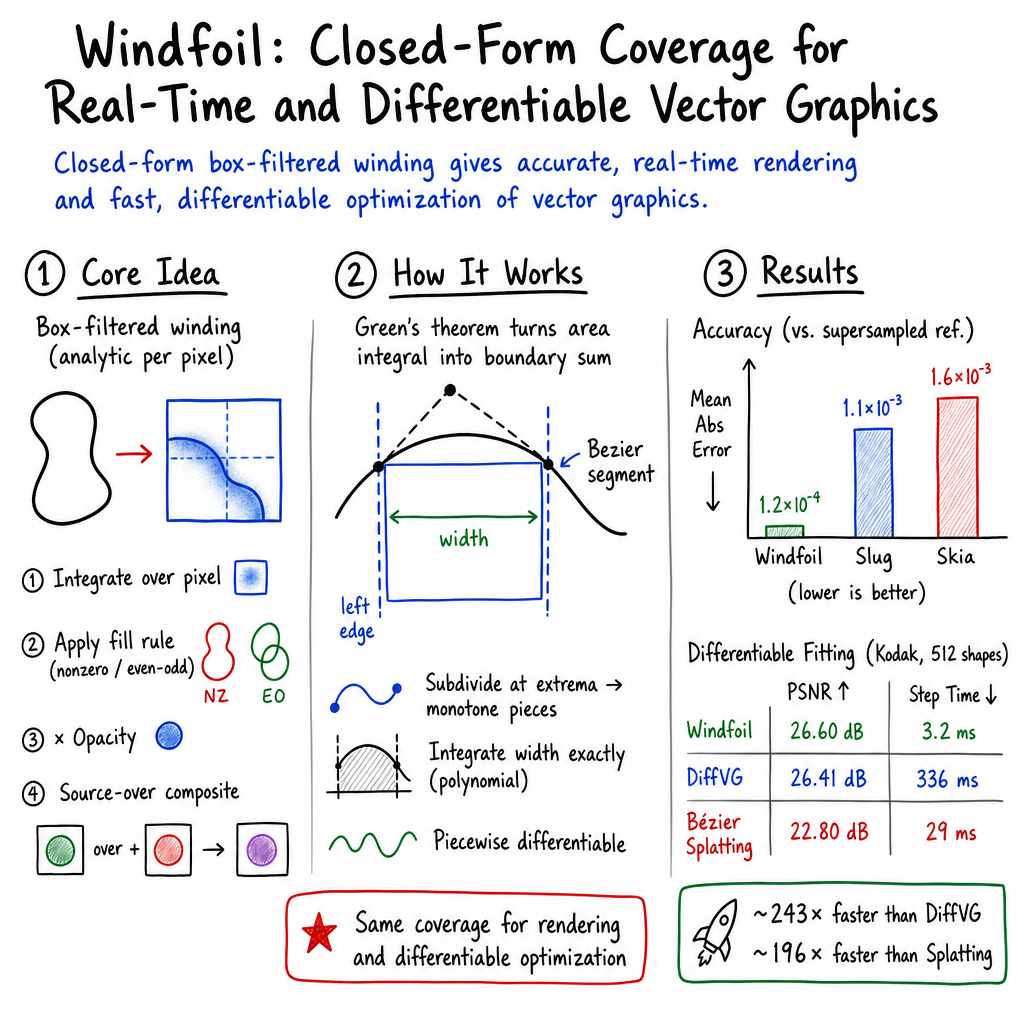
Abstract: We present Windfoil, a GPU-friendly algorithm that treats rasterisation and differentiable vector graphics as two sides of the same problem by evaluating the box-filtered winding number of quadratic Bézier contours in closed form. We implement this in WebGPU, allowing it to run across a range of environments, including a web browser on a consumer laptop, and apply the system to real-time 2D rendering, high-resolution rasterisation for print media, and a differentiable renderer. We compare our renderer against Skia, a production-grade engine, and Slug, a popular GPU rasterisation algorithm for games and real-time applications, measuring fidelity to a reference box-filtered coverage. Our renderer matches the reference more closely than either, at performance comparable to Slug. We also compare our optimiser against DiffVG and Bézier Splatting, where it reaches equivalent or better reconstruction quality at a fraction of the per-step cost, scaling to tens of thousands of shapes at interactive rates.













Paper Prompts
Sign up for free to create and run prompts on this paper.
Top Community Prompts
Explain it Like I'm 14
1. ¿De qué trata el artículo?
El artículo presenta Windfoil, un nuevo sistema para dibujar gráficos vectoriales de forma rápida y precisa.
Los gráficos vectoriales son imágenes formadas por líneas y curvas matemáticas, como:
- letras,
- iconos,
- logotipos,
- ilustraciones,
- formas geométricas.
A diferencia de una fotografía, un dibujo vectorial puede hacerse más grande o más pequeño sin perder tanta calidad.
El problema es que, al convertir estas curvas en píxeles, los bordes pueden verse dentados o borrosos. Windfoil intenta resolver este problema usando la tarjeta gráfica, o GPU, para calcular con precisión cuánto ocupa una forma dentro de cada píxel.
Además, el sistema puede usarse en inteligencia artificial para ajustar automáticamente formas y colores hasta que una imagen se parezca a otra.
2. ¿Qué preguntas intenta responder?
El artículo intenta averiguar principalmente lo siguiente:
- ¿Se puede dibujar gráficos vectoriales con bordes suaves y precisos sin hacer miles de muestras por píxel?
- ¿Puede este proceso ser suficientemente rápido para funcionar en tiempo real, por ejemplo, en un navegador web o en un videojuego?
- ¿Puede el mismo método ayudar a la inteligencia artificial a aprender y modificar dibujos vectoriales?
- ¿Windfoil es más rápido o preciso que otros sistemas existentes, como Skia, Slug, DiffVG y Bézier Splatting?
- ¿Puede funcionar con muchas formas al mismo tiempo, incluso con decenas de miles?
3. ¿Cómo funciona la investigación?
Representar las formas con curvas
Windfoil representa las figuras usando contornos cerrados hechos de curvas Bézier cuadráticas. Una curva Bézier es una línea suave controlada por varios puntos. Es parecida a una regla flexible cuyos extremos y puntos de control indican su dirección.
Decidir qué parte de un píxel está cubierta
Una imagen digital está formada por pequeños cuadrados llamados píxeles. Cuando el borde de una figura pasa por medio de un píxel, ese píxel no debería ser simplemente “encendido” o “apagado”. Debería tener un color intermedio.
Windfoil calcula qué porcentaje del área del píxel está cubierta por la figura. Por ejemplo:
- si la figura cubre todo el píxel, la cobertura es
1, o 100 %; - si cubre la mitad, la cobertura es
0.5, o 50 %; - si no lo cubre, la cobertura es
0.
Esto produce bordes más suaves. A este proceso se le llama antialiasing, que significa reducir los bordes dentados.
Usar una caja alrededor de cada píxel
El método estudia un pequeño rectángulo alrededor del centro de cada píxel. Después calcula cómo cambia dentro de él el llamado número de enrollamiento o winding number.
En términos sencillos, el número de enrollamiento sirve para decidir si un punto está dentro o fuera de una forma contando cómo sus bordes rodean ese punto. Es similar a lanzar una línea desde un punto y contar cuántas veces cruza el contorno.
En vez de comprobar muchísimos puntos al azar, Windfoil usa una fórmula matemática cerrada. Una fórmula cerrada es una fórmula que da directamente el resultado, sin tener que repetir muchas aproximaciones.
Ejecutar los cálculos en la GPU
La GPU puede realizar muchos cálculos pequeños al mismo tiempo. Windfoil aprovecha esta capacidad para calcular numerosos píxeles en paralelo.
El sistema está implementado con WebGPU, una tecnología que permite usar la GPU desde navegadores y otros programas. Por eso puede funcionar:
- en un navegador web,
- en un ordenador personal,
- en un servidor,
- para imágenes grandes destinadas a impresión.
Usar el método para inteligencia artificial
Windfoil también es diferenciable. Esto significa que puede indicar cómo cambiar una forma para que la imagen final se parezca más a una imagen objetivo.
Por ejemplo, si un dibujo generado no se parece suficientemente a una fotografía, el sistema puede calcular:
- qué puntos de las curvas deben moverse,
- qué colores deben cambiar,
- qué formas deben hacerse más transparentes u opacas.
Después, un algoritmo de optimización realiza pequeños cambios y repite el proceso. Es parecido a corregir un dibujo muchas veces siguiendo pistas sobre qué partes están equivocadas.
Los investigadores compararon el resultado usando un error llamado error cuadrático medio, que mide cuánto se diferencian dos imágenes píxel por píxel. También usaron PSNR, una medida que indica la calidad de la reconstrucción: normalmente, un valor mayor significa que la imagen se parece más al objetivo.
4. ¿Cuáles fueron los principales resultados?
Mejor precisión en los bordes
Windfoil se comparó con:
- Skia, una biblioteca muy utilizada para dibujar gráficos;
- Slug, un método rápido para renderizar texto y formas;
- DiffVG, un sistema de gráficos vectoriales diferenciables;
- Bézier Splatting, otro método usado para ajustar curvas.
Al compararlo con una imagen de referencia, Windfoil tuvo un error medio de aproximadamente:
| Sistema | Error medio aproximado |
|---|---|
| Windfoil | 0.00012 |
| Slug | 0.0011 |
| Skia | 0.0016 |
En estas pruebas, un error más pequeño significa que el resultado se parece más a la referencia. Windfoil tuvo, por tanto, una precisión aproximadamente 9 veces mejor que Slug y 13 veces mejor que Skia frente a esa referencia concreta.
Velocidad comparable a otros métodos rápidos
Windfoil tuvo un rendimiento parecido al de Slug. En algunas situaciones fue más rápido:
- cuando la imagen estaba muy ampliada;
- cuando las formas eran tan pequeñas que apenas ocupaban unos pocos píxeles.
En otras situaciones, Slug fue entre 1,2 y 2,8 veces más rápido. Esto muestra que Windfoil no es siempre el ganador en velocidad, pero sí ofrece una combinación fuerte de precisión y rapidez.
En las pruebas realizadas en un portátil con un chip Apple M2, ambos métodos pudieron mantener alrededor de 60 imágenes por segundo en tareas habituales, como dibujar muchos iconos o letras.
Mucho más rápido para optimización con inteligencia artificial
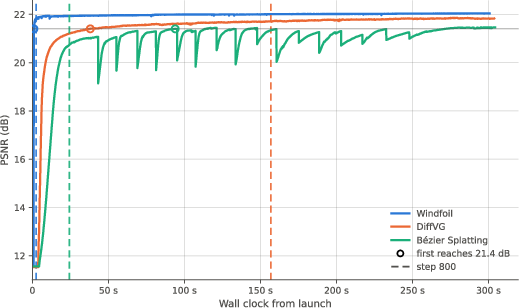
En las pruebas de ajuste de imágenes, Windfoil consiguió una calidad parecida o mejor que DiffVG y Bézier Splatting, pero usando mucho menos tiempo.
Por ejemplo, en una colección de imágenes llamada Kodak:
- Windfoil obtuvo una puntuación PSNR de
26.60; - DiffVG obtuvo
26.41; - Bézier Splatting obtuvo
22.80.
Windfoil también necesitó mucho menos tiempo por paso:
- Windfoil: unos
3.2milisegundos; - DiffVG: unos
336milisegundos; - Bézier Splatting: unos
29milisegundos.
En algunos experimentos, Windfoil alcanzó la calidad final de los otros sistemas cientos o incluso miles de veces más rápido. También pudo trabajar con escenas de hasta 50.000 formas en un tiempo razonable.
Otras demostraciones
El artículo muestra que Windfoil puede utilizarse para:
- renderizar texto e iconos;
- producir imágenes de alta resolución para impresión;
- controlar diferentes tipos de desenfoque;
- ajustar formas vectoriales para que se parezcan a fotografías;
- crear dibujos guiados por una descripción de texto, como “una cafetería de París” o “una noria”.
Para estas últimas pruebas se utilizó CLIP, un modelo de inteligencia artificial que relaciona imágenes con palabras. El modelo ayuda a decidir si una imagen se parece al texto indicado.
5. ¿Por qué son importantes estos resultados?
Windfoil intenta resolver dos problemas que normalmente se tratan por separado:
- dibujar gráficos vectoriales rápidamente;
- permitir que una inteligencia artificial modifique esos gráficos mediante aprendizaje.
Al usar el mismo método para ambas tareas, la imagen que se optimiza durante el aprendizaje es muy parecida a la imagen que finalmente se muestra. Esto evita que el sistema aprenda a producir una imagen que se ve bien durante el entrenamiento, pero diferente cuando se renderiza con otro programa.
La técnica también puede ser útil porque:
- funciona en navegadores web;
- no necesita guardar grandes mapas de texturas;
- puede dibujar imágenes muy grandes por partes;
- permite cambiar la suavidad de los bordes;
- puede trabajar con miles de formas;
- facilita herramientas interactivas de diseño y dibujo.
6. Limitaciones del sistema
Los autores también explican que Windfoil no es perfecto.
La principal limitación aparece cuando las curvas:
- se cruzan consigo mismas;
- se superponen de formas complicadas;
- tienen varios cambios de interior a exterior dentro de un mismo píxel.
En esos casos, Windfoil puede dibujar pequeños errores, como una línea que parece convertirse en un agujero. Esto ocurre porque el sistema calcula primero un promedio y después decide si el área está dentro de la figura. En situaciones complejas, ese orden no siempre da exactamente el mismo resultado que calcular cada punto por separado.
Además, la versión estudiada:
- trabaja principalmente con curvas Bézier cuadráticas;
- no maneja directamente todos los trazos, máscaras, texturas o degradados;
- utiliza una caja alineada con los ejes para cada píxel;
- no es totalmente exacta cuando hay rotación, perspectiva o deformaciones complejas;
- necesita convertir las curvas cúbicas y los trazos en otras formas antes de procesarlos.
También hay que tener cuidado al interpretar los resultados: algunos experimentos se ejecutaron una sola vez y las comparaciones dependieron de configuraciones concretas de hardware y software.
7. Conclusión e impacto posible
En resumen, Windfoil es un método para dibujar formas vectoriales con bordes suaves de forma rápida y precisa, y al mismo tiempo permitir que una inteligencia artificial las modifique.
El artículo muestra que puede:
- igualar o superar la precisión de varios renderizadores;
- funcionar a velocidades adecuadas para aplicaciones interactivas;
- ejecutarse en navegadores mediante WebGPU;
- ajustar imágenes con muchas formas mucho más rápido que algunos métodos anteriores;
- ayudar a crear dibujos vectoriales a partir de fotografías o descripciones de texto.
Si se sigue desarrollando, Windfoil podría utilizarse en editores gráficos, videojuegos, páginas web, herramientas de diseño, impresión de alta resolución y programas de inteligencia artificial que convierten imágenes o textos en ilustraciones vectoriales. Su mayor aportación es unir en un solo sistema la rapidez del renderizado en tiempo real y la capacidad de aprendizaje necesaria para modificar dibujos automáticamente.
Knowledge Gaps
Conocimiento faltante, limitaciones y preguntas abiertas
- Generalización a curvas cúbicas: el método solo admite contornos cuadráticos cerrados; no se cuantifica el coste, la precisión ni la estabilidad de extender la integración cerrada a curvas Bézier cúbicas sin convertirlas previamente a aproximaciones cuadráticas.
- Soporte de trazos: los trazos deben convertirse en contornos rellenos, pero no se evalúa cómo afecta esta conversión a la precisión, el rendimiento, las uniones, las terminaciones, los anchos variables o los trazos extremadamente delgados.
- Transformaciones generales: la caja de filtrado deja de ser exacta bajo rotación, cizallamiento y perspectiva. Queda abierta una formulación eficiente para footprints transformados, posiblemente no axis-aligned, y una evaluación cuantitativa del error introducido por usar cajas axis-aligned.
- Intersecciones y auto cruces: la aproximación de promediar el número de winding antes de aplicar la regla de relleno puede producir agujeros o costuras incorrectas en auto-intersecciones, contornos superpuestos y múltiples transiciones even-odd. No se proporciona una caracterización completa de los casos degenerados ni un límite formal del error.
- Corrección exacta del relleno: no se desarrolla un mecanismo que aplique la regla nonzero o even-odd punto por punto dentro del footprint antes de filtrar. Sería necesario investigar una alternativa que conserve la velocidad del método y elimine los errores en regiones con variaciones de winding mayores que uno.
- Composición y filtrado global: el filtrado se realiza por forma antes de la composición, aunque el filtrado de la escena completamente compuesta puede producir resultados diferentes en bordes coincidentes, transparencias y oclusiones. Falta cuantificar este desacuerdo y desarrollar una estrategia de filtrado composicionalmente correcta.
- Máscaras y efectos de pintura: el renderer diferenciable no admite máscaras de recorte, degradados, texturas ni otros efectos de pintura. No se estudia cómo extender la integración y la diferenciación a estos elementos manteniendo un coste compatible con tiempo real.
- Núcleos distintos del box filter: los filtros tent y cubic B-spline se aproximan mediante cuadratura de número fijo de muestras, no mediante convoluciones cerradas. No se analiza el error frente a soluciones exactas ni cómo adaptar el número de muestras a la geometría, la escala o una tolerancia de calidad.
- Núcleos arbitrarios: aunque se afirma que la formulación puede extenderse a otros kernels, no se especifica una teoría general ni se demuestra cómo generar automáticamente evaluadores diferenciables para filtros compactos o anisotrópicos.
- Calidad de gradientes en discontinuidades: la cobertura es solo piecewise differentiable y el sistema emplea convenciones fijas y salvaguardas numéricas donde las derivadas no están definidas. Falta medir el sesgo, la varianza y la estabilidad de esos gradientes durante optimizaciones difíciles.
- Gradientes a través de las reglas de relleno: las funciones
clamp, valor absoluto, módulo y saturación de las reglas nonzero/even-odd introducen puntos no diferenciables. No se evalúa sistemáticamente el impacto de estas discontinuidades en la convergencia ni se comparan subgradientes, suavizados o formulaciones alternativas. - Robustez numérica: no se presentan experimentos sobre curvas degeneradas, raíces cuadráticas coincidentes, segmentos casi horizontales o verticales, cajas de filtrado muy pequeñas, coordenadas de gran magnitud y geometría cercana a tangencias.
- Atomics de punto fijo: la acumulación de gradientes usa atomics enteros para garantizar independencia del orden, pero puede sufrir cuantización y overflow. Faltan límites analíticos de rango, mediciones de error según número de formas y resolución, y estrategias de escalado o detección de overflow.
- Preprocesamiento en CPU: la descomposición en piezas monotónicas y la construcción de estructuras de binning se ejecutan en CPU y deben repetirse en cada iteración durante la optimización. No se evalúa el coste de este paso en escenas dinámicas grandes ni se implementa la alternativa GPU propuesta.
- Escalabilidad de las estructuras de aceleración: el rendimiento depende de bandas horizontales, listas por tiles y ordenación parcial. Falta estudiar escenas con distribución espacial muy desigual, enormes niveles de overdraw, formas gigantes que cubren toda la pantalla y escenas con millones de segmentos.
- Dependencia del hardware y del backend: los benchmarks principales usan un Apple M2 para rasterización y una NVIDIA RTX 2000 Ada con Vulkan para diferenciación. No se evalúa el comportamiento en GPUs móviles, integradas, AMD, Intel, distintos drivers, WebGPU nativo ni navegadores con implementaciones heterogéneas.
- Comparación experimental limitada: cada benchmark de optimización se ejecuta una sola vez con una semilla. No se reportan intervalos de confianza, variabilidad entre semillas, sensibilidad a la inicialización ni pruebas de significancia para las diferencias de PSNR y tiempo.
- Comparaciones no completamente equivalentes: DiffVG y Bézier Splatting utilizan representaciones, configuraciones de muestreo y procedimientos de optimización diferentes; además, algunas comparaciones omiten baselines para 10.000 y 50.000 formas. Se necesita una evaluación controlada con igual representación, inicialización, presupuesto de memoria, resolución, número de evaluaciones y criterio de parada.
- Cobertura de los conjuntos de datos: la evaluación de ajuste de imágenes se limita principalmente a Kodak y una imagen de Färlev. Falta validar el método en imágenes con texto, líneas finas, transparencias complejas, alto rango dinámico, contenido sintético adversarial y escenas vectoriales reales de gran diversidad.
- Objetivos de optimización limitados: la evaluación cuantitativa usa principalmente MSE/PSNR. No se estudia el comportamiento con pérdidas perceptuales, LPIPS, objetivos semánticos, pérdidas multi-escala, restricciones vectoriales o funciones de calidad específicas para tipografía.
- Text-to-sketch con CLIP: el experimento con CLIP no analiza fidelidad semántica humana, estabilidad entre prompts, sensibilidad a la inicialización, sesgos del modelo ni la relación entre la pérdida CLIP y la calidad visual o estructural del SVG generado.
- Minification guard: el perfil de tinta precomputado usado cuando las formas son menores que aproximadamente cuatro píxeles es una aproximación cuya construcción, error y umbral se describen de forma limitada. Falta una comparación sistemática con la cobertura exacta y una política adaptativa basada en una tolerancia de error.
- Escenas animadas: aunque se menciona el uso en animación, no se estudian temporalmente el popping, shimmer, flickering, coherencia entre frames ni la estabilidad de los gradientes cuando las curvas o las transformaciones cambian continuamente.
- Perspectiva y transformaciones dependientes del píxel: no se aborda cómo mantener una cobertura correcta cuando el tamaño y la orientación del footprint varían dentro de una primitiva bajo perspectiva, deformaciones no lineales o pipelines 2.5D.
- Calidad tipográfica: se menciona el texto como caso de uso, pero no se evalúan legibilidad, hinting, small sizes, subpixel rendering, alfabetos CJK, ligaduras, fuentes variables ni grandes atlas Unicode.
- Composición de color: se afirma compatibilidad potencial con HDR, wide gamut y alta profundidad de bits, pero no se presentan resultados ni se aclara el espacio de color, el manejo de alpha premultiplicado, la linealización y la diferenciación a través de la conversión de color.
- Memoria y transferencia de datos: no se proporciona un análisis detallado de memoria GPU/CPU, ancho de banda, tamaño de las listas por tile, coste de duplicación de datos ni comportamiento ante escenas que exceden la memoria disponible.
- Calidad de exportación a gran escala: se menciona la generación de imágenes de hasta píxeles, pero faltan mediciones reproducibles de tiempo, memoria, precisión numérica, stitching, compresión y comportamiento con escenas complejas.
- Reproducibilidad de los resultados: aunque se proporciona código, no se detallan completamente versiones de drivers, configuraciones de compilación, parámetros de optimización, implementación exacta de los baselines ni protocolos para reproducir todas las cifras reportadas.
- Relación entre fidelidad y rendimiento: el trabajo muestra una mejora frente a una referencia supersampleada, pero no explora la frontera calidad-tiempo ni ofrece un mecanismo para seleccionar dinámicamente entre evaluación analítica, muestreo adicional y aproximaciones según el presupuesto de error.
- Aplicación a geometría no bien formada: se afirma exactitud para formas bien formadas, pero no se define con precisión qué condiciones geométricas son necesarias ni cómo se comporta el sistema ante contornos abiertos, orientaciones inconsistentes, solapamientos inválidos o datos SVG malformados.
- Optimización conjunta de geometría y topología: el sistema optimiza control points, color y opacidad, pero no permite cambios topológicos discretos como añadir o eliminar segmentos, modificar agujeros o cambiar reglas de relleno. Queda abierta una estrategia diferenciable o híbrida para optimizar la estructura del vector.
- Análisis teórico de complejidad: no se proporciona un análisis formal de complejidad temporal y espacial en función del número de curvas, tamaño del footprint, número de tiles, overdraw y distribución geométrica, ni condiciones bajo las cuales el método supera a las alternativas.
Practical Applications
Immediate Applications
The paper’s open-source WebGPU implementation and reported browser/server compatibility make the following uses potentially deployable now, particularly for quadratic, closed vector contours.
- Browser-based vector editors and design tools — software/design
- Integrate Windfoil as a real-time renderer for SVG-like shapes, icons, illustrations, and text outlines.
- Provide zoom-independent antialiasing, smooth hairline rendering, and interactive previews without requiring native desktop graphics libraries.
- A practical workflow is: import or convert vector paths to closed quadratic contours, preprocess row bands, and render them through the WebGPU fragment pipeline.
- Dependencies: WebGPU support, conversion of cubic or stroked paths to quadratic closed outlines, and fallback rendering for devices without adequate GPU support.
- High-quality web typography, icons, and UI graphics — browsers, games, mobile/web applications
- Use direct curve evaluation instead of precomputed distance-field textures for scalable glyphs, emoji, interface icons, and decals.
- This can reduce resolution-specific artifacts and storage requirements for large glyph or symbol collections.
- Repeated characters can share preprocessed curve data, making the method suitable for interfaces containing thousands of glyph instances.
- Dependencies: Font outlines must be converted into supported quadratic contours; self-intersecting or overlapping glyph structures may exhibit localized fill-rule errors.
- Real-time rendering of SVG and vector assets in games and interactive media — entertainment/software
- Use the display backend for HUDs, menus, vector logos, map symbols, decals, and animated 2D artwork.
- The reported performance is comparable to Slug and remains within a 60-fps budget for tested workloads such as large quantities of text and icons.
- The minification guard and banded ink profiles can accelerate very small shapes and reduce shimmering.
- Dependencies: Performance will vary with GPU architecture, scene complexity, overdraw, zoom level, and WebGPU driver quality. Production engines would need additional support for clipping, gradients, textures, and strokes.
- Interactive SVG-to-raster conversion and image tracing — creative software and digitization
- Fit quadratic vector shapes to a raster image using GPU-based gradients, allowing users to trace or simplify photographs, illustrations, logos, and scanned diagrams interactively.
- A design tool could expose shape count, opacity, colour, and geometry as editable parameters while optimising mean-squared pixel error.
- The shared rendering and optimisation model reduces discrepancies between the image used during fitting and the final displayed result.
- Dependencies: Mean-squared error does not necessarily preserve semantic or perceptual quality; practical systems may need perceptual, structural, or vision-language losses.
- Text-to-sketch and prompt-guided vector illustration — generative AI and creative tools
- Combine the differentiable renderer with CLIP or another image-text model to produce sketches, icons, abstract scenes, and stylised illustrations from natural-language prompts.
- A practical architecture is a WebGPU renderer plus an external Python loss service that returns a gradient or optimisation objective.
- This could support interactive “prompt-to-editable-SVG” tools rather than producing only raster images.
- Dependencies: Prompt quality depends on the vision-LLM, initial shape layout, optimisation strategy, and suitable regularisation. CLIP-based optimisation may produce semantically matching but visually unstable or non-editable geometry.
- High-resolution raster export for print and publishing — graphic design, publishing, advertising
- Render posters, signage, illustrations, maps, and other vector artwork at very large resolutions using independently processed tiles.
- The paper reports tests up to approximately pixels, with tile stitching that avoids inter-tile coverage artifacts.
- Floating-point compositing, high-bit-depth output, wide-gamut colour, and HDR workflows could be incorporated into a print-export pipeline.
- Dependencies: Production print workflows require colour-management validation, reliable memory and worker scheduling, and support for unsupported paint effects and path types.
- Moiré and shimmer reduction in dense line art — publishing, mapping, CAD, and visualization
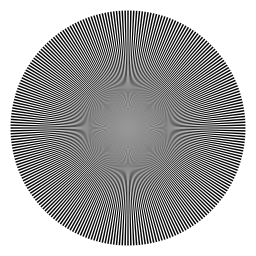
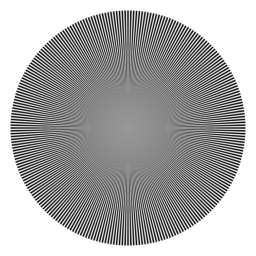
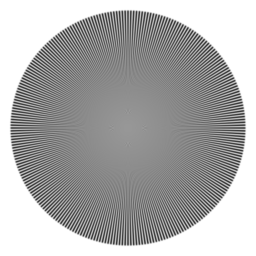
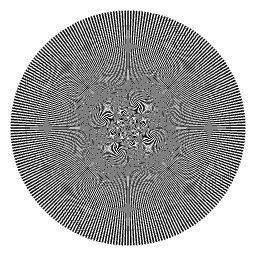
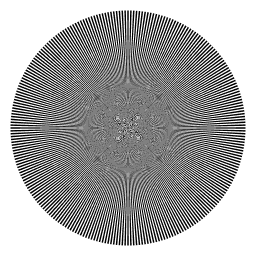
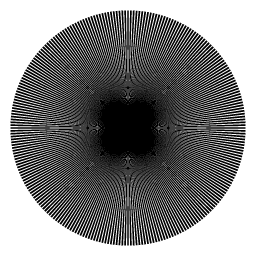
- Use adjustable filter widths or tent/cubic B-spline filtering to soften dense line work, sunbursts, technical diagrams, map layers, and thin repeated patterns.
- Designers could preview several filter kernels and choose a quality/performance trade-off for screen or print output.
- Dependencies: The alternative kernels are currently evaluated using fixed-tap quadrature rather than fully closed-form integration and therefore incur additional computational cost.
- Server-side and headless vector rendering — cloud graphics and automated media pipelines
- Deploy the Node.js/Dawn or Deno backends for batch thumbnail generation, SVG conversion, document previews, asset validation, and remote rendering services.
- Independent pixel evaluation allows rendering to be divided across tiles or worker processes.
- Dependencies: Server deployment requires GPU availability, WebGPU runtime compatibility, resource quotas, and safeguards against pathological inputs with excessive curve counts or overdraw.
- Reproducible rendering experiments and teaching — academia and graphics engineering
- Use the public implementation, validation tools, and benchmarks to teach analytic antialiasing, winding-number rasterisation, GPU tiling, differentiable rendering, and WebGPU programming.
- Researchers can compare rasterisers against a common supersampled box-filter reference rather than relying only on visual inspection.
- Dependencies: Results should be replicated across more hardware and with multiple random seeds; the paper notes that some benchmarks were run only once and that timings vary by host.
- Daily-life vector applications — productivity, accessibility, and communication
- Improve the rendering of scalable diagrams, charts, stickers, digital handwriting, map annotations, and messaging-app graphics in browser-based applications.
- Adjustable filtering may make thin lines and small symbols more legible across different display densities and zoom levels.
- Dependencies: Accessibility benefits require user studies and careful tuning; smoother rendering alone does not guarantee improved readability, especially for text.
Long-Term Applications
The following possibilities are enabled by the paper’s formulation but require broader curve support, validation, scaling, or additional research before they can become robust general-purpose products.
- A general differentiable vector-graphics platform — machine learning and creative AI
- Extend the renderer beyond quadratic closed contours to native cubic Bézier paths, stroked paths, clipping masks, gradients, textures, blend modes, and complex paint effects.
- This could provide a unified optimisation framework for vectorisation, logo generation, icon design, typography, sketch synthesis, and editable image reconstruction.
- Dependencies: New analytic derivatives, stable handling of topology changes, robust gradient accumulation, and validation against production rendering semantics.
- Differentiable layout, typography, and document design — publishing, education, and human-computer interaction
- Optimise font choice, glyph geometry, kerning, layout, colour, and illustration structure against raster, perceptual, or language-based objectives.
- Potential products include automatic logo and poster layout systems, adaptive educational diagrams, and tools that turn rough handwriting into editable vector documents.
- Dependencies: The current implementation does not directly model text layout, font hinting, language shaping, or accessibility constraints. Optimisation must also avoid degrading legibility while improving pixel or semantic losses.
- Interactive vectorisation of photographs and video — media production and digital archives
- Scale the reported image-fitting workflow to video, enabling temporally consistent vector abstractions, rotoscoping, stylised animation, and compact scene representations.
- A real-time renderer could provide immediate feedback while thousands of shapes are optimised over successive frames.
- Dependencies: Temporal coherence, shape tracking, occlusion handling, scene topology changes, and optimisation cost across many frames remain unresolved. Per-frame pixel fitting may produce flicker without explicit temporal losses.
- Differentiable CAD, technical illustration, and scientific visualization — engineering and research
- Optimise vector diagrams, schematics, technical drawings, and layered visualisations while maintaining editable geometry and exact rendering consistency.
- Analytic coverage could be useful where thin lines, high zoom ranges, and high-resolution export are important.
- Dependencies: CAD and scientific formats commonly require strokes, clipping, joins, caps, transforms, and perspective; the current axis-aligned box approximation is not exact under rotation, shear, or perspective.
- Perspective-aware and transformation-aware analytic filtering — robotics, AR/VR, mapping, and 3D graphics
- Generalise the pixel footprint from an axis-aligned box to a transformed quadrilateral or other footprint, enabling accurate vector rendering under rotation, shear, projective distortion, and camera motion.
- Applications could include vector overlays in augmented reality, map labels, robot vision interfaces, and 2D elements embedded in 3D scenes.
- Dependencies: Closed-form integration over general footprints is more difficult, and performance may decline. The current method is explicitly most accurate under translation and axis-aligned scaling.
- Robust rendering of self-intersecting and overlapping paths — production graphics
- Develop a coverage formulation that applies fill rules at the appropriate spatial level rather than averaging winding before applying the rule.
- This would remove the reported seam and hole artifacts in self-crossings, overlapping contours, and multiple even-odd transitions within one pixel footprint.
- Dependencies: The correction must preserve the renderer’s speed and differentiability. It may require additional subdivision, local sampling, or more complex per-pixel topology analysis.
- GPU-native preprocessing and dynamic scenes — high-end rendering and animation
- Move curve extrema detection, monotone subdivision, row binning, and tile-list construction from the CPU to GPU compute pipelines.
- This could reduce CPU overhead when geometry changes every optimisation step or when thousands of animated objects are present.
- Dependencies: GPU preprocessing must handle dynamic memory, synchronization, sorting, and numerical robustness without becoming more expensive than the current CPU path.
- Large-scale generative vector models — AI research and commercial design automation
- Use Windfoil-like differentiable coverage inside models that generate tens of thousands of editable shapes from text, images, sketches, or multimodal instructions.
- Possible outputs include compact vector assets, procedural illustrations, game environments, animated diagrams, and brand graphics.
- Dependencies: Large shape counts require memory-efficient optimisation, better regularisation, topology control, and evaluation metrics beyond PSNR or CLIP loss. The reported large-scene results do not by themselves establish product-level reliability.
- Hardware and browser-standard adoption — platform engineering and policy
- The method could inform standardised WebGPU vector-rendering primitives or interoperable browser APIs for analytic, differentiable, and high-quality vector coverage.
- Public reference implementations and benchmarks could support procurement or standards decisions concerning browser graphics capabilities and open rendering infrastructure.
- Dependencies: Adoption would require independent security, performance, accessibility, and conformance testing. Browser vendors would also need to address GPU availability, driver variability, privacy, and resource isolation.
- Energy-efficient rendering and low-resource computing — sustainability and edge devices
- Reduced sampling, texture storage, and optimisation time could lower compute and memory requirements for vector-heavy interfaces and generative design workflows.
- This may benefit laptops, tablets, embedded displays, and offline creative applications.
- Dependencies: The paper does not provide energy measurements. Actual gains depend on GPU utilisation, preprocessing overhead, device thermal limits, and whether analytic computation is cheaper than existing cached or hardware-specific pipelines.
Glossary
- Alpha blending: Combining a foreground color with a background color according to opacity values. “draw shapes as instanced quads with standard painter-order compositing and alpha blending.”
- Analytic antialiasing: Antialiasing that computes pixel coverage mathematically rather than by sampling or lookup. “Analytic antialiasing has attracted considerable interest because it can produce legible text and smooth edges across resolutions.”
- Automatic differentiation: Algorithmic computation of derivatives through a sequence of operations. “demonstrating that automatic differentiation can produce gradients with respect to control points, colour, opacity, and filter width.”
- Boundary integral: An integral over a curve or boundary that represents an equivalent area or volume integral. “By Green's theorem, the integral over the footprint in Equation~\eqref{eq:filtered-winding} can be rewritten as a boundary integral”
- Box filter: A filter that assigns uniform weight to every point in a rectangular region. “We use an axis-aligned box, which is exact during translation and scaling, but an approximation under rotation, shear, or perspective transform.”
- Closed-form evaluation: Direct computation using a finite expression rather than numerical iteration or approximation. “The formulation presents an extensible primitive for 2D vector graphics.”
- Compute pipeline: A GPU processing pipeline designed for general-purpose parallel computation rather than traditional rendering. “a real-time WebGPU implementation built on this solution, demonstrated in a fragment shader for display and a compute pipeline for differentiable optimisation”
- Cotangent: In reverse-mode automatic differentiation, the gradient propagated backward from an output quantity. “The image-space gradient is passed as the cotangent to the backward pass.”
- Differentiable rendering: Rendering that provides derivatives of image outputs with respect to scene parameters. “Some of these problems also arise in machine learning during differentiable rendering”
- Fragment shader: A GPU program executed to determine the color and other attributes of individual rasterized fragments. “The system runs in WebGPU within a web browser”
- Gradient descent: An iterative optimization method that updates parameters in the direction that reduces an objective function. “allowing these parameters to be optimised by gradient descent.”
- Green’s theorem: A theorem relating a line integral around a closed planar curve to a double integral over the enclosed region. “By Green's theorem, the integral over the footprint in Equation~\eqref{eq:filtered-winding} can be rewritten as a boundary integral”
- Implicit form: A representation of a geometric object through an equation whose zero set defines the object. “Loop and Blinn triangulate shapes and evaluate an implicit form of each curve per fragment”
- Instanced rendering: Rendering multiple copies of geometry while reusing shared vertex or shape data. “For real-time display, we draw shapes as instanced quads with standard painter-order compositing and alpha blending.”
- Mean-squared error: The average of squared differences between corresponding predicted and target values. “For image fitting, we compare the rendered image with a target on the GPU using the mean-squared error over pixels”
- Monotone curve segment: A curve segment whose coordinate value changes in only one direction, without reversals. “we subdivide each quadratic curve at its - and -extrema into at most three pieces that are monotone in both coordinates.”
- Monte Carlo sampling: Estimation using repeated samples drawn from a probability distribution. “Existing differentiable renderers typically resort to Monte Carlo sampling or smooth analytic approximations”
- Moiré interference: Visible patterns caused by interference between overlapping repetitive structures or sampling grids. “These filters have a notable performance cost and are best suited to reducing moiré and shimmering in dense line work.”
- Multisampling: Antialiasing or numerical integration by evaluating multiple samples within each pixel. “Windfoil addresses these problems by computing the box-filtered winding number analytically in closed form over a given pixel footprint, without multisampling or baked texture storage.”
- Numerical safeguards: Procedures that prevent instability, invalid values, or excessive error during numerical computation. “Where derivatives are undefined or numerically unstable, we use fixed derivative conventions and numerical safeguards.”
- Painter’s order: Compositing objects sequentially according to their drawing order, with later objects covering earlier ones. “We then combine shapes in painter's order using standard source-over compositing.”
- Prefix sum: A parallel or sequential operation that computes cumulative sums of an ordered sequence. “carrying winding between tiles with a prefix sum”
- Quadrature: Numerical approximation of an integral using weighted evaluations at selected points. “We demonstrate this with tent and cubic B-spline filters using quadrature approximations”
- Rasterisation: Converting geometric descriptions into a grid of pixels. “Vector graphics has long been a central pillar of computing research.”
- Signed distance field: A scalar field whose value gives the signed distance from a point to a boundary, with the sign indicating the side of the boundary. “Valve popularised baking signed distance fields for text and decals in 3D games”
- Source-over compositing: A standard alpha-compositing operation in which a source layer is placed over a destination layer. “We then combine shapes in painter's order using standard source-over compositing.”
- Tiled binning: Assigning potentially relevant geometric objects to spatial image tiles to reduce unnecessary processing. “acceleration structures tailored to each path: horizontal row binning for the fragment shader and tiled binning for the compute dispatch”
- Vector-Jacobian product: The product of a vector with the Jacobian of a function, commonly used to propagate gradients in reverse-mode differentiation. “The backward pass is an explicit analytic vector-Jacobian product (VJP) on the GPU.”
- Winding number: A signed count of how many times a curve boundary crosses a ray from a point, used to determine shape inclusion. “A point's winding number is the signed count of boundary crossings along a horizontal ray cast to the right.”
- Workgroup: A group of GPU shader invocations that can cooperate during parallel execution. “The system runs in WebGPU within a web browser”

