VGGT-Diff: Visual Geometry Meets Diffusion for Sparse-View Novel View Synthesis
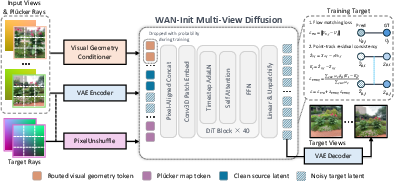
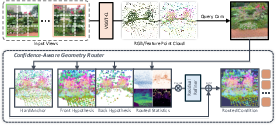
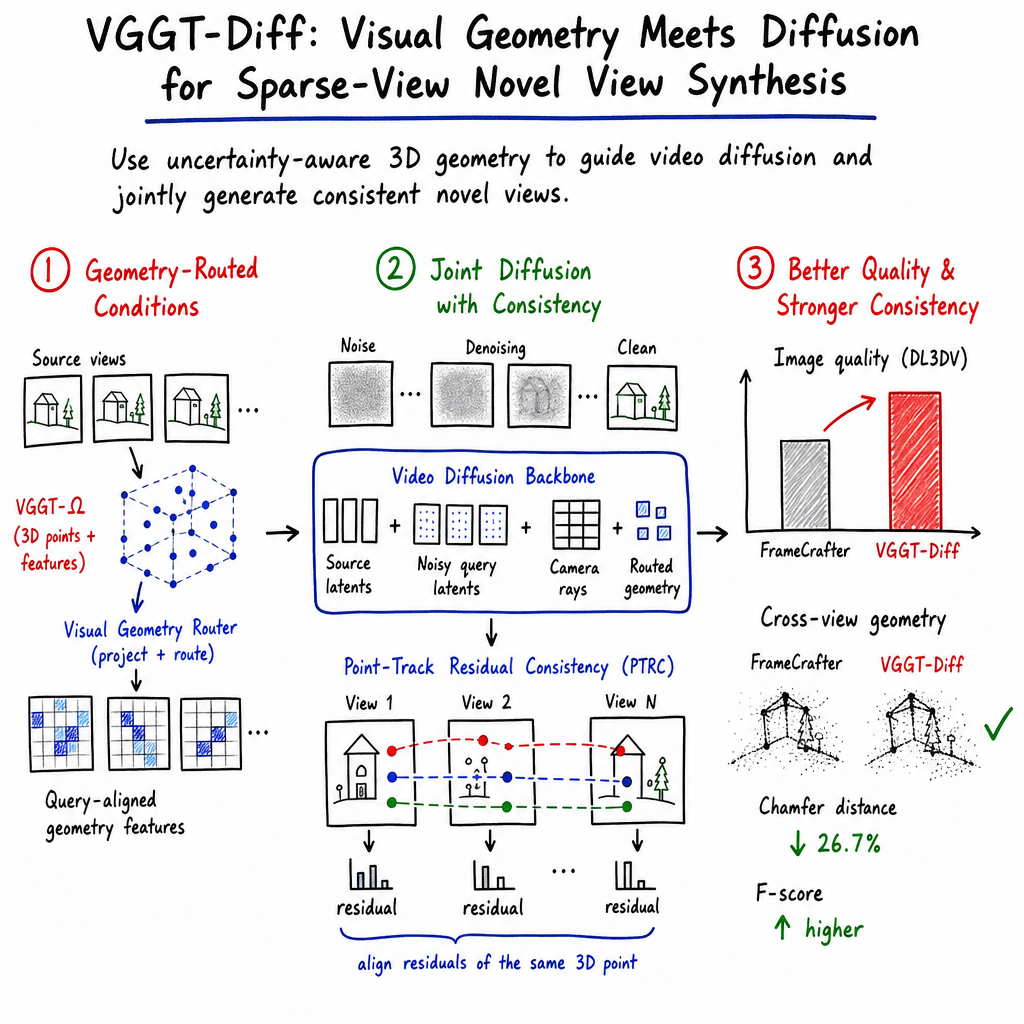
Abstract: We present VGGT-Diff, a geometry-routed multi-view diffusion model for sparse-view novel view synthesis. Existing novel view synthesis (NVS) methods face a fundamental trade-off: reconstruction-based approaches preserve observed geometry but struggle to synthesize unseen regions, while diffusion-based methods provide strong generative priors yet rely on implicit source-to-query correspondence. VGGT-Diff bridges these regimes by routing visual geometry latents from VGGT-Ω into a pretrained video diffusion model. Each visual token is associated with a 3D point and confidence, then transformed into query-aligned latent conditions through a confidence-aware Visual Geometry Router (VGR) that preserves front and back surface evidence. These conditions guide joint target-view denoising, while Point-Track Residual Consistency (PTRC) regularizes predicted-clean residuals along reliable 3D tracks, improving multi-view stability. We further introduce robust geometry conditioning, combining training-time regularization with inference-time guidance for improved robustness. Experiments show competitive or state-of-the-art performance across interpolation and extrapolation under different viewpoint difficulties. Our code is available at https://github.com/chenkangjie1123/VGGT-Diff.
Paper Prompts
Sign up for free to create and run prompts on this paper.
Explain it Like I'm 14
1. What is this paper about?
This paper presents a system called VGGT-Diff. Its goal is to create new views of a place or object using only a few photographs.
Imagine taking six pictures of a chair from different angles. VGGT-Diff tries to generate what the chair would look like from another angle—even if nobody took a picture from there. This task is called sparse-view novel view synthesis.
The system combines two types of artificial intelligence:
- Geometry-based computer vision, which studies the 3D shape and positions of objects.
- Diffusion models, which are good at creating realistic-looking images and filling in missing parts.
The main idea is to use geometry to keep the generated images accurate, while using diffusion to imagine parts that were not visible in the original photographs.
2. What questions are the researchers asking?
The researchers are trying to solve several problems:
- How can a model create realistic new camera views from only a few images?
- How can it preserve details that appeared in the original photographs?
- How can it avoid inventing objects or shapes that do not really belong in the scene?
- How can several generated views remain consistent with one another?
For example, if a model creates one image showing the left side of a car and another showing the back, the car should still have the same shape, wheels, and windows in both images. The views should fit together like different pages showing the same object.
3. How does the method work?
The basic idea
VGGT-Diff begins with a few source images and information about the cameras that took them. It also receives the locations of the new cameras that the user wants to see.
The system then uses two important tools:
- VGGT-, a geometry model that estimates where important points are in 3D space.
- A video diffusion model, which gradually turns noisy information into a clear image.
A useful analogy is this:
The geometry model acts like a map, while the diffusion model acts like an artist. The map tells the artist where things belong, and the artist fills in missing details in a realistic way.
Geometry information
VGGT- looks at the source images and finds visual features, such as:
- the edge of a table,
- a window,
- a chair leg,
- a sign,
- or a corner of a building.
It estimates each feature’s:
- 3D position, meaning where it is in the scene;
- confidence, meaning how sure the system is that the estimate is correct.
The system then projects these features into the requested camera views. In simple terms, it asks:
“If this point is really located here in 3D, where should it appear in the new image?”
This process is called the Visual Geometry Router. It sends useful information from the original images to the correct places in the new images.
The router also considers objects that may be partly hidden. For example, a table edge might be in front of a chair in one view but behind it in another view. The method keeps several possible layers of information instead of immediately throwing away everything that is not closest to the camera.
Diffusion image generation
The method starts with noisy image information and repeatedly improves it. This is similar to starting with television static and slowly removing the noise until a meaningful picture appears.
The diffusion model uses:
- the original photographs,
- camera information,
- and the geometry information from VGGT-.
This helps it create realistic unseen regions without forgetting the evidence in the source images.
Keeping different views consistent
The authors also add a technique called Point-Track Residual Consistency, or PTRC.
This technique follows the same 3D point across multiple generated views. If a particular corner of a building appears in three images, the model checks whether its remaining errors are similar across those views.
A simple analogy is drawing the same character in several comic-book panels. The character can look slightly different because of lighting or viewpoint, but its basic shape and position should remain consistent.
Importantly, PTRC does not force the images to be identical. It allows valid changes caused by lighting, visibility, or camera angle.
Handling uncertain geometry
The geometry estimates are not always perfect. To prevent the model from trusting them too much, the researchers sometimes weaken or remove the geometry information during training.
This teaches the model to use geometry as helpful evidence, rather than treating it as an unquestionable answer.
4. What did the researchers find?
The researchers tested VGGT-Diff on several image datasets, including:
- DL3DV, containing many 3D scenes;
- Mip-NeRF 360, containing scenes from a different dataset used to test whether the method works in unfamiliar situations.
They compared VGGT-Diff with both ordinary reconstruction systems and other diffusion-based systems.
Better image quality
VGGT-Diff generally produced images that were more accurate and more visually pleasing than the comparison methods.
On the DL3DV test, the standard version of the method:
- achieved a PSNR score of 18.104;
- improved over FrameCrafter, a similar diffusion-based method, which scored 17.180;
- preserved details such as chair legs, building edges, signs, and object boundaries more successfully.
The larger version, trained with much more data, achieved an even higher PSNR of 19.283.
These scores are technical measures of image quality. Higher PSNR and SSIM usually mean that the generated image is closer to the real target image. Lower LPIPS and DreamSim scores generally mean that people would perceive the generated image as more similar to the real one.
Stronger performance from difficult viewpoints
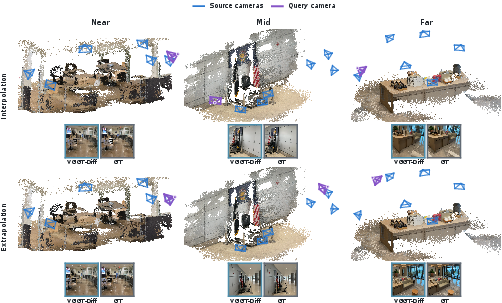
The method worked well when the requested camera was far from the source cameras. These situations are difficult because the original images reveal less information about the new viewpoint.
It performed especially well for:
- interpolation, where the new view lies between known views;
- extrapolation, where the new view is outside the range of the known views;
- near, medium, and far camera positions.
The scaled version ranked first in all the pose-difficulty groups reported in the table.
Better consistency between views
The researchers generated eight views of the same scene and used separate 3D reconstruction systems to check whether the views fit together.
VGGT-Diff produced the most consistent 3D results among the tested methods. Compared with FrameCrafter, it:
- reduced one 3D error measure by about 26.7% using VGGT-;
- reduced the same type of error by about 16.4% using another system called Pi3.
This suggests that the generated images do not merely look good individually. They also describe a scene that can be reconstructed in a more coherent way.
Which parts of the method mattered most?
The researchers removed different parts of VGGT-Diff to see what happened. This is called an ablation study—like taking parts out of a machine one at a time to discover which parts are important.
They found that:
- Removing the geometry information caused a large drop in performance.
- Using geometry-based visual features worked better than using only estimated RGB colors.
- Removing PTRC made the views less consistent.
- Removing the training method that weakens geometry conditioning also hurt performance.
- Adding geometry-guided inference improved the final results slightly more.
These tests support the authors’ claim that both geometry and diffusion are important.
5. Why is this research important?
Creating new views from a few images could be useful in many areas, including:
- virtual and augmented reality;
- video-game environments;
- movie and animation production;
- 3D mapping;
- robotics and self-driving vehicles;
- online shopping, where users might inspect an object from different angles.
The paper’s main contribution is showing that image-generation models can be made more reliable by giving them explicit information about 3D structure.
Instead of allowing the diffusion model to freely guess what unseen areas look like, VGGT-Diff gives it a geometry-based guide. At the same time, it does not force the system to build a complete, rigid 3D model. This balance lets it preserve known details while still filling in missing information.
Simple conclusion
VGGT-Diff combines the strengths of two approaches:
- 3D geometry helps keep objects in the right places and makes different views agree with one another.
- Diffusion generation helps create realistic details in areas that were not visible in the original images.
The experiments show that this combination can produce clearer, more accurate, and more consistent new viewpoints than several existing methods. In the future, systems like this could help computers build useful 3D understanding of the world from only a small number of photographs.
Practical Applications
Immediate Applications
The paper’s open-source implementation and its ability to synthesize multiple camera views from a small set of posed images make the following uses technically plausible now, provided that users can supply calibrated cameras and sufficient computational resources.
- Automotive perception and vehicle design — sparse-view 3D scene visualization
- Integrate
VGGT-Diffinto vehicle-capture pipelines to generate intermediate or extrapolated views of roads, parking areas, garages, dealerships, and vehicle interiors from a limited number of cameras. - Potential products include rapid 3D visualization tools for design review, remote inspection, digital mock-ups, and simulation-data generation.
- The geometry router and
Point-Track Residual Consistency (PTRC)are particularly useful for preserving object boundaries, signage, thin structures, and consistent geometry across jointly generated views. - Dependencies: accurate camera poses and calibration; adequate source-view coverage; reliable geometry estimation; validation against LiDAR or multi-view ground truth before use in safety-critical perception. Hallucinated content must not be treated as observed road or obstacle evidence.
- Integrate
- Robotics and embodied-AI simulation — completion of partially observed environments
- Use the model to generate plausible views of rooms, warehouses, industrial sites, or outdoor spaces that are only sparsely observed by a robot.
- Generated views could support viewpoint planning, exploratory navigation, manipulation simulation, and synthetic training data for visual policies.
- Confidence-weighted routing is beneficial because it can distinguish strongly supported geometry from areas that should be completed by the diffusion prior.
- Dependencies: the output is a visually plausible completion rather than a guaranteed metric-accurate map. Robot control should rely on verified sensors for collision avoidance and manipulation; generated views should be labeled as uncertain.
- Immersive media, virtual production, and 3D content creation
- A creator could capture a subject, set, product, or location from a small number of cameras and generate additional viewpoints for previews, storyboarding, virtual cinematography, and immersive video.
- Joint denoising of multiple query views can produce more coherent camera trajectories than independently generated images.
- A practical workflow would combine source-image capture, camera-pose estimation with
VGGT-, target-camera specification, multi-view generation, and human review. - Dependencies: view-dependent effects, reflections, transparent surfaces, and large unseen regions may remain unreliable. Commercial production requires temporal consistency, identity preservation, and higher-resolution evaluation beyond the reported benchmarks.
- Retail, e-commerce, and product visualization
- Generate additional product angles from a small image set for online catalogs, interactive product viewers, and augmented-reality previews.
- The approach is especially suitable for rigid products whose geometry and appearance are well captured in the source images.
- Geometry-prior guidance can help preserve logos, edges, handles, and other product-specific details rather than replacing them with generic diffusion outputs.
- Dependencies: products with reflective, transparent, deformable, or highly textured surfaces may require controlled lighting and more source views. Generated imagery should be identified as synthesized, especially where dimensions, safety features, or product configuration matter.
- Real-estate, architecture, and construction documentation
- Use sparse photographs or walkthrough frames to create exploratory views of interiors, building facades, and construction sites.
- Possible tools include an interactive “look-around” viewer, preliminary architectural visualization, and rapid comparison of alternative camera positions.
- The method’s performance under interpolation and moderate extrapolation is relevant to filling gaps between captured viewpoints.
- Dependencies: the method does not establish legal-grade measurements or complete building geometry. Architectural, engineering, and inspection workflows require measurement sensors, explicit uncertainty reporting, and human verification.
- Digital asset and heritage documentation
- Museums, archives, and cultural institutions could create exploratory multi-view renderings of artifacts or sites from a limited set of photographs.
- The system may reduce capture costs when full photogrammetric coverage is unavailable and can help visitors inspect objects from otherwise missing angles.
- Dependencies: preservation work requires provenance, reproducibility, and separation between observed evidence and generated hypotheses. Fragile details, inscriptions, and occluded regions must be checked against original photographs or scans.
- Software tools for geometry-aware image and video generation
- The paper provides reusable engineering components: confidence-aware feature routing, layered front/back visibility hypotheses, geometry-condition dropout, and geometry-prior classifier-free guidance.
- These modules could be incorporated into existing image-to-video or multi-view diffusion systems to reduce structural drift and improve correspondence between generated frames.
- The reported ablations suggest that visual feature routing is more informative than simply rendering incomplete point-cloud RGB, while PTRC improves cross-view consistency.
- Dependencies: deployment may require substantial GPU memory and inference latency because the model is initialized from a large video diffusion backbone and uses multiple flow-sampling steps. Licensing and compatibility of the pretrained backbone and geometry model must also be checked.
- Academic research and benchmarking
- Researchers can use the released code as a baseline for studying uncertainty-aware conditioning, multi-view diffusion, correspondence-preserving generation, and residual-based consistency losses.
- The paper’s evaluation protocol—pose-stratified interpolation/extrapolation, joint multi-view reconstruction, and cross-reconstructor testing—can be adapted for future NVS studies.
- Dependencies: reported results are primarily based on DL3DV and Mip-NeRF 360, with references reconstructed by models rather than physical scans. Independent datasets, real sensor noise, dynamic scenes, and absolute geometric ground truth are needed for stronger claims.
- Policy, public-sector visualization, and emergency planning
- Government agencies could use the system for non-authoritative visualization of streetscapes, public buildings, disaster scenes, or infrastructure from sparse imagery.
- It may help analysts explore possible viewpoints when complete 3D capture is delayed or unavailable.
- Dependencies: generated content must not be used as forensic evidence, definitive damage assessment, cadastral measurement, or operational intelligence without sensor-based confirmation. Data governance, privacy, and chain-of-custody requirements are essential.
- Daily-life applications — personal 3D photo and spatial-memory tools
- A consumer application could generate an interactive view of a room, object, vacation location, or event from a handful of phone images.
- Potential features include virtual “walk-around” memories, furniture visualization, remote sharing, and approximate room previews.
- Dependencies: consumer cameras may lack accurate poses, and processing may require cloud inference. Privacy protection is necessary because source images can reveal homes, faces, documents, and personal possessions.
Long-Term Applications
The following applications are promising but require additional research, validation, scaling, or integration with physical sensing before dependable deployment.
- Autonomous driving and advanced driver-assistance systems
- The model could eventually support sparse-camera surround-view completion, simulation of rare viewpoints, and reconstruction of driving scenes for training and testing.
- A future system might combine multi-camera images, vehicle odometry, LiDAR, radar, and uncertainty-aware diffusion to produce a coherent scene representation.
- Dependencies: safety-critical deployment requires bounded error, calibrated uncertainty, real-time inference, robustness to weather and motion, and guarantees against hallucinating or removing pedestrians, vehicles, and road hazards. The current paper does not establish these requirements.
- Robotic exploration and navigation in unknown environments
- Long-term systems could use geometry-grounded diffusion to predict unseen regions and choose camera movements that maximize information gain.
- PTRC-like constraints could help maintain a coherent world model across views gathered at different times.
- Dependencies: dynamic objects, lighting changes, moving cameras, and inaccurate poses are not fully addressed. Active sensing and continuous uncertainty updates would be necessary.
- Medical imaging and surgical visualization
- A carefully adapted version could generate intermediate views of anatomical structures from sparse endoscopic, laparoscopic, ultrasound, or radiographic observations.
- Potential tools include view planning, educational visualization, and preoperative exploration of incompletely observed anatomy.
- Dependencies: this is a high-risk extrapolation. Anatomical correctness, patient-specific validation, regulatory approval, modality-specific training, and strict uncertainty quantification are required. Generated anatomy must never substitute for clinically validated imaging.
- Digital twins for factories, cities, and infrastructure
- Large-scale systems could combine sparse mobile-camera observations with geometry foundation models to maintain continuously updated, viewable digital twins.
- Applications include facility monitoring, maintenance planning, construction progress tracking, warehouse optimization, and urban visualization.
- Dependencies: scaling from individual scenes to large environments requires efficient streaming, persistent coordinate frames, dynamic-scene modeling, change detection, and integration with GIS, BIM, LiDAR, and IoT data.
- Film, games, and interactive virtual worlds
- The approach could become part of production pipelines that turn a small number of photographs or video frames into navigable environments and controllable camera trajectories.
- Geometry-routed conditions could provide a more reliable bridge between image-generation priors and game-engine or virtual-production assets.
- Dependencies: production use requires temporal consistency, editable geometry, stable materials and lighting, deterministic re-rendering, high resolution, and artist-controllable outputs. A 2D diffusion result alone is insufficient for physically interactive worlds.
- AR/VR telepresence and remote collaboration
- Sparse-view capture could eventually produce coherent remote spaces for telepresence, training, inspection, and social interaction.
- Multiple target views could be synthesized for head motion between physical cameras, reducing capture hardware requirements.
- Dependencies: low latency, view-dependent rendering, accurate head-pose alignment, privacy controls, and strong temporal stability are necessary. Disocclusion artifacts could cause discomfort or misrepresent spatial relationships.
- Energy and infrastructure inspection
- Future versions could generate views around solar farms, wind turbines, power lines, bridges, and pipelines from drone or handheld imagery.
- The system might help inspectors examine occluded components and prioritize areas for additional sensing.
- Dependencies: generated views should be used only for triage or visualization unless confirmed by physical inspection. Weather, repetitive structures, corrosion, small defects, and precise dimensional requirements may exceed the method’s current reliability.
- Finance, insurance, and claims assessment
- Insurers could use sparse photographs to create an interactive overview of damaged vehicles, homes, or commercial properties.
- This could accelerate remote claims intake and help determine which additional photographs or inspections are required.
- Dependencies: legal and financial decisions require auditable evidence. Generated regions must be clearly separated from observed regions, and the system would need calibration studies across damage types, fairness testing, fraud resistance, and regulatory approval.
- Education and scientific visualization
- Students could explore historical sites, laboratory equipment, archaeological objects, or natural environments from a small collection of images.
- Researchers could use generated viewpoints to formulate hypotheses or inspect specimens when complete imaging is expensive.
- Dependencies: educational and scientific interfaces must distinguish measured data from model-generated completion. For quantitative science, outputs require uncertainty estimates and validation against independent instruments.
- Active data acquisition and adaptive camera placement
- The confidence maps and visibility-aware routing could support a controller that identifies poorly supported areas and requests the next most informative camera view.
- This could reduce capture cost in robotics, inspection, photogrammetry, and media production.
- Dependencies: this requires extending the current fixed-query setup to active sequential sensing, defining information-gain objectives, and ensuring that predicted confidence correlates with actual reconstruction error.
- General-purpose scene reconstruction with calibrated uncertainty
- The longer-term goal is a system that combines explicit geometry, generative completion, and uncertainty into a usable 3D representation rather than merely a set of synthesized images.
- Such a representation could support rendering, measurement, navigation, editing, and downstream spatial reasoning.
- Dependencies: research is needed on metric accuracy, uncertainty calibration, dynamic and deformable scenes, transparent and reflective materials, long-range extrapolation, reproducibility, and safeguards against plausible but false geometry.
Glossary
- 3D inductive bias: A modeling preference that encourages a system to represent or reason about three-dimensional structure. “learn view synthesis with reduced explicit 3D inductive bias”
- 3D point track: A sequence of corresponding observations of the same reconstructed 3D point across multiple views. “regularize the generated views along shared 3D point tracks”
- Amortized reconstruction: Learning a shared model that performs reconstruction across many scenes rather than optimizing separately for each scene. “generalizable models that amortize reconstruction across scenes”
- Camera extrinsics: The camera’s position and orientation relative to a coordinate system. “let denote its extrinsics”
- Camera rays: Lines extending from a camera through image pixels into the scene. “dense Pl\"ucker ray maps encode the camera associated with every source and query pixel”
- Chamfer distance: A metric measuring the average nearest-neighbor distance between two point sets. “Chamfer ”
- Confidence-aware conditioning: Conditioning that weights geometric evidence according to an estimate of its reliability. “a confidence-aware Visual Geometry Router (VGR)”
- Conditional generation: Generating data while constrained by supplied inputs or conditions. “A complementary line formulates NVS as conditional generation”
- Cross-view consistency: Agreement in scene structure or appearance across images from different viewpoints. “improving multi-view stability”
- Denoising residual: The error or correction associated with transforming a noisy representation into a clean one. “align denoising residual errors of the same physical point across generated views”
- Diffusion prior: A learned distribution used by a diffusion model to generate plausible data. “video diffusion models provide strong generative priors”
- DiT: A diffusion transformer architecture that uses a Transformer as the denoising network. “Source and query tokens are then jointly processed by the [PERSON_NAME] DiT.”
- Epipolar reasoning: Using the geometric relationship between multiple camera views to constrain corresponding image points. “multi-view stereo, epipolar reasoning, or learned ray aggregation”
- Extrapolation: Novel-view synthesis for viewpoints outside the range of the observed cameras. “Experiments show competitive or state-of-the-art performance across interpolation and extrapolation”
- Feed-forward 3D representation: A 3D scene representation predicted directly by a trained model in a single forward pass. “feed-forward 3D representations”
- Flow matching: A generative-model training method that learns a velocity field connecting noise to data. “we sample a flow time and Gaussian noise”
- Gaussian primitive: A parameterized Gaussian element used to represent a 3D scene’s geometry and appearance. “Gaussian primitives”
- Gauge: A chosen coordinate-frame convention that removes arbitrary transformations from a geometric representation. “All camera poses are expressed in a gauge defined solely by the source cameras.”
- Geometry-conditioned diffusion: Diffusion generation guided by explicit geometric information. “geometry-conditioned video diffusion”
- Geometry-Prior CFG: Classifier-free guidance that strengthens the influence of routed geometry during diffusion inference. “Geometry-Prior CFG at inference”
- Geometric fidelity: The degree to which a generated or reconstructed scene preserves correct spatial structure. “These approaches provide strong geometric fidelity”
- Hallucination: Generation of plausible content that is unsupported by the observed evidence. “hallucinate plausible yet inconsistent content”
- Hard z-buffer: A visibility operation that retains the closest projected feature at a pixel or grid location. “For every cell, a hard z-buffer retains features close to the nearest valid camera-space depth”
- Implicit correspondence: A relationship between source and target observations learned indirectly rather than explicitly represented. “rely on implicit source-to-query correspondence”
- Inference-time guidance: Additional control applied during generation rather than during model training. “combining training-time regularization with inference-time guidance”
- Interpolation: Novel-view synthesis for viewpoints located between observed camera positions. “performance across interpolation and extrapolation”
- Latent diffusion: Diffusion generation performed in a compressed latent representation rather than directly in pixel space. “latent video diffusion”
- Latent-grid location: A spatial position in the compressed representation used by a latent diffusion model. “mapped to the nearest latent-grid locations”
- Linear flow formulation: A formulation in which noisy and clean representations are connected along a linear interpolation path. “Following [PERSON_NAME]'s linear flow formulation”
- Multi-view stereo: Reconstruction of 3D structure from multiple images captured from different viewpoints. “multi-view stereo, epipolar reasoning, or learned ray aggregation”
- Neural radiance field: A neural representation that models view-dependent scene color and density for rendering novel views. “including neural radiance fields”
- Novel view synthesis: Rendering an image from a previously unseen viewpoint using one or more observed images. “Novel view synthesis (NVS) aims to render previously unseen viewpoints of a scene from sparse observations.”
- Occlusion boundary: A location where one surface blocks another from the camera’s view. “valid evidence near occlusion boundaries”
- Perspective projection: Mapping 3D points to image coordinates while accounting for depth-dependent scaling. “Here, $z_{nj}^{\mathrm{c}$ is the query-camera depth and is perspective projection.”
- Plücker ray map: A representation of camera rays using Plücker coordinates. “dense Pl\"ucker ray maps encode the camera associated with every source and query pixel”
- Point cloud: A collection of points representing the geometry of a 3D scene. “each model should recover a coherent point cloud close to its GT-view reconstruction.”
- Point-rendered RGB: Color values rendered from projected 3D points rather than transferred as learned visual features. “Replacing routed features with point-rendered RGB”
- Pose-conditioned synthesis: Image generation controlled by a specified camera pose or viewpoint. “Early diffusion methods perform pose-conditioned synthesis”
- Query camera: A camera whose viewpoint defines a requested output image. “to prescribed query cameras”
- Radiance field: A function describing the density and emitted color of points in a scene for view-dependent rendering. “infer explicit or implicit scene representations, including neural radiance fields”
- Regularization: A training strategy that constrains a model to improve generalization or stability. “This regularization also enables optional Geometry-Prior CFG at inference”
- Residual refinement: Learning a correction added to an initial estimate or condition. “Layered residual refinement.”
- Scene representation: A computational encoding of a scene’s geometry, appearance, or both. “complete scene representation”
- Sparse-view synthesis: Novel-view generation from a small number of observed images. “a geometry-routed multi-view diffusion framework that injects visual geometry latents from VGGT- into a pretrained video diffusion model”
- Smooth-L1 penalty: A robust loss that is quadratic for small errors and linear for large errors. “let denote the channel average of the scalar Smooth-L1 penalty .”
- State-of-the-art: Performance matching or exceeding the best previously reported results. “competitive or state-of-the-art performance across interpolation and extrapolation”
- Stochastic attenuation: Randomly reducing the strength of a conditioning signal during training. “Stochastic attenuation and dropout reduce over-reliance on imperfect projections”
- Structural drift: Progressive deviation of generated geometry from the actual scene structure. “leading to structural drift, unstable occlusions, and cross-view inconsistency”
- Temporal ordering: The sequence-based arrangement of representations according to time. “remove temporal ordering from the view axis”
- Under-constrained reconstruction: Reconstruction with insufficient observations to uniquely determine the scene. “making deterministic reconstruction increasingly under-constrained under large viewpoint changes”
- Variational autoencoder (VAE): A neural network that compresses data into a latent representation and reconstructs it. “A frozen VAE encodes training views into the clean latent volume”
- View-dependent appearance: Appearance changes caused by viewpoint, illumination, or visibility. “because viewpoint-dependent illumination, visibility, and local context legitimately alter these representations”
- Visual Geometry Router (VGR): A module that uses 3D locations and confidence to route visual features into query-view conditioning. “we propose a confidence-aware Visual Geometry Router (VGR)”
- Visual geometry latent: A latent feature encoding image appearance together with geometric information. “routing visual geometry latents from VGGT- into a pretrained video diffusion model”
- Visibility uncertainty: Uncertainty about whether a projected surface or feature is visible from a particular camera. “providing query-aligned guidance without treating reconstructed geometry as a complete scene explanation”
- Wide-baseline interpolation: Novel-view synthesis between cameras separated by a large viewpoint difference. “cross-view inconsistency under wide-baseline interpolation and extrapolation”
- Z-buffer visibility test: A depth-based test that determines which projected surface is visible at a pixel. “passes a per-view z-buffer visibility test”