WorldCrafter: Consistent Video World Model with Implicit 3D-aware Memory
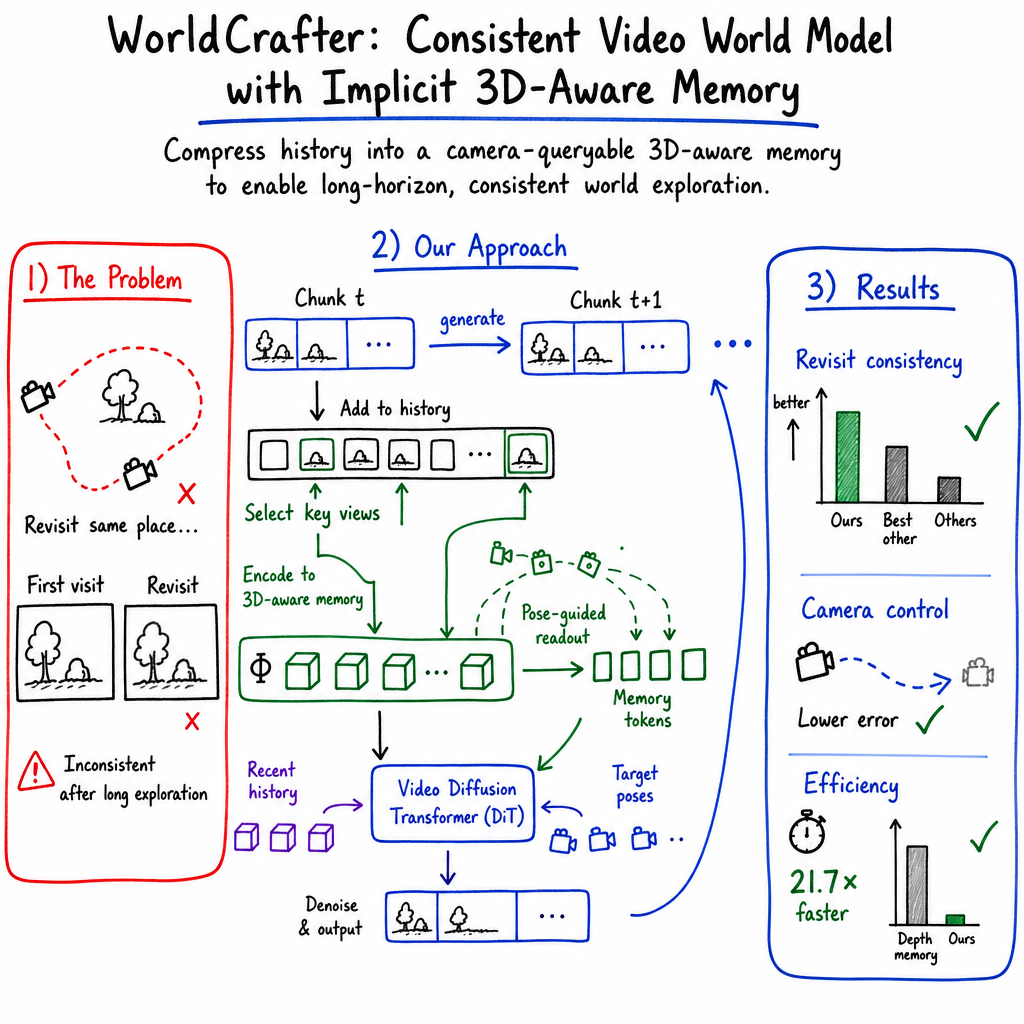
Abstract: Video world models enable interactive exploration of dynamic environments, yet struggle to respect prior observations over long horizons and across viewpoints. We present WorldCrafter, a video world model that learns a camera-queryable implicit 3D-aware memory for this purpose. The key insight is to let the requested viewpoint shape how multi-view evidence is compressed into the video generator's limited token budget. Trained jointly with the video generator, a memory encoder and pose-conditioned readout module integrate historical observations into a fixed set of target view-specific tokens before denoising, without explicit depth-based correspondences. By combining this memory with recent temporal context and few-step distillation, WorldCrafter enables streaming scene exploration from a single input image or text prompt. Experiments across static and dynamic scenes show substantial gains in long-horizon consistency and camera-control accuracy while preserving visual quality during minute-scale exploration.
Paper Prompts
Sign up for free to create and run prompts on this paper.
Top Community Prompts
Explain it Like I'm 14
1. What is this paper about?
This paper introduces WorldCrafter, an artificial intelligence system that can create and continue videos while allowing a user to control the camera.
For example, a user could give the system:
- One picture of a room,
- A text description such as “a small spaceship interior,” or
- A planned camera movement, such as “move forward, turn left, and look behind you.”
WorldCrafter then generates what the camera would see. Its main goal is to make the generated world stay consistent over a long period of time. If the camera looks away from a chair and later looks back, the chair should still look like the same chair, in the same place.
2. What questions are the researchers asking?
The researchers are mainly trying to solve three problems:
- How can an AI remember a scene for a long time? A normal video generator may remember only the most recent frames. After many camera movements, it may forget what earlier parts of the scene looked like.
- How can the AI keep the world consistent from different viewpoints? A room should still look like the same room when viewed from the front, side, or behind.
- How can the AI follow camera instructions accurately? If the user tells the camera to move in a certain direction, the generated video should follow that path instead of drifting somewhere else.
The researchers also want the system to work quickly enough for interactive use, rather than taking a very long time to generate every new video section.
3. How does WorldCrafter work?
A video generator with memory
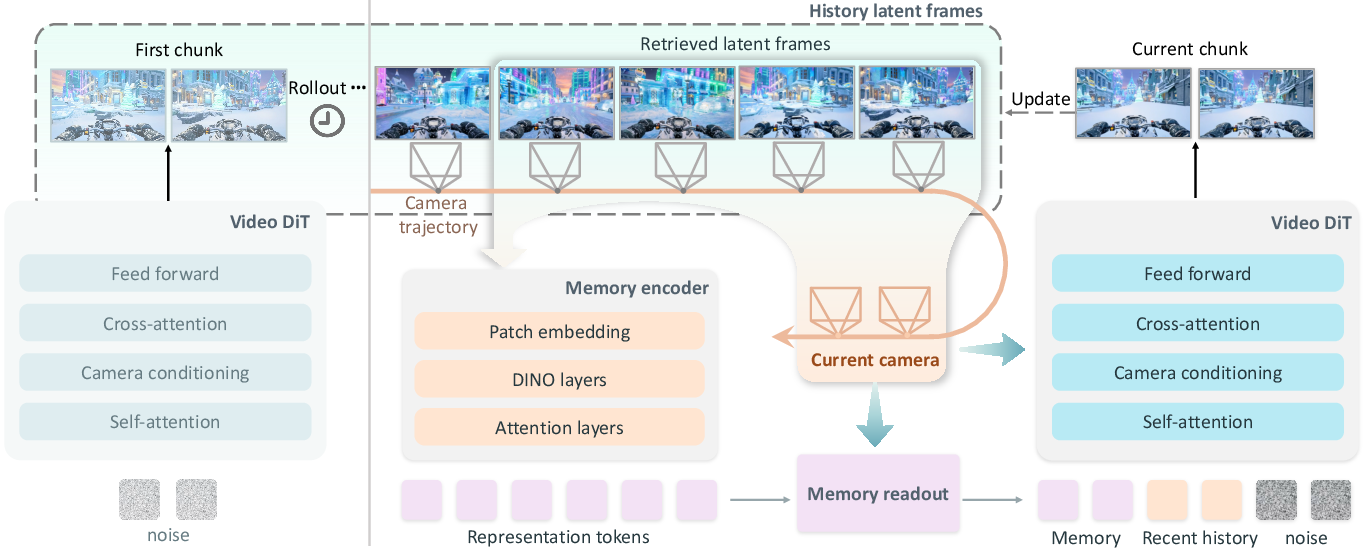
WorldCrafter generates videos in small pieces, called chunks. It creates one chunk, then uses that result to help create the next chunk.
This is similar to writing a story one paragraph at a time. The problem is that remembering every paragraph would eventually become too expensive for the computer. Instead, WorldCrafter creates a compact summary of the earlier video.
An “implicit 3D-aware memory”
The key idea is an implicit 3D-aware memory.
- Memory means information from earlier parts of the video.
- 3D-aware means the memory tries to understand how objects and places are arranged in space.
- Implicit means it stores this information as learned numbers inside the AI, rather than building a complete visible 3D model such as a detailed computer game map.
An everyday analogy is a person remembering a house. They may not carry around a full blueprint, but they still remember that the kitchen is beside the living room and that a window is behind the sofa.
WorldCrafter stores information about both:
- Appearance, such as colors, textures, and object details.
- Structure, such as where objects are located and how different views fit together.
Choosing useful past views
The system does not use every old frame. That would require too much computer power. Instead, it selects a small group of earlier views that together cover the parts of the scene relevant to the camera’s planned movement.
This is like choosing photographs for a travel scrapbook. Rather than selecting five nearly identical pictures of one street, it chooses pictures that show different streets and landmarks.
The paper calls this maximum-coverage history retrieval.
Camera-guided memory reading
WorldCrafter also uses the planned camera path when reading its memory. If the camera is about to look toward a doorway, the system gives extra attention to past information about that area.
This is called pose-guided readout:
- A camera “pose” describes its position and direction.
- A readout is the process of pulling useful information from memory.
The computer has only a limited number of memory “slots,” so camera guidance helps it spend those slots on the most useful information.
Diffusion and latent representations
WorldCrafter uses a type of video generator called a diffusion model. A diffusion model begins with noisy information and gradually removes the noise until a clear video appears. This is similar to slowly bringing a blurry photograph into focus.
To make this process faster, the system first compresses the video into a smaller hidden form called a latent representation. Instead of processing every individual pixel, it works with a shorter summary of the video. It later converts that summary back into normal video frames.
The researchers also create a faster version called WorldCrafter-fast. It uses a technique called distillation, where a smaller or faster model learns to imitate a slower, more careful model. The paper reports that this version can generate about 16 frames per second on four GPUs.
4. How was the system tested?
The researchers created a test set containing:
- 145 starting images,
- Both static scenes and scenes with moving objects,
- Five planned camera paths for each image,
- Videos lasting between 528 and 1,648 frames.
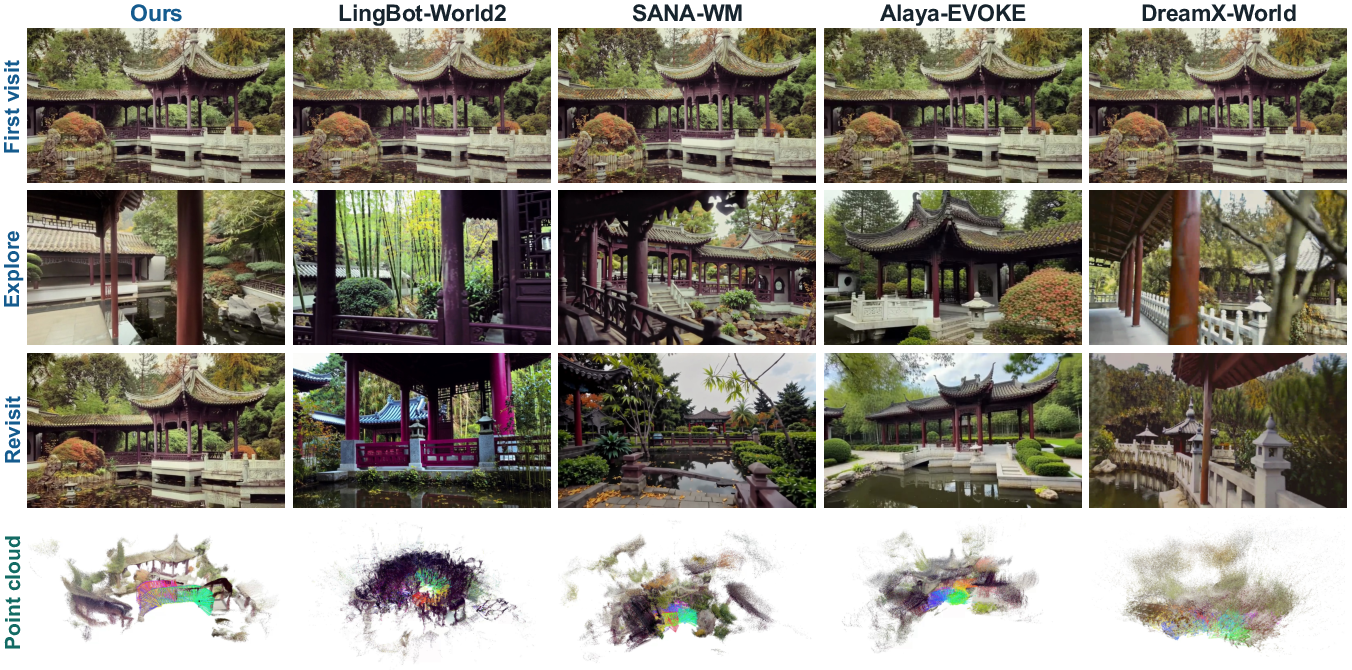
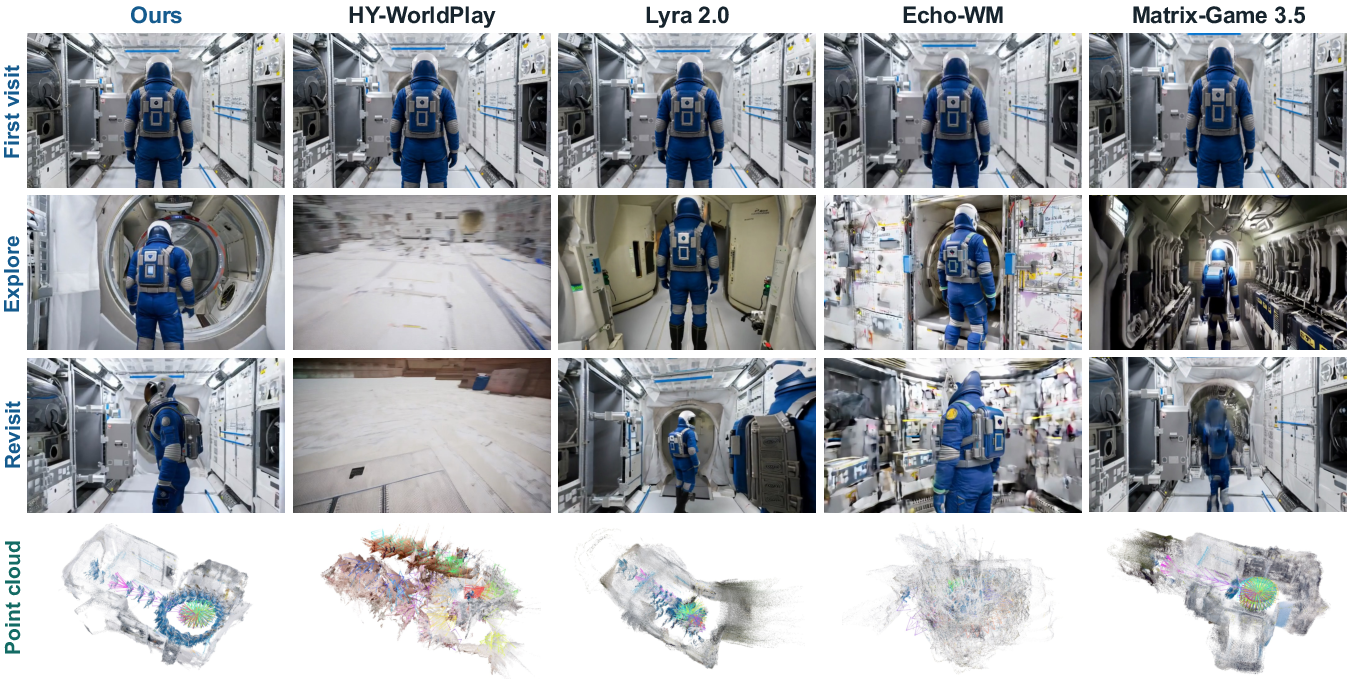
Some camera paths eventually returned to places that had already been seen. This allowed the researchers to test whether the system remembered earlier views.
WorldCrafter was compared with eight other recent video world models.
The researchers measured several things:
- Revisit consistency: Does a place look the same when the camera returns?
- Camera accuracy: Does the generated camera follow the requested path?
- Visual quality: Are the videos clear, smooth, and realistic?
Some technical measurements used in the paper include:
- PSNR and SSIM: Numbers that measure how similar two images are. Higher values are usually better.
- LPIPS: A measure of visual difference between images. Lower values are better.
- Rotation and translation error: How much the generated camera’s turning and movement differ from the requested movement.
- VBench: A collection of tests for video quality, such as object consistency, background consistency, smooth motion, and flickering.
5. What did the researchers find?
Better memory when revisiting places
WorldCrafter was much better at reproducing previously seen views.
For example, compared with the strong baseline Lyra 2.0:
- WorldCrafter reduced the LPIPS difference from 0.487 to 0.255.
- It increased PSNR from 14.050 to 18.016.
- Its SSIM score was also higher, meaning revisited images were more structurally similar.
The faster version, WorldCrafter-fast, performed even better on the main revisit measurements.
In simple terms, when the camera returned to an earlier location, WorldCrafter was more likely to show the same objects with similar shapes, colors, and positions.
More accurate camera movement
WorldCrafter had the lowest error on all three camera-control measurements tested.
This means it followed instructions such as “move forward,” “turn right,” or “look around the object” more accurately than the systems used for comparison.
WorldCrafter-fast was somewhat less accurate than the full model, but it still ranked near the top.
Strong overall video quality
WorldCrafter achieved the best overall VBench score among the systems tested, with a score of 81.910.
It performed especially well at:
- Keeping subjects consistent,
- Keeping backgrounds consistent,
- Producing smooth motion,
- Avoiding unwanted changes between frames,
- Maintaining overall video coherence.
This is important because improving memory can sometimes make videos less visually attractive or less natural. The results suggest that WorldCrafter improved long-term memory without seriously damaging video quality.
The design choices mattered
The researchers tested simpler versions of their system to see which parts were important. They found that performance became worse when they:
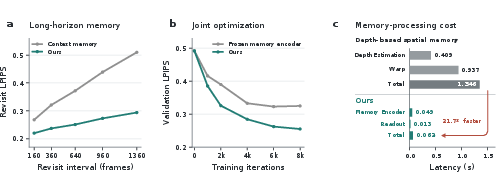
- Replaced the learned memory with only a few old video frames,
- Froze the memory encoder instead of training it together with the video generator,
- Removed camera guidance from the memory readout,
- Selected old views by simple similarity instead of selecting views that jointly covered more of the scene.
These tests support the paper’s main claim: the combination of 3D-aware memory, camera-guided reading, joint training, and broad view selection is useful.
Much faster memory processing
WorldCrafter does not need to estimate detailed depth maps or warp old images into new viewpoints. Its memory system processes old video information directly in its compressed form.
The researchers report that WorldCrafter’s memory processing took about 0.062 seconds per video chunk, compared with 1.346 seconds for the depth-based approach they tested. This is about 21.7 times faster for that part of the process.
6. Why is this research important?
WorldCrafter could help make interactive AI-generated worlds more believable. Possible uses include:
- Video games that create environments while the player explores,
- Virtual reality worlds,
- Training environments for robots,
- Interactive stories and films,
- Systems that turn text or images into explorable spaces.
The most important improvement is that the AI is less likely to “forget” its own world. Without memory, a building might change shape, a person’s appearance might change, or an object might disappear and reappear somewhere else. WorldCrafter is designed to reduce these problems.
However, the system is not perfect. The paper says that consistency can still fail during especially complicated or very long camera movements. Also, the system repeatedly processes older history, which adds some delay. The researchers suggest building a memory system that updates itself continuously as new video is generated.
Overall, the paper presents a promising step toward AI systems that can create large, interactive, and believable video worlds rather than only short video clips.
Knowledge Gaps
Knowledge gaps, limitations, and open questions
- Long-horizon robustness remains unresolved: Consistency degrades on particularly complex or extended camera trajectories, but the paper does not quantify the failure threshold or identify which trajectory properties—duration, viewpoint displacement, revisits, occlusion, or motion complexity—cause breakdowns.
- Memory re-encoding is computationally inefficient: The full selected history is re-encoded at every generation chunk, introducing additional latency; the paper does not evaluate how this cost scales with rollout length or compare it against an incremental memory-update strategy.
- Incremental memory updates are untested: The proposed autoregressive streaming memory encoder is suggested but not implemented, leaving open whether it can preserve the same revisit accuracy while avoiding cumulative compression errors and stale representations.
- Dynamic-scene memory behavior is insufficiently characterized: The method is evaluated on dynamic scenes, but it is unclear how the memory distinguishes persistent scene structure from moving objects, handles object deformation, or updates previously stored content after objects change position.
- Conflicting observations are not addressed: The paper does not specify how the memory handles contradictory history, such as a moved object, changed lighting, newly revealed geometry, or generated artifacts that conflict with earlier observations.
- Occlusion and disocclusion remain open problems: The max-coverage retrieval strategy selects views based on camera field of view, but the paper does not test whether this reliably captures surfaces hidden during earlier observations or prevents hallucination in newly visible regions.
- The implicit representation lacks interpretability and guarantees: Because the memory does not explicitly reconstruct geometry or establish depth-based correspondences, it remains unclear what spatial information is encoded, how accurately it is localized, and whether it provides any geometric consistency guarantees.
- Memory-token capacity is not systematically studied: The experiments fix the DiT memory budget to the equivalent of four full frames; the trade-off between token count, memory coverage, visual fidelity, camera control, and inference cost is not reported.
- The history-input limit is underexplored: The encoder uses a fixed number of selected history latents, but the paper does not examine how performance changes with different values of , scene size, trajectory length, or the number of revisited regions.
- Retrieval is tied to known camera trajectories: Max-coverage retrieval assumes access to the upcoming target trajectory. It is unclear how the method would operate under reactive, user-driven, uncertain, or partially specified camera actions.
- Retrieval quality under inaccurate camera estimates is unknown: The system depends on camera parameters for history selection, relative pose encoding, and pose-guided readout, but robustness to noisy, biased, or incomplete pose estimates is not evaluated.
- Camera-control evaluation relies on estimated trajectories: Camera accuracy is measured using trajectories recovered by VGGT-, rather than ground-truth poses from the generation process or an independent physical reference. Errors or biases in this estimator may affect the reported comparisons.
- Sim(3) alignment can obscure absolute control errors: Aligning estimated and target trajectories with Sim(3) removes global scale, rotation, and translation discrepancies, so the reported metrics do not establish whether the model preserves absolute scale, world-frame position, or metric camera motion.
- The benchmark may not represent real interactive use: The evaluation uses 145 initial images and five pre-defined trajectories per image, with many inputs sourced from curated or generated images. Generalization to user-generated trajectories, continuous feedback, irregular actions, and unconstrained real-world environments is not demonstrated.
- Benchmark diversity is limited for broad world modeling claims: The paper does not report performance by scene type, object category, motion pattern, lighting condition, or camera-motion regime, making it difficult to determine where the method generalizes or fails.
- Text-only scene generation is not quantitatively evaluated: Although the teaser presents generation from text descriptions alone, the experiments focus on image-conditioned inputs. The quality, consistency, and camera controllability of text-initialized exploration remain unmeasured.
- The contribution of pretrained LagerNVS features is not isolated: The paper compares frozen and jointly optimized memory encoders but does not compare LagerNVS initialization against alternative pretrained representations, random initialization, or representations trained specifically for video-world-model memory.
- Joint training may introduce data or optimization confounds: The reported gains from joint optimization are based on a single training schedule and iteration budget; it is unclear whether improvements arise from representation co-adaptation, additional optimization of the DiT, or differences in effective training exposure.
- The role of appearance versus geometry is not disentangled: The paper argues that appearance-preserving 3D representations are preferable to geometry-oriented features, but it does not provide experiments that separately measure geometric accuracy and appearance fidelity.
- Generated-history contamination is not analyzed: Subsequent memory inputs consist of generated frames, whose artifacts may accumulate over time. The paper does not quantify how errors in generated history propagate through memory writing and affect later revisits.
- Error accumulation across repeated revisits is unclear: Results report matched first-visit and revisit frames, but do not examine whether repeated departures and returns to the same location progressively alter scene identity or appearance.
- No uncertainty or confidence mechanism is provided: The model does not indicate when memory information is unreliable, missing, or inconsistent with recent context, leaving open how a downstream agent or user could detect hallucinated scene content.
- Real-time claims are hardware- and configuration-dependent: The reported 16 fps speed is measured on a four-GPU system, but the paper does not provide end-to-end latency, memory consumption, scaling behavior, or performance on more practical single-GPU or edge-device configurations.
- Distillation effects are only partially characterized: WorldCrafter-fast has different memory and camera-control performance from the base model, but the paper does not isolate how few-step distillation affects long-horizon memory retention, rare camera motions, dynamic-object consistency, or failure rates.
- The hybrid distillation strategy lacks broader validation: The use of separate low-noise and high-noise models is motivated by a trade-off between texture quality and subject following, but the paper does not test alternative data mixtures, distillation objectives, or whether the strategy transfers to other base models.
- Perceptual metrics may not fully measure world consistency: LPIPS, PSNR, SSIM, MEt3R, and VBench assess image similarity and visual quality, but the evaluation does not directly measure object identity, 3D structural correctness, physical plausibility, action-conditioned state transitions, or consistency under unseen viewpoints.
- The relationship between camera accuracy and visual consistency is not established: The paper reports both metrics but does not determine whether improved camera control causes better revisits, whether memory quality independently improves control, or how the two objectives trade off under different memory budgets.
- Physical and causal world dynamics are largely unexplored: The model generates visually coherent videos, but the paper does not evaluate whether objects obey persistent physical rules, respond consistently to interventions, or maintain state under actions beyond camera movement.
- The method is limited to camera-based interaction: The experiments do not test non-camera actions such as object manipulation, locomotion, collisions, or changes to the environment, leaving its usefulness as a general interactive world model uncertain.
- Training-data dependence and domain shift are not evaluated: The model uses OSP, DL3DV, and synthetic MIND data with estimated poses and captions, but robustness to domains absent from these datasets—such as surveillance footage, indoor robotics, medical scenes, or unusual optics—is unknown.
- Potential biases from automatically generated annotations are unexamined: Depth Anything 3, Qwen2.5-VL captions, and estimated camera trajectories provide key training signals, yet the paper does not analyze annotation noise, systematic biases, or their effect on camera control and memory quality.
- A broader user-centered evaluation is missing: The paper does not assess whether users can reliably specify trajectories, perceive improvements in consistency, or interact effectively with the system under real-time conditions.
Practical Applications
Immediate Applications
- Interactive virtual walkthroughs and spatial storytelling — media, gaming, real estate
- Use WorldCrafter to generate camera-controlled explorations of an environment from a single image or text prompt, while preserving scene appearance when the camera revisits earlier locations.
- Potential products include lightweight virtual-tour systems, interactive film previews, game prototyping tools, and browser-based 3D scene explorers.
- The distilled variant reports streaming generation at approximately 16 fps on four GPUs, making demonstrations and controlled deployments feasible now.
- Dependencies: sufficient GPU capacity, reliable camera-pose inputs, acceptable visual latency, and environments that do not require exact physical geometry or safety-critical accuracy.
- Game-level prototyping and interactive environment authoring — gaming and software development
- Game designers can specify camera trajectories and text descriptions to rapidly prototype explorable scenes before building full 3D assets.
- A practical workflow would use WorldCrafter to test level layouts, subject-following shots, environmental transitions, and revisit behavior, then replace generated content with conventional assets during production.
- The implicit memory mechanism is particularly useful for detecting whether a generated scene remains visually coherent after long camera trajectories.
- Dependencies: generated videos are not guaranteed to be physically simulated, editable at the object level, or deterministic across runs; integration with game engines would require APIs for camera control and asset export.
- Virtual cinematography and previsualization — film, advertising, and animation
- Directors and cinematographers can explore alternative camera paths from a reference image or textual scene description, including tracking shots, returns to earlier viewpoints, and subject-following movements.
- A production tool could combine a storyboard, target camera poses, and generated video previews to evaluate shot composition before filming or rendering.
- Improved revisit consistency reduces one common failure mode in generative previsualization: a location or character changing appearance when the virtual camera returns.
- Dependencies: the model may still accumulate errors on very long or complex trajectories, and generated content would require human review for continuity, identity, lighting, and copyright compliance.
- Synthetic data generation for computer-vision research — academia, robotics, and autonomous systems
- Researchers can generate controlled videos with specified camera trajectories, static or dynamic scenes, and long-horizon revisits for testing tracking, pose estimation, visual localization, and video-consistency algorithms.
- The model can provide inexpensive variations of camera motion and scene descriptions, complementing real datasets rather than replacing them.
- Its camera-conditioned generation and implicit spatial memory make it suitable for creating sequences in which the same region is observed from multiple viewpoints.
- Dependencies: synthetic-to-real transfer must be validated; estimated camera trajectories and generated geometry may contain artifacts; datasets should be annotated with provenance and used alongside real-world benchmarks.
- Evaluation and regression testing for generative video systems — software engineering and AI research
- Teams can use long closed-loop camera trajectories as a repeatable test suite for measuring revisit consistency, camera-control accuracy, temporal flicker, and subject persistence.
- A practical evaluation workflow could compare first-visit and revisit frames using metrics such as LPIPS, PSNR, SSIM, and trajectory errors, following the paper’s benchmark design.
- This can support model-version regression testing, especially for systems that claim persistent scene memory.
- Dependencies: metric scores do not fully capture semantic correctness or physical plausibility; camera-pose recovery itself may introduce evaluation error.
- Interactive educational demonstrations — education and training
- Teachers and developers can create explorable visualizations of historical sites, biological environments, engineering spaces, or fictional worlds from images and text.
- Students could follow prescribed camera trajectories, revisit locations, and compare how viewpoint changes affect visual understanding.
- The technology is most immediately useful as a visualization and engagement layer rather than as a source of authoritative instructional content.
- Dependencies: generated scenes must be fact-checked, clearly labeled as synthetic, and reviewed for accessibility, cultural accuracy, and misleading visual details.
- Rapid visualization for architecture, interior design, and property marketing — construction and real estate
- A reference image or preliminary design can be converted into a navigable visual preview with user-controlled camera motion.
- Designers could inspect proposed viewpoints and revisit rooms or building exteriors without requiring a complete CAD or photogrammetry pipeline.
- The latent-memory approach may reduce the processing overhead associated with explicit depth estimation and geometric warping; the paper reports a 21.7× lower measured memory-processing cost than the compared depth-based pipeline under its test setup.
- Dependencies: this is suitable for visual communication, not structural verification, code compliance, quantity estimation, or construction decisions; metric geometry and dimensions would require a separate validated system.
- Personalized visual exploration from photographs — consumer and daily-life applications
- Users could turn a photograph into a short interactive visual experience, such as exploring a travel scene, room, landscape, or family event from alternative camera paths.
- Text prompts could be used to create imaginative extensions or scene-based visualizations for games, social media, and creative hobbies.
- Dependencies: outputs may invent unseen content, alter people or objects, and create privacy or consent risks; interfaces should distinguish observed content from generated extrapolation and avoid presenting hallucinated details as photographs.
- Research infrastructure for memory-efficient video models — academia and industrial R&D
- The architecture provides a practical baseline for comparing context memory, explicit spatial memory, and implicit 3D-aware memory under a fixed token budget.
- Researchers can reuse the pose-guided readout, complementary field-of-view retrieval, and joint memory–generator training strategy in other video-generation systems.
- The method is particularly relevant when full-history attention is too costly but simple frame retrieval loses spatial coverage.
- Dependencies: reproducing the results requires specialized video datasets, camera-pose annotations, substantial multi-GPU training, and compatible pretrained video and 3D representation encoders.
Long-Term Applications
- Embodied-agent simulation and robot navigation — robotics
- A future system could provide robots with a visual predictive model for imagining observations along candidate camera or motion trajectories before acting.
- Persistent implicit memory could help an agent recognize previously seen rooms, objects, or landmarks after leaving and returning from a different viewpoint.
- Possible workflows include simulated exploration, active-vision planning, camera placement, and training policies for search and inspection tasks.
- Dependencies: WorldCrafter currently controls a camera trajectory rather than a complete robot body or action space. Deployment would require calibrated dynamics, collision and contact modeling, uncertainty estimates, real-time latency guarantees, and robust behavior under lighting and object changes.
- Autonomous inspection and digital twins — industrial maintenance, energy, and infrastructure
- The system could support long-horizon visual inspection of machinery, pipelines, buildings, wind turbines, or power facilities by generating or completing views along planned trajectories.
- An eventual product might combine real sensor observations with a persistent learned scene memory to identify changed or previously inspected regions.
- Its ability to preserve appearance across revisits could support visual comparison over time.
- Dependencies: safety-critical inspection requires metrically accurate geometry, calibrated sensors, uncertainty quantification, and validated change detection. The current model can generate plausible but incorrect content and therefore should not be used alone for maintenance decisions.
- Medical and surgical visualization — healthcare
- In the long term, related models could support exploration of patient-specific scans, endoscopic imagery, or surgical environments from controlled viewpoints.
- Potential uses include preoperative visualization, clinician training, and simulation of camera motion in minimally invasive procedures.
- Dependencies: the current evidence does not establish medical accuracy, anatomical fidelity, or clinical safety. Translation would require modality-specific training, strict validation, patient privacy protection, traceability to source data, and regulatory approval. Generated views should not be treated as diagnostic evidence without independent confirmation.
- High-fidelity virtual reality and augmented reality environments — XR and training
- WorldCrafter-like models could generate persistent, navigable environments that remain coherent as a user moves, looks around, or revisits a location.
- Applications include emergency-response rehearsal, military or industrial training, museum exhibits, remote tourism, and collaborative virtual workspaces.
- Pose-guided memory readout is well suited to allocating limited computation to the user’s upcoming viewpoint.
- Dependencies: immersive applications need substantially lower latency, stable stereoscopic or multi-view consistency, spatial audio, interaction with objects, and reliable handling of occlusions and dynamic entities.
- Policy and urban-planning scenario exploration — government and public-sector planning
- Planners could create visual scenarios for proposed streetscapes, public spaces, disaster routes, or infrastructure projects and inspect them along standardized camera paths.
- Policymakers could use such tools to communicate possible changes to the public and compare visual consequences of alternative designs.
- Dependencies: generated scenes must not be presented as accurate forecasts without validated geographic, demographic, and physical models. Public-facing use requires transparent labeling, reproducible inputs, accessibility, and safeguards against persuasive but misleading visualizations.
- Long-horizon interactive storytelling and persistent characters — entertainment
- Future systems could maintain the appearance, location, and behavior of characters and objects across branching narratives, enabling viewers to control the camera or explore story worlds.
- WorldCrafter’s dynamic-scene support and subject consistency could form part of an interactive film or personalized narrative engine.
- Dependencies: narrative state, character identity, dialogue, causal actions, and copyright-controlled assets would require additional systems. Visual consistency alone does not provide plot consistency or reliable world physics.
- Incremental streaming memory for large-scale world models — foundational AI
- The paper identifies autoregressive memory updating as a direct next step: instead of re-encoding selected history at every chunk, a streaming encoder could incrementally incorporate each new observation.
- This could reduce latency and memory-processing costs, enabling longer sessions, more users, and deployment on fewer GPUs.
- A mature system could maintain multiple memory levels: recent temporal context, persistent scene memory, and task-specific semantic memory.
- Dependencies: incremental updates must avoid drift, catastrophic forgetting, duplicate information, and error accumulation. Research is needed on memory confidence, correction after erroneous generations, dynamic-object separation, and recovery after inconsistent observations.
- Physics-aware and action-conditioned world models — robotics, games, and simulation
- Combining WorldCrafter’s appearance-preserving memory with learned object dynamics could produce simulators in which users or agents manipulate objects and revisit the consequences later.
- Potential products include training environments for manipulation robots, interactive game worlds, and engineering design simulators.
- Dependencies: the current method primarily predicts visually plausible video conditioned on camera poses; it does not establish physical laws, object permanence under intervention, collision handling, or causal action modeling.
- Data-efficient 3D reconstruction and scene capture — mapping and spatial computing
- The implicit representation could eventually be used as a compact scene memory for view synthesis or approximate reconstruction from sparse observations, especially when explicit depth estimation is expensive or unreliable.
- Mobile devices could capture a limited set of frames and later generate exploratory views of the environment.
- Dependencies: the paper emphasizes generation consistency rather than metric reconstruction. Applications requiring accurate measurements, navigation-grade maps, or legally reliable records would need explicit geometric supervision and quantitative reconstruction validation.
Glossary
- 3D inductive bias: A built-in modeling preference that encourages a system to represent information according to three-dimensional structure. “our memory encoder and readout inherit a learned 3D inductive bias”
- 3D self-attention: An attention operation that relates tokens across spatial and temporal dimensions. “applies 3D self-attention”
- Autoregressive generation: Sequential generation in which each new output depends on previously generated outputs. “camera-conditioned autoregressive video generation”
- Camera intrinsics: Parameters describing a camera’s internal geometry, such as focal length and principal point. “The target trajectory specifies a camera-to-world pose and camera intrinsics for each frame.”
- Camera-to-world pose: A transformation specifying a camera’s position and orientation in world coordinates. “The target trajectory specifies a camera-to-world pose and camera intrinsics for each frame.”
- Conditional flow matching: A generative-training method that learns a vector field transporting noise distributions toward data distributions under conditioning information. “The denoiser is trained with conditional flow matching”
- Context memory: A memory mechanism that stores historical frames, latent tokens, or attention features for later reuse. “Context memory retains historical frames”
- Denoising: The iterative removal of noise from a corrupted representation to produce a generated sample. “before denoising”
- Diffusion Transformer (DiT): A Transformer architecture used as the denoising network in diffusion-based generation. “video diffusion transformer (DiT)”
- Distribution matching distillation: A distillation technique that trains a smaller or faster model to reproduce the output distribution of a larger model. “apply distribution matching distillation”
- Dynamic scene: A visual environment containing objects or elements that change position or appearance over time. “Qualitative long-horizon revisit comparison in a dynamic scene.”
- Explicit depth estimation: The computation of depth values for image pixels using a dedicated geometric estimator. “without requiring explicit depth estimation or warping.”
- Field of view (FoV): The portion of a scene visible through a camera. “whose joint field of view (FoV) maximizes coverage of the target region”
- Flow matching: A generative-learning objective that trains a model to predict a velocity field along a chosen path between noise and data. “Flow Matching for Generative Modeling”
- FramePack: A video-generation strategy that organizes compressed historical frames into a context window. “a FramePack-style clean history”
- Geometric warping: Transforming image or feature coordinates according to estimated scene geometry or camera motion. “condition generation through geometric warping.”
- Geometry-aware representation: A learned representation that explicitly incorporates information about spatial or three-dimensional structure. “Geometry-aware approaches draw on pretrained geometry estimators”
- History latent frame: A compressed latent representation of a previously generated video frame. “The encoder produces tokens of dimension per history latent frame.”
- Implicit 3D-aware memory: A learned memory representation that captures three-dimensional scene information without explicitly reconstructing a 3D model. “We introduce an implicit 3D-aware memory mechanism for video world models.”
- Implicit memory: A memory system that stores past observations in learned representations rather than directly retaining original observations. “Implicit memory encodes history into learned representations”
- Joint field-of-view coverage: The combined amount of a target region visible across multiple selected camera views. “whose joint field of view (FoV) maximizes coverage of the target region”
- Joint optimization: Training multiple components simultaneously so that their representations and objectives adapt to one another. “We jointly train this module with the memory encoder, video DiT, and camera conditioning branch”
- Latent diffusion: Diffusion-based generation performed in a compressed representation space rather than directly on pixels. “Latent video diffusion.”
- Latent patch embedding: A layer that converts patches of latent representations into tokens for a neural network. “adding a new patch embedding layer to map each latent frame directly into its representation space.”
- Long-horizon exploration: Interaction or generation over an extended sequence of time steps or camera movements. “consistent long-horizon exploration”
- Metric-scale camera pose: A camera pose whose translation is represented using physically meaningful scale rather than an arbitrary normalization. “metric-scale camera pose annotations”
- Memory encoder: A neural module that converts historical observations into a compact memory representation. “we learn a memory encoder to map history latent frames into a compact 3D-aware representation”
- Memory readout: A module that extracts a fixed number of usable tokens from a larger stored representation. “The written representation should then be read out as a fixed-size memory ”
- Novel-view synthesis: Generating an image of a scene from a viewpoint not present in the input observations. “Representative methods perform this transformation via novel view synthesis”
- Patchifies: Divides a spatial or spatiotemporal representation into smaller patches that are converted into tokens. “the denoiser, which patchifies into video tokens”
- Pose-conditioned readout: Memory extraction guided by the camera poses requested for the upcoming generated content. “pose-conditioned memory readout module”
- Pose-free readout: Memory extraction that does not use the upcoming target camera trajectory. “The first is pose-free readout”
- Point-cloud reconstruction: Representing a scene as a collection of points with spatial coordinates and associated visual attributes. “point clouds reconstructed from the generated videos”
- Pyramid denoising: A coarse-to-fine denoising process that operates across multiple spatial resolutions. “we adopt a coarse-to-fine pyramid denoising scheme”
- Recurrent memory: A memory representation updated incrementally as new observations arrive. “Existing methods update memory recurrently alongside local context”
- Relative-camera attention: An attention mechanism that uses geometric relationships between camera poses to connect tokens. “retrieves them through relative-camera attention inside the denoising network.”
- Rollout: A sequential generation process in which a model repeatedly produces future chunks using its own prior outputs. “At a generic rollout step”
- Rollout-aware training: Training that accounts for the model’s behavior when repeatedly generating its own future inputs. “rollout-aware training improve sampling efficiency and mitigate error accumulation”
- Self-attention: An attention mechanism in which tokens compute relationships with other tokens within the same sequence. “The resulting tokens condition the DiT directly through self-attention”
- Sim(3) alignment: Alignment under the three-dimensional similarity transformation group, including rotation, translation, and uniform scaling. “aligned using Umeyama Sim(3) alignment”
- Sliding window: A fixed-size sequence that moves forward as new items are appended and older items are discarded. “the sliding window of is updated with .”
- Spatiotemporal latent: A compressed representation encoding both spatial and temporal video information. “maps it to a spatiotemporal latent”
- Spatial memory: A memory representation that preserves or reconstructs scene information in relation to spatial viewpoints. “Spatial memory instead transforms history frames into views specified by target camera poses”
- Streaming inference: Generating outputs continuously as a sequence rather than waiting for an entire result to be produced. “real-time streaming inference”
- Subject-following ability: The capacity to maintain camera or generation focus on a moving object or subject. “improves the model's subject-following ability”
- Temporal context: Information from preceding video frames used to maintain continuity over time. “The memory supplies historical scene information, while recent context supports the continuation of visible motion.”
- Temporal flickering: Unwanted frame-to-frame changes in appearance or brightness in generated video. “Temporal Flickering (TF)”
- Token budget: The fixed number of tokens that a model can allocate to a particular input or memory representation. “under a fixed token budget”
- Variational autoencoder (VAE): A generative neural architecture that maps data to a probabilistic latent space and reconstructs it from that space. “A video variational autoencoder (VAE) maps it to a spatiotemporal latent”
- Vector field: A function assigning a direction and magnitude to every point in a space, used here to describe generative transport dynamics. “The denoiser is trained with conditional flow matching”
- Viewpoint-conditioned generation: Generation controlled by a specified camera position or viewing direction. “The key insight is to let the requested viewpoint shape how multi-view evidence is compressed”
- World model: A model that simulates an environment and predicts observations resulting from actions or changes in state. “Video world models enable interactive exploration of dynamic environments”

