Neural Cellular Automata Learn General Features in their Hidden Channels
Abstract: Modern deep learning models achieve impressive generalization through over-parameterization, but this paradigm often struggles with overfitting and memorization in few-shot regimes. Neural Cellular Automata (NCAs) offer a highly parameter-efficient alternative, yet research has focused primarily on their output, leaving the role of their internal hidden channels largely unexplored. In this paper, we investigate the internal dynamics of NCA hidden channels and introduce a novel transfer-learning mechanism that injects a pretrained teacher's hidden states into a student model to guide early optimization. Evaluated on few-shot and scale-variant MNIST benchmarks, NCAs outperform comparable recurrent and feed-forward architectures, demonstrating superior generalization with a minimal parameter budget (~9,800 parameters). Mechanistic analysis reveals that the hidden channels decouple feature extraction from uniform classification consensus by absorbing morphological complexity and converging to mutually orthogonal states. Furthermore, we demonstrate that these hidden channels capture general, scale-invariant topological primitives rather than class-specific templates. This allows a student model to achieve strong few-shot performance on unseen classes using features transferred from a teacher trained only on a subset of digits (0-5). Our results highlight the potential of utilizing hidden-state dynamics as a robust, decentralized computational substrate for parameter-efficient transfer learning
Paper Prompts
Sign up for free to create and run prompts on this paper.
Top Community Prompts
Explain it Like I'm 14
1. What is this paper about?
This paper studies Neural Cellular Automata (NCAs), a type of artificial intelligence inspired by how cells in a living organism work together.
Instead of one large computer program making decisions all at once, an NCA is made of many small “cells” arranged in a grid. Each cell looks at nearby cells and updates its information repeatedly. Over time, the whole grid can recognize an image, such as a handwritten digit.
The researchers are especially interested in the NCA’s hidden channels. These are internal information spaces that are not directly shown in the final answer. They are similar to the hidden steps a person uses when solving a problem.
The main idea is that these hidden channels may learn useful general features—such as edges, bends, and intersections—rather than simply memorizing particular examples.
2. What questions did the researchers ask?
The paper focuses on several main questions:
- Can a very small NCA learn to recognize digits when it sees only a few examples?
- Does it generalize better than other small machine-learning models?
- What exactly happens inside the NCA’s hidden channels?
- Can hidden information from a trained NCA help another NCA learn more quickly?
- Can features learned from some digits, such as 0–5, help recognize completely different digits, such as 6–9?
- Do the hidden channels learn general shapes rather than memorizing specific digit images?
This type of learning from very few examples is called few-shot learning. For example, a one-shot task might give the model only one example of each digit.
3. How did the researchers do the experiments?
Neural Cellular Automata
The NCA receives an image of a handwritten digit. Its grid is made up of many small locations, or “cells.” Each cell communicates only with nearby cells, much like people passing messages to their neighbors.
The same small set of rules is used across the entire grid. The NCA repeats these rules many times, allowing information to spread and form a useful internal pattern.
The model had about 9,800 adjustable numbers, called parameters. These numbers control how the model processes information. This is a very small number compared with many modern AI systems.
Comparing models
The researchers compared the NCA with other models that had roughly the same number of parameters. They trained the models using different amounts of data:
- 1 example per digit
- 5 examples per digit
- 10 examples per digit
- 25 examples per digit
- 50 examples per digit
- 100 examples per digit
They then tested the models on the full MNIST test set. MNIST is a collection of small, black-and-white images of handwritten digits from 0 to 9.
The researchers also made the digits smaller and placed them back inside a normal-sized image. This tested whether the models could recognize a digit when its size changed.
Each experiment was repeated using 100 different random starting points. This helped make the results more reliable.
Transferring hidden information
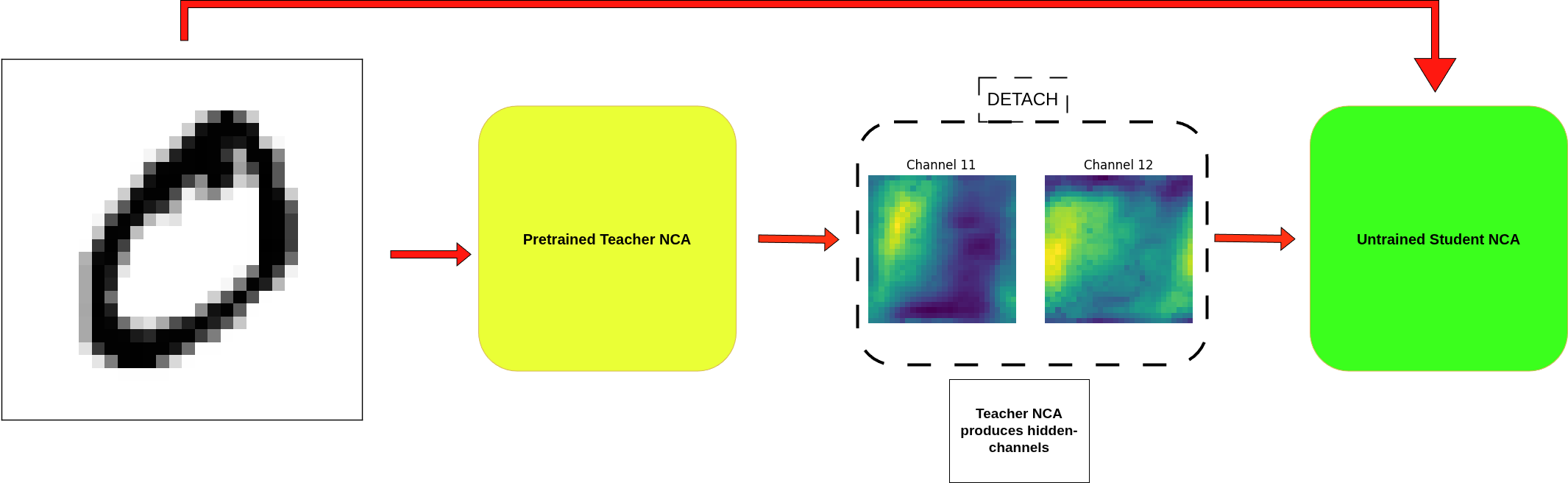
The researchers also created two NCAs:
- A teacher NCA, which was already trained.
- A student NCA, which needed to learn.
The teacher’s hidden channels were copied and given to the student. This is different from traditional transfer learning, where the weights of a trained model are copied or adjusted.
An analogy is teaching someone to draw. Instead of giving them your entire brain or your exact drawing instructions, you give them useful sketches showing important shapes and lines. The student can then use those sketches as a starting point.
The researchers tried several versions:
- The student received hidden information during part of training.
- The student received it during all of training and testing.
- The teacher had only learned digits 0–5, while the student had to recognize all digits, including 6–9.
Studying the hidden channels
The researchers also measured how the hidden channels changed over time. They examined:
- How much the information varied across different parts of the image.
- Whether different channels learned different jobs.
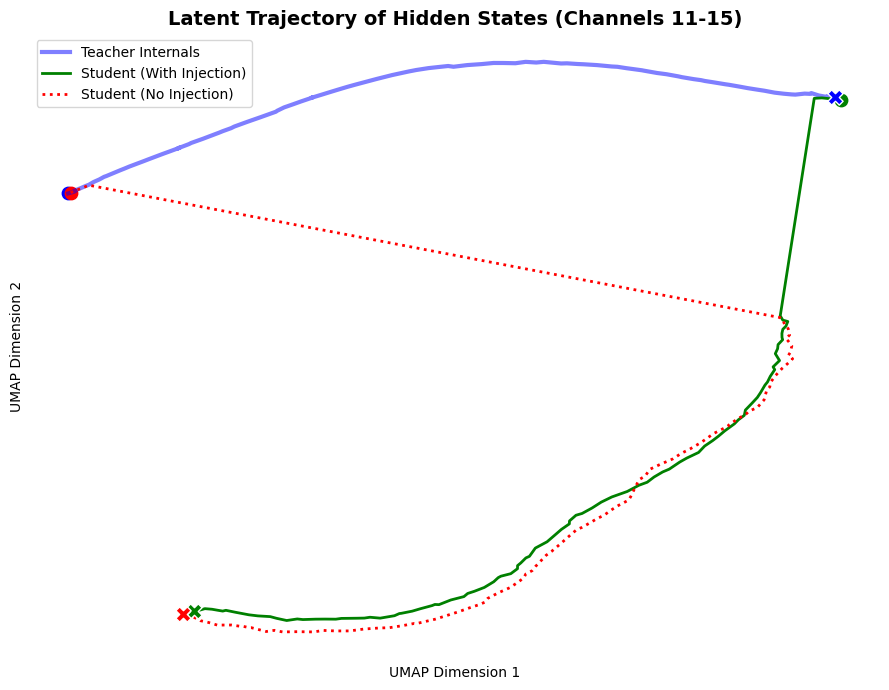
- How the internal state changed as the NCA processed an image.
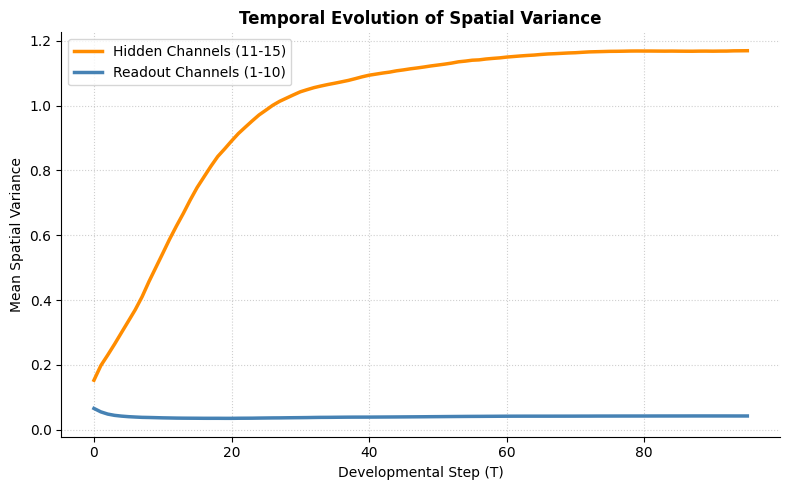
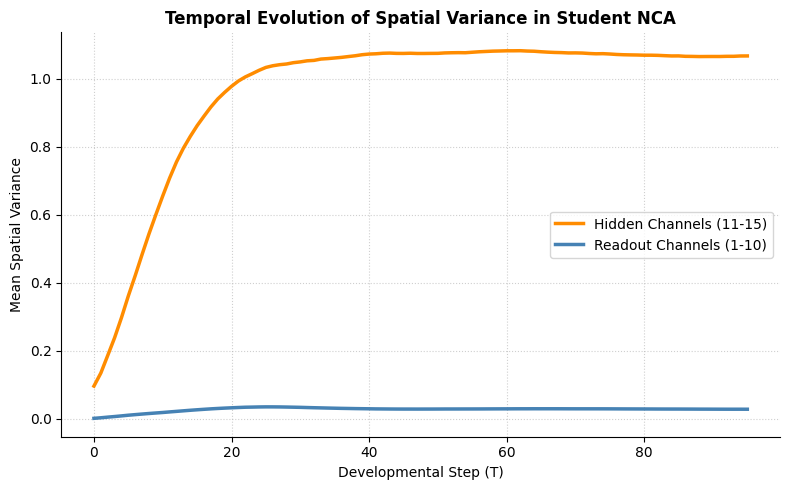
They used mathematical tools to measure these changes. For example, spatial variance measures how different the information is from one location in the grid to another. A high value means the channel contains a detailed pattern across the image.
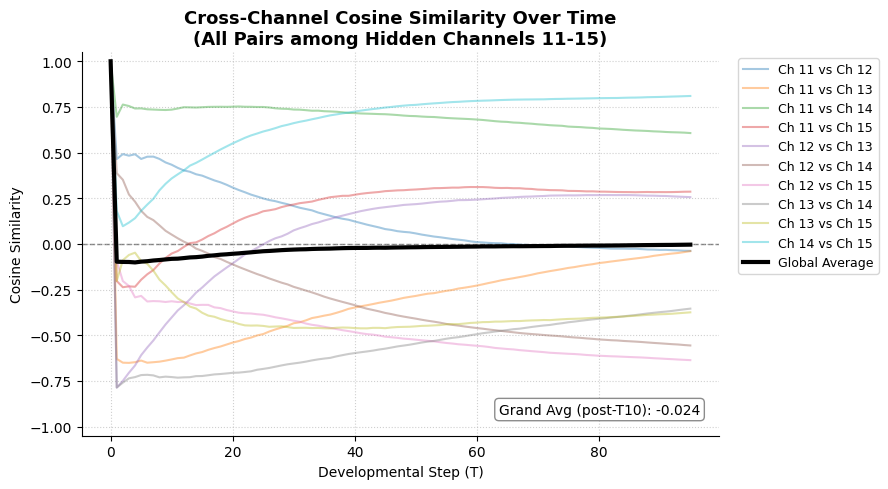
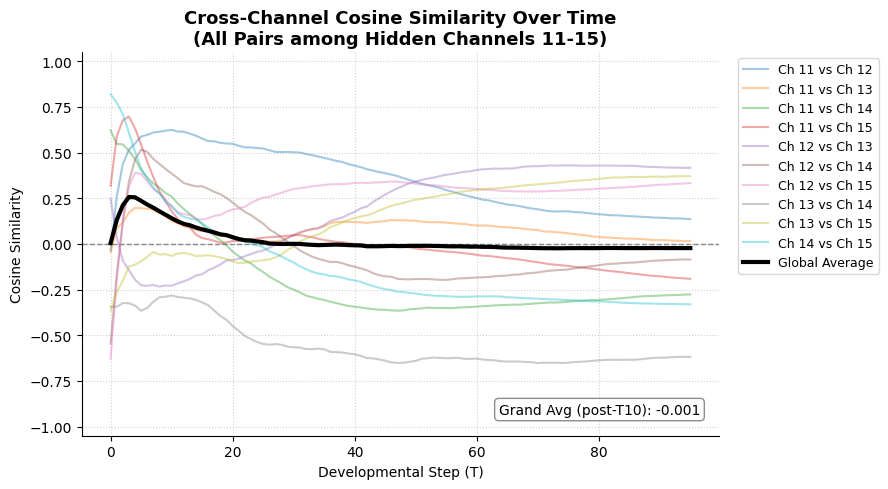
They also used cosine similarity, which measures how alike two channels are. If the similarity is close to zero, the channels are doing relatively different things.
4. What did they find?
The NCA learned well from very little data
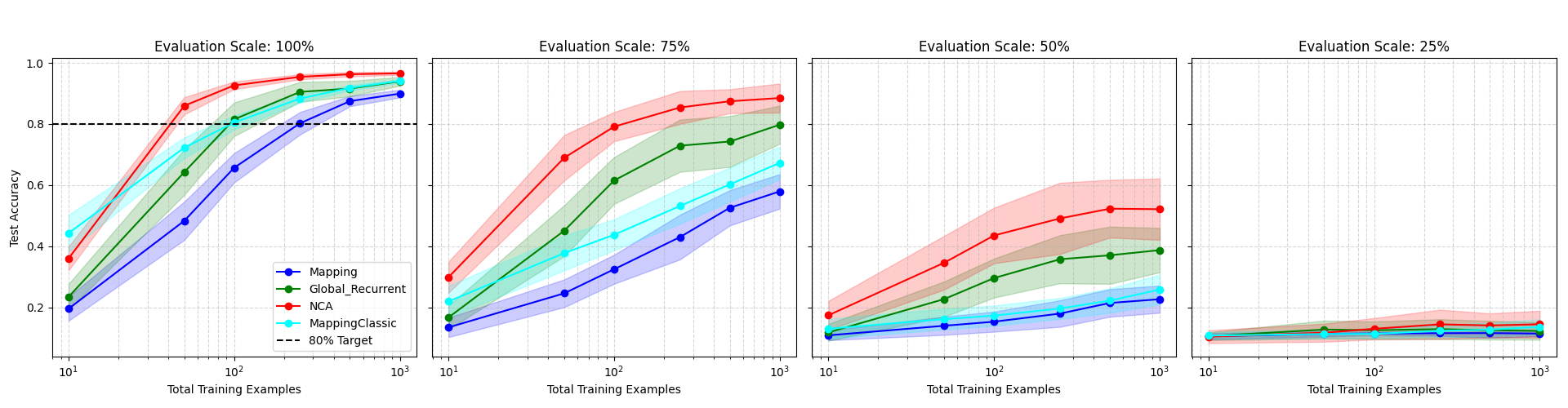
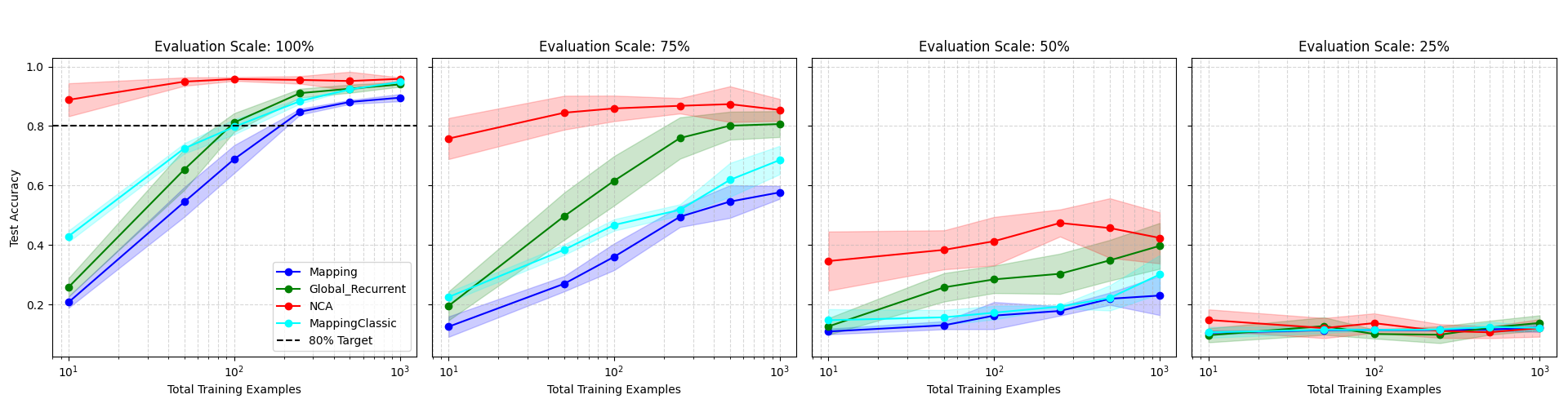
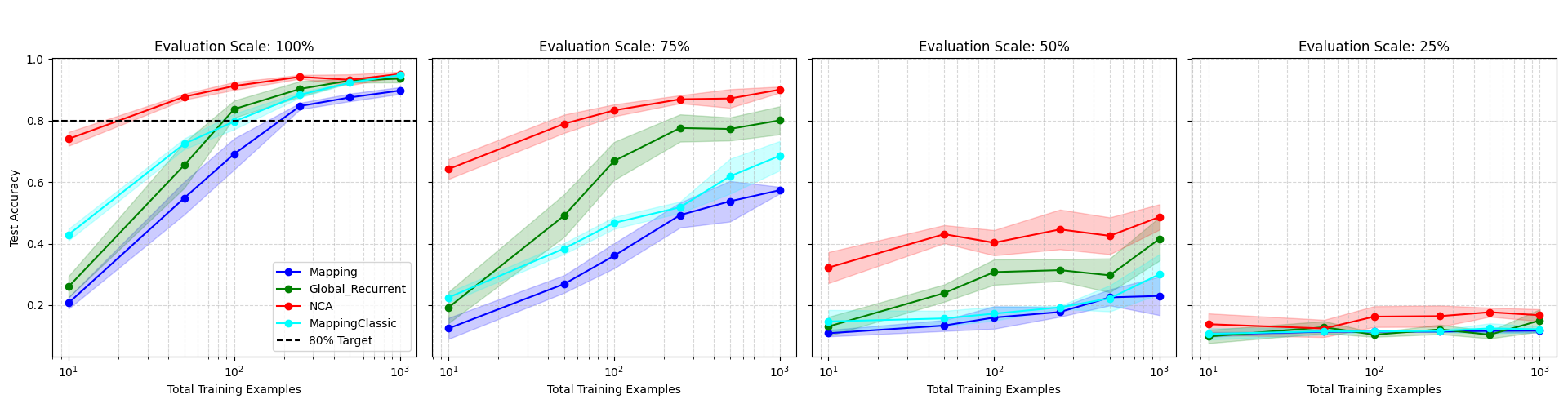
The NCA generally performed better than the other small models when it had only a few training examples.
It reached about 80% accuracy after roughly 4 examples per digit. The other models usually needed around 10 or 11 examples per digit to reach a similar level.
The NCA also performed well when the digits were made smaller. This suggests that it learned general shapes instead of memorizing the exact size and position of the training images.
At the smallest image size, its advantage was no longer clearly different from the other models.
The hidden channels learned useful visual features
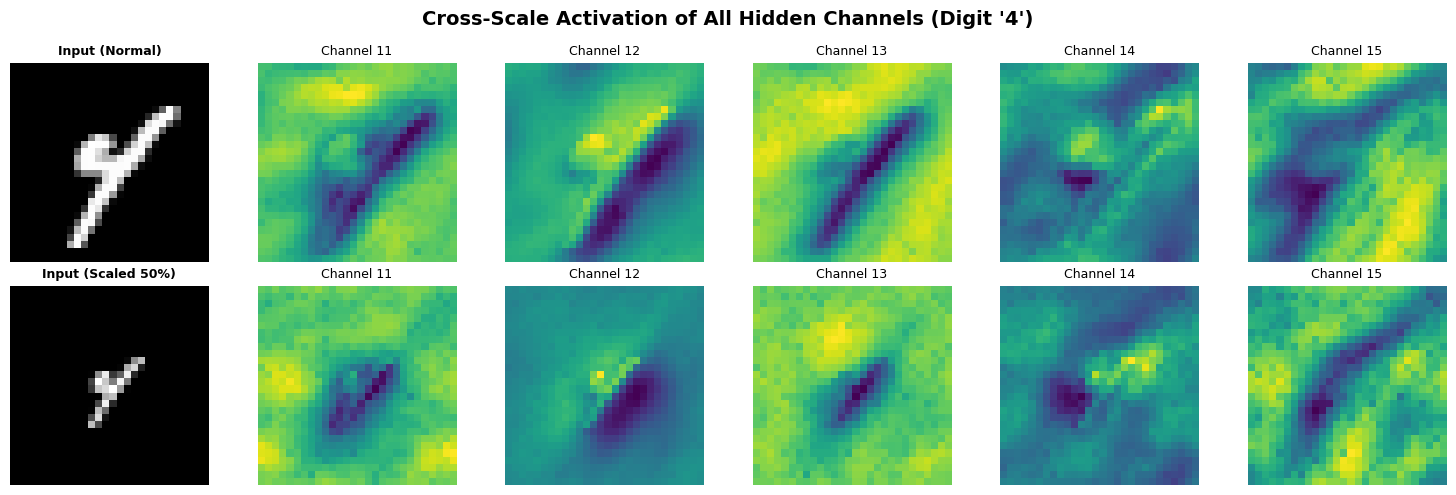
The hidden channels appeared to learn basic parts of shapes, such as:
- Edges
- Curves
- Intersections
- Other geometric patterns
These features stayed useful even when the digit was resized. This is important because the NCA communicates only with nearby locations. It cannot easily memorize that a certain feature always appears at one exact position.
As a result, it is encouraged to learn rules such as “this looks like an edge” rather than “this pixel is part of a 4.”
Different channels developed different jobs
The hidden channels became increasingly varied across the image. They stored complicated information about the structure of the digit.
The output channels behaved differently. They became almost uniform across the grid, as if every cell agreed on the final answer.
This suggests a division of labor:
- Hidden channels study and store the shape of the digit.
- Output channels spread the final classification decision across the whole grid.
The researchers also found that different hidden channels became nearly independent of one another. In simple terms, they avoided repeating the same information and instead developed specialized roles.
Hidden-state transfer helped the student learn
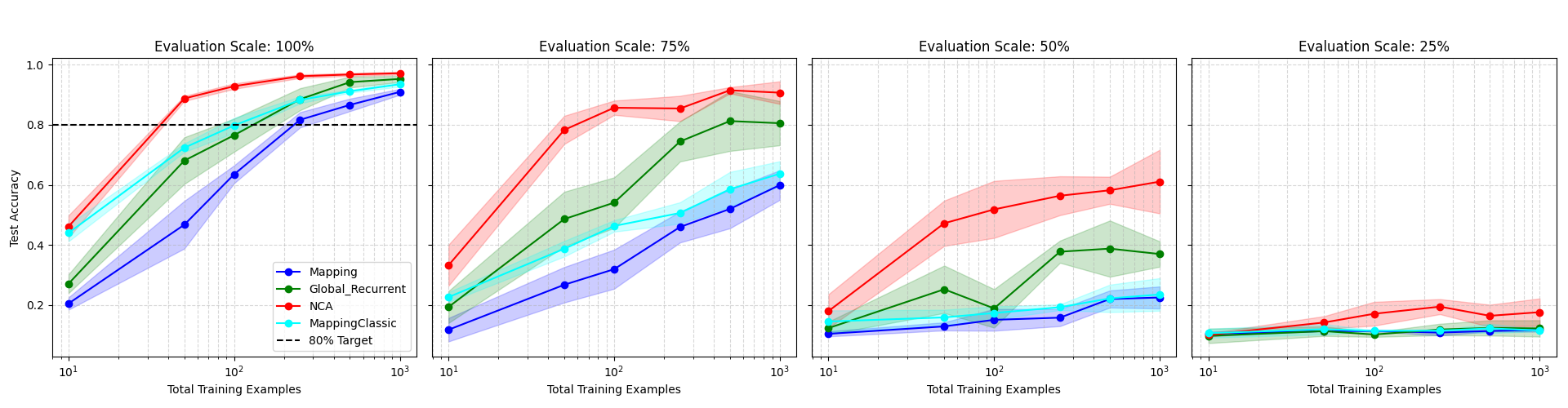
Giving the student NCA the teacher’s hidden state improved its performance.
When the student received this information during part of training, it performed better than the comparison models, including on resized digits.
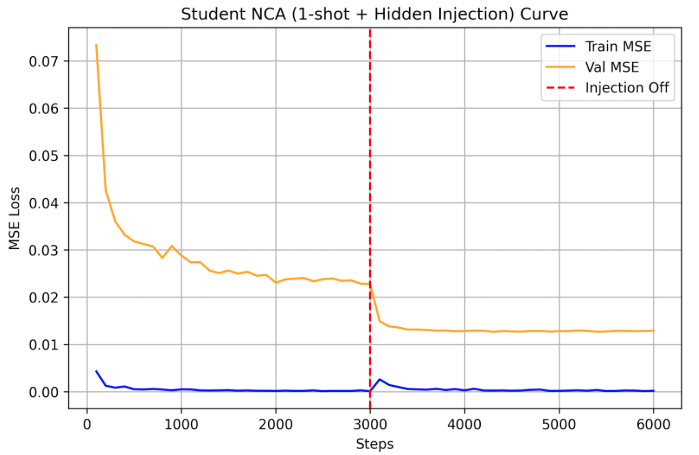
When the hidden state was provided during both training and testing, the student performed especially well. The hidden state gave it a useful starting point, allowing it to skip some of the difficult early stages of building its internal representation.
However, when the hidden state was removed after training, the student initially struggled because it had not learned how to create those hidden patterns by itself. This shows that receiving help is not exactly the same as learning the whole process independently.
Features transferred to unseen digits
One of the most interesting results came from the reduced-knowledge experiment.
The teacher was trained only on digits 0–5. Its hidden features were then given to a student that had to learn all digits, including 6–9.
The student still performed well. This suggests that the teacher had not simply memorized examples of digits 0–5. Instead, it had learned more general building blocks, such as lines, edges, and intersections, that are useful for many different shapes.
5. Why are these results important?
The results suggest that an AI system does not always need millions of parameters or enormous amounts of training data to learn useful patterns.
The NCA’s local design acts as a built-in rule that encourages it to focus on shapes and relationships rather than exact positions. This may help it avoid memorizing its training examples.
The research also presents a different form of transfer learning. Instead of transferring the model’s learned weights, researchers can transfer its internal hidden patterns. This could allow a smaller or differently designed model to start with useful knowledge.
In the future, this approach might be useful when:
- Only a small amount of training data is available.
- The model must work with objects of different sizes.
- A small, efficient AI system is needed.
- Researchers want to understand how an AI reaches its decisions.
- Knowledge needs to be shared between models with different internal designs.
6. Limitations and overall conclusion
The results are promising, but the experiments were performed mainly on MNIST. MNIST contains simple, black-and-white digits, so it is much easier than real-world images containing colors, backgrounds, animals, objects, and changing lighting.
NCAs also require many repeated update steps. Although they use few parameters, running all these steps can take considerable time and computing power. This may make them slower than ordinary one-step image-recognition systems.
Overall, the paper argues that the hidden channels of Neural Cellular Automata are not just temporary storage areas. They actively learn general visual features and organize themselves into different specialized roles. These features can sometimes be transferred from one model to another, even when the teacher has seen only some of the possible classes.
The research suggests that small, locally connected AI systems may be able to learn and transfer knowledge efficiently. More experiments are needed to discover whether the same ideas work on larger and more complicated real-world tasks.
Knowledge Gaps
Knowledge gaps, limitations, and open questions
- Limited dataset diversity: The claims are supported only on MNIST and resized MNIST variants; it remains unknown whether hidden-state transfer works on natural images, color data, higher resolutions, cluttered backgrounds, or non-visual tasks.
- Restricted notion of scale invariance: The scale experiments use nearest-neighbor downscaling of the same MNIST digits, so they do not establish robustness to continuous scale changes, translation, rotation, stroke-width variation, or independently varying object size and image resolution.
- Unclear transfer performance beyond digit classes: The teacher is trained on digits 0–5 and transfers to digits 6–9, but these classes share the same highly constrained visual domain. It remains unresolved whether the method transfers across substantially different semantic categories or datasets.
- Incomplete architectural specification: The paper does not fully describe the NCA update rule, neighborhood definition, activation functions, initialization, stochastic update scheme, developmental-step count, grid handling, or the exact architectures of the comparison models, limiting reproducibility.
- Insufficient training-protocol detail: Important details such as batch size, data sampling procedure, learning-rate scheduling, weight decay, stopping criteria, validation-set construction, and the selection of the reported checkpoints are not specified.
- Potentially unfair baseline comparisons: The models are matched approximately by parameter count but not by total computation, number of recurrent steps, memory use, or optimization budget. The paper acknowledges that some recurrent baselines receive different computational budgets, making the superiority claims difficult to interpret.
- Non-equivalent objective functions: The NCA is trained with MSE while the other models use cross-entropy. The effect of this difference on optimization difficulty, calibration, and accuracy is not controlled through a common loss or matched objective.
- Insufficient statistical reporting: Results from 100 random seeds are mentioned, but the paper does not report confidence intervals, variance estimates, exact significance tests, effect sizes, or corrections for multiple comparisons.
- Ambiguous definition of the 80% threshold: The threshold is selected as a “reasonably good score,” but the results may depend strongly on this arbitrary choice. Threshold-free metrics such as area under the learning curve or sample efficiency curves are not provided.
- Lack of ablations on hidden-channel injection: The contribution of injection timing, duration, location, channel subset, injection frequency, and injection magnitude is not isolated. It is unclear whether the reported gains depend on the specific choice of channels 11–15 and the 1,500-step schedule.
- No comparison with simpler transfer mechanisms: Hidden-state injection is not directly compared with weight transfer, frozen pretrained layers, feature-map distillation, initialization from teacher states without continued injection, or conventional few-shot methods such as prototypical networks.
- Teacher–student compatibility is underexplored: The paper suggests that teacher and student models need not have identical parameters or architectures, but experiments do not systematically vary architecture, channel count, neighborhood size, developmental-step count, or spatial resolution to establish this claim.
- Possible information leakage in the transfer setup: The teacher’s hidden states are generated from the same input digits used by the student, and the paper does not clearly separate feature reuse from direct sample-specific conditioning. More controls are needed to determine whether the student learns transferable abstractions or simply receives a near-solution representation for each example.
- Transfer dependence on teacher quality is unknown: The study does not measure how student performance changes with teacher accuracy, teacher training duration, teacher dataset size, or teacher representation quality.
- Generalization to unseen classes is not fully isolated: In the reduced-knowledge experiment, the student receives the unseen classes during training, albeit with few examples. A stricter evaluation would test whether transferred features enable recognition of entirely unseen classes without class-specific student training or with only a separate lightweight classifier.
- Causal interpretation of hidden channels is unsupported: Spatial variance shows that hidden channels are spatially heterogeneous and readout channels are more uniform, but this does not establish that hidden channels are causally responsible for feature extraction or that they “absorb” morphological complexity.
- Orthogonality is measured too narrowly: Near-zero average pairwise cosine similarity does not prove that channels are nonredundant, independent, or assigned distinct algorithmic roles. The analysis does not examine nonlinear dependence, redundancy under ablation, mutual information, or functional substitutability.
- Individual channel roles are not experimentally identified: The proposed roles of channels such as edges and intersections are inferred visually rather than tested through channel masking, permutation, replacement, activation optimization, or targeted perturbation experiments.
- Spatial variance may be confounded by activation scale: The variance analysis does not control for channel normalization, magnitude differences, sparsity, or saturation, so changes in variance may not directly reflect increasing morphological complexity.
- UMAP-based trajectory conclusions are uncertain: The latent-trajectory interpretation relies on a two-dimensional UMAP projection, whose geometry can distort distances and temporal structure. The paper does not validate the claimed attractor basins using quantitative dynamical-systems measures or multiple projections.
- Attractor stability is not quantified: The study does not test robustness to perturbations of hidden states, input noise, cellular damage, asynchronous updates, or partial cell failures, despite framing the hidden representation as a stable decentralized computational substrate.
- Robustness claims are incomplete: The experiments do not evaluate adversarial perturbations, noisy inputs, occlusions, missing pixels, rotations, translations, or corruptions, leaving the practical robustness of the learned features unresolved.
- Computational efficiency is not measured comprehensively: Although BPTT overhead is acknowledged, the paper does not report wall-clock training and inference time, memory consumption, energy use, parallelization behavior, or comparisons at equal computational cost.
- Scaling behavior is unknown: It remains unclear how parameter count, hidden-channel dimensionality, grid resolution, and developmental-step count affect accuracy, transferability, stability, and computational cost.
- Reliability across random initializations and datasets is unclear: Aggregate performance is presented, but there is limited analysis of failure modes, outlier runs, seed sensitivity, and whether the observed hidden-channel organization consistently emerges across independently trained models.
- Few-shot sampling variability is not examined: The experiments vary the number of examples per class but do not characterize performance across different class-balanced subsets, class orderings, or particularly atypical support examples.
- The mechanism of post-injection adaptation remains unresolved: The student’s transient dynamics are interpreted as translation into its own representation, but the paper does not determine which computations are inherited from the teacher and which are relearned by the student after injection is removed.
- The relationship between hidden-state transfer and ordinary initialization is unclear: The reported benefit may partly arise from initializing the student near a favorable state rather than from transferring semantic features. Controls using random but distribution-matched states, noise-perturbed teacher states, or learned initial states are needed.
- No theoretical account links locality to scale invariance: The paper attributes scale-invariant representations to local message passing, but locality alone does not necessarily guarantee scale invariance. The conditions under which this property emerges remain unspecified.
- Biological and mechanistic analogies remain speculative: Comparisons between hidden channels and biological chemical gradients or morphogenesis are not tested against biological principles or formal models, so their explanatory value remains limited.
Practical Applications
The paper’s results suggest that Neural Cellular Automata (NCAs) can provide compact, locally computed representations that generalize from very few examples and transfer across classes and input scales. The strongest evidence is currently limited to MNIST-like grayscale images, so the applications below should be understood as practical opportunities or prototypes rather than validated production systems.
Immediate Applications
- Few-shot visual classification for constrained industrial systems — Industry, computer vision
- Deploy a small NCA classifier for tasks where only a handful of labeled examples are available, such as recognizing product variants, symbols, components, or surface defects.
- Its approximately 9,800-parameter footprint could support inference on embedded processors, edge devices, or low-memory inspection hardware.
- The scale-tolerant behavior could be useful when camera distance, object size, or imaging resolution varies.
- Dependencies: The current evidence comes from simple MNIST digits; industrial deployment would require testing on noisy, colored, textured, and occluded images. The multi-step developmental process may also create latency and energy costs despite the low parameter count.
- Rapid adaptation of edge-device classifiers — Software, robotics, IoT
- Use a pretrained “teacher” NCA to provide hidden feature states to task-specific “student” NCAs. A new device could then learn a local classification task with very few examples instead of retraining a large model.
- Potential products include an on-device calibration workflow for cameras, robots, warehouse scanners, or mobile sensors.
- Hidden-state transfer may be especially useful when teacher and student models have different weights or modestly different architectures.
- Dependencies: The hidden-state tensor must be compatible with the student’s spatial dimensions and channel structure, or an adaptation layer will be needed. Persistent state injection is currently evaluated experimentally and should be benchmarked for robustness and security.
- Reusable feature libraries for geometric primitives — Industry, academia, software tooling
- Store teacher-generated hidden channels representing features such as edges, intersections, and local topological structures, then reuse them as initialization signals for new classification tasks.
- A software library could expose pretrained NCA feature states as a lightweight alternative to conventional pretrained weights.
- This could reduce the need to collect class-specific data when new categories share underlying geometric structure with previously learned categories.
- Dependencies: The claimed class-independent and scale-invariant features need validation beyond handwritten digits. Feature transfer may fail for domains whose relevant structure is semantic, temporal, or non-geometric.
- Low-data visual inspection and anomaly screening — Manufacturing, maintenance, logistics
- Train an NCA using a small number of examples of acceptable or defective patterns, then use its local feature dynamics to flag images that do not converge to expected representations.
- The hidden-channel trajectory, spatial variance, or distance from a learned attractor could become an auxiliary anomaly score rather than relying only on the final class output.
- This is potentially useful for rare-defect detection, where collecting many positive examples is difficult.
- Dependencies: The paper demonstrates classification rather than validated anomaly detection. Threshold calibration, false-negative analysis, and distribution-shift testing would be essential in safety-critical workflows.
- Educational demonstrations of emergent computation — Academia, education
- Use the model as a compact teaching tool for local message passing, recurrent computation, self-organization, transfer learning, and mechanistic interpretability.
- Students could visualize hidden-channel spatial variance, cross-channel cosine similarity, and developmental trajectories to observe how feature formation differs from classification consensus.
- Compared with large deep networks, the small parameter budget makes controlled experiments more accessible in classroom environments.
- Dependencies: Reproducible implementations, clearer documentation, and computationally efficient training scripts would be needed. The results should be presented as a case study rather than proof that NCAs universally outperform conventional networks.
- Diagnostic tooling for decentralized neural models — Software research tools
- Implement monitoring dashboards that track:
- hidden-channel spatial variance over developmental steps;
- cross-channel similarity and redundancy;
- convergence to attractor states;
- sensitivity to scale and initialization.
- These metrics could help developers determine whether an NCA is learning specialized feature channels or collapsing into redundant representations.
- Dependencies: The interpretation of individual channels as specific algorithmic roles remains preliminary. The metrics should be correlated with task performance across more datasets before being used as formal quality controls.
- Privacy- and bandwidth-conscious model adaptation — Edge AI and distributed learning
- Instead of transmitting a full model or raw training data, a server could distribute compact teacher hidden states or feature-state exemplars to edge devices.
- Devices could use these states to bootstrap local classifiers with limited data and computation.
- This could reduce communication costs in sensor networks or federated edge deployments.
- Dependencies: Hidden states may still reveal information about training data, so privacy leakage must be assessed. Standardization of state formats, quantization, compression, and protection against poisoned teacher states would also be required.
- Scale-robust preprocessing for everyday visual recognition — Daily life and accessibility
- A lightweight NCA-based module could support recognition of simple icons, handwritten notes, labels, or controls when images are captured at inconsistent sizes.
- Potential uses include assistive reading tools, smart-device interfaces, and offline recognition applications on low-end hardware.
- The local, coordinate-independent computation may help when objects shift or change scale within a fixed image frame.
- Dependencies: Real-world images introduce lighting variation, perspective, clutter, and background complexity not represented in MNIST. User-facing systems would require strong reliability and calibration.
Long-Term Applications
- Few-shot medical imaging and clinical decision support — Healthcare
- Develop NCA-based models for rare findings, tissue morphology, cellular structures, or device placement, where labeled clinical examples are scarce.
- A teacher trained on common morphological primitives could provide hidden-state initialization to student models for rare diseases or new hospitals.
- The spatially distributed hidden representation may be useful for retaining local anatomical structure while producing a global diagnostic consensus.
- Dependencies: Clinical images are substantially more complex than MNIST, and errors have high consequences. Validation would require diverse multi-site datasets, uncertainty estimates, clinician oversight, regulatory approval, and rigorous comparison with established architectures.
- Adaptive perception for robots operating in changing environments — Robotics
- Equip robots with a shared teacher NCA for general geometric features and small student NCAs that adapt to new objects, tools, or workspace layouts from a few demonstrations.
- Hidden-state transfer could support rapid adaptation without uploading raw sensor data or retraining a large perception stack.
- The local update rule may be compatible with decentralized computation across robot sensors or spatially distributed processing units.
- Dependencies: Real robotic perception includes depth, motion, occlusion, and multimodal data. The developmental-step latency, stability under sensor noise, and interaction between perception and control would need systematic study.
- Decentralized sensor-fusion and spatial computing — Smart infrastructure, environmental monitoring
- Extend the NCA framework so neighboring sensor nodes exchange local messages and collectively infer events such as fires, leaks, structural damage, or pollution patterns.
- The paper’s local communication principle could lead to computation that remains functional despite partial node failures or changing network topology.
- Teacher hidden states could initialize new deployments in locations with limited labeled data.
- Dependencies: The current experiments use a regular image grid, not physical sensor networks. Communication delays, asynchronous updates, faulty nodes, calibration differences, and adversarial inputs must be addressed.
- Low-power neuromorphic or hardware-accelerated inference — Hardware, robotics, energy
- Map NCA update rules onto spatially organized processors, GPUs, FPGAs, or neuromorphic hardware that can execute local cell updates in parallel.
- The absence of global connectivity and the separation between local feature formation and global readout may reduce memory movement compared with conventional models.
- Products could include low-power vision chips for drones, industrial cameras, or wearable devices.
- Dependencies: A low parameter count does not automatically imply low energy use: repeated developmental steps may dominate cost. Hardware feasibility depends on parallelism, memory bandwidth, numerical precision, and whether update steps can be reduced without harming accuracy.
- Robust transfer learning across domains and modalities — Software, finance, cybersecurity, science
- Investigate whether hidden-state primitives can transfer from one structured domain to another, such as:
- spatial patterns in satellite imagery;
- transaction-network motifs in finance;
- graph-local patterns in cybersecurity;
- molecular or biological structures in computational science.
- A teacher could encode reusable local motifs, while a student learns a domain-specific readout from limited labels.
- Dependencies: The paper establishes transfer mainly within digit classification. Transfer across modalities may require graph NCAs, temporal NCAs, or modality-specific encoders, and there is no guarantee that orthogonal hidden channels will remain meaningful outside image grids.
- Continual learning without full model retraining — Industry and public-sector analytics
- Use teacher hidden states as developmental scaffolding when new classes or operating conditions appear.
- A deployed system could add categories incrementally while preserving previously learned local features, potentially reducing catastrophic retraining costs.
- This could support evolving product catalogs, changing traffic signs, new equipment types, or newly observed cyberattack patterns.
- Dependencies: The paper does not test continual learning, class imbalance, forgetting, or long-term state stability. A production system would need replay strategies, confidence monitoring, rollback mechanisms, and safeguards against corrupted updates.
- Mechanistically interpretable decentralized AI — Academia and regulated AI
- Build analysis tools that associate hidden channels with morphological operations, such as edge detection, intersection detection, or inhibitory coordination.
- The observed near-orthogonality and temporal specialization could support a more explicit account of how a compact model decomposes a task.
- Such models could become experimental platforms for studying interpretable recurrent computation and biologically inspired learning.
- Dependencies: Channel roles may not be uniquely identifiable, and cosine similarity or spatial variance alone does not establish causal function. Interventions, ablations, causal tracing, and replication on complex datasets are needed.
- Policy and public-sector deployment in data-scarce settings — Government and humanitarian technology
- Apply compact, few-shot visual models to localized needs such as infrastructure inspection, crop or pest identification, document classification, or disaster-response imagery where labeled datasets are limited.
- A pretrained teacher could provide general structural features, while local agencies train small student readouts using region-specific examples.
- This could lower data-collection and infrastructure requirements for smaller institutions.
- Dependencies: Public-sector use requires fairness audits, transparency about model limitations, local validation, data governance, and human review. Performance on minority conditions and geographically different imagery cannot be inferred from MNIST results.
- NCA-based generative repair and self-healing systems — Graphics, robotics, interactive media
- Combine hidden-channel representations with existing NCA growth and regeneration methods to create systems that reconstruct damaged images, textures, layouts, or spatial configurations.
- The attractor-basin interpretation suggests a possible mechanism for restoring corrupted states toward stable representations.
- Applications could include procedural content generation, resilient robot morphology, and self-repairing spatial simulations.
- Dependencies: The paper studies classification rather than generation or physical repair. Demonstrating reliable reconstruction would require new objectives, robustness tests, and control over the desired attractor states.
Glossary
- Attractor basin: A region of state space toward which a dynamical system converges. “placing the model directly into a stable, mature representational basin”
- Backpropagation through time (BPTT): A training method for recurrent systems that unfolds computations across time steps to calculate gradients. “Backpropagation through time (BPTT) over many steps remains a scaling bottleneck”
- Bootstrapping: Using an existing model or representation to provide a new model with an advantageous initialization or starting point. “can serve as a form of bootstrapping”
- Cell morphogenesis: The biological process through which cells develop their form and structure. “Inspired by the biological processes of cell morphogenesis and self-organization”
- Chaotic transient manifold: A temporary, irregular region of state space traversed before a system settles into stable behavior. “the system must traverse a chaotic transient manifold before finally settling into its global attractor basin”
- Computational substrate: An underlying system or representation that supports computation. “act as a decentralized, dynamic computational substrate”
- Conditioned readout model: A model whose output prediction depends on an externally supplied representation or condition. “This effectively turns the NCA into a conditioned readout model”
- Coordinate-free: Independent of fixed absolute spatial coordinates. “forcing the network to learn robust, coordinate-free structural rules”
- Cross-entropy loss: A loss function commonly used to measure the difference between predicted class probabilities and target labels. “the other models (producing logits) are evaluated using cross-entropy loss”
- Decentralized computation: Computation performed through local interactions rather than a single centralized controller. “a robust, decentralized computational substrate”
- Developmental scaffolding: Information or structure that guides a model during an early developmental or optimization phase. “hidden-channel injection effectively acts as developmental scaffolding”
- Emergent behavior: Complex behavior that arises from the interaction of simpler components without being explicitly programmed. “NCAs exhibit emergent, complex behaviors and strong robustness”
- Feed-forward architecture: A neural-network architecture in which information generally moves from input to output without recurrent feedback. “standard single-pass feed-forward architectures”
- Few-shot learning: Learning to generalize from only a small number of examples. “a fundamental challenge for few-shot learning”
- Global attractor: A stable state or set of states toward which trajectories from a broad range of initial conditions converge. “before finally settling into its global attractor basin”
- Global spatial coordinates: Absolute positional information describing locations across an entire spatial domain. “it is incapable of memorizing global spatial coordinates and features”
- Hidden channels: Internal feature maps in a model that are not directly exposed as outputs. “the hidden channels of an NCA (channels 11–15) act as a decentralized, dynamic computational substrate”
- Inductive bias: A model’s built-in preference for certain solutions or patterns, which influences how it generalizes. “Its strict adherence to local message-passing acts as a structural inductive bias”
- Latent trajectory: The path followed by internal representations through a model’s latent state space over time. “Finally, we visualize the dynamical attractors of the NCA by projecting the continuous temporal trajectory”
- Logits: Unnormalized numerical outputs produced by a classifier before conversion into probabilities. “while the other models (producing logits) are evaluated using cross-entropy loss”
- Local message-passing: Information exchange restricted to neighboring spatial units or cells. “Their strict adherence to local message-passing acts as a structural inductive bias”
- Mechanistic interpretability: The analysis of how a model’s internal components and processes produce its outputs. “improve the mechanistic interpretability of decentralized learning architectures”
- Morphological complexity: Complexity related to the shapes, structures, and spatial forms represented by a system. “the hidden channels decouple feature extraction from uniform classification consensus by absorbing morphological complexity”
- Morphogenesis: The process by which an organism or system develops its form and structure. “bypassing the chaotic initial phases of morphogenesis”
- Nearest-neighbor downscaler: An image-resizing method that assigns each output pixel the value of the closest input pixel. “using a nearest-neighbor downscaler”
- Neural Cellular Automata (NCAs): Neural systems composed of spatially distributed cells that repeatedly update their states using shared local rules. “Neural Cellular Automata (NCAs) represent a promising alternative”
- One-hot encoding: A representation in which one category is indicated by a single active entry and all other entries are inactive. “it learns to identify the digit and the hidden state to produce the one-hot encoding”
- Over-parameterization: The use of a model with substantially more parameters than may be necessary to represent the training data. “Modern deep learning relies heavily on over-parameterization”
- Parameter-efficient: Requiring relatively few trainable parameters to achieve a desired level of performance. “a highly parameter-efficient alternative”
- Representational redundancy: Repetition or overlap of information across different internal representations. “the NCA eliminates representational redundancy”
- Readout channels: Output-oriented channels used to convert internal representations into predictions or classifications. “the classification readout channels maintain a near-zero spatial variance”
- Recurrent architecture: A neural architecture that repeatedly processes information while maintaining evolving internal states. “the recurrent, local nature of NCAs forces them to capture structural patterns”
- Scale-invariant: Unchanged in essential structure or behavior when the spatial scale of an input changes. “these hidden channels capture general, scale-invariant topological primitives”
- Self-organization: The spontaneous emergence of organized structure from local interactions within a system. “Inspired by the biological processes of cell morphogenesis and self-organization”
- Shared update rule: A single parameterized transformation applied repeatedly and consistently across spatial locations or cells. “NCAs operate by repeatedly applying highly localized, shared update rules across a spatial grid”
- Spatial variance: A measure of how much activation values differ across spatial positions. “To quantify how the NCA separates feature extraction from classification, we tracked the mean spatial variance”
- Synaptic weights: Trainable numerical parameters that determine the strength of connections in a neural network. “Traditional transfer learning relies on the extraction and fine-tuning of pre-trained synaptic weights”
- Topological primitives: Basic structural patterns defined by connectivity, shape, or spatial relationships rather than exact measurements. “well-structured topological primitives—such as edges and intersections”
- Transfer learning: Reusing knowledge or representations learned by one model or task to improve performance on another. “we explore a different method exclusive to NCAs: transfer learning via hidden channels rather than weights”
- UMAP embedding: A low-dimensional representation produced by Uniform Manifold Approximation and Projection to visualize high-dimensional data. “into a 2D UMAP embedding”
- Uniform classification consensus: Agreement among spatial units on a common classification result. “allowing the readout channels to converge uniformly on a classification consensus”

