JEPA-Anything: Learning Predictive Models across Different Worlds
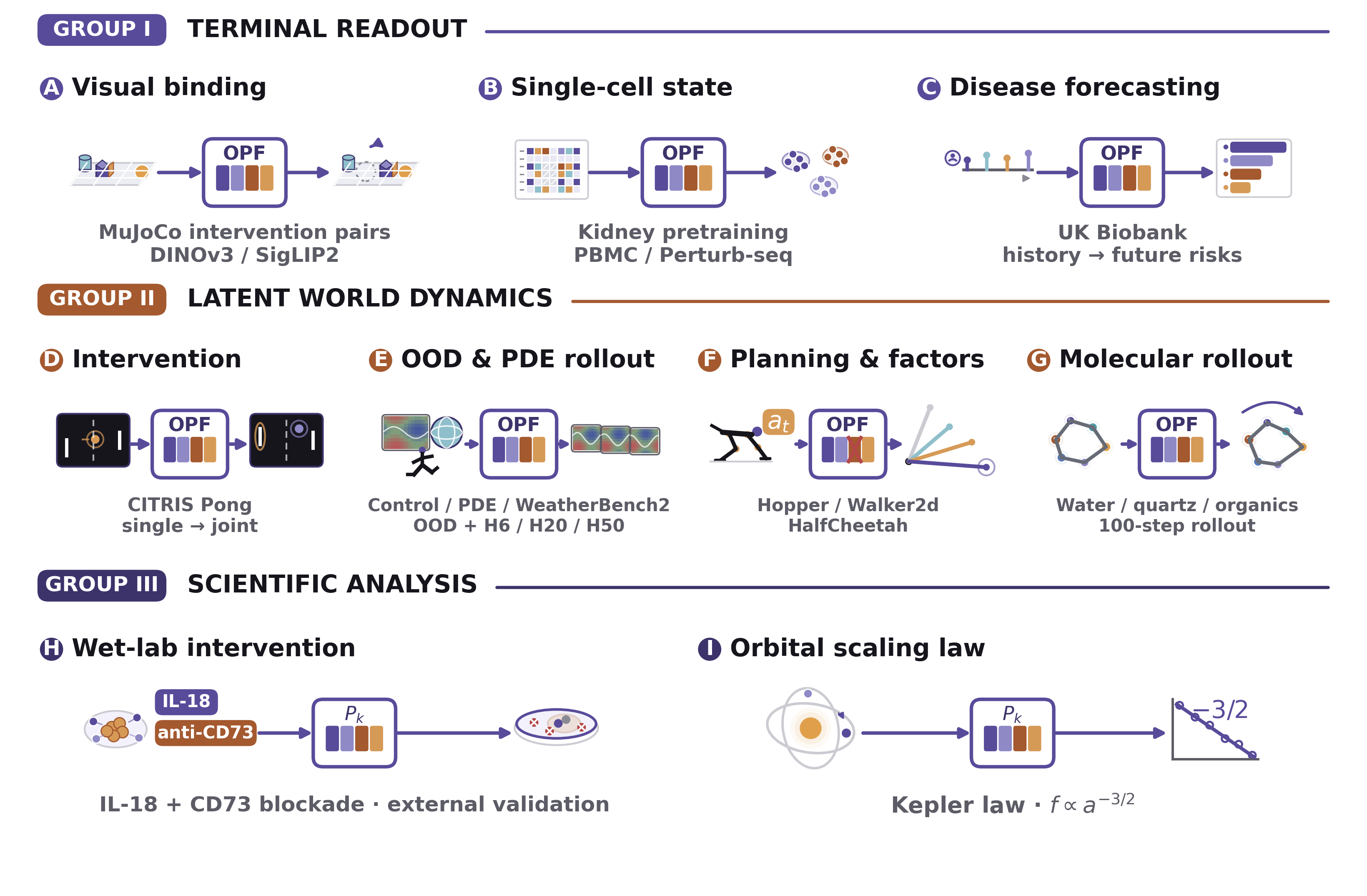
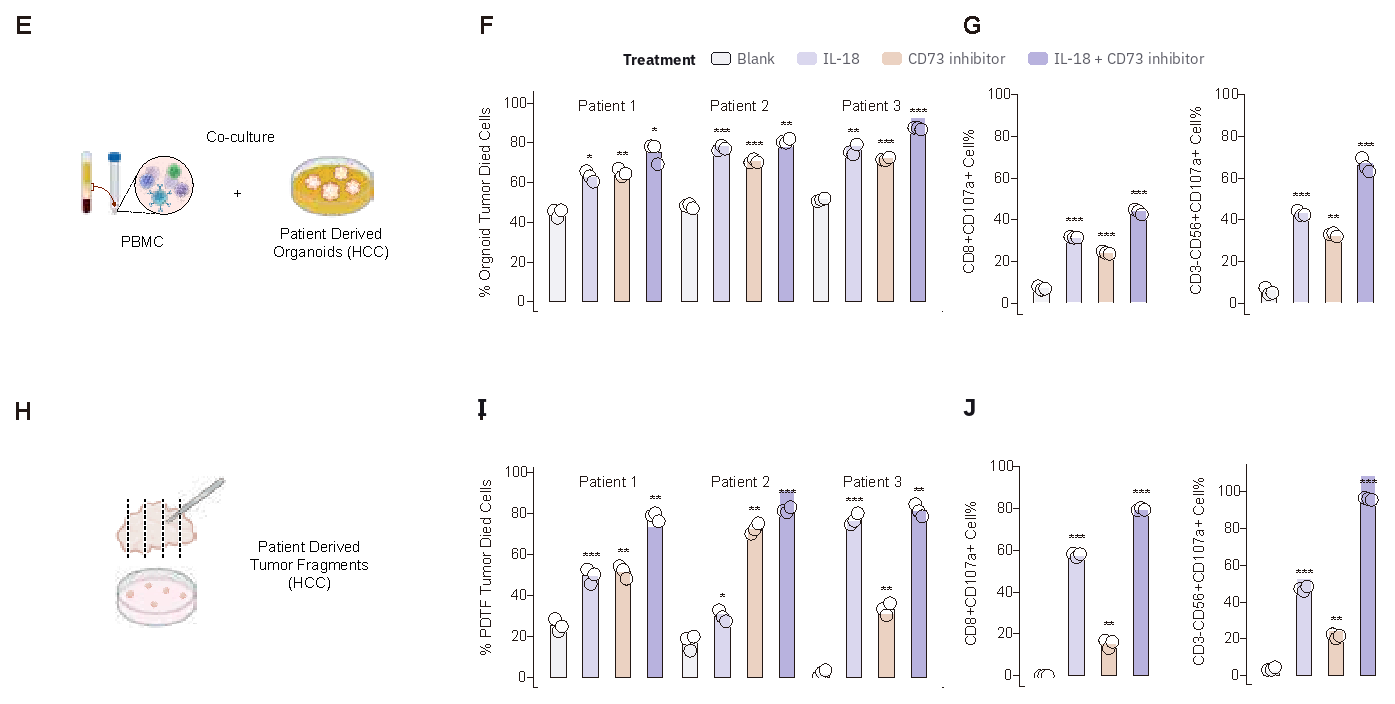
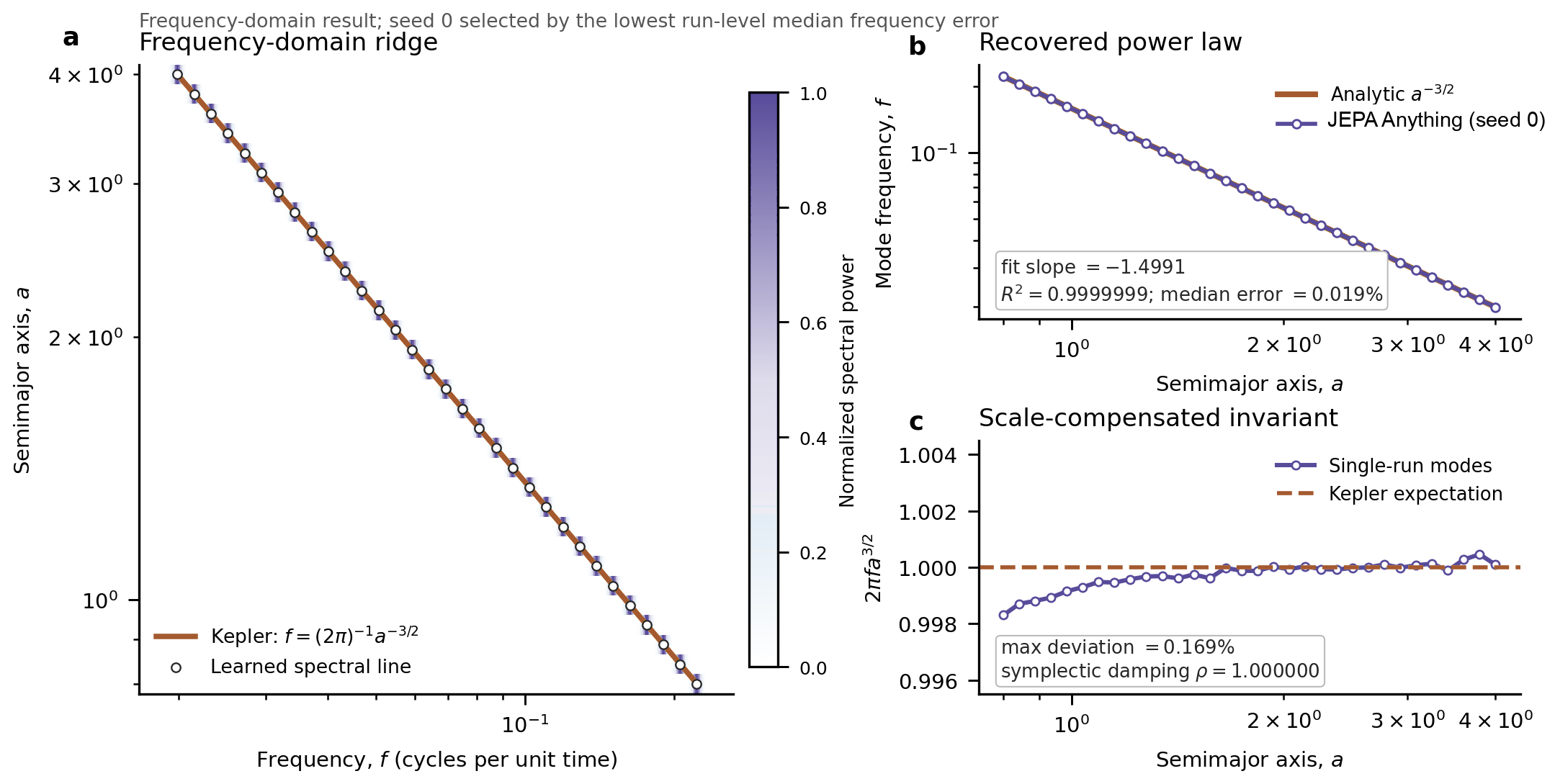
Abstract: World modeling enables intelligence to anticipate consequences, guide interventions, and learn from interaction. Yet predictive models remain domain-specific: can a common learning principle support world modeling across radically different systems? We introduce JEPA-Anything, a domain-agnostic framework based on orthogonal predictive factorization (OPF). Extending joint-embedding predictive architectures, OPF decomposes latent targets into complementary factors, learns them through dedicated pathways, and recombines them within a shared predictive design. We evaluate JEPA-Anything across seven domains: vision, biology, clinical trajectories, control, molecular dynamics, physical fields, and weather. Experiments span representation learning, intervention prediction, out-of-distribution generalization, and long-horizon dynamics, including 10 matched dynamics tasks, forecasting of over 1,000 clinical events, and 100-step molecular rollouts across four systems. Against matched JEPA baselines, JEPA-Anything improves reported metrics on all 10 dynamics tasks and reduces single-intervention prediction error on Interventional Pong by 34.8%. It achieves the lowest one-step and 100-step molecular errors among compared methods in all four systems. Beyond prediction, a factor-nominated biological intervention receives experimental support in cell co-cultures, patient-derived organoids, tumor fragments, and mice; latent orbital modes recover the Keplerian scaling exponent with a fitted slope of -1.4991. These results support a common factorized predictive principle across heterogeneous worlds, connecting world modeling with intervention and experimentally grounded scientific discovery. Code: https://github.com/Gen-Verse/JEPA-Anything
Paper Prompts
Sign up for free to create and run prompts on this paper.
Top Community Prompts
Explain it Like I'm 14
1. What is this paper about?
The paper introduces a machine-learning system called JEPA-Anything. Its goal is to help computers build “world models.”
A world model is an internal picture of how something works. For example:
- A robot may use one to predict what will happen after it moves.
- A weather model may predict tomorrow’s temperature and storms.
- A medical model may predict a patient’s future health problems.
- A biology model may predict how cells react to a drug.
- A physics model may predict how molecules or planets move.
The authors ask whether the same basic learning method can work for many very different kinds of data, instead of needing a completely different model for every field.
Their answer is a system called JEPA-Anything, which divides information into several separate but connected parts. The authors call this process orthogonal predictive factorization, or OPF.
2. What questions did the researchers investigate?
The paper focuses on several main questions:
- Can one learning approach work across many different “worlds”? The researchers test vision, biology, healthcare, robots, molecules, physical systems, and weather.
- Does dividing information into separate factors improve prediction? For example, in a game, one factor might represent an object’s position while another represents its movement.
- Can the model predict the results of actions or interventions? An intervention means deliberately changing something, such as giving a drug, moving a robot, or changing a game object.
- Can the model handle new situations that were not in its training data? This is called out-of-distribution generalization. It is similar to learning addition problems and then being asked to solve a new combination of numbers.
- Can predictions remain useful over many steps? The model is sometimes asked to predict the future repeatedly: its first prediction becomes the starting point for the next prediction, and so on.
- Can the model help scientists discover useful patterns? The researchers investigate whether the model’s internal factors can suggest biological experiments or reveal known physical laws.
3. How does the method work?
The basic JEPA idea
JEPA stands for Joint-Embedding Predictive Architecture.
Instead of trying to recreate every tiny detail of an input, JEPA learns a shorter internal description, called a latent representation.
For example, when looking at a photo of a bicycle, the model does not need to remember every individual pixel. It may only need to understand useful information such as:
- where the bicycle is,
- its shape,
- its direction,
- and what might happen if it moves.
The model receives some information called the context and tries to predict another part called the target.
This is like seeing part of a puzzle and predicting what the missing piece should look like. However, the model predicts the missing information in its internal representation rather than directly guessing every pixel or number.
What JEPA-Anything changes
A normal JEPA uses one large internal description and one main prediction path.
JEPA-Anything divides this description into several smaller parts, or factors. Each factor has its own prediction pathway.
A simple analogy is organizing a school backpack:
- one section holds books,
- one holds pens,
- one holds sports equipment,
- and one holds lunch.
The sections are different, but together they describe the whole backpack.
In JEPA-Anything, the factors are not manually labeled. The system learns how to divide information based on what can be predicted. The researchers also encourage the factors not to duplicate one another. This is done with orthogonality constraints, which are mathematical rules that push the factors to represent different directions of information.
The model also uses two safeguards:
- Factor activity: keeps every factor useful instead of allowing some to become empty or ignored.
- Encoder activity: prevents the whole representation from collapsing into a nearly constant answer.
After predicting the separate factors, the model combines them again into a complete predicted state. This complete state can be used for:
- predicting the next moment,
- planning actions,
- forecasting a patient’s future,
- simulating molecules,
- or analyzing scientific patterns.
Training process
The general training process is:
- Convert the data into a form the model can process.
- Show the model part of the information.
- Ask it to predict another part.
- Divide the target information into several factors.
- Give each factor its own predictor.
- Compare the predictions with the correct answers.
- Encourage the factors to remain different and active.
- Repeat this process many times.
The same central procedure is used across all domains, although each domain has its own way of representing data. For instance, an image uses patches, while a medical record uses events over time.
4. What did the researchers find?
The researchers tested JEPA-Anything in seven broad areas:
- computer vision,
- single-cell biology,
- clinical forecasting,
- robot control,
- molecular motion,
- physical fields,
- and weather prediction.
They compared it with regular JEPA and other suitable models. The paper reports several important results.
Better visual and biological representations
In visual experiments, JEPA-Anything was better at recognizing combinations of:
- where something changed, and
- what type of change happened.
It also reduced the number of cases where the model confused or “collapsed” different visual situations together.
In single-cell experiments, it performed better at:
- grouping cells into the correct types,
- predicting how cells respond to changes,
- and transferring knowledge to new biological data.
For example, its reported results were higher than regular Cell-JEPA on both cell clustering and perturbation-response prediction.
Improved clinical forecasting
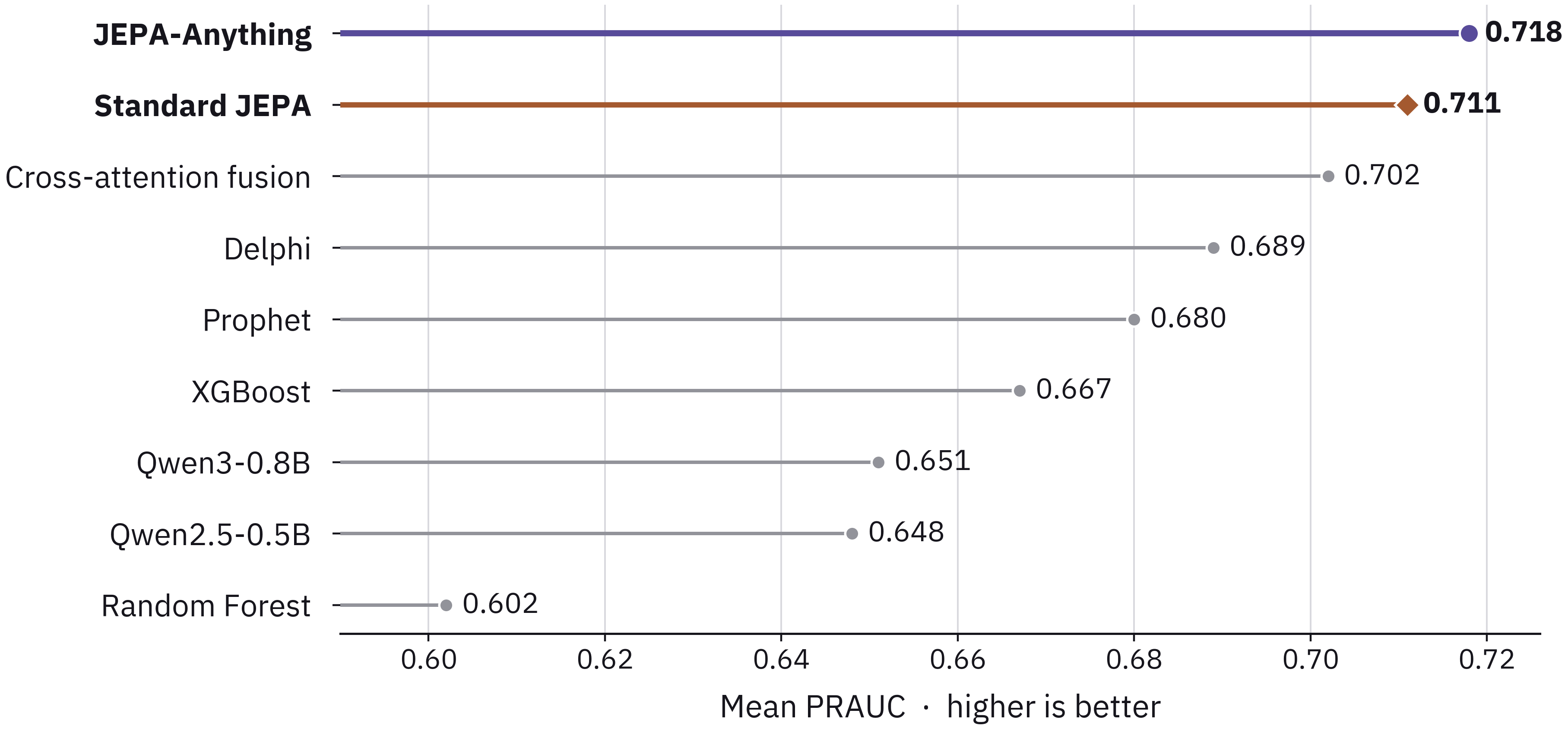
The model predicted more than 1,000 possible future clinical events from patient histories.
The factorized version achieved a higher average precision-recall score than the regular JEPA version. In simple terms, it was better at identifying which health events were likely to happen, especially when many events were rare.
Better intervention prediction
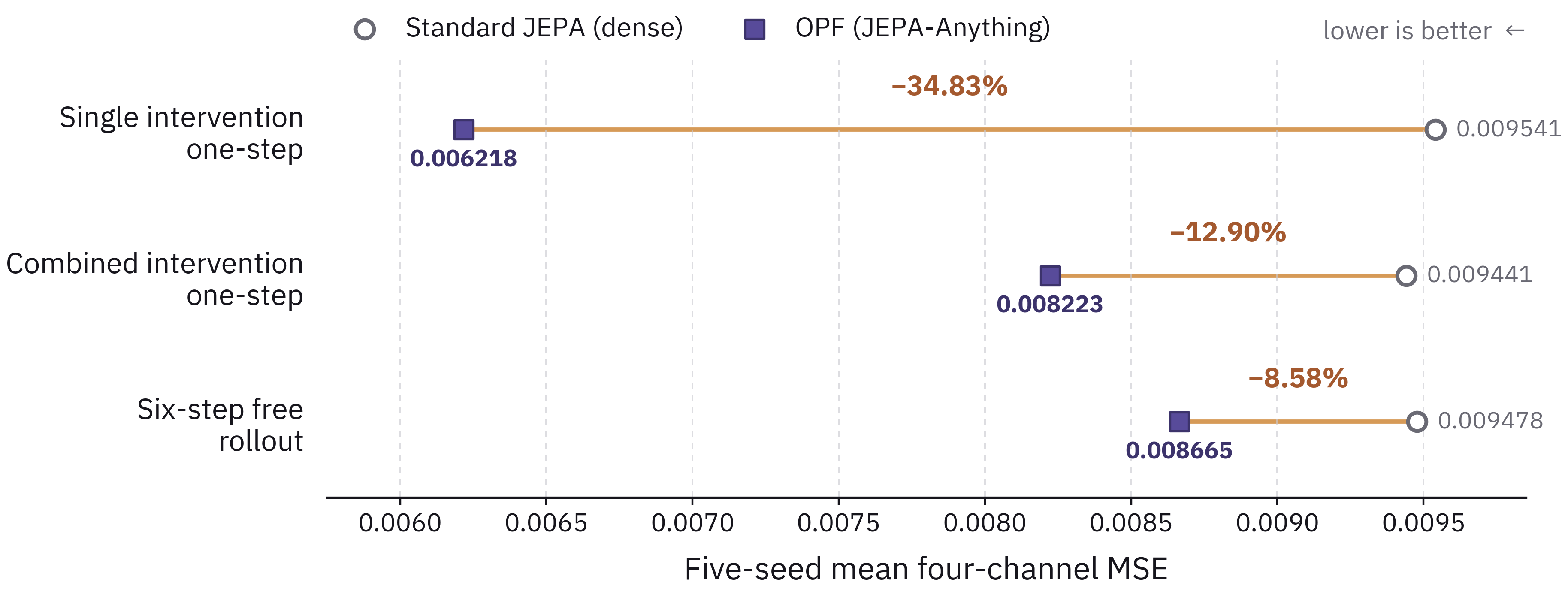
In the Interventional Pong experiment, the model was shown a game state and information about what had been changed. It then predicted the next state.
Compared with standard JEPA, JEPA-Anything reduced the error for a single intervention by about 34.8%.
It also improved predictions when several changes happened together, even when that exact combination had not appeared during training. This suggests that the model could combine separate learned rules instead of simply memorizing examples.
Better performance across dynamics tasks
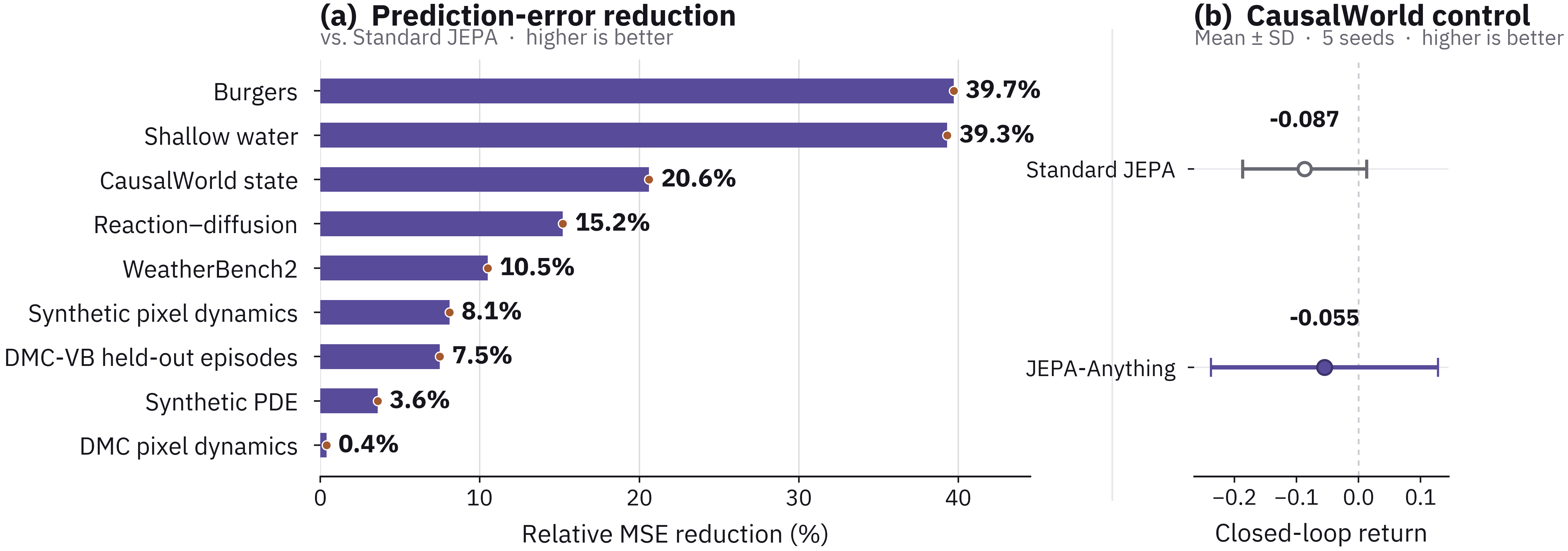
The researchers tested ten dynamics tasks involving robots, physical systems, weather, and other changing environments.
The paper reports that JEPA-Anything improved the chosen prediction measures on all ten tasks compared with matched standard JEPA models.
This is important because predicting one step is relatively easy, while predicting several steps can be difficult. Small mistakes can grow larger over time, like a tiny navigation error causing someone to end up far from their destination.
More accurate molecular rollouts
The model was tested on four molecular systems, including water, quartz, paracetamol, and benzene.
It achieved the lowest reported error for both:
- one-step predictions, and
- 100-step predictions.
A 100-step rollout means the model repeatedly predicts the next molecular state 100 times. Performing well over such a long sequence suggests that its internal state remains relatively stable.
Useful scientific patterns
The researchers also used the model’s factors for scientific analysis.
In biology, a factor-based analysis suggested a possible intervention. The authors report that this suggestion received supporting evidence from experiments involving:
- cell co-cultures,
- patient-derived organoids,
- tumor fragments,
- and mice.
The paper also studied simulated orbital motion. The model’s internal modes recovered a relationship similar to Kepler’s law, which describes how the time taken by an orbit relates to its size. The fitted slope was approximately −1.4991, close to the expected value of −1.5 in the analysis used by the authors.
This does not mean the model independently discovered all of physics, but it suggests that its internal representations can reflect meaningful scientific structure.
5. Why are these findings important?
Many machine-learning systems are designed for only one type of information. A model trained for images may not work well with medical records or molecular trajectories.
JEPA-Anything suggests that a shared learning principle can be reused across many areas. The details of the data still change, but the central idea remains the same:
Learn a useful internal state, divide it into complementary predictive parts, and use those parts to predict what happens next.
The separation into factors may help because different kinds of information do not compete as strongly during training. For example, the model may be able to represent both “where something is” and “how it changes” without allowing one type of information to overwhelm the other.
The orthogonality rule also makes the factors mathematically stable. In the paper’s tests, the factors covered the state space more completely and were much less redundant than unconstrained prediction heads.
6. Potential impact and limitations
If the results hold up in further studies, this approach could help create more flexible models for:
- robots that plan before acting,
- medical systems that forecast patient risks,
- drug and cell research,
- weather and climate prediction,
- molecular simulation,
- and scientific discovery.
A particularly interesting possibility is that the same model could both predict what will happen and help researchers decide what experiment to try next.
However, the results should be interpreted carefully. The experiments use different datasets, model designs, and evaluation measures across different fields. Success in these tests does not prove that one model can solve every real-world problem. The biological discoveries, for example, still require extensive independent laboratory testing.
Simple conclusion
JEPA-Anything is a method for teaching computers to understand changing systems. It does this by building an internal description of the system, splitting that description into different useful parts, and predicting each part separately.
The paper reports that this approach improves performance in vision, biology, healthcare, robotics, physics, weather, and molecular modeling. It also appears to make long-term predictions more stable and can expose patterns that are useful for science.
In short, the research suggests that many very different problems may share a common learning idea: understand a system by breaking its future behavior into separate pieces that can be predicted and recombined.
Knowledge Gaps
Knowledge gaps, limitations, and open questions
- Incomplete empirical record: The provided paper text ends during the dynamics-results section, so the numerical results, analyses, and conclusions for several reported experiments—including weather, physical fields, locomotion, molecular dynamics, and possibly later appendices—are not available for independent assessment.
- Limited evidence for domain agnosticism: Although the framework is applied across seven domains, each domain still uses a domain-specific adapter, tokenizer, encoder, view sampler, base loss, and readout. The paper does not establish how much performance depends on these specialized components rather than on the shared OPF core.
- No cross-domain joint pretraining experiment: The paper does not test whether a single JEPA model can be trained jointly on multiple heterogeneous domains and transfer predictive factors between them. The claimed common interface is evaluated mainly through separate domain-specific instantiations.
- Unclear contribution of each regularizer: Orthogonality, factor-activity, encoder-variance, and predictive losses are introduced together, but comprehensive ablations isolating each term and their interactions are not reported in the provided text.
- Insufficient analysis of factor-count and factor-width selection: Most experiments use four factors, while other configurations are not systematically compared. It remains unclear how performance changes with the number of factors, unequal factor widths, latent dimensionality, or dynamically chosen factor capacity.
- Factor semantics are not shown to be identifiable: The factors are defined only up to rotations, permutations, and other equivalent parameterizations within their subspaces. The paper does not establish whether factors are stable across random seeds, datasets, training runs, or model architectures.
- Orthogonality may not imply semantic disentanglement: The geometric results demonstrate non-overlapping subspaces and stable synthesis, but they do not show that each factor corresponds to a distinct causal mechanism, physical variable, or interpretable predictive mode.
- Potential conflict between orthogonality and useful representations: Enforcing mutually orthogonal subspaces may separate predictive directions that are statistically or causally dependent. The paper does not investigate whether this constraint harms performance when relevant factors are correlated or interact nonlinearly.
- Approximate-training behavior is insufficiently characterized: The formal guarantees assume exact orthogonality, whereas trained models use penalty-based approximate orthogonality and pseudoinverse synthesis. The relationship between finite penalty strength, conditioning, prediction error, and rollout stability is not systematically quantified.
- No comparison with broader factorized or disentangled baselines: The principal comparison is with monolithic JEPA and selected domain-specific baselines. The paper does not compare OPF against alternative approaches such as mixture-of-experts predictors, low-rank factorization, independent subspace predictors, causal representation learning, or explicit object-centric world models.
- Unclear fairness of the matched comparisons: Adding multiple predictors and regularization terms may change optimization dynamics, effective parameterization, or inductive bias even when nominal model budgets are matched. Parameter counts, FLOPs, wall-clock training time, memory use, and hyperparameter-search budgets are not fully compared.
- Hyperparameter sensitivity is unresolved: The paper does not report sensitivity to orthogonality, factor-activity, and encoder-variance coefficients, EMA momentum, activity thresholds, mask ratios, predictor architecture, or target-view sampling.
- Statistical significance is incomplete: Results are generally summarized over five seeds, with some experiments using only three seeds or one analyzed run. Confidence intervals, hypothesis tests, effect-size uncertainty, and corrections for multiple comparisons are not consistently provided.
- Limited robustness to distribution shift: The reported OOD settings involve selected held-out combinations, episodes, time periods, or frequencies. Broader shifts—new environments, sensors, institutions, molecular compositions, weather regimes, intervention mechanisms, or missing-data patterns—remain untested.
- Long-horizon stability is only partially demonstrated: Six-step rollouts in several tasks and 100-step molecular rollouts do not establish stability over substantially longer horizons. The paper does not determine whether factorization delays error accumulation or prevents eventual divergence.
- Closed-loop planning evidence is limited: The framework is used with planners such as CEM, but the paper does not clearly separate improvements due to the learned world model from improvements due to planner settings, reward design, action distributions, or model-predictive-control implementation.
- Intervention generalization is narrow: CITRIS evaluates withheld combinations of known intervention types, but the paper does not test unseen intervention mechanisms, continuous intervention magnitudes, noisy intervention labels, imperfect interventions, or interventions that alter the underlying transition dynamics.
- Causal interpretation is not established: Improved intervention prediction does not by itself demonstrate causal representation learning. The paper does not show that OPF factors correspond to causal variables or support valid counterfactual predictions under unobserved confounding.
- Clinical evaluation lacks external validation: Disease forecasting uses a single fixed patient-level cohort split. External cohorts, temporal validation, cross-institution transfer, demographic subgroup performance, calibration, and robustness to coding or measurement changes are not evaluated.
- Clinical utility remains uncertain: The paper reports mean PRAUC across more than 1,000 events but does not assess calibration, decision-curve utility, clinically meaningful thresholds, time-to-event discrimination, treatment-selection value, or prospective usefulness.
- Potential data leakage and preprocessing risks are not fully documented: For the longitudinal clinical and biological settings, the paper does not provide enough detail to verify that future information, repeated patients, batch identifiers, or post-intervention measurements cannot enter the context or target representations.
- Single-cell transfer claims are limited: Biological representation experiments rely on particular datasets and a kidney-cell pretraining source. Generalization across species, tissues, sequencing technologies, laboratories, disease states, and perturbation modalities remains unresolved.
- Perturbation prediction may be dataset-specific: The strong Adamson and Norman results do not establish performance on unseen genes, unseen drug combinations, dosage changes, temporal responses, or perturbations outside the training assay distribution.
- Wet-lab validation has limited scale: The biological intervention claim is supported by three organoids, three tumor fragments, and external mouse validation, but the paper does not report sufficiently broad replication, sample-size justification, randomization, blinding, negative controls, dose-response analysis, or independent prospective cohort validation.
- The biological nomination pipeline is underspecified: It is unclear how candidate interventions were selected from factor coordinates, how many hypotheses were tested, whether selection occurred before experiments, and how multiple-testing or researcher degrees of freedom were controlled.
- Orbital-law recovery may be circular or underpowered: The Keplerian scaling result is based on one analyzed run and a known analytic law. The paper does not show robustness across initial conditions, noise levels, architectures, seeds, trajectory lengths, or systems whose governing laws are unknown.
- Scientific interpretability is not benchmarked: The paper does not compare factor-based scientific discovery against conventional latent representations, supervised physical variables, sparse regression, symbolic regression, or domain-specific spectral methods.
- Observation noise and missingness are underexplored: Real clinical, biological, molecular, and weather data contain measurement noise, irregular sampling, missing variables, and corrupted observations, but systematic robustness experiments are not described.
- Partial observability is not rigorously evaluated: The framework is presented as a world model for partially observed systems, yet the paper does not quantify how performance changes with observation sparsity, delayed observations, hidden state dimensions, or ambiguous context–target relations.
- The target-encoder design may introduce training–deployment mismatch: Targets are generated by an EMA encoder, while downstream operational predictions use the online encoder and synthesized states. The effects of encoder drift, EMA momentum, and mismatch between online and target representations on long rollouts are not analyzed.
- Recursive decoding and representation drift are insufficiently examined: The paper reports latent rollouts, but it does not fully evaluate whether synthesized states remain on the data manifold, whether decoders amplify latent errors, or whether repeated predictions create progressively unrealistic states.
- Computational scalability is unclear: The cost of maintaining multiple predictors, projectors, orthogonality penalties, pseudoinverse synthesis, and domain-specific adapters is not compared with monolithic JEPA at larger latent widths, factor counts, sequence lengths, or dataset scales.
- No principled procedure is given for selecting the predictive factorization: The framework assumes a fixed partition into equal-width subspaces. It remains open how to detect the appropriate number, granularity, hierarchy, or temporal persistence of predictive factors from data.
- The framework’s failure modes are not characterized: The paper does not identify conditions under which OPF degrades performance, such as weak context–target dependence, highly entangled dynamics, stochastic transitions, multimodal futures, nonstationary systems, or targets dominated by unpredictable information.
- Stochastic and multimodal futures are insufficiently addressed: The predictors appear to regress conditional means using squared error. The paper does not evaluate whether JEPA can represent uncertainty, multiple plausible futures, aleatoric noise, or risk-sensitive predictions.
- Transferability of learned factors remains unknown: It is not shown whether factor projectors or predictor branches can be reused across tasks, environments, interventions, or datasets, despite the paper’s emphasis on reusable predictive structure.
- The relationship between representation-mode and world-model-mode performance is unclear: The paper uses the online encoder for downstream readouts and retains projectors and predictors for operational rollouts, but it does not determine whether improvements in one mode predict improvements in the other.
- The broad “Anything” claim remains bounded by manually designed interfaces: Because the domain adapter must define tokens, descriptors, context–target semantics, and structural views, the method does not yet demonstrate fully automatic applicability to arbitrary new domains.
Practical Applications
Immediate Applications
The reported results support several applications that could be deployed now as research prototypes, decision-support systems, or components within existing machine-learning workflows. These uses generally do not require autonomous control or direct clinical deployment.
- Reusable predictive representations for multimodal AI
- Sectors: AI infrastructure, computer vision, bioinformatics, scientific machine learning.
- Organizations can add JEPA-Anything’s orthogonal predictive factorization (OPF) to existing ViT, Transformer, GNN, MLP, or equivariant-model pipelines. The online encoder can provide reusable embeddings for classification, clustering, retrieval, anomaly detection, or regression.
- A practical workflow is: tokenize domain data, define context and target views, train with the OPF objective, discard the target encoder and prediction heads, and reuse the online encoder with task-specific readouts.
- Dependencies: The context and target must describe statistically related states of the same underlying system. Domain-specific tokenization, descriptors, and sampling remain necessary; the method does not eliminate the need for suitable data engineering.
- Improved single-cell representation and perturbation analysis
- Sector: Biotechnology and drug discovery.
- JEPA-style cell representations can support cell-type clustering, cross-dataset transfer, zero-shot analysis, and prediction of gene-expression responses to perturbations. The paper reports improvements on PBMC clustering and Adamson and Norman perturbation datasets.
- A deployable tool could provide a
cell-state embeddingservice for ranking perturbations, identifying responsive cell populations, or prioritizing experiments before laboratory testing. - Dependencies: Predictions depend on the relevance and coverage of the training cell types, perturbations, and biological contexts. Batch effects, assay differences, and distribution shifts may reduce reliability. Model outputs should be treated as hypotheses rather than biological facts.
- Clinical event-risk forecasting as decision support
- Sector: Healthcare and health insurance analytics.
- The model can synthesize a predicted future patient state from longitudinal records and generate risk scores for many future events, including the paper’s setting with more than 1,000 event types.
- Potential products include population-health dashboards, patient-monitoring systems, trial-enrollment filters, and clinician-facing alerts for prioritizing chart review or follow-up.
- Dependencies: Deployment requires external validation, calibration, subgroup fairness assessment, privacy-preserving infrastructure, and compatibility with irregular, incomplete, and institution-specific records. The reported PRAUC improvement does not establish clinical utility or safety, and the system should not independently diagnose or prescribe.
- Intervention-conditioned forecasting
- Sectors: Robotics, simulation, gaming, industrial control, and causal machine learning.
- Given a current state and an intervention label, the model can predict the next state and estimate the effects of individual or combined interventions. The Interventional Pong results suggest improved compositional generalization to unseen combinations of interventions.
- A practical workflow could use factorized predictions to compare “what-if” scenarios, such as changing multiple operating parameters, applying several robot actions, or modifying multiple game-state variables.
- Dependencies: Intervention labels must be defined consistently, and the training data must contain enough variation to identify the effects of individual factors. Performance on simple simulated environments does not guarantee validity for real-world causal interventions.
- Short-horizon forecasting for physical and environmental systems
- Sectors: Weather, energy, computational physics, engineering, and climate analytics.
- The shared factorized architecture can be adapted to predict physical fields, weather states, or PDE trajectories from current fields and known forcing variables.
- Immediate prototypes include accelerated surrogate models for simulation, short-range weather downscaling, wind or temperature-field prediction, and engineering parameter sweeps.
- Dependencies: Numerical stability, conservation laws, resolution, boundary conditions, and the quality of forcing data are critical. The reported rollout tests are limited in horizon and task configuration; production systems would require longer evaluations and comparison with physics-based solvers.
- Molecular trajectory prediction for computational chemistry
- Sector: Pharmaceutical research and materials science.
- The molecular implementation can forecast latent molecular configurations and support rapid screening of molecular dynamics trajectories. The paper reports the lowest compared one-step and 100-step errors across four molecular systems.
- Potential tools include approximate trajectory simulators, conformational-state exploration, pre-screening of candidate compounds, and initialization of more expensive molecular-dynamics calculations.
- Dependencies: The current evidence covers four systems and does not establish accuracy for arbitrary molecules, reaction mechanisms, solvents, temperatures, or long physical timescales. Symmetry handling, force-field consistency, and physical validity checks are required before scientific use.
- Latent-state diagnostics and model monitoring
- Sectors: Enterprise AI, software engineering, scientific computing, and safety engineering.
- The factor coordinates can be logged and analyzed separately to identify which predictive modes are active, redundant, unstable, or missing. Orthogonality provides a numerically stable coordinate system for comparing predicted and observed states.
- This could produce tools for factor-activity dashboards, drift detection, rollout-error attribution, and failure analysis in deployed predictive models.
- Dependencies: Orthogonal factors are not automatically human-interpretable. Their semantic meaning may change across datasets, training runs, or domains, so factor-level explanations require independent validation.
- Educational and research tooling
- Sector: Academia and technical education.
- The open-source implementation and published model collection can serve as a common experimental framework for comparing latent prediction across vision, biology, clinical records, control, weather, and molecular dynamics.
- Researchers can use it to study representation learning, world models, intervention prediction, OOD generalization, and multi-step error accumulation under a shared interface.
- Dependencies: Reproducibility depends on access to the required datasets, computational resources, precise implementation details, and corrected handling of the paper’s domain-specific adapters and evaluation protocols.
Long-Term Applications
The following applications are plausible extensions of the findings but require additional research, broader validation, or safety-critical engineering before deployment.
- Model-based robot planning and control
- Sectors: Robotics, autonomous vehicles, warehouse automation, and industrial manufacturing.
- Retaining the factor predictors enables latent transition rollouts that can be scored by a planner. A future system could simulate candidate action sequences, predict their consequences, and select actions using model-predictive control or a cross-entropy method planner.
- Factorized states may be useful for separately modeling object motion, contact dynamics, actuator effects, and environmental changes.
- Dependencies: Real robots introduce partial observability, sensor noise, unknown dynamics, actuator delay, and safety constraints. Long-horizon compounding error, rare events, sim-to-real transfer, and reliable uncertainty estimation must be addressed before closed-loop deployment.
- Counterfactual clinical planning
- Sector: Healthcare and precision medicine.
- A future clinical world model could predict how a patient’s latent health state might evolve under alternative treatments, monitoring schedules, or interventions, then expose those trajectories to a clinical decision-support system.
- Possible products include treatment-comparison simulators, adaptive trial-planning tools, and individualized disease-progression models.
- Dependencies: Observational health records contain confounding, selection bias, missing-not-at-random data, and treatment-policy changes. Valid counterfactual use requires causal identification, prospective studies, uncertainty estimates, clinician oversight, regulatory review, and rigorous evaluation of harms from incorrect recommendations.
- Biology-guided intervention discovery
- Sector: Oncology, immunology, cell therapy, and drug discovery.
- The factor-analysis interface could nominate biological interventions by associating predictive latent modes with cellular response patterns. The paper reports external support for a factor-nominated intervention in cell co-cultures, organoids, tumor fragments, and mice.
- A longer-term workflow could be: learn factorized cell states, identify intervention-sensitive factors, rank candidate perturbations, test them in organoids or animal models, and feed experimental results back into the model.
- Dependencies: The reported validation is promising but limited in scale and biological scope. Translating latent associations into therapeutic mechanisms requires replication, dose-response studies, toxicity testing, mechanistic experiments, and eventual human trials.
- Long-range weather, climate, and energy forecasting
- Sectors: Meteorology, climate science, electric-grid operations, renewable-energy integration, and disaster response.
- Factorized latent dynamics could support multi-step weather forecasting, extreme-event scenario generation, renewable-power forecasting, and grid planning under uncertain wind or solar availability.
- A product might combine a learned world model with a physics-based solver, ensemble uncertainty estimation, and an operator dashboard for scenario analysis.
- Dependencies: Small systematic errors can become severe over long horizons. Deployment requires calibration, physical-consistency constraints, high-resolution validation, rare-event testing, uncertainty-aware ensembles, and safeguards against using a model outside its training climate regime.
- Accelerated scientific simulation and digital twins
- Sectors: Aerospace, materials, fluid mechanics, manufacturing, and infrastructure.
- JEPA-based latent rollouts could act as surrogate simulators for digital twins of turbines, factories, fluid systems, chemical processes, or materials. Orthogonal factors may organize distinct spatial scales, entities, or dynamical modes.
- Such systems could enable rapid design optimization, predictive maintenance, parameter inversion, and interactive engineering simulation.
- Dependencies: Digital twins require continual data assimilation, uncertainty quantification, conservation-law compliance, and validation against high-fidelity measurements. A learned model should complement—not silently replace—trusted numerical models in safety-critical applications.
- Molecular design and reaction planning
- Sector: Pharmaceutical and materials industries.
- Extending the molecular rollout capability could enable models that explore conformational landscapes, estimate transition pathways, or guide the design of molecules with desired dynamical properties.
- A potential workflow would couple factorized molecular dynamics with generative design, docking, quantum-chemistry refinement, and laboratory synthesis.
- Dependencies: Accurate long-horizon dynamics, chemical validity, reaction modeling, solvent and temperature effects, and integration with quantum or experimental validation remain unresolved. Low trajectory error alone does not ensure correct reaction energetics or useful drug properties.
- General-purpose compositional world models
- Sectors: Artificial general intelligence research, simulation, interactive software, and autonomous agents.
- The paper’s central architectural claim could support a common world-model interface spanning images, sequences, graphs, sets, patient records, molecular systems, and physical fields. Agents might reuse factorized states across prediction, planning, intervention simulation, and task-specific readouts.
- Potential systems include interactive simulators, embodied agents, scientific copilots, and software agents that model application-specific environments.
- Dependencies: The current evidence demonstrates a shared learning principle, not a universal model that transfers directly between domains. Cross-domain transfer requires compatible representations, scalable adapters, semantic alignment, memory, uncertainty handling, and methods for resolving conflicting or changing factor meanings.
- Policy simulation and public-sector planning
- Sector: Public health, transportation, energy policy, and emergency management.
- With reliable causal and temporal data, factorized predictive models could simulate policy interventions, such as vaccination strategies, traffic restrictions, energy incentives, or disaster-response actions.
- A policy tool could expose alternative intervention combinations and estimate short- and medium-term system trajectories.
- Dependencies: Policy environments are highly confounded, socioeconomically heterogeneous, and subject to feedback effects. Deployment requires causal validity, transparency, fairness analysis, stakeholder review, uncertainty communication, and governance preventing model forecasts from being treated as deterministic predictions.
- Factor-based scientific discovery and theory testing
- Sector: Physics, astronomy, biology, and applied mathematics.
- The recovery of a Keplerian scaling exponent from latent orbital modes suggests that factor coordinates may help expose scientifically meaningful dynamical structure. Future systems could use factor spectra to identify conserved quantities, scaling laws, phase transitions, or hidden modes in complex datasets.
- A practical research workflow would combine unsupervised factor discovery with symbolic regression, dimensional analysis, and targeted experimental validation.
- Dependencies: Latent factors are learned for predictability, not guaranteed to correspond to physical variables. Scientific interpretation therefore requires multiple datasets, invariance tests, perturbation studies, known-law comparisons, and independent experiments rather than relying on visual or statistical alignment alone.
Glossary
- Autoregressive rollout: Sequential prediction in which each predicted state is fed back as input for the next prediction. “an autoregressive rollout”
- CausalWorld: A simulated environment for studying causal reasoning and robot control. “CausalWorld closed-loop control”
- Condition number: A numerical measure of how sensitive a matrix-based computation is to errors or perturbations. “its condition number without bound”
- Context encoder: A neural network that converts observed contextual information into a latent representation. “A context encoder summarizes what is observed”
- Cross-factor orthogonality: A constraint requiring different learned factor subspaces to represent mutually perpendicular directions. “the second discourages different factors from repeatedly encoding the same directions”
- Domain adapter: A component that converts domain-specific observations into a common token and descriptor representation. “A domain adapter maps into content tokens”
- Exogenous input: An input determined outside the modeled system, such as an action, intervention, or external forcing. “let denote the exogenous input at step ”
- Exponential moving average (EMA): A weighted running average that updates parameters gradually using the current parameters and their previous averaged values. “The target parameters are updated as an exponential moving average”
- Factor activity: The extent to which coordinates within a learned predictive factor vary meaningfully across examples. “a per-factor activity floor keeps every projected target coordinate active across samples”
- Factorized predictive state: A latent state decomposed into multiple separately predicted components. “predicted components can be synthesized into a complete latent state”
- Free rollout: Repeated model prediction without replacing predicted states with ground-truth states. “We additionally evaluate six-step free rollout.”
- Injective alignment: A one-to-one matching between elements of two sets, preventing multiple elements from being assigned to the same counterpart. “injective Hungarian alignment”
- Intervention-conditioned prediction: Prediction of a future state given an explicitly specified external change to the system. “intervention-conditioned dynamics”
- Joint-embedding predictive architecture (JEPA): A representation-learning architecture that predicts a target embedding from a context embedding rather than reconstructing raw observations. “Joint-embedding predictive architectures (JEPAs) provide a natural mechanism for learning such states”
- Keplerian scaling: A relationship between orbital quantities governed by Kepler’s laws of motion. “the Keplerian scaling exponent”
- Latent dynamics: The evolution of hidden, learned representations over time. “learned latent dynamics can support planning”
- Latent world model: A model that constructs an internal hidden state of a system and uses it to predict other states of that system. “a model that constructs a latent state from context and uses it to predict another state of the same underlying world”
- Long-horizon dynamics: System behavior predicted across many successive time steps. “out-of-distribution generalization, and long-horizon dynamics”
- Masked prediction: Learning to predict information that has been intentionally hidden from the model’s input. “masked image prediction”
- Mean squared error (MSE): The average of squared differences between predicted and reference values. “We report the mean four-channel MSE”
- Moore–Penrose pseudoinverse: A generalized matrix inverse used when a matrix is non-square or singular. “through the Moore--Penrose pseudoinverse of the analysis map”
- Molecular dynamics: Computational modeling of the time-dependent motion of atoms and molecules. “molecular dynamics”
- Monolithic target embedding: A single undivided latent representation used as the prediction target. “one target embedding and one prediction pathway”
- Out-of-distribution (OOD) generalization: The ability to perform well on data or conditions that differ from those used during training. “Out-of-distribution and long-horizon dynamics”
- Orthogonal direct sum: A decomposition of a vector space into mutually perpendicular subspaces whose combination spans the whole space. “the factor spaces form an orthogonal direct sum”
- Orthogonal predictive factorization (OPF): A method that divides a latent target into orthogonal subspaces and predicts each with a dedicated pathway. “We introduce orthogonal predictive factorization, which partitions a latent target into learned subspaces with dedicated predictors”
- Orthogonality regularization: A training penalty that encourages learned vectors or subspaces to be perpendicular. “The learned subspaces are therefore predictive and orthogonality-regularized.”
- Out-of-distribution forecasting: Prediction for states, trajectories, or conditions outside the training distribution. “readout, OOD forecasting, planning, rollout stability, and scientific diagnostics”
- PDEBench: A benchmark suite for machine-learning models of partial differential equations. “PDEBench, and WeatherBench2”
- Partial differential equation (PDE): An equation involving derivatives of a function with respect to multiple continuous variables. “APEbench Burgers and KS”
- Predictive factor: A learned latent component that captures a distinct aspect of a target that can be inferred from context. “Each factor has a corresponding predictor”
- Predictive state: An internal representation containing information needed to anticipate future or otherwise unobserved system states. “the central object is a predictive state”
- Representation learning: Learning useful features or embeddings directly from data rather than defining them manually. “We evaluate JEPA across seven domains”
- Singular value: A nonnegative value describing the scaling of a matrix along one of its principal directions. “Minimum singular value ”
- Spectral analysis: The study of a system through frequency- or mode-based decompositions of its representations or dynamics. “latent spectral modes”
- Stop-gradient: An operation that prevents gradients from being propagated through a specified tensor during optimization. “Stop-gradient is applied to the target-encoder output”
- Target encoder: The encoder that produces the latent representation serving as the prediction target. “A target encoder produces a latent target”
- Trajectory rollout: Sequential generation of future states by repeatedly applying a learned transition model. “Repeated application defines a latent rollout.”
- Variance collapse: A failure mode in which learned representations become nearly constant and lose informative variation. “the second sends a direct anti-collapse gradient to the online encoder”
- WeatherBench2: A benchmark for evaluating machine-learning systems that forecast weather variables. “PDEBench, and WeatherBench2”
- Zero-shot evaluation: Evaluation on a task or dataset without task-specific fine-tuning. “PBMC zero-shot AvgBIO”

