Fingers as Legs: Learning Self-Supported Locomotion and Manipulation with an Anthropomorphic Hand
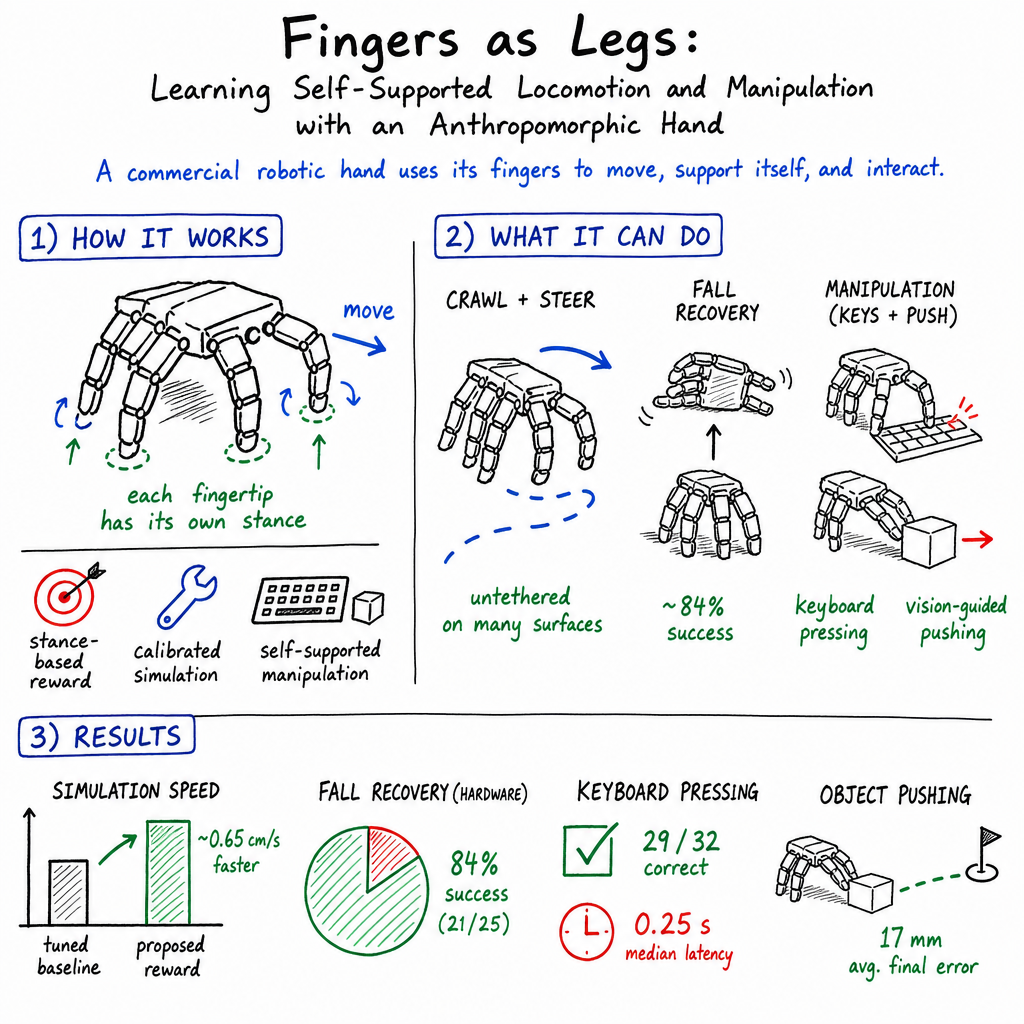
Abstract: A walking robotic hand must use the same fingers to move its body, support its weight, and interact with the environment. We show how an anthropomorphic hand can learn these skills while retaining its finger design and position controller. Onboard power and computation make the platform self-contained. Our reinforcement learning approach accounts for the hand's unequal fingers, with training in a simulator calibrated from hardware measurements. In simulation, the hand moves faster with our reward formulation than with tuned rewards originally designed for quadrupeds. On hardware, task-specific policies enable untethered crawling, steering, and fall recovery. While supporting its own weight, the hand also executes successive keyboard commands without vision and pushes an object to targets using overhead visual feedback. These results demonstrate a compact mobile manipulator that reuses its fingers for locomotion and interaction, without a separate locomotion mechanism.
Paper Prompts
Sign up for free to create and run prompts on this paper.
Top Community Prompts
Explain it Like I'm 14
1. What is this paper about?
This paper describes a robotic hand that can walk using its fingers.
Most robotic hands are attached to an arm and stay in one place. The researchers wanted to make a hand that could:
- move by using its fingers like legs,
- carry its own battery and computer,
- keep itself balanced,
- press buttons, and
- push objects.
The robot is an ordinary commercial hand with five unequal fingers, including a thumb. The researchers did not redesign the fingers. Instead, they taught the hand new skills using artificial intelligence.
The title, “Fingers as Legs,” means that the robot uses the same fingers both to move its body and to interact with the world.
2. What questions did the researchers ask?
The researchers mainly wanted to find out:
- Can a normal robotic hand learn to crawl without being attached to an arm?
- Can the hand stay balanced while lifting one finger and moving another?
- Can it move across many different surfaces?
- Can it recover by itself after falling over?
- Can it use some fingers for support while another finger presses a button?
- Can it push an object toward a target while continuing to support its own body?
- What kind of training instructions help the hand learn to move effectively?
A major challenge is that the fingers are not identical. The thumb points in a different direction, and each finger has a different length and reach. This makes the hand unlike a four-legged robot, where the legs are often more symmetrical.
3. How did the researchers do it?
Building a self-contained robot
The researchers started with a commercial robotic hand weighing about 738 grams. They added:
- a battery,
- a small computer,
- an orientation sensor, similar to the motion sensor in a smartphone, and
- communication equipment.
With these additions, the complete robot weighed about 818 grams. It no longer needed wires or an external computer while moving.
The hand had 20 moving joints, with four joints in each finger.
Teaching the hand with reinforcement learning
The researchers used a method called reinforcement learning. This is similar to training a dog:
- the robot tries an action,
- it receives a “reward” for doing something useful,
- it receives a penalty for doing something bad, such as falling,
- and it gradually learns which actions work best.
For example, the robot received rewards for:
- moving in the requested direction,
- keeping its body upright,
- using its fingertips for support, and
- avoiding contact with the palm.
It received penalties for:
- falling,
- moving too much up and down,
- using too much energy, and
- making sudden, unstable movements.
The researchers used an algorithm called PPO, or Proximal Policy Optimization. In simple terms, PPO helps a robot improve its behavior step by step without changing its actions too wildly between attempts.
Training in a computer simulation
Before testing the real hand, the researchers trained it in a physics simulation. A simulation is a computer-generated world where the robot can practice thousands of times without breaking.
To make the simulation more realistic, they measured the real hand’s:
- fingertip grip and friction,
- motor delays,
- joint movement speed, and
- response to commands.
They then put these measurements into the simulation. They also changed conditions during training, such as friction and the robot’s balance. This helped the learned behavior work on real surfaces, not only in the computer.
This process is called sim-to-real transfer: learning in simulation and transferring the skill to a physical robot.
A special way of rewarding the fingertips
The researchers created a reward called the footprint objective. Each fingertip was given its own preferred position, based on where it naturally rested when the hand was balanced.
This is like telling each finger:
“Try to stay near your own support spot, but move away when you need to take a step.”
The researchers allowed more movement in the direction of travel and discouraged movement sideways or upward. This helped the hand remain stable while crawling.
The robot was not given a fixed walking pattern. It learned for itself:
- which finger should move,
- when it should move, and
- how far it should move.
Testing several skills
The researchers trained separate policies, or learned control programs, for:
- crawling and steering,
- recovering after falling,
- pressing keyboard keys, and
- pushing an object toward a target.
For pushing, an overhead camera tracked the hand and the object. For keyboard pressing, the robot did not use vision during the task. The keyboard had to be lined up manually beforehand.
4. What did they find?
Crawling on different surfaces
The hand crawled across 14 surfaces, including:
- carpet,
- hardwood,
- tile,
- asphalt,
- concrete,
- grass,
- artificial turf, and
- gravel.
This showed that the hand could move on both indoor and outdoor surfaces.
In simulation, the researchers compared their special reward system with reward systems originally designed for four-legged robots. Their method made the hand move about 0.65 centimeters per second faster, on average, than the best adapted comparison method.
The special fingertip-position reward was especially important. When the researchers removed it, the robot became slower and used its fingertips less effectively.
Steering
The hand could turn left and right using commands. However, its turning was not perfectly balanced:
- it turned more easily in one direction,
- it naturally drifted slightly to the right, and
- large left turns were sometimes difficult.
Using the onboard orientation sensor, the researchers added a correction system. This allowed the hand to reach several target headings, including turns of about 15 degrees and a 30-degree turn to the right.
The average crawling speed during steering tests was about 0.093 meters per second, or roughly 9 centimeters per second.
Recovering after a fall
The hand learned to raise itself after falling onto its side.
In physical tests, it recovered in 21 out of 25 trials, or 84% of the time. In the failed trials, some fingers caught on one another and stopped the hand from getting upright.
In simulation, the recovery behavior succeeded in 28 out of 32 falls.
Pressing keyboard keys
The hand could keep itself supported while using one finger to press keys.
In a sequence of 32 commands, it made:
- 29 correct key presses, and
- 3 mistakes.
The mistakes happened when the robot tried to press the Up key but hit the nearby Right Shift key instead. The hand did not use vision to locate the keyboard during the test, so the keyboard had to be aligned manually.
The typical time from receiving a command to pressing a key was about 0.25 seconds.
The researchers also used the hand to enter keyboard commands for small Sokoban puzzles. It successfully completed both a one-box puzzle and a two-box puzzle.
Pushing an object
The hand used an overhead camera to find a small cube and push it toward different targets.
It completed 15 object-delivery trials. The final average distance from the target was about 17 millimeters, which was less than half the cube’s width.
This showed that the hand could move its body, remain supported, make contact with an object, and push it—all at the same time.
5. Why are these results important?
The main achievement is that one compact robot can perform several jobs without needing:
- a separate set of legs,
- a robotic arm following it,
- wires connected to a computer, or
- a person constantly placing it back upright.
The fingers have to perform two competing roles. Some fingers must support the body while another finger moves or presses something. The experiments show that a hand can learn to coordinate these jobs.
The researchers also showed that designing rewards around the robot’s actual body shape works better than simply copying methods made for symmetrical four-legged robots.
6. What could this lead to?
In the future, a larger robot might place this hand near a narrow opening, inside a difficult-to-reach area, or next to a control panel. The hand could then:
- crawl toward the control,
- press buttons or move an object,
- recover from a fall if necessary, and
- return to the larger robot.
This could be useful in places where a full-sized robot or arm cannot fit.
However, the system still has limitations. It needs improvements such as:
- better turning in all directions,
- cameras or other sensors carried directly on the hand,
- automatic alignment with keyboards and controls, and
- better handling of unfamiliar objects and environments.
Overall, the paper shows that a robotic hand does not have to be only a tool at the end of an arm. With learning, its fingers can also become legs, allowing the hand to move through human-built spaces and interact with objects on its own.
Knowledge Gaps
The paper leaves the following knowledge gaps, limitations, and open questions unresolved:
- Generalization beyond one hand: It is unclear whether the approach transfers to other anthropomorphic hands with different finger lengths, joint limits, actuator characteristics, masses, or palm geometries.
- Limited hardware validation: Locomotion is demonstrated on 14 surfaces, but the study does not report quantitative speed, stability, energy use, slip rate, or failure statistics across those surfaces.
- Restricted terrain complexity: The experiments do not evaluate slopes, steps, gaps, deformable terrain, wet or contaminated surfaces, loose gravel in depth, or transitions between surfaces.
- Unresolved contact-model accuracy: The simulator calibrates friction and actuator response, but the paper does not quantify sim-to-real prediction error for fingertip forces, slip, body motion, or locomotion success under unseen conditions.
- No systematic sim-to-real ablation: The individual effects of friction randomization, actuator-gain randomization, payload variation, IMU bias, delay modeling, and contact modeling on transfer performance are not isolated.
- Limited actuator and load characterization: The study does not examine long-term changes in stiffness, thermal behavior, battery voltage, current limits, or motor performance during sustained crawling and manipulation.
- Energy and endurance are unreported: Battery capacity, operating time, power consumption, recharge time, and performance degradation as the battery discharges are not evaluated.
- Reliability over repeated operation is unknown: The demonstrations use short experimental sequences, so durability of the fingers, fingertips, position controller, and onboard hardware under repeated weight-bearing impacts remains unresolved.
- Fall-recovery generalization is limited: Recovery is tested on a small number of manually selected thumb-side and wrist-side falls; robustness to arbitrary orientations, obstacles, entangled fingers, partial occlusions, or falls during motion is not established.
- Recovery performance is not quantified consistently on hardware: Hardware results report success rates but not recovery time, joint error, energy consumption, contact forces, or the distribution of failure modes.
- Limited steering capability: Turning is asymmetric, open-loop drift is substantial, and the controller fails to reach some left-turn targets. The causes of this asymmetry and methods for compensating for it are not investigated.
- No comprehensive navigation evaluation: The paper does not measure waypoint-following accuracy, path efficiency, obstacle avoidance, heading control over long distances, or autonomous navigation without an operator.
- No onboard perception: Locomotion and pushing depend partly on external instrumentation, while the hand lacks onboard visual or tactile perception for localization, obstacle detection, and object tracking.
- Manual keyboard registration remains a bottleneck: The keyboard task assumes fixed placement and operator alignment, so robustness to keyboard displacement, rotation, different keyboard layouts, key spacing, and occlusion is unknown.
- Keyboard interaction is evaluated on too few trials and devices: The 29/32 result comes from one sequence on a fixed keyboard, and the study does not assess repeated trials, different keyboards, key actuation forces, or accumulated positional drift.
- No autonomous task-level planning: Commands for keyboard operation and Sokoban are issued by an operator. The system does not integrate perception, planning, action sequencing, failure recovery, or task completion autonomously.
- Object-pushing generalization is untested: Pushing is demonstrated with one PLA cube and target setup; effects of object mass, size, shape, material, friction, orientation, and center of mass are not evaluated.
- External-camera dependence limits applicability: The pushing policy requires an overhead camera and a dorsal marker. Performance without a fixed camera, under occlusion, changing illumination, camera motion, or outside the camera workspace remains unknown.
- Manipulation success metrics are incomplete: The pushing experiment reports final target error but not success rate under a predefined protocol, number of failed approaches, contact loss, path efficiency, or robustness to target and object-position uncertainty.
- No force or tactile feedback is used for interaction: The policies rely primarily on proprioception and vision; the benefits of fingertip force, tactile, or contact-location sensing for preventing slip, excessive loads, and accidental contacts are unexplored.
- Support–manipulation trade-offs are not characterized: The paper demonstrates keyboard pressing and pushing but does not quantify how available support polygon, stability margin, body tilt, or locomotion capability changes during interaction.
- Task-specific policies prevent seamless behavior switching: Crawling, recovery, keyboard pressing, and pushing use separate policies. The work does not show a unified policy or a verified transition mechanism among locomotion, manipulation, recovery, and navigation.
- Policy robustness to command and sensor disturbances is unknown: The experiments do not systematically test command delays, packet loss, IMU dropouts, calibration errors, noisy key identifiers, inaccurate object tracking, or unexpected external disturbances.
- No comparison with model-based or non-learning controllers: The evaluation compares reward formulations in simulation but does not compare the learned policies against hand-designed gaits, optimization-based controllers, hybrid control, or classical manipulation strategies on hardware.
- Reward-design conclusions are narrow: Ablations are performed only for selected terms, weights, seeds, and flat-ground simulation settings. It remains unclear whether the footprint objective is beneficial under different morphologies, terrains, payloads, commands, or task constraints.
- A potential conflict in reward interpretation remains unresolved: The footprint objective improves speed and participation but shifts mean contact tilt toward the nail side; the safety and mechanical consequences of this trade-off are not measured.
- No explicit stability or contact-force guarantees are provided: The learned policies lack formal guarantees regarding support-polygon margins, fingertip load limits, tipping probability, or safe operation near joint and current limits.
- Payload generalization is weakly assessed: Training randomizes a limited payload center-of-mass range around an 80 g payload, but hardware tests do not establish performance across different payload masses, mounting locations, or payload dynamics.
- Human and environmental safety are not evaluated: Potential hazards from sharp fingertip contacts, unexpected crawling, falls, keyboard failures, object collisions, and operation near people are not analyzed.
- Scalability to confined real-world deployments is unverified: The proposed use case involves deployment through restricted openings and retrieval by a larger robot, but no experiments test deployment, communication loss, recovery, retrieval, or operation in genuinely confined spaces.
- Long-horizon task performance remains unknown: The demonstrations are short and structured; cumulative drift, fatigue, battery depletion, contact wear, and failure recovery during extended multi-stage missions are not reported.
Practical Applications
Immediate Applications
The demonstrated capabilities are sufficiently mature for controlled, prototype-scale deployment, particularly in structured environments where the hand’s workspace, object properties, and safety conditions can be constrained.
- Confined-space inspection and control operation — industrial robotics, infrastructure, and emergency response. A larger mobile robot could place the approximately 818 g hand near a restricted opening, after which the hand could crawl toward nearby controls, press buttons or keys, push lightweight objects, and return for retrieval. Potential workflow: deploy → crawl using IMU-based steering → execute a predefined manipulation policy → recover from a fall if necessary → return or signal completion. Dependencies: sufficient opening size, bounded surface roughness, reliable wireless or supervisory communication, and task-specific calibration. The current system has only demonstrated lightweight pushing and keyboard interaction, not hazardous or force-intensive work.
- Remote operation of human-oriented interfaces — industrial automation and accessibility technology. The keyboard policy could be adapted to operate keyboards, switches, elevator controls, laboratory panels, or other discrete interfaces that are difficult for conventional robotic grippers to access. Potential product: a compact “interface-access robot” with libraries of policies for key presses, toggle switches, and push buttons. Dependencies: accurate registration between the hand and the interface is currently manual; visual localization and contact-force monitoring would be needed for reliable deployment across different layouts.
- Lightweight object delivery and rearrangement — warehouse, laboratory, and service robotics. The vision-guided pushing policy can move small objects toward designated targets while the fingers maintain body support. This could support simple workflows such as clearing a workspace, positioning components, or moving lightweight packages in confined areas. Potential workflow: overhead camera or fixed local camera detects the hand and object → policy approaches and pushes → target tolerance verifies delivery. Dependencies: the demonstrated object was a 41.4 g, 40 mm PLA cube; heavier, deformable, slippery, or irregular objects require new training and validation. The current perception system also depends on an overhead camera.
- Self-righting mobile manipulation — field robotics and service robots. The fall-recovery policy could reduce the need for human intervention after a robot is overturned or displaced. The hardware achieved recovery in 84% of 25 trials, making this useful as a prototype recovery behavior even though it is not yet sufficiently reliable for safety-critical autonomy. Potential tool: a recovery controller integrated with crawl, idle, and emergency-stop states. Dependencies: failures caused by fingers catching on one another; improved collision handling, sensing, and recovery-state detection are required for unattended operation.
- Rapid prototyping of mobile manipulators from commercial hands — robotics R&D and education. Researchers and laboratories can reproduce the platform by combining an off-the-shelf anthropomorphic hand, onboard computing, an IMU, a battery, ROS 2, and PPO-based policies. The work demonstrates that mobility can be added without redesigning the fingers or replacing the manufacturer’s position controller. Potential tool: a benchmark platform for learning locomotion, support, contact-rich manipulation, and sim-to-real transfer. Dependencies: access to compatible hardware, accurate actuator and friction measurements, thermal and battery management, and suitable safety limits.
- Morphology-aware reinforcement-learning training — academia and industrial robot software. The stance-calibrated footprint reward provides a reusable method for robots with asymmetric limbs or nonstandard contact geometries. Rather than imposing quadruped gait timing or symmetry assumptions, the method assigns each fingertip its own nominal support location and lets the policy learn stepping order. Potential software component: a reward-design and calibration module for asymmetric hands, modular robots, or reconfigurable manipulators. Dependencies: a stable nominal stance, a simulator capable of contact dynamics, and hardware measurements for stiffness, latency, friction, and filtered joint response.
- Sim-to-real calibration workflows — robotics engineering and digital twins. The paper’s measurement procedure—joint frequency sweeps, loaded fingertip pulls, command-response timing, friction estimation, and filter identification—can be adopted as a repeatable calibration pipeline for position-controlled robots. Potential workflow: measure hardware response → parameterize the simulator → randomize friction, payload, center of mass, gain, and sensor bias → train in simulation → validate on hardware. Dependencies: calibration quality strongly affects transfer; changes in battery voltage, wear, payload, surface material, or firmware behavior may invalidate the model.
- Educational demonstrations of embodied AI — universities and schools. The platform can provide a concrete demonstration of reinforcement learning, robot morphology, sim-to-real transfer, visual servoing, and whole-body coordination. Keyboard pressing and cube pushing are especially accessible laboratory exercises. Potential course projects: compare reward formulations, measure sim-to-real gaps, train policies for new surfaces, or study the trade-off between contact stability and locomotion speed. Dependencies: experiments should use guarded workspaces, low-energy objects, and supervised operation because the hand can move unpredictably or pinch objects.
- Evaluation benchmark for contact-rich robot learning — academic research and policy evaluation. The hand offers measurable benchmark tasks: crawling speed, steering accuracy, fall-recovery success, keyboard accuracy and latency, object-delivery error, finger participation, and contact posture. These metrics can support comparisons among reward functions, policy architectures, and calibration methods. Dependencies: broader validation is needed across hardware instances, payloads, surfaces, temperatures, and longer operating periods before the benchmark can become standardized.
- Controlled interactive entertainment or assistive demonstrations — daily life and human–robot interaction. The hand could operate simple physical games or control interfaces, as shown by the Sokoban demonstrations, and could serve as a compact educational or entertainment robot. Dependencies: operation should remain supervised, with physical barriers and low-force interfaces. The current system does not provide general-purpose household manipulation or safe interaction with people.
Long-Term Applications
These applications follow naturally from the paper’s findings but require advances in perception, reliability, manipulation strength, planning, and safety certification.
- Autonomous “deploy-and-retrieve” robots for confined or hazardous environments — inspection, nuclear facilities, disaster response, and space robotics. A carrier robot could release a self-supporting hand into ducts, machinery gaps, rubble, or other spaces inaccessible to the carrier’s arm. The hand could navigate locally, operate controls, move small obstructions, and return. Required developments: onboard cameras and object tracking, robust localization, navigation beyond short command-following, obstacle negotiation, stronger hardware, communication-loss behaviors, and recovery rates near operational requirements. Surface conditions such as loose debris, steep slopes, or liquid contamination may exceed the demonstrated capability.
- Fully autonomous interface maintenance — manufacturing, utilities, and building systems. With visual registration, the hand could identify and operate switches, keypads, circuit-breaker controls, valves, and machine panels without manual alignment. Potential product: a mobile maintenance agent that performs repetitive control-panel sequences in spaces where a full robotic arm cannot fit. Dependencies: reliable 3D perception, force-aware contact, semantic recognition of controls, verification of successful actuation, and fail-safe behavior to prevent pressing the wrong control.
- General-purpose confined-space mobile manipulation — logistics, healthcare, and domestic service robotics. Integrating crawl, steering, grasping, pushing, and object transport could produce a compact robot able to operate under furniture, inside shelves, or between densely packed equipment. Required developments: manipulation beyond pushing, object grasping while maintaining support, obstacle-aware path planning, variable-height locomotion, and coordinated use of fingers as both legs and manipulators. Current demonstrations are limited to flat surfaces, known interfaces, and lightweight objects.
- Multi-modal whole-body policies for asymmetric robots — robotics research and advanced autonomy. The reward and calibration principles could be extended into a single policy or hierarchical controller that switches between locomotion, recovery, pressing, pushing, grasping, and carrying. Potential architecture: a high-level planner selects task skills, while low-level policies maintain support and adapt fingertip contact timing. Dependencies: catastrophic-failure prevention, better task transitions, out-of-distribution robustness, interpretable safety constraints, and training data covering contact combinations not present in the current experiments.
- Onboard perception and camera-free manipulation — field robotics. Replacing the overhead camera with cameras or depth sensors mounted on the hand would allow operation outside a laboratory workspace and enable local object tracking. This is explicitly identified by the authors as a route to pushing beyond the overhead camera’s range. Potential workflow: onboard visual-inertial localization → detect object and target → estimate relative motion → execute contact-aware pushing or manipulation. Dependencies: severe viewpoint changes during crawling, occlusion by the palm and fingers, limited onboard compute, lighting variation, and the need to maintain real-time control at approximately 50 Hz.
- Adaptive locomotion across unknown terrain — outdoor inspection, agriculture, and planetary robotics. Demonstrated crawling on 14 surfaces suggests a foundation for mobility over floors, carpet, grass, gravel, and textured metal. A future system could select or adapt gait behavior according to estimated friction and compliance. Required developments: terrain classification, online friction estimation, slip detection, uneven-ground training, slope handling, weather resistance, and energy-aware gait selection. The current results are qualitative for most surfaces and do not establish performance on slopes, mud, stairs, or moving terrain.
- Commercial modular “mobile hand” platforms — robotics industry. Manufacturers could develop detachable hands that serve as ordinary manipulators when mounted on an arm and as independent mobile agents when released. This would extend the workspace of a larger robot without dedicating a second arm. Potential product family: interchangeable hand modules with onboard battery, compute, sensing, and task-specific policy libraries. Dependencies: mechanical protection, standardized docking and recharging, greater endurance, reliable retrieval, payload capacity, and lifecycle durability. The current prototype’s battery duration and long-term mechanical reliability are not reported.
- Assistive devices for inaccessible controls — healthcare and daily life. A compact mobile hand might operate switches, computers, or household controls in locations inaccessible to a wheelchair user or a conventional assistive arm. Required developments: intuitive user interfaces, personalization to household layouts, force and speed limits, obstacle avoidance, robust error recovery, and certification for operation around people. Current keyboard accuracy—29 of 32 commands—would need improvement for safety-critical assistive use.
- Distributed micro-robot teams for inspection or manipulation — infrastructure and environmental monitoring. Multiple inexpensive mobile hands could be deployed across a large facility, with each performing local inspection or simple control tasks. Their small size and reuse of fingers for locomotion could reduce mechanical complexity compared with robots that require separate legs and arms. Dependencies: multi-robot coordination, localization in GPS-denied spaces, fleet charging, communication through obstructions, collision avoidance, and reliable task verification. The paper evaluates only a single robot and does not establish scalable fleet operation.
- Policy and safety standards for learned contact-rich robots — regulation and governance. The work highlights the need to evaluate not only speed but also contact posture, finger participation, recovery success, wrong-key presses, latency, and target error. These metrics could inform testing protocols for learned robots that physically interact with infrastructure. Potential outcome: standardized certification procedures requiring hardware-in-the-loop tests, uncertainty bounds, failure-rate reporting, and recovery guarantees. Dependencies: larger datasets, repeatability across robot units, agreed risk thresholds, and formal methods for bounding reinforcement-learning behavior.
- Energy-efficient robot design through morphological reuse — sustainable robotics and product engineering. Using fingers as both legs and manipulators may reduce the number of actuators, transmissions, and structural components compared with a robot having separate locomotion and manipulation mechanisms. Potential benefit: smaller robots with fewer dedicated mechanisms and lower transport mass. Dependencies: the shared-use design creates conflicts between support and manipulation, may increase wear on fingertips, and could require more computation or slower operation. A complete lifecycle, energy, durability, and cost analysis is still needed before claiming a net sustainability advantage.
Glossary
- Actuator dynamics: The mechanical and control behavior governing how an actuator responds to commands. “Sim-to-real locomotion relies on modeling actuator dynamics, observation noise, latency, and contact variation”
- Anthropomorphic hand: A robotic hand designed to resemble the form and function of a human hand. “We study these capabilities on an off-the-shelf WUJI right hand”
- Backdrivable / non-backdrivable: Describes whether external forces can drive an actuator backward through its transmission. “The joints are non-backdrivable.”
- Closed-loop delay: The time between issuing a control command and observing the resulting system response. “Closed-loop delay & \SI{19}{\milli\second}”
- Cubic smoothstep: A smooth interpolation function commonly used to transition gradually between two values. “ is a cubic smoothstep that rises from 0 at”
- Curriculum: A training strategy that gradually increases task difficulty or introduces objectives over time. “The yaw coefficient is introduced by curriculum.”
- Domain randomization: Randomly varying simulation parameters during training to improve robustness when transferring to real hardware. “Randomization covers fingertip friction, effort scale, and the payload's horizontal and vertical center of mass offsets”
- Dorsal module: A component mounted on the back of the hand that contains onboard electronics or power systems. “The dorsal module in \cref{fig:platform}(a) provides onboard power, sensing, and computation”
- Equivariant policy: A policy whose outputs transform predictably when the inputs undergo a symmetry transformation. “These methods need a mirroring of states and actions that leaves the reward unchanged”
- Exponential linear unit (ELU): A neural-network activation function that is linear for positive inputs and smoothly saturates for negative inputs. “Both are multilayer perceptrons with exponential linear unit (ELU) activations.”
- Feedforward network: A neural network in which information flows from inputs to outputs without recurrent feedback connections. “Each policy is a feedforward network, trained with PPO in simulation”
- Footfall sequence: The ordered pattern specifying when individual legs or limbs make contact with the ground. “The targets move with the body without prescribing ground locations or a footfall sequence.”
- Footprint objective: A reinforcement-learning reward term that encourages fingertips to remain near desired stance positions. “The footprint objective supplies this geometric reference.”
- Generalized advantage estimation: A method for estimating the advantage function in policy-gradient reinforcement learning while balancing bias and variance. “We use , generalized advantage estimation with”
- Gait: A coordinated pattern and timing of limb movements used for locomotion. “Gait rewards for legged robots often prescribe timing.”
- Hardware-calibrated simulation: A simulation whose physical parameters are adjusted using measurements from the real robot. “Policies act through the hand's retained position controller.”
- Interphalangeal joint: A joint located between the phalange bones of a finger. “Frequency sweeps of the proximal and distal interphalangeal”
- Inverse dynamics: The computation of forces or torques required to produce specified motion, although the paper uses the related dynamics terminology in modeling control behavior. “The actuator gains vary around the calibrated stiffness multipliers”
- Kinematic: Relating to the geometry and motion of bodies without necessarily considering forces. “retaining its finger kinematics, factory controller gains, and vendor-provided position-control interface”
- Loco-manipulation: The combined coordination of locomotion and manipulation. “Mobile manipulation, loco-manipulation, legged robots, multifingered hands, reinforcement learning.”
- Low-pass filter: A filter that attenuates rapid changes while allowing slower signal components to pass. “We configure the firmware's position-command low-pass filter to a \SI{3}{\hertz} cutoff.”
- Multilayer perceptron: A feedforward neural network composed of multiple fully connected layers. “Both are multilayer perceptrons with exponential linear unit (ELU) activations.”
- Nonholonomic: Describing a system whose motion constraints cannot be expressed solely as restrictions on its configuration. “The hand combines untethered locomotion with self-supported interaction.”
- One-hot encoding: A representation in which one category is indicated by a single active binary value. “A key identifier, one-hot during commands and zero while idle”
- On-policy reinforcement learning: Reinforcement learning in which updates use data generated by the current or a closely related policy. “We train separate actor and critic networks using proximal policy optimization (PPO)”
- PPO (Proximal Policy Optimization): A policy-gradient reinforcement-learning algorithm that limits excessively large policy updates. “We train separate actor and critic networks using proximal policy optimization (PPO)”
- Privileged state: Information available during training but not provided to the deployed policy, often used by a critic. “the critic also receives the base state, joint torque, and fingertip contact force.”
- Proprioceptive input: Information about the robot’s internal configuration and motion, such as joint angles or angular velocity. “It maps a short history of proprioceptive inputs, plus the task inputs”
- Quadruped: A robot with four legs. “In simulation, the hand moves faster with our reward formulation than with quadruped rewards adapted to it.”
- Reward ablation: An experiment that removes or varies components of an objective to measure their individual contributions. “Reward-term ablation and stock-reward comparison”
- Root pose: The position and orientation of a robot’s primary reference body, usually its base. “then saving the settled root pose and joint positions.”
- Sim-to-real transfer: The process of transferring a policy or controller learned in simulation to a physical robot. “Sim-to-real locomotion relies on modeling”
- Smoothstep: A polynomial interpolation function that changes smoothly between boundary values. “ is a cubic smoothstep”
- Stance-calibrated frame: A coordinate frame defined from the robot’s stable reference stance. “Frame , illustrated in”
- Support polygon: The region enclosed by the ground-contact points that determines static balance. “the support polygon formed by the five fingertip contacts.”
- System identification: The process of estimating a physical system’s parameters from measured input-output behavior. “Hardware measurements used to parameterize the simulator.”
- Torque: A rotational force applied about a joint or axis. “During training, the critic also receives the base state, joint torque, and fingertip contact force.”
- Trajectory: A time-ordered sequence of positions, orientations, or states. “Command filter cutoff & \SI{3}{\hertz} & trajectory comparison”
- Untethered operation: Operation without external cables supplying power, communication, or control. “Onboard power and computation enable untethered operation.”
- Yaw rate: The angular velocity associated with rotation about the vertical axis. “The crawl policy learns to follow planar-velocity and yaw-rate commands”
- Zero-shot deployment: Applying a learned policy to a new setting without additional task-specific training, although this exact term is not used explicitly in the paper. “Deployment uses the same observation and action transforms, with additional hardware safety limits.”

