How Good Are Frontier Models at Physics? Expert Re-Grading Reveals Broken Evaluations and Near-Saturation of Leading Benchmarks
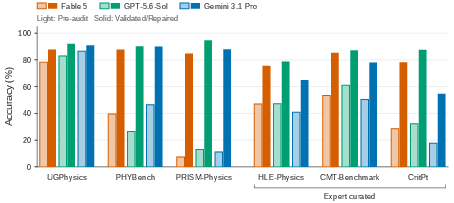
Abstract: Low reported scores on leading physics benchmarks, including those featured in the Artificial Analysis Intelligence Index (2026), suggest that frontier LLMs still struggle with advanced physics, a demanding test of their scientific reasoning and quantitative problem-solving abilities. Yet this impression does not always align with domain experts' experiences using these models in their work. We revisit these reported findings by evaluating frontier models on six widely used physics benchmarks and auditing them with experts, focusing on text-only problems with verifiable final answers. For each subfield of physics, faculty and graduate researchers with relevant expertise carefully review problem statements, reference solutions, and model responses to distinguish genuine model errors from grader errors, incorrect reference solutions, and ambiguous or underspecified questions. Most audited cases initially evaluated as incorrect reflect these benchmarking issues rather than errors in the models' physics reasoning. We then ask experts to address these benchmarking issues by correcting erroneous reference solutions and repairing or excluding flawed questions. We find that GPT-5.6-Sol's measured mean@4 rises from 47.3% to 78.7% on HLE-Physics and from 61.0% to 87.2% on CMT-Benchmark, while its corrected pass@4 reaches 94.4% on the 54 retained CritPt challenges. Corrected scores are computed on the retained evaluation subsets following expert review. Scores on the audited subsets of UGPhysics, PRISM-Physics, and PHYBench also rise substantially after correction. These findings suggest that current benchmarks substantially understate frontier models' ability to solve well-posed physics problems. Near-saturation on these closed-ended tasks highlights the need for more demanding, expert-validated evaluations.
Paper Prompts
Sign up for free to create and run prompts on this paper.
Top Community Prompts
Explain it Like I'm 14
1. ¿De qué trata el artículo?
Este artículo estudia qué tan bien pueden resolver problemas de física los modelos de inteligencia artificial más avanzados, también llamados modelos frontera.
Algunos exámenes anteriores indicaban que estos modelos eran bastante malos en física. Por ejemplo, parecían resolver correctamente solo entre el 10 % y el 60 % de ciertos problemas difíciles.
Pero los autores sospechaban que esas notas podían ser injustas. Tal vez los modelos no estaban fallando: quizá las preguntas tenían errores, las respuestas oficiales eran incorrectas o los sistemas que calificaban las respuestas no reconocían soluciones válidas.
Por eso, los investigadores volvieron a revisar varios exámenes de física con ayuda de profesores y estudiantes expertos.
2. ¿Qué querían descubrir?
La pregunta principal era:
¿Los modelos de inteligencia artificial realmente tienen problemas con la física, o los exámenes están midiendo mal sus capacidades?
Para responderla, los autores querían:
- Averiguar si los errores atribuidos a los modelos eran realmente errores de razonamiento.
- Encontrar preguntas ambiguas o incompletas.
- Revisar si las soluciones oficiales eran correctas.
- Comprobar si los calificadores rechazaban respuestas correctas escritas de otra manera.
- Volver a calcular las notas después de arreglar los problemas encontrados.
Por ejemplo, una respuesta matemática puede escribirse como o como . Ambas expresiones significan lo mismo. Sin embargo, algunos calificadores automáticos consideraban incorrecta una de ellas porque no tenía exactamente el mismo formato que la respuesta oficial.
3. ¿Cómo hicieron la investigación?
Los exámenes estudiados
Los autores probaron tres modelos avanzados:
- GPT-5.6-Sol
- Claude Fable 5
- Gemini 3.1 Pro
Los evaluaron en seis pruebas de física:
- UGPhysics, con problemas de nivel universitario.
- PHYBench, con problemas que llegan aproximadamente al nivel de las Olimpiadas de Física.
- PRISM-Physics, con problemas avanzados.
- HLE-Physics, parte de un examen general de preguntas muy difíciles.
- CMT-Benchmark, centrado en física de la materia condensada.
- CritPt, con problemas avanzados de muchas áreas de la física.
Todos eran problemas con una respuesta final concreta, como un número, una fórmula o una conclusión específica.
La auditoría de expertos
Después de obtener las notas originales, los expertos revisaron cuidadosamente:
- El texto de cada problema.
- La solución oficial.
- La respuesta dada por el modelo.
- La forma en que el sistema había calificado esa respuesta.
Una auditoría es una revisión detallada para descubrir si un resultado es confiable. Es parecida a revisar un examen con un profesor, pero también comprobando si la propia pregunta y la clave de respuestas están bien hechas.
Los expertos clasificaron cada caso en tres grupos:
| Tipo de problema | Qué significa |
|---|---|
| Error del modelo | La pregunta estaba bien, la solución oficial era correcta y el modelo respondió mal. |
| Error del calificador | El modelo respondió correctamente, pero el sistema no reconoció su respuesta. |
| Error del examen | La pregunta era ambigua, estaba incompleta o la solución oficial era incorrecta. |
Cuando era posible, los expertos reparaban las preguntas. Por ejemplo, podían añadir una condición que faltaba. Si una pregunta no se podía arreglar de manera segura, la eliminaban.
Después de eso, calcularon nuevas notas llamadas resultados corregidos o validados.
¿Qué significa “mean@4” y “pass@4”?
El artículo hizo que los modelos intentaran cada problema varias veces.
- mean@4: el promedio de aciertos en cuatro intentos.
- pass@4: el porcentaje de problemas que el modelo consiguió resolver correctamente al menos una vez en cuatro intentos.
Esto permite distinguir entre “el modelo nunca pudo resolverlo” y “el modelo lo resolvió, pero no en todos los intentos”.
4. ¿Qué encontraron?
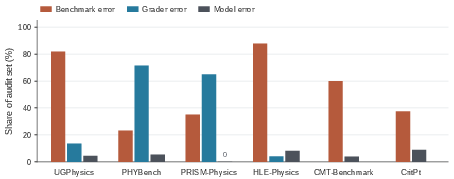
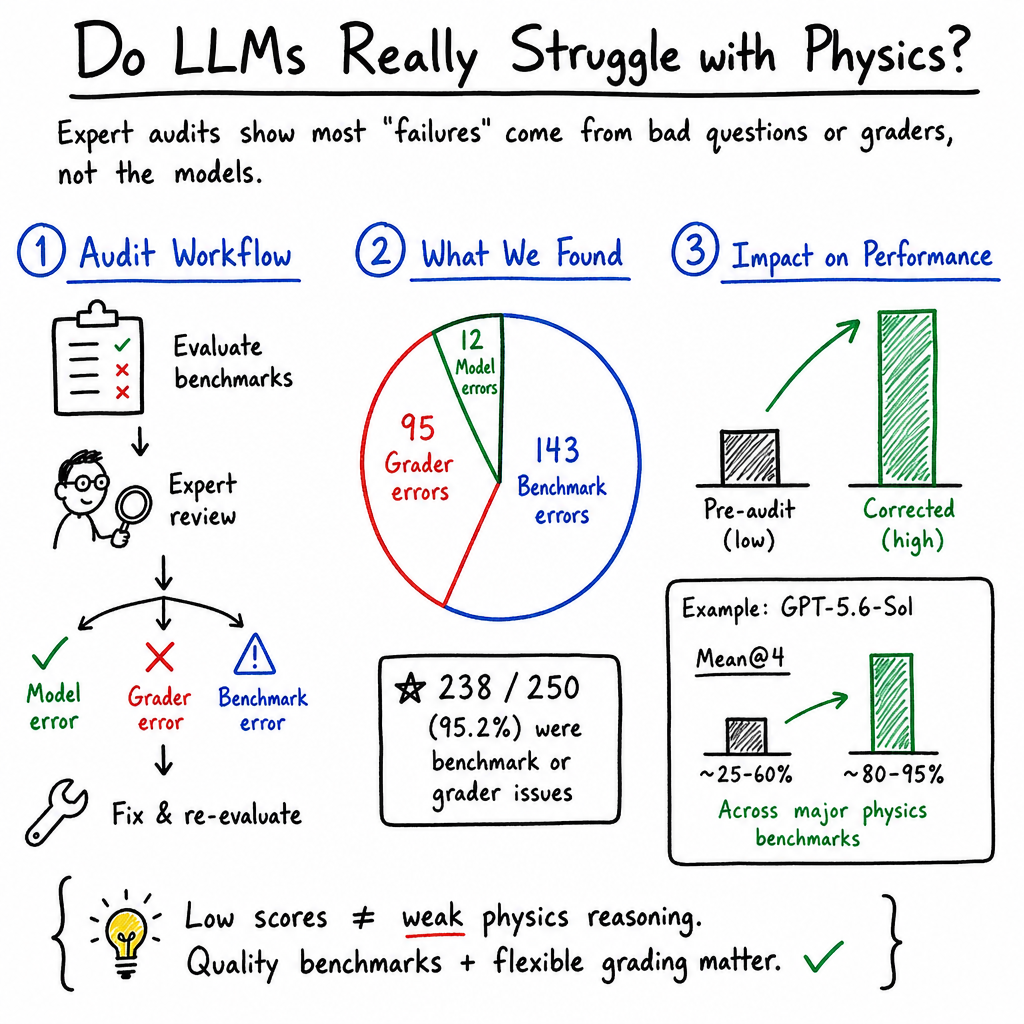
El resultado principal fue que muchos supuestos errores de los modelos no eran realmente errores de razonamiento. Eran problemas de las preguntas o de los sistemas de calificación.
En una revisión de 250 casos:
- Solo 12 casos fueron errores reales de los modelos.
- Los otros 238 casos fueron causados por errores en las preguntas, las soluciones oficiales o los calificadores.
En los tres exámenes basados en problemas públicos, los investigadores encontraron que aproximadamente el 97 % de los casos revisados se debían al examen o al calificador, no al modelo.
Las notas aumentaron mucho después de corregir los exámenes
Algunos resultados importantes para GPT-5.6-Sol fueron:
| Examen | Nota original | Nota corregida |
|---|---|---|
| PHYBench | 26.50 % | 90.23 % |
| PRISM-Physics | 13.00 % | 94.59 % |
| UGPhysics | 83.00 % | 92.07 % |
| HLE-Physics | 47.28 % | 78.66 % |
| CMT-Benchmark | 61.00 % | 87.24 % |
| CritPt | 32.29 % | 87.50 % |
En CritPt, después de la revisión, GPT-5.6-Sol resolvió correctamente al menos una vez aproximadamente el 94.44 % de los problemas conservados.
Esto no significa que el modelo sea perfecto. Todavía cometió algunos errores en preguntas válidas. Pero sus resultados reales fueron mucho mejores que los que mostraban las evaluaciones originales.
Un ejemplo de pregunta defectuosa
Una pregunta de física pedía calcular la energía de un sistema, pero no explicaba claramente qué significaban ciertas letras y símbolos.
En física, una misma letra puede representar cosas diferentes según la convención usada. Por ejemplo, una fórmula puede usar matrices de Pauli o una versión de los operadores de espín que es cuatro veces menor. Eso cambia el resultado numérico.
Los expertos añadieron la definición exacta de esos símbolos. Así, la pregunta pasó de tener varias posibles respuestas a tener una respuesta bien definida.
5. ¿Por qué son importantes estos resultados?
Una prueba solo puede medir bien a un estudiante o a una inteligencia artificial si sus preguntas y sus respuestas oficiales son correctas.
Si un examen tiene preguntas ambiguas o un calificador demasiado rígido, puede parecer que un estudiante sabe menos de lo que realmente sabe. Lo mismo ocurre con los modelos de IA.
El artículo muestra que los problemas son especialmente importantes cuando los modelos ya son muy buenos. Si un modelo falla mucho, es difícil notar los pequeños errores del examen. Pero si el modelo responde correctamente a casi todo, los errores del examen pueden convertirse en la mayor parte de los fallos observados.
Por ejemplo, un calificador automático puede funcionar razonablemente bien con respuestas sencillas, pero fallar cuando los modelos empiezan a dar respuestas correctas en muchas formas diferentes.
6. ¿Qué consecuencias podría tener esta investigación?
La principal conclusión es que los modelos avanzados parecen ser mucho mejores resolviendo problemas de física bien escritos de lo que indicaban las pruebas anteriores.
Sin embargo, esto no demuestra que puedan hacer investigación física completa por sí solos. Resolver una pregunta cerrada —con una respuesta concreta— es diferente de:
- Elegir qué problema científico estudiar.
- Decidir qué supuestos son razonables.
- Diseñar un experimento.
- Crear una teoría nueva.
- Trabajar durante semanas para resolver una pregunta abierta.
- Comprobar que un descubrimiento es realmente correcto.
Por eso, los autores creen que las futuras pruebas deberían ser más difíciles y estar revisadas cuidadosamente por expertos. También deberían incluir problemas nuevos, para evitar que los modelos ya hayan visto las respuestas durante su entrenamiento.
En resumen, el artículo dice que los modelos frontera pueden resolver muchos problemas de física de tipo escolar o universitario con una precisión cercana a la perfección, pero las pruebas actuales contienen tantos errores que hacen que su rendimiento parezca peor de lo que es. La siguiente generación de evaluaciones tendrá que ser más precisa, más difícil y mejor comprobada.
Knowledge Gaps
Knowledge gaps, limitations, and open questions
- Audit selection bias: For HLE-Physics, PHYBench, PRISM-Physics, and UGPhysics, the audit was restricted primarily to questions on which all GPT-5.6-Sol attempts were marked incorrect; this does not establish the defect rate among correctly answered or partially answered items.
- Limited and uneven audit coverage: Only subsets of the six benchmarks were audited, with coverage varying substantially across benchmarks; the reported error proportions may therefore not generalize to the full datasets.
- Small effective sample sizes: Some corrected evaluations rely on very small retained sets, such as 49 CMT-Benchmark questions and 54 CritPt challenges, making performance estimates and model comparisons statistically uncertain.
- No confidence intervals or formal significance tests: The paper reports percentage scores without uncertainty estimates, item-level variance analyses, or statistical tests showing whether differences between models or pre-audit and corrected results are robust.
- Non-comparable pre-audit and corrected scores: Corrected scores are often computed after excluding or repairing questions and, for CritPt, using different numbers of attempts and a different metric (
mean@4versus pre-auditmean@5), so the magnitude of improvement cannot be interpreted as a clean causal effect of benchmark repair. - Subjective repair decisions: The criteria for repairing versus excluding defective questions may depend on auditor judgment, and the paper does not quantify how alternative reasonable repairs would affect model rankings or scores.
- Insufficient inter-rater reliability evidence: The study does not report independent double-coding rates, agreement statistics, adjudication procedures, or the extent to which experts disagreed about whether an item was ambiguous, repairable, or incorrectly solved.
- Potential auditor and institutional bias: Auditors were primarily based at Yale and were matched to subfields by the study team; the robustness of classifications across institutions, research traditions, and disciplinary conventions remains untested.
- Possible evaluator circularity: Corrected evaluations use an HLE-adapted LLM judge, while the study’s central claim concerns weaknesses in evaluation systems; independent human grading, formal symbolic verification, or multiple blinded judges are needed to establish that the corrected scores are not artifacts of the replacement evaluator.
- Unquantified errors in the corrected judge: The reported 4.08% grader-error rate is based on audited cases and may not represent the evaluator’s error rate on all retained questions, especially on more difficult or unusual answers.
- Incomplete attribution of partial correctness: The three-way classification—model error, grader error, and benchmark error—does not fully capture partially correct derivations, correct reasoning with numerical slips, uncertainty about conventions, or errors introduced by tool use.
- Model-specific audit dependence: Many audit decisions were made using GPT-5.6-Sol’s rejected responses, so the corrected benchmark may be optimized around one model’s answers and may not be equally valid for other models or future systems.
- Unequal model evaluation conditions: The models differ in tool access, reasoning settings, attempt budgets, and possibly system prompts; consequently, the comparisons do not isolate model capability from evaluation configuration.
- No systematic ablation of tools and prompting: The paper does not determine how much of the corrected performance comes from external tools, repeated attempts, reasoning effort, evaluator prompts, or other elements of the evaluation harness.
- Training-data contamination remains unresolved: Three benchmarks draw on public problems and solutions, but the study does not test for memorization or contamination; high scores on these datasets may therefore overestimate general physics reasoning.
- Limited assessment of generalization: The evaluation uses closed-ended, text-only questions with verifiable final answers and does not establish performance on novel problem formulations, incomplete information, experimental data, diagrams, simulations, laboratory tasks, or open-ended modeling.
- Weak evidence for end-to-end physics research ability: The paper acknowledges that benchmark success does not imply research competence, but it does not provide a systematic evaluation of hypothesis generation, experimental design, literature synthesis, theory development, reproducibility, or sustained autonomous research.
- Narrow representation of physics: The six benchmarks do not necessarily cover all physics subfields, levels of expertise, mathematical formalisms, or culturally diverse problem-solving conventions; performance in omitted areas remains unknown.
- Near-saturation claims may be benchmark-specific: The conclusion that frontier models can solve “almost no” closed-ended physics problems beyond their reach is not supported by a systematically constructed set of new, adversarial, or independently held-out hard problems.
- Difficulty calibration is missing: The paper does not establish the human performance distribution, expert agreement, time requirements, or pedagogical difficulty of the retained and repaired items, making it difficult to interpret scores as scientific reasoning ability.
- No analysis of failure modes among retained items: The paper reports aggregate corrected accuracy but provides limited systematic analysis of the remaining model errors, including whether they arise from conceptual misunderstandings, algebraic mistakes, numerical instability, tool misuse, or sensitivity to wording.
- Robustness to problem perturbations is untested: It remains unknown whether models retain their performance when numerical values, notation, boundary conditions, wording, diagrams, or equivalent physical representations are changed.
- Evaluation reproducibility is uncertain: The study does not fully establish whether the results are reproducible across model API versions, random seeds, sampling temperatures, repeated evaluation dates, or independent implementations of the judging pipeline.
- Potential conflict-of-interest effects are not examined: The paper reports support from an AI-related industry sponsor and evaluates frontier models, but it does not provide analyses of whether sponsorship, model access, or benchmark-selection decisions could influence the conclusions.
- Future benchmark design is underspecified: Although the paper calls for expert-validated and more difficult evaluations, it does not define operational standards for item verification, contamination prevention, evaluator validation, maintenance, statistical power, or fair comparison across models.
Practical Applications
Immediate Applications
- Benchmark validation for AI evaluation organizations and model developers — AI/software
- Adopt the paper’s audit workflow before publishing or relying on physics benchmark scores: independently verify problem statements, re-derive reference answers, test whether questions are fully specified, and compare model outputs using semantic rather than exact-string matching.
- Build evaluation pipelines that explicitly distinguish:
- genuine model errors,
- grader errors,
- incorrect reference solutions, and
- ambiguous or underspecified questions.
- Potential tools: benchmark-auditing dashboards, expert-review queues, answer-equivalence checkers, and metadata schemas recording validation status and known assumptions.
- Dependencies: access to qualified domain experts, sufficient review time, and transparent benchmark materials. Corrected scores may not be directly comparable with original scores if defective items are removed or repaired.
- Replacing brittle exact-match grading in quantitative domains — Education, scientific computing, software
- Deploy symbolic normalization and semantic answer checking for physics, mathematics, engineering, and finance problems. The paper demonstrates that algebraically equivalent answers—such as different factorizations or rationalized expressions—can be incorrectly rejected by rule-based graders.
- A practical grading workflow can combine:
- 1. unit and dimensional checks,
- 2. symbolic algebraic equivalence,
- 3. numerical tolerance checks,
- 4. convention-aware parsing, and
- 5. an independently validated LLM judge for unresolved cases.
- Potential products: automated homework graders, scientific response evaluators, coding-agent test harnesses, and benchmark scoring APIs.
- Dependencies: reliable parsers, explicitly documented conventions, safeguards against LLM-judge bias, and human escalation for ambiguous cases.
- Quality control for existing educational assessment banks — Education
- Universities, online-course providers, and textbook publishers can audit physics question banks for missing boundary conditions, inconsistent assumptions, incorrect solutions, and ambiguous notation.
- The workflow is immediately useful for undergraduate mechanics, electromagnetism, quantum mechanics, and condensed-matter exercises, especially where automated grading is used at scale.
- Potential workflow: sample questions with high disagreement or unexpectedly low model/student performance, route them to subject-matter reviewers, repair or retire defective items, and version the corrected bank.
- Dependencies: reviewer expertise and a clear policy for whether repaired questions retain historical statistics.
- More reliable evaluation of AI tutoring and homework assistants — Education
- Use corrected benchmarks to test whether an AI tutor genuinely solves well-posed problems rather than merely matching reference wording. The reported corrected scores—often above 85–90% on retained subsets—suggest that frontier models can already handle many closed-ended, problem-set-style physics tasks.
- This supports immediate deployment for:
- step-by-step explanations,
- alternative derivations,
- checking student work,
- generating practice problems, and
- identifying likely algebraic or conceptual mistakes.
- Dependencies: human oversight for advanced topics, accurate problem specifications, calibrated uncertainty, and safeguards against students treating generated solutions as authoritative.
- AI-assisted routine scientific and engineering calculations — Research, engineering, energy, robotics
- Researchers and engineers can use frontier models as assistants for well-defined calculations such as symbolic derivations, order-of-magnitude estimates, parameter substitutions, and interpretation of standard physics formulas.
- The paper supports using these systems for closed-ended and verifiable tasks, not as autonomous scientific authorities.
- Potential tools: notebook copilots, equation-solving assistants, simulation-preparation agents, and document assistants that connect model outputs to computer algebra systems or numerical solvers.
- Dependencies: external verification, correct units and conventions, tool access where necessary, and expert review for safety-critical or novel results.
- Improved model selection and procurement decisions — Industry and public-sector technology
- Organizations should not reject a model solely because of low raw scores on physics or quantitative benchmarks. Procurement evaluations can require validated subsets, transparent audit reports, and separate reporting of model and evaluator error.
- This is relevant to companies selecting models for technical support, engineering design, quantitative analysis, or scientific literature workflows.
- Dependencies: independent auditing is needed to avoid replacing one biased evaluation with another; corrected benchmark results should be reported with confidence intervals and item counts.
- Daily-life use of physics-capable assistants — Consumer software
- Consumers can use current frontier models for ordinary, well-specified tasks such as unit conversion, basic mechanics, electricity calculations, optics explanations, and interpretation of textbook problems.
- The practical workflow should require the user to state assumptions explicitly—for example, frictionless surfaces, sign conventions, or units—and should encourage calculator or reference checks for consequential decisions.
- Dependencies: the paper does not establish reliability for medical, structural, electrical-safety, or other high-risk advice. Near-saturation on benchmark-style questions should not be generalized to real-world physical environments.
- Policy and research reporting standards for AI benchmarks — Government, academia, funding agencies
- Benchmark creators and grant reviewers can require:
- expert validation of questions and solutions,
- documentation of assumptions and conventions,
- separate accounting of grader errors,
- reporting of retained and excluded items,
- contamination analysis,
- multiple-attempt metrics such as
mean@kandpass@k, and - release of audit data and evaluation prompts.
- This would make published model comparisons more reproducible and reduce incentives to optimize for flawed scoring procedures.
- Dependencies: funding for expert review and agreement on common validation standards across institutions.
Long-Term Applications
- Expert-validated, dynamically maintained benchmarks for advanced scientific reasoning — AI research and academia
- Develop continuously refreshed benchmarks composed of newly authored, difficult physics tasks with independent derivations, explicit assumptions, and adversarial checks for ambiguity. Items should be retired or revised when contamination, leakage, or saturation becomes likely.
- A mature benchmark could include:
- open-ended derivations,
- numerical and symbolic verification,
- experimental-data interpretation,
- model selection,
- uncertainty analysis, and
- multi-step research planning.
- Dependencies: substantial financial resources, a large international expert network, secure item generation, and executable or independently checkable validation procedures.
- Evaluation of end-to-end AI physics research agents — Scientific research
- The paper distinguishes strong performance on closed-ended questions from difficulty with open physics problems. A longer-term application is a benchmark for agents that must formulate hypotheses, select assumptions, design calculations, run simulations, compare with data, and produce reproducible research artifacts.
- Potential tools: agent systems connected to symbolic algebra, numerical solvers, laboratory databases, simulation platforms, and theorem or code verifiers.
- Dependencies: reliable external checkers, evaluation of originality and reproducibility, substantial inference budgets, and human experts capable of assessing research-level validity.
- Autonomous or semi-autonomous engineering design assistants — Robotics, energy, aerospace, manufacturing
- Once models are tested on physical systems rather than only text questions, they could assist with controller design, materials selection, energy-system optimization, robotics dynamics, and aerodynamic or electromagnetic configuration.
- The paper’s findings support using models for the analytical component of these workflows, while the long-term challenge is connecting them safely to simulation and hardware feedback.
- Dependencies: accurate simulators, robust uncertainty quantification, hardware-in-the-loop testing, formal safety constraints, and certification before deployment.
- Scientific discovery and literature-to-model pipelines — Physics, materials science, climate and energy
- Frontier models could eventually integrate literature retrieval, equation extraction, hypothesis generation, symbolic derivation, simulation, and experimental comparison to accelerate work in condensed matter, quantum systems, materials, and energy science.
- The paper’s audit methodology could serve as a validation layer for generated derivations and reference solutions before they enter a research workflow.
- Dependencies: models must improve beyond benchmark-style reasoning; domain knowledge, experimental validation, provenance tracking, and protection against plausible but incorrect derivations remain essential.
- Cross-domain benchmark auditing for finance, software, medicine, and law — Policy and industry
- The same failure modes identified in physics—wrong reference answers, ambiguous specifications, and evaluators that reject equivalent outputs—can affect quantitative finance tasks, software-engineering benchmarks, clinical reasoning datasets, and legal question banks.
- Organizations could create domain-specific audit protocols that classify errors by source rather than treating every failed model response as a model failure.
- Dependencies: domain-specific notions of correctness, privacy and regulatory constraints, reproducible ground truth, and independent auditors.
- Adaptive evaluation that remains informative near saturation — AI safety and governance
- Because fixed closed-ended benchmarks lose discriminative power when models approach very high accuracy, future systems could use adaptive item generation: increase difficulty, introduce novel contexts, require calibrated uncertainty, and test whether the model can detect underspecification rather than silently assume an answer.
- Evaluation could score not only final answers but also:
- assumption identification,
- dimensional consistency,
- robustness to alternate conventions,
- error correction,
- reproducibility, and
- appropriate refusal or escalation.
- Dependencies: validated difficulty calibration, protection against benchmark contamination, and reliable scoring of reasoning processes without rewarding verbose but incorrect explanations.
- Human–AI expert review marketplaces and collaborative auditing — Academia and policy
- The paper suggests a scalable institutional model in which experts review benchmark items through funded nonprofit programs, open competitions, or distributed audit platforms.
- Such platforms could assign questions by specialization, collect independent solutions, resolve disagreements, and publish versioned benchmark releases with audit trails.
- Dependencies: fair compensation, conflict-of-interest controls, reviewer agreement metrics, secure handling of unreleased questions, and governance over who can modify benchmark items.
Glossary
- Agentic harness: A framework that coordinates an AI model, tools, and iterative procedures to perform complex tasks. “we used GPT-based agentic harnesses of the kind that have been used successfully on open mathematics conjectures”
- Ambiguity: A lack of sufficient specificity that permits multiple reasonable interpretations. “This includes an incorrect reference solution, inconsistent conditions, ambiguity, or a missing assumption.”
- Answer equivalence: The property of two answers expressing the same result despite differing notation or form. “use the same procedure to assess answer equivalence.”
- Auxiliary LLM judge: A secondary LLM used to evaluate another model’s responses. “where the benchmark's evaluator already includes an auxiliary LLM judge”
- Benchmark contamination: The presence of evaluation questions or solutions in a model’s training data, potentially inflating performance. “creating a potential route for training-data contamination.”
- Binary score: An evaluation value with only two possible outcomes, typically correct or incorrect. “Pre-audit grader error: EED score 0.0, binary score 0”
- Bravais lattice: A regularly repeating arrangement of points used to represent crystal structures. “on a 3x2 Bravais lattice with periodic boundary conditions.”
- Closed-ended benchmark: An evaluation set in which each question is intended to have a definite answer. “All six are closed-ended benchmarks.”
- Condensed matter theory: The study of collective physical properties of matter, especially solids and quantum materials. “CMT-Benchmark focuses on advanced condensed matter theory”
- Convention: A specified choice of notation, normalization, sign, or representation used in a technical calculation. “clarifying a convention needed to determine the intended answer”
- Critical point: A threshold or special condition at which a system undergoes a qualitative change in behavior. “Probing the Critical Point ({CritPt}) of {AI} Reasoning”
- Curation: The expert selection, organization, and quality control of data or evaluation questions. “expert-curated challenges”
- Degenerate ground state: One of multiple distinct lowest-energy states having the same energy. “How many degenerate ground states are there?”
- Expression Edit Distance (EED): A metric that measures the edits required to transform one mathematical expression into another. “A correct answer in an equivalent form receives zero credit in PHYBench's Expression Edit Distance (EED) evaluation.”
- Factorization theorem: A mathematical result showing that a complex object can be decomposed into simpler factors. “a new factorization theorem”
- Flux-free sector: The subset of states in a lattice model with zero effective gauge flux through the relevant plaquettes. “How many of them are in the flux-free sector?”
- Frontier model: A highly capable, state-of-the-art artificial intelligence model. “We evaluate three frontier models”
- Grader error: An evaluation failure in which a correct model response is judged incorrect. “Grader error. The problem is well posed, the reference solution is correct, and the model under test gives a correct answer, but the evaluator marks it incorrect.”
- Ground state: The lowest-energy state available to a physical system. “Compute the energy of the ground states with three decimal precision.”
- Hamiltonian: An operator or function representing the total energy of a physical system. “To fix the normalization and sign convention unambiguously, take ”
- Held-out question: An evaluation question withheld from model development or training. “None of these is a score on held-out questions.”
- Homogeneous sphere: A sphere whose mass or material properties are uniformly distributed. “Three identical homogeneous balls are placed on a smooth horizontal surface”
- Isotropic limit: A regime in which directional parameters or couplings are equal in all relevant directions. “Consider the Kitaev honeycomb model at the isotropic limit”
- Kitaev honeycomb model: A quantum spin model defined on a honeycomb lattice with direction-dependent interactions. “Consider the Kitaev honeycomb model at the isotropic limit”
- LLM judge: A LLM used to assess the quality or correctness of another model’s output. “LLM judges grade more flexibly”
- Mean@4: The average accuracy obtained over four independent model attempts for each question. “We report mean@4, except for the pre-audit CritPt scores described below.”
- Near-saturation: A condition in which measured performance is approaching the maximum possible score. “Near-saturation on these closed-ended tasks highlights the need for more demanding, expert-validated evaluations.”
- Normalization: A scaling or convention that fixes the numerical magnitude of a mathematical or physical quantity. “To fix the normalization and sign convention unambiguously”
- Pass@4: The fraction of questions for which at least one of four model attempts is correct. “We also report pass@4, the fraction of questions solved in at least one of four attempts.”
- Periodic boundary conditions: Conditions that connect the edges of a finite system so that it behaves as though it repeats indefinitely. “on a 3x2 Bravais lattice with periodic boundary conditions.”
- Process-level evaluation: Assessment of the intermediate reasoning or steps used to produce an answer, rather than only the final result. “contains advanced physics problems with both final-answer and process-level evaluation”
- Reference solution: An authoritative answer or derivation used to evaluate a model’s response. “Some benchmarks also supply a worked solution, a derivation of that answer.”
- Rule-based evaluator: An evaluation system that applies explicitly programmed matching or decision rules. “This happens mainly with rule-based evaluators”
- Sign convention: A chosen assignment of positive and negative signs in a mathematical or physical formulation. “The correction makes the problem well posed and gives it a unique answer.”
- Symbolic evaluator: A program that compares or manipulates mathematical expressions according to their symbolic structure. “rule-based evaluators, whether exact-match or symbolic”
- System prompt: Instructions provided to a LLM that define its role, behavior, or task constraints. “including its system prompt and LLM-judge prompt”
- Training-data contamination: The unintended overlap between benchmark content and the data used to train a model. “creating a potential route for training-data contamination.”
- Underspecified question: A question lacking information needed to determine a unique answer. “because the question is underspecified or because competent people read it differently.”
- Validated/repaired evaluation: An evaluation performed after experts correct, clarify, or remove defective questions or solutions. “We label the resulting evaluations ``validated/repaired''”
- Well-posed problem: A problem with sufficiently precise conditions and a determinate solution. “The problem is well posed and the reference solution is correct”
- Worked solution: A solution that includes the derivation or intermediate reasoning leading to the final answer. “Some benchmarks also supply a worked solution, a derivation of that answer.”

