MoEMB: Scaling Universal Multimodal Embeddings with Efficient Mixture-of-Experts Models
Abstract: Universal multimodal embedding (UME) increasingly demands encoder's capacity for handling a broad range of tasks and modalities with increased complexity. Prior scaling methods either increase the representation size, retrieval effort, or scales the encoder into a heavy multimodal LLM. Recent works, such as Think-Then-Embed (TTE), explore scaling via reasoning tokens. However, embedding models are hard to scale up: increasing parameters directly tradeoffs for the large training batch size that contrastive learning needs, and retrieval has to be served under tight latency. Moreover, UME tasks are diverse in complexity, where scaling up embedders can bring significant redundant computation. In this work, we propose MOEMB, which instead scales UME along the expert axis through mixture-of-experts (MoE), growing encoder capacity while preserving single-vector, non-autoregressive encoding. Through a systematic study of the design space and training recipes for MoE-based UME, MoEMB sets a new state of the art on both MMEB-V2 and MRMR among models trained on public MMEB-family data: with only 3B active parameters, MoEMB surpasses TTE-based methods with >4x active parameters, using significantly less computes. To further improve the scalability and efficiency, we conduct the first comprehensive study of adaptive computation for MoE-based embedding, spanning diverse strategies across training-based and inference-only methods. Together, these results support expert scaling as an effective and efficient direction for UME, with adaptive computation further improving efficiency for MLLM-based embedding models towards large-scale retrieval and recommendation systems.

Paper Prompts
Sign up for free to create and run prompts on this paper.
Explain it Like I'm 14
1. ¿De qué trata el artículo?
El artículo presenta MoEMB, un modelo de inteligencia artificial diseñado para buscar y comparar información de distintos tipos, como:
- texto,
- imágenes,
- videos,
- documentos visuales.
El modelo convierte cada elemento en una representación numérica llamada embedding. Puede imaginarse como colocar textos e imágenes en un enorme mapa matemático: los elementos con significados parecidos quedan cerca unos de otros.
El objetivo principal es crear un modelo que sea:
- más preciso para tareas variadas;
- más rápido y barato de usar;
- capaz de trabajar con muchos tipos de información sin necesitar un modelo diferente para cada tarea.
2. ¿Qué preguntas intenta responder?
El estudio intenta resolver varios problemas:
- ¿Cómo se puede hacer que un modelo multimodal sea más inteligente sin aumentar demasiado el tiempo de cálculo?
- ¿Es mejor aumentar el tamaño de la representación final o mejorar directamente el “cerebro” del modelo?
- ¿Puede un modelo aprender muchas tareas diferentes sin que unas interfieran con otras?
- ¿Se puede hacer que el modelo use menos cálculo cuando una tarea es sencilla?
- ¿Puede superar a modelos que generan pasos intermedios de razonamiento, pero que son mucho más lentos?
En pocas palabras, los investigadores preguntan:
¿Podemos construir un modelo que entienda mejor imágenes, textos y videos, pero que siga siendo rápido para buscar información?
3. ¿Cómo hicieron la investigación?
Embeddings: convertir información en números
Primero, MoEMB transforma una consulta y un posible resultado en vectores, es decir, listas largas de números. Después compara esos vectores.
Por ejemplo, si alguien busca:
“un perro jugando en la nieve”
una imagen de un perro jugando en la nieve debería producir un vector parecido al de la frase. Si la imagen muestra una bicicleta, su vector debería quedar más lejos.
El modelo aprende esto comparando respuestas correctas con respuestas incorrectas. Durante el entrenamiento, intenta acercar las parejas correctas y alejar las incorrectas. Este método se llama aprendizaje contrastivo.
Una analogía sería enseñar a un estudiante con tarjetas: se le muestra una pregunta y varias respuestas, y debe aprender cuál combina mejor con ella.
Mixture-of-Experts: varios especialistas dentro de un modelo
La principal idea de MoEMB es usar una arquitectura llamada Mixture-of-Experts, o mezcla de expertos.
En lugar de tener un único bloque que procese todos los datos, el modelo contiene muchos “expertos” especializados. Un pequeño sistema llamado router decide qué expertos deben trabajar con cada parte de la información.
Por ejemplo:
- un experto puede ser especialmente útil para texto;
- otro puede ayudar con imágenes;
- otro puede reconocer documentos;
- otro puede manejar preguntas difíciles.
No todos los expertos trabajan al mismo tiempo. Para cada dato, el router selecciona solo algunos. Esto permite que el modelo tenga muchos parámetros en total, pero use solo una parte en cada operación.
Es parecido a una escuela con muchos profesores: no todos enseñan cada clase; se elige a los profesores más adecuados para cada tema.
Tres formas de construir el modelo
Los investigadores compararon tres diseños:
- MoE nativo: usar un modelo que ya tenía expertos entrenados previamente.
- Convertir un modelo denso en MoE: copiar partes de un modelo normal para crear varios expertos.
- Expertos por modalidad: enviar texto, imágenes u otros tipos de datos a expertos determinados.
El primer método funcionó mejor, probablemente porque sus expertos y su router ya habían aprendido mucho durante el entrenamiento original.
Métodos para reducir el cálculo
También probaron varias formas de ahorrar recursos:
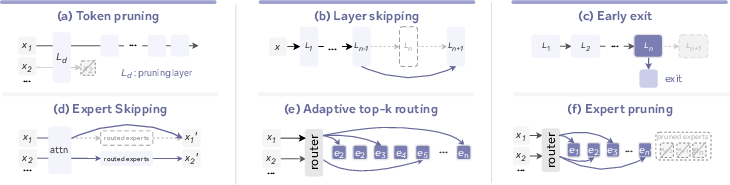
- Eliminar tokens: quitar partes poco importantes de una imagen o texto.
- Saltar capas: no usar algunas capas del modelo cuando no son necesarias.
- Saltar expertos: evitar expertos que probablemente no ayudarán.
- Usar menos expertos: elegir dinámicamente solo los expertos más importantes.
- Eliminar expertos permanentemente: quitar expertos que casi nunca se utilizan.
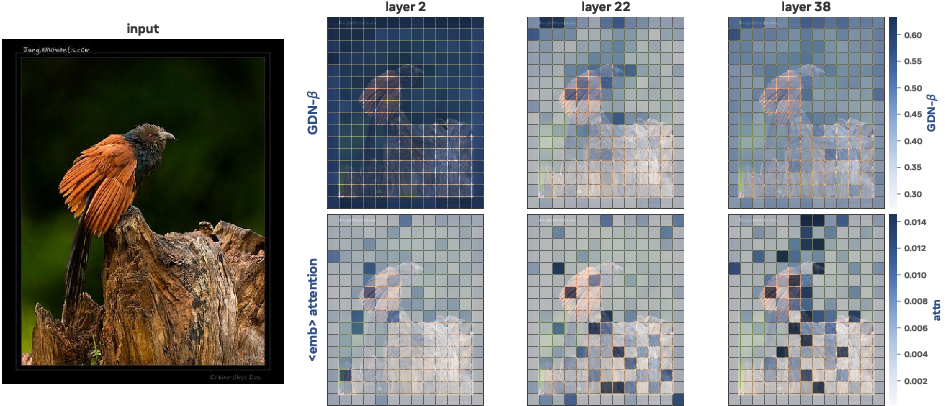
Para decidir qué partes eran importantes, usaron señales internas del modelo. Una de ellas, llamada β, indica cuánto está escribiendo cada token en la memoria del sistema. Un token con un valor alto puede ser más relevante.
Finalmente, no solo midieron el número teórico de operaciones. También comprobaron si esas reducciones producían una mejora real en la velocidad del ordenador.
4. ¿Cuáles fueron los principales resultados?
MoEMB obtuvo mejores resultados
MoEMB fue probado en dos grandes conjuntos de pruebas:
- MMEB-V2, con 78 tareas de imágenes, videos y documentos;
- MRMR, que requiere razonamiento más complejo, como detectar contradicciones o identificar teoremas.
En MMEB-V2, el modelo MoEMB-A3B obtuvo una puntuación general de 70.4, usando aproximadamente 3.1 mil millones de parámetros activos. Esto superó a otros modelos que utilizaban más parámetros y más cálculo.
Una versión más grande, MoEMB-A10B, alcanzó 72.4.
En MRMR, MoEMB-A3B obtuvo 51.6, superando modelos con entre 7 y 13.2 mil millones de parámetros activos.
| Modelo | Parámetros activos aproximados | MMEB-V2 | MRMR |
|---|---|---|---|
| MoEMB-A3B | 3.1B | 70.4 | 51.6 |
| MoEMB-A10B | 10.2B | 72.4 | — |
| UME-R1-7B | 8.3B | 65.6 | 48.2 |
| Embed-RL-4B | 13.2B | 68.1 | 46.8 |
Estos resultados son importantes porque muestran que un modelo más pequeño puede ser mejor si utiliza sus recursos de manera inteligente.
Aumentar los expertos mejoró la precisión sin ralentizar demasiado el modelo
Cuando los investigadores aumentaron el número total de expertos de 32 a 256, la precisión mejoró en más de 10 puntos.
Sin embargo, como el modelo solo activa unos pocos expertos para cada token, la velocidad cambió muy poco. Es decir, el modelo ganó más conocimientos disponibles sin tener que usar todos al mismo tiempo.
Esta fue una de las ideas centrales del artículo:
Aumentar el número de expertos puede ser más útil que hacer que todos los cálculos del modelo sean más grandes.
El razonamiento paso a paso era mucho más lento
Algunos modelos anteriores generan pensamientos o pasos intermedios antes de producir el embedding. Esto puede ayudar con tareas difíciles, pero requiere mucho tiempo.
Según el artículo, un modelo con razonamiento podía reducir la velocidad de 41 consultas por segundo a solo 0.11, aproximadamente 370 veces más lento.
MoEMB consiguió mejores resultados sin necesitar ese largo proceso de razonamiento adicional.
Se pudo ahorrar cerca de la mitad del cálculo
Los mejores métodos de cálculo adaptativo, especialmente:
- eliminar tokens poco importantes;
- elegir dinámicamente cuántos expertos usar;
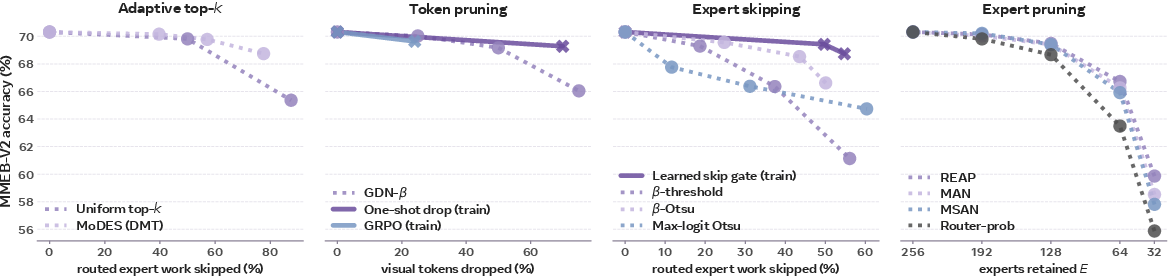
permitieron ahorrar aproximadamente 50 % del cálculo con una pérdida de precisión menor al 1 %.
Esto significa que el modelo podía ser casi igual de bueno, pero consumir muchos menos recursos.
Algunos métodos no funcionaron bien
No todas las ideas fueron exitosas. Por ejemplo:
- convertir un modelo denso en uno de expertos no mejoró los resultados;
- obligar al router a repartir el trabajo de manera demasiado equilibrada perjudicó el rendimiento;
- usar información adicional sobre la tarea o la instrucción para cambiar las decisiones del router no ayudó;
- combinar demasiados métodos de ahorro al mismo tiempo podía hacer que el entrenamiento fuera inestable.
Un resultado interesante fue que el mejor router fue, en general, el router original, sin modificarlo demasiado. Esto sugiere que los expertos ya estaban bien organizados gracias a su entrenamiento previo.
5. ¿Por qué es importante este trabajo?
El estudio muestra una nueva forma de hacer crecer los modelos de inteligencia artificial. En vez de activar un modelo enorme completo para cada consulta, MoEMB utiliza muchos expertos, pero selecciona solo los necesarios.
Esto podría hacer que los sistemas de búsqueda y recomendación sean:
- más precisos;
- más rápidos;
- menos costosos;
- capaces de comprender texto, imágenes, videos y documentos juntos;
- más fáciles de utilizar en servicios con millones de consultas.
Por ejemplo, una aplicación podría usar MoEMB para encontrar imágenes relacionadas con una pregunta, buscar información dentro de documentos escaneados o localizar un momento concreto de un video.
Conclusión
El artículo concluye que la mezcla de expertos es una buena manera de mejorar los modelos multimodales sin aumentar demasiado el costo de funcionamiento. MoEMB obtuvo resultados superiores a varios modelos más grandes y lentos, especialmente en tareas que requieren entender relaciones complejas entre texto e imágenes.
Además, el modelo puede ahorrar una gran cantidad de cálculo si decide qué tokens, capas o expertos son realmente necesarios. En el futuro, estas ideas podrían ayudar a construir sistemas de búsqueda y asistentes de inteligencia artificial más rápidos, económicos y capaces de manejar muchos tipos de información al mismo tiempo.
Practical Applications
Immediate Applications
- Multimodal search and retrieval platforms — software, e-commerce, and media
- Deploy MoEMB-style encoders to map text, images, video, and visual documents into a shared embedding space for semantic search, product discovery, duplicate detection, and content recommendation.
- The reported performance of 70.4 on MMEB-V2 with approximately 3.1B active parameters and high throughput suggests a practical alternative to autoregressive “think-then-embed” pipelines for large-scale retrieval.
- Potential products include:
- Image-to-product and text-to-product search.
- Natural-language search over video archives.
- Cross-modal enterprise search over PDFs, scans, diagrams, and presentations.
- Unified recommendation systems for text, images, and video.
- Dependencies: Production deployment requires compatible multimodal input preprocessing, vector databases, GPU support for sparse MoE routing, and validation on domain-specific data. Benchmark gains may not transfer directly to proprietary catalogs or highly specialized content.
- Visual document search and enterprise knowledge management — legal, finance, healthcare, and government
- Use a single embedding service for OCR text, page images, tables, forms, charts, and user instructions. This can support retrieval-augmented generation, document similarity, case-law search, compliance investigation, and records management.
- MoEMB performs strongly on visual-document subsets and achieves high scores on VisDoc-related tasks, making it suitable for workflows where text-only indexing loses layout or visual context.
- A practical workflow is:
- 1. Convert each document page or document segment into an embedding.
- 2. Store vectors with metadata and access-control labels.
- 3. Embed user queries using the same instruction-conditioned encoder.
- 4. Retrieve candidate pages or documents for downstream ranking or generation.
- Dependencies: OCR quality, document segmentation, access-control enforcement, data privacy, and evaluation against domain-specific terminology are critical. Retrieval should not be treated as proof of factual correctness.
- High-throughput multimodal recommendation — social platforms, streaming, and advertising
- Use sparse MoE embeddings to represent user queries, posts, advertisements, thumbnails, short videos, and product assets while keeping active computation bounded through top- expert routing.
- The paper reports that increasing the total number of experts from 32 to 256 improved accuracy by more than 10 points while producing only a small QPS reduction, because the number of active experts remained fixed.
- This supports a two-stage architecture:
- MoEMB for candidate generation and approximate nearest-neighbor retrieval.
- A smaller cross-encoder or ranking model for final personalization and policy checks.
- Dependencies: Recommendation quality also depends on behavioral signals, freshness, diversity constraints, content moderation, and latency guarantees. Expert routing may create uneven hardware utilization unless grouped-GEMM or equivalent kernels are available.
- Large-scale video retrieval and indexing — entertainment, security, journalism, and research archives
- Encode video clips, keyframes, subtitles, and natural-language queries in one shared space for moment retrieval, scene search, archive navigation, and content reuse.
- The model’s evaluation across video classification, question answering, retrieval, and moment retrieval indicates applicability beyond static image search.
- Token pruning can reduce the cost of processing long visual sequences, particularly when many visual tokens are redundant.
- Dependencies: Effective deployment requires temporal segmentation, representative frame selection, robust handling of long videos, and careful testing for missed events. Security and surveillance uses additionally require legal authorization, privacy safeguards, and human review.
- Low-cost multimodal retrieval inference — cloud services and edge-adjacent systems
- Apply inference-only adaptive computation to reduce serving cost without retraining the model:
- Adaptive top- expert routing.
- Visual-token pruning based on Gated DeltaNet scores.
- Permanent expert pruning for lower memory requirements.
- The reported inference-only configuration achieved roughly 50% expert skipping with less than 1% overall accuracy degradation in the broader study, while the representative adaptive top- result reduced FLOPs by about 11.6% and increased QPS by approximately 1.19 times.
- These mechanisms can support dynamic service tiers, such as:
- Full computation for difficult queries.
- Reduced computation for simple text or image matching.
- Strict latency modes for interactive applications.
- Dependencies: FLOP reductions translate into wall-clock improvements only when the runtime supports packed variable-length sequences and fused or grouped expert kernels. Hardware-specific benchmarking is necessary.
- Domain-specific multimodal embedding fine-tuning — academic and industrial ML teams
- Adapt a pretrained sparse multimodal MoE to a new retrieval domain using contrastive learning, a dedicated embedding token, and parameter-efficient LoRA updates.
- The paper’s ablations provide a practical recipe:
- Start from a native pretrained sparse MoE rather than upcycling a dense model.
- Preserve or freeze the pretrained router.
- Use a dedicated
<emb>pooling token. - Maintain a large global batch for abundant in-batch negatives.
- Prefer conservative learning rates during adaptation.
- This can be used to build specialized embedders for scientific literature, engineering drawings, medical imaging archives, or financial documents.
- Dependencies: Training requires substantial GPU memory, distributed expert parallelism, large batches, carefully constructed positive pairs, and representative negative examples. The paper does not establish safety or accuracy for regulated domains.
- Efficient benchmark and dataset exploration — academia
- Researchers can use MoEMB as a common embedding backbone for multimodal retrieval, grounding, classification, and question-answering experiments rather than maintaining separate encoders for each modality.
- The native sparse-MoE, dense-to-MoE, and modality-level variants provide controlled baselines for studying capacity scaling and task interference.
- Adaptive inference can make large benchmark sweeps more affordable, especially for candidate-side encoding, which is often the dominant cost.
- Dependencies: Results should be reproduced using clearly separated in-domain and out-of-domain data. The paper emphasizes that external data can cause domain leakage, so evaluation protocols must report training-data provenance.
- Policy and public-sector information access
- Government agencies, libraries, and public institutions can use multimodal embeddings to search scanned records, maps, forms, photographs, videos, and textual archives through natural-language or image queries.
- Adaptive compute can reduce infrastructure costs for large collections while preserving a full-compute path for sensitive or ambiguous searches.
- Dependencies: Deployment must address public-record retention, accessibility, multilingual coverage, personally identifiable information, auditability, and the possibility of systematic retrieval bias.
Long-Term Applications
- Unified multimodal enterprise agents and retrieval-augmented systems — enterprise software
- MoEMB could serve as the retrieval layer for agents that search across email, documents, screenshots, diagrams, videos, and structured business records.
- A future system could use routing signals to select specialized experts for different content types while retaining a shared embedding space for cross-modal retrieval.
- This would support workflows such as:
- Finding all documents visually similar to an engineering schematic.
- Linking a customer complaint to related call-center video segments.
- Retrieving financial reports containing a particular chart pattern.
- Dependencies: Further work is needed on access-aware embeddings, provenance tracking, adversarial retrieval, continual learning, and resistance to prompt or document injection.
- Adaptive-compute retrieval routers that allocate compute by query difficulty
- The paper’s adaptive top-, token pruning, expert skipping, and layer skipping mechanisms could evolve into a learned controller that estimates difficulty before selecting a compute budget.
- Simple queries could use few experts and fewer visual tokens, while reasoning-intensive queries could receive the full model.
- This would enable cost-aware retrieval services with explicit latency, energy, or quality targets.
- Dependencies: The current results show that not all adaptive actions combine successfully; several training-based combinations caused substantial degradation. Robust calibration, uncertainty estimation, and per-domain quality constraints remain necessary.
- Energy-efficient AI infrastructure — cloud computing and data centers
- Sparse expert activation and adaptive routing could reduce energy consumption for large-scale embedding jobs, including bulk indexing of product catalogs, video archives, or scientific corpora.
- Expert pruning could reduce model memory, while dynamic token and expert selection could reduce runtime computation.
- A future serving stack could optimize jointly for QPS, GPU memory, energy per query, and retrieval recall.
- Dependencies: Actual energy savings depend on hardware utilization, communication overhead from expert parallelism, batch composition, routing imbalance, and whether sparse kernels outperform dense kernels on the target accelerator.
- Robotics and embodied perception
- A shared embedding space for images, video, text instructions, and task descriptions could support semantic scene retrieval, visual memory, object search, and instruction-conditioned perception in robots.
- MoE routing may allow a robot to allocate more capacity to visually complex scenes while using lightweight computation for routine observations.
- Potential systems include:
- Retrieval of prior observations matching a current scene.
- Text-guided object or location search.
- Cross-modal retrieval of manipulation demonstrations.
- Dependencies: The paper evaluates retrieval benchmarks rather than real-time robotic control. Deployment would require temporal state modeling, calibrated uncertainty, strict latency guarantees, physical-world robustness, and safety validation.
- Healthcare and biomedical knowledge retrieval
- Future specialized models could embed clinical notes, medical images, pathology slides, charts, and biomedical literature for cohort discovery, case retrieval, literature review, and clinical decision-support search.
- The reasoning-intensive MRMR results suggest potential value for retrieving information involving domain-specific relationships, contradictions, and technical concepts.
- Dependencies: Medical use requires validated clinical datasets, privacy-preserving training, demographic and institutional bias assessment, explainable retrieval evidence, regulatory review, and explicit separation between retrieval assistance and medical diagnosis.
- Scientific and engineering discovery
- Multimodal embeddings could connect papers, equations, plots, experimental images, schematics, videos, and natural-language hypotheses.
- Applications include searching for similar experimental setups, identifying papers discussing a visualized phenomenon, matching engineering designs, and retrieving evidence for contradiction or theorem-related queries.
- MoE capacity scaling may be useful when one system must cover many scientific disciplines without maintaining a separate encoder for each field.
- Dependencies: Scientific terminology, notation, and data formats vary substantially. Specialized training pairs, citation-aware evaluation, provenance preservation, and domain-expert review are needed.
- Personalized multimodal education tools
- Educational systems could embed lecture slides, textbook pages, handwritten work, diagrams, videos, and student questions for semantic tutoring, related-example retrieval, and study-material recommendation.
- Adaptive computation could reduce cost for routine searches while allocating more capacity to complex visual reasoning tasks such as interpreting diagrams or multi-step mathematical material.
- Dependencies: Educational accuracy, age-appropriate behavior, accessibility, multilingual support, student privacy, and safeguards against over-reliance on automatically retrieved material are required.
- Financial and legal compliance search
- A multimodal embedding service could retrieve relevant clauses, tables, scanned signatures, charts, filings, policy documents, and prior cases from natural-language or image-based queries.
- Contradiction-oriented retrieval could help identify inconsistent statements across reports or versions of a document.
- Dependencies: High recall is not sufficient for compliance decisions. Systems would need complete audit trails, deterministic rechecking, document version control, explainable evidence links, and human approval for consequential actions.
- Continual and modular expert specialization
- The expert axis could eventually support adding or adapting experts for new languages, modalities, industries, or task families without retraining the entire embedding model.
- A modular platform might maintain shared experts for general semantics and specialized experts for medicine, law, engineering, or video.
- Dependencies: The paper’s evidence supports scaling pretrained native MoE models, but it does not demonstrate safe expert insertion, continual learning, avoidance of catastrophic interference, or stable routing after expert modification. These capabilities require further research and governance controls.
Glossary
- Adaptive computation: Dynamically varying the amount or type of computation performed for different inputs or tokens. “we conduct the first comprehensive study of adaptive computation for MoE-based UME embedders”
- Adaptive top- routing: Dynamically selecting a variable number of experts for each token instead of using a fixed number. “Adaptive top- routing selects a dynamic number of experts per token via a predefined condition.”
- Activation memory: Memory required to store intermediate neural-network activations during computation, especially for backpropagation. “contrastive training encodes and backpropagates through both queries and targets, so the activation memory is doubled”
- Auxiliary objective: An additional training loss introduced to encourage a desired property besides the primary objective. “alongside three auxiliary objectives”
- Calibration pass: A preliminary inference pass used to collect statistics for setting thresholds or ranking model components. “the global threshold and layer-scaling factors are estimated during a calibration pass”
- Contrastive learning: A learning paradigm that brings representations of matching examples closer and separates representations of nonmatching examples. “we follow the standard one-directional InfoNCE objective”
- Cosine similarity: A similarity measure based on the cosine of the angle between two vectors. “ is the cosine similarity function.”
- Dense-to-MoE upcycling: Converting a dense model into a sparse mixture-of-experts model by replicating components as experts. “we explore upcycling a dense MLLM into a sparse MoE embedder”
- Distillation loss: A loss that encourages a model to reproduce the outputs or representations of a teacher model. “we replace the KL term with a distillation loss toward a teacher embedding”
- Expert collapse: A failure mode in which a mixture-of-experts router sends most inputs to only a small subset of experts. “load-balancing and -losses to prevent expert collapse”
- Expert parallelism: A distributed-training strategy that places different experts on different devices. “We use Nvidia Megatron Core MoE with Expert Parallelism for accelerated MoE-UME training.”
- Expert pruning: Permanently removing selected experts from a mixture-of-experts model according to an importance criterion. “Total expert pruning. We consider pruning experts from the model permanently”
- Expert skipping: Avoiding computation by bypassing selected experts for particular tokens or layers. “Learned expert skipping.”
- FLOPs: Floating-point operations, commonly used to quantify computational workload. “A reduction in logical computation is not a reduction in QPS”
- Fused kernel: A GPU implementation that combines multiple operations into one optimized computational kernel. “which we find to be $5.7$-- slower than a fused kernel”
- Gated DeltaNet (GDN): A recurrent sequence-processing architecture that updates a memory using gated delta-rule operations. “we propose to leverage the writing strength in Gated DeltaNet (GDN)”
- Gumbel/STE: A combination of Gumbel-based discrete sampling and a straight-through estimator for training discrete decisions. “One-shot pruner after decoder block (Gumbel/STE)”
- GRPO: Group Relative Policy Optimization, a policy-optimization method that estimates relative advantages from groups of sampled outputs. “we also explore adaptive computation as policy optimization and adapt GRPO”
- Grounding: Linking information in one modality, such as text, to its corresponding region, object, or segment in another modality. “diverse tasks spanning classification, question answering, retrieval, grounding, and document search”
- InfoNCE: A contrastive objective that maximizes agreement between positive pairs relative to negative samples. “we follow the standard one-directional InfoNCE objective”
- In-batch negatives: Nonmatching examples from the same minibatch that are used as negative examples in contrastive learning. “global batch size (in-batch negative volume)”
- Inference-only method: A method applied during deployment without changing model parameters through additional training. “under both training-based and inference-only settings”
- Load balancing: Distributing tokens or computational work relatively evenly among experts. “load-balancing and -losses to prevent expert collapse”
- LoRA: Low-Rank Adaptation, a parameter-efficient fine-tuning method that trains low-rank update matrices rather than all model parameters. “and LoRA of rank 64 and scale 128”
- Logit scaling: Multiplying similarity logits by a learned or fixed factor before applying a probability function. “global batch size (in-batch negative volume), logit scaling”
- MAN: An output-based expert-saliency measure using the norm of an expert’s output. “MAN and MSAN~\citep{liu2026scoreexperts} take its norm and squared norm”
- Matryoshka Representation Learning: A method that trains embeddings so that prefixes of different dimensionalities remain useful representations. “Matryoshka Representation Learning adjusts the embedding dimensionality”
- Mixture-of-Experts (MoE): A model architecture containing multiple expert subnetworks and a router that activates only selected experts for each input. “We propose MoEMB, the first Mixture-of-Experts (MoE) UME model.”
- Multimodal LLM (MLLM): A LLM extended to process multiple modalities, such as text and images. “recent works turn multimodal LLMs (MLLMs) into embedders”
- Multi-vector retrieval: Retrieval that represents each input with multiple vectors rather than one pooled vector. “multi-vector retrieval methods”
- MSAN: An output-based expert-saliency measure using the squared norm of an expert’s output. “MAN and MSAN~\citep{liu2026scoreexperts} take its norm and squared norm”
- NDCG@10: Normalized Discounted Cumulative Gain evaluated over the top ten retrieved results. “Following the benchmark, we report NDCG@10 for all subtasks except Negation”
- Native MoE: A mixture-of-experts backbone whose experts and router were learned during the model’s original pretraining. “Native MoE: we reuse a backbone whose experts and router are learned in standard LLM pretraining”
- One-shot pruning: Removing tokens or components through a single pruning decision at a designated point in the network. “A one-shot pruning makes a single pruning decision at an early layer”
- Out-of-domain (OOD): Describing data or tasks that differ substantially from the distribution used for training. “MMEB-V2's evaluation suite is largely out-of-domain (OOD) relative to its training data”
- Pareto frontier: The set of solutions representing the best achievable trade-offs between competing objectives. “our proposed expert scaling against test-time reasoning scaling along the accuracy--throughput Pareto frontier”
- Pooling: Combining token-level representations into a single fixed-size embedding. “where is the pooling operation that produces the final embedding representation”
- QPS: Queries per second, a measure of serving throughput. “Scaling the number of total experts from to improves MoEMB-A3B accuracy by points while QPS drops negligibly”
- REAP: An expert-saliency measure that weights an expert’s output norm by its routing weight. “REAP additionally scales the norm by the routing weight.”
- Router: A learned function that assigns tokens or inputs to experts in a mixture-of-experts model. “the pretrained router scores all experts”
- Saliency: A measure of the estimated importance of a model component for retaining performance. “Each layer keeps the experts with the largest saliency ”
- Sparse MoE: A mixture-of-experts architecture in which only a subset of experts is activated for each token. “Sparse MoE is well studied for language modeling”
- Straight-through estimator (STE): An optimization technique that uses a discrete operation in the forward pass but substitutes a differentiable approximation for backpropagation. “We train one-shot pruning with a straight-through estimator (STE).”
- Token pruning: Removing selected input tokens to reduce subsequent computation. “We study two types of token pruning: one-shot and gradual pruning.”
- Token-level routing: Routing each token independently to its highest-scoring experts. “regular token-level routing, where each token is dynamically routed to its top- experts”
- Think-then-embed (TTE): An embedding strategy that generates intermediate reasoning tokens before producing the final embedding. “A recent line of think-then-embed (TTE) methods scale for reasoning-heavy retrieval”
- Top- routing: Selecting the highest-scoring experts for each token. “the pretrained router scores all experts and keeps the highest”
- Universal multimodal embedding (UME): A unified embedding setting in which one encoder handles multiple modalities and retrieval-related tasks. “recent universal multimodal embedding (UME) tasks now require a single encoder to handle diverse modalities”
- Upcycling: Reusing a pretrained dense model to initialize a sparse mixture-of-experts model. “Dense-to-sparse Upcycling: we convert a dense MLLM into sparse MoE during contrastive training”
- Wall-clock saving: A reduction in actual elapsed execution time rather than only in theoretical computational cost. “Realizing Wall-Clock Savings”
- -loss: An auxiliary loss used to regulate router logits and help stabilize expert utilization. “load-balancing and -losses to prevent expert collapse”