VLA-Precision: Asymmetric Co-Bootstrapping for Efficient Real-World Online RL of Vision-Language-Action Models
Abstract: Pretrained vision-language-action (VLA) models enable broad manipulation but remain unreliable in tasks demanding precision and repeatability. Applying real-world online reinforcement learning (RL) to VLA post-training enables autonomous trial-and-error improvement beyond demonstrations alone, but exposes two bottlenecks: 1) unreliable value signals can induce policy drift; 2) large-VLA overhead constrains throughput and sample efficiency. To address these challenges, we present VLA-Precision, an efficient real-world online RL framework featuring the Asymmetric Co-Bootstrapping (ACoB) algorithm and the ACoB-Stream architecture. Specifically, ACoB establishes asymmetric co-bootstrapping across timescales: early intervention-guided behavioral learning rapidly improves policy performance while enhancing online experience quality. As autonomous experience accumulates, global return propagation and local preference ranking progressively calibrate value estimates, yielding relative action advantages for reference-regularized policy improvement while suppressing drift. To enable ACoB on large VLAs, we develop ACoB-Stream, a closed-loop experience--policy architecture that establishes invariant-state decoupling and on-demand streaming as design principles, delivering up to 10.9 improvements in throughput and computational efficiency. Extensive evaluations on nine high-precision chemistry tasks across four categories and four robot embodiments show that VLA-Precision achieves 98.3\% mean success rate in 45.8 min/task, with 27.6 s episodes running at 1.2 and 1.8 the speeds of VLA and RL baselines. Resources are available at https://vla-precision.github.io.
Paper Prompts
Sign up for free to create and run prompts on this paper.
Top Community Prompts
Explain it Like I'm 14
1. What is this paper about?
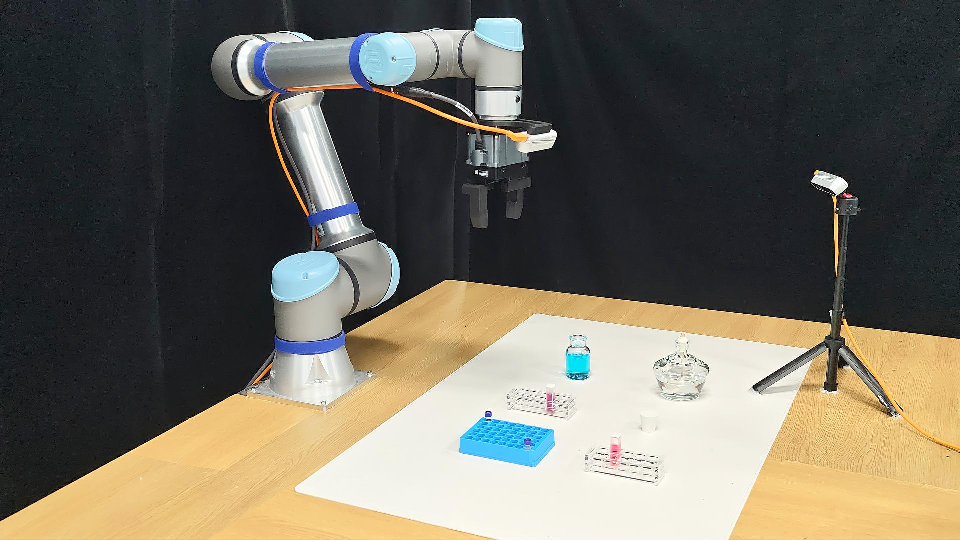
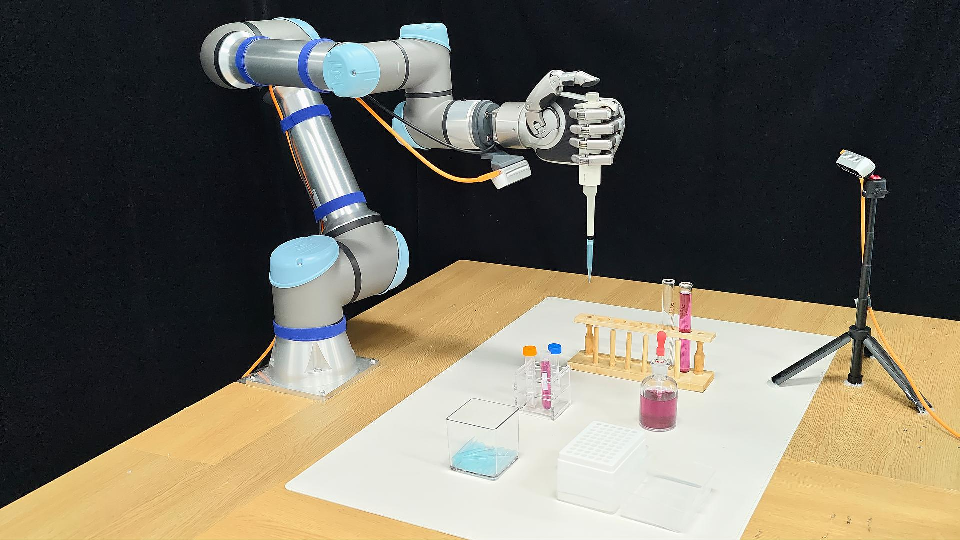
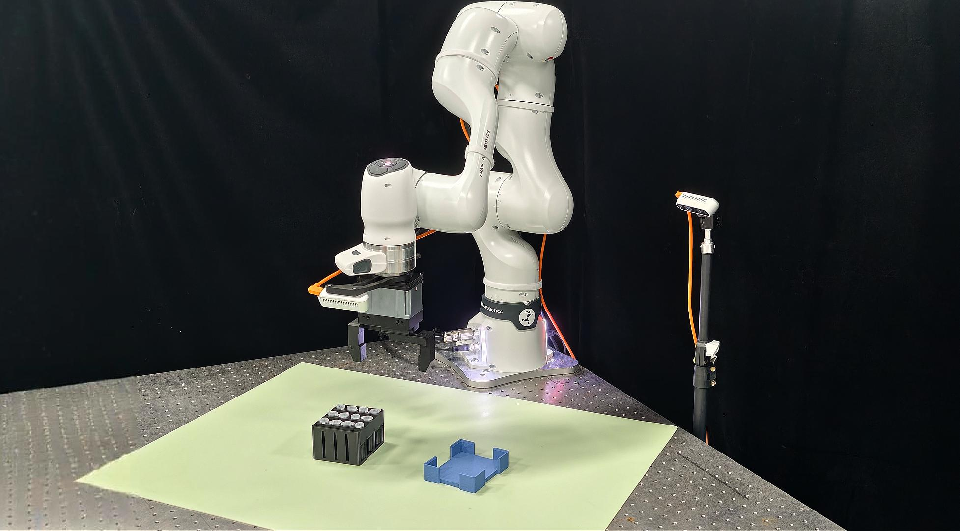
This paper presents VLA-Precision, a system for helping robots perform very precise tasks in the real world, especially chemistry tasks such as handling objects, aligning tools, or carrying out delicate laboratory procedures.
The system uses a vision-language-action model, or VLA. A VLA is like a robot’s combined eyes, language understanding, and movement planner:
- It looks at the world through cameras.
- It understands instructions written in language.
- It decides what movements the robot should make.
VLAs are already good at many general tasks, but they can still make small mistakes. In precision tasks, even a tiny error can cause failure. The paper introduces two main ideas to make these robots more accurate and to train them faster:
- Asymmetric Co-Bootstrapping (ACoB): a learning method that combines human guidance, robot experience, and trial-and-error learning.
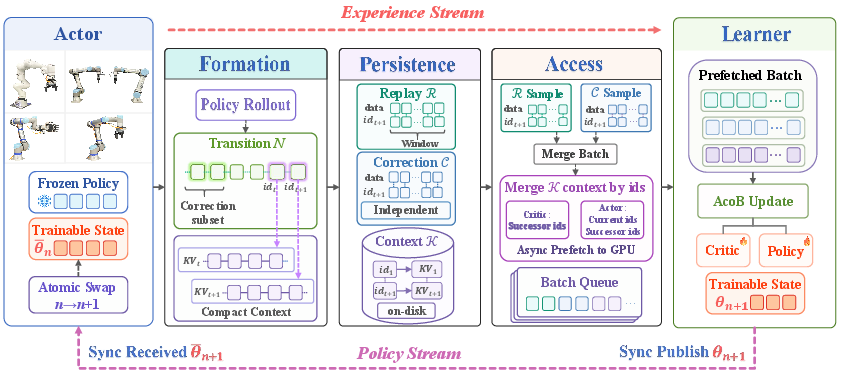
- ACoB-Stream: a computer system that reduces the time and memory needed to train a large robot model.
2. What questions does the research ask?
The researchers are mainly trying to solve two problems.
How can a robot learn from mistakes without becoming worse?
A robot can learn through reinforcement learning (RL). In RL, the robot tries actions and receives rewards for good results, similar to learning a game by seeing which moves earn points.
However, RL can be unstable. If the robot incorrectly believes that a bad action is good, it may gradually change its behavior and forget useful skills. This problem is called policy drift.
The paper asks:
- Can the robot quickly learn from successful demonstrations and human corrections?
- Can it gradually become better at judging which actions are useful?
- Can it improve beyond its original demonstrations without forgetting what it already knows?
How can a large robot model be trained efficiently?
Large VLAs require a lot of computing power. Training them can involve repeatedly processing the same camera and language information, moving large model files between computers, and storing a large amount of experience.
The paper asks:
- Can repeated calculations be avoided?
- Can the robot continue working while the learning computer updates the model?
- Can new learning be sent to the robot without transferring the entire model each time?
3. How did the researchers approach the problem?
The system uses a two-stage training process.
Stage 1: Learning from demonstrations
First, the researchers train the VLA using demonstrations. A human shows the robot how to perform a task, and the model learns to copy the demonstrated actions. This is called behavior cloning.
It is similar to teaching someone to draw by showing them many examples. The robot learns a useful starting skill, but it may still fail when it encounters a situation that was not included in the examples.
Stage 2: Learning through real-world practice
Next, the robot practices the task on a real robot. It collects information about:
- What it saw.
- What action it proposed.
- What action was actually carried out.
- Whether a human had to correct it.
- Whether the task succeeded.
The robot then uses this information to improve its future actions.
The process works as a continuous loop:
- The robot tries a task.
- It records what happened.
- A learning computer studies the recorded experience.
- The improved policy is sent back to the robot.
- The robot tries again.
Here, a policy means the robot’s strategy for choosing actions.
ACoB: Combining fast learning and careful evaluation
ACoB has two main parts.
Learning quickly from good actions
If a human corrects the robot or the robot completes a task successfully, those actions are used for behavior cloning. This allows the robot to quickly copy reliable behavior.
For example, if a robot is about to place a tool incorrectly and a human moves it into the correct position, the robot can learn from that correction.
Learning which actions are better
The system also uses a group of models called critics. A critic estimates how useful an action is by considering not only the immediate result but also what may happen later.
This is similar to a chess player asking, “If I make this move, how will the next several moves turn out?”
ACoB uses two kinds of information:
- Global return information: whether a sequence of actions eventually led to success.
- Local preference information: whether a corrected action was better than the robot’s original action at the same moment.
The second type is important because sometimes the robot’s original action is replaced by a human correction. The robot sees the corrected action succeed, but it never gets to see what would have happened if its original action had been used. ACoB directly teaches the critic that the correction was better.
Comparing actions instead of trusting one score
Rather than asking only, “How good is this action?”, ACoB asks, “Is this action better than a reference action?”
The reference action comes from the model before online training began. The robot is encouraged to improve when there is strong evidence that a new action is better, while staying close to its previous useful behavior.
This acts like a safety rail. It helps the robot learn new skills without suddenly changing its entire personality or movement style.
ACoB-Stream: making training faster
ACoB-Stream improves the computer system used for training.
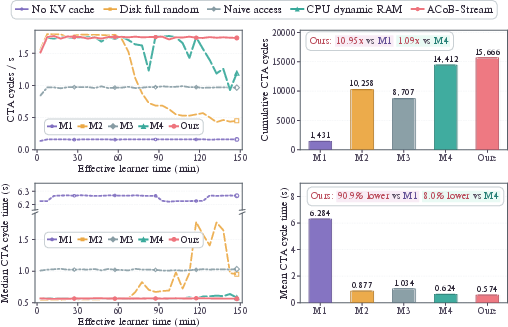
A VLA repeatedly processes the same visual and language information. Since some parts of the model remain frozen during training, ACoB-Stream saves the results of those calculations instead of repeating them.
The system also:
- Stores repeated information only once.
- Retrieves only the information needed for a particular learning step.
- Prepares the next training batch while the current batch is being processed.
- Sends only the trainable part of the model to the robot instead of transferring the entire VLA.
This is similar to saving frequently used calculations and sending only a small update to a video game instead of reinstalling the whole game every time.
Real robots and human control
The researchers tested several ways for people to guide the robots:
- A special robot-like control device for long movements.
- A keyboard interface for very small, careful movements.
The keyboard interface allows the operator to make tiny movements, which is useful for millimeter- or submillimeter-level adjustments.
4. What were the main results?
According to the paper, VLA-Precision was tested on:
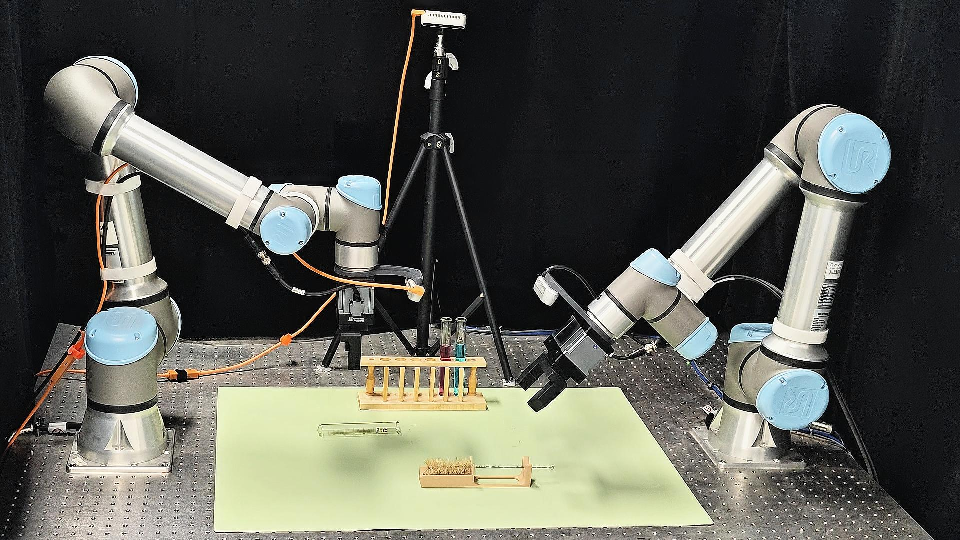
- Nine high-precision chemistry tasks
- Four different types of robots
- Multiple categories of manipulation tasks
The reported results were:
| Result | Reported value |
|---|---|
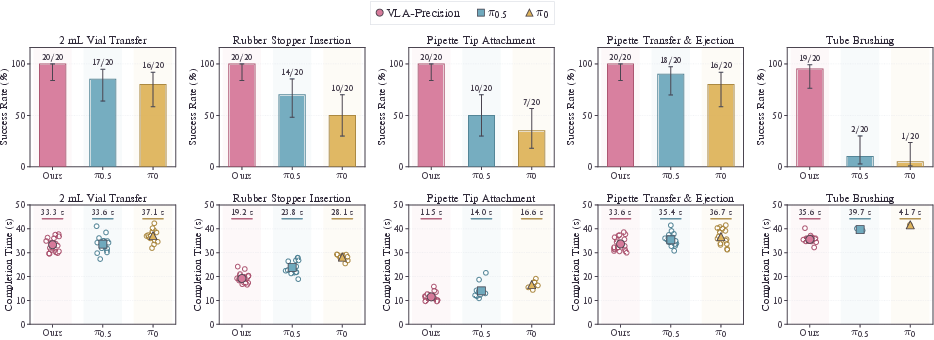
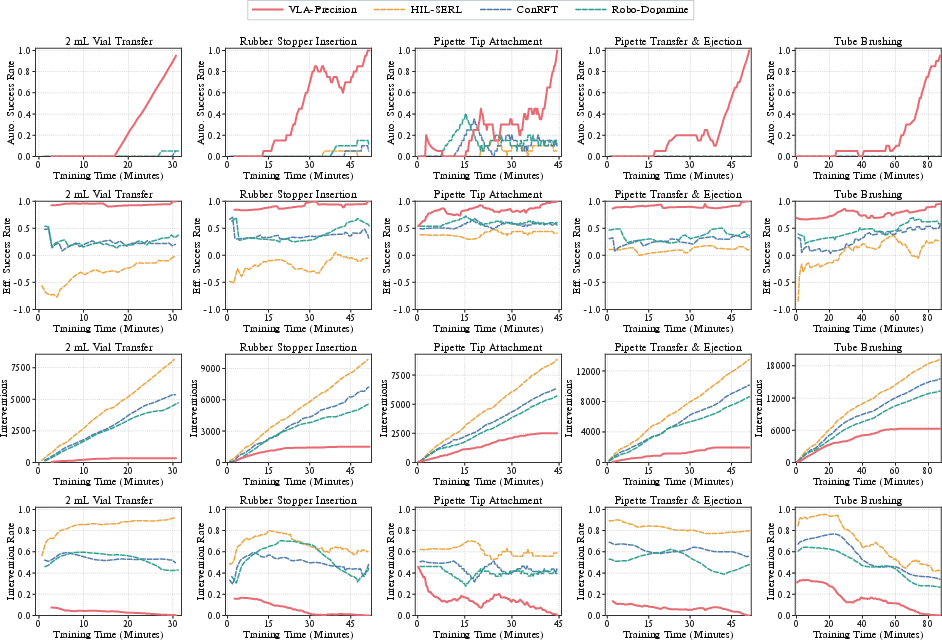
| Average task success rate | 98.3% |
| Average training time per task | 45.8 minutes |
| Average episode length | 27.6 seconds |
| Speed compared with a VLA baseline | 1.2 times faster |
| Speed compared with an RL baseline | 1.8 times faster |
| Maximum claimed throughput improvement from ACoB-Stream | 10.9 times |
These results suggest that the method helped the robots become highly successful while requiring relatively little real-world training time.
The results are important for two reasons. First, the robots reportedly became more reliable at tasks where small errors matter. Second, the training process became faster and more efficient, reducing the amount of computer time and robot practice needed.
5. Why is this research important?
Teaching robots in simulation is often cheaper and safer than teaching them in the real world. However, simulations do not perfectly match reality. Real robots have sensor noise, friction, unexpected contact, and small mechanical differences.
VLA-Precision focuses on learning directly from real-world experience. This can help robots deal with the conditions they will actually face when deployed.
If the approach works as reported, it could lead to robots that are better at:
- Laboratory and chemistry procedures.
- Manufacturing and assembly.
- Medical or assistive tasks requiring careful movement.
- Handling fragile objects.
- Repeating precise actions reliably.
The most important idea is that the robot does not rely only on demonstrations or only on trial and error. It first learns from people, then uses real-world practice to improve, while keeping a reference to its original abilities. At the same time, ACoB-Stream helps the computer update the robot quickly.
In simple terms, the paper describes a robot that learns from examples, accepts corrections, practices in the real world, and improves without forgetting what it already knows.
Knowledge Gaps
Knowledge gaps, limitations, and open questions
- The paper does not provide a complete specification of the reward function, success criteria, termination conditions, or per-task reward design, making the reported results difficult to reproduce or compare fairly.
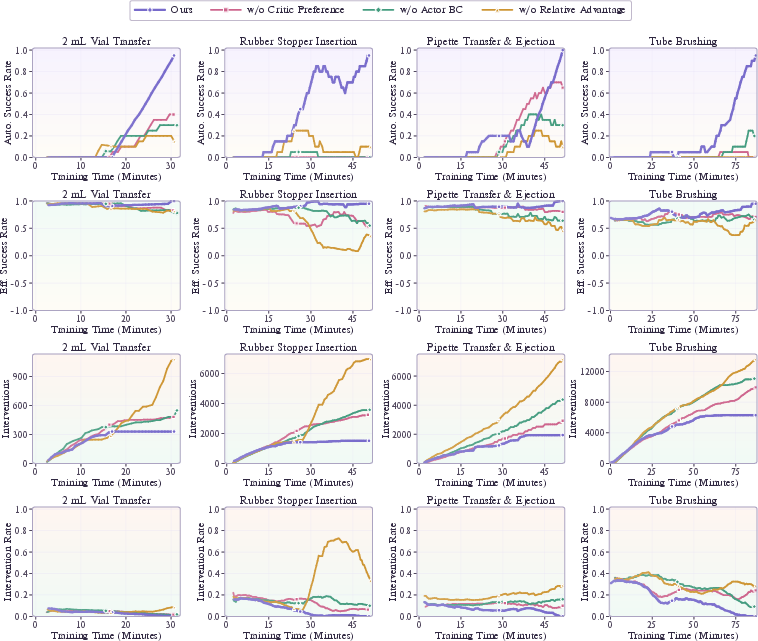
- The relative contribution of ACoB’s main components—behavior cloning, global return propagation, local preference ranking, relative-advantage optimization, and reference regularization—is not fully isolated through comprehensive ablation studies.
- The sensitivity of performance to key hyperparameters, including the number of critics, ranking margin, policy margin, loss weights, critic warm-up duration, publication interval, replay-window size, and intervention threshold, remains unexplored.
- The paper does not establish whether the critic ensemble provides calibrated uncertainty estimates or merely reduces overestimation through minimum aggregation.
- It remains unclear how ACoB behaves when human interventions are sparse, inconsistent, delayed, suboptimal, or unavailable after initialization.
- The method assumes that effective human corrections are superior to the original policy proposals, but the consequences of incorrect or unsafe corrections are not analyzed.
- The local preference-ranking objective only compares actions at intervention states; its effectiveness for non-intervention states and for correcting systematic autonomous-policy errors is unresolved.
- The paper does not quantify how intervention frequency changes over training or how much human labor is required per task, operator, robot, and training phase.
- The procedure for assigning episode-level success labels to every transition in a trajectory may provide weak or temporally imprecise supervision, but the impact of this credit-assignment choice is not evaluated.
- The behavior-cloning mask includes all chunks from successful trajectories, although successful episodes may contain inefficient, redundant, or accidental actions; the effect of this assumption is unknown.
- The use of a frozen Stage-I reference policy may preserve prior competence but could also prevent substantial behavioral improvement or adaptation to novel dynamics; this trade-off is not systematically studied.
- Only LoRA parameters in the action expert are updated. The paper does not test whether adapting the multimodal prefix, vision encoder, language conditioning, or full action expert would improve performance on substantially shifted environments.
- The reported results do not clarify whether the learned policy generalizes across unseen task instructions, object instances, object materials, lighting conditions, camera viewpoints, workspace layouts, or initial robot configurations.
- Generalization beyond the nine chemistry tasks, four task categories, and four robot embodiments is not demonstrated, particularly for non-chemistry manipulation, deformable objects, dynamic tasks, or contact-rich operations.
- The paper does not evaluate transfer of a policy or critic across tasks, despite describing task-specific critics and task-conditioned policies.
- It is unclear whether the method can scale to multi-task training without requiring separate critics, buffers, references, and task-specific training pipelines.
- The claimed 98.3% mean success rate may conceal substantial variation across tasks and embodiments; confidence intervals, per-task distributions, failure rates, and statistical significance tests are not reported in the provided text.
- The experimental comparisons do not clearly establish matched compute, robot time, number of demonstrations, number of interventions, hardware, or hyperparameter-tuning budgets for all baselines.
- The claim that training completes in 45.8 minutes per task is not decomposed into demonstration collection, intervention time, robot execution, learner computation, idle time, and deployment synchronization overhead.
- The paper does not report the total number of real-world episodes, successful episodes, failed episodes, and environment interactions required by ACoB for each task.
- The method’s sample efficiency is not compared under equal numbers of robot interactions or equal amounts of human supervision; throughput alone may not reflect learning efficiency.
- The reported throughput improvements are not sufficiently separated from improvements caused by hardware, parallelism, caching, storage configuration, or implementation optimizations.
- The ACoB-Stream architecture is evaluated primarily through aggregate throughput claims, without a detailed breakdown of latency and utilization for context formation, disk I/O, retrieval, GPU transfer, policy synchronization, and robot execution.
- The scalability limits of the disk-backed context buffer are unknown, including behavior under long-running training, rapidly growing datasets, multiple robots, slower storage, networked storage, or insufficient page-cache capacity.
- The architecture retains full history for checkpoint recovery, but storage growth, checkpoint size, cache invalidation, corruption recovery, and long-term data-management costs are not evaluated.
- The method assumes that frozen-prefix key-value caches remain valid, but the effects of changes in observation schema, camera calibration, image resolution, tokenizer configuration, or multimodal preprocessing are not discussed.
- The interaction between context deduplication and observations that are visually similar but dynamically distinct is not analyzed; incorrect deduplication could produce stale or mismatched contexts.
- The asynchronous actor–learner design introduces policy-version lag, but the paper does not quantify the lag distribution or evaluate its effect on off-policy learning stability and final performance.
- The algorithm’s behavior under multiple actors or robot embodiments collecting data concurrently is not established, including issues of heterogeneous data distributions, synchronization conflicts, and task interference.
- Safety constraints are not formally incorporated into the optimization objective, despite physical online exploration and human interventions; collision avoidance, force limits, damage prevention, and recovery procedures are not systematically evaluated.
- The paper does not report failure severity, near-miss events, hardware damage, unsafe actions, or the number and duration of emergency stops during training.
- The MDP formulation assumes Markovian state information, but the provided state may omit relevant contact history, unobserved object state, actuator state, or temporal information; the consequences of partial observability are not examined.
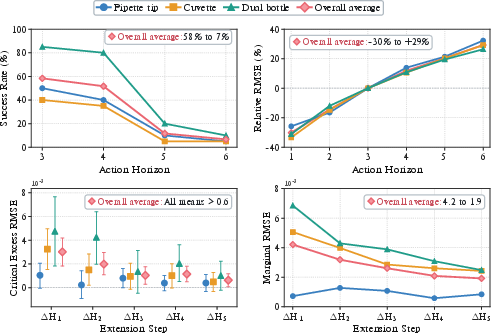
- The fixed action-chunk horizon and delta task-space representation are not studied across tasks with different temporal scales, contact dynamics, precision requirements, or action frequencies.
- The action-space masking and normalization procedures are described operationally but not evaluated for their effect on critic accuracy, policy gradients, or cross-robot transfer.
- The critic observes visual–proprioceptive state but excludes the language instruction in its stated input; the validity of this choice for multi-task or instruction-dependent behavior is unresolved.
- The ensemble critics are task-specific, yet the paper does not explain how critic initialization, target-network updates, replay distribution, and bootstrapping are stabilized in detail.
- The method relies on bootstrapped value learning from limited real-world data, but its susceptibility to distribution shift, extrapolation error, reward sparsity, and replay-buffer imbalance is not characterized.
- The paper does not compare ACoB against alternative offline-to-online algorithms, conservative value-learning methods, preference-learning approaches, or uncertainty-aware critics under identical settings.
- It remains unclear whether the improvements arise primarily from the proposed optimization objectives or from the strong task-finetuned initialization and high-quality demonstrations.
- The paper does not evaluate performance without Stage-I full-parameter imitation learning, with fewer demonstrations, or with demonstrations of lower quality.
- The extent to which reference regularization suppresses policy drift versus simply limiting exploration is not quantified.
- The method’s long-term behavior after many online updates is unknown; potential performance plateaus, catastrophic forgetting across tasks, and accumulation of biased corrections are not investigated.
- The reproducibility of the custom isomorphic master, keyboard interface, robot calibration, teleoperation protocol, and task setup is insufficiently documented in the provided text for independent replication.
- Operator variability is not considered: the paper does not measure differences in correction quality, intervention timing, workload, learning curves, or ergonomics across human users.
- The experiments do not establish whether the method remains effective with noisy proprioception, degraded cameras, latency, dropped observations, actuator wear, or changing environmental dynamics.
- The paper does not address sim-to-real transfer or whether simulation can be used to pretrain critics, test safety constraints, or reduce the amount of physical interaction required.
- The theoretical convergence, bias, or stability properties of asymmetric co-bootstrapping and relative-advantage optimization are not established.
- The relationship between the proposed relative-advantage objective and the true policy-gradient objective is not formally characterized, particularly when critic estimates are inaccurate or the reference and current policies have different action distributions.
- The paper does not clarify how stochastic action decoding, common-noise coupling, and flow-matching discretization affect the reliability of paired advantage comparisons.
- The method’s applicability to other VLA architectures, action distributions, policy parameterizations, and pretrained models beyond the reported setting remains an open question.
Practical Applications
Immediate Applications
The paper’s results support several applications that could be deployed with existing robotic hardware, pretrained VLA models, and task-specific demonstrations, provided that the deployment environment is controlled and adequate safety supervision is available.
- High-precision laboratory automation — healthcare, chemistry, and life sciences. Deploy VLA-Precision to automate repetitive, contact-sensitive procedures such as liquid handling, tube or vial manipulation, pipette positioning, sample transfer, reagent preparation, and instrument loading. The combination of intervention-guided learning, relative-advantage policy improvement, and reference regularization is particularly suited to tasks where small positioning errors cause failure. Potential workflow: collect a small set of demonstrations, fine-tune the VLA, run supervised robot trials with human corrections, and allow ACoB to refine execution using success rewards and intervention data. Dependencies: reliable task-success detection, calibrated cameras and robot state sensors, safe human intervention, compatible end-effectors, and rewards that accurately reflect precision and completion.
- Robotic execution of chemistry protocols — research laboratories and industrial R&D. Use the system to learn and refine multi-step manipulation sequences involving laboratory containers, reaction vessels, caps, trays, and other apparatus. Its long-horizon return propagation can assign credit across an entire procedure, while local preference ranking can teach the robot that a human correction is preferable to an unsuccessful autonomous action at the same state. Potential products: task-specific “robot chemist” modules, protocol-execution software, and closed-loop experiment platforms. Dependencies: the evaluated chemistry tasks must be representative of the target protocol; the system currently assumes that demonstrations, task-specific rewards, and suitable robot embodiments are available.
- Human-in-the-loop robot programming — manufacturing, logistics, and service robotics. Use teleoperation or keyboard-based correction as an efficient programming interface rather than requiring engineers to manually script every trajectory. Successful demonstrations and effective corrections are stored in separate buffers and incorporated into policy updates. Potential workflow: an operator supervises the robot, intervenes only at critical stages, and gradually reduces intervention as the policy improves. Dependencies: operators must be able to intervene quickly; intervention labels must distinguish meaningful corrections from negligible deviations; safety systems must override learned behavior when necessary.
- Precision assembly and insertion — manufacturing and electronics. Apply the bounded delta task-space actions and fine-grained correction mechanism to connector insertion, component placement, screw or cap alignment, fixture loading, and other contact-rich operations. The approach is relevant where traditional behavior cloning performs well initially but fails because of small changes in object pose, friction, or contact dynamics. Potential tools: adaptive assembly cells that maintain a frozen pretrained policy while learning task-specific LoRA updates online. Dependencies: stable object presentation, force or tactile sensing where visual information is insufficient, carefully designed failure penalties, and restrictions on online exploration near fragile components.
- Robotic quality-control and rework operations — industrial automation. Train a robot to detect and correct small execution errors during inspection, placement, alignment, or rework. ACoB’s preference-ranking mechanism can encode that a corrected action is better than the original proposal even when the intervention successfully rescues the overall episode. Dependencies: reliable visual inspection and episode-level success labels; the paper primarily demonstrates manipulation success, not complete industrial quality-control pipelines.
- Efficient online learning infrastructure for large multimodal models — robotics software and AI systems. ACoB-Stream can be integrated into robot-learning platforms to reduce the cost of repeated frozen-prefix computation, context storage, batch retrieval, and model synchronization. Its disk-backed context buffer, context deduplication, sliding-window sampling, and trainable-subspace policy transfer are directly actionable system-design patterns. Potential products: asynchronous actor–learner frameworks, robotics training servers, and deployment tools for VLA models with LoRA-based online adaptation. Dependencies: the frozen multimodal prefix must remain invariant; the underlying model must expose a trainable action-expert subspace; storage and I/O must support the required context-cache throughput.
- Resource-efficient deployment on limited hardware — small laboratories and edge robotics. Use LoRA-only updates and partial policy synchronization to adapt large VLAs without transferring or retraining the entire model after every update. This can lower GPU memory, network bandwidth, and policy-refresh latency. Dependencies: sufficient local compute for VLA inference, compatibility between actor and learner model versions, and atomic policy replacement to avoid deploying partially updated parameters.
- Robotics education and academic research. The paper provides a reproducible experimental template for studying real-world online RL: demonstrations initialize behavior, an actor collects physical experience, a learner updates critics and the action expert, and updated parameters are periodically redeployed. This can be used to build benchmarks for intervention efficiency, policy drift, critic calibration, throughput, and sim-to-real performance. Dependencies: access to robots, standardized task-success metrics, transparent logging, and replication beyond the reported chemistry-oriented task suite.
- Low-cost precision teleoperation interfaces — robotics training and daily assistive systems. The open isomorphic master design and incremental keyboard interface can be used for collecting demonstrations or correcting robot behavior. Keyboard increments are especially useful for final alignment, while the active master is more suitable for long sequences and compliant intervention. Dependencies: mechanical durability, actuator sizing, ergonomic validation, operator training, and task-specific calibration between master and slave robots.
Long-Term Applications
The following applications are plausible extensions of the reported methods but require additional research, broader validation, or substantial engineering before dependable deployment.
- Autonomous “robot scientist” platforms — chemistry, materials science, and pharmaceuticals. A mature version of VLA-Precision could combine protocol execution, experiment selection, observation of results, and continual policy improvement in a closed-loop laboratory. The current framework addresses manipulation refinement, but a full autonomous scientist would also need experiment-planning models, scientific hypothesis generation, instrument integration, and robust reward definitions. Key dependencies: reliable interpretation of experimental outcomes, contamination prevention, regulatory traceability, safe chemical handling, and generalization across instruments and laboratories.
- Fleet-scale continual learning for warehouse and factory robots — logistics and manufacturing. Multiple robots could share successful trajectories, corrections, context representations, and policy updates through a centralized learner. ACoB-Stream’s trainable-subspace synchronization is compatible with this direction, while shared critics or task-specific critics could support fleet-wide adaptation. Required development: methods for handling heterogeneous robot embodiments, conflicting data distributions, policy-version management, catastrophic forgetting, and safe rollout of updates across a fleet.
- Cross-embodiment policy adaptation — general-purpose robotics. The reported evaluation across four robot embodiments suggests a path toward adapting a common VLA policy to different arms, grippers, and workspace geometries. Future systems could preserve high-level visual-language competence while learning embodiment-specific action experts or adapters. Dependencies: standardized action and state representations, embodiment-aware conditioning, calibration procedures, and evidence that improvements transfer rather than remaining task- and robot-specific.
- Multi-modal contact-rich manipulation — healthcare, caregiving, and delicate handling. With tactile, force, auditory, and proprioceptive inputs, the framework could support tasks such as surgical instrument preparation, handling deformable medical materials, assistive feeding, dressing, or delicate packaging. Relative advantages could compare candidate actions under uncertain contact conditions. Dependencies: new sensor-fusion architectures, much stricter safety constraints, uncertainty estimation, human-subject validation, and domain-specific certification. The current paper relies primarily on visual and robot-state observations and does not establish medical safety.
- Autonomous recovery from unexpected failures — service robotics and infrastructure maintenance. The intervention buffer and correction-ranking mechanism could be extended to learn recovery behaviors after dropped objects, occlusions, misalignment, or partial task failure. Instead of merely optimizing nominal execution, the robot could learn when to pause, retry, regrasp, or request assistance. Dependencies: explicit failure and recovery taxonomies, safe exploration, human-approval mechanisms, and rewards that distinguish successful recovery from unsafe temporary progress.
- Safety-constrained online reinforcement learning — all physical-robot sectors. ACoB could be combined with safety critics, control-barrier functions, collision checking, force limits, and runtime monitors. Reference regularization may help preserve known behavior, but it is not by itself a formal safety guarantee. Dependencies: verified safety layers that operate independently of the learned policy, conservative uncertainty estimates, certified hardware limits, and formal evaluation under distribution shift.
- General-purpose robot foundation-model post-training services — software and cloud robotics. A cloud or on-premises service could accept demonstrations, intervention logs, rewards, and robot telemetry, then produce task-specific LoRA adapters and deploy them to edge robots. ACoB-Stream’s separation of invariant model state and trainable action-expert state is well suited to this architecture. Dependencies: privacy-preserving storage, bandwidth-efficient synchronization, secure model deployment, multi-tenant data isolation, and robust APIs for heterogeneous robot platforms.
- Personalized assistive and household robots — daily life. Robots could learn user-specific preferences for object placement, appliance interaction, food preparation, or home organization through occasional corrections rather than extensive demonstrations. The relative-advantage formulation could favor a user’s corrected action over the robot’s original proposal while retaining general pretrained competence. Dependencies: long-term personalization without privacy violations, reliable household-object perception, safe operation around people, nonexpert-friendly intervention interfaces, and prevention of undesirable behavior drift.
- Adaptive agricultural, inspection, and field robots — agriculture and energy. Real-world online RL could refine manipulation under changing lighting, terrain, crop geometry, equipment wear, or weather conditions. Applications include precision harvesting, connector inspection, valve operation, and maintenance of solar, wind, or utility infrastructure. Dependencies: robustness to outdoor distribution shift, reliable communication with remote learners, weatherproof hardware, sparse or delayed rewards, and safety procedures for operating near energized or hazardous equipment.
- Standardized benchmarks for real-world VLA reliability and efficiency — academia and policy. The paper’s metrics—success rate, episode duration, critic-to-actor latency, intervention frequency, throughput, and training time per task—could form part of a benchmark for comparing real-world VLA post-training systems. Such benchmarks could inform procurement standards and responsible deployment policies. Dependencies: independent replication, diverse tasks and embodiments, standardized reporting of failures and human interventions, and evaluation protocols that prevent success rates from obscuring safety or operator burden.
- Policy and regulatory frameworks for continually learning robots — public policy. If online adaptation becomes common in laboratories, factories, or homes, regulators and organizations could require versioned policy checkpoints, intervention logs, reward definitions, rollback mechanisms, and records of which human corrections influenced deployment. ACoB-Stream’s explicit actor–learner cycle provides a natural audit boundary. Dependencies: legally meaningful logging standards, explainable update records, cybersecurity controls, responsibility assignment between model developers and operators, and evidence that online updates remain within approved operating envelopes.
Glossary
- Action chunk: A sequence of multiple low-level actions generated and executed as one policy decision. “A VLA policy action is an -step action chunk”
- Action expert: The policy component responsible for generating robot actions from multimodal inputs. “we optimize only the LoRA parameters~blue{hu2022lora} in the action expert”
- Advantage function: The value of an action relative to the expected value of its state. “Under the decomposition , represents the state-only component shared across actions”
- Asymmetric co-bootstrapping: A learning strategy in which behavioral learning and value calibration improve one another at different rates. “These asymmetric interactions establish a cross-timescale co-bootstrapping loop”
- Asynchronous actor--learner system: An architecture in which one process collects experience while another independently updates the policy. “we first formulate real-world RL post-training of large VLAs under an asynchronous actor--learner process”
- Behavior cloning: Supervised learning that trains a policy to imitate demonstrated actions. “Behavior cloning (BC) learns task behavior directly from dense action labels in demonstrations”
- Bootstrapping: Estimating a value target using another estimated value rather than waiting for a complete outcome. “Through recursive bootstrapping, this objective propagates long-horizon returns along executed trajectories.”
- Closed-loop experience--policy architecture: A system in which newly collected experience is used to update a policy that is subsequently redeployed for further experience collection. “ACoB-Stream, a closed-loop experience--policy architecture for real-world online RL of large VLAs”
- Critic: A value-estimation model that evaluates states or actions for guiding policy optimization. “ACoB instantiates the value model as an ensemble of task-specific critics.”
- Critic-to-actor latency: The time required for an updated policy to move from the learning process to the acting robot. “it outperforms baselines in success rate, episode time, critic-to-actor latency, and throughput.”
- Cross-timescale learning: Coordinating learning processes that operate at different temporal rates. “ACoB establishes asymmetric co-bootstrapping across timescales”
- Credit assignment: Determining which actions are responsible for later rewards or failures. “Reliable value learning requires both long-horizon return estimation and fine-grained credit assignment.”
- Diffusion policy: A policy that generates actions through an iterative denoising or diffusion process. “RL-100 blue{lei2025rl100} applies offline-to-online RL to diffusion policies”
- Discount factor: A coefficient that reduces the contribution of rewards received further in the future. “ the initial-state distribution, and the discount factor.”
- Distribution shift: A mismatch between the data distribution used for training and the distribution encountered during deployment. “errors compound outside the demonstrated distribution”
- DoF (degree of freedom): An independent dimension of motion available to a mechanical system. “the six-DoF active, kinematically isomorphic master interface”
- Flow matching: A generative-model training method that learns a continuous velocity field connecting noise to target data. “ACoB therefore couples relative-advantage improvement with flow-matching behavior cloning”
- Flow-based action expert: An action generator that produces outputs using a learned continuous flow. “ the flow-based action expert.”
- Frozen reference policy: A fixed policy used as a behavioral baseline during optimization. “the task-finetuned action expert is retained as a frozen reference.”
- Global return propagation: The process of transmitting long-horizon rewards through temporal-difference value updates. “Global return propagation is realized by the ensemble TD objective defined as follows”
- Heterogeneous workload: A computational workload containing different types of operations or resources. “RLinf-VLA blue{zang2025rlinf} coordinates heterogeneous workloads”
- Imitation learning: Learning a policy from expert demonstrations rather than directly from reward optimization. “Stage I performs full-parameter imitation learning on task demonstrations”
- Invariant-state decoupling: Separating state components that remain unchanged from those that must be repeatedly updated. “Guided by invariant-state decoupling and on-demand streaming”
- Inverse kinematics: Computing joint configurations required to achieve a desired end-effector pose. “preserve direct joint-space mapping without online inverse kinematics.”
- KV cache: Stored key and value tensors from attention computation that allow repeated transformer inference without recomputing prior context. “ACoB-Stream retains prefix KV caches generated during actor inference.”
- Leave-one-out advantage: An advantage estimate computed by comparing one sample against an aggregate formed from the other samples. “RIPT-VLA blue{tan2025ript} pairs dynamic rollout sampling with leave-one-out advantages”
- LoRA (Low-Rank Adaptation): A parameter-efficient fine-tuning method that trains low-rank updates while keeping the original model parameters frozen. “we optimize only the LoRA parameters~blue{hu2022lora} in the action expert.”
- Markov decision process: A formal model of sequential decision-making in which the next state depends only on the current state and action. “we model physical interaction under task instruction as a standard Markov decision process (MDP)”
- Multimodal prefix: A jointly encoded representation of inputs from multiple modalities that precedes action generation. “ is the task-conditioned multimodal prefix context”
- On-demand streaming: Loading or transmitting only the data required for the current computation. “on-demand streaming limits context access and policy synchronization to the state required by the current objective.”
- Offline-to-online reinforcement learning: A training paradigm that begins with a fixed dataset and then continues learning through live interaction. “ConRFT blue{chen2025conrft} reaches 96.3\% mean success in 45--90 min with offline-to-online RL”
- Out-of-distribution hallucination: An implausible prediction produced for inputs outside the data distribution used to train a model. “but OOD hallucinations can misguide optimization.”
- Pessimistic ensemble aggregation: Combining multiple value estimates by selecting the most conservative estimate. “ACoB instead computes paired advantage differences within each critic before pessimistic ensemble aggregation.”
- Policy drift: Undesired movement of a learned policy away from previously reliable behavior. “unreliable value signals can induce policy drift”
- Policy handoff: Transferring a policy or policy component between systems or stages of execution. “externalized improvements and policy handoffs limit end-to-end adaptation.”
- Policy prior: An initial policy that provides useful task behavior or behavioral constraints before further optimization. “to obtain the task-specific policy prior $\Theta_{\mathrm{IL}$.”
- Policy-state synchronization: Updating the deployed policy process with parameters produced by the learner process. “Policy-state synchronization: through trainable-subspace policy dissemination”
- Proprioceptive state: Information about the robot’s internal configuration, such as joint positions or velocities. “ is the visual--proprioceptive component of the state”
- Replay buffer: A memory structure that stores previously collected transitions for later training. “The online experience pool comprises the replay buffer ”
- Reference regularization: A penalty that keeps an updated policy close to a fixed reference policy. “Reference regularization keeps online refinement focused on execution precision rather than reshaping behavior”
- Relative advantage: The difference between the action advantages of a current policy and a comparison baseline. “ACoB therefore proposes relative-advantage policy improvement”
- Reward shaping: Modifying or augmenting rewards to provide more informative learning signals. “VLA-RL blue{lu2025vlarl} combines trajectory-level RL with process rewards”
- Rollout: An episode or trajectory generated by executing a policy in an environment. “rollouts generate online experience and learner optimization yields action-expert updates for redeployment.”
- Sample efficiency: The ability to learn effectively from a limited number of data samples or interactions. “applying RL to VLA post-training enables autonomous trial-and-error improvement beyond demonstrations alone”
- Sim-to-real gap: The performance difference that arises when a policy trained in simulation is deployed on a physical robot. “the sim-to-real gap in visual observations and contact dynamics limits reliable transfer to physical robots”
- Softplus: A smooth approximation to the rectified linear unit, defined as . “where ”
- Stop-gradient: An operation that prevents gradients from propagating through a specified quantity during optimization. “where denotes stop-gradient”
- Temporal-difference learning: A reinforcement-learning method that updates value estimates using immediate rewards and estimated successor values. “ACoB propagates long-horizon returns through temporal-difference optimization.”
- Teleoperation: Direct control of a robot by a human operator, often through a specialized interface. “Task requirements for motion range, adjustment precision, and human--machine compliance motivate two distinct teleoperation schemes”
- Trainable subspace: The subset of model parameters that are allowed to change during optimization. “ACoB-Stream therefore designs synchronization around the trainable policy subspace.”
- Trajectory: A sequence of states, actions, and rewards generated during an episode. “The task-conditioned policy maps each state to an action-chunk distribution and induces trajectory ”
- Value calibration: Improving the accuracy and reliability of estimated state or action values. “we propose Asymmetric Co-Bootstrapping (ACoB), a real-world online RL algorithm that couples rapid behavioral learning with progressive value calibration”
- Value--advantage decomposition: Expressing an action value as a state value plus an action-specific advantage. “Each critic adopts the value--advantage decomposition”
- Vision-language-action model: A model that jointly processes visual and linguistic inputs to produce robot actions. “Pretrained vision-language-action (VLA) models enable broad manipulation”
- Zero-shot or one-shot success: Successful task execution with no or very few task-specific demonstrations or training examples. “raising one-shot success from 4\% to 97\%”