Sparse auto-regressive modeling for scene generation from multi-view images
Abstract: Generating complete 3D scenes from sparse, unconstrained views is a fundamental challenge in 3D vision which requires reasoning beyond observed content while remaining computationally tractable. Existing feed-forward reconstruction methods are inherently limited to content visible in the input images, while 3D generative modeling is hindered by the high computational cost of dense volumetric representations and the scarcity of large-scale 3D supervision. We introduce SPAR3S, a sparse voxel-aligned 3D latent generative model for conditional scene completion without requiring ground-truth 3D data for supervision. Our key insight is to formulate 3D scene generation in a structured, compact, voxel-aligned 3D latent space where only occupied voxels are represented. We learn this sparse latent space directly from multi-view images using photometric supervision via differentiable 3D Gaussian Splatting. Given a partial set of observed voxels encoded from sparse input views, scene completion reduces to predicting the missing latent tokens and their spatial support within the voxel grid. To this end, we train a masked autoregressive transformer that jointly models voxel occupancy and latent token values, enabling efficient and spatially consistent generation of unseen regions. We demonstrate the effectiveness of our method on synthetic indoor scenes, achieving higher novel-view quality than prior work. We further validate its generalization on RealEstate10k, highlighting its applicability to real-world data.


Paper Prompts
Sign up for free to create and run prompts on this paper.
Top Community Prompts
Explain it Like I'm 14
1. What is this paper about?
This paper introduces a computer vision system called SPAR3S. Its goal is to build a complete 3D scene from only a few ordinary pictures taken from different viewpoints.
For example, imagine giving the system two photos of a room. Some parts of the room may be hidden because they are behind furniture or outside the camera’s view. SPAR3S tries to:
- Understand the parts of the room shown in the pictures.
- Guess what the hidden parts probably look like.
- Create a complete 3D version of the room.
- Allow people to view that room from new camera angles.
The paper focuses on making this process both realistic and computationally efficient.
2. What questions are the researchers asking?
The main research questions are:
- Can a computer create a complete 3D scene from only a few images?
- Can it reasonably guess areas that were never visible in the input pictures?
- Can it keep the scene geometrically consistent? This means that an object should stay in the same place when viewed from different angles.
- Can this be done without needing large collections of pre-built 3D models?
- Can the system work efficiently instead of spending a very long time calculating each scene?
Earlier methods often reconstructed only what could be directly seen. Other methods generated new 2D images, but those images could disagree with one another. SPAR3S instead tries to generate the missing information directly in 3D.
3. How does the method work?
The system has three main parts.
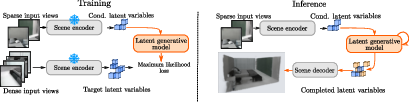
A. Turning images into a compact 3D description
First, SPAR3S examines the input images and estimates where visible points are located in 3D space. It then places this information into a 3D grid made of small cubes, called voxels.
A voxel is similar to one tiny cube in a 3D Minecraft world. However, SPAR3S does not store every cube. It stores only the cubes that seem to contain something, such as a wall, chair, table, or other object.
This is called a sparse representation. It saves computer memory because empty parts of the scene are ignored.
The system stores information about each occupied voxel in a compact code called a latent token. A latent token is like a small summary containing useful information about a location, such as its shape, color, and texture.
B. Converting the 3D description into a visible scene
The latent tokens are sent to a decoder. The decoder turns them into a collection of small blurry shapes called 3D Gaussians.
These shapes are not exactly the same as normal mathematical bell curves. In this paper, they are small colored 3D blobs that can be combined to represent surfaces and objects.
A rendering method called 3D Gaussian Splatting places these blobs onto the screen to create an image. It works somewhat like throwing many soft, colored paint spots into 3D space and viewing them from a camera.
The model compares the rendered image with the original input image. It then adjusts itself so that the rendered result looks more like the real picture. This is called photometric supervision: the model learns by comparing image colors and brightness rather than by being given a perfect 3D model.
Importantly, the researchers do not need ground-truth 3D data for this part. They only need images and information about the cameras.
C. Guessing the missing parts
The visible input images usually describe only part of the scene. SPAR3S uses a masked auto-regressive transformer to predict the missing voxels.
The idea is similar to filling in missing words in a sentence. If a sentence says:
“The cat is sitting on the ___.”
a LLM might predict “chair.”
SPAR3S does something similar in 3D. It sees some occupied voxels and predicts:
- Which other voxels probably contain objects.
- What the latent tokens in those voxels should contain.
The system predicts the scene in several steps. It usually starts near the known voxels and gradually expands outward, like growing a region from the parts already discovered.
It also predicts occupancy, which simply means whether a voxel is empty or contains something. This prevents the system from wasting effort generating details in empty areas.
4. What experiments were performed?
The researchers tested SPAR3S on two datasets:
- 3DFront, which contains computer-generated indoor scenes such as bedrooms, living rooms, dining rooms, and libraries.
- RealEstate10K, which contains real videos of homes and apartments.
They often gave the system only two input views, sometimes with very little overlap between them. This is difficult because the pictures may show completely different parts of the same room.
The researchers compared SPAR3S with several other methods, including systems based on:
- Direct 3D reconstruction.
- Image diffusion models.
- Other methods that generate 3D Gaussian scenes.
- Methods that predict only the visible parts of a scene.
To measure quality, they rendered the completed 3D scenes from new viewpoints and compared the results with real images.
Some important measures were:
- PSNR: how closely the pixel colors match. Higher is better.
- SSIM: how similar the overall structures and patterns are. Higher is better.
- LPIPS: how similar two images look to people. Lower is better.
- FID: how realistic the generated images look compared with real images. Lower is better.
5. What were the main findings?
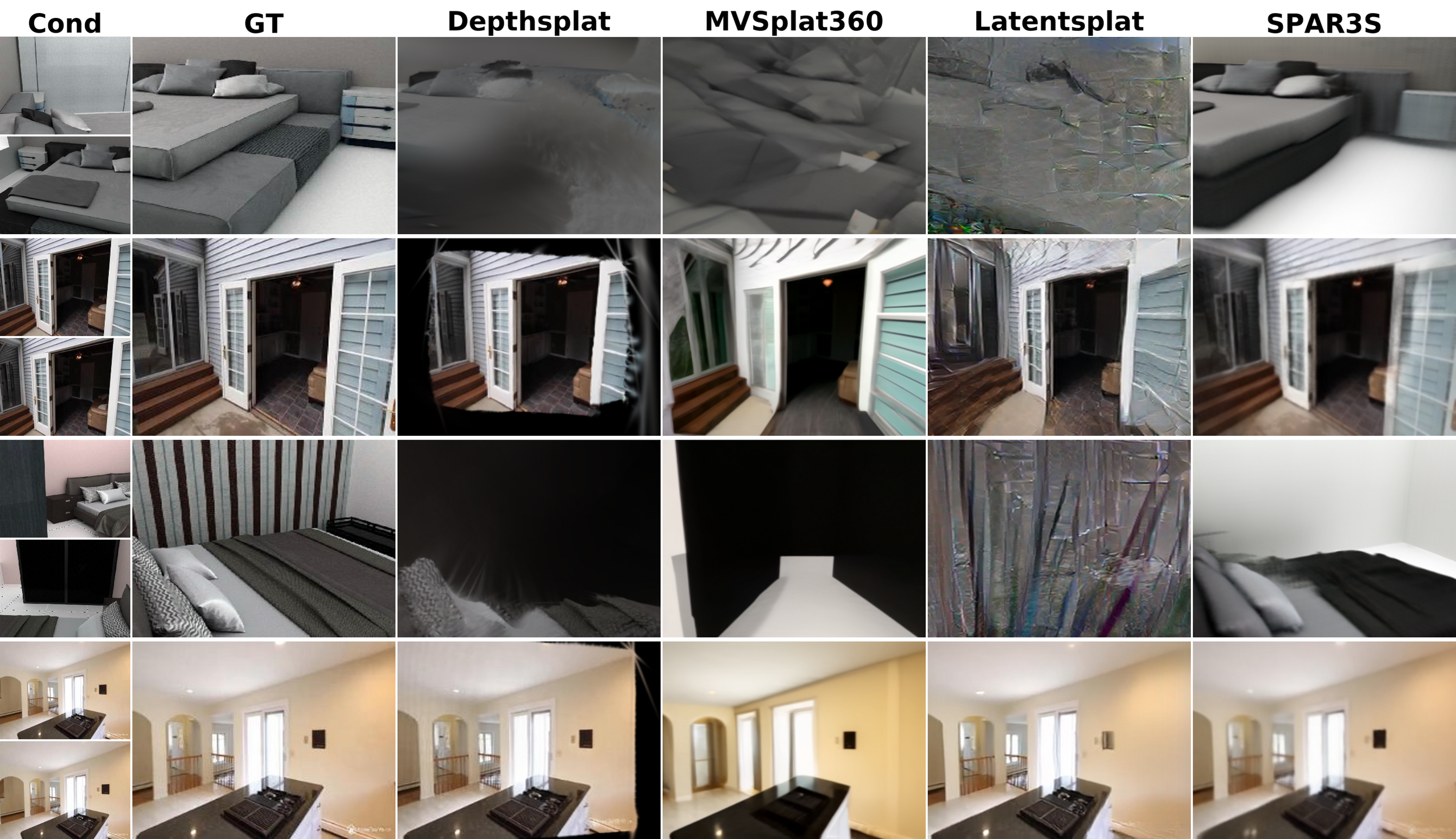
SPAR3S performed better than the other tested methods, especially when only two images were provided.
For the two-view experiment, the results were:
| Dataset | FID | PSNR | SSIM | LPIPS |
|---|---|---|---|---|
| 3DFront | 59 | 15.18 | 0.62 | 0.50 |
| RealEstate10K | 41 | 16.72 | 0.57 | 0.36 |
These results were better than the competing methods listed in the paper. For example, on 3DFront, the next strongest methods had FID scores of 111 or 180, while SPAR3S achieved 59. Since lower FID is better, this suggests that SPAR3S produced more realistic images.
The results show that SPAR3S was especially useful when:
- The input images had little overlap.
- The new viewpoint showed areas not visible in the original images.
- The system had to guess missing rooms, walls, furniture, or decorations.
The researchers also found that:
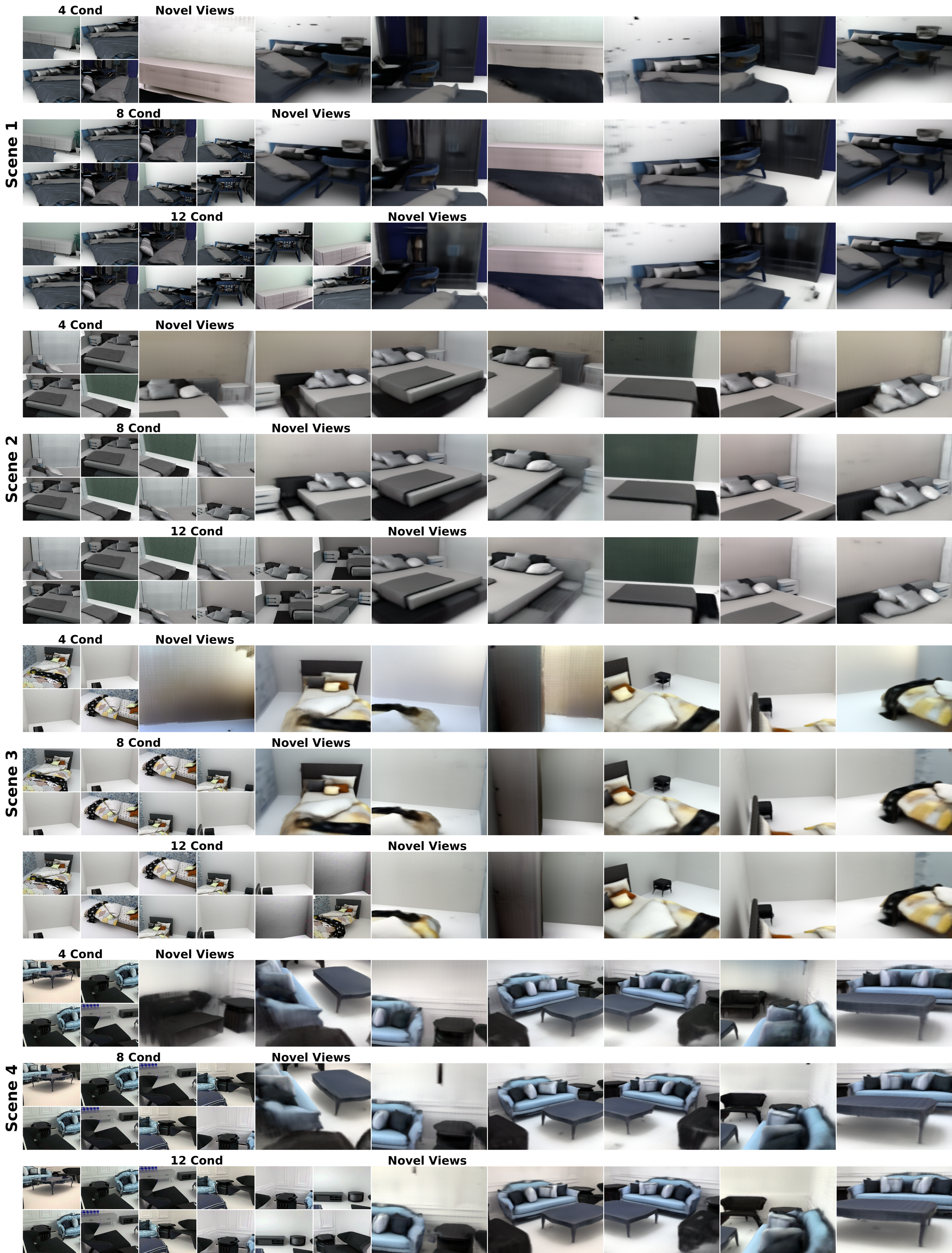
- Giving the system more input views usually improved its results.
- Using a sparse 3D representation made the method more practical.
- Adding geometry information to the attention mechanism helped the model learn.
- Predicting voxel occupancy before detailed information saved computation.
- The model worked not only on synthetic scenes but also on real estate videos.
6. Why are these results important?
A normal reconstruction system can usually rebuild only what its cameras have seen. If a chair or wall is hidden, it may simply be missing from the reconstruction.
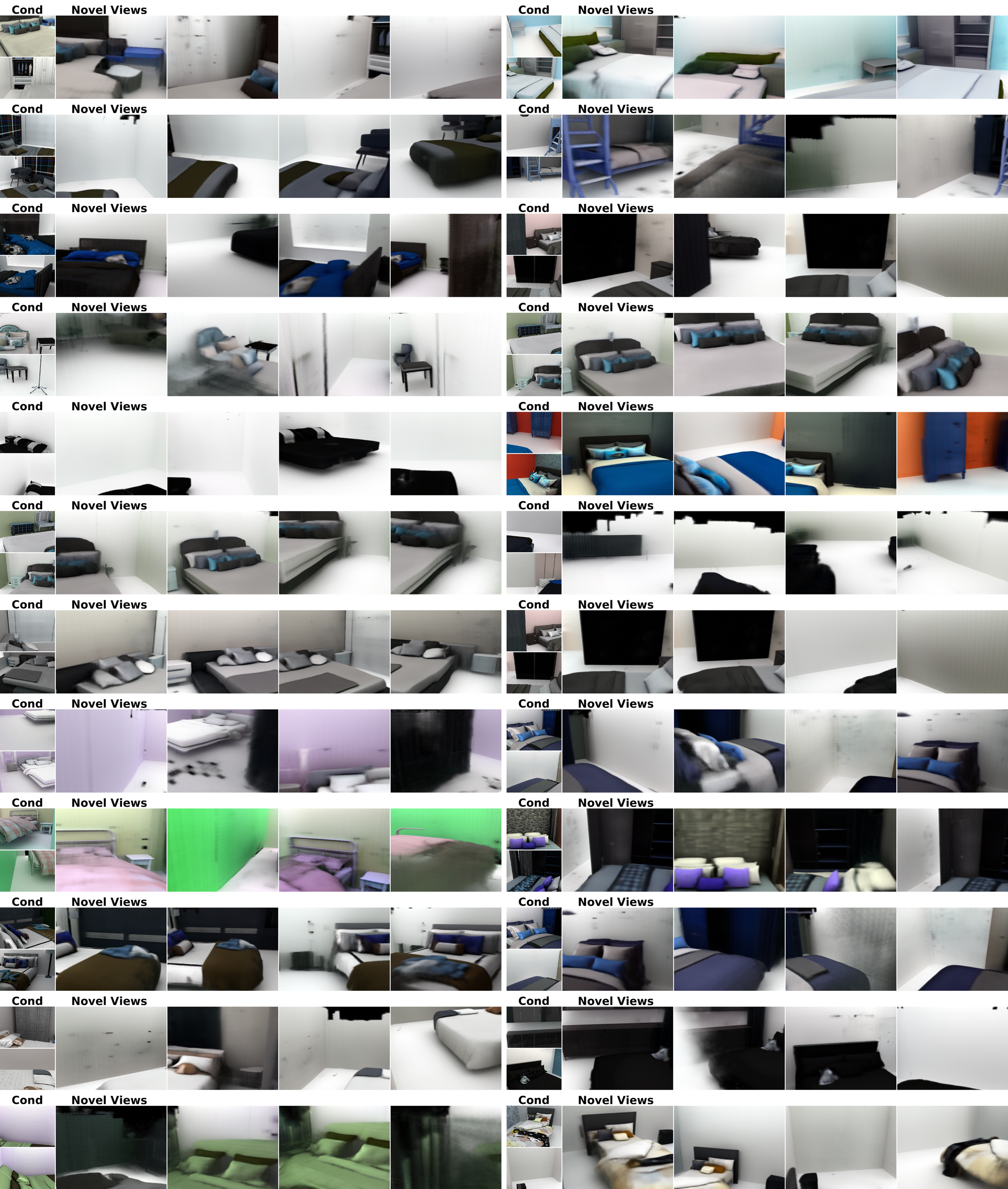
SPAR3S can make an educated guess about hidden areas. It does this directly in 3D, so the guessed objects remain in consistent positions when viewed from different angles.
This is better than generating separate 2D images for each camera angle. Separate images might show a table in one place from one viewpoint and a different place from another viewpoint. A shared 3D representation helps avoid this problem.
The method is also important because it learns from images without requiring a huge collection of accurately labeled 3D scenes. Creating such 3D labels by hand would be expensive and difficult.
7. Possible impact and limitations
SPAR3S could be useful for:
- Virtual and augmented reality.
- Video games and film production.
- Virtual tours of houses and buildings.
- Robots that need to understand rooms.
- Creating 3D environments from ordinary photographs.
- Changing the viewpoint in photographs or videos.
However, the system does not truly know what hidden objects look like. It makes predictions based on patterns learned from training examples. Therefore, it may create objects that are plausible but not actually present.
The experiments also mainly focus on indoor scenes, and the paper provides stronger evidence on synthetic data than on highly varied real-world environments. Further testing would be needed for outdoor scenes, unusual buildings, cluttered spaces, or objects that are very different from the training data.
Conclusion
SPAR3S is a method for completing 3D scenes from only a few images. It stores visible information in a compact 3D grid, uses a transformer to predict missing areas, and turns the completed description into a viewable 3D scene.
The main achievement is that it can produce more realistic and consistent new viewpoints than earlier methods, even when the input images show only small and separate parts of a scene. This could help computers understand and recreate the world in 3D using much less visual information.
Knowledge Gaps
Knowledge gaps, limitations, and open questions
- Incomplete paper evidence: The provided text ends during the two-view evaluation section, so results for the full experimental analysis, qualitative comparisons, ablations, computational evaluation, and supplementary details are not available for independent assessment.
- Limited dataset diversity: Evaluation is restricted to synthetic indoor scenes from 3DFront and predominantly indoor real-estate videos from RealEstate10K; performance on outdoor environments, urban scenes, non-Manhattan layouts, objects, cluttered spaces, and dynamic scenes remains untested.
- Dependence on indoor-scene priors: The voxel-aligned representation, bounded volume, and scene-completion strategy may rely on regular indoor layouts. It is unclear whether the method generalizes to scenes with large-scale geometry, irregular topology, long-range structures, or unbounded spatial extent.
- No evaluation of dynamic content: The method assumes a single static 3D scene representation, leaving its behavior under moving people, changing illumination, camera motion blur, reflections, or other temporal inconsistencies unresolved.
- Reliance on upstream geometry and camera estimation: Real-world inference depends on MASt3R-SfM pointmaps, camera poses, and intrinsics. The paper does not quantify how errors in these inputs affect voxel occupancy, latent completion, Gaussian quality, or final novel-view synthesis.
- No robustness analysis for severely degraded inputs: Performance under occlusion, missing frames, low light, motion blur, extreme exposure, textureless surfaces, rolling-shutter distortion, or substantial image noise is not investigated.
- Unclear behavior with unknown or erroneous camera parameters: Although the method targets unconstrained viewpoints, it still uses camera parameters obtained from reconstruction pipelines. The effect of inaccurate or partially known cameras is not systematically studied.
- Limited assessment of input-view configurations: The experiments emphasize randomly sampled views and particularly two-view settings. Systematic evaluation across structured baselines, adjacent views, non-overlapping views, viewpoint elevation changes, and highly asymmetric camera arrangements is missing.
- Unresolved extrapolation limits: The paper does not establish how far beyond the observed camera frustums SPAR3S can generate reliable content, nor how completion quality changes with angular distance, spatial distance, or the fraction of the scene that is unobserved.
- No ground-truth 3D evaluation: The method is trained without explicit 3D supervision, but the paper does not report geometric metrics such as depth error, occupancy IoU, surface distance, completeness, or Gaussian-to-mesh accuracy against available ground-truth geometry.
- Image metrics may not measure 3D correctness: PSNR, SSIM, LPIPS, FID, and KID on rendered views cannot fully distinguish geometrically correct reconstructions from view-dependent or duplicated geometry. Multi-view consistency, camera-path consistency, and 3D structural correctness remain insufficiently evaluated.
- No explicit uncertainty calibration: The generative model can produce multiple plausible completions, but the paper does not measure whether its uncertainty reflects actual ambiguity, nor whether confidence or occupancy scores are calibrated.
- Diversity–fidelity trade-off is not characterized: The number and variability of generated completions, mode collapse, repeated scene structures, and the relationship between sample diversity and novel-view accuracy are not reported.
- Potential bias from latent targets: Generative targets are produced by the same encoder trained from photometric reconstruction. The paper does not determine how artifacts, omissions, or biases in the encoder-decoder representation propagate into the autoregressive model.
- Unobserved training regions are weakly supervised: Positions in are masked from the loss, and the assumption that random cameras make these regions representative is not validated. This may leave some scene structures systematically underrepresented during generative training.
- No comparison with stronger 3D completion objectives: The paper does not isolate whether improvements arise from sparse autoregression, the latent representation, the Gaussian decoder, or learned scene priors, nor does it compare against supervised occupancy or geometry-completion objectives when 3D annotations are available.
- Ablation coverage is incomplete: Although several design choices are ablated, the relative contribution of pointmap initialization, KL regularization, latent diffusion, conditioning-token refinement, region-growing order, hierarchical occupancy, and occupancy/latent joint prediction is not fully disentangled.
- Sensitivity to voxelization is unresolved: The effects of voxel resolution, scene-volume normalization, voxel size, quantization errors, and boundary truncation on geometry and appearance are not systematically reported.
- Fixed-volume representation may truncate scenes: Rescaling every scene into can distort spatial scale or discard content outside the predefined volume. The consequences for scenes with different aspect ratios or larger spatial extent are unknown.
- Occupancy threshold selection is not generalized: Results depend on occupancy thresholds, but the paper does not provide a principled calibration method or test whether thresholds transfer across datasets, scene types, voxel resolutions, and numbers of conditioning views.
- Autoregressive error accumulation is not quantified: Iterative region growing feeds predicted tokens back into the model, potentially compounding occupancy and latent errors. The paper does not measure degradation as the number of completion iterations increases.
- Dependence on the chosen voxel ordering is unclear: Region-growing BFS is presented as beneficial, but alternative orderings and their effects on long-range dependencies, disconnected regions, generation quality, and runtime are not comprehensively compared.
- Disconnected or isolated scene regions may be difficult to generate: A k-nearest-neighbor graph seeded by observed voxels may poorly represent geometrically disconnected structures or regions separated by empty space. The ability to generate such regions is not evaluated.
- The representation’s capacity for fine detail is uncertain: Sparse voxels and a fixed number of Gaussian splats per voxel may limit thin structures, small objects, high-frequency textures, and detailed geometry. Detail-level benchmarks and failure analyses are absent.
- Appearance–geometry entanglement is not analyzed: Latent tokens jointly encode geometry and appearance, but the paper does not examine whether this entanglement causes inconsistent textures, incorrect material assignments, or geometry changes when sampling alternative completions.
- View-dependent effects are unexplored: The decoder’s ability to represent specularities, transparency, reflections, and other non-Lambertian effects is not assessed, despite their importance in real-world novel-view synthesis.
- Generalization across camera and image distributions is unknown: RealEstate10K provides smooth, densely sampled camera trajectories, whereas the synthetic data use randomly distributed cameras. Cross-dataset transfer, domain shifts in camera motion, and different image statistics are not systematically evaluated.
- Training and inference scalability remain unclear: The paper reports training time on a single A100 GPU but does not provide parameter counts, peak memory, inference latency, number of autoregressive iterations, throughput, or scaling behavior with voxel count and scene size.
- Efficiency claims lack direct comparison: The computational advantage of sparse autoregression over dense volumetric models and 3D diffusion baselines is not quantified under matched quality, resolution, and hardware settings.
- No study of longer or variable input sequences: The encoder is described as supporting variable numbers of views, but performance and computational scaling beyond the tested settings are not established, particularly for dozens or hundreds of views.
- No failure taxonomy is provided: The paper does not systematically categorize failures such as hallucinated objects, missing rooms, duplicated structures, incorrect topology, texture bleeding, floating Gaussians, or inconsistent scene boundaries.
- Reliability in safety-critical or measurement applications is unknown: Since the method hallucinates unobserved content, its suitability for robotics, mapping, navigation, architectural measurement, or other applications requiring geometrically reliable completions is not established.
- Reproducibility is incomplete: Key implementation details—including architecture dimensions, voxel resolutions, masking distributions, diffusion schedules, threshold-selection procedures, training splits, and sampling settings—are deferred to supplementary material that is not included here.
- Statistical significance is not reported: The tables do not include confidence intervals, variation across random seeds, per-scene distributions, or significance tests, making it difficult to determine whether reported improvements are robust.
- Evaluation of perceptual quality is incomplete: FID and KID are reported for rendered images, but their dependence on the selected view distribution and their suitability for evaluating 3D scene completion are not examined.
- Human assessment is absent: No user study or expert evaluation tests whether generated scenes are judged plausible, spatially coherent, and faithful to the conditioning views.
- The learned prior’s semantic understanding is unclear: The method may exploit layout and appearance correlations, but it is not tested on controlled semantic interventions, rare object arrangements, unusual furniture configurations, or compositional generalization to unseen combinations.
Practical Applications
Immediate Applications
- Real-estate virtual tours and property visualization — real estate, architecture
- Deploy SPAR3S-like inference to generate a navigable 3D Gaussian scene from a small number of interior photographs or video frames, including plausible views of areas not directly captured.
- Potential products include rapid virtual-tour generation, browser-based room exploration, renovation previews, and automated listing visualization.
- Dependencies and assumptions: reliable camera-pose and point-map estimation are required; generated unseen areas are plausible reconstructions rather than verified measurements. The current validation is strongest for indoor scenes and RealEstate10k-style data, so unusual layouts, outdoor spaces, or clutter may reduce reliability.
- Sparse-input novel-view synthesis — media, e-commerce, marketing
- Convert two or a few photographs of a room, product, or interior setting into a renderable 3D Gaussian representation that supports interactive viewpoint changes.
- This could reduce the need for dense photography in product catalogs, advertising assets, virtual showrooms, and social-media content.
- Dependencies and assumptions: the object or scene must be sufficiently compatible with the model’s training distribution. Occluded surfaces, text, mirrors, transparent materials, and fine geometry may be hallucinated or distorted.
- Interactive 3D scene preview in visualization software — graphics and software tools
- Integrate the sparse voxel encoder, occupancy predictor, and Gaussian decoder into authoring tools as a fast “draft reconstruction” mode.
- A workflow could be: upload a few images → estimate camera geometry → generate several candidate scene completions → inspect or export the selected 3D Gaussian scene.
- Dependencies and assumptions: practical deployment requires optimized inference, GPU or capable edge hardware, robust handling of variable image quality, and interfaces for editing or rejecting uncertain regions.
- Dataset augmentation for computer-vision research — academia and industrial AI
- Use the model to generate plausible completed 3D scenes and render additional camera views for training or stress-testing multi-view reconstruction, robotics perception, and visual localization systems.
- The explicitly 3D representation can provide more geometrically consistent views than independently generated 2D images.
- Dependencies and assumptions: synthetic completions should be labeled as generated data and quality-controlled. They should supplement, not replace, real measurements because the model may reproduce systematic biases or incorrect geometry.
- Fast prototyping of indoor spatial maps — construction, facilities management, education
- Generate preliminary 3D visualizations from photographs taken during site visits, classroom surveys, office inventories, or building documentation.
- Such outputs can support communication, rough space planning, and prioritization of areas requiring detailed measurement.
- Dependencies and assumptions: the output is suitable for visualization and early planning, not structural certification, safety analysis, accessibility compliance, or exact dimensional surveying without independent validation.
- Research and benchmarking of sparse 3D generation — academia
- Reuse the paper’s training strategy as a practical baseline for learning 3D generative representations without ground-truth meshes or point clouds.
- The combination of photometric supervision, sparse voxel-aligned latents, occupancy prediction, and masked autoregressive completion offers a workflow for developing new scene-completion models from multi-view image collections.
- Dependencies and assumptions: training still requires substantial compute and suitable multi-view data. The reported evidence is primarily from indoor scenes at resolution, so transfer to larger-scale or outdoor environments remains unverified.
- Uncertainty-aware visual content generation — design review and content production
- Since multiple completions can be sampled for unobserved regions, applications can present alternative layouts or appearances instead of a single deterministic reconstruction.
- Designers could compare several plausible room arrangements, furnishings, or viewpoints before selecting one for visualization.
- Dependencies and assumptions: the system must expose sample diversity and uncertainty clearly; users must not interpret a generated completion as factual evidence about an unseen region.
Long-Term Applications
- Robotic exploration and navigation from sparse observations — robotics
- A robot could use a few camera observations to construct and complete a provisional 3D map, then plan viewpoints or exploration trajectories toward regions with high uncertainty.
- The sparse occupancy representation could support memory-efficient scene modeling, while iterative region growing could provide coarse-to-fine map expansion.
- Dependencies and assumptions: real-time performance, calibrated or reliably estimated camera poses, temporal consistency, dynamic-object handling, collision-safe uncertainty estimates, and rigorous evaluation in real environments are still required. Hallucinated obstacles or free space would be safety-critical.
- Augmented and virtual reality scene reconstruction — AR/VR
- Generate a consistent, navigable 3D environment from a small number of headset or mobile-camera views, enabling rapid world reconstruction and plausible completion beyond the currently visible frustum.
- Potential tools include instant room capture, remote collaborative walkthroughs, and persistent mixed-reality environments.
- Dependencies and assumptions: low latency, stable tracking, scale preservation, temporal updates, and prevention of visual drift are necessary. The current method is evaluated mainly on static scenes and does not establish performance under camera motion, lighting changes, or moving people.
- Digital twins for buildings and facilities — architecture, engineering, operations
- Extend the method to generate preliminary digital twins from routine inspection imagery, enabling interactive review of rooms, equipment placement, and inaccessible viewpoints.
- A future workflow could combine SPAR3S with semantic segmentation, object recognition, CAD alignment, and sensor data to create editable building models.
- Dependencies and assumptions: exact geometry, material identification, semantic correctness, and multi-session consistency would need substantial improvement. Generated regions must be separately flagged and verified before use in maintenance, compliance, or engineering decisions.
- Healthcare and clinical-environment visualization — healthcare
- A sufficiently validated version could reconstruct and complete visual representations of treatment rooms, surgical environments, or patient-specific spaces for simulation, training, and workflow planning.
- It could also help create virtual walkthroughs of facilities from limited photographic documentation.
- Dependencies and assumptions: the paper provides no clinical validation. Privacy-preserving data handling, accurate scale and geometry, strong uncertainty reporting, and regulatory review would be mandatory. It should not be used for diagnosis, surgical navigation, or patient safety without independent evidence.
- Autonomous inspection of industrial sites — energy, manufacturing, infrastructure
- Combine sparse-view scene completion with inspection robots or drones to generate a preliminary 3D representation of equipment and inaccessible structures, then guide additional imaging toward uncertain areas.
- Potential uses include inspection planning, asset visualization, and change detection when integrated with repeated scans.
- Dependencies and assumptions: industrial environments contain reflective, repetitive, outdoor, and highly elongated structures that are outside the paper’s demonstrated scope. Metric accuracy, weather and lighting robustness, temporal registration, and certified inspection protocols are required.
- Simulation environments for robotics and embodied AI — robotics and machine learning
- Use completed Gaussian scenes as compact environments for training navigation, manipulation, and perception policies under varied camera poses and occlusion patterns.
- Multiple sampled completions could create controlled distributions of plausible but unseen layouts for robustness testing.
- Dependencies and assumptions: Gaussian splats must be extended with collision geometry, semantic labels, physical materials, object dynamics, and reliable interaction affordances. Visual plausibility alone does not guarantee physical or behavioral validity.
- Large-scale 3D content creation from image archives — entertainment and cultural heritage
- Apply the method to generate navigable 3D reconstructions from historical photographs, film footage, museum documentation, or location scouting imagery.
- Long-term products could include virtual sets, heritage exploration platforms, and interactive archival experiences.
- Dependencies and assumptions: the method currently targets indoor scenes and requires suitable multi-view consistency. Historical imagery may lack camera metadata, contain changing appearances, or show mutually inconsistent time periods; provenance and uncertainty must therefore be preserved.
- Policy and urban planning visualization — public-sector planning
- Generate early-stage 3D visualizations of buildings or public interiors from limited imagery to support accessibility discussions, emergency-planning exercises, public consultation, and scenario comparison.
- A policy workflow could use the model to identify areas requiring on-site surveying rather than treating the completion as an official map.
- Dependencies and assumptions: fairness, geographic coverage, privacy, and representational accuracy must be assessed. Generated scenes cannot substitute for cadastral, accessibility, emergency-response, or legally authoritative spatial data.
- Personal mobile “room capture” and home planning — daily life and consumer software
- A mobile application could create a navigable room model from a few photographs, propose alternative furniture layouts, and render viewpoints for decoration, moving, or remote sharing.
- The sparse representation may reduce the amount of imagery users must capture compared with dense scanning workflows.
- Dependencies and assumptions: consumer deployment requires efficient mobile inference or cloud processing, robust scale estimation, privacy controls, and clear warnings about hallucinated furniture or unseen surfaces. Accurate purchase, construction, or safety decisions would require physical measurement.
- Generative 3D previsualization and game development — entertainment
- Use sparse-view scene completion to create draft environments, set extensions, or background geometry that artists can refine into production assets.
- The autoregressive completion mechanism could support multiple environment variants while maintaining a single coherent 3D representation.
- Dependencies and assumptions: production use requires editable meshes or compatible asset formats, temporal consistency, controllable semantics, high-resolution textures, and artist-directed constraints. The current Gaussian output is primarily suited to rendering rather than full asset authoring.
Glossary
- 3D Gaussian Splatting: A differentiable rendering technique that represents scenes as collections of spatial Gaussian primitives. “Recent advances in novel view synthesis, e.g 3D Gaussian Splatting (3DGS)”
- autoregressive model: A model that predicts elements sequentially, conditioning each prediction on previously generated elements. “Our generative model is built on Masked Auto-regressive models”
- backprojection: The process of mapping image pixels and depth information back into three-dimensional space. “initial pointmaps are obtained by backprojecting pixels using rendered depth maps.”
- binary cross-entropy: A loss function for binary classification that compares predicted probabilities with binary target labels. “We use a binary cross-entropy (BCE) head over upsampled voxel positions”
- bottleneck: A constrained intermediate representation through which information must pass in an encoder–decoder architecture. “This constraint can be seen as a type of bottleneck in the general auto-encoder framework”
- breadth-first search: A graph traversal algorithm that explores nodes in increasing order of their distance from a starting node. “a breadth-first search (BFS) assigns a depth level to each voxel”
- camera frustum: The truncated pyramidal volume visible from a camera, determined by its position, orientation, and field of view. “enabling more reliable reconstruction outside the observed camera frustums”
- categorical distribution: A probability distribution over a finite set of discrete categories. “a categorical distribution over discretized values”
- conditioning: The use of observed information to guide a model’s predictions or generation process. “Given a partial set of observed voxels encoded from sparse input views”
- cost volume: A representation that stores matching costs for candidate correspondences across multiple images or views. “MVSplat aggregates multi-view information in a cost volume before predicting Gaussians”
- cross-attention: An attention mechanism in which queries attend to representations from another sequence or modality. “A stack of bidirectional cross-attention blocks”
- denoising diffusion: A generative process that learns to reverse the gradual corruption of data with noise. “we parametrize the latent prediction head as a tokenwise denoising network”
- differentiable rendering: Rendering formulated so that gradients can be propagated through the rendering operation for optimization. “using differentiable Gaussian splatting operation”
- epipolar cues: Geometric constraints relating corresponding points in images captured from different camera viewpoints. “by relying on epipolar cues”
- false-positive noise injection: The deliberate addition of incorrect positive occupancy predictions during training to improve robustness. “augmented with false-positive noise injection to improve the model's robustness”
- feed-forward model: A model that produces an output in one forward computation without iterative per-scene optimization. “Existing feed-forward reconstruction methods are inherently limited to content visible in the input images”
- geometric consistency: Agreement among reconstructed or generated geometry across different views. “multi-view diffusion models lack geometric consistency across novel views”
- geometry-aware correspondence: Correspondence information that incorporates the spatial relationships of scene geometry. “attention maps in the CA blocks incorporate geometry-aware correspondence information”
- ground-truth supervision: Training supervision based on reference labels or data regarded as correct. “this learning process does not require any ground-truth 3D supervision.”
- hierarchical coarse-to-fine: A strategy that first makes a lower-resolution prediction and then progressively refines it at higher resolutions. “we propose to perform occupancy prediction in a hierarchical coarse-to-fine manner.”
- inference: The process of generating predictions from a trained model. “At inference, positions are grouped into disjoint subsets”
- intrinsics: Camera parameters describing internal properties such as focal length and principal point. “We estimate camera poses, intrinsics, and initial pointmaps”
- Kullback–Leibler divergence: A measure of the difference between two probability distributions. “regularize the latent space of the encoder using a Kullback--Leibler divergence term”
- latent representation: A compact learned representation that encodes information about data in an internal feature space. “The completed latent representation is then decoded into a 3DGS representation”
- latent token: A learned feature vector representing an element of a latent spatial or sequential representation. “The generated latent tokens can be decoded into 3D Gaussians”
- masked autoregressive model: An autoregressive model trained to predict hidden elements from randomly selected visible elements. “Masked auto-regressive models in particular can predict the chain in any order”
- monocular depth prior: Depth information inferred from a single image and used as a constraint or regularizer. “further introduce monocular depth priors as regularization”
- novel-view synthesis: The generation of images depicting a scene from viewpoints not present in the input data. “We demonstrate the effectiveness of our method on synthetic indoor scenes, achieving higher novel-view quality”
- occupancy grid: A spatial grid whose cells indicate whether locations contain scene content. “SCube and XCube both sample occupancy grids in a voxelized latent space”
- occupancy prediction: The prediction of whether a voxel or spatial location is occupied. “our model also predicts both where the 3D latent vectors through occupancy prediction”
- photometric supervision: Training supervision based on differences between rendered and observed image appearance. “We learn this sparse latent space directly from multi-view images using photometric supervision”
- pixel-aligned: Corresponding directly to individual pixels or pixel locations in an image. “pixel-aligned 3D Gaussian regression from sparse views”
- pointmap: A dense image-associated representation that assigns a three-dimensional coordinate to each image pixel. “represent a scene by predicting a dense per-pixel 3D point map”
- pose: The position and orientation of a camera in three-dimensional space. “Given a set of posed conditioning images”
- probabilistic framework: A modeling framework that represents uncertainty using probability distributions. “The use of a probabilistic framework accounts for the fact that multiple sets of Gaussians can yield the same projections”
- reparameterization trick: A technique that permits gradient-based optimization through random sampling in variational models. “we sample using the reparametrization trick”
- region growing: An iterative spatial expansion procedure that adds neighboring locations to an existing region. “We opt for a region growing approach”
- raster-order: An ordering that processes grid elements sequentially according to image-like scanlines. “raster-order auto-regressive models consider all tokens sequentially”
- scene completion: The generation of missing or unobserved parts of a scene from partial observations. “scene completion reduces to predicting both voxel occupancy and latent token features.”
- scene decoder: A model that converts a latent scene representation into a three-dimensional scene representation. “The generated latent tokens can be decoded into 3D Gaussians using the scene decoder.”
- sparse representation: A representation that stores only the elements that contain meaningful or nonzero information. “only tokens that correspond to voxels with content (ie. non empty) will be processed”
- splatting: A rendering method that projects Gaussian primitives onto image planes and aggregates their contributions. “that can be rendered via splatting”
- stop-gradient: An operation that prevents gradients from propagating through a specified computation during training. “we apply a operation before the conditioning token refinement head.”
- tokenization: The conversion of input data into discrete or vector-valued units processed by a model. “the 2D multi-view inputs are patchified and tokenized into 2D tokens”
- triangulation: The estimation of a three-dimensional point from corresponding observations in multiple camera views. “implicitly learning to match and triangulate.”
- variational autoencoder: An autoencoder that learns a probabilistic latent distribution and reconstructs data from sampled latent variables. “Closer to our work, LatentSplat adopts a VAE formulation”
- voxel: A volumetric pixel representing a discrete cell in a three-dimensional grid. “Our key idea to address scalability is to only materialize occupied voxels”
- voxel-aligned: Spatially aligned with the cells of a three-dimensional voxel grid. “a sparse voxel-aligned 3D latent generative model”
- voxel-wise: Applied independently to individual voxels. “two lightweight voxel-wise heads”
- wide baseline: A large separation between camera viewpoints, producing substantially different viewing perspectives. “Novel view synthesis evaluation with two conditioning views (very wide baseline)”

