Does On-Policy Distillation Really Distill? From Noisy Teacher to Self-Improvement
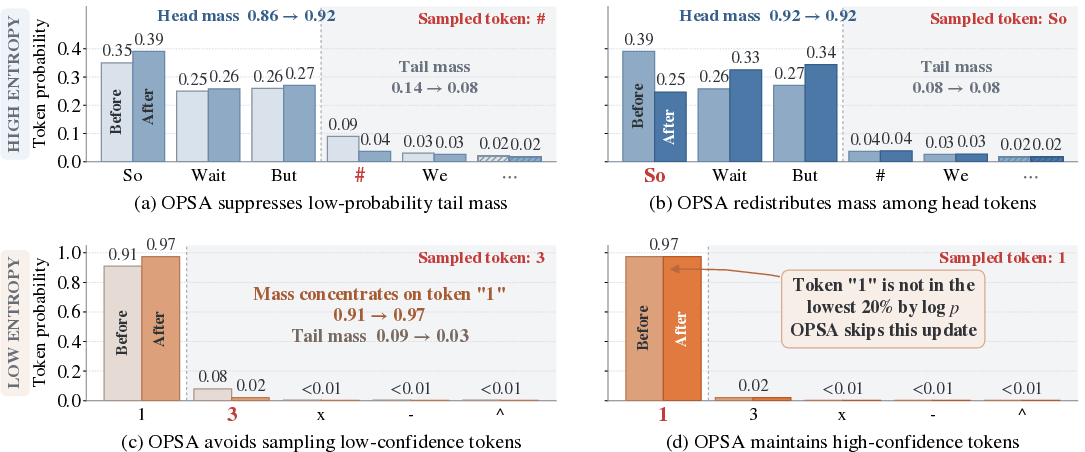
Abstract: On-policy distillation (OPD) offers dense token-level supervision as an alternative to the sparse outcome-level advantages of reinforcement learning with verifiable rewards (RLVR). However, the teacher scores student-generated trajectories that are inherently off-policy for it, so the reliability of its supervision, and hence the source of the student's improvement, remains unclear. We quantitatively analyze teacher supervision during OPD training and find substantial noise whose prevalence increases with teacher scale. Surprisingly, the student policy is insensitive to such noise, converging to comparable performance regardless of whether noisy supervision is retained or removed. Does OPD distill at all? By analyzing what drives its gains, we find that learning concentrates on low log-probability tokens, and using a single fixed negative advantage matches the performance of teacher-provided ones. This suggests that OPD works largely by suppressing low log-probability tokens, which requires no teacher. These findings motivate On-Policy Self-Adaptation (OPSA), a supervision-free method using entropy-adaptive negative advantages. It assigns stronger learning signals to high-entropy positions, suppressing tail tokens, and evenly redistributing probability mass among head tokens. Compared with the base \texttt{Qwen3-1.7B}, OPSA improves Avg@32 by 35.41 points on AIME24, corresponding to a 263\% relative gain, and more than doubles Pass@32 across all three benchmarks. It also outperforms OPD by 16.77 points in Avg@32 on AIME24. Extensive experiments and analyses across model families and tasks further demonstrate its effectiveness and generalizability.
Paper Prompts
Sign up for free to create and run prompts on this paper.
Top Community Prompts
Explain it Like I'm 14
1. What is this paper about?
This paper studies a method for training LLMs to become better at difficult tasks such as mathematical reasoning.
A common method, called on-policy distillation (OPD), uses a stronger LLM as a teacher. The smaller model, called the student, generates answers, and the teacher gives advice about which words or tokens were good or bad.
The paper asks an important question:
Is the student really learning useful knowledge from the teacher, or is something else causing it to improve?
The authors propose a new method called On-Policy Self-Adaptation (OPSA). Unlike OPD, OPSA does not need a teacher, correct answers, or rewards from outside the model.
2. Main research questions
The paper focuses on several related questions:
- How accurate is the teacher’s advice when it judges answers created by the student?
- Does the student still improve when some of the teacher’s advice is wrong?
- Which words have the biggest effect on learning?
- Is the teacher’s detailed advice actually necessary?
- Can a model improve by studying its own behavior, without outside supervision?
Here, a token means a small piece of text, such as a word, part of a word, or punctuation mark.
3. How did the researchers study this?
Comparing a student and several teachers
The researchers used:
- Qwen3-1.7B as the main student model.
- Larger Qwen models, including 4B, 30B-A3B, and 235B-A22B models, as teachers.
- Mathematics questions from the DAPO-17k dataset for training.
- AIME24, AIME25, and HMMT25 for mathematical testing.
- MBPP+ for programming and GPQA-Diamond for general academic questions.
The student generated both correct and incorrect answers. The researchers then checked whether the teacher’s advice agreed with the actual answer.
For example:
- If the answer was correct but the teacher gave the important answer tokens a negative signal, that was counted as noisy advice.
- If the answer was incorrect but the teacher gave those tokens a positive signal, that was also noisy advice.
This is similar to checking whether a tutor gives the right feedback on a student’s homework.
Studying different kinds of tokens
The researchers measured how likely the student thought each token was.
- A high-probability token is one the model strongly expected.
- A low-probability token is one the model considered unlikely.
- The model’s uncertainty at a particular point is measured using entropy.
Entropy can be understood as how confused or undecided the model is. If the model thinks one word is clearly best, entropy is low. If many different words seem possible, entropy is high.
The researchers tested what happened when they:
- Used the teacher’s original signals.
- Removed noisy teacher signals.
- Kept only noisy signals.
- Replaced all teacher signals with the same negative signal.
- Trained only on the student’s least-probable tokens.
- Gave stronger negative signals at positions where the model was more uncertain.
Creating OPSA
OPSA follows three main rules:
- Look at the tokens the student generated.
- Focus on about the lowest-probability 20% of those tokens.
- Give them negative learning signals, with stronger signals at high-uncertainty positions.
In simple terms, OPSA tells the model:
“Be less likely to make these unlikely choices, but keep several reasonable choices available when you are uncertain.”
4. Main findings
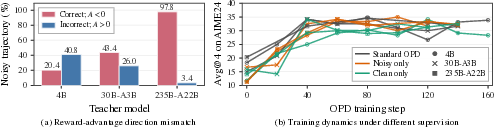
Teacher advice was often wrong
The teacher’s advice contained a surprising amount of noise.
With the 4B teacher:
- About 30.6% of the tested answer-token signals disagreed with whether the answer was correct.
With the largest teacher:
- The noise rate rose to about 50.6%.
The largest teacher often gave negative signals to answer tokens whether the student’s answer was correct or incorrect. This suggests that a very large teacher may have difficulty judging text that comes from a much smaller and different model.
The student improved even with bad advice
The researchers trained students in three ways:
- Using all teacher advice.
- Using only examples with noisy advice.
- Using only examples without noisy advice.
All three versions reached similar performance.
This is important because it suggests that the student’s improvement may not mainly come from copying useful knowledge from the teacher. If the student can improve even when using mostly bad advice, then another part of the training process is probably responsible.
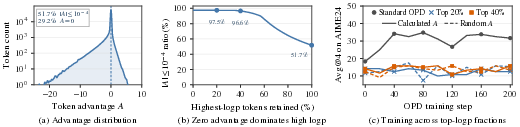
Low-probability tokens mattered most
The student did not learn equally from every token.
High-probability tokens usually produced very small changes because the model was already confident about them. The useful learning mostly came from tokens that the student considered unlikely.
For example, suppose a model is deciding between several possible next words. If it chooses a very unlikely word, training can teach it to avoid that choice in the future.
The authors found that training mainly on the lowest-probability tokens could produce nearly the same improvement as ordinary OPD.
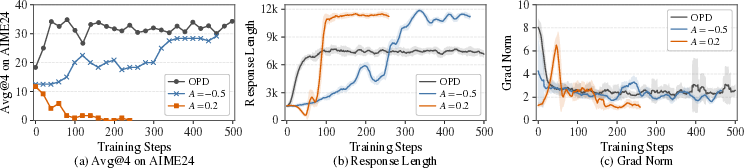
Fixed negative signals were surprisingly effective
The researchers replaced the teacher’s detailed advice with one simple rule:
Give selected low-probability tokens the same negative signal every time.
This simple teacher-free method still improved the student.
However, using a fixed positive signal caused the model to collapse. It began producing very short, broken, or random-looking outputs. This shows that the direction of the signal matters: discouraging unlikely tokens helped, while encouraging them indiscriminately was harmful.
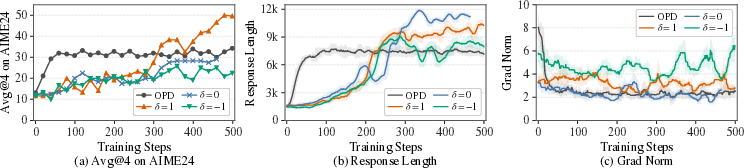
Entropy helped decide how strongly to learn
The best results came from giving stronger negative signals to low-probability tokens at positions with high entropy.
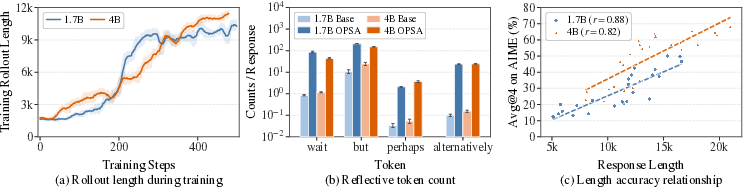
These are places where the model is uncertain and several possible reasoning paths exist. The model may generate words such as “wait” or “but,” which can begin reflection or self-correction.
OPSA tries to:
- Reduce the chance of very unlikely choices.
- Keep several reasonable choices available.
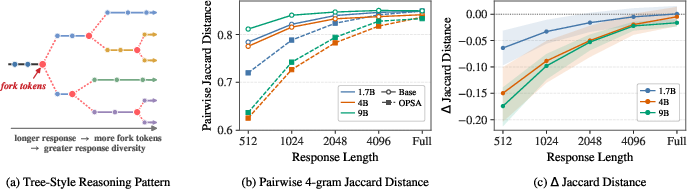
- Preserve diversity in the model’s possible answers.
- Encourage longer reasoning and self-correction.
OPSA improved test performance
OPSA improved several models, including Qwen3-1.7B, Qwen3-4B, and Qwen3.5-9B.
For example, on AIME24:
| Model | Before OPSA | After OPSA |
|---|---|---|
| Qwen3-1.7B, Avg@32 | 13.44 | 48.85 |
| Qwen3-4B, Avg@32 | 23.33 | 62.08 |
| Qwen3.5-9B, Avg@32 | 76.35 | 87.81 |
The paper also reports improvements on AIME25, HMMT25, programming, and general question-answering tasks.
Two evaluation terms are useful here:
- Avg@32 measures the average quality of 32 sampled answers.
- Pass@32 measures whether at least one of 32 attempts is correct.
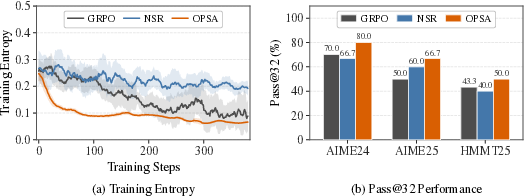
On the three mathematics benchmarks, OPSA more than doubled the Avg@32 score of the Qwen3 models. It also improved Pass@32, meaning the model was more likely to find at least one correct solution among many attempts.
5. Why are these findings important?
The usual explanation for OPD is that a smaller model learns by copying a larger teacher. This paper argues that much of the improvement may instead come from a simpler process:
The model learns to avoid its own unlikely token choices.
This challenges the idea that a powerful teacher is always necessary for on-policy distillation.
OPSA is useful because it does not require:
- A separate teacher model.
- Correct answers or human labels.
- A reward-checking system.
- Extra hints or reference solutions.
It may also be cheaper and faster because the training system only needs to examine the student model’s own predictions.
The method appears to improve reasoning by changing how the model explores possible solutions. It makes the model more careful at confident decisions while still allowing different paths when it is uncertain. The authors connect this to longer reasoning, reflection, and self-correction.
Simple conclusion
The paper’s main message is that on-policy distillation may not work mainly because the student copies the teacher. Instead, the important part may be that training discourages the student from choosing very unlikely tokens.
Based on this idea, the authors create OPSA, which lets a model improve using only its own predictions. Their experiments show large gains in mathematical reasoning and smaller but consistent gains in programming and general question answering.
If these results hold more broadly, future LLMs might be trained with less reliance on expensive teacher models, labeled data, and carefully designed rewards. However, the findings come from particular models, datasets, and training settings, so more research is needed to determine how well OPSA works in other languages, tasks, and real-world situations.
Knowledge Gaps
Knowledge gaps, limitations, and open questions
- Causal source of improvement remains unresolved. The experiments show that negative advantages on low-probability tokens can reproduce OPD gains, but they do not definitively establish that teacher knowledge transfer is absent; teacher-derived signals may still contribute indirectly through token selection, optimization dynamics, or interactions with the student policy.
- Noise is defined only on final answer tokens. The noise analysis labels supervision as noisy only when
\boxed{}answer-token advantages disagree with verifiable correctness. Noise in intermediate reasoning tokens—which constitute most of the trajectory—is not measured because no token-level reference is available. - The reported noise metric does not capture signal magnitude. Counting sign disagreements treats a small negative advantage and a very large negative advantage as equivalent. Future work should analyze the magnitude, calibration, and cumulative gradient impact of teacher errors.
- The explanation for scale-dependent noise is not tested causally. The paper attributes increasing noise with teacher scale to distributional mismatch, but does not isolate this mechanism from differences in calibration, instruction tuning, decoding behavior, tokenizer effects, or teacher architecture.
- The teacher-scale study is narrow. It uses Qwen3-4B, Qwen3-30B-A3B, and Qwen3-235B-A22B teachers with a Qwen3-1.7B student. It remains unclear whether the observed relationship between teacher size and noise holds across unrelated model families, teacher–student capability gaps, tokenizer configurations, or teacher fine-tuning procedures.
- The noise-filtering experiment may confound trajectory selection with supervision noise. Training only on trajectories containing or excluding noisy answer-token signals changes the data distribution, response composition, and possibly trajectory lengths, so the comparable performance cannot be attributed solely to robustness against noisy advantages.
- No controlled teacher-information ablation is provided. The study does not compare teacher advantages with shuffled, magnitude-matched, calibrated, prefix-independent, or selectively informative signals that preserve statistical properties while removing teacher knowledge.
- The analysis of effective tokens is based on a fixed percentile threshold. The conclusion that the lowest-log-probability tokens drive learning may depend on the chosen ranking procedure and threshold. It is unknown whether absolute probability, surprisal, margin, rank, entropy, or other uncertainty measures are more fundamental.
- The apparent irrelevance of high-log-probability tokens is not fully established. The experiments train on selected high-log-probability tokens, but do not evaluate their effects when combined with low-probability updates, under different learning rates, or over longer training horizons.
- The fixed-negative-advantage comparison is limited. Only one fixed negative value (
-0.5) and one fixed positive value (+0.2) are tested. The optimal range, sensitivity to advantage normalization, and interaction with batch size, clipping, learning rate, and rollout temperature remain unknown. - The mechanism behind positive-advantage collapse is underexplored. The paper reports response-length collapse and exploding gradients for fixed positive advantages, but does not determine whether this results from objective sign, unbounded reinforcement of sampled tokens, sequence-length effects, optimizer instability, or implementation-specific details.
- The entropy-based scaling rule is insufficiently validated. The proposed correlation between entropy and negative-advantage magnitude is supported primarily by experiments on AIME24 with Qwen3-1.7B. Its validity for other tasks, tokenization schemes, model sizes, and training stages is not systematically established.
- The choice of the lowest 20% of tokens is still heuristic. Although 10%, 20%, 30%, and 40% are tested, the search is coarse and does not establish whether the best ratio varies with model scale, entropy distribution, rollout temperature, response length, or task difficulty.
- Per-response entropy normalization can be unstable or ill-defined. The method rescales entropy using the minimum and maximum among selected positions within each response, but the paper does not analyze sensitivity to outliers, very short responses, ties, narrow entropy ranges, or alternative global and batch-level normalizations.
- The proposed objective may have unintended length incentives. OPSA increases response length, but the paper does not determine whether this reflects genuinely better reasoning, an implicit reward for prolonged generation, or altered termination-token probabilities. Length control and performance at fixed generation budgets remain insufficiently studied.
- The role of reflective tokens is correlational rather than causal. Increased frequencies of words such as “wait” and “but” and longer responses correlate with accuracy, while masking identified fork positions reduces gains. However, it is not shown that reflective language itself causes improvement rather than serving as a proxy for particular contexts, token entropies, or training artifacts.
- Fork-token identification may be model- and vocabulary-dependent. The masking analysis relies on head-token sets containing manually characterized reflective words. The robustness of this definition across languages, domains, tokenizers, and alternative forms of self-correction is unknown.
- The diversity evaluation is narrow. Diversity is measured primarily with Jaccard distance over 32 responses on AIME24. This does not establish semantic, reasoning-path, calibration, or functional diversity, nor does it test much larger sample counts, different temperatures, or adversarially difficult problems.
- Pass@k improvements do not fully rule out exploration loss. Pass@32 may remain high even if diversity or coverage at larger
kdeclines. The method’s effect on the full success-versus-sample-count curve and on rare correct trajectories remains unresolved. - Generalization evidence is limited in breadth. The training data are drawn from DAPO-17k and the models are concentrated in the Qwen3/Qwen3.5 families. More extensive tests are needed across languages, domains, model architectures, pretrained checkpoints, and tasks requiring factuality, planning, dialogue, or perception.
- Out-of-domain gains are small and not statistically characterized. Improvements on MBPP+ and GPQA-Diamond are modest relative to the mathematical gains, but the paper does not report confidence intervals, repeated runs, item-level significance tests, or variance across random seeds.
- Training reproducibility and statistical reliability are unclear. The results appear to rely on limited evaluation sets and do not provide sufficient information about the number of independent training runs, checkpoint-selection procedures, random seeds, or variance in training and evaluation outcomes.
- Comparisons with baselines may not be fully matched. TTRL is evaluated on AIME24 directly and at its best checkpoint, while other methods use different supervision and selection procedures. Differences in compute, rollout counts, training steps, checkpoint selection, and access to benchmark-specific information may affect the comparison.
- Compute-efficiency claims need a broader accounting. Removing the teacher reduces forward-pass cost, but OPSA still requires rollouts and student probability or entropy calculations. A complete comparison should report wall-clock time, memory, energy, communication overhead, total generated tokens, and performance per unit compute.
- The method’s behavior under distribution shift is unknown. Because OPSA derives all signals from the current student distribution, it may reinforce systematic errors when correct reasoning paths have very low probability. The paper does not identify conditions under which self-adaptation improves, stagnates, or amplifies incorrect modes.
- Interaction with verifiable rewards is unexplored. OPSA is presented as an alternative to RLVR, but it is unclear whether combining entropy-adaptive negative updates with outcome rewards yields additive gains, mitigates reward sparsity, or causes conflicting optimization pressures.
- Compatibility with thinking-mode and decoding settings is incomplete. The main experiments use non-thinking rollouts, while some evaluations enable thinking at inference. The effects of training with thinking enabled, different temperatures, top-p values, greedy decoding, and adaptive stopping are not systematically separated.
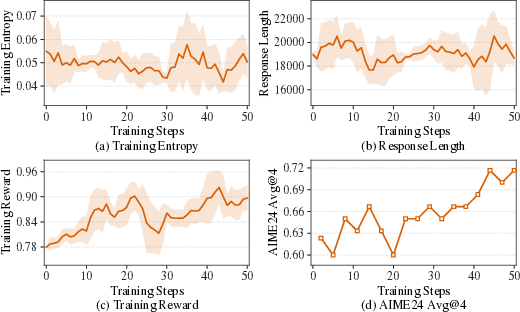
- The method’s long-term stability is not established. The reported training curves cover a limited number of steps and show potential entropy and length dynamics. Longer training could produce over-sharpening, degeneration, loss of factuality, or eventual diversity collapse.
- Theoretical guarantees are absent. The paper provides qualitative gradient analyses but no formal characterization of when suppressing sampled tail tokens improves expected task reward, preserves exploration, or avoids reinforcing erroneous prefixes.
- The relationship between token entropy and reasoning quality remains underspecified. High entropy is treated as a useful indicator of productive forks, but high uncertainty may also reflect confusion or poor calibration. A causal or calibrated distinction between beneficial exploration and uncertainty-induced errors is still needed.
- Effects on calibration and probability quality are not evaluated. OPSA changes token distributions substantially, yet the paper does not measure token-level calibration, sequence-level likelihood, confidence on correct versus incorrect answers, or reliability under selective prediction.
- Potential degradation on non-reasoning capabilities is insufficiently examined. The evaluation covers code and GPQA in addition to mathematics, but does not assess factual recall, instruction following, safety, stylistic quality, multilingual performance, or susceptibility to repetition and hallucination.
- The truncated presentation leaves methodological details unresolved. The provided paper text ends during the conclusion and refers to appendix analyses not included in the text, so important details about hyperparameters, overhead, masking procedures, evaluation protocols, and ablations cannot be independently assessed.
Practical Applications
Immediate Applications
- Lower-cost post-training for LLMs — Software/AI industry. Implement OPSA as a teacher-free alternative to on-policy distillation for improving reasoning models. A practical workflow is: generate rollouts with the student model, rank sampled tokens by log-probability, select approximately the lowest 20%, assign negative advantages, and scale the magnitude of the update using token entropy. This can reduce the need for teacher-model inference, teacher-logit access, shared vocabularies, and labeled answers. Assumptions/dependencies: The model must expose token probabilities or logits, support on-policy generation, and be trainable with a policy-gradient-style objective. The reported 20% selection ratio and advantage scale may require tuning for other architectures and tasks.
- Efficient adaptation of smaller reasoning models — Cloud providers and model developers. Use OPSA to improve relatively small models without repeatedly running a much larger teacher. The paper reports substantial gains for Qwen3-1.7B and Qwen3-4B, suggesting a workflow for upgrading compact models used in local inference, edge devices, educational tools, or cost-sensitive APIs. Assumptions/dependencies: The gains must remain stable under the target model’s tokenizer, context length, sampling temperature, and optimization infrastructure. Training still requires substantial rollout generation and GPU resources, even though teacher forward passes are removed.
- Teacher-free generation-quality optimization — Enterprise NLP platforms. OPSA can be integrated into post-training pipelines for chatbots, coding assistants, and reasoning agents when high-quality teacher logits or reference answers are unavailable. The method can be used as a model-shaping stage before supervised alignment, preference optimization, or verifier-based reinforcement learning. Assumptions/dependencies: Because OPSA does not directly identify correct answers, it should not be treated as a complete alignment method. Human evaluations, safety filters, task-specific rewards, or downstream verification remain necessary.
- Improved mathematical reasoning and self-consistency — Education and automated problem solving.
Deploy OPSA-trained models in systems that sample multiple solutions and select or verify them. The reported increases in
Avg@32andPass@32indicate potential improvements in answer reliability when generating multiple reasoning attempts for mathematics and related symbolic tasks. Assumptions/dependencies: The reported results are strongest on mathematical benchmarks and use multiple samples. Production systems need a reliable answer verifier, aggregation strategy, and safeguards against lengthy but incorrect reasoning. - Code-generation assistants — Software engineering. Apply OPSA during post-training for code models to improve multi-step generation, debugging, and alternative-solution exploration. The paper reports smaller but positive improvements on MBPP+, indicating that OPSA may be useful for code-completion or program-synthesis systems. Assumptions/dependencies: Improvements on MBPP+ do not establish reliability for production code. Compilation, unit tests, security scanning, and human review remain required. The method’s ability to improve complex repositories, tool use, or long-horizon coding agents is not demonstrated.
- Training without ground-truth labels — Academia and data-constrained organizations. Use unlabeled question corpora to conduct exploratory post-training when answer annotations are expensive, proprietary, or unavailable. The paper’s experiments train on questions without access to labels or ground-truth answers, making OPSA suitable for an initial adaptation stage. Assumptions/dependencies: The base model must already contain useful capabilities; OPSA suppresses unlikely sampled tokens rather than discovering an external notion of correctness. Poor initial models or domains with severe distribution shift may therefore receive limited benefit or reinforce undesirable behavior.
- Reducing dependence on white-box teachers — Open-source model development. Replace OPD pipelines that require access to teacher logits with a method based only on the student’s own token distributions. This can enable adaptation across models with different vocabularies and architectures and simplify open-source training workflows. Assumptions/dependencies: The student must be white-box during training. OPSA does not eliminate all infrastructure requirements, such as rollout storage, distributed training, sampling control, and monitoring for policy collapse.
- Inference-time model selection and sampling policies — AI application engineering. Use the paper’s findings to tune decoding systems: avoid excessively high sampling temperatures that frequently produce tail-token branches, while preserving sampling at high-entropy “fork” positions to maintain diverse reasoning paths. This can be deployed immediately as a decoding-policy heuristic, even without retraining. Assumptions/dependencies: Token entropy must be available at inference time, and the relationship between entropy, reflection, and correctness may vary by model and domain. Excessive suppression of tail tokens can reduce creativity or eliminate rare but valid solutions.
- Diagnostic tooling for on-policy distillation — ML research and MLOps. Build monitoring dashboards that measure teacher–student log-probability gaps, token-level advantage distributions, noise rates, gradient contributions, entropy, response length, and diversity. Such tools can identify whether an OPD run is actually transferring teacher behavior or primarily suppressing low-probability student tokens. Assumptions/dependencies: The paper’s definition of supervision noise is based mainly on verifiable final-answer tokens. Intermediate reasoning-token noise is harder to measure and requires additional evaluation instruments.
- Policy and procurement guidance for reasoning-model training — Public-sector AI governance. Organizations can use the paper’s results when comparing teacher-based and teacher-free post-training. A procurement or governance review should distinguish genuine knowledge transfer from generic probability reshaping and should require evaluations for correctness, diversity, calibration, safety, and distribution shift. Assumptions/dependencies: Benchmark improvements alone do not establish safety, factuality, fairness, or robustness. Independent replication and domain-specific testing are needed before deployment in regulated settings.
Long-Term Applications
- Self-improving domain models without continuous annotation — Healthcare, law, finance, and science. OPSA could become part of an adaptation loop for specialized models that learn to generate more coherent diagnostic hypotheses, legal analyses, financial explanations, or scientific reasoning traces from unlabeled domain prompts. It may serve as a low-cost preliminary optimization stage before adding expert feedback or verified rewards. Assumptions/dependencies: These domains require correctness and accountability, which OPSA alone cannot provide. Expert validation, privacy-preserving training, domain verifiers, calibration, and audit trails would be essential.
- Autonomous reasoning agents — Robotics and software agents. Incorporate OPSA into agents that generate plans, tool calls, or recovery strategies. Suppressing improbable action tokens while preserving diversity at high-entropy decision points could help agents avoid unstable branches while retaining alternative plans. Assumptions/dependencies: The paper studies language-model token generation, not physical actions or tool execution. Extending the method requires state-dependent safety constraints, environment feedback, action-level verification, and protection against irreversible low-probability actions.
- Hybrid teacher-free and verifier-based reinforcement learning — AI infrastructure. Develop training systems that use OPSA for dense, cheap exploratory updates and selectively invoke verifiers, human feedback, or large teachers only on difficult or high-uncertainty examples. This could reduce expensive supervision while preserving task correctness. Assumptions/dependencies: The optimal division between self-adaptation and external supervision is unknown. Research is needed on scheduling, stability, reward conflicts, and whether OPSA improves or biases later RLVR or preference-optimization stages.
- Adaptive token- and state-level learning for multimodal models — Vision, speech, and embodied AI. Generalize entropy-adaptive negative updates from text tokens to image patches, audio units, action candidates, or multimodal decision states. The core idea would be to suppress unlikely sampled branches while redistributing probability among plausible alternatives. Assumptions/dependencies: Token entropy may not be a sufficient uncertainty measure in multimodal or continuous action spaces. The method would require new objectives, calibrated uncertainty estimates, modality-specific selection rules, and experiments beyond autoregressive LLMs.
- Robust exploration in long-horizon planning — Robotics, operations research, and games. Use high-entropy states as locations for controlled exploration and low-probability actions as candidates for suppression. This could produce planning systems that avoid implausible branches without collapsing to a single deterministic strategy. Assumptions/dependencies: Exploration must be connected to external task success; entropy does not necessarily distinguish a productive novel action from a dangerous or incorrect one. Environment simulators, safety constraints, and long-horizon evaluations are required.
- Personalized and on-device language-model adaptation — Consumer technology. A lightweight OPSA-like optimizer could adapt local models to user-specific prompts or workflows without uploading private data or maintaining a large teacher model. Potential products include offline writing assistants, tutoring systems, coding tools, and private enterprise copilots. Assumptions/dependencies: On-device rollout generation and optimization may still be computationally expensive. Privacy leakage through generated trajectories, catastrophic forgetting, and reinforcement of user misconceptions must be addressed.
- New theories of “distillation” and policy improvement — Academic research. The paper motivates a broader research program separating knowledge transfer from distribution reshaping. Future studies could compare OPSA with OPD across larger model families, thinking modes, languages, domains, and task types, and determine when teacher supervision provides benefits beyond suppressing low-probability tokens. Assumptions/dependencies: Current conclusions are based on selected Qwen models, primarily non-thinking-mode rollouts, specific benchmarks, and a fixed token-selection strategy. Replication is needed before treating the mechanism as universal.
- Automated uncertainty-aware training controllers — MLOps and adaptive optimization. Future systems could dynamically choose which tokens, states, or trajectories to train on using entropy, log-probability, gradient magnitude, and diversity metrics rather than fixed thresholds. Such controllers could adjust the selected-token fraction, advantage magnitude, temperature, or rollout length during training. Assumptions/dependencies: Dynamic control may introduce instability, especially because the paper shows that poorly chosen negative-signal correlations can increase gradient norms and cause degradation. Reliable stopping criteria and collapse detection are necessary.
- Evaluation standards for label-free learning — Policy and academia.
OPSA can motivate benchmark protocols that separately report average accuracy,
Pass@k, response diversity, length, calibration, verifier agreement, and robustness to adversarial or out-of-domain prompts. These measures would help detect systems that appear more capable because they generate longer or more varied outputs without improving correctness. Assumptions/dependencies: Standardized evaluation must distinguish genuine reasoning improvement from test-set adaptation, response-length effects, and sampling changes. Independent test sets and contamination controls are required.
Glossary
- Advantage: A scalar learning signal indicating whether a sampled action or token should be reinforced or suppressed. “OPD provides token-level advantage signals for the student policy during the Reinforcement Learning (RL) training”
- AIME24/AIME25: Mathematical reasoning benchmarks based on American Invitational Mathematics Examination problems. “We evaluate the models on three in-domain mathematical reasoning benchmarks, AIME24, AIME25, and HMMT25”
- Avg@32: The average performance measured over 32 generated responses. “Compared with the base Qwen3-1.7B, OPSA improves Avg@32 by 35.41 points on AIME24”
- Chain of thought: A sequence of intermediate reasoning steps generated by a LLM. “where different tokens may initiate distinct reasoning branches”
- Credit assignment: The process of determining which actions or tokens contributed to an outcome and should receive learning signals. “or fine-grained credit assignment”
- DAPO: An on-policy reinforcement-learning algorithm that uses verifiable rewards for training LLMs. “Reinforcement learning with verifiable rewards (RLVR), including GRPO and DAPO”
- Distributional mismatch: A difference between the probability distributions or behaviors of two policies. “We attribute this to the growing distributional mismatch between the student and teacher policies”
- Exposure bias: A discrepancy between training-time inputs and inference-time inputs caused by conditioning on reference sequences during training. “MiniLLM adopts reverse-KL distillation to reduce exposure bias”
- Fork token: A token at which multiple plausible continuation or reasoning branches can begin. “Such positions often correspond to ``fork'' tokens in the chain of thought”
- Generalization: The ability of a trained model to perform well on tasks or data outside its training distribution. “Extensive experiments and analyses across model families and tasks further demonstrate its effectiveness and generalizability.”
- Gradient norm: A measure of the magnitude of the gradient used to update model parameters. “while the gradient norm explodes”
- GRPO: Group Relative Policy Optimization, an on-policy reinforcement-learning method that normalizes rewards within groups of sampled responses. “Reinforcement learning with verifiable rewards (RLVR), including GRPO and DAPO”
- Head token: A token with relatively high probability under a model’s output distribution. “This suppresses tail tokens and redistributes their mass among head tokens”
- HMMT25: A mathematical reasoning benchmark associated with the Harvard-MIT Mathematics Tournament. “We evaluate the models on three in-domain mathematical reasoning benchmarks, AIME24, AIME25, and HMMT25”
- Information leakage: The unintended use or exposure of information that should not be available to a model during training or evaluation. “Constructing such hints still requires additional sampling or annotation and may risk information leakage”
- Jaccard distance: A dissimilarity measure based on the complement of the ratio of set intersection to set union. “We quantify diversity using Jaccard distance (JD)”
- K1 estimator: A particular estimator for computing the token-level reverse Kullback–Leibler divergence in on-policy distillation. “which is computed using the K1 estimator”
- Kullback–Leibler divergence: A measure of the difference between two probability distributions. “On-Policy Distillation (OPD) optimizes the reverse Kullback–Leibler (KL) divergence between the student and teacher distributions”
- Logit: An unnormalized real-valued score produced by a model before conversion into probabilities. “let denote the logit for token conditioned on context ”
- Log probability (logp): The natural logarithm of a token’s predicted probability. “we restrict training to the 20\% of tokens with the lowest student logp”
- Long-horizon reasoning: Reasoning involving many sequential steps over an extended generation. “response-level rewards provide coarse and sparse supervision for long-horizon reasoning”
- Mode collapse: A failure in which a policy concentrates excessively on a narrow set of outputs and loses diversity. “The Pass@32 results in Table~\ref{tab:opsa_main} provide further evidence that OPSA-induced distribution sharpening neither restricts the policy’s exploration space nor degrades its pass@k performance.”
- Negative Sample Reinforcement (NSR): A reinforcement-learning approach that updates a policy using only negative learning signals. “Negative Sample Reinforcement (NSR), which learns only from negative signals, can improve policy performance.”
- Off-policy: Describing data generated by a policy different from the policy whose behavior is being evaluated or optimized. “the teacher must score trajectories it would not generate”
- On-policy distillation (OPD): Distillation in which a teacher supplies token-level supervision on trajectories sampled from the student policy. “On-Policy Distillation (OPD) addresses this limitation by using a strong teacher to provide token-level advantages through reverse Kullback–Leibler (KL) optimization on student-sampled trajectories”
- On-Policy Self-Adaptation (OPSA): A teacher-free training method that assigns entropy-dependent negative advantages to low-probability sampled tokens. “Altogether, we propose On-Policy Self-Adaptation (OPSA), a supervision-free token-level RL method”
- On-Policy Self-Distillation (OPSD): A distillation method that uses the policy itself, conditioned on additional hints, instead of an external teacher. “On-Policy Self-Distillation (OPSD) retains the same OPD paradigm but replaces the external teacher with the policy itself conditioned on hints”
- Pass@k: An evaluation metric measuring whether at least one of generated responses is correct. “The Pass@32 results in Table~\ref{fig:diversity} provide further evidence”
- Policy collapse: A training failure in which the learned policy degenerates and produces highly restricted or nonsensical outputs. “training with a fixed positive advantage leads to policy collapse”
- Pseudo-gold answer: An answer inferred from model-generated responses and treated as if it were a reference answer. “instead infer pseudo-gold answers from GRPO rollouts through majority voting or clustering”
- Qwen3-1.7B: A LLM variant with approximately 1.7 billion parameters used as the student model. “We use Qwen3-1.7B as the student policy ”
- Reverse-KL distillation: Distillation based on minimizing the Kullback–Leibler divergence in the direction that emphasizes student-generated outcomes. “MiniLLM adopts reverse-KL distillation to reduce exposure bias”
- Reinforcement learning with verifiable rewards (RLVR): Reinforcement learning in which generated answers receive rewards checked by an external verifier. “Reinforcement learning with verifiable rewards (RLVR), including GRPO and DAPO”
- Rollout: A sampled trajectory or sequence generated by a policy during training or evaluation. “where and are the minimum and maximum entropy over the lowest--logp positions within each response”
- Self-consistency: An inference or training strategy that samples multiple outputs and uses their agreement to select or reinforce an answer. “its self-consistency-based training tends to sharpen the policy distribution around a local optimum”
- Self-certainty: A confidence signal derived from a model’s own predictive uncertainty. “Intuitor adopts self-certainty, using trajectory-level entropy as a reward”
- Sparse supervision: Learning feedback provided only at relatively few points, such as a final outcome rather than each generated token. “offering dense token-level supervision as an alternative to the sparse outcome-level advantages”
- Tail token: A token with relatively low probability under the model’s output distribution. “OPSA suppresses sampled tail tokens and reallocates probability to head tokens”
- Test-Time Reinforcement Learning (TTRL): Reinforcement learning performed using information or evaluations obtained at inference time. “Test-Time Reinforcement Learning (TTRL), which does not require external supervision”
- Token-level entropy: A measure of uncertainty in the model’s probability distribution at a particular token position. “We find that high token-level entropy is closely associated with self-reflective reasoning behavior.”
- Token-level supervision: Learning feedback assigned individually to generated tokens rather than only to an entire response. “OPD offers dense token-level supervision as an alternative to the sparse outcome-level advantages of reinforcement learning with verifiable rewards (RLVR).”
- Trajectory: A complete sequence of states, actions, or generated tokens produced during policy execution. “the teacher scores student-generated trajectories that are inherently off-policy for it”
- Verifier: A mechanism that checks whether a model-generated answer satisfies a correctness criterion. “whose correctness is determined by the verifier”
- White-box access: Direct access to a model’s internal values, such as logits, rather than only its outputs. “it requires shared vocabularies and white-box access to teacher logits”