Next generation tracking and vertexing detectors
Abstract: Precise and efficient track and vertex reconstruction is essential to exploit the physics potential of collider experiments. The requirements of future tracking systems are determined by the collider type and its collision environment, required measurement precision, and beam structure. This contribution reviews the requirements and challenges of vertexing and tracking detectors at future , -hadron, , and hadron colliders. Several common trends emerge across the different collider types. Tracking systems require increasingly precise spatial measurements, low-material designs, and, in some cases, integrated particle identification capabilities. Monolithic active pixel sensors are currently the leading option for vertex detectors at and -hadron colliders. Tracker concepts range from gaseous detectors, which provide many measurements per track and can achieve very low material budgets, to silicon and scintillating-fibre trackers, which provide fewer but more precise measurements and can tolerate higher hit rates. At 10 TeV parton centre-of-mass colliders, precision timing throughout the tracking system is needed for beam-background rejection or pile-up mitigation. For future hadron colliders specifically, radiation tolerance beyond that demonstrated by existing sensor technologies is required. Ultimately, meeting the vertexing and tracking requirements of future colliders will require substantial R&D and the integrated optimisation of sensors, front-end electronics, readout, cooling, powering, and mechanics.
Paper Prompts
Sign up for free to create and run prompts on this paper.
Top Community Prompts
Explain it Like I'm 14
1. What is this paper about?
This paper explains how scientists are designing the next generation of particle detectors for future particle colliders.
A particle collider smashes tiny particles together at extremely high speeds. These collisions can create new particles, but the new particles disappear almost instantly. Detectors must therefore record the paths of the particles produced in the collision.
The paper focuses on two important detector jobs:
- Tracking: following the paths of charged particles.
- Vertexing: finding the exact places where particles were created or decayed.
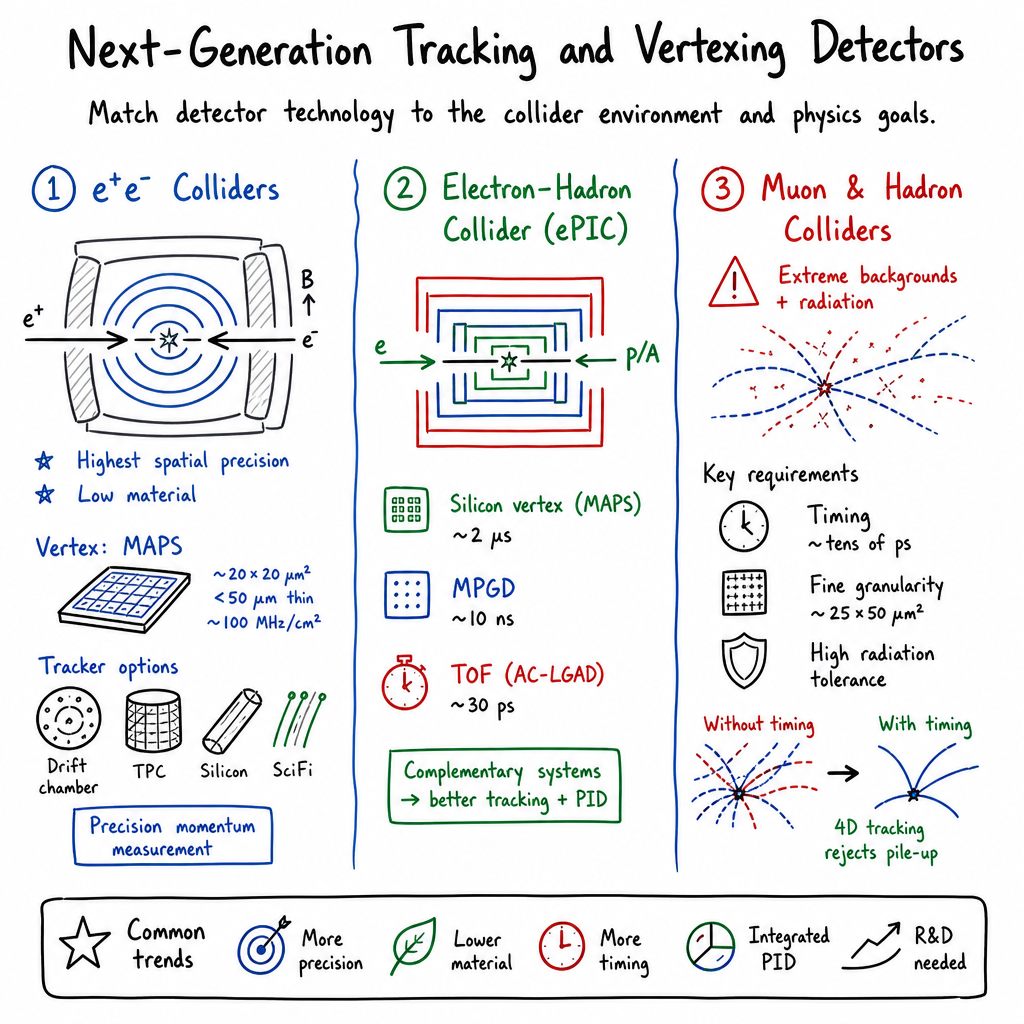
The author compares the detector needs of several possible future colliders:
- Electron–positron colliders
- Electron–hadron colliders
- Muon colliders
- Hadron colliders, such as future versions of the Large Hadron Collider
2. Main questions and objectives
The paper mainly asks:
- How accurately must future detectors measure particle paths?
- How quickly must detectors record particles?
- How much radiation and background noise must they survive?
- Which detector technologies could meet these difficult requirements?
- How should sensors, electronics, cooling, and mechanical supports work together?
The answers depend on the kind of collider. For example, some colliders produce relatively clean collisions but require extremely precise measurements. Others create many particles and intense radiation, so their detectors must be very fast and very tough.
3. How the research was done
This is mainly a review paper. That means the author did not report one single new experiment. Instead, they studied and compared many existing detector designs, research projects, and future collider plans.
The paper examines the following factors.
Measuring particle paths
A charged particle bends when it travels through a magnetic field. The amount of bending tells scientists how much momentum the particle has.
A tracker works somewhat like taking many photographs of a moving object. By connecting the small pieces of its path, scientists can reconstruct the full trajectory.
The detector needs:
- Very precise position measurements
- High efficiency, so it does not miss particles
- Low noise, so false signals are not mistaken for real particles
- Wide coverage around the collision point
Finding vertices
A vertex is a point where particles are created or where one particle decays into others.
The detector’s innermost layers are placed very close to the collision. They measure where a track begins. This helps scientists distinguish:
- The original collision point
- A later decay of a short-lived particle
- More complicated decay chains
This is similar to using several camera views to work out exactly where a ball was thrown from and where it changed direction.
Comparing detector technologies
The paper compares several types of trackers.
- Silicon detectors: have very precise measurements, like a ruler with extremely small markings.
- Gaseous detectors: contain gas that produces signals when particles pass through. They provide many measurements and can be very light.
- Scintillating-fibre trackers: use fibres that produce tiny flashes of light when particles pass through.
- Monolithic active pixel sensors, or MAPS: place the sensing part and much of the electronics on the same piece of silicon. This can make detectors thin and lightweight.
- Timing detectors: measure not only where a particle passed, but also exactly when it passed.
The paper also considers practical issues such as power use, cooling, mechanical support, data transfer, and radiation damage.
4. Main findings
Electron–positron colliders need extreme precision
Future electron–positron colliders are expected to have fairly clean collision environments. However, they need exceptionally accurate measurements, especially for studying the Higgs boson and other rare processes.
The paper finds that their vertex detectors should:
- Use very small pixels
- Be placed as close as possible to the collision
- Contain as little material as possible
- Use very thin, lightweight sensors
The leading technology is MAPS. Some research projects are developing pixels about micrometres in size. This is much smaller than the width of a human hair.
Reducing the detector material is important because particles can scatter when passing through matter. That scattering makes their paths harder to measure accurately.
Different tracker designs have different strengths
The paper identifies two broad approaches for outer tracking systems.
| Approach | Strengths | Main difficulties |
|---|---|---|
| Gaseous trackers | Many measurements, very little material, useful for long-lived particles | Can be too slow or affected by high particle rates |
| Silicon or fibre trackers | Very precise, fast, and able to handle many hits | Usually need more cooling, electronics, or material |
There is no single best technology for every collider. The best choice depends on the collision environment and the scientific goals.
The Electron-Ion Collider uses several technologies together
The planned ePIC detector at the Electron-Ion Collider is an example of a combined approach.
It will use:
- A silicon vertex detector for accurate positions
- A gas detector for additional tracking and faster timing
- A time-of-flight detector to help identify different types of particles
A time-of-flight detector measures how long a particle takes to travel a known distance. Since different particles move at different speeds, this helps scientists identify them.
This design shows that several detector technologies can work together, with each one performing the job it is best at.
Muon colliders have serious background problems
Muon colliders could reach very high energies, but muons naturally decay. Their decays create many unwanted particles that can produce false detector signals.
The paper finds that muon-collider trackers will need:
- Timing accuracy of tens of picoseconds
- Very precise spatial measurements
- Strong radiation resistance
- Special designs around the beam pipe to reduce backgrounds
A picosecond is one trillionth of a second. Measuring time this accurately is like distinguishing events separated by an incredibly tiny fraction of a blink.
Because muon colliders may have only one bunch of positive muons and one bunch of negative muons, they could have fewer collisions per second. This might allow the detector to be switched off between collisions, saving power.
Future hadron colliders will be the most challenging
Future hadron colliders could produce up to about 1,000 overlapping collisions at once. This is called pile-up.
Imagine trying to understand one conversation in a room where 1,000 other conversations are happening at the same time. The detector must determine which particle tracks belong to which collision.
The paper says these detectors will need:
- Timing accuracy of about 30 picoseconds or better
- Extremely small pixels
- Much greater radiation resistance than current detectors
- Large tracking volumes
- Special systems to detect particles moving close to the beam direction
The expected radiation may be 10 to 100 times greater than in the High-Luminosity LHC. At present, no existing sensor technology fully meets all these requirements.
Researchers are therefore studying:
- Three-dimensional silicon sensors
- Special fast-timing sensors called LGADs
- New radiation-resistant materials known as wide-band-gap semiconductors
5. Why these results matter
Tracking and vertexing are not just technical details. They are necessary for discovering and measuring new particles.
Better tracking can help scientists:
- Measure the Higgs boson more accurately
- Identify particles produced in collisions
- Study very short-lived particles
- Search for long-lived or invisible particles
- Separate real collision events from background noise
- Explore physics beyond the current Standard Model
The paper’s main message is that future detectors cannot be designed by improving only the sensor. The entire detector must be planned as one connected system. Sensors, electronics, cooling, power supplies, data collection, and mechanical supports all affect one another.
Conclusion
Future particle colliders will create very different challenges. Electron–positron colliders mainly need maximum precision. Muon and hadron colliders must cope with large backgrounds, fast signals, and intense radiation. The Electron-Ion Collider lies between these cases and demonstrates how several detector technologies can be combined.
The research shows that future tracking systems will need to be:
- More precise
- Thinner and lighter
- Faster
- More radiation-resistant
- Better at identifying particles
- Designed to handle huge amounts of data
Developing these detectors will require years of research and testing. If scientists succeed, the detectors could make it possible to study the smallest building blocks of nature in much greater detail and perhaps discover entirely new particles or physical laws.
Knowledge Gaps
Knowledge gaps, limitations, and open questions
- The review does not provide a unified, quantitative comparison of tracking concepts across collider types using common metrics such as momentum resolution, impact-parameter resolution, efficiency, material budget, timing, power, cost, and scalability.
- The detector requirements are largely presented as target values, without systematic sensitivity studies showing how changes in spatial resolution, timing, material budget, occupancy, or radiation damage affect specific physics measurements.
- The impact of detector performance on a broad range of benchmark physics channels remains unexplored; only a limited example, , is discussed for vertexing.
- The paper does not establish how the stated performance targets should be prioritised when they conflict—for example, when improving timing increases power consumption, cooling needs, material, or readout complexity.
- The assumed collider conditions, including luminosity, pile-up, beam backgrounds, bunch structure, radiation levels, and magnetic fields, are not accompanied by uncertainty ranges or scenario studies for machine parameter variation.
- The effects of nonuniform, time-dependent, and correlated beam-induced backgrounds on pattern recognition and vertex reconstruction are not quantitatively evaluated.
- The feasibility of integrating vertex detectors into the machine–detector interface is not demonstrated, particularly with respect to mechanical tolerances, vibration, alignment stability, vacuum constraints, magnetic fields, and access for maintenance.
- Air cooling for the innermost layers is identified as a baseline for lepton colliders, but the achievable thermal performance, temperature uniformity, mechanical stability, and long-term reliability are not established.
- The material-budget estimates do not appear to include a complete accounting of sensors, interconnects, flexible circuits, support structures, cooling, power distribution, and services for full detector systems.
- The review focuses on MAPS as the leading option for future vertex detectors but does not systematically compare MAPS with alternative technologies such as hybrid pixels, depleted CMOS, 3D sensors, or other emerging architectures.
- The MAPS performance values in the table mix measured results, specifications, goals, and prototype-stage values, but the paper does not distinguish their maturity, measurement conditions, uncertainties, or comparability.
- The long-term effects of radiation, thermal cycling, mechanical bending, and wafer-scale fabrication on MAPS performance and yield remain insufficiently quantified.
- The trade-off between pixel pitch, sensor thickness, depletion depth, charge collection, power consumption, timing, radiation tolerance, and spatial resolution is not analysed in a common framework.
- The feasibility of wafer-scale bent MAPS and overlapping curved layers for large-area production, assembly, alignment, repair, and quality assurance is left unresolved.
- The review does not address how detector nonuniformities, dead areas, seams, edge effects, and sensor-to-sensor calibration will affect tracking and vertexing performance.
- The achievable timing performance of MAPS under realistic hit rates, charge-sharing conditions, radiation damage, temperature variations, and time-walk corrections is not demonstrated for complete detector layers.
- The paper does not quantify the readout bandwidth, data volume, latency, buffering, and power requirements associated with the proposed sensor technologies and collider beam structures.
- The potential benefits and limitations of power pulsing are not evaluated for realistic duty cycles, including wake-up transients, thermal cycling, electromagnetic interference, and impacts on detector lifetime.
- The tracker comparison does not provide full-system simulations of gaseous, silicon, and scintillating-fibre technologies under identical detector geometries and physics conditions.
- The performance of gaseous trackers in the presence of beam backgrounds, space charge, ion backflow, ageing, and local occupancy variations is not quantified.
- The stated concerns for drift chambers, TPCs, and straw tubes are listed but not connected to engineering tolerances, failure probabilities, operating lifetimes, or mitigation strategies.
- The integration of particle identification with tracking is discussed qualitatively, without quantitative studies of PID separation power, timing requirements, material penalties, calibration needs, or performance at different momenta and polar angles.
- The role of machine learning or advanced reconstruction algorithms in recovering tracking efficiency and vertexing performance under high occupancy and pile-up is not investigated.
- The treatment of long-lived particles is limited to noting that gaseous trackers may benefit from continuous tracking; dedicated requirements for displaced tracks, disappearing tracks, non-pointing trajectories, and delayed signals are not developed.
- The collider discussion does not quantify the spatial and temporal distributions of muon-decay backgrounds or demonstrate that tens-of-picoseconds timing is sufficient across all tracking layers.
- The compatibility of power pulsing with the irregular timing and background structure expected at muon colliders remains uncertain.
- The radiation estimates for muon-collider detectors are described as comparable to the HL-LHC, but spatially varying dose and fluence maps, sensor-specific damage mechanisms, and safety margins are not provided.
- No complete detector concept is evaluated for simultaneous timing, radiation tolerance, spatial resolution, low mass, cooling, and high-rate readout at a multi-TeV muon collider.
- The future hadron-collider radiation requirements are extrapolated from projections, but the uncertainty in the and targets is not assessed.
- The claim that no existing sensor technology meets future hadron-collider requirements is not supported by a systematic technology benchmark under identical irradiation, temperature, bias, and timing conditions.
- The survivability and performance of 3D sensors, LGADs, and wide-band-gap materials at the combined fluence and total-ionising-dose levels expected for future hadron colliders remain open questions.
- The paper does not address whether the required ps timing resolution can be maintained after irradiation, over large detector areas, and with acceptable power and cooling requirements.
- The relationship between the proposed pixel granularity and the stated occupancy and momentum-resolution goals is not demonstrated with detailed simulations including realistic pile-up, detector geometry, and reconstruction inefficiencies.
- The feasibility of tracking particles up to TeV with the proposed tracker radius, magnetic field, spatial resolution, alignment precision, and available lever arm is not quantitatively validated.
- The consequences of extending tracking coverage to for material budget, radiation exposure, services, pattern recognition, and mechanical integration are not studied in detail.
- Forward tracking performance under extreme radiation, small polar angles, secondary interactions, and beam-induced backgrounds remains insufficiently specified.
- The review does not quantify alignment and calibration requirements for achieving the stated momentum and vertex resolutions, particularly for very large or flexible detector structures.
- Failure tolerance and graceful degradation are not considered, including the effects of dead modules, cooling failures, power-supply failures, communication faults, and radiation-induced single-event effects.
- The reliability, maintainability, replacement strategy, and operational lifetime of future tracking systems are not addressed.
- The paper identifies integrated optimisation of sensors, electronics, readout, cooling, powering, mechanics, and DAQ as necessary, but does not present a co-optimised system-level design or methodology.
- The cost, manufacturing capacity, supply-chain constraints, and industrial scalability of the proposed large-area detector systems are not evaluated.
- Environmental considerations, including energy consumption, cooling infrastructure, material use, and end-of-life handling, are not included in the technology comparison.
- The review does not identify quantitative decision criteria or technological milestones that would determine when a proposed detector concept is sufficiently mature for construction.
Practical Applications
Immediate Applications
The paper’s findings are primarily applicable to particle-physics instrumentation and adjacent high-performance sensing technologies. The following uses can be pursued with existing prototypes, established detector architectures, or current development programs.
- Upgrade of present and near-term collider detectors (particle physics). Deploy monolithic active pixel sensors (MAPS), silicon trackers, micro-pattern gas detectors (MPGDs), scintillating-fibre trackers, and low-gain avalanche detectors (LGADs) in experiments such as the EIC, HL-LHC upgrades, ALICE, Belle II, and LHCb. These systems can improve charged-particle tracking, secondary-vertex reconstruction, heavy-flavour measurements, and searches for long-lived particles. Dependencies: sensor qualification, radiation testing, integration with existing magnetic fields and detector geometries, and compatibility with experiment-specific readout and trigger systems.
- ePIC-style hybrid tracking workflows (particle physics and scientific computing). Combine subsystems with different strengths: a precise but relatively slow MAPS vertex detector, a moderately fast MPGD for pattern recognition, and an AC-LGAD time-of-flight system for particle identification. A practical workflow would use the fast detector layers to seed or validate tracks while the vertex detector supplies accurate spatial information. Dependencies: synchronized clocks, calibrated alignment across technologies, unified reconstruction software, and reliable data fusion between different ASIC and readout systems.
- Improved heavy-flavour and rare-decay measurements (particle physics). Low-material, few-micrometre vertex detectors can improve impact-parameter resolution and the separation of primary, secondary, and tertiary vertices. This directly supports measurements involving displaced heavy-flavour decays, including rare -meson channels such as . Dependencies: achieving the targeted spatial resolution in a full detector, controlling multiple scattering, maintaining low noise, and preserving efficiency in the presence of beam-induced backgrounds.
- Long-lived-particle search capabilities (particle physics). Gaseous trackers with many measurements and continuous tracking can be incorporated into searches for particles that decay far from the interaction point. Their low material budget and extended tracking volume are advantageous for reconstructing displaced tracks and unusual decay topologies. Dependencies: adequate hit-rate performance, sufficiently short integration times, dedicated reconstruction algorithms, and detector layouts that do not impose overly restrictive inner material or geometric boundaries.
- Particle identification integrated into tracking (particle physics). Add , , or time-of-flight measurements to tracking systems. Drift chambers, TPCs, straw tubes, silicon sensors, and AC-LGAD-based timing layers can provide complementary information for separating particle species. Dependencies: sufficient timing precision and calibration stability; gaseous systems may be limited by ion backflow, charge accumulation, or long integration times, while silicon systems may require additional cooling and services.
- Power-pulsed detector electronics (low-power electronics and accelerator instrumentation). In linear colliders and potentially muon colliders, detector electronics can be activated only during bunch trains or collision windows. This reduces average power consumption, cooling requirements, and the material associated with cooling infrastructure. Dependencies: a suitable beam structure, fast and reliable power cycling, preservation of detector performance during wake-up, and front-end electronics designed for transient operating conditions.
- Ultra-light mechanical and cooling architectures (advanced instrumentation). Apply air cooling, wafer-scale bent MAPS, curved sensors, flexible interconnects, and side-abuttable modules to build lightweight detector layers. These design principles can be used immediately in prototype trackers and in detector upgrade programs where multiple scattering is a dominant limitation. Dependencies: mechanical stability, thermal uniformity, service routing, sensor yield over large areas, and reliable operation of flexible circuits under radiation and repeated thermal cycles.
- Technology-transfer programs for high-performance imaging and timing sensors. MAPS development in CMOS processes, including ARCADIA, OCTOPUS, TaichuPix, MOSAIX, CASSIA, and MADPix-related work, can produce compact sensors with integrated amplification and readout. Near-term outputs include evaluation boards, radiation-test systems, timing demonstrators, and customizable sensor ASICs. Dependencies: fabrication access, production yield, front-end design maturity, packaging, and the ability to adapt particle-detector requirements to non-physics markets.
- Training and design tools for detector engineering (academia and industry). The paper provides a framework for selecting a tracker technology based on collision rate, particle multiplicity, magnetic field, material budget, timing, radiation dose, and beam structure. This can support simulation packages, detector trade-study templates, laboratory courses, and engineering design reviews. Dependencies: validated detector simulations, realistic radiation and occupancy models, and access to representative beam-test data.
- Radiation-tolerant sensor testing and qualification services (industry and research infrastructure). Existing HL-LHC expertise can be used to test MAPS, LGADs, 3D sensors, and front-end electronics for radiation damage, timing degradation, leakage current, and non-ionising energy loss. Such facilities can support aerospace, nuclear instrumentation, medical accelerators, and space-instrumentation customers. Dependencies: availability of irradiation facilities, standardized qualification procedures, reliable lifetime models, and sufficient correlation between laboratory tests and operational environments.
Long-Term Applications
The most consequential applications require new sensor materials, large-scale manufacturing, system-level optimization, or construction of future colliders. They represent development targets rather than immediately deployable products.
- 4D tracking at future hadron and muon colliders (particle physics). Develop trackers with spatial precision of a few micrometres to tens of micrometres and timing precision of roughly tens of picoseconds. Time information throughout the tracker would reject beam-induced backgrounds at muon colliders and associate tracks with the correct interaction vertex under pile-up levels approaching 1,000 at future hadron colliders. Dependencies: simultaneous achievement of timing, granularity, radiation tolerance, power efficiency, and scalable readout; the paper notes that no existing sensor technology yet satisfies the most demanding future-hadron-collider requirements.
- Radiation-hard tracking for 100-TeV-class hadron colliders (particle physics and materials science). Create detector layers capable of operating near fluences of and doses approaching . Candidate technologies include 3D sensors, LGADs, and ultra-wide-band-gap semiconductors. Dependencies: demonstration of long-term performance, radiation-hard ASICs, radiation-resistant packaging and interconnects, industrial fabrication capacity, and acceptable cost per instrumented area.
- High-precision Higgs and electroweak measurements at future colliders. A tracker achieving momentum resolution better than —and potentially near —for approximately $50$ GeV tracks would improve Higgs-mass reconstruction and precision measurements of electroweak processes. Possible products include large-area MAPS vertex systems, low-material drift chambers, silicon trackers, and hybrid silicon–gas tracker architectures. Dependencies: minimizing material in the beam pipe and detector, maintaining alignment over large volumes, controlling magnetic-field and beam-interface constraints, and achieving the required resolution at production scale.
- Wafer-scale curved detector modules (semiconductor manufacturing and robotics). Bent, wafer-scale MAPS with flexible power and readout connections could enable nearly seamless cylindrical imaging surfaces. Beyond collider vertexing, the underlying architecture could support compact curved imaging modules for robotic vision, industrial inspection, scientific cameras, or endoscopic instruments. Dependencies: reliable wafer thinning and bending, low defect rates, thermal management, packaging methods, and adaptation of radiation-focused designs to visible-light or other imaging requirements. These non-physics uses are plausible technology-transfer opportunities, not demonstrated outcomes of the paper.
- General-purpose ultrafast, low-power imaging systems (healthcare, industrial inspection, and transportation). Integrated sensors combining position, amplification, and timing could support high-speed event imaging, time-of-flight measurements, and precise localization. Potential long-term products include fast medical-imaging detectors, radiation-monitoring instruments, industrial defect scanners, and three-dimensional machine-vision systems. Dependencies: market-specific validation, safety certification, suitable photon or particle sensitivity, data-processing hardware, and cost reductions relative to conventional sensors.
- Advanced medical imaging and radiation therapy monitoring (healthcare). High-granularity MAPS and LGAD-like timing layers could be developed into detectors for beam monitoring, proton or ion-beam range verification, positron-emission tomography, and time-resolved radiation imaging. The ability to combine position and timing could improve localization of deposited energy and treatment quality assurance. Dependencies: clinical validation, dose-response calibration, radiation hardness appropriate to the application, patient-safety certification, and integration with treatment-planning and hospital information systems.
- High-speed particle and radiation monitors for space and nuclear environments (aerospace and energy). Radiation-tolerant sensors derived from collider programs could monitor energetic particles, accelerator beams, fusion devices, nuclear facilities, or spacecraft radiation environments. Timing and tracking could help distinguish particle types, trajectories, and background sources. Dependencies: qualification under vacuum, temperature extremes, launch vibration, and application-specific radiation spectra; power and telemetry limits are also critical for space deployment.
- Real-time reconstruction and hardware-assisted triggering (software and computing). The high data rates implied by fine-grained, timed trackers will motivate FPGA-, ASIC-, and accelerator-based reconstruction pipelines. Future systems could perform online track finding, vertex association, pile-up rejection, and long-lived-particle selection before storage. Dependencies: scalable algorithms, deterministic latency, low-power computing, high-bandwidth interconnects, and validated physics performance. Machine-learning methods may assist reconstruction, but the paper itself does not establish their effectiveness.
- Integrated detector-system engineering platforms (industry and academia). Future projects will require joint optimization of sensors, front-end electronics, data acquisition, cooling, powering, mechanics, and reconstruction software. This could lead to reusable modular platforms, digital twins, standardized interfaces, and procurement frameworks for large scientific instruments. Dependencies: coordination across international collaborations, stable technical requirements, common interface standards, long development times, and sustained public investment.
- Policy and infrastructure planning for future colliders. The paper supports policy decisions that fund sensor R&D, radiation-testing facilities, semiconductor access, advanced packaging, cooling research, and multidisciplinary training before collider construction begins. Detector feasibility should be included in collider roadmaps rather than treated as a later subsystem decision. Dependencies: long-term funding commitments, international coordination, credible cost and schedule estimates, and successful demonstration of the most demanding timing and radiation specifications.
- Education and workforce development in systems engineering (academia). Future detector programs can provide interdisciplinary training spanning semiconductor physics, electronics, mechanical engineering, cryogenics or air cooling, data acquisition, signal processing, and scientific software. The EIC and other intermediate-scale projects can serve as practical testbeds before deployment at more extreme colliders. Dependencies: access to beam tests and laboratories, open technical documentation, collaboration between universities and industry, and continued operation of accelerator facilities.
Glossary
- 4D tracking: Tracking that combines three-dimensional spatial information with precise time measurements to distinguish particles from different collision times. “enabling 4D tracking”
- AC-coupled low-gain avalanche detector (AC-LGAD): A silicon detector using capacitive signal coupling and controlled avalanche gain for precise timing and position measurements. “both using AC-coupled low-gain avalanche detectors (AC-LGADs) for PID.”
- Air cooling: Cooling a detector with moving air rather than liquid or solid thermal systems, reducing added material. “air-cooling is the baseline for the first couple of layers to minimise material budget.”
- Beam-induced background: Detector signals or particles generated by beam interactions unrelated to the desired collision. “beam-induced backgrounds”
- Beam pipe: The evacuated tube through which accelerator beams travel and around which detector components are arranged. “the beam pipe in front must be minimised.”
- Bunch crossing: The time at which two particle bunches pass through one another and may collide. “associate hits with the correct bunch crossing and track”
- Bunch train: A sequence of closely spaced particle bunches followed by a longer interval without bunches. “Linear colliders feature bunch trains with tightly packed bunches”
- Charge accumulation: The buildup of electrical charge in a detector medium due to repeated particle interactions. “charge accumulation from beam-induced backgrounds”
- Charge-coupled detector: A detector or readout structure in which charge is transferred between adjacent regions or electrodes; in the paper, this concept appears in the related term “AC-coupled.” “AC-coupled low-gain avalanche detectors (AC-LGADs)”
- CMOS process: A semiconductor manufacturing technology based on complementary metal–oxide–semiconductor circuitry. “Thanks to advanced CMOS processes”
- Collision environment: The combination of particle density, radiation, background activity, and collision frequency surrounding a detector. “Their collision environment and reconstruction requirements are less demanding”
- Continuous tracking: Tracking performed throughout a detector volume rather than only at discrete measurement layers. “Gaseous trackers offer low material budgets and continuous tracking”
- Curvature measurement: Determination of a charged particle’s trajectory curvature in a magnetic field to infer its momentum. “By measuring the curvature of charged-particle trajectories”
- Drift chamber: A gaseous detector that reconstructs particle positions from the drift time of ionisation electrons toward sensing wires. “as in drift chambers, time-projection chambers (TPCs), and straw tubes.”
- dE/dx: Specific energy loss per unit path length, used to identify particles by comparing their ionisation losses. “”
- dN/dx: The number of ionisation clusters or detectable interactions per unit path length, used for particle identification. “”
- Forward coverage: The detector’s ability to measure particles emitted at small angles relative to the beam axis. “extended forward coverage up to ”
- Gain layer: A sensor region engineered to amplify signals through controlled charge multiplication. “These projects develop MAPS with a gain layer”
- Granularity: The fineness of a detector’s spatial segmentation, generally determined by the size and spacing of its pixels or sensing elements. “granularities as small as $25 \times \SI{50}{\micro\meter\squared}$ are required.”
- Hit rate: The frequency at which detector sensing elements register particle interactions. “Pixel hit rate”
- Hit resolution: The uncertainty with which a detector determines the position of a particle interaction. “Hit resolution”
- HL-LHC: The High-Luminosity Large Hadron Collider, an upgraded LHC configuration designed for substantially greater integrated collision data. “comparable to those at the HL-LHC”
- Impact parameter: The closest transverse or three-dimensional distance between a reconstructed particle trajectory and the interaction point. “their precise measurement of track impact parameters”
- Incoherent pair creation: Production of electron–positron pairs through beam-related electromagnetic processes that are not phase-coherent with the colliding beams. “The dominant backgrounds are incoherent pair creation”
- Instantaneous luminosity: The collision rate per unit area and time, characterising the intensity of a collider at a given moment. “Instantaneous luminosity and particle multiplicity determine”
- Integration time: The period over which a detector collects charge or signals before reading them out. “a vertex detector with a \SI{2}{\micro\second} integration time”
- Ion backflow: The movement of positive ions produced in a gaseous detector’s amplification region back into its drift region, potentially distorting electric fields. “Field distortions from ion backflow”
- Long-lived particle: A particle whose lifetime is sufficiently long to travel a measurable distance before decaying. “the detection of long-lived particles from the outset”
- Low-gain avalanche detector (LGAD): A silicon detector containing a controlled multiplication layer that provides internal signal amplification and excellent timing. “Relevant R{paper_content}D programmes include 3D sensors, LGADs”
- Magnetic lever arm: The effective distance over which a particle’s curved trajectory is measured in a magnetic field; a longer distance improves momentum determination. “over a long lever arm”
- Machine-detector interface (MDI): The region where accelerator components and the particle detector meet, containing structures such as the beam pipe and nearby magnets. “fully integrated into the machine-detector interface (MDI) region”
- Material budget: The amount of material traversed by particles, often expressed relative to radiation length, which affects scattering and energy loss. “the material budget in the vertex detector”
- Micro-pattern gas detector (MPGD): A gaseous particle detector employing finely structured amplification electrodes to achieve high spatial or temporal precision. “a moderately fast micro-pattern gas detector (MPGD)”
- Monolithic active pixel sensor (MAPS): A pixel detector integrating sensing, signal amplification, and readout electronics on the same semiconductor substrate. “The only sensor technology currently considered for future vertex detectors are monolithic active pixel sensors (MAPS).”
- Multiple Coulomb scattering: The cumulative deflection of charged particles through many electromagnetic interactions with detector material. “ describes the effect of multiple Coulomb scattering”
- Non-ionising energy loss: Energy transferred to a material through displacement damage rather than through ionisation, potentially degrading semiconductor detectors. “non-ionising energy loss”
- Occupancy: The fraction of detector channels registering signals during a specified readout or integration interval. “while keeping the occupancy below 1\%”
- Pile-up: The overlap of multiple particle collisions within the same detector readout interval or event. “a pile-up of up to 1000”
- Pixel pitch: The centre-to-centre spacing between neighbouring pixels in a pixel sensor. “Pitch [\SI{}{\micro\meter\squared}]”
- Power pulsing: Rapidly switching detector electronics off during periods without collisions to reduce power consumption and cooling requirements. “allowing to turn off detector components in-between (power pulsing).”
- Radiation length: The characteristic distance over which a high-energy electron loses most of its energy through bremsstrahlung in a material; it also quantifies material thickness relevant to scattering. “low-material designs”
- Radiation tolerance: The ability of detector materials and electronics to maintain performance after exposure to intense radiation. “radiation tolerance beyond that demonstrated by existing sensor technologies”
- Readout rate: The rate at which detector data can be transferred from sensing elements to downstream electronics or acquisition systems. “readout-rate requirements”
- Scintillating-fibre tracker (SciFi tracker): A tracker using light-producing optical fibres to detect charged particles and measure their trajectories. “as in silicon and scintillating-fibre (SciFi) trackers”
- Secondary vertex: A reconstructed decay or interaction point displaced from the primary collision point. “the reconstruction of primary, secondary and tertiary vertices.”
- Space-charge effect: The modification of a gaseous detector’s electric field by accumulated positive or negative charge. The paper discusses this mechanism through “charge accumulation from beam-induced backgrounds.”
- Spatial resolution: The precision with which a detector measures the position of a particle interaction. “stringent spatial-resolution requirements”
- Straw tube: A thin-walled gaseous drift detector consisting of a cylindrical tube with a central sensing wire. “as in drift chambers, time-projection chambers (TPCs), and straw tubes.”
- Synchrotron radiation: Electromagnetic radiation emitted by charged particles when they are accelerated along curved trajectories in a magnetic field. “The dominant backgrounds are incoherent pair creation and synchrotron radiation”
- Tertiary vertex: A reconstructed point corresponding to a decay or interaction occurring downstream of a secondary decay. “the reconstruction of primary, secondary and tertiary vertices.”
- Time-of-flight (TOF): Particle-identification technique that infers particle type from the time required to travel a known distance. “a fast time-of-flight (TOF) system”
- Time walk: A signal-timing error in which the measured threshold-crossing time depends on pulse amplitude. “$< \SI{100}{ns}$ time walk”
- Time-projection chamber (TPC): A gaseous detector that reconstructs particle tracks in three dimensions using ionisation drift time and segmented readout. “time-projection chambers (TPCs)”
- Total ionising dose: The cumulative radiation energy deposited through ionisation in a material, especially relevant to electronic damage. “The associated total ionising dose and non-ionising energy loss”
- Transverse impact parameter resolution: The precision with which the distance of closest approach of a track to the interaction point is measured in the plane transverse to the beam. “The vertex-detector performance requirement can be stated as a requirement to the transverse impact parameter resolution”
- Wafer-scale sensor: A semiconductor sensor fabricated over a large area comparable to an entire wafer, reducing the need for tiled assemblies. “wafer-scale bent MAPS”
- Wide-band-gap material: A semiconductor material with a large electronic band gap, often providing improved radiation tolerance and high-temperature operation. “wide-band-gap materials”

