Puro-2B: Poor Lab's Qwen2-1.5B Trained on RTX 5090 within $5090
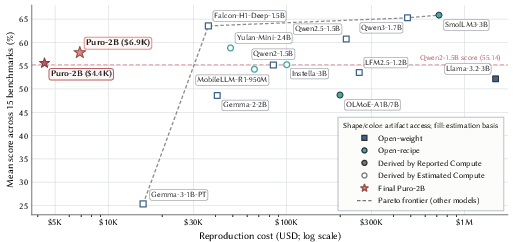
Abstract: LLM pretraining has become almost synonymous with prohibitive cost, placing it out of reach for much of the academic and open-source communities. Although strong open-source efforts already exist, including open-weight models and open-source training recipes, a cost-efficient, hardware-accessible, and open-source pretraining recipe has long been missing. Even at a small scale, training Llama-3.2-3B costs over $1.5M, and reproducing SmolLM3-3B needs over $700K. In this report, we present an open pretraining recipe designed to lower this barrier. Using this recipe, we train a collection of Puro-2B models from scratch on up to 1.4 trillion tokens with FP8 precision on consumer-grade RTX 5090 GPUs. The models in the collection differ in token budgets and selected recipe variants. Our best model is trained at a compute cost of less than $6.9K and approaches Qwen2.5-1.5B performance under our evaluation protocol. This cost efficiency is enabled by a combination of approaches, including hardware selection, low-precision training, hyperball optimization, curriculum model averaging, and the data recipe. Beyond the recipe itself, we provide two additional results. First, across the Puro-2B collection, we derive a Puro Cost Scaling Law that relates training cost to average model performance; the fitted law suggests that about $4.4K, less than $5,090, is sufficient to reach the performance of Qwen2-1.5B. Second, as an end-to-end case study, we examine how pretraining data curricula shape downstream performance after post-training. Such controlled studies are enabled by having access to the full pretraining pipeline rather than model weights alone. We release the full training recipe for Puro-2B, including data, code, and model weights under Apache 2.0 at https://huggingface.co/collections/thu-pacman/puro-2b.
Paper Prompts
Sign up for free to create and run prompts on this paper.
Top Community Prompts
Explain it Like I'm 14
1. Paper overview
This paper asks a practical question:
Can a small research team train a useful LLM without spending millions of dollars?
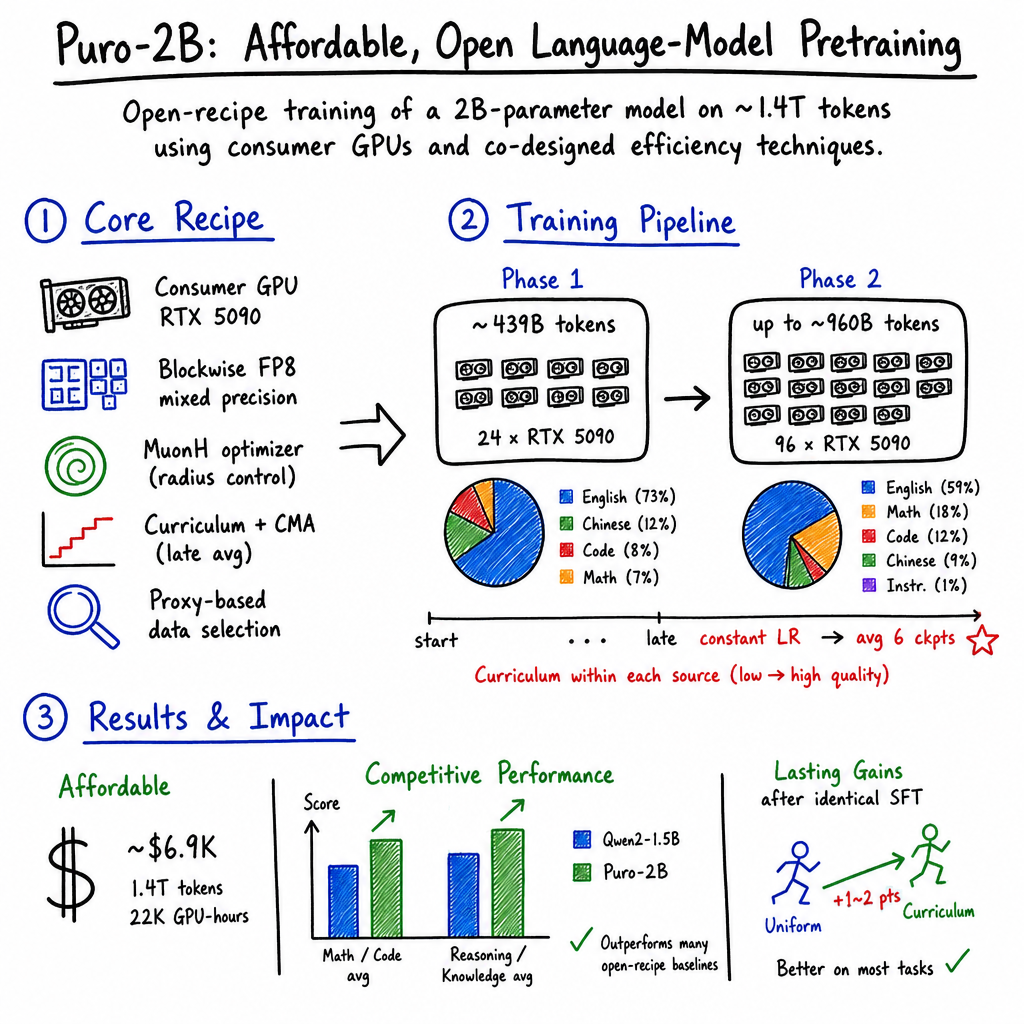
The authors create a LLM called Puro-2B, which has about 2 billion adjustable settings, called parameters. They train it from the beginning using relatively inexpensive, consumer-grade RTX 5090 graphics cards instead of very expensive data-center computers.
Their best model costs about $6,900 in estimated computer time to train. It performs similarly to some well-known models with around 1.5–2 billion parameters. The authors also release the model, data information, and training code so that other researchers can study or reproduce their work.
2. Main objectives and research questions
The paper focuses on several connected questions:
- Can language-model training be made affordable for smaller laboratories and open-source projects?
- Can ordinary consumer GPUs train a useful model?
- Which techniques save the most money or computer time?
- Does carefully choosing and ordering training data improve the final model?
- Can researchers predict how much performance they will get for a certain training budget?
- Do improvements made during pretraining still help after the model receives additional instruction training?
The larger goal is to make language-model research less controlled by organizations with enormous computing budgets.
3. How the research was carried out
Building the model
The researchers trained a LLM from scratch. In simple terms, they started with a model that knew nothing and showed it a very large amount of text, computer code, mathematics, and synthetic examples.
The model was trained on up to 1.4 trillion tokens. A token is a small piece of text, such as a word, part of a word, or punctuation mark.
Training happened in two stages:
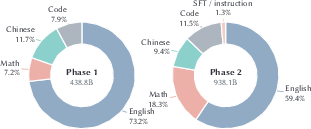
- Phase 1: The model learned from about 438.8 billion tokens.
- Phase 2: The model continued learning from about 960 billion tokens.
The model uses a Transformer design, the same general type of architecture used by many modern LLMs.
Using inexpensive hardware
Instead of using specialized data-center GPUs, the researchers used RTX 5090 GPUs, similar to powerful graphics cards that can be used in high-end computers.
These GPUs have less memory and weaker communication between cards than professional data-center GPUs. To improve their performance, the researchers changed how the GPUs communicated and arranged the work among them.
This is similar to organizing a group project so that students who need to share information often sit close together. Better communication means less time waiting.
Using FP8 precision
The researchers used a method called FP8 mixed-precision training.
Computers normally store numbers using different levels of precision. Using fewer bits, such as 8 bits instead of 16 or 32, is like writing numbers with fewer decimal places. This can make calculations faster and use less memory, but it may also cause mistakes from rounding.
The researchers used FP8 for many of the model’s large calculations, while keeping more precise formats for parts where accuracy was especially important. They also divided numbers into small groups and chose a separate scale for each group. This helped reduce the loss of accuracy.
The paper reports that FP8 made training much faster while keeping about 98% of the quality of higher-precision training.
Using a specialized optimizer
An optimizer is an algorithm that helps the model improve after each mistake. It changes the model’s parameters so that its next predictions are usually better.
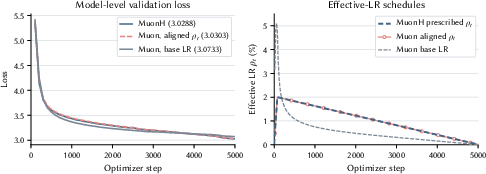
The researchers used a method called MuonH, based on the Muon optimizer. It includes a “hyperball” rule that prevents certain model weights and updates from becoming too large or unstable.
An everyday analogy is a coach correcting an athlete’s movements after every attempt, while making sure the corrections are not so extreme that the athlete loses balance.
Choosing and ordering the data
The researchers collected data from public sources, including:
- Web text
- Mathematics
- Computer code
- Synthetic training examples
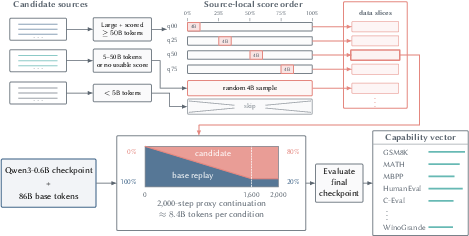
They removed repeated web material and used small test models to decide which datasets were useful. These small test models acted like taste tests: instead of cooking every possible meal, the researchers tried small samples first to see which ingredients helped most.
They also tested two ways of presenting the data:
- Uniform order: The examples were thoroughly shuffled.
- Curriculum order: The model saw less-preferred examples earlier and higher-quality examples later.
This is similar to teaching a student with a planned course: basic or less polished material comes first, while the most useful material appears near the end.
For the curriculum version, the researchers also averaged several late-stage model checkpoints. A checkpoint is a saved copy of the model during training. Averaging several copies can produce a more stable final model.
Measuring performance and cost
The researchers compared Puro-2B with other models on 15 tests involving:
- Mathematics
- Programming
- Reasoning
- General knowledge
They also trained the models further using supervised fine-tuning, or SFT. In SFT, people provide examples of good instructions and answers so the model learns to respond more helpfully.
Finally, they estimated the cost of training and created a cost scaling law. This is a mathematical pattern used to estimate how much model quality can be achieved at different budgets.
4. Main findings
Useful performance at a much lower cost
The best Puro-2B model cost approximately $6,900 in estimated GPU computing costs. It:
- Performed better than Qwen2-1.5B under the authors’ testing system.
- Came close to Qwen2.5-1.5B.
- Performed better than some larger or similarly sized comparison models on the combined tests.
- Used much less estimated training cost than several other open model projects.
One version trained with a smaller budget of about $4,400 already exceeded the performance of Qwen2-1.5B according to the paper’s average score.
Several improvements worked together
The paper shows that the savings did not come from only one trick. They came from combining several choices:
| Technique | Main benefit |
|---|---|
| RTX 5090 GPUs | Lower cost for each unit of computing |
| FP8 training | Faster calculations and lower memory use |
| MuonH optimizer | Helps the model learn efficiently |
| Data selection | Avoids spending tokens on less useful material |
| Curriculum training | Places more useful data at important points in training |
| Checkpoint averaging | Produces a more stable final model |
The authors emphasize that these methods were designed as one connected system. For example, FP8 works especially well because the RTX 5090 supports it directly, and the data curriculum works together with the learning-rate schedule and checkpoint averaging.
FP8 was efficient without greatly harming quality
The model kept approximately 98% of the quality of a comparable BF16 training setup while gaining about 1.36 times the training speed. Overall, FP8 saved about 25% of GPU-hours in the researchers’ experiments.
This matters because training LLMs involves an enormous number of calculations. Even a small speed improvement can save a large amount of money.
Curriculum training helped later performance
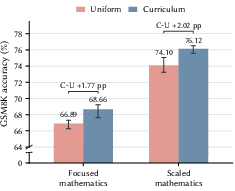
The curriculum version generally performed better than the uniformly shuffled version, especially on mathematics tasks.
These benefits remained after the models received the same supervised fine-tuning. This suggests that the way a model learns during its original training can continue to affect how well it learns later.
A budget-performance estimate was possible
The authors created the Puro Cost Scaling Law, which estimates the performance that can be expected from different training budgets using their recipe.
According to this estimate, spending around $4,400 could be enough to reach the average performance of Qwen2-1.5B. This gives smaller research groups a rough idea of what they might achieve with a limited budget.
Important limits of the cost claims
The reported $4,400 and$6,900 figures are not the total cost of creating the research project. They mainly count the estimated GPU time for the final pretraining runs.
They do not include:
- Researchers’ salaries
- Data collection and preparation
- Failed experiments
- Smaller test runs
- Ablation studies
- Model evaluation
- Fine-tuning
- Storage and networking
- Other computer resources
Therefore, the real cost of developing the complete model would be higher. The numbers are best understood as the cost of repeating the final main training run.
5. Implications and possible impact
The paper suggests that useful language-model research may no longer require millions of dollars in computing resources. A small university laboratory or open-source group might be able to train and study a capable model for thousands, rather than hundreds of thousands or millions, of dollars.
This could have several important effects:
- More researchers could experiment with new training methods.
- Universities and smaller companies could study the entire process instead of only downloading finished model weights.
- Open-source communities could create models whose data, code, and training details are available for inspection.
- Researchers could test questions about data quality, training order, and optimization more fairly.
- The environmental and financial cost of some experiments might be reduced.
However, the approach also has limitations. The model is still much smaller than the largest modern LLMs, and its results depend on special hardware adjustments and careful engineering. Modifying GPU drivers can also be risky and may not work on every computer setup.
Overall, the paper’s main message is that training a useful LLM can be made far more affordable by combining cheaper hardware, faster number formats, smarter learning methods, and better data choices. By releasing the code, data information, and model weights, the authors hope to make language-model research more accessible to what they call “poor labs”—research groups that have good ideas but limited computing budgets.
Knowledge Gaps
Knowledge gaps, limitations, and open questions
- Limited model scale: The study evaluates a dense approximately 2B-parameter model, leaving unresolved whether the proposed combination of FP8, MuonH, Curriculum Model Averaging (CMA), and consumer GPUs remains effective for models substantially larger than 2B parameters.
- Narrow hardware validation: The recipe is primarily validated on RTX 5090 GPUs with a particular server, PCIe, NUMA, InfiniBand, driver, and topology configuration. Its performance and cost advantages on other consumer GPUs, data-center accelerators, mixed GPU clusters, or stock driver configurations remain unquantified.
- Unsupported driver modifications: The reported communication performance depends partly on modified NVIDIA drivers and undocumented CUDA user-space changes to enable P2P and GDR. The reproducibility, stability, security implications, and long-term maintainability of this setup are unresolved.
- Operational reliability is not established: The paper does not report failure rates, hardware faults, thermal behavior, checkpoint-recovery behavior, or downtime over the full 17.6-day production run, all of which could materially affect real-world reproduction cost.
- Incomplete end-to-end cost accounting: The headline costs exclude data acquisition and preprocessing, proxy experiments, exploratory and failed runs, post-training, evaluation, storage, networking, CPU resources, electricity-related ownership costs, taxes, depreciation, and research labor. Consequently, the total cost of independently recreating the project remains unknown.
- Rental-price assumptions may not generalize: RTX 5090 cost estimates rely on amortized ownership costs and private-provider information rather than a widely available rental market. The reported cost-efficiency comparisons may change with electricity prices, hardware lifetime, supply constraints, or regional prices.
- No sensitivity analysis for accounting choices: The conclusions are not shown under alternative GPU prices, depreciation periods, electricity costs, utilization rates, or inclusion of excluded infrastructure and labor costs.
- Unclear statistical strength of benchmark comparisons: The paper reports aggregate benchmark scores but does not fully establish confidence intervals, variance across random seeds, evaluator variance, or the statistical significance of differences from competing models.
- Potential evaluation contamination is unresolved: The study does not establish whether the pretraining corpus, synthetic data, proxy datasets, or post-training data overlap with any of the reported evaluation benchmarks.
- Benchmark coverage is limited: The evaluation focuses on 15 mathematics, coding, reasoning, and knowledge benchmarks. Robustness, multilingual ability, factuality, instruction following beyond the selected tasks, safety, long-context behavior, calibration, agentic use, and real-world deployment performance remain unexplored.
- Comparison fairness remains uncertain: Competitor costs and capabilities are estimated under the authors’ accounting protocol, while differences in tokenizer, architecture, training data, post-training, evaluation prompts, and release conditions may affect the comparisons. A fully controlled comparison with identical architecture, tokenization, data, and evaluation procedures is absent.
- Architecture choices are not isolated: The Qwen3-1.7B configuration with untied embeddings is adopted as the base architecture, but the effects of untied versus tied embeddings and other architectural alternatives are not separately measured.
- Ablations do not cover all interactions: The paper emphasizes that hardware, precision, optimization, curriculum, and data design are co-dependent, but the reported ablations do not appear to identify all pairwise or higher-order interactions among these components.
- MuonH’s contribution is not fully disentangled: The relative effects of MuonH’s hyperball projection, Muon updates, parameter-group selection, 10× learning-rate multiplier, and learning-rate schedule are not separately isolated.
- Optimizer generality is unknown: MuonH is evaluated in this specific architecture, scale, precision regime, and two-phase schedule. Its behavior relative to AdamW or other optimizers across different model sizes, batch sizes, sequence lengths, and datasets remains unresolved.
- FP8 robustness is insufficiently characterized: The paper reports comparable quality to BF16 in the tested setting, but the effects of FP8 on optimization stability, rare-token learning, outlier-heavy data, long sequences, gradient behavior, and downstream calibration are not comprehensively examined.
- Precision alternatives are not compared broadly: There is no systematic comparison among BF16, FP8 variants, FP4, different block sizes, alternative scaling-factor representations, or mixed-precision schedules under matched hardware and compute budgets.
- Numerical reproducibility is unclear: Online scaling, hardware-specific MXFP8 behavior, modified software components, and distributed execution may introduce nondeterminism. The reproducibility of losses and final capabilities across independent runs is not established.
- The curriculum relies on source-specific quality scores: Scores from different datasets are not comparable, and sources without usable scores are randomly ordered. The paper leaves open how much performance depends on imperfect score calibration, arbitrary thresholds, or source-specific ordering artifacts.
- Curriculum ordering is confounded with training schedule changes: The curriculum variant changes both data ordering and late-stage learning-rate/checkpoint-averaging behavior. The independent effects of ordering, constant late learning rate, and averaging are therefore not completely separated.
- CMA’s mechanism is not explained: The paper demonstrates empirical benefits from averaging selected checkpoints but does not establish why CMA works, how sensitive it is to the number and spacing of checkpoints, or whether it improves generalization across other curricula and architectures.
- Curriculum benefits may be task-specific: The reported post-training gains are concentrated on mathematics and selected instruction settings. It remains unknown whether curriculum initialization improves or harms other capabilities, including coding, factual knowledge, multilingual tasks, and safety behavior.
- Limited random-seed replication: The paper mentions repeated post-training runs but does not provide broad replication across pretraining seeds, data-order seeds, initialization seeds, or independent hardware clusters.
- Data-mixture optimization may overfit proxy tasks: Dataset selection and mixture weighting are guided by proxy-model benchmark profiles. The extent to which these choices overfit the proxy benchmarks rather than improve general capability is not tested with held-out proxy tasks or independently designed evaluations.
- Proxy-to-full-scale transfer is unverified: The relationship between small proxy experiments and the final 2B-model outcomes is not systematically quantified, leaving uncertainty about whether proxy results reliably predict data utility at production scale.
- Data quality and licensing remain heterogeneous: Although manifests and components are released, upstream licensing terms are component-specific and some data may not be permissive. The practical legal status and reproducibility of the complete corpus across jurisdictions remain unresolved.
- Data processing reproducibility is incomplete: The paper summarizes family-level components rather than providing a complete component-level manifest in the supplied description. Exact filtering decisions, document versions, sample order, deduplication effects, and regeneration procedures may therefore be difficult to reproduce exactly.
- Synthetic-data effects are not isolated: The contribution of synthetic examples, their generation models, and possible contamination or stylistic homogenization is not separately evaluated.
- Data deduplication effectiveness is not fully measured: The paper describes deduplication of the web portion but does not quantify residual duplication, cross-source overlap, benchmark leakage, or the capability–data-retention trade-off caused by deduplication.
- The cost scaling law has narrow support: The Puro Cost Scaling Law is fitted from Phase 2 runs sharing the same Phase 1 checkpoint, architecture, recipe, and apparently limited token budgets. Its validity outside this local regime, especially for different model sizes or training phases, is unknown.
- Scaling-law uncertainty is underdeveloped: The paper does not establish confidence intervals, model-selection uncertainty, sensitivity to the functional form, or the effect of random variation on the estimated $4.4K threshold.
- Extrapolation to target performance may be unreliable: The claim that a specific budget is sufficient to exceed Qwen2-1.5B depends on extrapolating or interpolating a recipe-specific curve and may not hold under different prices, seeds, evaluation protocols, or data mixtures.
- Token efficiency and compute efficiency are not fully separated: Reported improvements combine changes in data selection, token ordering, optimizer behavior, precision, hardware utilization, and cost assumptions. The marginal capability gain per token, FLOP, GPU-hour, and dollar is not consistently disentangled.
- Training beyond 1.4T tokens is unexplored: The study does not determine whether the model is undertrained, saturated, or harmed by additional tokens, nor whether the proposed curriculum remains beneficial after the reported training horizon.
- Post-training generality is limited: The case study uses supervised fine-tuning as a probe, but does not examine preference optimization, reinforcement learning, distillation, tool use, or deployment-specific adaptation.
- Inference cost is omitted: The paper focuses on pretraining reproduction cost and does not quantify inference throughput, memory requirements, energy consumption, quantization quality, or total cost of ownership.
- Environmental impact is not reported: Energy use, carbon emissions, cooling requirements, and hardware manufacturing impacts are excluded from the analysis, limiting assessment of the recipe’s broader efficiency.
- Open-recipe accessibility is still infrastructure-dependent: Although the model, data, and code are released, reproducing the canonical run requires specialized multi-GPU hardware, high-bandwidth networking, driver modifications, and substantial systems expertise; accessibility for labs without these resources is not evaluated.
- Long-term maintenance of released artifacts is uncertain: The paper does not address version drift in upstream datasets, software dependencies, CUDA/driver stacks, benchmark implementations, or hardware support that could prevent exact reproduction over time.
Practical Applications
Immediate Applications
- Low-cost pretraining for academic and open-source labs (Academia; software/AI research) Labs can reproduce or adapt the released Puro-2B training pipeline using the Apache 2.0 code, model weights, data manifests, checkpoints, and configurations. The reported production-run compute cost—approximately $4.4K–$6.9K under the paper’s narrow GPU-cost accounting—makes billion-parameter pretraining more accessible than conventional data-center-based recipes. Dependencies: Access to a sufficiently large RTX 5090 cluster, compatible CUDA/Megatron Core and Transformer Engine versions, legally usable dataset components, and the ability to reproduce the authors’ networking and memory configurations. The stated cost excludes preprocessing, storage, networking, research labor, evaluation, failed runs, and post-training.
- Reproducible end-to-end studies of language-model training (Academia; ML systems research) Researchers can use the released artifacts to study how hardware, FP8 precision, MuonH optimization, curriculum ordering, checkpoint averaging, and data mixtures interact in a complete pretraining pipeline rather than evaluating weights from an opaque model release. This supports controlled ablations, alternative optimizer studies, and replication experiments. Dependencies: Experiments should preserve the paper’s evaluation protocol and distinguish recipe-specific findings from generally applicable scaling laws. The Puro Cost Scaling Law is fitted to this model size, data recipe, and infrastructure, so it should not be assumed to transfer directly to other architectures or scales.
- Development of domain-specialized small LLMs (Industry; healthcare, finance, legal technology, education, enterprise software) Organizations can start from the open Puro-2B architecture and replace or augment the data mixture with licensed domain data—for example, medical literature, financial filings, programming repositories, legal documents, or educational material. The paper’s proxy-training methodology can be used to compare candidate sources before committing to full-scale training. Dependencies: Domain data must be properly licensed, de-identified where necessary, and evaluated for bias, factuality, privacy, and contamination. A 2B-parameter model may be appropriate for narrow or on-device tasks but insufficient for broad expert-level reasoning.
- Budget-aware model planning and compute allocation (Industry; AI infrastructure and R&D management) Teams can use the Puro Cost Scaling Law as an initial planning tool to estimate the performance reachable at different budgets. For example, the paper reports that roughly $4.4K** can exceed Qwen2-1.5B under its aggregate benchmark and accounting protocol, while a curriculum-based run at about **$6.9K approaches Qwen2.5-1.5B. This can inform go/no-go decisions, experiment prioritization, and hardware procurement. Dependencies: These figures are rental-equivalent estimates rather than complete project costs. Actual results depend on GPU prices, utilization, network topology, dataset preparation, engineering time, and the target task distribution.
- FP8 training and inference optimization workflows (Industry; cloud computing, software infrastructure, edge AI) The blockwise FP8 method can be integrated into training stacks for models whose linear-layer computation dominates runtime. It provides a reported 1.36× throughput improvement, approximately 1.34× network speedup, and around 25.2% GPU-hour savings, while retaining about 98% of the corresponding precision performance in the reported setting. Similar workflows could reduce cloud bills or increase training throughput. Dependencies: Benefits require supported Blackwell hardware or another implementation with reliable FP8 kernels and scaling-factor handling. Numerical stability, outlier behavior, model architecture, kernel shapes, and task sensitivity must be validated separately; FP8 is not automatically safe for every model or operation.
- Consumer-GPU clusters for private or local model training (Industry and academia; private cloud, startups, independent developers) Small organizations can build multi-GPU clusters from consumer RTX 5090 systems rather than relying exclusively on expensive data-center accelerators. The paper provides practical guidance on pipeline/data parallelism, micro-batch sizing, layer placement, embedding/LM-head balancing, and memory-aware optimizer allocation. Dependencies: Consumer GPUs have only 32 GB of memory, lack NVLink, and may have lower reliability and support than data-center hardware. The reported system depends on high-bandwidth InfiniBand and carefully tuned topology. Unsupported driver modifications for PCIe peer-to-peer and GPUDirect RDMA introduce security, stability, maintenance, and vendor-support risks.
- Data-mixture selection through proxy experiments (Industry and academia; dataset engineering) Teams can train small proxy models on candidate datasets or slices, measure domain-specific benchmark profiles, and use the results to select sources and mixture weights. For example, datasets that improve mathematical proxy scores can receive greater weight in a mathematics-oriented model. This creates a practical alternative to expensive universal sample-level quality scoring. Dependencies: Proxy-task performance must correlate with full-model performance. Poorly selected benchmarks may optimize for narrow metrics, amplify dataset artifacts, or cause overfitting to evaluation distributions.
- Curriculum-based pretraining and checkpoint averaging (AI research and model development) Developers can order samples within each source from lower to higher configured quality, align source-local curriculum ranks, use a late-stage learning-rate strategy, and average late checkpoints. The paper reports that this curriculum/CMA approach improves cost efficiency and that gains persist after supervised fine-tuning in mathematics and broad instruction settings. Dependencies: Source-provided quality scores are not directly comparable across datasets. The method requires meaningful within-source rankings, careful learning-rate scheduling, sufficient checkpoint storage, and validation against uniform shuffling. Gains may vary by domain and data scale.
- Local deployment of compact open models (Daily life and software products; personal assistants, coding tools, document search) The released 2B-scale weights can support local or private applications such as offline text drafting, lightweight coding assistance, retrieval-augmented document question answering, summarization, and educational tutoring. Local deployment can reduce data-sharing with hosted APIs and lower per-query costs. Dependencies: The base model requires task-specific instruction tuning, safety filtering, and factuality controls. Its capabilities and context limitations may make it unsuitable for high-stakes medical, legal, financial, or autonomous decisions without human oversight.
Long-Term Applications
- Affordable pretraining infrastructure for universities and public-interest research (Policy and academia; national research infrastructure) The paper’s hardware/software design could motivate shared regional “poor-lab” clusters in universities, public laboratories, and developing research ecosystems. Such facilities could support open replication, multilingual model development, reproducibility audits, and training-method research without dependence on a few hyperscalers. Dependencies: Sustainable operation requires procurement, electricity, cooling, networking, maintenance, storage, and technician support. Consumer-GPU availability and vendor licensing policies may change, and the system’s unsupported driver modifications may not be acceptable for institutional infrastructure.
- Publicly auditable and jurisdiction-specific LLMs (Policy, government, and regulated industries) Governments and regulated organizations could use the open recipe to train models on locally governed datasets, retaining control over data provenance, training logs, evaluation, and deployment. Potential uses include public-service information systems, multilingual government support, regulatory document search, and internal administrative assistance. Dependencies: Public-sector deployment requires formal privacy, cybersecurity, procurement, accessibility, records-management, and AI-governance procedures. Open data manifests do not automatically resolve copyright, personal-data, or cross-border data restrictions.
- Energy- and carbon-efficient model development (Energy and sustainability) The reported reduction in GPU-hours—up to 37.2% for the combined efficiency design relative to the stated baseline—could reduce energy consumption and emissions for repeated training experiments. The approach could also support carbon-aware scheduling, where low-cost consumer clusters run experiments during periods of cleaner or cheaper electricity. Dependencies: GPU-hour savings do not directly equal emissions savings; regional power mix, embodied hardware emissions, cooling, utilization, and hardware lifetime must be measured. Additional preprocessing and exploratory runs could offset production-run savings.
- Scaling the recipe to larger models and longer contexts (Long-term AI systems research) Future work could test whether FP8, MuonH, curriculum model averaging, proxy-based data selection, and communication-aware parallelism remain effective for 7B-scale or larger models, multimodal systems, mixture-of-experts models, and longer context windows. If successful, this could substantially lower the entry cost for stronger open models. Dependencies: The current evidence is centered on a dense approximately 2B-parameter model. Larger models will increase memory pressure, communication volume, optimizer complexity, and sensitivity to numerical error; consumer GPUs may no longer provide a favorable system-level trade-off.
- Automated dataset and training-budget optimization platforms (Industry; MLOps and AI tooling) The proxy-profile methodology could become an automated tool that samples candidate corpora, trains small probes, predicts downstream capability trade-offs, selects data mixtures, and recommends token budgets. A future MLOps product could expose cost–quality Pareto frontiers for coding, mathematics, reasoning, multilingual ability, or enterprise-specific tasks. Dependencies: Reliable automation requires standardized evaluation sets, robust transfer from proxy models to target models, contamination detection, license tracking, and uncertainty estimates. Benchmark optimization could otherwise produce models that perform well on proxies but poorly in deployment.
- Low-cost specialized assistants for education and healthcare support (Education and healthcare) With extensive validation and domain adaptation, compact models could provide personalized practice feedback, curriculum-aligned tutoring, clinical-literature search, medical coding assistance, or patient-facing administrative support. The paper’s curriculum and domain-mixture findings could help allocate scarce training budgets toward desired capabilities. Dependencies: These are high-stakes applications requiring expert review, rigorous safety testing, privacy protection, calibrated uncertainty, multilingual validation, and regulatory compliance. The paper does not establish clinical or educational efficacy, so deployment would require new domain-specific studies.
- Embedded and offline AI in consumer devices and robotics (Daily life, robotics, and edge computing) More efficient training and compact model sizes could enable customized language interfaces for robots, vehicles, industrial equipment, home devices, and offline personal assistants. Local models could support speech-to-command pipelines, task planning interfaces, maintenance guidance, and device control without continuous cloud connectivity. Dependencies: Real-world robotics requires grounding, tool-use reliability, latency guarantees, adversarial robustness, and deterministic safety constraints. Language-model benchmark performance alone does not demonstrate safe physical-world behavior.
- Open benchmarking of the full training lifecycle (Academia and policy) The released intermediate checkpoints, data configurations, cost accounting, and post-training comparisons could support future standards for reporting total training cost, data provenance, energy use, failed experiments, and post-training performance. This could improve claims of reproducibility and enable more meaningful comparisons between proprietary and open systems. Dependencies: Comparable reporting requires community agreement on accounting boundaries. The paper’s narrow production-run cost excludes many material expenses, so future standards should report both marginal accelerator cost and full lifecycle cost.
Glossary
- Ablation study: An experiment that removes or changes one component to measure its individual effect. “Furthermore, we conduct targeted ablations over the first four design choices and report cost-efficiency estimates”
- AdamW: An Adam-based optimizer that decouples weight decay from gradient updates. “while AdamW updates the remaining parameters”
- AllGather: A distributed communication operation in which every process obtains data from all other processes. “parameter AllGather around optimization”
- AllReduce: A collective operation that combines values across processes and distributes the result to all of them. “The eight-GPU AllReduce bandwidth over PCIe”
- Amdahl’s law: A principle stating that the maximum speedup of a parallel system is limited by its sequential portion. “strong scaling is limited by Amdahl's law”
- arithmetic intensity: The ratio of computational operations to memory traffic, indicating how effectively hardware computation can be utilized. “Increasing the micro-batch size (MBS) improves the arithmetic intensity”
- bfloat16 (BF16): A 16-bit floating-point format with a wide exponent range commonly used in machine-learning training. “maintaining comparable model quality to bfloat16 (BF16) training”
- Blackwell architecture: An NVIDIA GPU architecture providing specialized hardware for modern numerical formats and accelerated computation. “the Blackwell architecture of RTX~5090 provides the hardware foundation for efficient FP8 training”
- blockwise FP8: A low-precision computation method that quantizes values in local blocks using separate scaling factors. “Blockwise FP8 training reduces per-token execution time”
- checkpoint: A saved snapshot of a model’s parameters and associated training state. “averages selected checkpoints”
- checkpoint averaging: Combining parameters from multiple saved model checkpoints to produce a final model. “the last 6 checkpoints to obtain the final checkpoint”
- coarse-grained: Organized into relatively large units rather than fine-grained individual examples. “The canonical run applies a data curriculum over the Phase~2 data pool”
- compute-bound: Limited primarily by the amount of available computational throughput rather than memory or communication. “FP8 kernels complete their arithmetic more quickly while introducing additional quantization operations, so they become memory-bound more readily than BF16 kernels.”
- curriculum learning: A training strategy that controls the order or difficulty of examples presented to a model. “We apply a data curriculum over the Phase~2 data pool”
- curriculum model averaging (CMA): A method that orders data according to a curriculum and averages selected late-training checkpoints. “Curriculum Model Averaging (CMA) organizes training over coarse-grained data chunks”
- data parallelism (DP): A distributed-training method in which replicas process different data batches and synchronize gradients. “We combine data parallelism (DP)”
- decoder-only Transformer: A Transformer LLM that generates outputs using only causal self-attention and decoder blocks. “We train a dense decoder-only Transformer from scratch”
- deduplication: The removal of duplicate or near-duplicate data examples. “We first use our Kai framework to deduplicate the large-scale web portion.”
- dense model: A neural network in which the relevant parameters are generally activated for every input, unlike a sparse mixture-of-experts model. “a dense billion-parameter/trillion-token pretraining”
- dynamic range: The span between the smallest and largest numerical values representable by a format. “E4M3 provides more mantissa bits than E5M2 but has a narrower dynamic range.”
- E4M3: An 8-bit floating-point representation with four exponent bits and three mantissa bits. “E4M3~\cite{micikevicius2022fp8formats} provides more mantissa bits than E5M2”
- E5M2: An 8-bit floating-point representation with five exponent bits and two mantissa bits, providing greater dynamic range than E4M3. “E4M3 provides more mantissa bits than E5M2”
- embedding matrix: A parameter matrix that maps discrete tokens to continuous vector representations. “unties the input embedding matrix from the output language-model head”
- FLOP/s: Floating-point operations performed per second, used to measure computational throughput. “select the smallest MBS beyond which achieved FLOP/s no longer increases materially”
- FlashAttention: An optimized attention algorithm that reduces memory traffic and improves attention efficiency. “the invocation shapes of GEMM and FlashAttention kernels”
- forward propagation (Fprop): The computation of model outputs from input data during a neural-network pass. “their Fprop, Dgrad, and Wgrad GEMMs all use the FP8 path”
- FP8: An 8-bit floating-point format used to accelerate neural-network computation while reducing memory and bandwidth requirements. “We use FP8 mixed precision from random initialization onward”
- FP4: A 4-bit floating-point format designed to reduce computational and memory costs further than FP8. “RTX~5090 is also the most practical option with FP4 support.”
- Frobenius norm: A matrix norm equal to the square root of the sum of the squares of all matrix entries. “projects each one back to its initial Frobenius radius after every step”
- GEMM: General Matrix-Matrix Multiplication, a fundamental operation in neural-network layers. “the main Transformer linear-layer GEMMs use blockwise FP8”
- global batch size: The total number of training sequences processed in one optimization step across all devices. “a global batch size of 1,536 sequences”
- GPUDirect RDMA (GDR): A technology allowing a GPU to access remote GPU memory directly through RDMA networking without staging through host memory. “GDR builds on P2P and allows a GPU to access remote GPU memory over RDMA NICs”
- gradient synchronization: The process of communicating and combining gradients among distributed workers. “gradient synchronization accounts for a larger fraction of the step time.”
- hidden-state tensor: An intermediate vector or multidimensional array representing information learned by a neural network layer. “which exchanges hidden-state tensors only at stage boundaries”
- hyperball constraints: Constraints that keep parameter matrices within fixed-radius regions defined by their initial norms. “which extends the Muon optimizer with hyperball constraints on parameter weights and updates”
- InfiniBand: A high-bandwidth, low-latency networking technology commonly used for connecting servers in supercomputing and distributed training. “We set up a 400 Gbps InfiniBand network among our servers”
- IOMMU: An input–output memory-management unit that controls and translates device memory accesses. “including disabling IOMMU and PCIe ACS”
- learning-rate schedule: A rule governing how the optimizer’s learning rate changes during training. “Both parameter groups share a base LR schedule.”
- linear decay: A learning-rate schedule in which the learning rate decreases at a constant rate. “continues from its terminal Phase~1 value with linear decay”
- LM head: The final neural-network layer that converts hidden representations into scores over the language-model vocabulary. “the embedding and LM head account for a non-negligible fraction of both computation and memory.”
- low-precision training: Training that uses numerical formats with fewer bits than standard floating-point formats to improve speed and reduce memory use. “The detailed low-precision compute flow”
- mantissa: The significant-precision component of a floating-point representation. “E4M3 provides more mantissa bits than E5M2”
- memory-bound: Limited primarily by the rate at which data can be read from or written to memory. “they become memory-bound more readily than BF16 kernels.”
- Megatron Core: A software framework for training large Transformer models efficiently across multiple GPUs. “We build our training system on Megatron Core”
- micro-batch size (MBS): The number of sequences processed by one device in a single pipeline micro-step. “The best configuration is MBS”
- mixed precision: A training approach that combines numerical formats of different precisions for efficiency and stability. “the RTX~5090 cluster reaches a mixed-precision effective MFU”
- model FLOPs utilization (MFU): The ratio of achieved model floating-point operations per second to the hardware’s theoretical peak. “Model FLOPs utilization (MFU) is conventionally defined as achieved model FLOP/s divided by the accelerator's peak FLOP/s”
- Muon optimizer: An optimization algorithm for updating neural-network parameters, particularly matrix-shaped parameters. “We apply the MuonH optimizer, which extends the Muon optimizer”
- MuonH: The paper’s hyperball-constrained variant of the Muon optimizer. “MuonH updates these matrices and projects each one back to its initial Frobenius radius”
- NVLink: NVIDIA’s high-bandwidth GPU interconnect for communication between GPUs. “the lack of NVLink for high-bandwidth GPU-to-GPU scaling”
- NVFP4: NVIDIA’s 4-bit floating-point numerical format. “RTX~5090 is also the most practical option with FP4 support.”
- NPS: NUMA Per Socket, a hardware configuration controlling the subdivision of a processor’s memory locality domains. “adjusting NPS (NUMA Per Socket, also known as Sub-NUMA Clustering on some platforms)”
- NUMA: Non-Uniform Memory Access, a computer architecture in which memory-access speed depends on the processor and memory location. “also known as Sub-NUMA Clustering on some platforms”
- optimizer state: Persistent information maintained by an optimization algorithm, such as momentum or second-moment estimates. “numerically sensitive operations and persistent training states, including master weights and optimizer states”
- outlier: A numerical value substantially larger or smaller than typical values in a tensor. “a few outliers can enlarge the quantization interval”
- pipeline parallelism (PP): A distributed-training strategy that divides model layers into sequential stages placed on different devices. “We combine data parallelism (DP) ... with pipeline parallelism (PP)”
- pipeline imbalance: Unequal computational or memory workloads across pipeline stages, causing some stages to wait. “creating substantial pipeline imbalance”
- PCIe P2P: Peer-to-peer communication between GPUs over the PCI Express interconnect without routing data through host memory. “enabling P2P improved one-way bandwidth”
- persistent dtype: The numerical data type used to store model parameters or training state throughout execution. “FP8 is therefore an online compute and activation-storage format rather than the persistent dtype of the whole model.”
- post-training: Model adaptation or processing performed after pretraining, such as supervised fine-tuning or format conversion. “followed by model averaging, post-training, and evaluation.”
- proxy experiment: A smaller or indirect experiment used to estimate the usefulness of data, models, or design choices. “we run proxy experiments on candidate sources and representative data slices”
- quantization: The conversion of numerical values to a representation with fewer levels or bits. “introducing additional quantization operations”
- RDMA: Remote Direct Memory Access, which transfers data between machines with minimal CPU involvement. “GDR builds on P2P and allows a GPU to access remote GPU memory over RDMA NICs”
- ReduceScatter: A distributed collective that reduces values across processes and scatters the resulting portions among them. “whose dominant collectives are gradient ReduceScatter”
- roofline curve: A performance model showing attainable computational throughput as a function of arithmetic intensity and hardware bandwidth. “analogous to locating the knee of a roofline curve.”
- scale-invariant matrix: A parameter matrix whose function or optimization behavior is relatively insensitive to rescaling. “we use Hyperball optimization for selected approximately scale-invariant matrices.”
- scaling law: An empirical relationship describing how model performance changes with variables such as model size, data volume, or compute cost. “we formulate the Puro Cost Scaling Law”
- strong scaling: The reduction in execution time achieved by adding processors while keeping the total workload fixed. “For larger-scale Phase~2 training, strong scaling is limited by Amdahl's law”
- synthetic example: Artificially generated data designed to resemble examples of a target type. “and also includes synthetic examples.”
- tensor parallelism (TP): A distributed-training method that splits individual tensor operations across multiple devices. “We do not use tensor parallelism (TP)”
- Tensor Core: Specialized GPU hardware for accelerating matrix operations used in machine learning. “its Tensor Cores are artificially limited to half of actual peak performance”
- Transformer Engine: NVIDIA software that provides optimized Transformer operations, including mixed-precision and FP8 support. “together with its Transformer Engine dependency.”
- uniform data recipe: A training-data strategy that globally shuffles the data rather than ordering it according to a curriculum. “This variant globally reshuffles the Phase~2 data instead of following the curriculum ordering.”
- weight gradient (Wgrad): The gradient of a loss with respect to a layer’s weights, used to update those weights. “their Fprop, Dgrad, and Wgrad GEMMs all use the FP8 path”
- warm-up stage: An initial training period in which a parameter, commonly the learning rate or numerical precision, is gradually introduced. “without a BF16 warm-up stage or a later precision switch”

