A counterexample to the symmetric-maximizer conjecture for Lyapunov operators
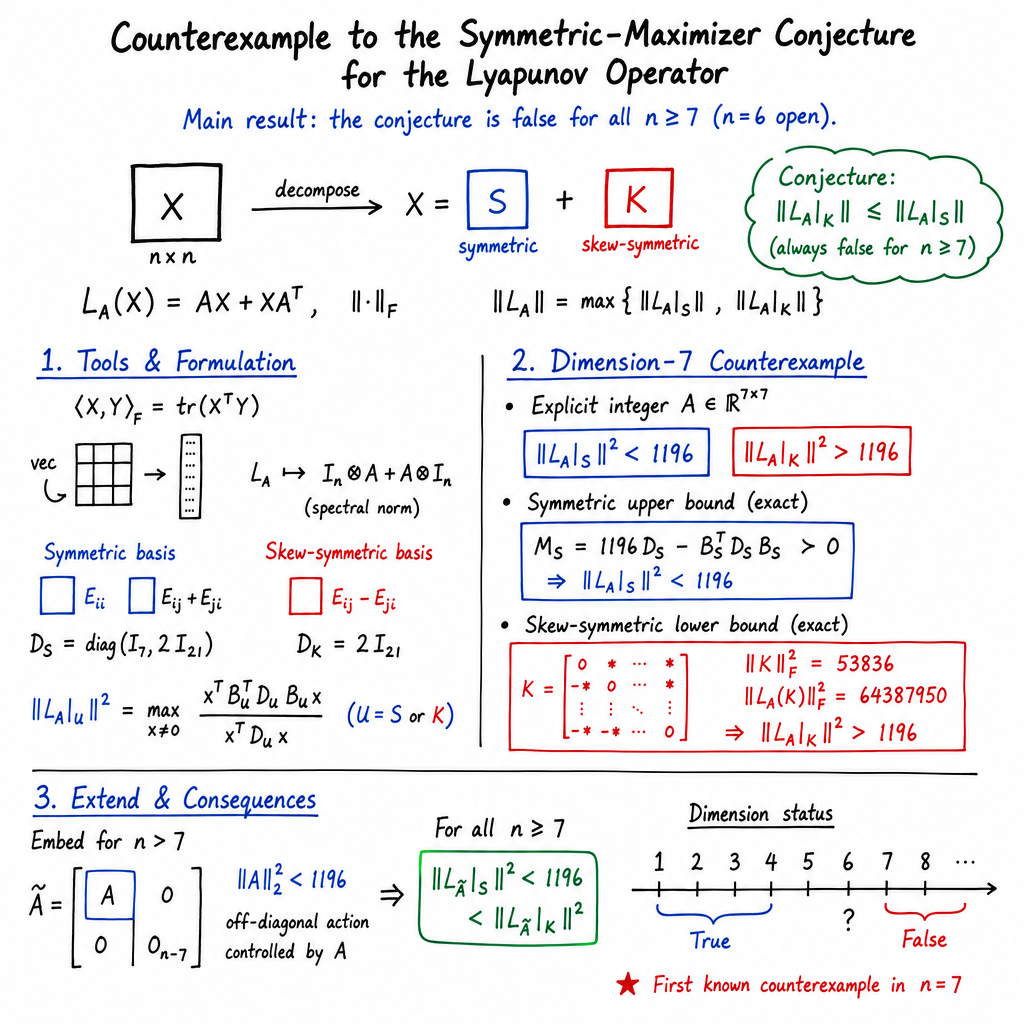
Abstract: It has been conjectured that the operator norm of the Lyapunov operator induced by the Frobenius norm is always attained at a symmetric matrix. The conjecture is known to hold for all matrices of order at most five. We give an integer matrix of order seven for which the skew-symmetric restricted norm is strictly larger than the symmetric restricted norm. A rational separator and exact-arithmetic certificates establish the strict inequality without relying on floating-point computations. A direct-sum construction yields counterexamples in every order ; the case remains open.
Paper Prompts
Sign up for free to create and run prompts on this paper.
Top Community Prompts
Explain it Like I'm 14
1. What is this paper about?
This paper studies a mathematical machine called a Lyapunov operator. For a given square matrix , the operator takes another matrix and produces
The researchers wanted to test a long-standing conjecture:
Does this operator always work most strongly on a symmetric matrix?
A symmetric matrix is the same when flipped across its main diagonal, like a mirror image. The paper proves that the answer is no. It gives an example where the operator works more strongly on a skew-symmetric matrix, whose flipped version is its negative.
The paper shows this happens for matrices of size and, using a construction technique, for every size .
2. What questions did the researchers ask?
The main research question was:
- Is the largest possible size of always achieved when is symmetric?
In simpler terms, imagine trying many different matrices and measuring how much the operator stretches them. The conjecture claimed that the matrix getting stretched the most could always be chosen to be symmetric.
The researchers aimed to:
- Find out whether this claim is true.
- If it is false, find a clear counterexample.
- Prove the counterexample exactly, rather than relying only on computer approximations.
- Extend the result to larger matrix sizes.
Before this paper, the conjecture was already known to be true for sizes up to . The case of size was still unknown.
3. How did they do the research?
Separating matrices into two types
Every real square matrix can be divided into a symmetric part and a skew-symmetric part. The researchers studied the operator separately on these two kinds of matrices.
They compared:
- : the largest stretching of the operator on symmetric matrices.
- : the largest stretching on skew-symmetric matrices.
Here, means a measurement of size called the Frobenius norm. It is similar to treating all the entries of a matrix as one long list of numbers and calculating its ordinary length.
Because the symmetric and skew-symmetric parts behave independently, the full operator’s largest stretching is whichever of these two restricted values is larger.
Searching with computers
The researchers first used numerical computer experiments to search for a matrix where
They used an optimization method called Adam. This is an algorithm that repeatedly changes the entries of a matrix in a direction that seems likely to improve the result. It is widely used when training machine-learning models.
The computer search first found an example of size . The researchers then simplified it and eventually found a sparse, integer-valued example of size .
Proving the result exactly
Computer calculations using decimal numbers can sometimes contain small errors. Therefore, the researchers did not use the numerical search as their final proof.
Instead, they:
- Used an integer matrix .
- Built exact matrices describing how acts on symmetric and skew-symmetric matrices.
- Used exact fractions and integer calculations.
- Proved that the symmetric value is smaller than $1196$.
- Found a particular skew-symmetric matrix for which the value is larger than $1196$.
This creates a definite gap between the two cases and proves the result without relying on rounding.
4. What did they find?
The paper gives a specific integer matrix . For this matrix, the researchers prove that
while
So the operator stretches at least one skew-symmetric matrix more strongly than it stretches any symmetric matrix.
Approximate calculations suggest the two values are:
- Symmetric matrices: about $1195.594$
- Skew-symmetric matrices: about $1196.025$
The difference is small, but it is real. The exact calculations prove that it is not just caused by computer rounding.
The researchers then used a direct-sum construction. This means they placed the example inside a larger matrix and filled the remaining parts with zeros. They showed that the important difference remains in the larger matrix.
Therefore, the conjecture is false for every matrix size
The results can be summarized as follows:
| Matrix size | Status of the conjecture |
|---|---|
| Known to be true | |
| Still unknown | |
| Proven false by this paper |
5. Why is this important?
The paper corrects a belief that had remained open for many years. Researchers had thought that symmetric matrices might always be enough to find the strongest action of a Lyapunov operator. This paper shows that this shortcut can fail.
This matters because Lyapunov operators are used in areas such as:
- Control systems, including aircraft and robots
- Studying whether systems are stable
- Matrix equations used in engineering and applied mathematics
- Understanding how sensitive calculations are to errors
If someone searches only among symmetric matrices, they may miss the true largest value when the matrix has size $7$ or larger.
The paper also shows an interesting connection between mathematical proof and computer search. A computer helped discover the example, but the final result was checked using exact arithmetic, making the proof reliable.
Simple conclusion
The paper answers an old mathematical question: symmetric matrices do not always give the strongest result for a Lyapunov operator. The researchers found a definite example in size $7$ and showed that similar examples exist in every larger size. The only remaining size that has not been settled is .
In short, the paper shows that skew-symmetric matrices can sometimes be more important than symmetric ones, changing how mathematicians must study these operators.
Knowledge Gaps
Knowledge gaps, limitations, and open questions
- The order-six case remains unresolved. The paper establishes counterexamples for every but neither proves the conjecture nor provides a counterexample for .
- The minimal counterexample dimension is unknown. Because positive results hold for and the paper does not settle , it remains unknown whether seven is the smallest dimension admitting a counterexample.
- No structural characterization of counterexamples is provided. The paper gives one sparse integer matrix but does not identify general properties of matrices that cause the skew-symmetric restricted norm to exceed the symmetric restricted norm.
- The mechanism behind the failure of the conjecture is not explained analytically. The result certifies an inequality for a specific matrix, but does not clarify which spectral, sparsity, block, or nonnormality features of that matrix generate the gap.
- The size and robustness of the violation are unexplored. The paper does not determine how large the ratio or difference can become, whether the gap persists under perturbations, or whether the exhibited example is close to an extremal one.
- The classification of matrices for which the conjecture still holds is incomplete. Known positive classes include several sign-pattern classes and tridiagonal matrices, but the paper does not extend this classification or identify broader sufficient conditions.
- The role of stability is not investigated for the maximization problem. The discussion references results for stable matrices concerning the smallest singular value, but does not determine whether Hurwitz stability, diagonal stability, or related assumptions restore the symmetric-maximizer property for the operator norm.
- The direct-sum construction is not shown to be minimal or canonical. It proves existence in higher dimensions by embedding the order-seven example, but does not establish whether genuinely irreducible counterexamples exist in every or whether smaller structured examples can be constructed.
- The behavior under matrix transformations is left open. The paper does not analyze how the symmetric-versus-skew-symmetric norm comparison changes under similarity transformations, orthogonal similarity, scaling, transposition, or perturbations of .
- No systematic characterization of equality cases is given. The paper does not describe matrices for which , including whether equality is generic, structurally induced, or associated with particular matrix classes.
- The computational-discovery methodology lacks systematic validation. The optimizer discussion is based on a few hundred random starts and empirical observations; there is no reproducible statistical study comparing optimizers, initialization schemes, dimensions, or search landscapes.
- The effectiveness of AI-assisted discovery is not independently benchmarked. The paper reports the use of an AI system but does not compare its performance against conventional optimization, symbolic-search, semidefinite, or exhaustive approaches.
- The numerical optimization problem may be nonsmooth and is not theoretically analyzed. Since restricted norms are largest singular values that can have multiplicities, the gradient-based search procedure may encounter nondifferentiable points, but the paper does not establish convergence properties or characterize the equality ridge it describes.
- The exact certificate is not presented in full within the paper. The proof relies on a rational factorization and an accompanying Python program, but the complete factorization data and independently checkable certificate are not printed, limiting verification without external code.
- The certificate’s margins are not optimized. The threshold $1196$ separates the two norms, but the paper does not determine the exact restricted norms, the sharpest rational separator, or the size of the positivity and violation margins achievable with this or related examples.
- The relationship to generalized Lyapunov operators remains unexplored. Although prior work is cited for , the paper does not investigate whether analogous counterexamples occur for the generalized operator, nor the smallest dimension in which they arise under additional restrictions on and .
- Consequences for Lyapunov-equation conditioning and numerical algorithms are not developed. The paper motivates the problem through Lyapunov operators and separation quantities but does not analyze how the counterexample affects algorithms that assume symmetric extremizers or exploit symmetry in norm estimation.
- The result is restricted to real matrices and the Frobenius-induced norm. It remains open how the symmetric-maximizer question changes over complex matrices, for other unitarily invariant norms, or for norms induced by weighted Frobenius inner products.
- The structure of maximizing singular vectors is not analyzed. The paper supplies one skew-symmetric test matrix certifying a lower bound but does not characterize exact maximizers, their rank or sparsity, or how their structure differs from symmetric singular vectors.
Practical Applications
Immediate Applications
The paper is primarily a theoretical and computational linear-algebra contribution. Its most immediate practical value is to improve how Lyapunov operators are analyzed, tested, and implemented rather than to provide a ready-to-deploy end-user technology.
- Correct norm computation for Lyapunov operators in control software Sectors: control systems, numerical linear algebra, robotics, aerospace. Software that estimates
should not assume that the maximizing matrix is symmetric. For matrices of order , the paper proves that the maximum can instead be attained on the skew-symmetric subspace. A practical workflow is therefore to compute both restricted norms,
and take their maximum. This can prevent systematically underestimated operator norms in robustness, gain, and perturbation calculations. Dependencies: The implementation must construct orthonormal bases for the symmetric and skew-symmetric subspaces and compute the largest singular value of each restricted operator. The counterexample directly applies for ; for , the conjecture remains unresolved.
- Validation and regression tests for scientific-computing libraries Sectors: software engineering, high-performance computing, numerical analysis. The sparse integer matrix in Theorem 2 can serve as a benchmark and regression test for packages implementing Lyapunov operators, Kronecker sums, singular-value computations, or structured matrix norms. A correct implementation should reproduce the strict ordering
The example is especially useful because it exposes algorithms that silently impose symmetry on the maximizing vector. Dependencies: Tests should use the exact matrix and preserve the stated Frobenius inner-product conventions. Floating-point tolerances alone may be insufficient because the gap is relatively small.
- Exact-arithmetic verification of numerical results Sectors: formal verification, certified numerical computing, safety-critical engineering. The paper demonstrates a reproducible certification pattern: use numerical optimization to discover a candidate, then verify the result with rational or integer arithmetic. The rational factorization certifies the upper bound for the symmetric restriction, while an explicit integer skew-symmetric matrix certifies a lower bound for the skew-symmetric restriction. This workflow can be adopted when a computed stability or robustness margin must be auditable rather than merely numerically plausible. Dependencies: Exact arithmetic can become expensive for larger matrices, and the method requires a rational certificate with manageable coefficient growth.
- Improved testing of Lyapunov-based robustness and conditioning analyses Sectors: control, system identification, optimization, model reduction. The result warns practitioners that structural assumptions about singular vectors can invalidate worst-case estimates involving Lyapunov mappings. Existing routines for perturbation bounds, separation estimates, or sensitivity analysis can be tested against nonsymmetric and skew-symmetric directions rather than only symmetric perturbations. This is particularly relevant when a workflow uses the norm of as a surrogate for amplification or conditioning. Dependencies: The paper concerns the induced Frobenius norm and the standard operator . Conclusions do not automatically transfer to other matrix norms, discrete-time Lyapunov operators, or generalized operators .
- Educational and research training examples
- invariant subspaces and norm maximizers,
- numerical evidence and exact proof,
- symmetric versus skew-symmetric matrix representations, and
- structured singular-value computations.
- The accompanying verification program can be used in coursework or computational mathematics laboratories.
- Dependencies: The example is most useful when students have access to rational-arithmetic tools and basic singular-value or Kronecker-product routines.
- A reproducible benchmark for AI-assisted mathematical discovery Sectors: machine learning for science, automated mathematics, optimization. The paper records a workflow in which gradient-based optimization, specifically Adam, searches over matrices on the Frobenius unit sphere to maximize
This can be reused as a benchmark for systems that generate conjectures, search for counterexamples, or propose sparse integer matrices. Dependencies: The optimization observations are empirical, not a theorem about Adam. Numerical candidates still require independent exact verification.
Long-Term Applications
The paper does not establish a new control law, solver, or physical device. Its longer-term applications arise if the counterexample changes theoretical bounds, algorithm design, or automated discovery methods built around Lyapunov operators.
- Redesign of structured Lyapunov solvers and optimization algorithms Sectors: control, robotics, autonomous systems, large-scale simulation. Many algorithms exploit symmetry to reduce storage and computation when solving Lyapunov equations or estimating Lyapunov-related quantities. The counterexample suggests that symmetry remains valid for some equation-solving tasks but cannot generally be assumed for worst-case norm maximization. Future solvers could maintain separate symmetric and skew-symmetric channels, or use adaptive structure selection based on the input matrix. Potential tools: structured Krylov methods, dual-channel norm estimators, certified restricted-SVD routines, and software flags that distinguish “symmetric solution” from “symmetric maximizer” assumptions. Dependencies: A redesign is necessary only for tasks involving the induced operator norm or related maximization problems. The result does not imply that standard Lyapunov equations lose their symmetric solutions under the usual symmetric data assumptions.
- More reliable robustness margins for high-dimensional dynamical systems Sectors: aerospace, power systems, automotive control, industrial automation. If Lyapunov-operator norms are used to bound uncertainty amplification, transient response, or model perturbations, future robustness tools may need to include skew-symmetric worst-case directions. This could alter certified margins or trigger more conservative controller designs. Potential products/workflows: robust-control packages that automatically compare symmetric and skew-symmetric restrictions before producing a certificate. Dependencies: The practical impact depends on whether the relevant robustness theorem actually uses under the Frobenius norm. The paper does not quantify how frequently such counterexamples occur in application-derived matrices.
- Reassessment of theoretical bounds for Lyapunov equations and matrix separation Sectors: numerical analysis, systems theory, scientific computing. The paper distinguishes the maximization problem from the smallest-singular-value problem
Future work could determine which structural claims remain valid for minima, maxima, stable matrices, generalized operators, and other norms. This may lead to sharper condition estimates and to the identification of cases where symmetric restrictions are mathematically justified. Dependencies: Additional theorems are required; the present counterexample alone does not invalidate all symmetric reductions in Lyapunov analysis.
- Automated counterexample generation for matrix-analysis conjectures Sectors: theorem proving, mathematical software, AI research. The discovery strategy—optimize a gap between structured restrictions, encourage sparsity and small coefficients, then certify exactly—could become a general pipeline for testing conjectures involving invariant matrix subspaces. Similar methods might target claims about positive semidefinite, diagonal, low-rank, or block-structured maximizers. Potential tools: differentiable spectral-norm objectives, manifold-constrained optimizers, symbolic simplification, integer-relation detection, and automated certificate generation. Dependencies: Spectral norms are nonsmooth at repeated singular values, optimization can be initialization-sensitive, and candidate discovery does not establish completeness or minimal dimension.
- Resolution of the order-six case and determination of the minimal counterexample dimension
- a proof that the conjecture holds for ,
- a smaller counterexample if one exists, or
- a structural characterization of dimensions in which symmetric maximizers are guaranteed.
- Dependencies: This requires new analytical arguments or exhaustive/certified computational searches; direct-sum constructions do not address minimality.
- Extension to generalized and application-specific Lyapunov operators Sectors: control, optimization, model reduction, network dynamics. The generalized operator
appears in broader sensitivity and stability analyses. The paper’s methodology could be used to test whether analogous symmetric-maximizer statements fail at higher dimensions or under constraints such as sparsity, positivity, or stability of and . Dependencies: The paper’s counterexample is for , not . New counterexamples or positive theorems would be needed before changing generalized Lyapunov software.
- Formal certification pipelines for safety-critical numerical decisions Sectors: aerospace certification, medical-device control, energy-grid protection, finance risk systems. In high-assurance settings, a numerical candidate can be followed by a compact exact certificate, such as a rational factorization proving an upper bound and an explicit witness proving a lower bound. This could support auditable decisions based on matrix-norm thresholds. Dependencies: Certificate size, arithmetic complexity, and integration with formal-verification frameworks may limit scalability. The approach is most feasible for moderate dimensions or reduced-order models.
Glossary
- Adam: An adaptive stochastic optimization algorithm using momentum and coordinate-wise gradient scaling. “The first counterexample obtained in the completed search had order nine and was found with Adam [KB15] from nine Gaussian random starts.”
- Block diagonal: A matrix structure in which nonzero entries are confined to diagonal blocks. “Relative to this orthogonal decomposition, is therefore block diagonal”
- Direct sum: A construction combining independent matrix or vector-space components into one larger object. “A direct-sum construction yields counterexamples in every order ”
- Equality ridge: A region or set in an optimization landscape where the objective function has equal values, here corresponding to zero gap. “Adam, and a few close variants, could escape the large equality ridge ”
- Exact arithmetic: Computation performed symbolically or with exact integers and rational numbers rather than floating-point approximations. “A rational separator and exact-arithmetic certificates establish the strict inequality without relying on floating-point computations.”
- Frobenius inner product: The matrix inner product obtained by summing elementwise products, equivalently . “We equip the space of matrices with the Frobenius inner product and norm”
- Frobenius norm: The square root of the sum of the squares of all matrix entries. “”
- Generalized continuous-time Lyapunov operator: A bilinear matrix operator of the form . “For , the generalized continuous-time Lyapunov operator is defined by ”
- Gaussian random starts: Initial optimization points generated from normally distributed random values. “The first counterexample obtained in the completed search had order nine and was found with Adam [KB15] from nine Gaussian random starts.”
- Gram matrix: A matrix containing inner products of vectors or basis elements, used here to represent the Frobenius inner product in coordinates. “The Gram matrices for these bases are , .”
- Hurwitz stable: Having all eigenvalues with strictly negative real parts. “They proved, in particular, that a symmetric minimizer exists when is Hurwitz stable”
- Induced operator norm: The largest ratio between the norm of an operator’s output and the norm of its input over all nonzero inputs. “and consider the induced operator norm”
- Invariant subspace: A subspace that is mapped into itself by a given operator. “Both subspaces are invariant under ”
- LDL factorization: A matrix factorization expressing a symmetric matrix as a lower-triangular factor, a diagonal factor, and the transpose of the lower-triangular factor. “performs the LDL elimination over ”
- Lyapunov equation: A matrix equation involving a term such as , commonly used in stability and control theory. “which is closely related to the conditioning of the Lyapunov equation.”
- Lyapunov operator: The linear map sending a matrix to . “define the Lyapunov operator ”
- Moment parameters: Parameters controlling the exponential moving averages of gradients and squared gradients in adaptive optimization methods. “The moment parameters had the standard values and .”
- Orthogonal decomposition: A decomposition of a space into mutually orthogonal subspaces. “Relative to this orthogonal decomposition, is therefore block diagonal”
- Orthogonal direct sum: A direct sum whose component subspaces are mutually orthogonal. “the nonzero part of is the orthogonal direct sum of and ”
- Rational separator: An exact rational threshold lying strictly between two quantities and thereby certifying their strict ordering. “A rational separator and exact-arithmetic certificates establish the strict inequality”
- Restricted norm: The operator norm obtained by limiting the inputs to a specified subspace. “For the symmetric restriction, set ”
- Root-mean-square scaling: Rescaling gradient coordinates using estimates of their recent squared magnitudes. “combined first-moment momentum with root-mean-square scaling of the raw gradient.”
- Singular value: The square root of an eigenvalue of a matrix multiplied by its transpose; it measures directional stretching by a matrix. “the two restricted norms were evaluated as largest singular values in orthonormal coordinate bases.”
- Spectral norm: The largest singular value of a matrix, equivalently its induced Euclidean norm. “ is also the spectral norm of .”
- Tangent space: The local linear space of feasible infinitesimal directions on a differentiable constraint surface. “The corresponding singular vectors supplied a gradient, which was projected onto the tangent space of the sphere before the next optimization step.”
- Vectorization: The operation of converting a matrix into a vector, typically by stacking its columns. “After column-wise vectorization, is also the spectral norm”
- Zero matrix direct-sum extension: Enlarging a matrix by adjoining a zero block while preserving a counterexample property. “For , let ”