- The paper presents an explicit construction of a 7D 0/1-polytope with 14 vertices that defies central symmetry, directly refuting Ziegler’s conjecture.
- It details a computational pipeline using symmetry reduction and exact arithmetic to classify combinatorial types efficiently.
- The enumeration identifies five non-centrally symmetric polytopes and measures their proximity to cross polytopes via minimal coordinate swaps.
Counterexample to Ziegler’s Cross-Polytope Conjecture for Simplicial 0/1-Polytopes
Background and Context
Ziegler’s cross-polytope conjecture concerns the structural characterization of simplicial d-dimensional $0/1$-polytopes with the maximal possible number of vertices, $2d$. The conjecture posits that such polytopes must necessarily be centrally symmetric and affinely isomorphic to the d-dimensional cross polytope. Prior enumeration results (Aichholzer, 2000; Ziegler, 1999) affirm the conjecture for d≤6, but its validity for higher dimensions remained unresolved.
Let P be a simplicial d-dimensional $0/1$-polytope embedded in [0,1]d, with vertex set V⊂{0,1}d and $0/1$0. Proposition 17 in [Ziegler, 1999] asserts $0/1$1 and equality is achieved only when each coordinate face consists of exactly $0/1$2 vertices, each forming a $0/1$3-simplex. Central symmetry for such polytopes implies that the vertex set is closed under the antipodal map $0/1$4.
Explicit Counterexample Construction
The critical contribution of this work is an explicit construction of a simplicial $0/1$5-dimensional $0/1$6-polytope with $0/1$7 vertices failing central symmetry, thus refuting Ziegler’s conjecture in dimension $0/1$8. The constructed polytope $0/1$9 is the convex hull of the following $2d$0 binary vectors:
$2d$1
Direct computation confirms that $2d$2 is full-dimensional ($2d$3) and each facet is a $2d$4-simplex, witnessed by facet enumeration yielding $2d$5 supporting facets. $2d$6 is not closed under the cube antipodal map: the vectors $2d$7, $2d$8, $2d$9, and d0 are unmatched, establishing the lack of central symmetry.
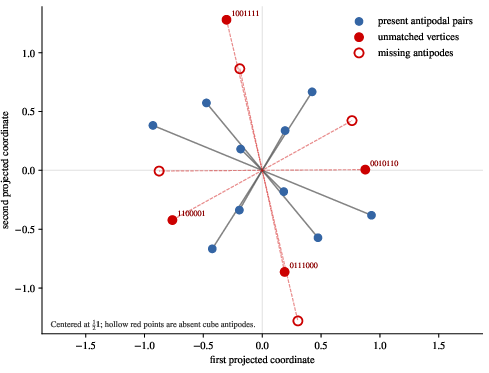
Figure 1: Two-dimensional projection of the centered vertex set d1, depicting five cube-antipodal pairs (blue) and four unmatched vertices (red), with hollow red markers indicating absent antipodes.
Furthermore, a single coordinate swap between d2 and d3 can convert this configuration into a cross polytope, suggesting proximity to central symmetry but not attaining it.
Complete Enumeration and Classification in Dimension 7
An exhaustive classification is performed for all simplicial d4-dimensional d5-polytopes with d6 vertices, leveraging the symmetry group of the d7-cube, balancedness conditions, and combinatorial splitting of the vertex set via column-sum vectors. This computational pipeline reduces the candidate sets from d8 to d9 for d≤60, and verifies each example with exact rational arithmetic and polymake's SIMPLICIAL predicate.
The enumeration results demonstrate:
- For d≤61, all simplicial d≤62-polytopes with d≤63 vertices are centrally symmetric, confirming the conjecture in these dimensions.
- For d≤64, five distinct polytopes are not centrally symmetric (partitioned into two combinatorial types), and all possess exactly five cube-antipodal pairs and four unmatched vertices.
The combinatorial and affine types of these polytopes are classified, with one type (144 facets) requiring a minimum of two coordinate swaps to restore central symmetry, while the other four (136 facets) require only one.
Numerical and Structural Analysis
The main counterexample possesses the following d≤65-vector and d≤66-vector:
- d≤67
- d≤68
This configuration achieves exactly five cube-antipodal pairs—consistent with the theoretical balance of the vertex set implied by the equality case in Proposition 17. The enumeration further reveals the minimal number of coordinate swaps required to convert a non-centrally symmetric example into a cross polytope, introducing metrics of “proximity to central symmetry”.
Practical and Theoretical Implications
The explicit counterexample addresses the open question posed by Ziegler (1999) and establishes that central symmetry is not a necessary condition for maximum-vertex simplicial d≤69-polytopes in dimension seven. This result informs the classification and structural understanding of high-dimensional P0-polytopes, with implications for polyhedral combinatorics and discrete optimization, where 0/1-polytopes play a foundational role.
From the computational perspective, the symmetry-based reduction offers a practical strategy for enumerating and certifying combinatorial types in higher dimensions. The methodology also points toward a combinatorial split-pair model for further investigation of simplicial 0/1-polytopes.
Theoretically, several questions are raised:
Conclusion
This work conclusively demonstrates, via explicit construction and exhaustive enumeration, that Ziegler’s cross-polytope conjecture does not hold in dimension seven. Five non-centrally symmetric simplicial P3-dimensional P4-polytopes with P5 vertices are characterized, partitioned into two combinatorial types. The methods and findings suggest novel directions for the combinatorial and affine classification of 0/1-polytopes and their extremal properties. Future research may address the enumeration in higher dimensions, neighborliness, and structural characterization without reliance on brute-force enumeration.