RIPE++: Reinforced Keypoint Learning from Positive Pairs Only
Abstract: Sparse keypoint extraction and matching underpin core tasks in geometric computer vision, including structure-from-motion, visual SLAM, augmented reality, and medical image registration. Learning robust local feature representations, however, typically requires accurate camera poses or depth supervision, which are often unavailable in real-world settings. Reinforcement learning (RL) has recently emerged as a promising alternative, requiring only the information if two images show the same scene or not. However, existing RL formulations such as RIPE rely on coarse binary rewards and carefully constructed negative training pairs, limiting training stability and descriptor discriminability. In this paper, we revisit RL-based keypoint learning and propose a reward that fully exploits the geometric consistency signal, deriving both reward and penalty from a single positive pair without contrasting against negatives. This richer signal provides sufficient supervisory contrast to learn discriminative detectors and descriptors from positive image pairs alone, enabling representation learning under extremely limited supervision. Furthermore, we show that the same RL objective can be extended to the matching stage by adapting LightGlue, raising AUC@5 on MegaDepth1500 from 56.58 to 59.65 and enabling weakly-supervised training of the full sparse matching pipeline from image pairs with partial visual overlap. We validate our approach on established benchmarks, demonstrating competitive results compared to fully-supervised methods. We further show that the method can be even trained on low texture medical video sequences, where camera poses are usually unavailable and standard SfM pipelines often fail. Code and data are available at https://github.com/fraunhoferhhi/RIPEpp .
Paper Prompts
Sign up for free to create and run prompts on this paper.
Top Community Prompts
Explain it Like I'm 14
1. What is this paper about?
This paper introduces RIPE++, a computer vision system that learns to find and match useful points in pictures.
These points are called keypoints. They are easy-to-recognize spots, such as:
- the corner of a window,
- a special mark on a building,
- the edge of a tool,
- a pattern on human tissue.
Finding the same keypoints in two images helps computers understand how the camera moved or how two images are related. This is useful in:
- augmented reality,
- robot navigation,
- 3D map building,
- camera tracking,
- medical image analysis.
Usually, training such a system requires extra information, such as the camera’s exact position or a depth map. Collecting this information can be expensive or impossible. RIPE++ tries to learn using much simpler information: only pairs of images that show some of the same scene.
2. What questions does the research ask?
The researchers mainly wanted to know:
- Can a computer learn good keypoints using only matching image pairs? For example, can it learn from two video frames that show the same object or place?
- Can the system avoid using negative image pairs? A negative pair contains two images from different scenes. Earlier methods needed these pairs to teach the system what not to match.
- Can the same weak training idea be used for the matcher? Finding keypoints is only one step. The system must also decide which point in one image corresponds to which point in another image.
- Can the method work in difficult areas, such as medical videos, where camera information is not available?
3. How did the researchers do it?
Finding and describing keypoints
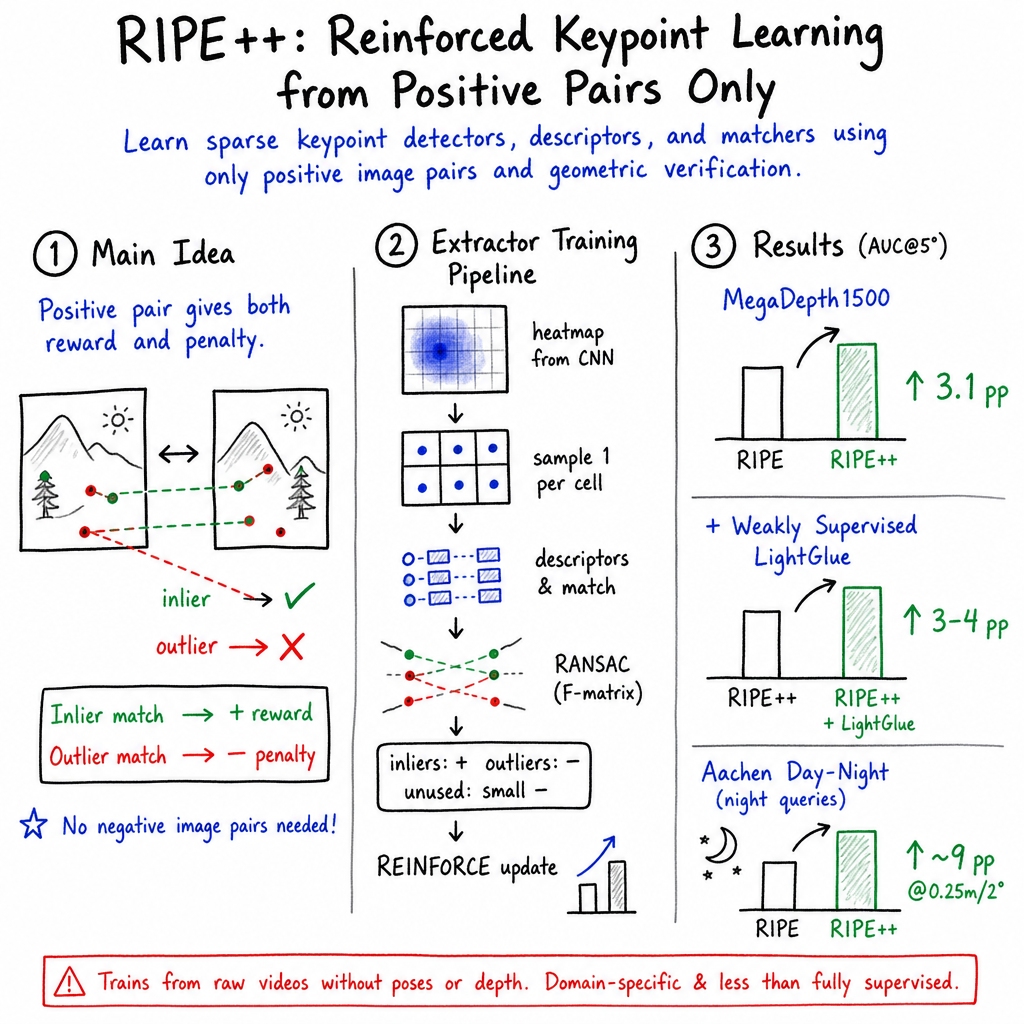
The system uses a neural network to create a heatmap for each image. A heatmap is like a map showing how likely each location is to be a useful keypoint. Bright areas mean “this might be a good point to choose.”
For every selected keypoint, the network also creates a descriptor. A descriptor is a numerical summary of the small area around the point. It works somewhat like a fingerprint: two similar-looking keypoints should have similar descriptors.
Using reinforcement learning
The researchers use reinforcement learning, which is similar to training a player in a video game.
- The network chooses keypoints.
- The chosen points are matched between two images.
- The system checks whether the matches make sense geometrically.
- Good choices receive a reward.
- Bad choices receive a penalty.
Over many training examples, the network learns to choose points that lead to reliable matches.
Checking geometric consistency
The researchers use a method based on the epipolar constraint. This is a rule describing where a point seen in one camera image should appear in another image when both images show the same 3D scene.
The system uses RANSAC, a method that repeatedly tests possible explanations and ignores unreliable matches. Imagine asking many groups of students to identify the same pattern in two pictures, then trusting the explanation supported by the largest number of students.
Matches that agree with the scene’s geometry are called inliers. Matches that do not agree are called outliers.
The main improvement in RIPE++
Earlier RIPE training mainly counted good matches. RIPE++ gives more detailed feedback:
- a geometrically correct match gets a positive reward;
- a geometrically incorrect match gets a penalty;
- unused or unsuitable points receive a small penalty.
This is important because the system can learn from a positive image pair alone. It does not need a separate pair of unrelated images to provide the negative example.
Sharpening the keypoint locations
The researchers also add entropy regularization. In simple terms, this encourages the network to make its choice concentrated in one precise location instead of spreading its probability over a large blurry area.
It is like asking someone to point to one exact place on a map rather than vaguely pointing to an entire neighborhood.
Training the matcher
The researchers also adapted LightGlue, a neural network that matches keypoints between two images.
Normally, LightGlue needs known correct matches during training. RIPE++ instead rewards matches that agree with the estimated scene geometry and penalizes matches that do not. This lets the matcher learn without exact camera poses or depth maps.
4. What did they find?
RIPE++ improved keypoint learning
On the MegaDepth1500 benchmark, RIPE++ achieved:
- 56.58% AUC@5°
- 69.53% AUC@10°
- 79.33% AUC@20°
These scores measure how often the system estimates the camera relationship accurately. A higher score means better performance.
RIPE++ improved clearly over the earlier RIPE method. For example, its AUC@5° score increased from 53.47% to 56.58%, even though RIPE++ did not use negative image pairs.
It performed similarly to strongly supervised methods
Some competing systems receive much more information during training, including camera poses, depth maps, or artificial image transformations. Despite using much less supervision, RIPE++ performed close to these methods and surpassed several of them.
This suggests that carefully designed feedback can sometimes replace large amounts of expensive training information.
It worked especially well when trained on medical video
The researchers trained a special version called RIPE++ Medical using endoscopic video frames. These are images captured inside the body during surgery.
RIPE++ Medical achieved the best results on the SCARED1500 medical benchmark:
- 20.90% AUC@5°
- 46.51% AUC@10°
- 68.72% AUC@20°
It performed better than all the tested comparison methods.
This result is important because medical videos often do not come with accurate camera positions or depth information. The system could learn directly from ordinary video frames.
The learned matcher improved performance further
When RIPE++ was combined with the weakly trained LightGlue matcher, the MegaDepth1500 results improved to:
- 59.65% AUC@5°
- 73.69% AUC@10°
- 83.86% AUC@20°
Thus, the same type of weak feedback helped both parts of the system:
- finding useful keypoints;
- matching those keypoints correctly.
Sharper heatmaps helped
The experiments also showed that entropy regularization made the keypoint locations more precise. However, the researchers had to choose its strength carefully:
- too little regularization made the points blurry;
- too much caused training to become unstable;
- the right amount improved accuracy by more than four percentage points at one evaluation threshold.
5. Why is this research important?
The main importance of RIPE++ is that it greatly reduces the information needed to train computer vision systems.
Instead of needing:
- exact camera poses,
- depth maps,
- manually labeled matching points,
- carefully prepared negative image pairs,
the system can learn from image pairs that show overlapping parts of the same scene. Even ordinary video can provide these pairs.
This could make it easier to build systems for places where detailed training data is unavailable, such as:
- surgical cameras,
- robots working in new environments,
- underwater cameras,
- drones,
- changing outdoor conditions.
The method is not perfect. Its performance depends on the training images, and a model trained in one type of environment may not work well in a very different environment. The medical experiment shows that the system may need to be retrained for each new domain.
Still, the paper shows that computers can learn useful visual features with surprisingly little supervision. In the future, methods like RIPE++ could help create cheaper, more flexible systems for camera tracking, robotics, 3D reconstruction, augmented reality, and medical imaging.
Knowledge Gaps
Knowledge gaps, limitations, and open questions
- Dependence on rigid epipolar geometry: The reward relies on fundamental-matrix estimation and therefore assumes rigid scenes, pinhole-camera imaging, and sufficient geometric structure; its effectiveness for non-rigid objects, highly distorted cameras, rolling-shutter imagery, or substantial lens distortion remains untested.
- Sensitivity to RANSAC reliability: The method treats RANSAC-derived inlier/outlier labels as supervisory signals, but does not quantify how failures in fundamental-matrix estimation, poor initialization, repetitive structures, or low inlier ratios affect training stability and learned features.
- Unclear behavior with weak or invalid positive pairs: Positive-only training assumes that paired images contain sufficient overlap, yet the paper acknowledges that video pairing can produce pairs with negligible motion or no overlap. The tolerance limits and failure modes under varying overlap, motion, and scene similarity are not systematically established.
- Residual dependence on pair-selection heuristics: Although negative-pair mining is removed, training still depends on temporal frame spacing, overlap characteristics, and—in the medical experiment—manually selected frame distances and augmentations. The method’s performance under arbitrary or uncontrolled video streams remains unresolved.
- Limited evidence for the central positive-only claim: Comparisons are primarily conducted on MegaDepth and one endoscopic dataset. It remains unclear whether positive-only rewards consistently outperform positive-and-negative training across broader domains, pair distributions, and levels of label noise.
- Unexplored robustness to false positive scene labels: The paper discusses mislabeled negative pairs in RIPE but does not measure the effect of incorrectly labeled positive pairs, which could cause geometrically unrelated matches to be rewarded and may be particularly problematic in long or repetitive video sequences.
- Reward-scale and regularization sensitivity: The entropy weight causes either performance degradation or training collapse at nearby values, indicating substantial hyperparameter sensitivity. The paper does not provide a principled method for selecting , , , , , or the matcher regularization weight across datasets.
- Potential reward hacking and degenerate solutions: It remains unclear whether the detector can exploit weaknesses in mutual-nearest-neighbor matching, descriptor learning, or RANSAC—for example, by concentrating on repetitive structures, producing correlated keypoints, or selecting features that yield a small but highly consistent set of matches.
- Incomplete analysis of descriptor learning: The detector is optimized with REINFORCE, while descriptors are trained using an auxiliary contrastive loss. The relative contribution, interaction, and possible conflict between the geometric reward and descriptor loss are not fully isolated across datasets.
- Unclear impact of the entropy regularizer on diversity: Sharper heatmaps may improve localization but could reduce spatial coverage or keypoint diversity. The paper does not systematically evaluate the trade-off between localization precision, repeatability, spatial distribution, and downstream pose accuracy.
- Approximation and variance of the policy-gradient estimator: The extractor objective uses sampled keypoints and REINFORCE, but the variance, effectiveness of baselines or variance-reduction methods, sensitivity to the number of samples, and reproducibility across random seeds are not reported.
- Limited end-to-end validation of the learned matcher: LightGlue is trained after pretraining on synthetic pairs and is evaluated mainly on MegaDepth. The extent to which the reported gain comes from the proposed weakly supervised reward rather than the retained synthetic pretraining protocol is not disentangled.
- No fully joint extractor–matcher training study: The paper trains the matcher on top of the RIPE++ extractor, but does not establish whether jointly updating detector, descriptor, and matcher produces additional gains or destabilizes the reward optimization.
- Matcher degeneracy is only partially addressed: The matcher requires a non-matchable regularizer to avoid rejecting all keypoints. The balance between accepting too many points and collapsing to too few matches, as well as the dependence of this behavior on feature count and scene overlap, remains insufficiently characterized.
- Geometric reward ambiguity for outliers: An outlier according to the estimated fundamental matrix may be a true correspondence rejected because of estimation error, while an inlier may be a geometrically accidental match. The paper does not assess how this label noise affects learned matching precision and recall.
- Narrow benchmark coverage: Evaluation is concentrated on MegaDepth1500 and SCARED1500, with relative pose estimation as the principal metric. Performance for visual localization, SfM reconstruction, SLAM tracking, augmented reality, and medical registration is not demonstrated.
- Limited cross-domain generalization analysis: The medical model is retrained specifically on endoscopic video, and the paper explicitly reports weak zero-shot transfer. The amount of video required for effective adaptation, performance under partial domain shift, and transfer between different organs, procedures, cameras, and surgical systems remain unknown.
- Insufficient medical validation: SCARED1500 evaluation measures relative pose accuracy but does not establish clinical usefulness, robustness to tissue deformation, safety implications, registration accuracy, or performance in real-time surgical workflows.
- Potential benchmark and split limitations: The MegaDepth and SCARED experiments use selected scenes and fixed training/test protocols. Generalization to unseen environments, camera devices, geographic locations, surgical subjects, and independently collected datasets is not established.
- Unquantified statistical reliability: The paper reports single performance values without confidence intervals, repeated-run variance, significance testing, or sensitivity to scene-level split changes, making it difficult to determine whether the reported gains are statistically robust.
- Fairness of baseline comparisons remains incomplete: Several baselines use different combinations of detector and descriptor supervision, input processing, or matching procedures. A controlled comparison isolating detector quality, descriptor quality, matcher quality, and supervision budget is still needed.
- Computational practicality is not fully assessed: Although positive-only training reduces training time relative to RIPE, training still requires repeated nearest-neighbor matching and robust fundamental-matrix estimation. Memory usage, inference latency, scaling with keypoint count, and suitability for embedded or real-time systems are not reported.
- Effect of camera calibration and image preprocessing is unclear: The experiments use resizing, padding, and—in SCARED—undistortion, but the sensitivity of the reward and learned features to unknown intrinsics, uncorrected distortion, aspect-ratio changes, and preprocessing mismatches is not evaluated.
- Distance-based rewards are not fully validated: The supplementary material introduces a Sampson-distance reward, but the provided text does not establish whether it improves final performance, how its thresholds should be chosen, or whether it is more robust than the binary inlier/outlier formulation.
- Open question about supervision efficiency: The minimum amount, temporal diversity, and visual overlap of positive-pair data needed to reach competitive performance are not quantified, leaving the true data-efficiency advantage over supervised and self-supervised alternatives unresolved.
Practical Applications
Immediate Applications
- Domain-specific visual localization from unlabeled or weakly labeled video (healthcare, robotics, industrial inspection)
- Train a sparse keypoint detector and descriptor using consecutive or temporally separated frames that are known—or assumed—to depict the same scene, without camera poses, depth maps, or manually annotated correspondences.
- A practical workflow is: collect video → form positive frame pairs → estimate geometric consistency with RANSAC → train RIPE++ → deploy the single-image extractor for pairwise matching and pose estimation.
- Example: endoscopic video can be used to train a procedure-specific feature extractor for camera tracking, tissue-surface mapping, and image registration. The paper reports that the medical model trained directly from endoscopic video outperformed the evaluated baselines on SCARED1500.
- Dependencies: sufficient overlap and camera motion between frames; mostly rigid or approximately rigid scene geometry; reliable robust estimation; domain-specific validation before clinical use.
- Low-cost visual SLAM and 3D reconstruction (robotics, autonomous systems, mapping)
- Replace or supplement pose/depth-supervised feature learning in visual SLAM, structure-from-motion, and multi-view reconstruction with a feature pipeline trained from raw video.
- RIPE++ can provide keypoints and descriptors, while the weakly supervised LightGlue adaptation can perform learned matching. The resulting correspondences can feed existing RANSAC, essential-matrix, SLAM, or SfM modules.
- Potential tools: a video-to-feature-training utility, a domain-adapted SLAM package, or a plug-in replacement for SIFT/SuperPoint-style feature extraction.
- Dependencies: the training video must contain repeatable visual structure; scenes with severe non-rigid motion, very low overlap, motion blur, or weak parallax may reduce performance. The method assumes a pinhole-camera and rigid-transformation setting for its geometric reward.
- Visual localization in changing environments (augmented reality, navigation, cultural heritage)
- Fine-tune feature extractors on locally collected video from a building, factory, archaeological site, or urban area rather than relying exclusively on phototourism datasets such as MegaDepth.
- This can improve matching under site-specific illumination, camera optics, texture, and viewpoint conditions.
- Potential products: AR anchoring systems, indoor navigation tools, warehouse localization, and site-specific image retrieval systems.
- Dependencies: retraining is likely needed for major domain shifts; the paper explicitly shows that the method’s advantage is inexpensive retraining rather than strong zero-shot generalization.
- Weakly supervised image registration (medical imaging, microscopy, scientific imaging)
- Use positive image pairs from the same anatomical region, specimen, or acquisition sequence to learn local features for registration when ground-truth transformations are unavailable.
- Applications include endoscopic frame alignment, surgical navigation support, longitudinal microscopy alignment, and registration of images from different acquisition sessions.
- Dependencies: geometric consistency must be a meaningful proxy for registration quality. Non-rigid anatomy, occlusion, specular highlights, and tissue deformation may require extensions such as deformation-aware rewards or additional safety checks.
- Training learned matchers without correspondence annotations (computer-vision software, research infrastructure)
- Adapt LightGlue-like matchers using inlier rewards and outlier penalties derived from robust geometric estimation, eliminating the need for depth- or pose-derived ground-truth assignments.
- A software workflow could fine-tune a matcher for a new camera, environment, or imaging modality using only positive image pairs.
- The paper reports an improvement from AUC@5 of 56.58 to 59.65 when adding the weakly supervised LightGlue matcher to RIPE++.
- Dependencies: current results remain below fully supervised LightGlue variants; the training objective needs regularization to prevent the degenerate solution of labeling all points as non-matchable.
- Reduction in data-curation and training costs (industry ML operations, academia)
- Build training datasets from raw video streams rather than constructing balanced positive/negative pairs or generating 3D reconstructions.
- Positive-only training also reduces the computational burden of RANSAC-based training; the reported extractor training time decreased from approximately 72 to 26 hours on a single A100 relative to RIPE.
- Dependencies: the reported costs depend on the chosen backbone, resolution, hardware, pair-generation strategy, and implementation. Robust estimation remains a central computational component.
- Research and teaching infrastructure for weakly supervised geometric vision (academia)
- Use the released code and data as a reproducible framework for studying policy-gradient learning, discrete keypoint selection, geometric rewards, entropy regularization, and weakly supervised matching.
- Suitable experiments include comparing binary versus correspondence-level rewards, testing distance-aware Sampson rewards, and evaluating domain adaptation from video.
- Dependencies: reproducibility depends on access to compatible GPU resources, correct RANSAC/OpenCV configurations, and careful tuning of the entropy coefficient.
Long-Term Applications
- End-to-end self-calibrating visual perception for surgical robots (healthcare, robotics)
- Integrate video-trained feature extraction and weakly supervised matching into robotic endoscopy systems for camera tracking, scene reconstruction, and registration during procedures.
- Such systems could continuously adapt to procedure-specific anatomy, imaging artifacts, and camera configurations without requiring a prebuilt geometric model.
- Dependencies: substantial clinical validation is required. Reliable uncertainty estimation, failure detection, regulatory approval, latency guarantees, and robustness to tissue deformation and instrument occlusion are essential.
- Adaptive perception for autonomous robots operating in new environments (robotics, logistics, drones)
- A robot could collect exploratory video in a new warehouse, mine, construction site, or planetary analogue and retrain its local feature pipeline without manual pose labeling.
- This supports rapid deployment across changing facilities and camera platforms.
- Dependencies: on-device or edge training, continual-learning stability, protection against catastrophic forgetting, and safeguards against self-reinforcing geometric errors must be developed.
- Large-scale 3D mapping from ordinary consumer video (mapping, real estate, construction, digital twins)
- Use smartphone, body-camera, or inspection-video footage to train locally specialized features and then construct 3D models or digital twins with SfM/SLAM systems.
- The approach could lower the barrier to mapping poorly documented environments where calibrated depth capture is unavailable.
- Dependencies: scale-up requires efficient pair sampling, distributed training, handling of dynamic objects, camera-model variation, and quality-control procedures for erroneous RANSAC models.
- Weakly supervised multi-modal and non-rigid feature learning (medical imaging, biology, materials science)
- Extend the reward beyond a fundamental matrix to optical flow, non-rigid registration, articulated motion, or modality-specific geometric constraints.
- This could enable feature learning for ultrasound, deformable surgical tissue, microscopy time series, and industrial materials under changing conditions.
- Dependencies: the current formulation assumes rigid epipolar geometry. New robust estimators and reward functions must avoid rewarding physically incorrect correspondences.
- Self-improving visual inspection systems (manufacturing, energy, infrastructure)
- Inspection systems could learn features from repeated video passes over turbines, pipelines, bridges, or production lines, improving matching across viewpoint and illumination changes without detailed 3D labels.
- Learned correspondences could support defect localization, temporal change detection, and alignment of inspection records.
- Dependencies: defects and moving components can violate the positive-pair assumption; safety-critical deployment requires calibrated confidence, traceability, and independent validation against metrology-grade systems.
- Privacy-preserving and annotation-efficient computer-vision services (software platforms, edge AI)
- Organizations could train feature models locally from internal video and share model updates or extracted representations rather than annotated imagery or camera poses.
- This may be valuable for hospitals, factories, and restricted facilities that cannot easily export data for centralized labeling.
- Dependencies: the paper does not establish privacy guarantees. Federated learning, secure aggregation, data governance, and defenses against leakage would be needed.
- Automated dataset construction and quality control (academia, industry AI development)
- The geometric reward can serve as a filter for identifying reliable correspondences and removing low-quality pairs from large video archives.
- A future tool could automatically score frame pairs, flag mislabeled or degenerate sequences, and produce training curricula based on geometric consistency.
- Dependencies: RANSAC can fail in repetitive, textureless, dynamic, or low-overlap scenes; confidence calibration and human-review workflows would be necessary.
- General-purpose weakly supervised feature-learning foundation models (software, research, robotics)
- A scaled version of the approach could jointly learn detectors, descriptors, and matchers from diverse video sources, offering domain-adaptable sparse features as an alternative to heavily reconstruction-dependent pretraining.
- Such a model could provide modular components for AR, SLAM, registration, inspection, and 3D reconstruction.
- Dependencies: the current evidence is limited to selected benchmarks and endoscopic data. Broader generalization, training stability, computational efficiency, dynamic-scene handling, and principled reward design require further research.
Glossary
- Adaptive early stopping: Dynamically terminating a neural network’s computation once sufficient confidence or accuracy has been reached. “LightGlue~\cite{lindenberger_2023_lightglue} replaced this with a more efficient transformer architecture with adaptive early stopping.”
- AUC (Area Under the Curve): The area under a performance curve, used here to summarize relative pose accuracy below specified error thresholds. “We report the Area Under the Curve (AUC) of the pose error at thresholds of \ang{5}, \ang{10}, and \ang{20}.”
- Categorical distribution: A probability distribution over a finite set of mutually exclusive outcomes. “The logit values, within a cell, define a categorical distribution, from which exactly on keypoint location is sampled.”
- Contextual bandit: A reinforcement-learning setting in which an action is selected based on context and receives an immediate reward without modeling long-term state transitions. “Note, that this formulation could also be viewed as a Contextual Bandit~\cite{Lattimore_Szepesvari_2020}.”
- Contrastive descriptor loss: An objective that brings representations of matching items closer while separating representations of nonmatching items. “we utilize the contrastive descriptor loss $\mathcal{L}_{\text{desc}$ from RIPE\cite{knzel2025ripe-7fa} to pull the descriptors of putative matches closer and repel others.”
- Cross-attention: An attention mechanism in which elements from one input sequence attend to elements in another sequence. “LightGlue refines point representations through stacks of self- and cross-attention layers.”
- Depthwise convolution: A convolution operation that applies a separate spatial filter to each input channel, reducing computational cost. “we use the same torchvision VGG-19 backbone combined with the depthwise convolutional refiners proposed by Edstedt~\etal~\cite{10.48550/arxiv.(Edstedt et al., 2022)}.”
- Descriptor: A numerical feature vector encoding the local visual appearance around a keypoint for comparison and matching. “Descriptors are extracted from the encoder, as Hypercolumn Features.”
- Differentiable matching layer: A neural-network component that computes correspondences while allowing gradients to propagate through the matching operation. “ALIKED~\cite{Wang.2023} introduces differentiable matching layers with attention-weighted local descriptors.”
- Discriminability: The ability of a representation to distinguish between different visual structures or locations. “binary reward is coarse, limiting training stability and descriptor discriminability while requiring carefully constructed negative pairs.”
- Domain shift: A change between the data distribution used for training and that encountered during evaluation or deployment. “The value of weak supervision is clearest under domain shift (Tab.~\ref{tab:scared1500}).”
- Epipolar constraint: A geometric relationship requiring corresponding points in two views to lie on corresponding epipolar lines. “it trains jointly on detection and description using only image pairs annotated with a same-scene/different-scene label, exploiting the epipolar constraint via RANSAC-based fundamental matrix estimation as a geometry-aware reward signal.”
- Entropy regularization: A training penalty that controls the uncertainty or spread of a probability distribution. “To address this, we replace $\mathcal{L}_{\text{low}$ with the negative entropy”
- Equivariant convolution: A convolutional operation designed so that transformations of the input produce corresponding, predictable transformations of the output. “S-TREK~\cite{101109iccv51070202300892} addressed patch-boundary artifacts via sequential off-policy sampling with equivariant convolutions.”
- False match: An incorrect correspondence between features detected in two images. “As a consequence, the network is able to produce many false matches without penalty, as long as they are filtered out by RANSAC.”
- Feature track: A sequence of observations of the same physical feature across multiple images or views. “which learns detectors directly from 3D feature tracks extracted via SfM.”
- Fundamental matrix: A matrix encoding the epipolar geometry between two views of a scene. “RIPE trained an RL-based detector and descriptor from image pairs annotated only with a binary same-scene/different-scene label, using RANSAC-based fundamental matrix estimation as a geometry-aware reward.”
- Geometric consistency: Agreement between image correspondences and the geometric constraints imposed by a common scene and camera motion. “we propose a reward that fully exploits the geometric consistency signal.”
- Geometric supervision: Training information describing scene geometry, such as camera poses, depth, or known correspondences. “modern learned pipelines still depend on dense geometric supervision, i.e.\ ground-truth depth and camera poses”
- Gradient accumulation: Combining gradients from multiple smaller batches before updating model parameters. “We use a batch size of 6 with gradient accumulation over 4 batches”
- Heatmap: A spatial array whose values represent the likelihood or score of a feature occurring at each image location. “a neural network predicts a heatmap indicating potential keypoint locations.”
- Homographic adaptation: A technique that aggregates detector predictions over images transformed by different homographies to improve detection robustness. “SuperPoint~\cite{DeTone.2018} bootstraps training from synthetic shapes and refines via homographic adaptation”
- Hypercolumn feature: A representation formed by combining activations from multiple layers of a neural network at the same spatial location. “Keypoint locations are then associated with their descriptors , computed as hypercolumn descriptor~\cite{Hariharan.2015} from the layers of the encoder part of the network”
- Inlier: A correspondence consistent with the estimated geometric model. “Geometrically consistent matches are rewarded and geometrically inconsistent matches are explicitly penalized.”
- Interest point: A visually distinctive image location suitable for detection and matching. “Classical detectors and descriptors such as SIFT~\cite{Lowe.2004}, SURF~\cite{Bay.2006}, and ORB~\cite{Rublee.2011} rely on hand-crafted image statistics to identify repeatable interest points”
- Keypoint detector: A model that identifies salient image locations for use in visual correspondence. “The keypoint extractor is trained with AdamW~\cite{Loshchilov2017DecoupledWD}”
- Logit: An unnormalized model output that is converted into a probability by a function such as softmax or sigmoid. “The logit values, within a cell, define a categorical distribution”
- Matchability score: A predicted probability that a feature can be reliably matched to a feature in another image. “and per-point matchability scores ”
- Mutual nearest-neighbor matching: A matching rule in which two features correspond only if each is the other’s nearest neighbor. “mutual nearest-neighbors are established between descriptors”
- Non-maximum suppression: A procedure that retains local maxima while removing nearby detections with lower scores. “the top- keypoints are selected from the heatmap based on their score, after applying non-maximum suppression in a window”
- Off-policy sampling: Sampling actions from a policy different from the one currently being optimized. “S-TREK~\cite{101109iccv51070202300892} addressed patch-boundary artifacts via sequential off-policy sampling”
- One-hot encoding: A vector representation in which one category has value one and all other categories have value zero. “This directly encourages the distribution within each patch to approach a one-hot encoding.”
- Policy gradient: A reinforcement-learning method that optimizes a parameterized action-selection policy using expected rewards. “Inspired by DISK~\cite{Tyszkiewicz.2020}, we develop a policy gradient formulation”
- Putative match: A tentative feature correspondence that has not yet been verified geometrically. “Given a putative match for the two keypoint locations and ”
- RANSAC: A robust estimation algorithm that fits a model using a subset of data while rejecting measurements inconsistent with that model. “For robust fundamental matrix estimation, we replace PoseLib~\cite{PoseLib} with the usac_magsac RANSAC variant from OpenCV~\cite{opencv_library}”
- Reinforcement learning: A machine-learning paradigm in which an agent learns from rewards or penalties resulting from its actions. “Reinforcement learning~(RL) has recently emerged as a promising alternative”
- REINFORCE: A Monte Carlo policy-gradient algorithm that estimates gradients using sampled actions and their rewards. “Using REINFORCE~\cite{williams.1992}, the gradient for maximizing the expected reward can be approximated as”
- Relative pose estimation: Estimation of the rotational and translational relationship between two camera views. “We evaluate relative pose estimation on the MegaDepth-1500 benchmark introduced by LoFTR~\cite{Sun.2021}”
- Robust estimator: An estimation method designed to reduce the influence of outliers in observed data. “we estimate the fundamental matrix using a robust estimator and classify the resulting correspondences as inliers or outliers.”
- Sampson distance: An algebraic approximation of geometric reprojection error for evaluating how well a correspondence satisfies an epipolar constraint. “the Sampson distance~\cite{Hartley2004}, measuring how well a correspondence satisfies the epipolar constraint.”
- Self-attention: An attention mechanism in which elements of a sequence attend to other elements within the same sequence. “LightGlue refines point representations through stacks of self- and cross-attention layers.”
- Sparse matcher: A correspondence model that matches a selected set of keypoints rather than dense image grids. “sparse matchers remain the dominant choice in production SfM and SLAM systems”
- Structure-from-motion (SfM): The recovery of camera motion and three-dimensional scene structure from multiple images. “Sparse keypoint extraction and matching is a cornerstone of geometric computer vision, underpinning structure-from-motion (SfM)”
- Subpixel refinement: Adjustment of a detected feature location to achieve precision finer than one image pixel. “after applying non-maximum suppression in a window and subpixel refinement following ALIKED~\cite{Zhao.2023dvq}”
- Transformer architecture: A neural-network architecture based primarily on attention mechanisms for modeling relationships among input elements. “LightGlue~\cite{lindenberger_2023_lightglue} replaced this with a more efficient transformer architecture with adaptive early stopping.”
- Visual SLAM: Simultaneous localization and mapping using visual sensor data. “Sparse keypoint extraction and matching underpin core tasks in geometric computer vision, including structure-from-motion, visual SLAM”
- Weak supervision: Training with incomplete, indirect, or coarse labels rather than detailed ground-truth annotations. “The weak supervision of RIPE++ enables training keypoint extractors in domains where ground-truth pose or depth information is difficult to obtain”
- Zero-shot transfer: Applying a model to a new domain or task without additional training on that domain or task. “What distinguishes RIPE++ is not zero-shot transfer but the ability to retrain cheaply wherever geometric ground truth is unavailable”

