Differentiable Voronoi Ray Tracing Beyond Rasterization Speeds
Abstract: Real-time novel view synthesis is dominated by rasterized explicit primitives. These projection-based pipelines provide high throughput but require specialized extensions for non-pinhole effects such as distortion, rolling shutter, and depth of field. Ray-based rendering expresses these effects naturally but is generally assumed too slow for competitive real-time rendering. We analyze the factors governing throughput in differentiable Voronoi ray tracing and identify traversal length, per-cell work, and memory locality as principal determinants. Guided by this, we introduce VoroTracing, which co-designs the scene representation, optimization, and GPU execution to reduce these costs. Compact octahedral appearance textures reduce memory traffic, while surface-concentrated opacity promotes early termination. The fixed-budget representation is optimized without pruning or densification and rendered with a GPU implementation designed for coherent traversal. On Mip-NeRF 360, VoroTracing renders at 623 FPS on an RTX 5090, providing the throughput of the fastest prior ray-based method and that of 3D Gaussian Splatting, while maintaining competitive reconstruction quality. Our renderer supports fisheye, rolling-shutter, motion-blur, and depth-of-field effects through ray generation and sampling, requiring no specialized rasterization. These results show that real-time throughput can be achieved with the flexibility of ray-based rendering. We release our source code, see https://research.zenseact.com/publications/vorotracing
Paper Prompts
Sign up for free to create and run prompts on this paper.
Top Community Prompts
Explain it Like I'm 14
1. What is this paper about?
This paper presents VoroTracing, a new way to create images of 3D scenes from different viewpoints.
Imagine taking photos of a garden from several places and then building a computer model that lets you look at the garden from a new position. This task is called novel view synthesis.
Many modern systems use a fast technique called rasterization, which draws 3D objects by projecting them onto the screen. Rasterization is very fast, but it can be difficult to use for unusual camera effects, such as:
- fisheye lens distortion,
- motion blur,
- rolling-shutter cameras,
- depth of field, where nearby or distant objects look blurry.
Another technique, ray tracing, handles these effects more naturally. It follows imaginary rays of light from the camera into the scene. However, ray tracing is usually considered too slow for real-time use.
The main purpose of this paper is to show that ray-based rendering can also be extremely fast if the scene representation and computer code are designed carefully.
2. What questions does the research ask?
The researchers focus on several main questions:
- Can ray tracing be made fast enough for real-time novel view synthesis?
- What makes Voronoi ray tracing slow?
- Can the amount of work done for each ray be reduced?
- Can the system keep good image quality while rendering many images per second?
- Can the same model support special camera effects without creating separate rendering systems for each effect?
Their central idea is that ray tracing does not have to be slow by nature. It may simply need a better combination of:
- scene representation,
- training method,
- memory organization,
- GPU programming.
3. How does the method work?
Representing the scene with Voronoi cells
VoroTracing divides 3D space into many regions called Voronoi cells.
A simple analogy is to imagine dropping many seeds onto the ground. Each seed owns the area closer to it than to any other seed. In 3D, these ownership regions become Voronoi cells.
Each cell stores information such as:
- how much it blocks light, called density or opacity;
- what color it should appear;
- how its color changes depending on the viewing direction.
Following a ray through neighboring cells
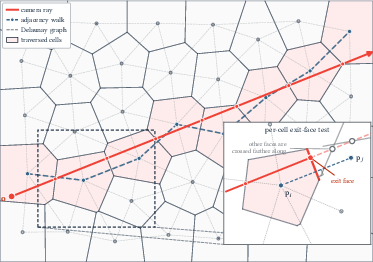
To render one pixel, the system sends a ray from the camera into the scene. The ray travels through a sequence of Voronoi cells.
Instead of searching through the entire scene every time, the system checks only the neighboring cells of the cell it is currently inside. It then moves to the next cell across the nearest boundary.
This is similar to walking through a building by checking only the doors in the room you are currently in, rather than searching every room in the whole building.
Combining colors along the ray
As the ray passes through cells, the renderer combines their colors. Transparent cells contribute a little, while opaque cells contribute more.
Once the ray has passed through enough opacity, the system stops tracing it. This is called early termination. It saves time because there is no need to inspect cells behind an already-visible surface.
Using small textures instead of spherical harmonics
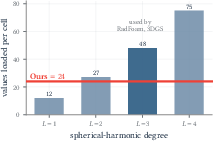
Earlier systems often used spherical harmonics to store how a cell’s color changes with viewing direction. This is a mathematical method that describes smooth directional changes, but it can require loading many numbers from memory.
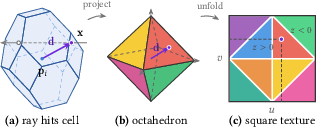
VoroTracing instead gives each cell two small 8 × 8 textures:
- one texture stores ordinary surface color and spatial detail;
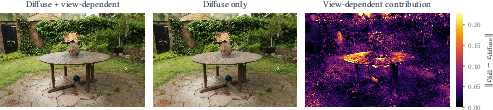
- the other stores view-dependent effects, such as shiny highlights and reflections.
The textures use octahedral mapping. This is a clever way of putting information from all directions around a 3D point onto a square image, like unfolding a small 3D shape into a 2D map.
This allows one cell to contain more detailed appearance information without needing many extra cells.
Concentrating opacity near surfaces
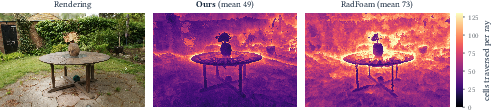
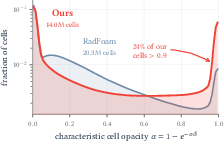
The method tries to make most empty-space cells nearly transparent and surface cells nearly opaque.
This is useful for two reasons:
- Rays can pass quickly through empty space.
- Rays can stop soon after reaching a visible surface.
The researchers use a training penalty called a distortion loss. In everyday terms, it encourages the visible part of a ray to be concentrated in one small region instead of being spread across many cells.
Training a fixed number of cells
Many related methods repeatedly add, split, and remove scene elements during training. This is called densification and pruning.
VoroTracing instead starts with a fixed budget of about 2 million cells. The initial cell locations are created from matching points across different camera images. These matches help estimate where parts of the scene are located in 3D.
The system then adjusts:
- the positions of the cells,
- their opacity,
- their textures.
It does not add or remove cells while training. This makes the training process simpler and easier to analyze.
Making the GPU implementation faster
The researchers also change how the GPU processes the rays. They:
- organize nearby cells close together in memory;
- process nearby image rays together;
- use memory-aligned data loads;
- use smaller, half-precision numbers where possible;
- skip color calculations for cells that contribute almost nothing.
These changes improve memory locality, meaning that the computer can reuse data that it has recently loaded instead of repeatedly fetching it from far-away memory.
4. Main findings
The paper reports strong results on the Mip-NeRF 360 dataset, which contains scenes photographed from many viewpoints.
The main results are:
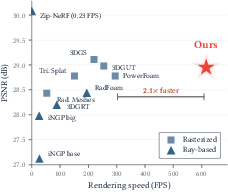
- VoroTracing reaches 623 frames per second on an NVIDIA RTX 5090 GPU.
- It is reported to be 3.2 times faster than the fastest previous ray-based method in the comparison.
- It is reported to be 2.8 times faster than 3D Gaussian Splatting.
- It achieves image quality close to the best rasterized methods.
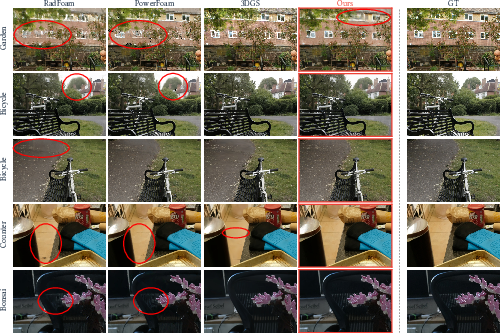
- It improves reconstruction quality over the earlier Voronoi-based method called Radiant Foam.
- It uses roughly 2 million cells, compared with about 4.1 million cells for Radiant Foam in one comparison.
The researchers identify three especially important sources of speed:
- Fewer cells are visited by each ray.
- Less data is loaded for each cell.
- Rays stop earlier when they reach an opaque surface.
The results are important because they challenge the usual belief that rasterization is always faster than ray tracing for this kind of task.
5. Special camera effects
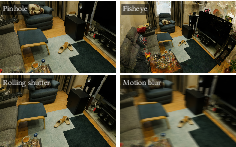
Because VoroTracing works by generating and following rays, it can support several camera effects simply by changing how the rays are created or sampled.
The paper demonstrates support for:
- fisheye views,
- rolling-shutter effects,
- motion blur,
- depth of field.
For example, to create depth of field, the renderer can send rays from slightly different positions across a camera lens. Objects at the chosen focus distance appear sharp, while other objects become blurred.
With a rasterization-based system, each of these effects may require a special extra technique. With VoroTracing, they fit naturally into the ray-based process.
6. Why does this research matter?
This research suggests that speed and flexibility do not always have to be opposites.
If ray tracing is carefully designed, it may be useful for:
- real-time computer graphics;
- virtual and augmented reality;
- games and interactive 3D applications;
- autonomous vehicles using unusual camera systems;
- simulations involving motion blur or lens distortion;
- viewing reconstructed real-world places from new perspectives.
The method is not necessarily perfect. Its results depend on good initial 3D points, powerful GPUs, and careful training. The paper also focuses on particular datasets and scenes, so more testing would be needed to know how well it works everywhere.
Still, the main message is clear: ray-based rendering can be both flexible and fast. VoroTracing shows that, by reducing unnecessary calculations and organizing data efficiently, a ray-tracing system can reach real-time speeds while keeping competitive visual quality.
Knowledge Gaps
Knowledge gaps, limitations, and open questions
- Evaluation is incomplete in the provided text: The results section is truncated before reporting the full quantitative, qualitative, ablation, and application findings, preventing independent assessment of the paper’s complete evidence.
- Generalization beyond Mip-NeRF 360 is unresolved: The method is evaluated primarily, and apparently quantitatively, on seven Mip-NeRF 360 scenes; its performance on urban driving data, indoor environments, large-scale outdoor scenes, dynamic scenes, and synthetic datasets remains unclear.
- Robustness to imperfect initialization is not established: The fixed-budget strategy depends on dense RoMa v2 correspondences, calibrated poses, and successful triangulation, but the paper does not determine how reconstruction quality and rendering speed degrade with sparse matches, incorrect correspondences, noisy poses, weak texture, or inaccurate calibration.
- The fixed budget of 2 million sites is not systematically justified: The quality–memory–training-time trade-off across substantially smaller and larger budgets is not fully characterized, nor is it shown whether the same budget is appropriate for scenes with different scales and geometric complexity.
- The claimed advantage over rasterization may be hardware-specific: Reported throughput is measured on an RTX 5090, and it is unknown whether VoroTracing remains competitive on older GPUs, mobile GPUs, integrated GPUs, or hardware without comparable memory bandwidth and cache capacity.
- Frame-rate comparisons may not be fully standardized: The paper does not establish whether all baselines use identical image resolution, ray counts, quality settings, precision, CUDA optimizations, output formats, and preprocessing assumptions, making the reported speed ratios difficult to generalize.
- End-to-end resource consumption is underreported: The memory footprint of 2 million Voronoi cells, textures, adjacency data, temporary buffers, and training structures is not clearly compared with competing methods, especially for deployment on memory-constrained devices.
- Preprocessing and construction costs are not incorporated into the real-time analysis: The time and memory required for dense correspondence extraction, triangulation, GPU Voronoi construction, adjacency generation, and Morton reordering are not evaluated as part of the total reconstruction pipeline.
- Dynamic-scene capability remains unexplored: The representation and optimization assume a static Voronoi partition, leaving open how the method could model moving objects, deforming surfaces, time-varying appearance, or rolling-shutter capture in which scene motion and camera timing interact.
- Rolling-shutter rendering is demonstrated conceptually rather than validated quantitatively: The paper states that rolling-shutter effects can be handled through ray generation, but does not report accuracy, runtime overhead, or reconstruction quality on real rolling-shutter imagery.
- Motion blur and depth of field are not evaluated across sampling budgets: The effects are supported by changing ray generation and sampling, but the paper does not quantify the number of rays required, the resulting throughput reduction, or the quality–speed trade-off for different blur strengths and aperture sizes.
- Fisheye and highly distorted cameras remain insufficiently tested: It is unclear whether the method handles severe distortion, noncentral cameras, catadioptric systems, or camera models whose rays cannot be represented by a single ray origin and direction.
- The representation’s handling of thin structures is unknown: Surface-concentrated opacity and coarse Voronoi cells may fail on wires, foliage, fences, translucent objects, and other geometry whose thickness is below or comparable to the cell scale.
- Transparency and participating media are not addressed: The preference for near-opaque surfaces and early termination may be inappropriate for glass, smoke, water, hair, vegetation transparency, or scenes requiring multiple layers of visible geometry.
- The impact of surface-concentrated opacity on view synthesis quality is not fully isolated: The paper attributes speed improvements to compact opacity, but does not clearly separate the effects of the distortion loss, exponential density parameterization, opacity thresholding, and initialization on reconstruction fidelity.
- The exponential density parameterization may introduce optimization risks that are not examined: Although it removes cell-size-dependent gradient scaling, can produce very large densities and unstable gradients; the paper does not report sensitivity to initialization, clamping, numerical precision, or optimizer hyperparameters.
- The scale-invariance claim is limited to the chosen rendering parameterization: It remains unclear whether the cancellation of cell-size dependence persists under nonuniform sampling, alternative opacity definitions, finite-precision arithmetic, or cells intersected near degenerate Voronoi faces.
- Degenerate and numerically unstable Voronoi configurations are not analyzed: The method may encounter nearly coplanar sites, very high-degree cells, tiny cells, unbounded cells, or ambiguous face crossings, but failure cases and numerical safeguards are not described.
- The cost of high-degree Voronoi cells is insufficiently characterized: The paper emphasizes average traversal length and per-cell work, but does not report how performance changes with the tail of the neighbor-degree distribution or with scenes that produce unusually complex cells.
- Differentiability at cell boundaries is not discussed in depth: Moving sites changes Voronoi topology discontinuously, yet the paper does not analyze gradients at face crossings, topology changes, or whether optimization can become biased or unstable near such events.
- The fixed topology may limit geometric refinement: Because sites cannot be added or removed, the method may be unable to recover surfaces absent from the initial point cloud; the paper does not quantify how often optimization gets trapped by missing or poorly placed cells.
- The dense-correspondence initialization may encode a significant external prior: The contribution of RoMa v2 relative to VoroTracing itself is not isolated through comparisons using identical initialization across methods or alternative point-generation procedures.
- Texture parameterization scalability is unresolved: Each cell stores two RGB maps, so appearance memory grows linearly with the site count; the paper does not investigate adaptive texture resolutions, shared textures, compression, or whether texture storage becomes the dominant cost at higher budgets.
- The octahedral mapping’s boundary behavior is not empirically evaluated: Although the mapping is described as continuous, interpolation across unfolded boundaries, seam artifacts, directional discontinuities, and anisotropic sampling near octahedral corners are not quantitatively examined.
- The view-independent/view-dependent decomposition is potentially ambiguous: Additive logit-space composition may allow geometry, diffuse texture, and view-dependent residuals to explain the same image evidence; the paper does not establish whether the learned decomposition is physically meaningful or stable across initialization and viewpoints.
- The view-dependent regularizer may suppress legitimate appearance variation: Penalizing the residual to remain small could reduce the representation’s ability to model strong specularities, reflections, iridescence, or appearance changes caused by complex illumination; this trade-off is not systematically measured.
- Unseen texture directions remain weakly constrained: The mean regularizer propagates information to unobserved texels within each cell, but the paper does not evaluate performance under narrow camera baselines, large extrapolative viewpoints, or cells visible from only a small range of directions.
- Novel-view extrapolation is not established: Results on held-out views do not necessarily demonstrate robustness to viewpoints outside the training camera distribution; performance under large translations, elevations, and backward-facing views remains an open question.
- The method’s quality on high-frequency geometry and appearance is unclear: The paper argues that textures reduce the need for additional cells, but does not establish the limits of maps for fine geometry, repeated patterns, text, sharp texture edges, or highly detailed surfaces.
- Early-termination and cell-skipping errors are not fully bounded: The approximation that skips low-contribution cells may accumulate errors over long paths or in scenes with many small contributions, but no formal error bound or broad stress test is provided.
- Warp-coherent scheduling may be scene- and camera-dependent: The benefit of ray tiles likely varies with camera orientation, distortion, depth of field, and scene layout; the paper does not identify when tiling improves or worsens occupancy and divergence.
- Morton ordering may be suboptimal for traversal locality: The paper reports spatial reordering but does not compare Morton codes with alternative layouts, cache-aware graph orderings, or dynamic data placement strategies.
- Training and inference use different approximations whose interaction is unclear: Half-precision attributes, aligned texture loads, skipped appearance evaluations, and fixed thresholds may produce a train–test mismatch; the resulting effect on optimization and final image quality is not isolated.
- The method’s performance under secondary rays is unknown: The paper motivates ray-based flexibility, but the experiments appear focused on camera rays; reflections, refractions, global illumination, shadow rays, and recursive or multi-bounce tracing are not demonstrated.
- Physical rendering capabilities are limited or unspecified: The learned color representation is designed for image reconstruction rather than physically based light transport, and the paper does not clarify whether materials, lighting changes, relighting, or view-consistent reflections can be supported.
- Training time and convergence are insufficiently compared: A fixed 20,000-step schedule is used, but the paper does not establish total optimization time, convergence speed, sensitivity to the number of steps, or whether competing methods are compared at equal training budgets.
- Failure cases are not reported: The paper does not identify scenes or conditions in which VoroTracing produces floaters, haze, holes, boundary artifacts, incorrect geometry, texture bleeding, or substantially worse perceptual quality than rasterized or ray-based baselines.
- Quality metrics may not capture the relevant artifacts: PSNR, SSIM, and LPIPS may overlook temporal instability, geometric inaccuracies, view-dependent inconsistencies, and artifacts introduced by non-pinhole rendering; evaluations using perceptual user studies, temporal metrics, or geometry-sensitive measures are missing.
- Reproducibility of the GPU implementation is uncertain: The paper states that source code will be released, but does not provide enough implementation detail in the text to reproduce kernel fusion, launch configurations, occupancy tuning, memory layout, precision choices, and timing methodology independently.
- Scalability to very large scenes is not demonstrated: The effects of scene extent, coordinate normalization, cell count beyond 2 million, multi-GPU rendering, streaming, and out-of-core storage remain unresolved.
- The relationship between cell distribution and scene geometry is not fully understood: The paper does not determine whether optimized sites converge to surfaces, how site density relates to curvature and texture frequency, or how the representation behaves in large empty regions and under uneven observation coverage.
- No principled adaptive densification strategy is provided: The paper acknowledges that insertion and removal may improve future systems, but leaves open how to detect under-resolved regions and add cells without sacrificing the favorable traversal, memory-locality, and optimization properties.
Practical Applications
Immediate Applications
- Real-time novel-view synthesis for 3D content creation — Media, gaming, XR, and visualization
- Deploy VoroTracing as a GPU renderer for interactively exploring photogrammetry- or image-reconstructed scenes from arbitrary viewpoints.
- Potential products include scene browsers, virtual-production previews, digital-twin viewers, game assets, architectural walkthroughs, and museum or cultural-heritage experiences.
- The reported throughput of 623 FPS on an RTX 5090 makes high-refresh-rate rendering feasible for suitable scenes, while the octahedral textures preserve spatial detail within cells.
- Dependencies: performance depends on high-end GPU availability, scene size, memory capacity, reconstruction quality, and whether the target scene resembles the evaluated mostly opaque scenes from Mip-NeRF 360.
- Interactive rendering with non-pinhole cameras — Automotive, robotics, computer vision, and simulation
- Use ray generation rather than specialized rasterization modules to render fisheye and distorted-camera views.
- This is directly relevant to automotive surround-view systems, robot-mounted wide-angle cameras, action cameras, and industrial inspection cameras.
- A practical workflow is: reconstruct a scene from calibrated images, retain the Voronoi representation, and generate rays according to the target camera model.
- Dependencies: accurate camera calibration and adequate training coverage are required; the paper demonstrates flexibility of ray generation, but does not establish safety-critical perception accuracy.
- Rolling-shutter and time-varying camera simulation — Autonomous vehicles, robotics, and sensor testing
- Generate images in which different scanlines correspond to different camera poses or exposure times, supporting rolling-shutter simulation.
- The same mechanism can be used to test perception systems against motion-induced distortions without creating a separate rasterization pipeline for each sensor model.
- Potential tools include synthetic-data generators, camera-model validation suites, and regression tests for visual odometry or object-detection systems.
- Dependencies: the scene representation must be paired with a suitable trajectory or time-dependent ray-generation model. The excerpt indicates support for rolling-shutter effects but does not provide quantitative validation under fast motion.
- Depth-of-field and motion-blur rendering — Virtual cinematography, XR, simulation, and visualization
- Produce shallow-depth-of-field images by sampling rays across an aperture and motion-blurred images by sampling rays over an exposure interval.
- Applications include cinematic previews, camera-placement tools, realistic augmented- and virtual-reality scenes, and synthetic training data for camera-aware vision systems.
- Because these effects are expressed through ray generation and sampling, the same trained scene can support multiple optical effects without redesigning the renderer.
- Dependencies: additional rays per pixel increase workload; real-time performance for complex blur or aperture sampling may require quality-speed controls and hardware comparable to the reported GPU.
- Rapid prototyping of differentiable rendering pipelines — Academic research and software development
- Researchers can use the released implementation as a baseline for studying differentiable ray tracing, explicit radiance fields, Voronoi representations, and GPU execution strategies.
- The fixed-budget training procedure provides a comparatively simple experimental workflow without pruning, densification, progressive downsampling, or multi-stage schedules.
- The code can support experiments involving camera calibration, inverse rendering, scene optimization, and differentiable sensor models.
- Dependencies: reproducibility requires compatible CUDA/GPU software, the dense-correspondence initialization pipeline, calibrated input cameras, and sufficient computational resources for constructing and optimizing millions of cells.
- GPU optimization patterns for irregular workloads — Software and hardware engineering
- The paper’s implementation techniques—Morton ordering, aligned texture loads, half-precision attributes, compact ray tiles, warp-coherent scheduling, and low-contribution cell skipping—can be reused in other GPU workloads involving spatial traversal.
- Potential applications include particle systems, volumetric simulation, collision queries, spatial analytics, and custom ray-tracing engines.
- The work provides a practical design principle: optimize not only the number of primitives but also traversal length, per-element memory traffic, and thread coherence.
- Dependencies: benefits are hardware- and workload-dependent; the reported speedups should not be assumed for unrelated scenes or GPU architectures without profiling.
- Camera and sensor-model evaluation — Automotive engineering and policy-oriented testing
- Render the same reconstructed environment through pinhole, fisheye, rolling-shutter, motion-blur, and depth-of-field models to compare how sensing conditions affect downstream algorithms.
- This can support test workflows for perception-stack robustness, camera selection, and sensor calibration.
- Dependencies: the reconstructed scene must faithfully represent relevant geometry, texture, reflections, and dynamic content. The paper primarily evaluates static novel-view synthesis, so dynamic-scene validity remains an open issue.
Long-Term Applications
- Synthetic data generation for autonomous-driving and robotics perception — Automotive, robotics, and embodied AI
- Build large datasets containing controlled variations in viewpoint, lens distortion, rolling shutter, motion blur, aperture, and camera trajectories.
- A future workflow could reconstruct real environments once and render many sensor-specific observations for training or validating detection, segmentation, localization, and planning systems.
- The ray-based formulation is particularly promising for cameras whose image formation differs substantially from a pinhole projection.
- Dependencies: deployment requires validation of geometric and photometric fidelity, support for dynamic objects and lighting changes, scalable multi-scene reconstruction, and evidence that generated data improves real-world generalization.
- Real-time digital twins with sensor-faithful visualization — Manufacturing, infrastructure, smart cities, and logistics
- Represent facilities, road environments, or infrastructure as explicit Voronoi radiance fields and render them from virtual cameras, robots, or inspection devices.
- Potential products include interactive digital-twin dashboards, remote inspection systems, operator training environments, and simulation-based maintenance tools.
- Ray-based rendering could allow one scene representation to serve multiple camera types and viewpoints.
- Dependencies: large-scale scenes may exceed the fixed two-million-site configuration; methods for streaming, level of detail, dynamic updates, semantic metadata, and temporal scene changes are still needed.
- Differentiable camera and optics design — Automotive, consumer electronics, and computational photography
- Integrate VoroTracing with gradient-based optimization to tune camera pose, lens parameters, distortion models, aperture, exposure timing, or sensor placement for a target scene or task.
- Possible tools include virtual camera-design environments and task-specific sensor optimization systems.
- Since image formation is represented by ray generation and sampling, optical parameters could potentially be optimized jointly with scene or perception objectives.
- Dependencies: the paper demonstrates differentiability and flexible ray generation but does not report optimization of physical camera parameters. Accurate lens and sensor models, stable gradients, and broader scene validation are required.
- Interactive inverse rendering and material inspection — Retail, cultural heritage, product design, and visual effects
- Extend the view-independent and view-dependent texture decomposition to estimate surface appearance, identify reflective regions, or inspect how materials change with viewpoint.
- The separate residual view-dependent map could provide a starting point for separating diffuse appearance from specular or reflective effects.
- Potential workflows include digital product inspection, virtual try-on, material cataloging, and interactive relighting research.
- Dependencies: the learned view-dependent texture is an appearance approximation rather than a physically based material model. Relighting, illumination changes, unseen viewpoints, and highly reflective or transparent objects require further research.
- High-quality mobile, edge, and embedded rendering — AR/VR, robotics, and field inspection
- The compact per-cell appearance representation and reduced memory traffic could eventually support deployment on lower-power GPUs or embedded accelerators.
- Applications include headset-based scene exploration, robot-localized visualization, and offline or near-real-time field inspection.
- Dependencies: the reported result uses an RTX 5090, so edge feasibility is unproven. Compression, level-of-detail selection, streaming, quantization, and hardware-specific kernels would be necessary.
- Scalable real-time rendering of much larger scenes — Cloud graphics, games, and geospatial visualization
- Extend the fixed-budget Voronoi representation to city-scale or long-duration captured environments using hierarchical diagrams, streaming partitions, adaptive cell insertion, and multi-resolution textures.
- Such systems could provide cloud-rendered digital environments with arbitrary camera models and optical effects.
- Dependencies: the paper explicitly leaves better densification strategies as future work. Diagram construction, memory footprint, initial nearest-cell lookup, distributed training, and temporal consistency become major challenges at scale.
- Robust rendering for dynamic and deformable environments — Robotics, sports analysis, film, and simulation
- Develop time-dependent Voronoi cells or scene updates that represent moving objects, changing geometry, and non-static lighting.
- This would enable realistic replay, robot simulation, and temporally consistent novel views from moving cameras.
- Dependencies: the presented experiments focus on static scenes. Efficiently updating adjacency, preserving differentiability, handling occlusion changes, and avoiding temporal flicker require substantial additional research.
- Policy and standards for sensor-realistic simulation — Transportation safety and regulatory testing
- If validated, the method could contribute to standardized benchmarks for testing perception systems under fisheye distortion, rolling shutter, blur, and depth-of-field conditions.
- Regulators, manufacturers, and researchers could use common reconstructed environments and camera models to compare system robustness.
- Dependencies: regulatory use would require repeatability, traceability of reconstruction error, calibrated ground truth, coverage of adverse weather and lighting, dynamic-scene support, and independent validation. The current paper establishes rendering throughput and flexibility, not certification-level simulation fidelity.
Glossary
- Adjacency graph: A graph connecting neighboring spatial cells that share a boundary. “The list of neighbors that share a face forms an adjacency graph, namely the Delaunay graph of the sites.”
- Alpha compositing: Combining foreground and background colors according to opacity and visibility. “Through projected primitives, tile sorting and alpha compositing, 3DGS introduced interactive rendering speeds to the novel view synthesis field.”
- Anisotropic Gaussian: A Gaussian-shaped primitive whose spread can differ by direction. “3D Gaussian Splatting~\cite{kerbl20233d} then shifted the practical focus of real-time novel view synthesis toward rasterized explicit primitives, combining anisotropic Gaussians, adaptive density control, tile sorting, and spherical-harmonic appearance into an interactive, high-quality renderer.”
- Bilinear interpolation: Estimating a value between four neighboring grid samples using weighted linear interpolation. “Bilinear interpolation provides smoothly varying color from the texture.”
- Bimodal distribution: A distribution with two prominent groups or peaks. “Our exponential density parameterization and distortion loss drives opacity to a strongly bimodal distribution --- cells are either near-transparent or near-opaque --- with of cells above .”
- BVH (bounding volume hierarchy): A tree-shaped acceleration structure that groups geometric objects into nested bounding volumes for efficient intersection tests. “3D Gaussian Ray Tracing~\cite{moenne20243d} traces Gaussian particle scenes with hardware-accelerated ray tracing, supporting distorted cameras and secondary rays while still relying on BVH traversal.”
- Cache reuse: Reusing data already loaded into a processor cache to reduce memory-access cost. “Neighboring camera rays often traverse overlapping cell sequences, so grouping coherent rays can improve cache reuse even without explicit cooperative loading.”
- Coherent traversal: Processing rays that follow similar paths through a scene so their computations and memory accesses are aligned. “The fixed-budget representation is optimized without pruning or densification and rendered with a GPU implementation designed for coherent traversal.”
- Convex polytope: A bounded geometric shape formed by the intersection of finitely many half-spaces. “The faces between neighboring cells form an explicit convex polytope structure.”
- Delaunay graph: A graph connecting sites whose Voronoi cells share a face. “The traversal thus follows edges of the Delaunay adjacency graph (dashed), visiting a short sequence of cells whose ray-segment lengths feed the piecewise volume rendering.”
- Delaunay triangulation: The geometric dual of a Voronoi diagram, connecting points that share a Voronoi boundary. “The Voronoi diagram and its more popular dual, the Delaunay triangulation, are fundamental structures in computational geometry that partition space based on proximity to a set of seed points~\cite{aurenhammer1991voronoi,boots1999spatial}.”
- Dense correspondence: A matching between many or nearly all pixels or points in two images. “We use dense correspondences to start from a fixed cell budget, so changes in quality or speed can be attributed to the representation and renderer rather than to cells being inserted or removed during training.”
- Differentiable rendering: Rendering formulated so that image outputs can be differentiated with respect to scene or model parameters. “Based on these design considerations, we propose VoroTracing, a differentiable renderer for an explicit Voronoi scene representation.”
- Disparity: A depth-related quantity commonly proportional to the inverse of distance. “Metric depth is first mapped to the bounded disparity-like coordinate”
- Densification: Increasing the number of scene primitives during optimization to represent additional detail. “We optimize a fixed budget of densely initialized cells without pruning or densification.”
- Distortion loss: A regularization term that penalizes rendering weights spread across separated or extended depths. “To push the optimization close to an opaque surface, we adopt the distortion loss of Mip-NeRF~360~\cite{barron2022mip}.”
- Early termination: Stopping ray traversal once the remaining unobserved contribution becomes negligible. “Early termination is possible when falls below a certain threshold, which is used as a stopping criterion for ray traversal.”
- Explicit radiance field: A directly stored scene representation that maps spatial and viewing information to emitted or observed color and density. “We argue that, for the explicit radiance-field setting studied here, this trade-off is not inherent.”
- Fisheye camera: A camera with an extremely wide field of view and substantial nonlinear lens distortion. “Our renderer supports fisheye, rolling-shutter, motion-blur, and depth-of-field effects through ray generation and sampling, requiring no specialized rasterization.”
- Half-precision: A 16-bit floating-point numerical format used to reduce storage and memory traffic. “The training formulation above is already designed to reduce the number of cells visited per ray. Our base inference kernel follows Radiant Foam~\cite{govindarajan2025radiant} in using half-precision appearance attributes and precomputed half-precision vectors from each site to its Voronoi neighbors.”
- Hardware warp: A group of GPU threads that execute instructions together, often in lockstep. “As threads are organized into warps---hardware groups of $32$ threads that execute in lockstep---throughput also depends on variation in traversal count across neighboring rays, memory locality, cache reuse, and scheduling.”
- Logit space: The space of inverse-sigmoid values, where probabilities or colors can be combined before applying a sigmoid. “The two maps combine additively in logit space, and a sigmoid produces the final cell color”
- Memory bound: Limited primarily by the rate of memory access rather than by arithmetic computation. “The kernel is also largely memory bound.”
- Memory locality: The tendency of a computation to access nearby or recently accessed memory locations. “Unlike tile-based splatting, which cooperatively loads the primitives shared by a screen tile and amortizes their cost across many pixels, a Voronoi traversal issues appearance loads on demand for each ray. This makes memory locality critical.”
- Morton code: An integer encoding that orders multidimensional coordinates to preserve spatial locality. “We additionally reorder cells by Morton code before rendering, improving spatial locality for rays that traverse neighboring regions of the diagram.”
- Neural radiance field: A learned continuous representation that predicts scene density and view-dependent color for volumetric rendering. “Neural radiance fields~\cite{mildenhall2021nerf} approached this problem through differentiable ray-based volume rendering.”
- Novel view synthesis: Generating images of a scene from viewpoints not present in the input images. “The task is not to render a known scene, but to reconstruct a scene representation from images and render it from new viewpoints.”
- Octahedral mapping: Mapping directions on a sphere to a two-dimensional square domain using an unfolded octahedron. “We use octahedral mapping to index from the direction to the square texture domain.”
- Opacity: The fraction of light blocked or absorbed by a region during compositing. “The opacity contributed by segment is”
- Pinhole camera: An idealized camera model in which rays pass through a single projection center. “Ray-based rendering expresses these effects naturally but is generally assumed too slow for competitive real-time rendering.”
- Radiance field: A function describing the color or radiance emitted or observed at locations in space as a function of viewing direction. “Explicit radiance-field methods depend heavily on where primitives are placed and how they are allowed to change during optimization.”
- Rasterization: Converting projected geometric primitives into pixels on an image plane. “Rasterization is one of the defining approximations of real-time computer graphics.”
- Rolling shutter: A camera exposure mechanism in which different image rows are captured at different times. “Rolling-shutter cameras require time aware projection or, more generally, a time varying image formation model~\cite{wu20253dgu, hess2025splatad, seiskari2024gaussian}.”
- Scale-invariant parameterization: A parameterization designed so that equivalent quantities receive comparable treatment despite changes in scale. “We instead set , whose derivative satisfies .”
- Spherical harmonics: Orthogonal basis functions on the sphere used to represent directional signals. “In 3D Gaussian Splatting~\cite{kerbl20233d} and Radiant Foam~\cite{govindarajan2025radiant}, this directional color is stored as spherical harmonics.”
- Specular highlight: A bright reflection whose appearance changes with viewing direction. “Real scenes, however, have variable color dependent on viewing direction, including specular highlights, sheen, and reflections of the surrounding environment.”
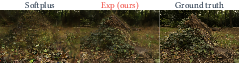
- Softplus: A smooth neural-network activation function, commonly defined as . “The softplus density activation used in prior works~\cite{govindarajan2025radiant,govindarajan2026power} does not address this issue.”
- Structure from motion: Recovering camera motion and scene structure from multiple images. “Adaptive density control can make a representation robust to sparse or uneven structure-from-motion points”
- Transmittance: The fraction of light that remains unattenuated after passing through preceding material. “where is the transmittance accumulated by segment .”
- Voronoi diagram: A partition of space into regions associated with the nearest site among a set of sites. “The diagram partitions space into cells of constant density and appearance, so a ray can be advanced by walking from cell to cell through local adjacency rather than repeatedly querying a global acceleration structure.”
- Voronoi partition: The division of a space into Voronoi cells determined by nearest-site relationships. “These sites induce a Voronoi partition of space, where each cell”
- View-dependent appearance: Appearance that changes according to the observer’s viewing direction. “The view-dependent regularizer”
- Volume rendering: Computing image colors by integrating density and radiance along camera rays through a volumetric scene. “Piecewise-constant volumetric rendering assumes that the scene is partitioned into regions of constant density and color.”
- Warp-coherent ray scheduling: Assigning rays to GPU warps so that neighboring threads tend to follow similar traversal and computation patterns. “To improve coherence within a warp, we schedule image rays in compact tiles.”
- Voxel grid: A three-dimensional regular grid of volumetric elements used to discretize space. “We estimate local sampling density with a voxel grid and draw points with probability proportional to the inverse voxel occupancy”

