Q-Learning With World Models
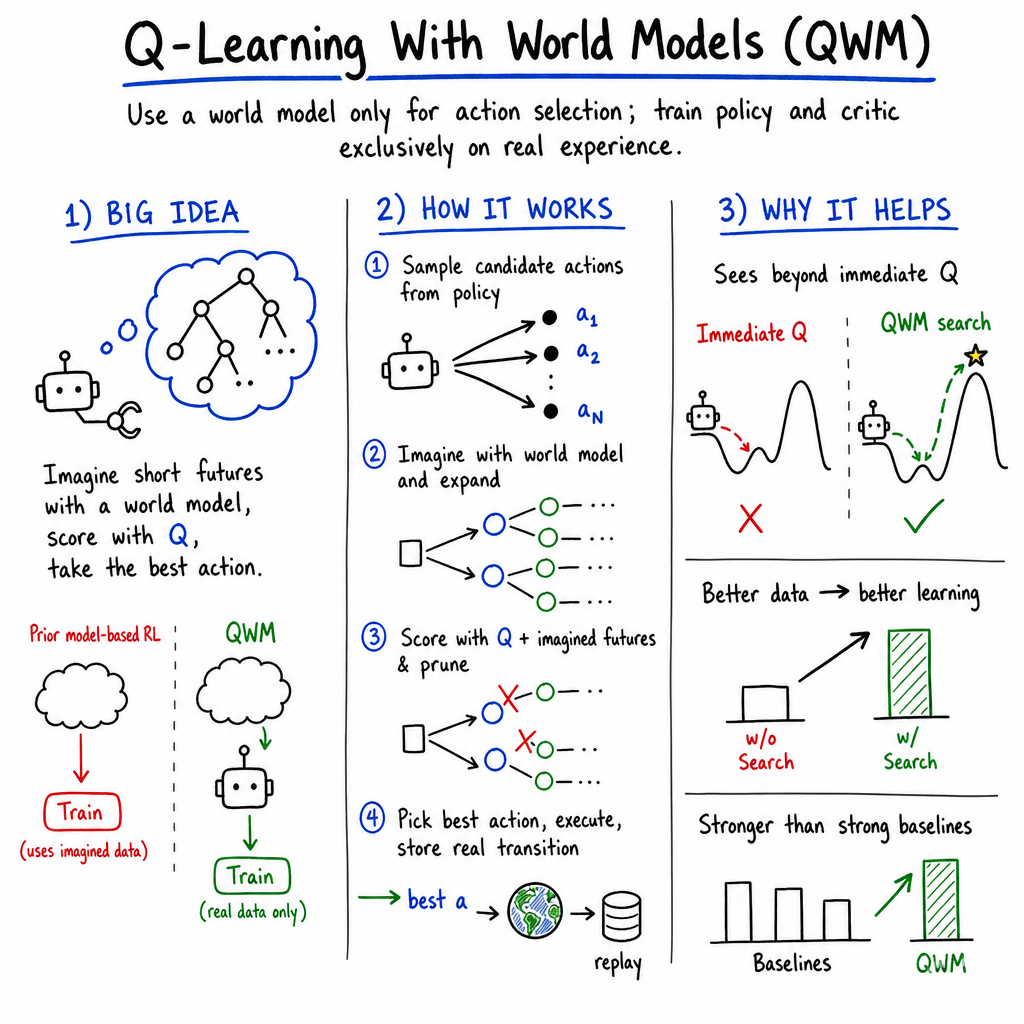
Abstract: Off-policy reinforcement learning (RL) has become increasingly sample-efficient, enabling applications such as RL fine-tuning of Vision-Language-Action models into reliable, high-performing policies. World models offer a further lever for sample efficiency, as they predict state changes rather than actions alone, but their success has largely been confined to supervised policy learning. Prior model-based RL methods often optimize the policy or value function directly on imagined rollouts, which is prone to compounding bias and struggles to scale to large, high-dimensional problems such as real-world robotics, a problem that worsens with task horizon and visual complexity. In this work, we instead ask whether we can leverage world models directly on top of standard Q-learning to improve performance, while remaining trained and grounded in the real, online setting. We propose QWM, a framework that leverages world models to perform test-time search over imagined trajectories on top of Q-learning to select high-value actions during both online rollouts and evaluation. Since the policy and value function are trained only on real transitions, QWM avoids compounding model bias while still gaining the sample-efficiency benefits of predictive search. On challenging manipulation benchmarks Robomimic and LIBERO, QWM significantly outperforms strong prior state-of-the-art methods on both sample efficiency and performance.
Paper Prompts
Sign up for free to create and run prompts on this paper.
Top Community Prompts
Explain it Like I'm 14
1. Main idea of the paper
This paper introduces Q-Learning with World Models, or QWM. It describes a way to help robots make better decisions while learning how to complete tasks.
The main idea is simple:
Before a robot takes an action, it uses a learned “world model” to imagine what might happen next. It then chooses the action that seems most likely to lead to success.
For example, if a robot wants to pick up a can, it might imagine several possibilities:
- moving its hand slightly too far,
- moving its hand near the can,
- moving toward the can and closing its gripper.
QWM compares these imagined futures and chooses the action with the best predicted result.
2. Research questions and objectives
The researchers wanted to find out whether world models could improve ordinary Q-learning, especially for difficult robot-control tasks.
More specifically, they asked:
- Does QWM work better than existing robot-learning methods?
- Does adding QWM improve the performance of an existing Q-learning system?
- Can QWM also work when the robot only sees images or video instead of simple measurements?
- Which parts of QWM are most important for success?
The researchers were especially interested in making robots learn successfully from fewer real-world attempts. This matters because real robot experiments can be slow, expensive, and sometimes dangerous.
3. How the research was done
Reinforcement learning in everyday language
The paper uses reinforcement learning, a method where an agent learns by trying actions and receiving rewards.
This is similar to training a dog:
- If the dog performs a desired behavior, it receives a treat.
- If it does not, it receives little or no reward.
- Over many attempts, the dog learns which behaviors are useful.
For the robot, a reward might be given when it successfully lifts an object or places it in the correct location.
Q-learning
Q-learning uses a function called a Q-function. The Q-function estimates how good a particular action is in a particular situation.
For example, it might estimate:
- “Closing the gripper now has a high chance of success.”
- “Moving left has a low chance of success.”
- “Moving forward may eventually lead to a successful placement.”
The robot normally chooses actions with high Q-values.
World models
A world model is a neural network that learns how the environment changes.
It answers questions such as:
“If the robot is in this situation and takes this action, what will the next situation look like?”
The model can predict future robot states, such as:
- the position of the robot’s hand,
- the position of objects,
- whether the gripper is open or closed,
- or what the next camera image may look like.
This is like a basic video-game simulator learned from examples. Instead of trying an action in the real world, the robot can first imagine what might happen.
Tree search
QWM uses the world model to perform a short tree search.
A tree search means considering several possible choices and their possible consequences. Imagine planning a route through a maze:
- Try several possible first steps.
- Imagine where each step leads.
- From each new position, consider several next steps.
- Keep the most promising routes.
- Choose the first step from the best-looking route.
The robot does something similar:
- Its policy suggests several possible actions.
- The world model predicts what would happen after each action.
- The policy suggests more actions from the predicted future states.
- The Q-function scores the possible paths.
- The robot executes the first action from the path with the highest predicted value.
The search is deliberately short. If the robot imagines too many steps, small prediction errors can build up and make the imagined future unreliable.
Training only with real experience
A major design choice is that QWM uses imagined futures mainly when choosing actions, not as replacement training data.
The robot still trains its policy and Q-function using transitions collected from the real environment. This helps avoid a problem called compounding model bias.
Compounding model bias happens when a world model makes a small mistake, then uses that incorrect prediction to make another prediction, and so on. After many imagined steps, the result may be very unrealistic—like using a slightly wrong map and eventually ending up in the wrong country.
The researchers added QWM to two existing Q-learning methods, called EXPO and RLPD.
Robot tasks and environments
The experiments used robotic manipulation benchmarks:
- Robomimic, with tasks such as lifting a block, picking up a can, inserting a square object, and hanging a tool.
- LIBERO, which tests robot learning from visual observations.
The robot had a seven-jointed arm. The experiments included both:
- State-based observations, containing numerical information about the robot and objects.
- Pixel-based observations, where the robot had to use camera images.
For state-based tasks, the world model was a relatively small neural network. For visual tasks, the researchers adapted a video-generation model so it could predict how the scene would change after different robot actions.
4. Main findings
QWM performed better than strong comparison methods
QWM achieved the best overall results among the tested model-free reinforcement-learning methods.
It also performed better than the tested model-based methods, including TD-MPC2 and EfficientZero V2, especially on difficult tasks with sparse rewards.
A sparse reward means the robot receives useful feedback only when it completes the task. For instance, it might receive no reward while trying to hang a tool and receive a reward only after succeeding. This makes learning much harder.
QWM improved its underlying algorithms
Adding tree search improved both EXPO and RLPD.
This shows that QWM is not limited to one particular learning algorithm. It can work as an extra decision-making tool placed on top of different Q-learning systems.
The robot learned faster because it collected better experiences during training. Instead of taking mostly ordinary actions, it used imagined futures to choose more promising actions.
Future consequences were useful
Compared with simply choosing the action with the highest immediate Q-value, QWM considered short sequences of actions.
This helped the robot recognize that an action that looks only moderately good now might lead to a much better future. This is particularly helpful for long or complicated tasks, such as assembling a stand and hanging a tool.
QWM also worked with images
The method improved performance on the visual LIBERO tasks. In several tasks, QWM learned faster or reached a higher final success rate than the base method.
However, the visual experiments used tree search mainly while collecting training data, not during final evaluation. The authors suggest that using search during both stages might improve results further, but it would require more computing power.
Moderate search worked best
The experiments found that more searching was not always better.
In general:
- A search depth of about two steps often worked well.
- Looking too far into the future increased the effect of world-model errors.
- Considering too few actions could cause the robot to miss a good choice.
- Considering too many actions increased computing costs and could also make mistakes more influential.
- Keeping a small number of the most promising paths was usually enough.
This suggests that QWM works best as a careful, short-term lookahead rather than as an attempt to imagine every possible future.
5. Why the results matter
QWM combines useful ideas from two approaches:
- Model-free Q-learning, which learns directly from real experience and avoids trusting an imperfect simulator too much.
- Model-based planning, which uses a model to imagine possible futures and make better decisions.
The key advantage is that the world model helps the robot choose actions, but the robot’s main learning process remains connected to real-world data. This reduces the risk that errors in the world model will become deeply built into the robot’s behavior.
The approach could help robots learn tasks using fewer real attempts. This may be valuable for robots working in homes, factories, hospitals, or other places where collecting large amounts of trial-and-error data is difficult.
Limitations and possible future impact
QWM also has important limitations.
First, tree search requires the robot to consider many possible actions before acting. This takes more time and computing power than simply running a policy once. That could be a problem when a robot must react very quickly.
Second, building a good world model is itself difficult and expensive. If the model predicts future images or movements poorly, the search may choose the wrong action.
Overall, the paper suggests that robots can make better decisions by “thinking ahead” for a few moments before acting. QWM does not completely replace real-world learning; instead, it uses imagination as a helper. If the computational cost and world-model accuracy can be improved, this method could make robot learning faster, more reliable, and more practical.
Knowledge Gaps
The paper leaves the following knowledge gaps, limitations, and open questions unresolved:
- Real-world validation is absent. QWM is evaluated only in simulated Robomimic and LIBERO environments, so its robustness to sensor noise, actuation errors, latency, visual disturbances, and unmodeled contacts on physical robots remains unknown.
- Generalization beyond demonstration-supported tasks is unclear. The world models are pretrained on demonstration transitions, but the paper does not test tasks, object configurations, dynamics, or action distributions substantially outside that data support.
- The effect of world-model quality is not systematically characterized. The experiments do not quantify how model prediction accuracy, calibration, multimodality, or distribution shift affects QWM’s action-selection quality and final task success.
- The deterministic state-based model is insufficient for stochastic environments. The low-dimensional dynamics model predicts a single residual next state, leaving unresolved whether QWM remains effective under stochastic transitions, uncertain contacts, or multiple plausible outcomes.
- Uncertainty is not explicitly represented in tree search. QWM averages or aggregates point estimates from the critic and imagined trajectories, but does not investigate uncertainty-aware pruning, risk-sensitive selection, or penalties for unreliable model predictions.
- The use of
arg maxaggregation may amplify overestimation bias. Selecting the best action or successor among many candidates can favor erroneous high-value Q estimates or implausible model predictions; the paper does not measure or mitigate this multiple-comparisons effect. - The fixed combination of value estimators is underexplored. The default arithmetic weighting of and , including the reported choice of , is tuned empirically but not adapted to state-dependent critic or model reliability.
- Sparse-reward assumptions limit applicability. In practice, QWM does not learn a reward model because the evaluated tasks have terminal rewards. Its effectiveness with dense, delayed, shaped, deceptive, or unknown rewards remains insufficiently established.
- Long-horizon planning remains unresolved. The experiments favor shallow search, particularly depth two, while the paper does not demonstrate whether QWM can handle substantially longer-horizon tasks without losing performance to model error and greedy beam pruning.
- The beam-search heuristic lacks guarantees. Pruning paths according to cumulative Q-values may discard branches with temporarily low value but high eventual return; the paper provides no theoretical analysis or empirical comparison with alternative search strategies such as uncertainty-aware beams, MCTS, CEM, or adaptive branching.
- The relationship between search and Q-function errors is not isolated. It remains unclear whether QWM’s gains come primarily from better future-state prediction, increased candidate sampling, altered data collection, or exploitation of critic overestimation.
- Search-time actions may induce exploration bias. Using QWM during online sampling preferentially collects high-scoring actions, potentially reducing behavioral diversity and causing replay-buffer coverage or exploration failures; this trade-off is not examined.
- Off-policy correction is not analyzed. The policy used to collect data differs from the learned actor because tree search modifies action selection, but the paper does not study whether this discrepancy creates instability or biased Q estimates.
- The interaction with the underlying RL algorithm is only lightly tested. QWM is instantiated on EXPO and RLPD, leaving its effectiveness with other actor–critic, diffusion-policy, transformer-based, or discrete-action Q-learning methods uncertain.
- The contribution of each computational component is not fully separated. The experiments do not provide matched-compute comparisons against best-of- Q selection, longer actor optimization, additional critic evaluations, model-free trajectory search, or stronger policy sampling baselines.
- Computational and latency costs are incompletely reported. The paper acknowledges substantial overhead but does not provide detailed measurements of inference time, GPU memory, energy use, throughput, or performance as a function of a fixed real-time budget.
- Pixel-based evaluation is restricted relative to the main method. For LIBERO, world-model search is used only during online data collection and not during evaluation because of computational constraints; therefore, the full visual version of QWM is not empirically validated.
- The visual world model’s contribution is difficult to assess. The paper does not report video-prediction quality, action-conditioning fidelity, temporal consistency, or whether errors in generated frames specifically cause downstream control failures.
- The evaluation lacks broad statistical reporting. The provided description does not establish the number of random seeds, confidence intervals, variance across runs, or statistical significance of improvements, making reproducibility and robustness difficult to assess.
- Task and benchmark coverage is limited. Only four Robomimic tasks and five LIBERO tasks are evaluated, so conclusions about diverse manipulation, navigation, locomotion, deformable objects, or highly stochastic environments remain unsupported.
- Robustness to failures and irreversible actions is not studied. The method’s behavior when the world model predicts an unsafe consequence, when an action causes an unrecoverable state, or when the critic is confidently wrong remains unknown.
- The offline-to-online world-model update strategy is unresolved. The world model is pretrained offline, but the paper does not investigate whether, when, or how it should be updated with newly collected online transitions.
- Model staleness is not evaluated. As the policy explores states outside the demonstration distribution, the fixed pretrained model may become increasingly inaccurate; the effect of this drift on search decisions is not measured.
- The method’s dependence on action-space structure is unclear. QWM samples candidate continuous actions from the policy and evaluates them through the model, but its scalability to very high-dimensional actions, temporally extended actions, hybrid action spaces, or constrained actions is not demonstrated.
- Safety and constraint handling are absent. The search objective maximizes predicted value but does not explicitly enforce collision avoidance, torque limits, workspace constraints, or task-specific safety requirements.
- No theoretical explanation is provided for why test-time search avoids harmful model bias. Although policy and critic updates use real transitions, model errors can still directly affect data collection and evaluation; the paper does not formalize conditions under which this bias remains bounded.
- The optimal allocation of inference computation is unknown. The paper varies depth, candidate count, and beam width separately, but does not study adaptive allocation based on state difficulty, model uncertainty, critic disagreement, or available latency.
- Failure cases are not analyzed qualitatively. The paper does not identify representative situations in which QWM performs worse than the base policy, best-of- selection, or no search, limiting understanding of when the method should or should not be deployed.
Practical Applications
Immediate Applications
- Sample-efficient robot manipulation in manufacturing and logistics — Robotics/Industry. Deploy QWM as a decision-time action-selection layer on top of an existing off-policy robot controller such as EXPO, RLPD, SAC, or another Q-learning system. The robot can use a learned dynamics model to evaluate short imagined action sequences before executing one, improving tasks such as grasping, insertion, component placement, packaging, tool use, and assembly. Potential workflow: collect demonstrations → train a state- or vision-based world model offline → fine-tune the Q-policy with real robot transitions → use shallow tree search during data collection and deployment. Assumptions/dependencies: sufficiently accurate short-horizon dynamics; a reliable critic; safe action bounds; enough computation for multiple model rollouts; adaptation to the specific robot, objects, and workspace.
- Improved fine-tuning of vision-language-action (VLA) robot policies — Robotics/AI software. QWM can serve as a plug-in inference and online-learning module for VLA systems. Rather than retraining the entire VLA policy inside an imperfect simulator, the system can sample candidate actions, imagine their consequences, and select the candidate with the highest predicted downstream value. This is particularly relevant for sparse-reward tasks where successful behavior is difficult to discover. Potential product: a “world-model inference server” that accepts the current camera observation and policy proposals, performs beam-pruned search, and returns the selected action. Assumptions/dependencies: the VLA must expose a candidate-action distribution and a compatible Q-function or value estimator; visual prediction quality must remain adequate under distribution shift.
- More effective online data collection for robotic RL — Robotics/Research tooling. Applying search during online sampling can bias experience collection toward higher-value transitions. This may reduce the number of physical trials required to learn a task and make expensive robot data collection more productive. It is useful for laboratories and companies with limited hardware access or costly human supervision. Potential workflow: use QWM to select actions during rollout, store only real transitions in the replay buffer, and continue standard off-policy training. Assumptions/dependencies: the policy must retain enough exploration; overly aggressive exploitation may reduce coverage and reinforce critic errors; safety filters are required before executing selected actions.
- Decision-time improvement for already-trained robot policies — Robotics/Deployment. QWM can be enabled only during evaluation or production execution, without changing the policy-training objective. A deployed controller can therefore obtain better action selection by considering short-horizon consequences while keeping the policy and critic grounded in real data. Potential product: a configurable “planning mode” with adjustable search depth , candidate count , beam width , and future-value weight . Assumptions/dependencies: the added latency must be acceptable; the world model must be calibrated on the deployment environment; fallback behavior is needed when predicted futures are uncertain.
- Retrofitting model-free RL systems with predictive planning — Software/AI infrastructure.
Because QWM operates on top of standard Q-learning rather than replacing the learning algorithm, it can be integrated into existing off-policy RL stacks. This supports reusable libraries for action proposal, world-model rollout, Q-based pruning, value aggregation, and execution.
Potential tool: an API such as
select_action(state, policy, critic, world_model, search_config), compatible with continuous-control policies. Assumptions/dependencies: consistent state/action representations, reliable batching of model queries, and engineering support for GPU memory and inference throughput. - Use of short-horizon planning in sparse-reward control — Robotics and autonomous systems. The paper demonstrates that imagined intermediate consequences can help distinguish actions even when rewards are mostly terminal. This can support manipulation, navigation, inspection, and other control tasks where failure is observed only after a long sequence. Assumptions/dependencies: the Q-function must provide useful terminal or long-horizon value estimates; the world model need not be perfect globally but must predict relevant short-term transitions.
- Offline-to-online reinforcement-learning workflows — Academia and industry. Demonstration datasets can be used to pretrain the world model, after which the agent continues learning from real online transitions. This offers a practical workflow for organizations that possess demonstrations but cannot rely exclusively on offline RL or large-scale simulation. Potential application: accelerate adaptation of a general-purpose manipulation policy to a new object set, fixture, or task using a small amount of robot interaction. Assumptions/dependencies: demonstrations must cover the relevant state-action region; offline model training may not generalize to novel objects, lighting, camera views, or contacts.
- Visual robot control for benchmark-like manipulation settings — Robotics/Computer vision. The pixel-based implementation indicates that action-conditioned video models can be used for short visual rollouts. Near-term applications include tabletop manipulation, bin picking, object relocation, and simple assembly under camera observations. Assumptions/dependencies: current visual results were computationally constrained and primarily used search during sampling; real deployment requires better visual prediction, uncertainty estimation, latency, and robustness to occlusion.
- Teaching and evaluation of model-based decision making — Education and academia. QWM provides a concrete experimental framework for studying the interaction among Q-functions, learned dynamics, search depth, candidate sampling, and model bias. It can be used in robotics courses or research labs as a modular platform for comparing model-free, model-based, and hybrid RL. Assumptions/dependencies: reproducible implementations, standardized datasets, and evaluation beyond the reported Robomimic and LIBERO tasks are needed to establish generality.
Long-Term Applications
- Reliable general-purpose household and service robots — Robotics/Daily life. A scaled version of QWM could help domestic robots reason about the consequences of actions such as opening containers, handling fragile objects, arranging items, or recovering from failed grasps. Search could be selectively activated for difficult or safety-critical steps while using a fast policy for routine actions. Assumptions/dependencies: substantial research is required for long-horizon visual prediction, open-world generalization, contact-rich dynamics, uncertainty-aware planning, and safe interaction with people and unpredictable environments.
- Autonomous warehouse and industrial systems with adaptive manipulation — Logistics/Manufacturing. QWM could enable robots to adapt to changing object layouts, packaging configurations, or assembly variants without collecting extensive new data for every change. Predictive search could select robust actions when several feasible manipulation strategies exist. Assumptions/dependencies: factory-scale deployment requires deterministic latency, formal safety constraints, certified behavior under model error, integration with scheduling systems, and large-scale validation outside laboratory benchmarks.
- Safety-aware control for collaborative robots — Robotics/Safety engineering. Future versions could combine tree-search value with uncertainty and risk estimates, rejecting actions whose imagined futures approach humans, equipment, or unsafe configurations. This could support collaborative manufacturing, healthcare assistance, and laboratory automation. Assumptions/dependencies: the current method does not provide formal safety guarantees; risk-sensitive objectives, calibrated uncertainty, verified fallback controllers, and extensive physical testing are necessary.
- Autonomous vehicles, drones, and mobile robots — Transportation/Autonomy. The core idea could be extended to select among continuous control actions using imagined short-horizon trajectories and a learned Q-function. Applications include local maneuver selection, drone landing, obstacle avoidance, inspection, and navigation in partially structured environments. Assumptions/dependencies: these domains impose stricter latency and reliability requirements than the reported manipulation tasks. They also require partial-observability handling, multi-agent prediction, sensor fusion, and robust out-of-distribution detection.
- Energy and building-control optimization — Energy/Infrastructure. A QWM-like controller could evaluate short-term consequences of HVAC, battery-storage, or demand-response actions before execution, while learning from real operational data. This may improve energy efficiency under changing occupancy, weather, and electricity prices. Assumptions/dependencies: the environment must have sufficiently predictable short-term dynamics; reward design must account for comfort, equipment wear, and grid constraints; deployment requires long-term stability and constraint guarantees.
- Adaptive healthcare and assistive systems — Healthcare. In principle, short-horizon world-model search could help select actions in rehabilitation robots, personalized therapy scheduling, or assistive devices by evaluating likely downstream effects. The real-data grounding of Q-learning is potentially valuable where synthetic trajectories are unreliable. Assumptions/dependencies: this is a long-term application because clinical dynamics, delayed outcomes, safety, consent, and regulation are substantially more demanding. Human oversight, causal validation, privacy protection, and clinical trials would be required; the method should not autonomously make high-stakes medical decisions without safeguards.
- Financial decision support and operations planning — Finance/Business analytics. The framework could eventually be adapted to sequential portfolio rebalancing, inventory control, pricing, or resource allocation, where a learned model evaluates the consequences of candidate actions. Search could provide a decision-support layer rather than directly executing transactions. Assumptions/dependencies: financial and organizational environments are nonstationary, multi-agent, and difficult to model accurately. Robust uncertainty estimates, distribution-shift monitoring, regulatory compliance, and strict limits on automated execution are essential.
- Interactive education and personalized tutoring — Education. A world-model/Q-learning system could simulate possible learner responses to candidate instructional actions and choose among explanations, exercises, hints, or review schedules. The analogue of the robot’s Q-function would estimate longer-term learning progress rather than immediate response quality. Assumptions/dependencies: reliable learner-state modeling and valid long-term reward signals are unresolved problems. Privacy, fairness, teacher oversight, and evidence that simulated responses predict actual learning outcomes would be required.
- General-purpose test-time scaling for embodied AI — AI research and software. QWM suggests a broader product and research direction: increasing inference-time computation for control by combining candidate action sampling, learned world models, value functions, and beam-pruned search. This could complement best-of- inference by scoring not only immediate actions but also predicted consequences. Assumptions/dependencies: future systems need adaptive compute allocation, uncertainty-aware branch selection, efficient model distillation, and methods for preventing the search from exploiting critic or world-model artifacts.
- Large-scale digital twins and simulation-assisted policy testing — Industry/Policy. Action-conditioned world models could become lightweight digital twins for testing candidate control policies before physical deployment. QWM’s real-transition training principle may reduce the risk of directly optimizing policies against inaccurate simulations. Assumptions/dependencies: the models must be validated against real outcomes, uncertainty must be propagated through imagined trajectories, and organizations need governance procedures for deciding when simulation evidence is sufficient.
- Policy and regulatory evaluation of autonomous systems — Public policy. The distinction between learning from real transitions and using models only for decision-time search can inform standards for evaluating autonomous systems. Regulators and auditors could require reporting of world-model provenance, search parameters, uncertainty, fallback behavior, and real-world validation. Assumptions/dependencies: this requires standardized benchmarks and audit protocols. The paper’s results are limited to simulated manipulation benchmarks, so policy conclusions cannot yet be generalized to safety-critical deployment.
- Hybrid controllers that dynamically trade accuracy for latency — Robotics/Embedded systems. A future controller could invoke deeper search only when the critic is uncertain, the task is long-horizon, or multiple actions have similar predicted values, while using a single policy forward pass for routine decisions. This would address QWM’s principal deployment limitation: computational overhead. Assumptions/dependencies: effective uncertainty and difficulty estimation are needed, along with hardware acceleration, model compression, and verified fallback policies to ensure real-time operation.
Glossary
- Action-conditioned world model: A predictive model whose output depends on both the current state and a selected action. “We instantiate the action-conditioned world model in two forms depending on the observation modality.”
- Ablation: An experiment that removes or changes one component to measure its contribution. “To better understand the significance of different pieces of QWM, we ablate over three key components”
- Bootstrapping: Estimating a value using another estimated value rather than waiting for a complete outcome. “These methods rely on some combination of having a known dynamics model, discrete actions, or bootstrapping policy and value targets from search statistics computed over model-imagined rollouts.”
- Compounding bias: The progressive accumulation of prediction or estimation errors across multiple steps. “Prior model-based RL methods often optimize the policy or value function directly on imagined rollouts, which is prone to compounding bias”
- Critic: A value-estimation function that evaluates states or actions in reinforcement learning. “the policy and critic are trained only on real environment transitions.”
- Cross-entropy method (CEM): A stochastic optimization technique that iteratively samples candidates and concentrates sampling around high-performing ones. “A second family instead uses the learned model only to plan over imagined rollouts with trajectory optimizers such as the cross-entropy method or MPPI”
- Diffusion transformer: A transformer-based neural architecture used to generate data through an iterative diffusion process. “The action encoder and diffusion transformer are jointly fine-tuned while keeping the VAE and text encoder frozen.”
- Discount factor: A value between zero and one that determines how strongly future rewards contribute to present value estimates. “ is the discount factor”
- Discounted return: The cumulative reward, with rewards received later weighted less heavily. “the Q-function estimates the discounted return of the policy given a state and action”
- Dynamics model: A model that predicts how an environment changes after an action. “Model-based RL methods learn a dynamics model of the environment and use it for policy or value learning.”
- Entropy regularization: A training method that rewards policy randomness to encourage exploration. “RLPD trains the actor with a SAC-style entropy-regularized objective”
- Exploration–exploitation trade-off: The balance between trying uncertain actions and selecting actions believed to yield high rewards. “Popular approaches involve balancing exploration and exploitation”
- Flow-matching objective: A learning objective for training generative models to follow a probability-flow vector field between distributions. “The model is trained on demonstration video clips with aligned action sequences using the standard Wan2.2 flow-matching objective.”
- Gaussian actor: A policy that represents its continuous actions using a Gaussian probability distribution. “RLPD trains the actor with a SAC-style entropy-regularized objective,”
- High-dimensional observation: An observation represented by a large number of features, such as an image or video. “QWM scale to a pixel-based setting?”
- Imagined rollout: A simulated sequence of states and actions generated by a learned environment model. “The state value estimator exploits the full imagined rollout but compounds world-model error with depth.”
- Markov decision process (MDP): A formal model of sequential decision-making in which the next state depends only on the current state and action. “We consider a Markov decision process (MDP) specified by the tuple ”
- Model bias: Systematic error caused by inaccuracies in a learned environment model. “This design allows QWM to leverage future predictions for improved action selection without relying on model-generated trajectories during learning, providing an effective way to combine the predictive capability of world models with online Q-learning while avoiding compounding bias from the world model.”
- Model predictive control (MPC): A control strategy that repeatedly plans over predicted future states and executes the next action. “Temporal difference learning for model predictive control”
- Model-free reinforcement learning: Reinforcement learning that learns a policy or value function without explicitly modeling environment dynamics. “We compare against strong model-free RL baselines in Section 5.1”
- Monte Carlo tree search (MCTS): A search algorithm that evaluates possible action sequences by repeatedly simulating and expanding a tree of future states. “A third family combines a learned (or known) model with Monte Carlo tree search guided by a learned value function”
- Off-policy reinforcement learning: Reinforcement learning in which data may be collected by a behavior policy different from the policy being optimized. “We focus on off-policy RL”
- On-policy reinforcement learning: Reinforcement learning that updates a policy primarily using data generated by that same policy. “WMPO (Zhu et al., 2025) and World4RL (Jiang et al., 2026a) run on-policy RL directly on imagined rollouts”
- Out-of-distribution (OOD) drift: A shift in model inputs or states away from the distribution represented in training data. “WoVR (Jiang et al., 2026b) targets the resulting reward hallucination and OOD drift”
- Q-function: A function estimating expected future return for taking an action in a particular state and then following a policy. “the learned Q-function also enables more powerful search to evaluate candidate actions and select the highest-value one”
- Q-learning: An off-policy reinforcement-learning algorithm that learns action values and selects actions based on those estimates. “We propose Q-Learning with World Models (QWM)”
- Replay buffer: A stored collection of past transitions sampled for training a reinforcement-learning agent. “these are appended to a replay buffer ”
- Residual dynamics model: A dynamics model that predicts the change relative to the current state rather than predicting the next state directly. “we use a deterministic residual dynamics model ”
- Rollout: A sequence of environment transitions generated by executing or simulating actions. “Tree search is used for both online sampling and evaluation”
- Sparse reward: A reward structure in which useful rewards are provided only rarely, often at task completion. “where a 7-DoF robot arm is required to complete diverse manipulation behaviors under sparse task-completion rewards.”
- State-action value: The expected return associated with taking a particular action from a particular state. “The value of a node can either be expressed as a function of state-action value or a function of state value ”
- State value: The expected return from a state when actions are selected according to a policy. “We can alternatively estimate using the world model’s predicted per-step reward”
- Synthetic transition: An artificially generated state transition produced by a learned model rather than by real environment interaction. “One family of methods generates additional synthetic transitions by rolling the learned model forward and treats them as if they were real experience”
- Temporal-difference (TD) learning: A value-learning method that updates estimates using rewards and estimates of subsequent states. “and is trained with TD learning”
- Test-time scaling: Increasing inference-time computation, such as by evaluating multiple candidates, to improve predictions or decisions. “A substantial body of work has demonstrated that test-time scaling”
- Tree search: A method that evaluates alternative future action sequences by expanding a branching structure of states and actions. “We instantiate QWM as a tree search over actions on top of standard Q-learning”
- Update-to-data (UTD) ratio: The number of parameter-update steps performed per newly collected data item or transition. “a sample-efficient off-policy RL algorithm that combines offline and online replay data with high update-to-data (UTD) ratios”
- Value estimator: A function or procedure that predicts the expected return of a state or state-action pair. “As such, we express the value of a node as a combination of these two estimators of the same underlying quantity.”
- Value function: A function estimating expected future return from a state or state-action pair. “Rather than using the state value function to conduct search”
- Variational autoencoder (VAE): A generative neural network that learns a probabilistic latent representation of data. “The action encoder and diffusion transformer are jointly fine-tuned while keeping the VAE and text encoder frozen.”
- World model: A learned model that predicts how an environment evolves in response to actions. “World models offer a further lever for sample efficiency, as they predict state changes rather than actions alone”
- 7-DoF robot arm: A robotic manipulator with seven independently controllable degrees of freedom. “where a 7-DoF robot arm is required to complete diverse manipulation behaviors under sparse task-completion rewards.”