Physics of Agents: Statistical Mechanics Predicts Collective Behavior of AI Agents
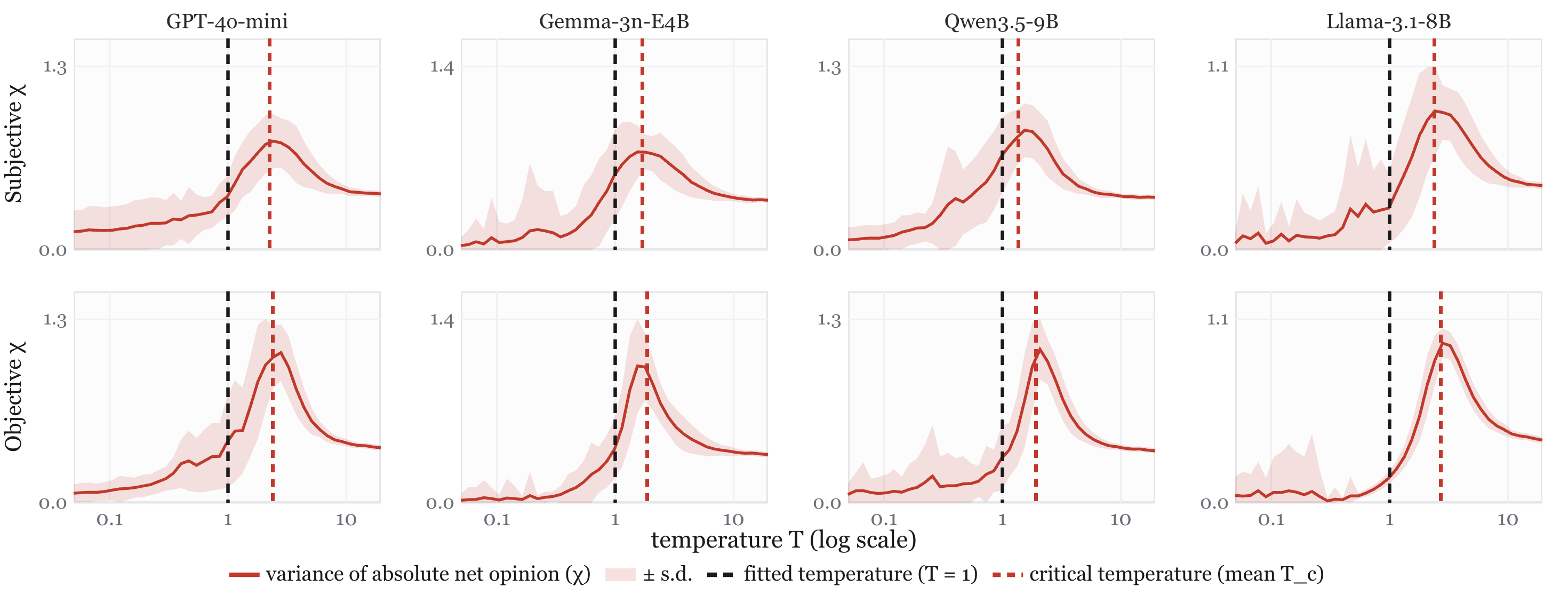
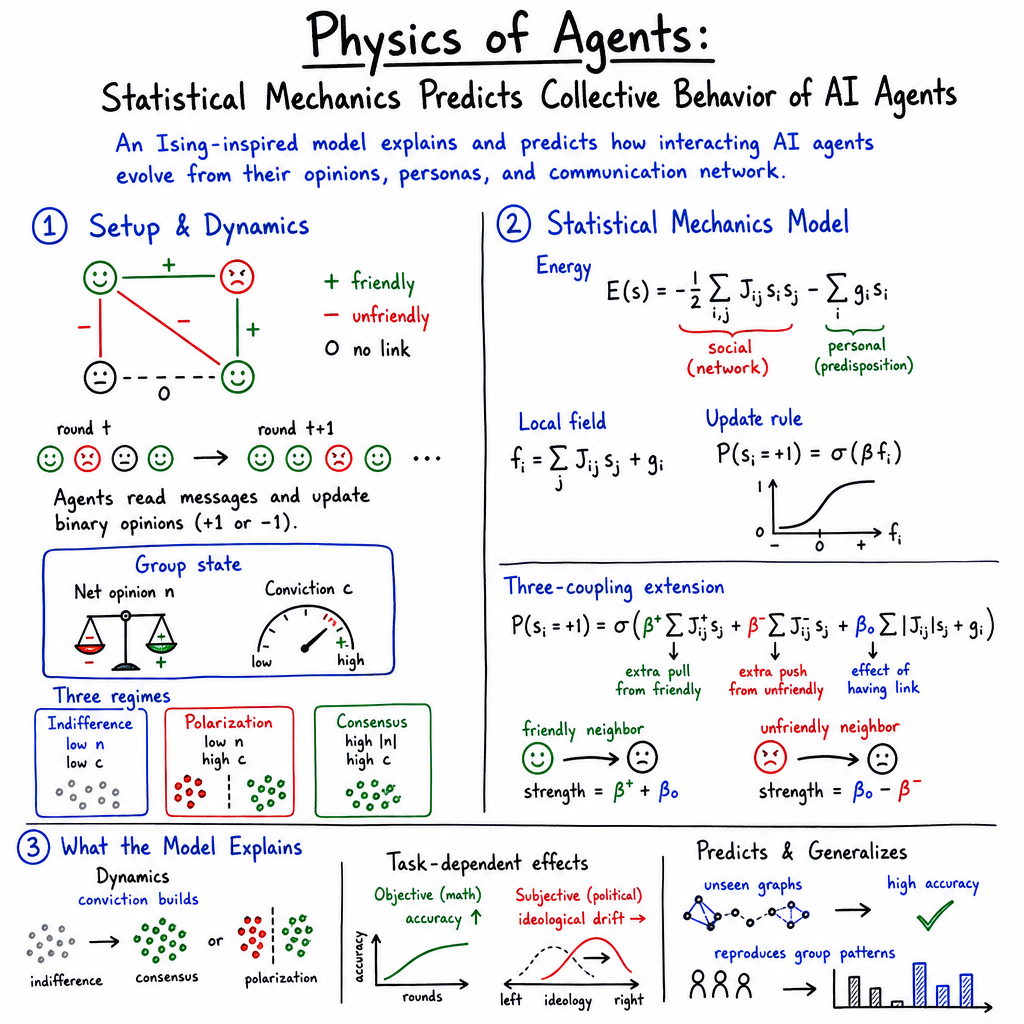
Abstract: AI agents increasingly operate as part of interacting systems rather than in isolation. As agents exchange information and jointly make decisions, their interactions can improve collective reasoning but may also produce herding, polarization, or amplify shared biases. Understanding and predicting these collective dynamics is therefore important for designing effective and aligned multi-agent systems. Here, we study over 10,000 communities of language-model agents that repeatedly exchange messages and revise their opinions across objective mathematics questions and subjective political statements. Despite substantial diversity in possible behavior, the individual and group dynamics can be represented by three characteristic regimes: indifference, polarization, and consensus. AI agents start indifferent and build conviction as they interact. On objective questions, communication improves collective accuracy, while on subjective questions it often drifts group opinions toward the right in the political spectrum. We explain these observations with a statistical-mechanics formalism in which agents stochastically favor lower social pressure. Given only initial opinions, our model predicts individual trajectories, outperforms all standard baselines, generalizes to unseen community graphs, and reproduces the observed group archetype distributions. Our fitted model parameters reveal the mechanics underlying our key observations: i) communities operate below the critical social temperature, which explains conviction buildup; ii) attractive ties outweigh repulsive ones, which favors consensus; and iii) agents holding the correct answer exert the strongest pull, which drives truth-seeking. Overall, our results demonstrate that collective behavior of AI agents, like that of other complex systems, follows compact and predictive dynamical laws.
Paper Prompts
Sign up for free to create and run prompts on this paper.
Top Community Prompts
Explain it Like I'm 14
1. What is the paper about?
This paper studies what happens when many AI agents communicate with one another and change their opinions over time.
An AI agent here means a LLM given a role, such as a mathematical expert or a person with certain political views. The agents answer the same question, read messages from other agents, and then decide whether to keep or change their opinions.
The researchers wanted to know whether groups of AI agents behave in predictable ways—similar to how large groups of particles, animals, or people can follow patterns.
2. Main research questions
The paper focuses on several questions:
- How do AI agents’ opinions change after they talk to one another?
- Do groups usually reach agreement, stay divided, or keep weak opinions?
- Does discussion help agents find the correct answer to a factual question?
- Can communication accidentally strengthen incorrect ideas or political biases?
- Can a mathematical model predict what each agent and the whole group will do next?
- How do different kinds of relationships—friendly or unfriendly—affect the final result?
The researchers also wanted to understand whether a simple set of rules could explain the complicated behavior of thousands of interacting AI communities.
3. How was the research done?
Creating groups of AI agents
The researchers created more than 10,000 simulated communities of language-model agents. Most groups had 32 agents.
Each agent was given a different persona, or background identity. For example:
- In mathematics tasks, an agent might be given expertise related to a particular math problem.
- In political tasks, an agent might be given a profile describing its personality, demographics, and political views.
The agents answered two kinds of questions:
- Objective questions, such as competition-level mathematics problems with definite right and wrong answers.
- Subjective questions, such as political statements where people may reasonably disagree.
Making agents communicate
The agents were connected by a communication network. This is like a map showing who is allowed to talk to whom.
A connection could be:
- Friendly, meaning the receiving agent was encouraged to trust or agree with the other agent.
- Unfriendly, meaning the receiving agent was encouraged to challenge or disagree with the other agent.
- Absent, meaning the two agents could not communicate.
The agents went through eight rounds. In each round, they:
- Read the latest messages from their neighbors.
- Chose an opinion.
- Wrote a short message explaining that opinion.
- Sent the message to connected agents.
To reduce randomness, each agent gave its vote five times per round. The researchers averaged these votes to estimate how strongly the agent supported one side.
Tracking opinion patterns
The researchers examined both individual agents and whole groups.
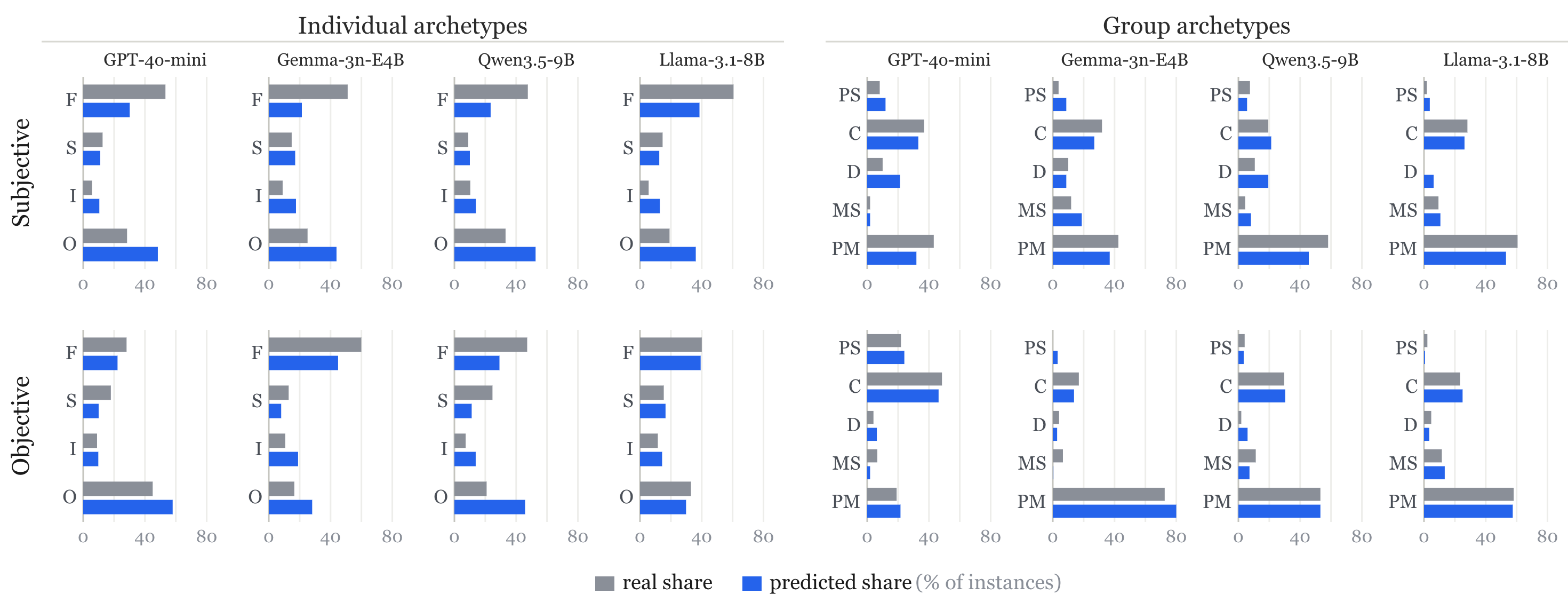
For individual agents, they identified patterns such as:
- Frozen: never changes opinion.
- Switcher: changes sides once.
- Intermittent: changes sides and later changes back.
- Oscillator: changes sides repeatedly.
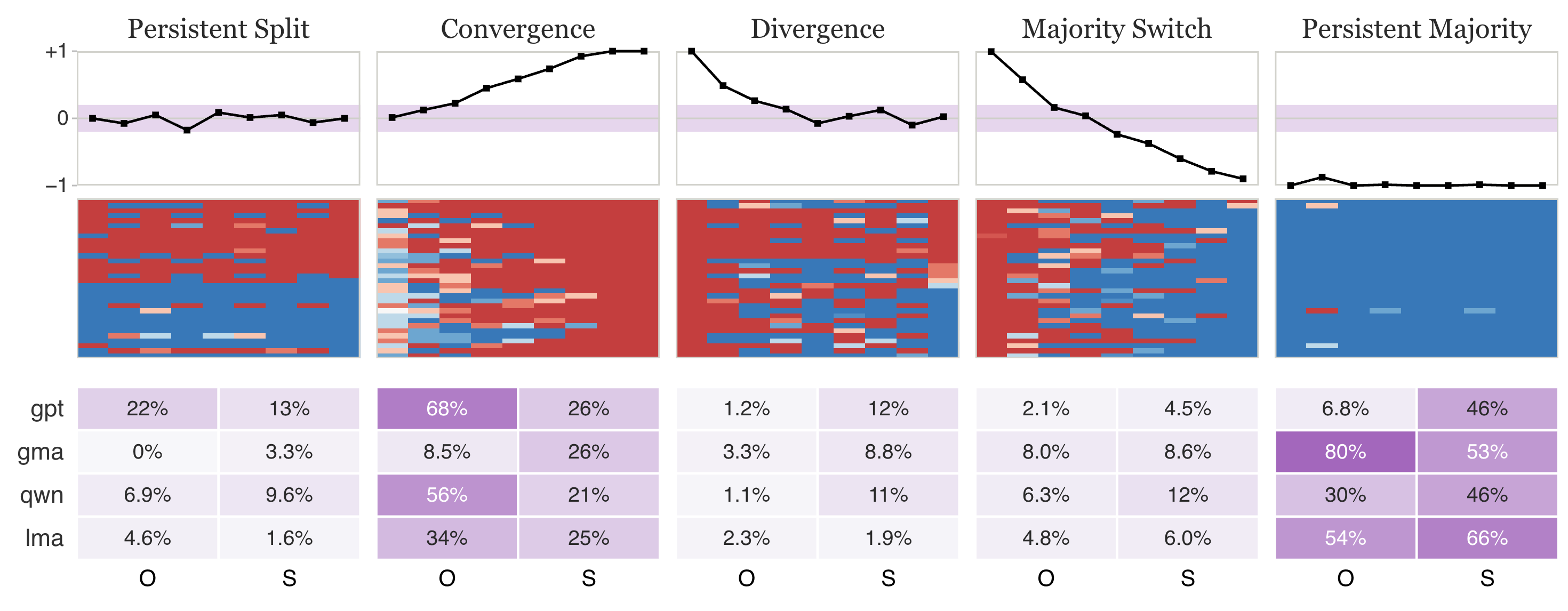
For groups, they looked for patterns such as:
- Consensus: most agents strongly agree.
- Polarization: agents strongly support opposite sides and remain divided.
- Persistent majority: the original majority stays in control.
- Majority switch: the group changes from one majority opinion to the other.
- Divergence: the original majority weakens until there is no clear winner.
Building a mathematical model
The researchers then built a model inspired by a physics idea called the Ising model.
A simple way to imagine this is to picture a group of tiny switches. Each switch points either up or down, just as each agent chooses one of two opinions.
The model assumes that an agent’s decision depends on two main forces:
- Personal preference: what the agent would believe based on its persona and the question.
- Social pressure: how the opinions of connected agents push it toward agreement or disagreement.
The model also includes a kind of randomness. An agent is more likely, but not guaranteed, to choose the option that seems to create less social pressure. This is similar to a person feeling pressure from friends but still occasionally making an independent choice.
The researchers fitted the model using observed examples. In other words, they showed it many real opinion changes and adjusted its settings so that it learned how strongly different kinds of connections influenced agents.
They tested three versions of social influence:
- The general effect of having a connection.
- The effect of a friendly connection.
- The effect of an unfriendly connection.
Finally, they tested whether the model could predict behavior on new questions and new network shapes.
4. Main findings
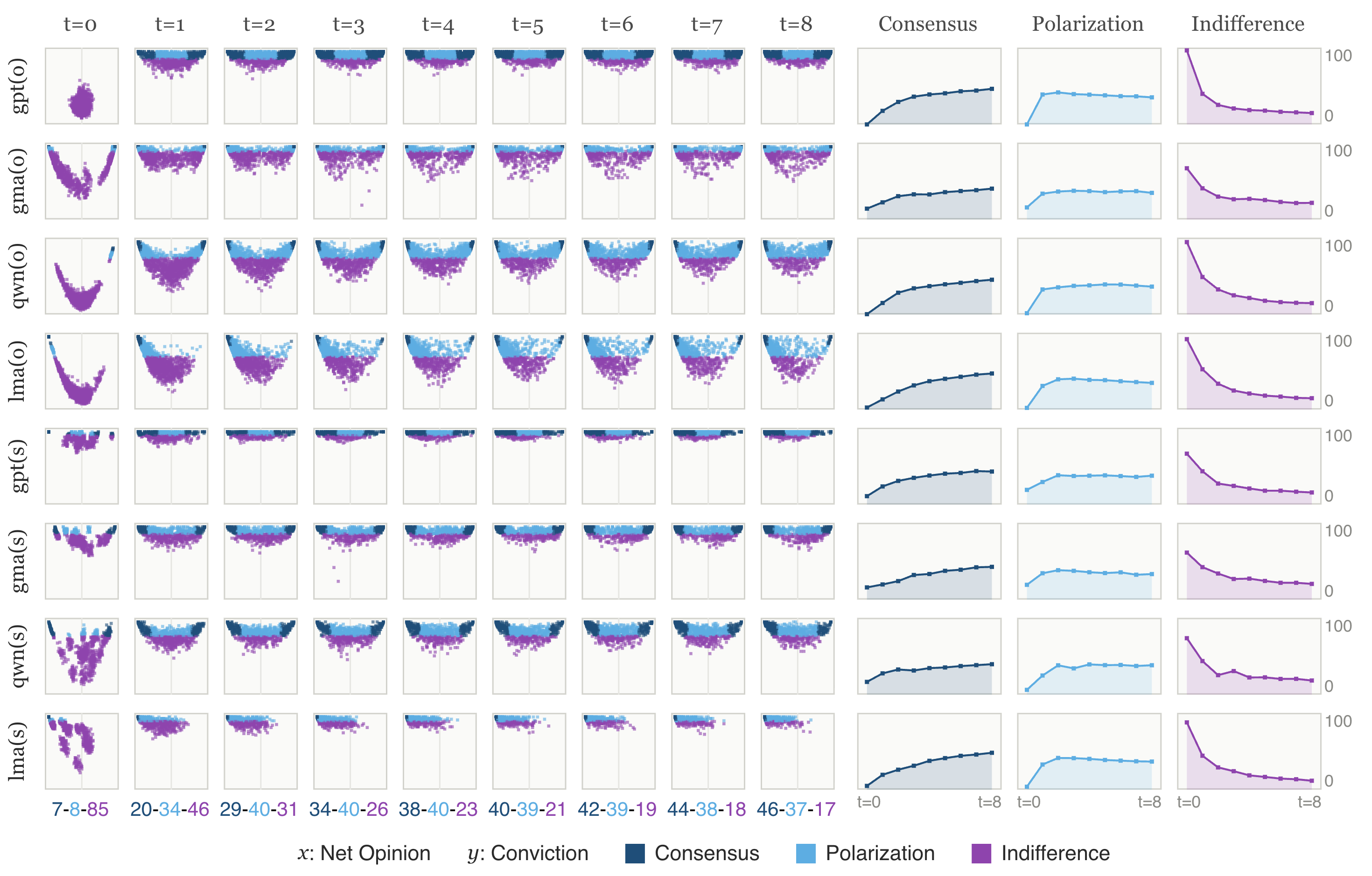
AI groups usually become more confident
At the beginning, many agents had weak or uncertain opinions. After communicating, they usually became more strongly committed.
The researchers described three broad group states:
| Group state | What it means |
|---|---|
| Indifference | Most agents are uncertain or only weakly support either side |
| Consensus | Most agents strongly support the same side |
| Polarization | Agents are strongly committed but divided into opposing groups |
Over time, groups tended to move away from indifference and toward either consensus or polarization.
This is important because discussion does not always make a group more thoughtful or balanced. It can also make the group more confident, even when that confidence is misplaced.
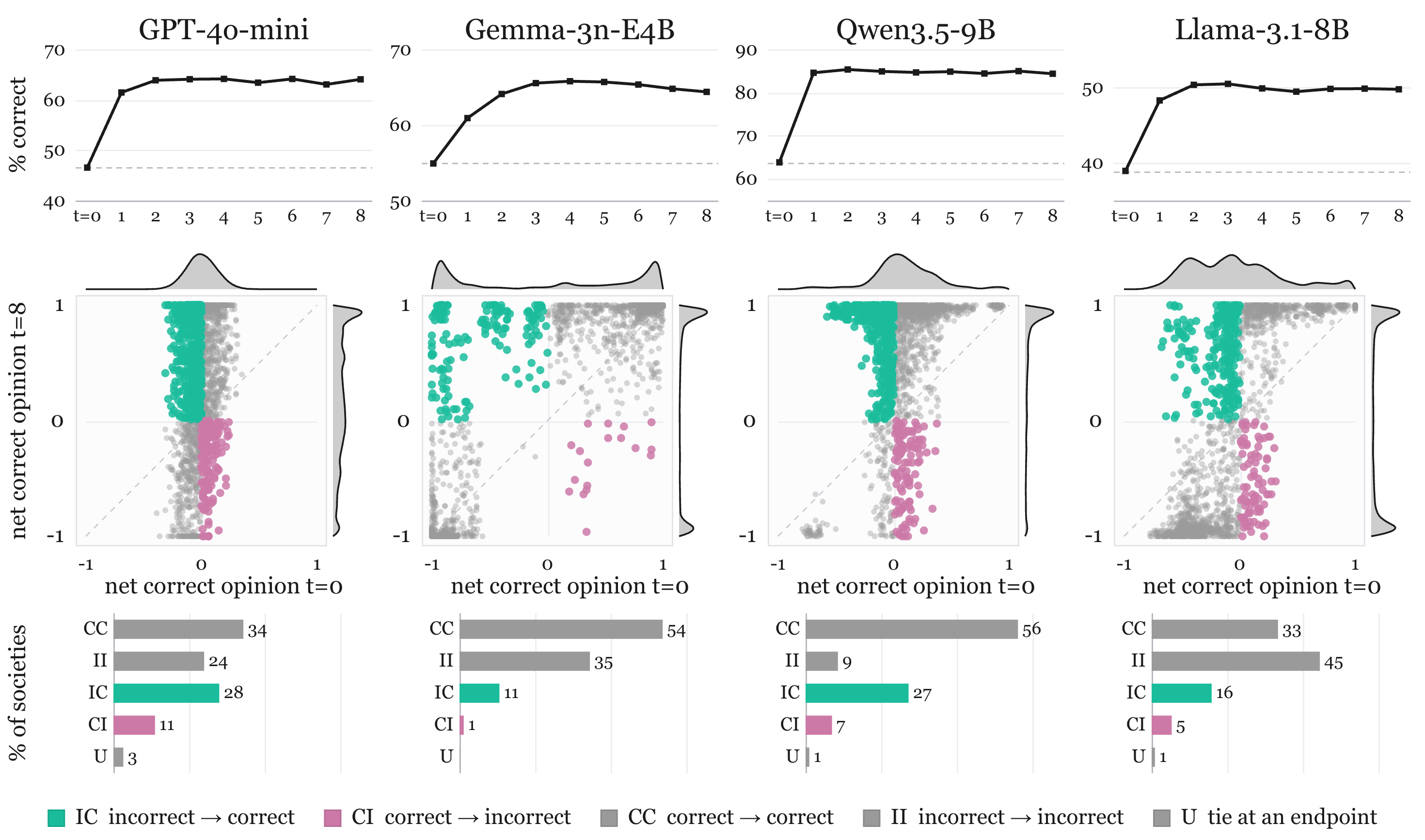
Discussion often improved mathematical answers
For objective math questions, communication usually helped the group reach the correct answer.
When groups changed their majority opinion, they were more likely to change from wrong to right than from right to wrong. This suggests that agents with useful knowledge sometimes had a stronger influence than agents with incorrect answers.
This finding supports the idea behind systems such as AI debate and “mixtures of agents,” where several AI systems exchange answers to improve performance.
Subjective discussions showed political drift
For political questions, there was no single objectively correct answer. However, the researchers found that group opinions were more likely to move from the left toward the right than in the opposite direction.
This does not necessarily mean that the agents were intentionally choosing a political side. Instead, the LLMs may already contain certain biases, and communication can spread or strengthen those biases throughout the group.
This is similar to a rumor spreading through a school: even if no one planned the rumor, repeated sharing can make it seem more believable or common.
Friendly influence was stronger than unfriendly influence
The mathematical model suggested that friendly relationships generally had a stronger effect than unfriendly relationships.
As a result, agents were more likely to move toward agreement than to remain permanently divided. This helps explain why many groups eventually formed consensus, even when some connections encouraged disagreement.
The model predicted agent behavior well
The three-part version of the model predicted the next opinion of an agent much better than simpler methods.
For example, it performed better than:
- Simply assuming agents would keep their current opinions.
- Ignoring communication entirely.
- Treating every agent as influenced only by the group’s overall average opinion.
The model achieved roughly 75%–86% balanced accuracy for predicting the next opinion across several LLMs and question types. It also worked reasonably well on communication networks that it had not seen during training.
However, predicting many rounds into the future was harder. Small mistakes at one step can affect later steps, much like a weather forecast becoming less reliable the farther into the future it looks.
The model reproduced group-level patterns
Even when the model did not always predict exactly which individual agent would change its mind, it could reproduce the overall mixture of group outcomes.
For example, it could estimate how often groups would:
- Reach consensus.
- Remain split.
- Keep their original majority.
- Switch to a new majority.
This means the model was useful for understanding the behavior of populations, even though the exact future of one particular group was partly random.
5. Why the results matter
The paper suggests that groups of AI agents do not behave in completely unpredictable ways. Their behavior can often be described using a small number of ideas:
- Agents have personal opinions.
- Their neighbors exert social pressure.
- Friendly and unfriendly relationships have different strengths.
- Randomness means the same group may not behave exactly the same way every time.
These ideas could help engineers design better multi-agent AI systems. For example, designers might use the model to predict whether a team of agents is likely to:
- Find a correct solution.
- Agree too quickly.
- Become polarized.
- Repeat a shared mistake.
- Amplify political or cultural bias.
The research also gives a warning. Consensus is not automatically the same as truth. A group can agree because its members discovered a correct answer, but it can also agree because they pressured one another into following the same mistaken idea.
Simple conclusion
The paper shows that interacting AI agents behave somewhat like other complex systems: although each agent is complicated, the whole group often follows simple patterns.
Talking can help AI agents solve factual problems, especially when knowledgeable agents influence others. But communication can also make agents overly confident, create polarization, or spread biases—particularly on subjective topics.
The main lesson is that when many AI agents work together, we should study not only what each agent knows, but also how their relationships and conversations shape the group’s final decision.
Knowledge Gaps
Knowledge gaps, limitations, and open questions
The paper leaves the following issues unresolved:
- External validity to real multi-agent systems: It remains unclear whether the observed regimes and fitted dynamics transfer to deployed agents performing coding, planning, negotiation, scientific discovery, or resource allocation tasks rather than binary opinion updates.
- Limited task diversity: The experiments use competition mathematics questions and a relatively narrow set of political statements; broader domains, multi-step reasoning tasks, factual questions, safety decisions, and real-world coordination problems are not evaluated.
- Binary opinion representation: Reducing opinions to binary states or six-level averaged votes cannot capture uncertainty, abstention, nuanced beliefs, conditional reasoning, or multidimensional positions.
- Short interaction horizons: Most experiments run for only eight synchronous rounds, leaving long-term behavior unresolved, including metastability, eventual consensus, persistent polarization, limit cycles, and sensitivity to rare stochastic events.
- Fixed population size: The main experiments use agents, so the effects of population size, sparsity, density, and large-population limits are not established.
- Restricted network structures: Although several synthetic graph families are tested, the networks are generated rather than derived from real communication patterns; the effects of heterogeneous degree distributions, community structure, directed ties, time-varying networks, and adaptive connections remain unexplored.
- Symmetric interaction assumption: All experiments use symmetric signed adjacency matrices, despite real systems often having asymmetric trust, authority, expertise, or influence relationships.
- Fixed edge signs: Social ties remain constant throughout an episode; the paper does not test whether agents revise, remove, or create connections in response to messages or outcomes.
- Unclear semantics of negative ties: A discordant edge is implemented through a separate inbox that changes how messages are presented, but it is not established whether this mechanism corresponds to disagreement, distrust, adversarial critique, or merely reduced credibility.
- Prompt-mediated rather than intrinsic social influence: The estimated effects may depend strongly on the exact prompt wording, message format, inbox organization, and instruction to provide one supporting reason; robustness to alternative communication protocols is not demonstrated.
- Natural-language content is largely abstracted away: The statistical model uses agent states and graph relations but does not explicitly model the quality, correctness, persuasiveness, novelty, or strategic content of messages.
- No strategic or deceptive behavior: Agents are treated as stochastic opinion updaters rather than strategic actors that may manipulate information, conceal beliefs, coordinate, flatter, deceive, or optimize objectives other than social-pressure minimization.
- Strong Markov assumption: Updates depend only on the latest inboxes and current states. Memory of earlier arguments, cumulative evidence, source reliability, and conversational history are excluded, although these factors may be central to real deliberation.
- Synchronous-update artifacts: The primary experiments use synchronized rounds, which can generate oscillations and other dynamics that may not occur under realistic asynchronous communication, despite a limited asynchronous extension.
- Insufficient analysis of asynchronous dynamics: The paper reports similar results for asynchronous updates but does not establish when the qualitative regimes, fitted parameters, or critical-temperature conclusions change under different update schedules and communication delays.
- Equilibrium interpretation is not fully validated: The Ising analogy and energy formulation provide an interpretable description, but the language-model agents are not shown to sample from a true Boltzmann distribution or to minimize the proposed energy directly.
- Questionable identifiability of temperature and couplings: The fitted parameters , , , , and may trade off against one another, making it unclear whether the inferred “temperature,” tie strengths, and intrinsic fields are uniquely identifiable.
- Potential confounding between persona and expertise: Objective-question personas encode access to worked solutions from other mathematics problems, while subjective personas encode demographics and political traits. These constructions differ substantially, making comparisons between objective and subjective dynamics potentially confounded.
- Limited model coverage: Only four LLMs are evaluated, with no systematic analysis of model scale, training data, instruction tuning, decoding strategy, or model-family-specific behavior.
- Lack of human-agent comparison: The paper does not determine whether the identified regimes, coupling asymmetries, or truth-seeking effects resemble human group dynamics or are specific to LLMs.
- No human validation of subjective ideological drift: The reported rightward shift is measured relative to the datasets’ political labels and model outputs, but its robustness to alternative ideological scales, question wording, demographic compositions, and human judgments is unresolved.
- Unresolved source of the rightward drift: The study attributes subjective drift to biases inherited from the underlying LLMs, but it does not disentangle model priors, persona construction, prompt framing, message content, sampling temperature, and network topology.
- Truth-seeking may reflect answer leakage or expertise design: On objective questions, the stronger influence of correct-answer agents could result from the way expertise is assigned or encoded rather than from a general truth-seeking mechanism.
- No evaluation of evidence quality: Correctness is assessed at the final vote level, without testing whether agents exchange valid derivations, identify flawed arguments, or improve the reliability of explanations.
- Aggregate accuracy can conceal harmful individual outcomes: Improvements in collective accuracy are not accompanied by analyses of minority suppression, confidence calibration, uneven influence, or whether incorrect but highly confident agents dominate particular subgroups.
- Archetype definitions are threshold- and horizon-dependent: The categories depend on the fixed split threshold and ; their stability under alternative thresholds, sampling counts, and observation windows is not established.
- Conviction is not externally calibrated: The measure captures strength of expressed binary preference, but it is not shown to correspond to calibrated confidence, epistemic certainty, or willingness to act.
- Model evaluation emphasizes prediction rather than intervention: High one-step or rollout accuracy does not establish that changing values, edge signs, or network structures will causally produce the predicted collective outcomes.
- No controlled causal manipulation of mechanisms: The claims that friendly ties dominate hostile ties and that correct agents exert greater influence would be stronger with experiments that directly manipulate tie valence, source correctness, expertise, and message reliability while holding other variables fixed.
- Rollout errors accumulate substantially: Although one-step prediction is strong, rollout accuracy is considerably lower in several settings, indicating that the model may not reliably forecast individual trajectories over multiple rounds.
- Distributional agreement is not trajectory-level agreement: The model reproduces aggregate archetype frequencies but often fails to predict the archetype of a specific group; the practical usefulness of such population-level predictions for system design remains unclear.
- Sampling variability is only partly characterized: Episodes with identical configurations frequently produce different group outcomes, but the paper does not quantify how this stochasticity depends on decoding temperature, number of samples , model family, network structure, or initial uncertainty.
- Potential data leakage and split limitations: The reported training and test splits contain only a small number of questions and include graphs seen during training in the in-distribution evaluation; stronger separation by model, task family, persona type, and network-generation process is needed.
- Limited baseline coverage: Comparisons do not include modern debate protocols, weighted voting, confidence aggregation, Bayesian evidence pooling, retrieval-augmented agents, learned influence models, or non-Ising dynamical models.
- No robustness analysis for prompt and decoding choices: The effects of system prompts, temperature, top- sampling, message length, number of sampled votes, and formatting constraints are not systematically tested.
- No fairness or alignment analysis: The study identifies ideological drift and shared-bias amplification but does not evaluate mitigation strategies or measure disparate effects across persona groups.
- Open question about optimal network design: The paper does not determine which graph structures, tie-sign assignments, update schedules, or expert-placement strategies maximize accuracy while minimizing polarization and overconfidence.
- Open question about adaptive intervention: It remains unknown whether targeted interventions—such as adding independent experts, weakening influential agents, introducing structured disagreement, or changing message routing—can reliably improve outcomes.
- Open question about heterogeneous objectives: All agents are modeled as answering the same shared question, leaving unresolved how the framework behaves when agents have different goals, utilities, information access, risk preferences, or authority levels.
- Open question about multimodal and tool-using agents: The dynamics are evaluated through text-only language-model interactions; the effects of external tools, retrieval systems, code execution, images, sensors, and persistent environments are not investigated.
- Open question about adversarial robustness: The framework does not test malicious agents, prompt injection, coordinated misinformation, sybil agents, collusion, or strategic attacks on the communication network.
- Open question about general dynamical laws: It remains uncertain whether the three-regime description is universal across agent architectures and tasks or is mainly an empirical summary of the particular experimental protocol used here.
Practical Applications
Immediate Applications
- Multi-agent system monitoring and risk assessment — software/AI engineering. The fitted three-coupling model can serve as a lightweight simulator for forecasting whether an agent community is likely to reach consensus, polarization, persistent disagreement, or a majority switch. Given initial agent opinions, personas, and a signed communication graph, system designers could estimate likely trajectories before deploying a debate, ensemble, coding, or research workflow. Potential tools: a “collective dynamics” dashboard, graph-risk scanner, or pre-deployment simulation module that reports predicted conviction, consensus probability, polarization risk, and likely opinion reversals. Dependencies: The model must be calibrated to the deployed LLM, prompt format, agent personas, and interaction protocol. Its strongest evidence concerns binary opinions, small communities, and short interaction horizons.
- Design of communication topologies for agent teams — software, robotics, and autonomous systems. Developers can use the model to compare fully connected, sparse, lattice-like, low-rank, or signed networks and select structures that encourage useful information aggregation without excessive conformity. Friendly and adversarial edges can be tuned rather than added indiscriminately. Workflow: generate candidate graphs → fit or import interaction parameters → simulate rollouts → select the graph that maximizes accuracy while limiting polarization or instability. Dependencies: The current experiments use symmetric signed graphs and assume that edge valence adequately represents trust or distrust. Real systems may require directed, weighted, dynamic, or task-dependent relationships.
- Inference-time ensemble and debate optimization — AI products and enterprise automation. The findings support using multiple agents for objective tasks such as mathematical reasoning, code review, planning, and document verification. Since interaction improved collective accuracy on the studied objective questions, teams could use the model to choose the number of rounds, the amount of critique, and the balance between cooperative and adversarial agents. Potential products: adaptive debate controllers that stop when consensus and confidence are sufficiently high, or introduce additional independent agents when the system enters polarization or persistent split. Dependencies: The observed truth-seeking effect may depend on heterogeneous expertise and on the availability of agents that possess correct information. Consensus alone is not evidence of correctness.
- Early-warning detection of herding and polarization — content moderation and AI safety. The net opinion and conviction provide operational indicators for distinguishing indifference, consensus, and polarization. A monitoring system could flag cases where the group has near-zero average opinion but high individual conviction, indicating two strongly opposed camps rather than uncertainty. Potential workflow: log agent states at each round → compute conviction and net opinion → classify the community regime → trigger independent verification, network rewiring, or human review. Dependencies: Binary or low-dimensional opinion representations may miss nuanced disagreement, conditional beliefs, and uncertainty expressed in natural language.
- Bias auditing for subjective decisions — policy, HR, finance, and recommendation systems. Because subjective interactions produced systematic rightward political drift in the experiments, organizations can audit multi-agent workflows for directional changes caused by repeated communication. The same procedure can be applied to hiring recommendations, moderation decisions, lending assessments, or public-policy analysis, provided the relevant bias dimensions are defined carefully. Potential tools: before-and-after opinion-drift reports, subgroup-specific trajectory analysis, and prompts or graph designs that preserve independent judgments. Dependencies: Political drift was observed for the tested models, personas, prompts, and questions; it should not be generalized automatically to all models or populations. Sensitive-persona data also raises privacy and fairness concerns.
- Independent-first decision workflows — research and professional practice. Since interaction can increase conviction and make errors harder to reverse, organizations can collect initial answers from agents independently before exposing them to peer messages. The initial states can then be used both for diversity preservation and for model-based forecasting. Applications: independent candidate generation followed by structured critique in scientific research, software debugging, legal research, and medical decision support. Dependencies: Independent answers must contain genuine diversity rather than correlated copies of the same model or training-data bias. Human experts or external evidence remain necessary for high-stakes decisions.
- Personal assistant coordination and negotiation — daily life and consumer software. The signed-network framework can model assistants negotiating schedules, travel plans, purchases, or shared-resource allocation. Cooperative edges may represent compatible preferences, while discordant edges represent conflicts between users or constraints. Simulations could identify whether the process will converge or oscillate. Potential products: meeting schedulers that detect unstable negotiations, household resource allocators, and travel planners that preserve minority preferences rather than simply following the first majority. Dependencies: The paper studies opinion updates rather than binding commitments, utility maximization, privacy-preserving negotiation, or real-world costs. Practical deployment would require explicit preference and consent models.
- Educational multi-agent tutoring and peer review — education. Multiple tutor or student-simulation agents could exchange solutions and critiques for objective subjects. The model can help determine when discussion is likely to correct an initially wrong majority and when it may merely reinforce a confident misconception. Workflow: obtain independent solutions → identify agents with relevant expertise → use limited, structured interaction → verify the final answer against an external rubric or solution. Dependencies: The experiments focus primarily on mathematical binary-choice questions. Educational transfer requires evaluation on open-ended reasoning, age-appropriate content, and authentic student behavior.
- Open-source simulation and benchmarking infrastructure — academia and industry research. The released code and dataset can support reproducible benchmarks for multi-agent dynamics, including one-step prediction, rollout prediction, graph generalization, and collective-archetype calibration. Researchers can compare new prompting strategies, models, and communication graphs using common metrics rather than only final-answer accuracy. Dependencies: Reproduction requires access to the evaluated models, matching prompts, sampling settings, and persona construction. The paper’s reported results do not establish universal performance across models or tasks.
Long-Term Applications
- Automated topology and protocol control for large agent organizations — software, robotics, and autonomous operations. A future controller could dynamically rewire agent interactions based on predicted social temperature, conviction, and local influence. It might down-weight highly reinforcing edges, add independent experts when a group polarizes, or introduce adversarial review only where it is likely to improve accuracy. Required development: online parameter estimation, causal intervention studies, weighted and directed graphs, asynchronous communication, changing agent membership, and scalability beyond 32-agent communities. Key assumption: The fitted Ising-like dynamics remain valid when agents have long-term memory, richer goals, tool use, and strategic communication.
- Truth-seeking orchestration for scientific discovery and engineering — research, energy, and biotechnology. The framework could become part of autonomous research systems that coordinate literature agents, simulation agents, coding agents, and experimental-design agents. The system could predict which candidate hypotheses will gain support and identify when consensus reflects evidence versus social reinforcement. Potential workflow: assign heterogeneous expertise → collect independent hypotheses → simulate graph arrangements → conduct evidence-weighted debate → require external computational or experimental validation. Dependencies: Correctness in the paper is defined for benchmark mathematics, not scientific hypotheses. Real deployment requires calibrated uncertainty, provenance tracking, experimental validation, and protection against correlated model errors.
- Safety-certified multi-agent decision systems — healthcare, finance, public infrastructure, and government. A mature version could provide formal or semi-formal safety checks for agent collectives making consequential recommendations. Systems could impose limits on conviction buildup, require diversity of evidence, and block decisions made under high polarization or unexplained directional drift. Required development: uncertainty quantification, subgroup fairness analysis, adversarial testing, human override mechanisms, audit logs, and domain-specific validation. Key dependency: Predicting collective dynamics is not equivalent to proving that the resulting decision is safe, fair, or legally compliant.
- Policy simulation for networks of AI assistants — public policy and regulation. Governments and standards bodies could use population-level simulations to study how interacting assistants might shape public opinion, negotiation outcomes, information cascades, or access to shared resources. This could inform requirements for transparency, independent recommendations, disclosure of agent relationships, and anti-manipulation safeguards. Potential outputs: regulatory stress tests, model cards for multi-agent interaction protocols, and standards for reporting consensus and polarization risks. Dependencies: Policy simulations must represent real users, institutions, incentives, and heterogeneous communication channels. The paper’s political results should be treated as a warning signal, not as a population-level forecast.
- Large-scale coordination in robotics and distributed infrastructure — robotics, transportation, and energy. The statistical-mechanics approach could help analyze fleets of robots, autonomous vehicles, warehouse systems, or distributed energy agents that exchange local states and negotiate actions. “Opinion” could be generalized to route choice, task allocation, charging strategy, or fault hypotheses. Required development: continuous and multidimensional states, physical constraints, delayed and lossy communication, asymmetric influence, nonstationary environments, and safety-critical control guarantees. Key assumption: A binary opinion model may capture only high-level coordination regimes; it cannot by itself control physical systems.
- Personalized negotiation markets and multi-party allocation — finance, commerce, and smart-home systems. Future platforms could use interaction models to predict whether buyer, seller, household, or institutional agents will converge on an allocation or become locked into strategic opposition. This could support adaptive negotiation protocols that preserve minority preferences and prevent dominant-agent capture. Dependencies: Real negotiations involve utilities, incentives, deception, budgets, and binding actions, none of which are fully represented by the paper’s opinion-update model. Regulatory and privacy requirements would also be substantial.
- General theory of emergent behavior in language-model collectives — academia. The paper suggests a research program in which agent communities are characterized by compact parameters such as intrinsic fields, attractive and repulsive couplings, and effective social temperature. Future work could test whether these parameters transfer across tasks, model families, languages, modalities, and agent architectures. Research directions: phase-transition analysis, causal experiments on network interventions, scaling laws for group size, continuous opinion models, multimodal agents, strategic messaging, and comparisons with human groups. Dependencies: The current formalism assumes Markovian updates, binary states, fixed personas, relatively short horizons, and stochastic pressure minimization. These assumptions must be validated before treating the model as a general law of AI-agent collectives.
- Everyday decision-support systems that balance consensus and independence — daily life. In the long term, personal assistants could maintain several independent “belief tracks,” estimate when a proposed decision is being socially amplified, and explain how network structure changed the recommendation. For example, a travel assistant might report that all agents agree because of shared evidence, or because they repeatedly copied one another. Dependencies: Such systems require interpretable provenance, user-controllable privacy settings, robust preference learning, and clear communication that model consensus is probabilistic rather than authoritative.
Glossary
- Asynchronous updates: An update process in which agents revise their states at different, independently timed moments rather than simultaneously. “We also extend the setup to asynchronous updates with similar results”
- Archetype: A recurring qualitative pattern used to classify an individual or group trajectory. “opinion trajectories fall into recurring archetypes”
- Balanced accuracy: The unweighted average of predictive accuracies across classes or transition categories, compensating for class imbalance. “We score predictions with balanced accuracy where we balance for the flips and class imbalance in the dataset.”
- Boltzmann distribution: A probability distribution assigning higher likelihood to lower-energy states according to temperature and energy. “Under the Boltzmann distribution, we can derive”
- Conviction: A measure of the strength of agents’ opinions, defined as the average squared opinion value. “we define conviction as a measure of how strongly opinionated agents are”
- Concordant interaction: A social interaction in which connected agents are treated as friendly or aligned. “Concordant interactions are substantially stronger than discordant interactions”
- Consensus: A collective state in which agents converge toward the same strongly held position. “consensus (high , high )”
- Continuous-time extension: A model formulation in which state changes can occur at arbitrary times rather than at discrete rounds. “we model this relaxation via a continuous-time extension of our model”
- Coupling coefficient: A parameter that quantifies the strength of influence between interacting agents. “The symmetric coupling coefficient quantifies the nature of social influence between agents and ”
- Cross-entropy: A loss function measuring the discrepancy between predicted probabilities and observed categorical outcomes. “We fit the s and by running gradient-descent to minimize the cross-entropy”
- Curie–Weiss model: A mean-field statistical-mechanics model in which each element interacts with a global average rather than with an explicit network. “Mean-Field (Curie-Weiss)”
- Dynamical law: A compact mathematical rule describing how a system changes over time. “follows compact and predictive dynamical laws”
- Energy function: A scalar function assigning a value to each configuration, often used to characterize preferred or stable states. “we can define a loss, or equivalently, an energy function as”
- Entropy: A measure of uncertainty or disorder in a probabilistic system. “statistical mechanics provides a framework for identifying recurring regimes”
- Intrinsic field: A model parameter representing an agent’s predisposition toward one opinion independently of social influence. “the intrinsic field captures agent 's predisposition on the issue”
- Ising model: A statistical-mechanics model of binary variables whose states are influenced by pairwise interactions and external fields. “This construction yields a theoretical model, whose mathematics can be mapped to the well-known Ising model”
- Indicator function: A function that equals one when a specified condition is true and zero otherwise. “where is the indicator function.”
- Inference-time compute: Computational resources used while a model is generating an answer, rather than during training. “language-model performance often improves with additional inference-time compute”
- Logistic function: An S-shaped function that converts a real-valued input into a probability between zero and one. “an agent's next opinion is a logistic function”
- Markovian: Having updates that depend only on the current state or current information, not on the full history. “The updates are Markovian”
- Master equation: A differential equation describing how probability mass flows between the states of a stochastic system. “a mean-field ODE derived from the master equation that captures probability flux between states”
- Mean-field approximation: An approximation that replaces detailed interactions among individual elements with an average or aggregate influence. “Mean-Field retains both personal and social pressure but ignores graph structure”
- Microstate: The detailed state of every individual component in a system. “Behavior of Groups and Individuals”
- Macrostate: A collective description of a system that summarizes many underlying individual states. “Group Archetypes”
- Net opinion: The population-average opinion used to summarize the direction of collective belief. “We define a group’s net opinion as .”
- Out-of-distribution generalization: The ability of a model to perform on data or structures unlike those used for training. “the out-of-distribution generalization and asynchronous-update experiments”
- Phase regime: A qualitatively distinct region of collective behavior characterized by different macroscopic properties. “the individual and group dynamics can be represented by three characteristic regimes”
- Polarization: A collective state in which strongly committed agents divide into opposing camps. “polarization (near-zero , high )”
- Probability flux: The rate at which probability moves between possible states in a stochastic dynamical system. “a mean-field ODE derived from the master equation that captures probability flux between states”
- Relaxation: The process by which a system changes toward a stable or equilibrium-like configuration. “we relax the assumption that every agent revises their opinion at discrete time steps”
- Signed adjacency matrix: A matrix representing network connections whose entries encode both whether a connection exists and whether its influence is positive or negative. “We encode this network as ”
- Signed graph: A graph whose edges carry positive or negative signs representing different types of relationships or influence. “the opinions of the agents connected to it”
- Social pressure: The aggregate influence exerted on an agent by its social environment and relationships. “we define the term as the total social pressure in the community.”
- Stochastic rollout: A repeated simulation in which future states are sampled probabilistically from a fitted transition rule. “by running stochastic rollout of the fitted Discrete Three couplings model”
- Stochastic update rule: A probabilistic rule governing how an agent changes its state. “We use this machinery to derive a stochastic update rule for opinions”
- Statistical mechanics: A framework that explains macroscopic system behavior through the interactions and probabilistic states of microscopic components. “Statistical mechanics provides a framework for identifying recurring regimes”
- Temperature: A parameter controlling the degree of randomness or fluctuation in a statistical-mechanics system. “communities operate below the critical social temperature”
- Truth-seeking tendency: The observed tendency of collective opinions to move toward a verifiable correct answer. “Truth-seeking tendency.”
- Valence: The positive or negative character of a relationship or interaction. “this choice allows a direct interpretation of the terms by decoupling the effect of being a neighbor from the valence of the connection.”
- Mean absolute deviation: The average absolute difference between predicted and observed quantities. “the group archetype shares deviate by only points for objective questions and points for subjective questions (mean absolute deviation).”
- Ground truth: The objectively correct answer or reference label used for evaluation. “agents differ in the expertise they bring to the shared question.”

