Revisiting Open-Loop Execution in Robotics: Toward Reactive, Higher-Performing Policies
Abstract: Action chunking --- the practice of predicting a sequence of actions and executing a prefix open-loop --- has emerged as a key enabler of recent progress in imitation learning for robotic manipulation. However, executing long open-loop prefixes reduces reactivity, limiting policies' ability to correct for errors. Further, the mechanisms underlying these performance benefits remain poorly understood: prior works cite mitigating compounding errors, absorbing inference latency, or smoothing motions, but provide limited controlled evidence or guidance for preserving reactivity. In this work, we argue that long open-loop execution primarily helps short-context policies imitate "non-Markovian demonstrations". Across four simulation and two real-world tasks, we show that expert non-Markovianity strongly shapes the relationship between task success and open-loop execution horizon. Further, we investigate the impact of compounding errors --- the prevailing explanation for long open-loop execution in prior work --- and find that while they matter, expert non-Markovianity has a much stronger impact in our experimental setting. Finally, we show that when policies are provided with a sufficiently long context, open-loop execution is no longer beneficial and the most reactive, closed-loop policies perform best. While imitation learning has seen great success using long open-loop execution, our findings motivate long-context, reactive policies as a more principled and performant paradigm.

Paper Prompts
Sign up for free to create and run prompts on this paper.
Top Community Prompts
Explain it Like I'm 14
1. What is this paper about?
This paper studies how often a robot should rethink its actions while doing a task.
Many modern robots use a method called action chunking. Instead of deciding one movement at a time, the robot predicts a short sequence of movements, such as:
- Move toward an object.
- Grab it.
- Lift it.
- Place it somewhere.
The robot then performs several of these movements before looking at the world again and making a new plan. This is called open-loop execution.
Open-loop execution can make robot behavior smoother and more successful. However, it also makes the robot less reactive because it cannot quickly respond if something goes wrong.
The paper’s main argument is:
Long action sequences mostly help because robots usually have very little memory when learning from human demonstrations. Giving the robot more useful history can allow it to act both successfully and reactively.
2. What questions did the researchers ask?
The researchers focused on several main questions:
- Why do robots often perform better when they execute several predicted actions without replanning?
- Is the main reason related to reducing mistakes that build up over time?
- Or is it because human demonstrations depend on information from the past that the robot cannot see?
- Can robots become more reactive if they are given a longer history of observations?
- Is it possible for a robot to perform better while checking the world after every action?
To understand these questions, the researchers compared different kinds of experts and different amounts of information given to the robot.
3. How did they do the research?
Imitation learning
The paper uses imitation learning, which is similar to teaching by example.
A human or computer-controlled expert shows the robot how to complete a task. The robot studies pairs such as:
- “This is what I see.”
- “This is the movement I should make.”
The robot then learns to copy the expert.
Action chunks and execution horizons
The robot predicts a group, or chunk, of future actions. The researchers changed how many actions the robot actually performed before asking it to plan again. This number is called the execution horizon.
For example:
- An execution horizon of 1 means the robot checks its surroundings after every action. This is highly reactive.
- A horizon of 5 means it performs five actions before checking again.
- A horizon of 15 means it follows a longer plan without interruption.
The researchers measured how successful the robot was at different execution horizons. They called this relationship the success-horizon curve.
Markovian and non-Markovian experts
The paper compares two kinds of experts.
A Markovian expert chooses its next action using only what is happening now. It is like a person following a simple rule:
“If the object is here, move toward it.”
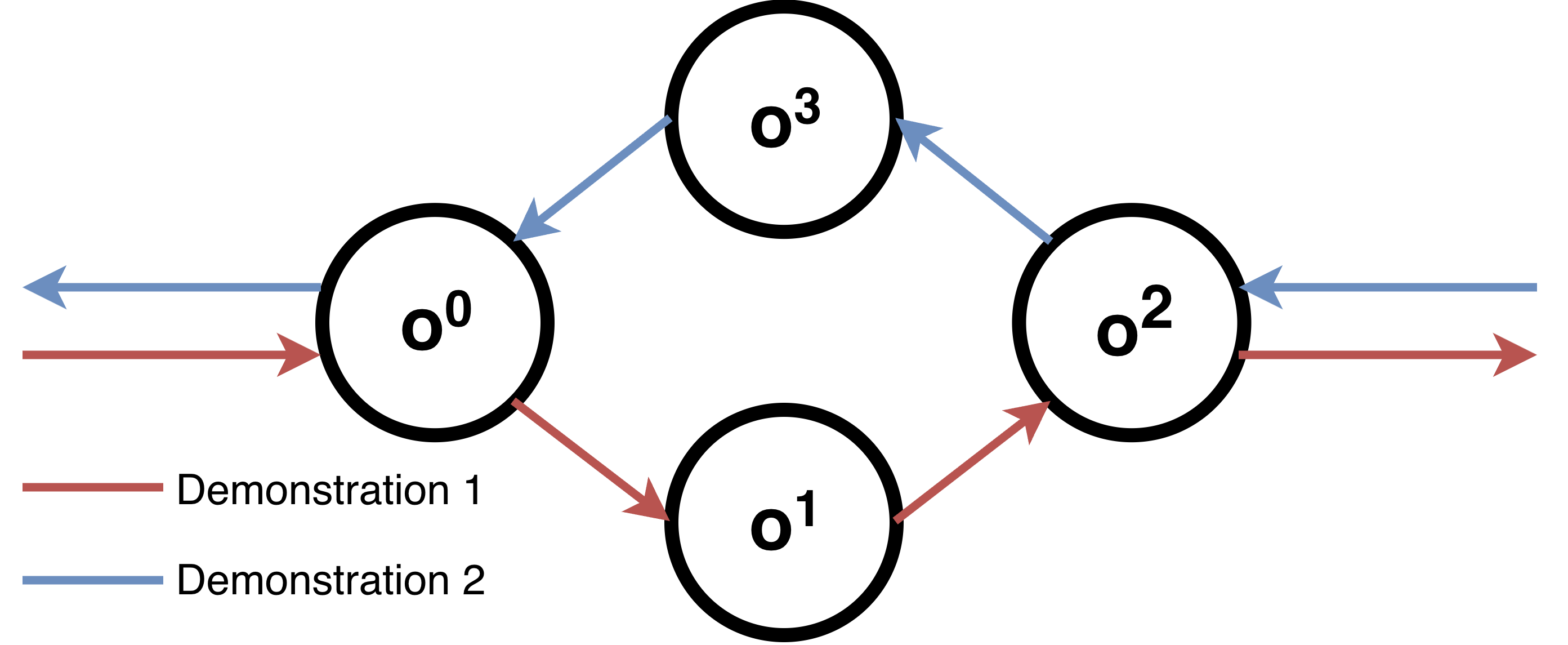
A non-Markovian expert also depends on the past. It may remember:
- How long it has been doing something.
- Which plan it started earlier.
- Whether it already tried a particular movement.
- Information that is not visible in the current image.
A human expert is usually non-Markovian because people naturally remember earlier events and use that memory when deciding what to do next.
The researchers used:
- Human demonstrations.
- Computer-controlled experts with simple, current-state-based behavior.
- Computer-controlled experts that included hidden pauses, plans, and timing information.
Tasks and experiments
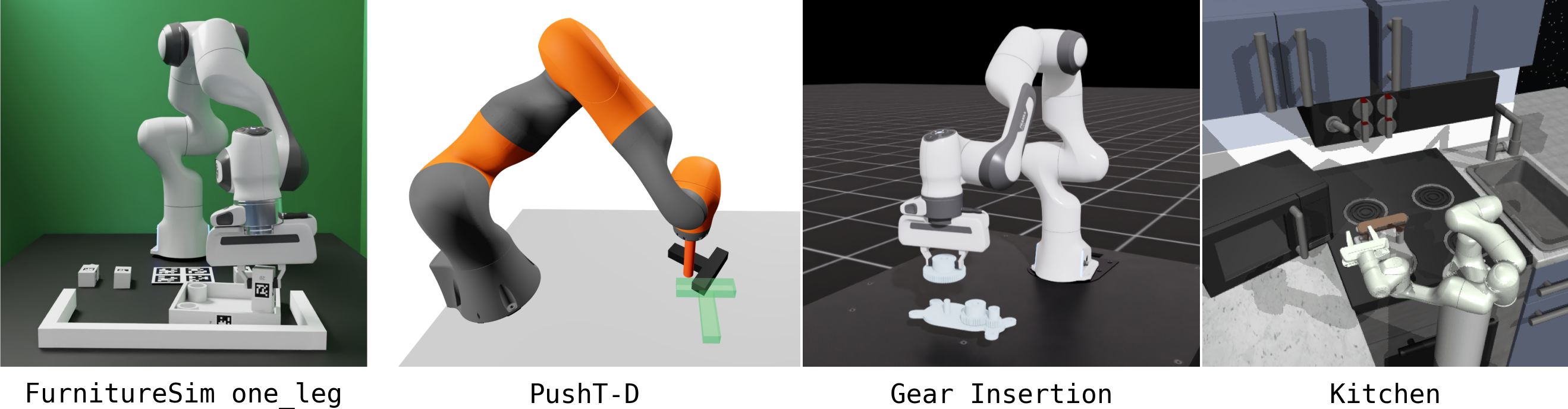
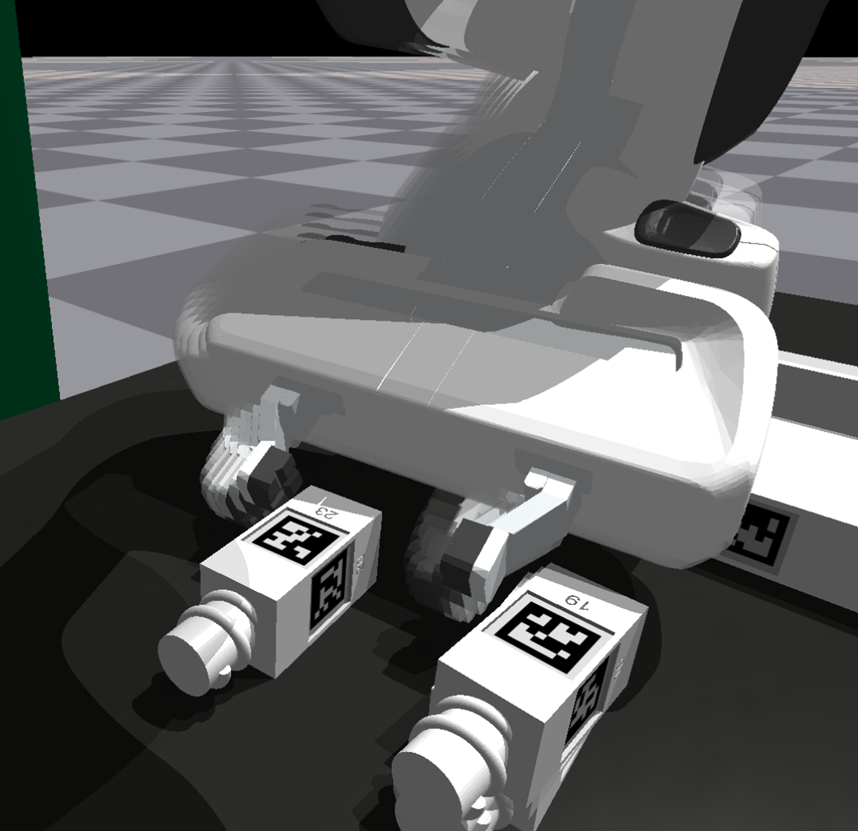
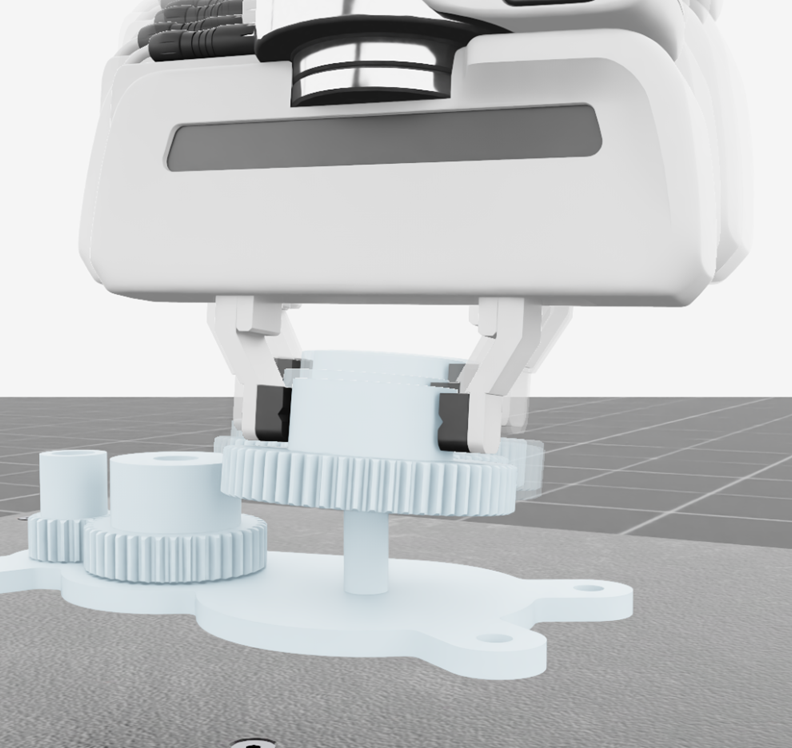
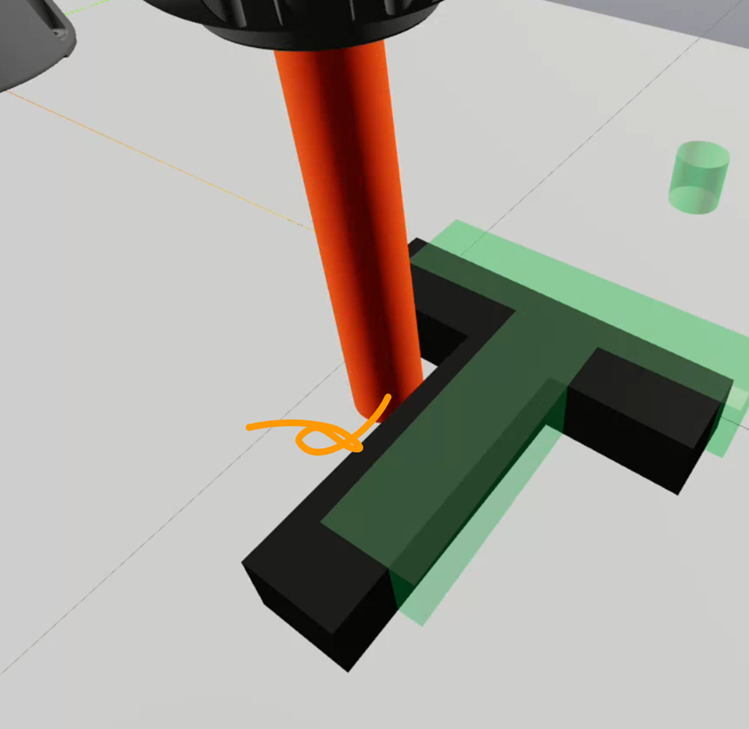
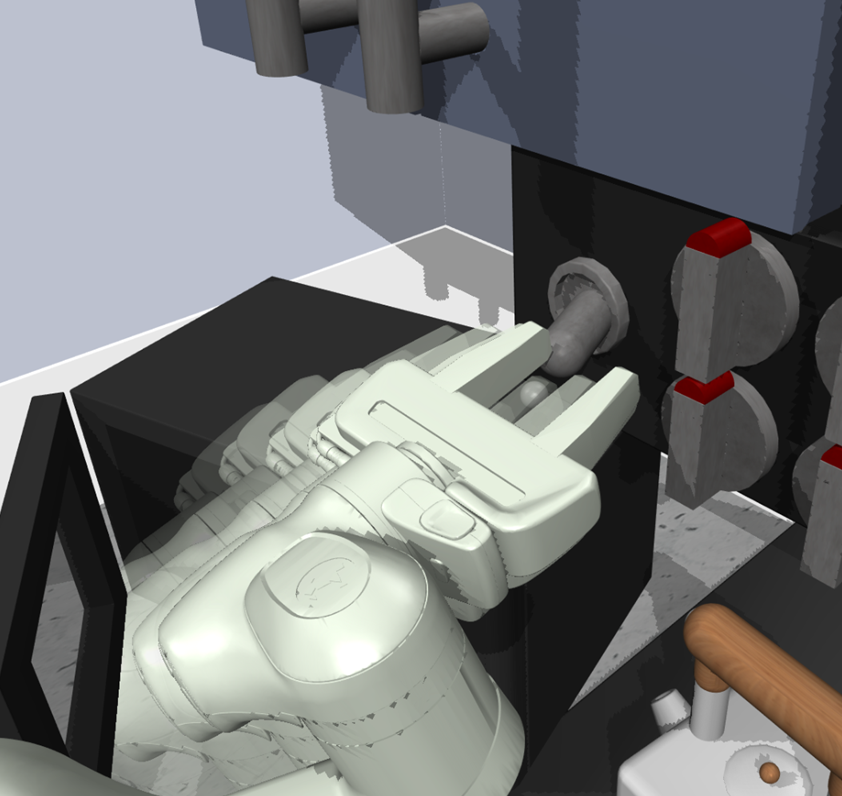
They tested robot policies on several simulated tasks, including:
- Assembling part of a table.
- Inserting a gear.
- Pushing a T-shaped object.
- Completing kitchen tasks.
They also tested two real-world robot tasks.
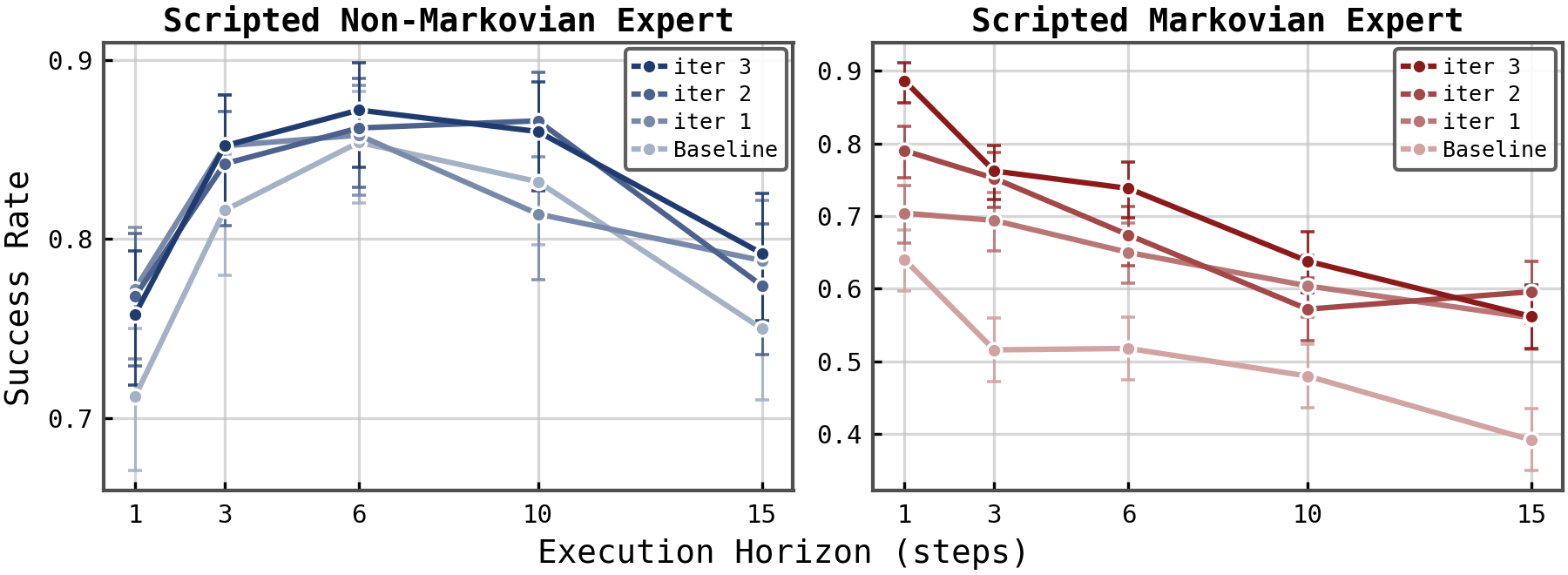
The researchers also studied compounding errors. This means that a small mistake can lead to another mistake, which leads to an even bigger mistake. For example, if a robot grabs an object slightly incorrectly, its next movement may be wrong too, and the errors can grow.
To test this, they tried:
- Giving the robot more training examples.
- Using a method called
DAgger, where the expert corrects the robot in situations where the robot struggles.
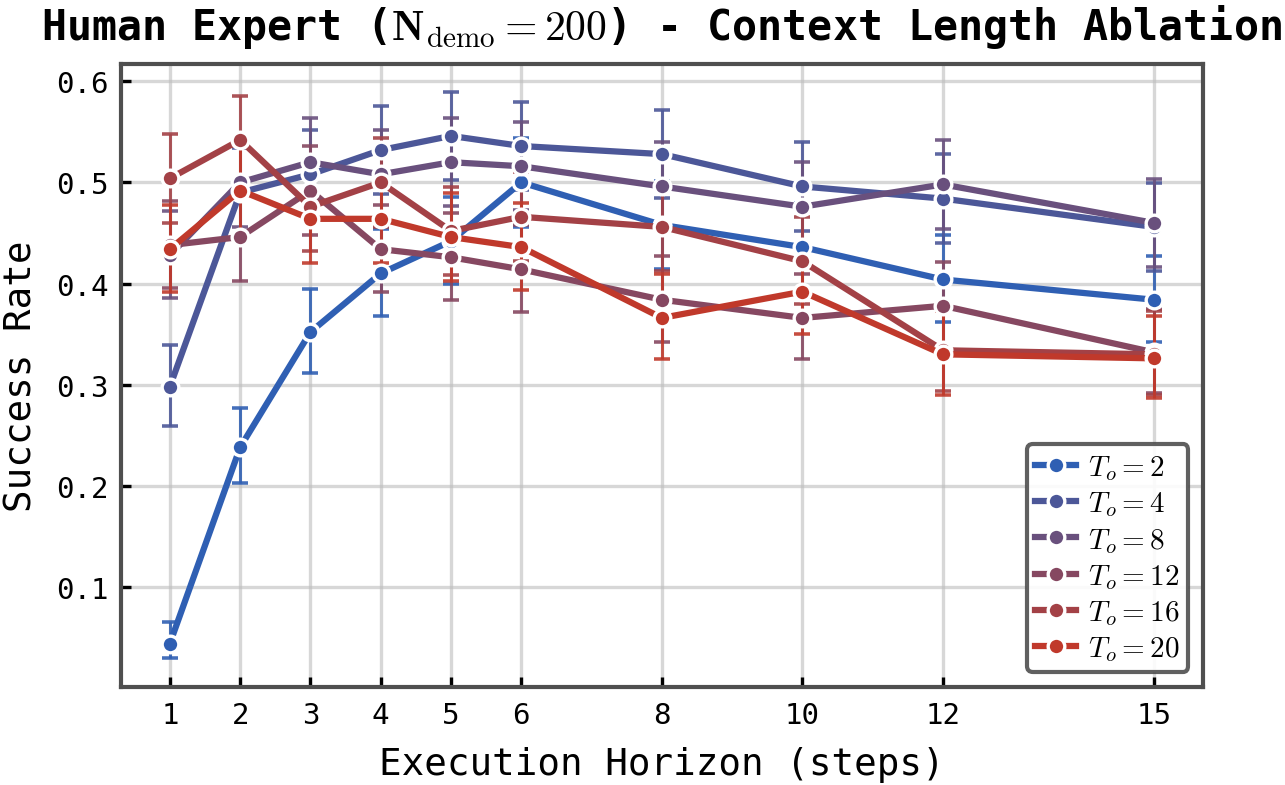
Finally, they trained robots with longer visual histories. Instead of seeing only the latest one or two images, the robot could use many earlier observations.
The paper also introduced a double encoder. In everyday terms, this is like giving the robot two visual systems:
- One focuses on what is happening right now.
- The other looks at older images to understand the larger story.
4. What did they find?
Long open-loop execution helps short-memory robots
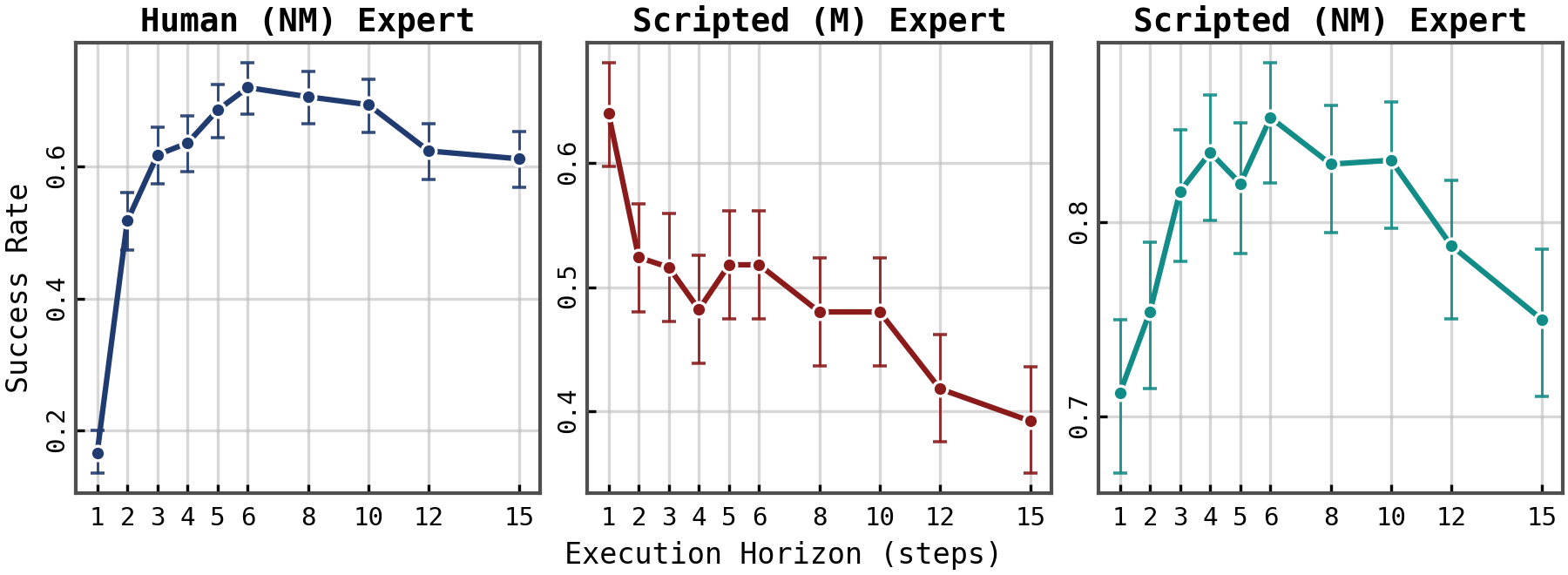
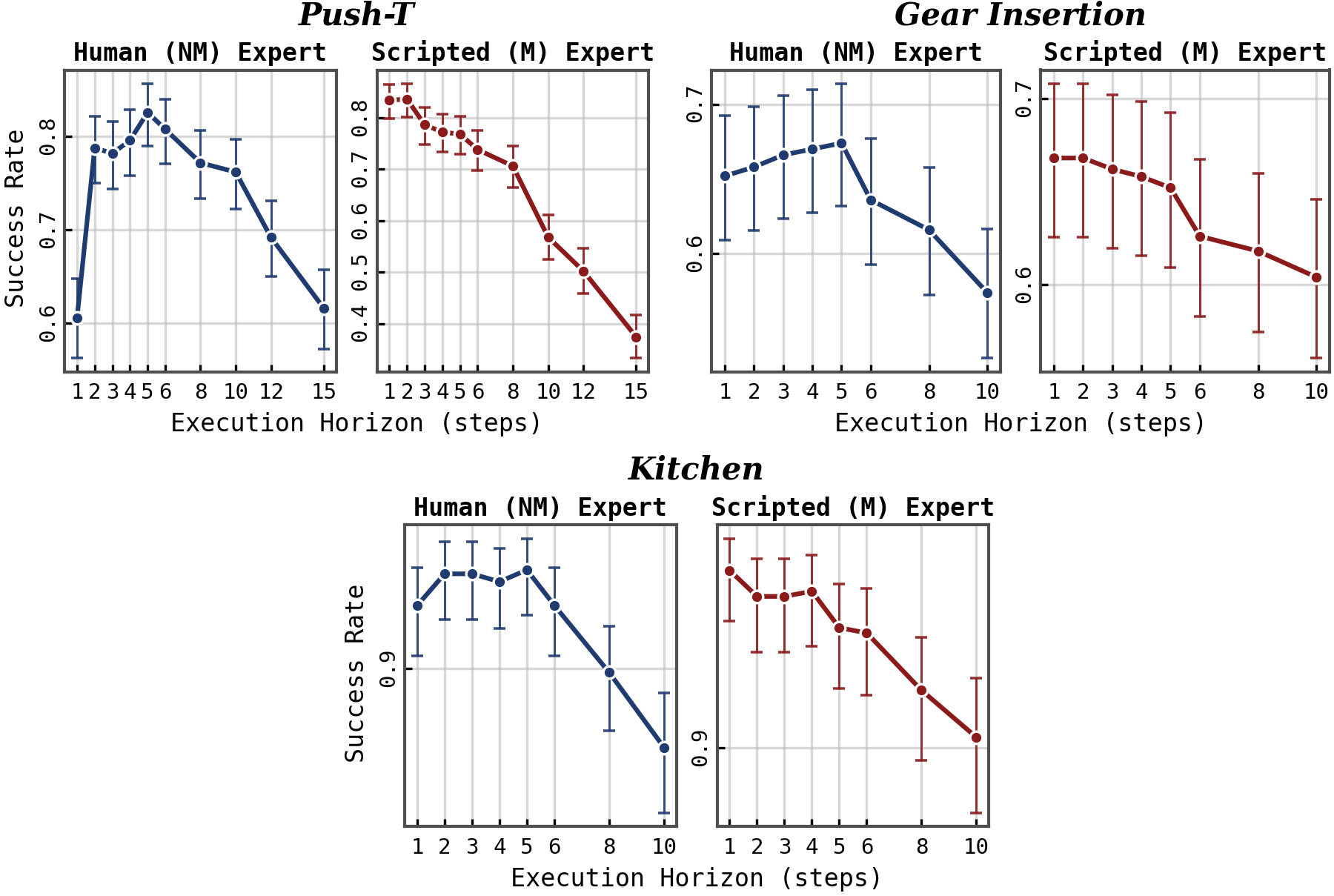
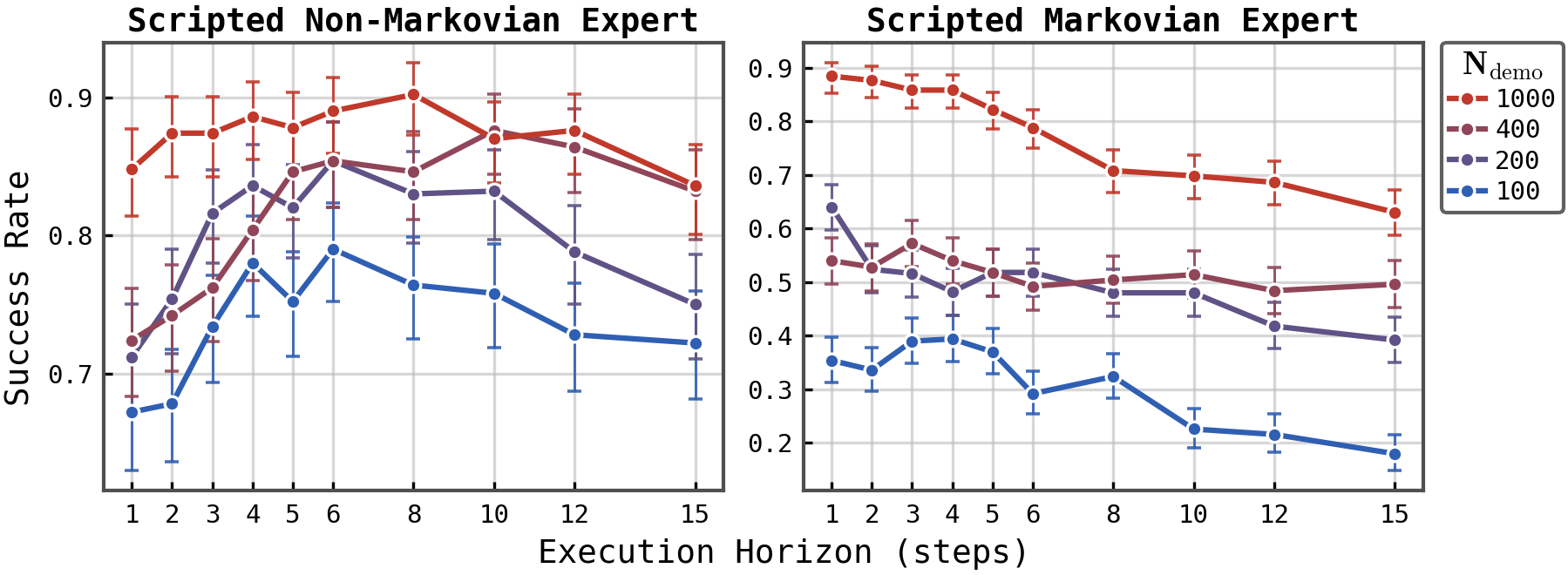
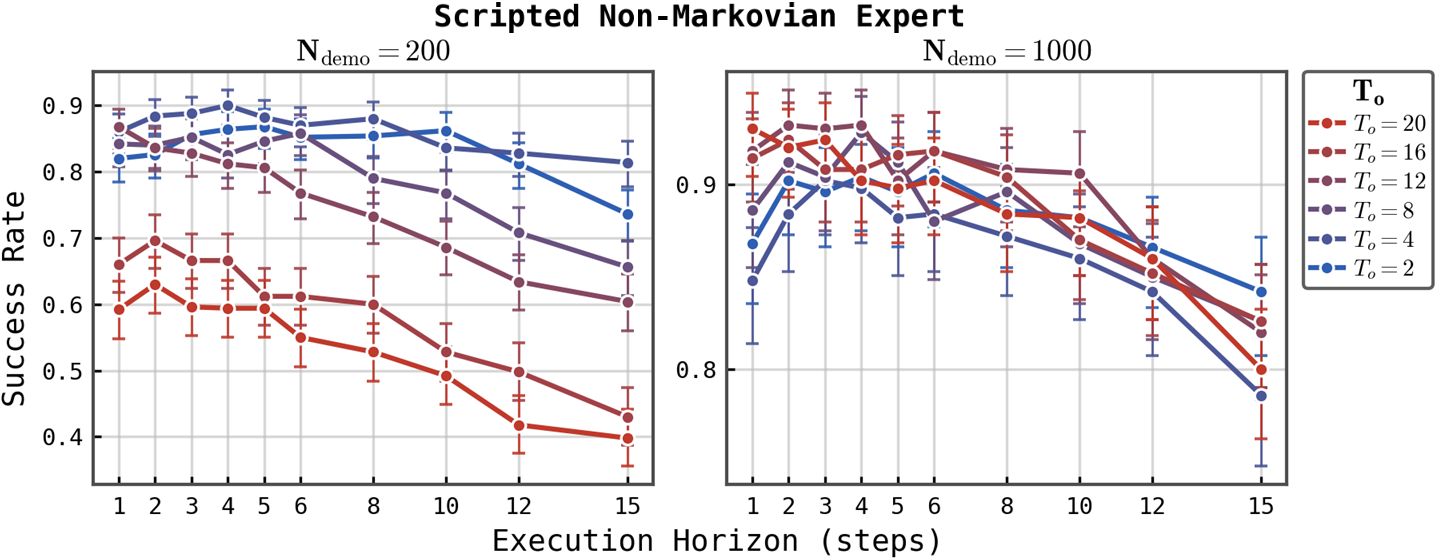
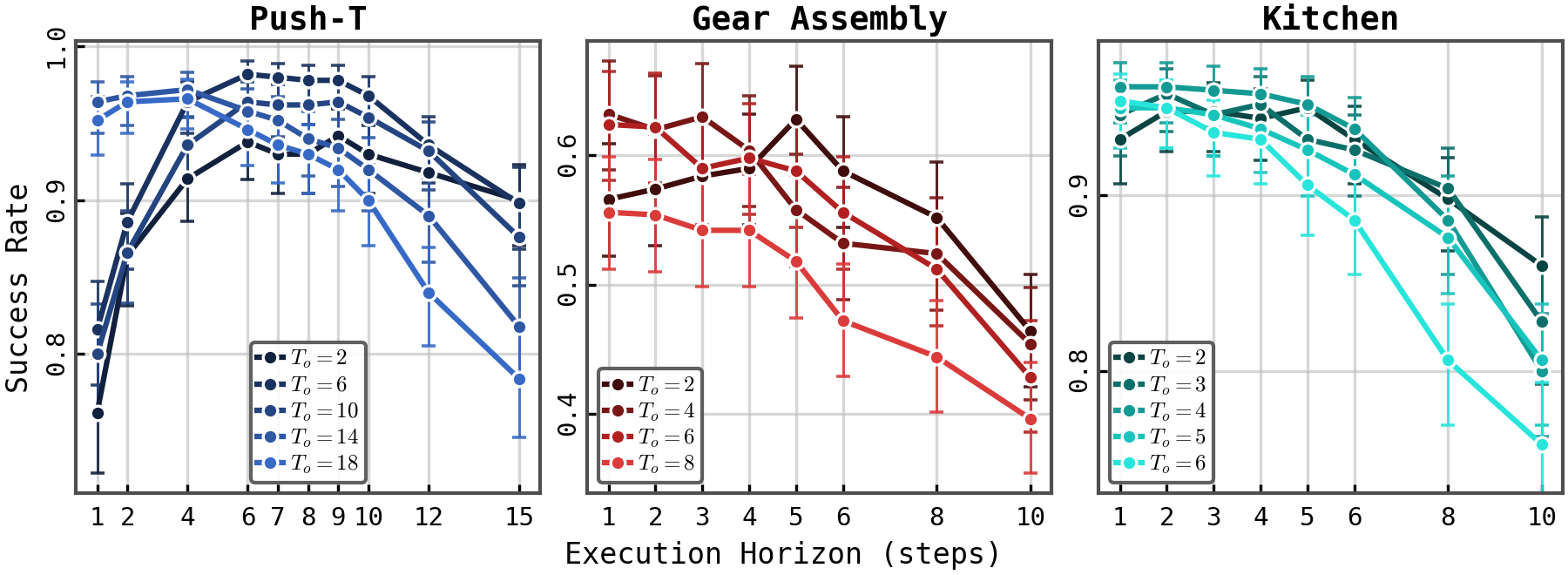
Robots trained from human demonstrations often performed best with a medium or long execution horizon. Their success curve usually looked like an upside-down letter U:
- Very short horizons performed poorly.
- Medium horizons performed best.
- Very long horizons became worse because the robot was not reactive enough.
The researchers explain that short-horizon robots often became confused when they had to make a new decision. Several actions might look reasonable from the latest image, but only one would match the expert’s full plan.
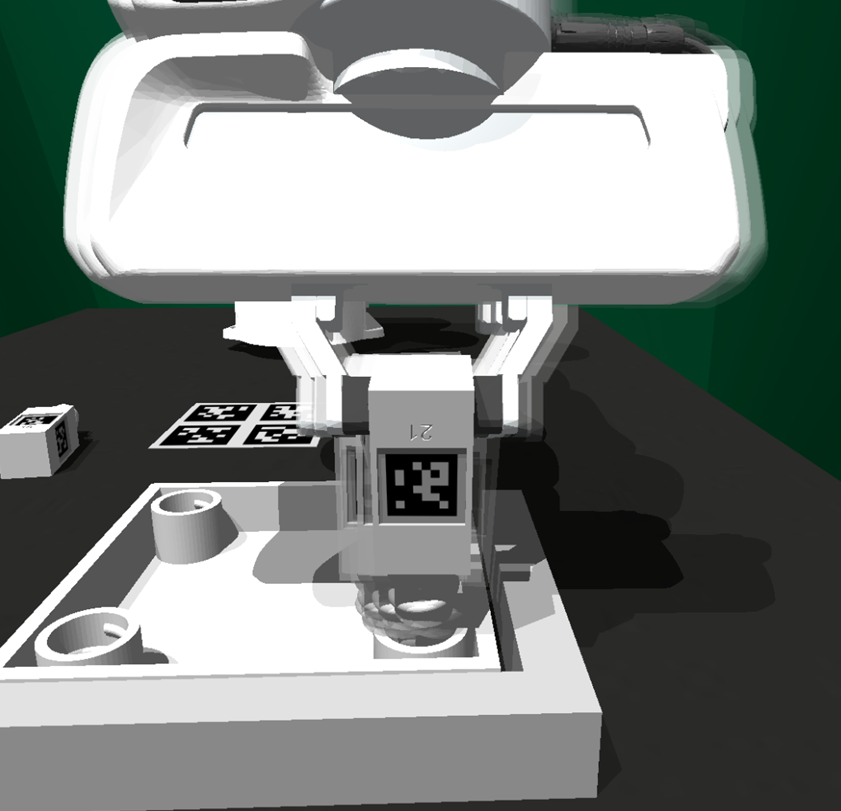
For example, while assembling a table, a robot might repeatedly move into the correct position but never actually grab or insert the part. Each individual movement looks sensible, but the robot does not remember enough to know when to move on.
A longer open-loop sequence helps because the robot commits to one plan for a while instead of repeatedly reconsidering it.
Markovian experts changed the result
When the robot learned from a Markovian expert—one whose actions depended only on the current state—the results were very different.
These robots usually performed best with an execution horizon of 1. In other words, they did best when they:
- Observed the world.
- Chose one action.
- Observed the world again.
- Replanned immediately.
Their performance generally became worse as the robot executed longer action sequences without checking again.
This suggests that long open-loop execution is not always necessary. It is especially useful when a short-memory robot is trying to copy an expert whose behavior depends on hidden information from the past.
Expert memory mattered more than compounding errors in most tests
Compounding errors did affect performance, especially when the robot had very little training data.
However, in the researchers’ main experiments, changing the expert from non-Markovian to Markovian had a much larger effect than using methods designed to reduce compounding errors.
This means that the common explanation—“long action chunks are mainly useful because they stop errors from building up”—does not tell the whole story.
The paper argues that the hidden memory and history in the demonstrations were usually the stronger reason.
Longer context made reactive robots possible
The most important result was that giving the robot more historical information reduced the need for long open-loop action sequences.
When the robot could see enough past observations, it became better at understanding:
- What it had already tried.
- How long it had been performing a subtask.
- Which plan it was following.
- When it should stop one behavior and begin another.
With sufficiently long context, the robot often performed best with an execution horizon of 1 or close to 1.
In some experiments, a robot with:
- Long visual memory, and
- Frequent replanning
performed better than a robot with:
- Very short memory, and
- Long open-loop action sequences.
The researchers observed this pattern across four simulated tasks and two real-world tasks.
5. Why are these findings important?
The findings suggest that robots should not always be made successful by simply following longer action sequences.
Long sequences can hide a robot’s lack of understanding. They may help the robot continue a plan, but they also prevent it from correcting mistakes quickly.
A better approach may be to build robots that have:
- Longer and more useful memory.
- Frequent feedback from cameras and sensors.
- The ability to replan after every action.
- Separate ways to understand both immediate details and long-term progress.
This could be especially important for difficult tasks involving:
- Fast movements.
- Objects that move unexpectedly.
- Delicate contact, such as inserting or grasping objects.
- Tools and many-step tasks.
- Human-like dexterity.
Simple conclusion
The paper challenges the idea that robots mainly need long open-loop action chunks to prevent mistakes from piling up.
Instead, it shows that these long chunks often help because robots are trying to copy human experts while seeing only a tiny part of the past. Since humans use memory when demonstrating tasks, the robot can become confused when it only sees the present moment.
The researchers found that giving the robot a longer history can solve much of this problem. Then the robot can recheck its surroundings more often, correct mistakes sooner, and still complete tasks successfully.
In short:
Robots may not need to act blindly for longer. They may simply need better memory so they can act intelligently and react quickly.
Knowledge Gaps
Knowledge gaps, limitations, and open questions
- The experiments do not establish whether expert non-Markovianity is the dominant explanation for long execution horizons beyond the selected four simulation tasks and two real-world tasks.
- The real-world evaluation is only summarized in the provided text; the paper does not clarify the tasks’ hardware configurations, environmental variability, number of trials, failure rates, or whether the results replicate across robots and operators.
- The proposed definition of expert non-Markovianity depends on treating image observations as Markovian environment states, an approximation that may fail under occlusion, limited camera views, unobserved forces, actuator delays, or partial observability.
- The paper does not quantify non-Markovianity with a task-independent metric, making it difficult to predict the optimal execution horizon for a new dataset or expert.
- The scripted non-Markovian expert injects hand-designed behaviors such as hidden waypoint offsets, sticky transitions, and latent counters; it remains unresolved how well these behaviors represent the broader forms of memory, intent, and adaptation used by human demonstrators.
- The relative contribution of the different injected non-Markovian mechanisms is not fully disentangled. For example, the effects of latent plans, pauses, delayed transitions, and cyclic alignment are not independently characterized across tasks.
- The study does not determine how much context is sufficient in general, nor how the required context length scales with task horizon, observation frequency, demonstration variability, or the duration of hidden expert state.
- It remains unclear whether long raw visual context is necessary, or whether compact recurrent, retrieved, symbolic, or task-specific memory representations could achieve comparable reactivity with lower computational and data costs.
- The causal-confusion problem associated with long-context imitation learning is discussed but not systematically measured. The paper does not identify when additional context improves hidden-state inference versus when it causes reliance on spurious historical correlations.
- The proposed double-encoder architecture is evaluated as part of the long-context intervention, so the benefits of longer context are not fully separated from the effects of encoder specialization, short-range dropout, initialization, and architecture-specific inductive biases.
- There is no comprehensive comparison between the double encoder and alternative long-context methods, such as recurrent state-space models, temporal attention, memory retrieval, observation compression, or hierarchical policies.
- The experiments primarily use Diffusion Policy variants; it remains uncertain whether the conclusions apply equally to autoregressive, flow-based, transformer-based, latent-variable, and vision-language-action policies.
- The paper does not fully isolate the effect of execution horizon from inference latency, action interpolation, control frequency, and synchronization. The experiments fix the action timestep and largely study zero-latency or controlled-latency settings.
- The claimed advantages of reactive execution under realistic variable latency, communication delay, and asynchronous sensing remain insufficiently tested.
- Temporal action consistency is discussed as a possible alternative explanation, but its interaction with expert non-Markovianity, context length, and execution horizon is not experimentally disentangled.
- The contribution of multimodality in the demonstrations is acknowledged but not directly studied. It remains unclear whether long execution horizons help because they preserve a selected behavioral mode, because they smooth multimodal predictions, or because they reduce replanning-induced mode switching.
- The paper does not compare long-context closed-loop policies against explicit mode-selection, trajectory-ranking, or commitment mechanisms that may address the same ambiguity without requiring long visual histories.
- The compounding-error analysis is concentrated on FurnitureSimOneLeg and uses only a limited set of interventions. The relative importance of compounding errors under different dynamics, data scales, policy capacities, and task horizons remains unresolved.
- HG-DAgger is human-gated, limited to three iterations, and adds a fixed number of corrections per condition; the results may therefore not reflect fully automated data aggregation or convergence under substantially larger corrective datasets.
- The study does not report a direct quantitative decomposition of failures into non-Markovian ambiguity, compounding errors, latency, temporal inconsistency, perception errors, and control or contact-model errors.
- The comparison between Markovian and human demonstrations may be confounded by differences in trajectory quality, variability, smoothness, success rate, action distributions, and data coverage, even though the paper attempts to hold training settings constant.
- The Markovian experts are scripted and may produce more homogeneous and easier-to-learn trajectories than human experts; therefore, the observed horizon shift may partly reflect dataset complexity rather than Markovianity alone.
- The paper does not establish whether the conclusions hold for imperfect Markovian experts, noisy experts, heterogeneous teams of experts, or demonstrations containing failed and corrective behavior.
- The effects of dataset size are evaluated over a limited range and mainly on one task; the threshold at which additional data eliminates the need for long execution horizons is not known.
- The analysis does not assess how demonstrations collected at different control frequencies affect the relationship between execution horizon and reactivity, since the study fixes and treats horizon in action steps.
- The reported success-horizon curves may depend strongly on the selected prediction horizon ; how the optimal execution horizon changes when prediction horizons are shorter, longer, or adaptive is not established.
- The paper does not investigate whether reactive policies remain stable when action predictions are noisy or when re-planning occurs at much higher frequencies than those tested.
- It remains unclear whether the performance gains from long-context reactive policies persist under distribution shift, novel object configurations, unseen task sequences, disturbances, or recovery from substantial execution errors.
- The experiments focus mainly on task success; the effects of context length and execution horizon on energy use, motion smoothness, peak control effort, wear, safety, inference cost, and latency are not fully characterized.
- The computational and memory costs of storing and encoding long observation histories are not compared against the practical benefits in deployment.
- The claim that long-context reactive policies are “more principled” is not supported by a formal control-theoretic analysis or guarantees regarding stability, robustness, or recovery.
- The paper does not determine whether the optimal strategy should always be once sufficient context is available, or whether task phases, contact modes, confidence, or uncertainty still justify adaptive execution horizons.
- The relationship between policy uncertainty and reactivity is left unexplored; confidence-based replanning could potentially achieve the benefits of both short and long execution horizons.
- The findings are based primarily on imitation learning from successful demonstrations, leaving open whether similar conclusions hold with offline reinforcement learning, online reinforcement learning, corrective demonstrations, or hybrid planning-and-learning systems.
- The paper’s expectation that the compounding-error findings extend to other tasks is not directly validated, particularly for highly dynamic, deformable, force-sensitive, or long-horizon manipulation environments.
Practical Applications
Immediate Applications
- Robotic manipulation: retune execution horizons by task and dataset.
Robotics teams can evaluate the success–execution-horizon curve for each deployed imitation-learning policy rather than assuming that long action chunks are universally optimal. For policies trained on highly observable or scripted Markovian demonstrations, setting
T_exec = 1or another very short horizon can improve reactivity and task success. This is directly applicable to assembly, insertion, pushing, screwing, pick-and-place, and kitchen manipulation workflows. Dependencies: Requires task-specific validation, adequate control-loop frequency, and sufficient compute to re-query the policy frequently. Very short horizons may still be harmful when the policy has insufficient context or when inference latency is substantial. - Use context length as a policy-design variable. Practitioners can augment current one- or two-frame policies with longer observation histories before increasing the open-loop execution horizon. A practical workflow is to compare policies across a grid of observation contexts and execution horizons, selecting the combination that maximizes success while preserving reactivity. The paper’s double-encoder design provides an immediately testable implementation: one visual encoder processes recent frames for immediate control, while another processes earlier frames for temporal reasoning and hidden-state inference. Dependencies: Long-context training requires more memory, training data, and careful handling of temporal redundancy and causal confusion. The reported results are strongest in the evaluated manipulation settings and should be verified on each robot platform.
- Diagnose cyclic and mode-switching failures as memory failures. Deployment and evaluation tools can log repeated behaviors such as re-aligning indefinitely, oscillating between locally valid actions, failing to commit to grasp or insertion, or switching between nearby subtasks. These patterns can be treated as evidence that the policy lacks information about prior actions, elapsed time, latent task phase, or previous failed attempts. Teams can then increase temporal context, add explicit phase or time features, or redesign demonstrations rather than merely increasing chunk length. Dependencies: The diagnosis assumes that observations contain enough information to infer the relevant hidden state. If the necessary state is not visually observable, additional sensors, proprioception, force feedback, or explicit task-state labels may be required.
- Adopt closed-loop control for high-precision and contact-rich operations. Manufacturing and laboratory-automation systems can use more frequent replanning for gear insertion, furniture assembly, screwing, grasp alignment, and other operations where small execution errors are costly. Reactive action updates can compensate for uncertain dynamics, contact variation, object pose error, and imperfect learned models, even in environments that appear static or quasi-static. Dependencies: Closed-loop operation depends on reliable sensing and sufficiently low end-to-end perception–inference–actuation latency. Safety limits, collision checking, and low-level stabilizing controllers remain necessary.
- Improve data-collection protocols for imitation learning. Academic and industrial teams can record longer histories, timestamps, action history, task-phase indicators, and relevant sensor streams during demonstrations. Demonstrators should avoid discarding pauses, corrections, and intermediate actions, since these may encode latent plans or timing information that short-context policies cannot recover. Dataset documentation can also identify whether behavior is scripted, teleoperated, multimodal, time-dependent, or dependent on unrecorded human memory. Dependencies: Longer histories increase storage and labeling costs. Additional context is useful only if the recorded observations preserve the information used by the demonstrator.
- Use Markovian scripted experts as a baseline for reactive policy development. Robotics researchers can generate controlled demonstrations from finite-state machines, trajectory controllers, or reinforcement-learning experts whose actions depend only on observable state. These datasets provide a clean baseline for measuring the effects of compounding errors independently from non-Markovian expert behavior. The released expert-policy code can support reproducible studies and benchmark construction. Dependencies: Scripted experts may not represent the diversity, flexibility, or hidden decision-making of human operators. Results obtained with synthetic experts should not be assumed to transfer directly to human-demonstrated tasks.
- Benchmark policies over both context and execution horizon. Standard robotics evaluations can report a two-dimensional matrix of results rather than a single action-chunking configuration: observation context length versus execution horizon. This would expose whether gains arise from genuine task understanding, reduced replanning ambiguity, or merely commitment to open-loop trajectories. Such a benchmark can be integrated into software libraries for Diffusion Policy, flow-based policies, and vision–language–action systems. Dependencies: Comparisons must hold prediction horizon, training budget, control frequency, hardware, and evaluation conditions constant. Otherwise, changes in performance may be attributed to the wrong mechanism.
- Apply targeted data aggregation where compounding errors dominate. Data scaling and HG-DAgger remain useful for failures caused by distribution shift, missed insertions, and basic manipulation mistakes. Teams can combine reactive policies with corrective demonstrations from states actually visited during deployment. However, if failures consist of repeated alignment or mode switching, simply adding more corrections may not solve the underlying ambiguity; context and memory should be addressed as well. Dependencies: DAgger-style methods require expert availability, human annotation or intervention, and a safe procedure for collecting corrective trajectories.
- Policy and system-level latency management. In current robot products, long action chunks can still be used as a temporary mechanism for masking neural-network inference latency. A practical deployment workflow is to reduce latency through hardware acceleration, model optimization, batching, or asynchronous inference while separately increasing reactivity where task precision requires it. Dependencies: The paper shows that latency is not the sole explanation for the benefits of chunking, particularly in zero-latency simulation. Lowering latency alone will not resolve ambiguity caused by insufficient temporal context.
Long-Term Applications
- Long-context, fully reactive generalist robot policies. A longer-term direction is to replace the prevailing short-context, long-open-loop paradigm in general-purpose robot policies with models that maintain sufficient temporal context and replan at every control step. Such systems could infer task phase, latent human intent, elapsed time, prior failures, and mode commitments while reacting to large environmental changes. Potential products include reactive vision–language–action controllers for warehouses, homes, laboratories, and flexible manufacturing. Dependencies: Requires scalable architectures, efficient temporal memory, large high-quality datasets, real-time inference, and robust behavior under observations that differ from demonstrations. The paper’s experiments do not establish performance for broad real-world generalist deployment.
- Hierarchical memory systems for robotics. The double encoder suggests a broader architecture in which recent observations support fast motor control while older observations support planning and hidden-state estimation. Future systems could combine raw temporal windows with compressed episodic memory, retrieval of relevant past events, task-phase representations, and explicit time or event counters. This could enable robots to distinguish “align again,” “commit to grasp,” and “proceed to the next subtask” when the current image alone is ambiguous. Dependencies: Memory selection must avoid irrelevant-history interference and causal confusion. The system must also determine when old observations remain relevant as the environment changes.
- Adaptive reactivity and confidence-based replanning. Industrial robots could eventually adjust their replanning frequency based on uncertainty, contact events, task phase, or detected environmental change. A robot might execute rapidly closed-loop near an insertion or human interaction, but use longer action segments during predictable free-space motion. This would combine the paper’s emphasis on reactivity with the practical efficiency of action chunking. Dependencies: Requires calibrated confidence or failure predictors, reliable event detection, safety guarantees, and validation that adaptive switching does not introduce new discontinuities or temporal inconsistency.
- Reactive dexterous and dynamic manipulation. The paper’s argument is likely especially relevant to fast dexterous manipulation, deformable objects, forceful contact, tool use, and interaction with moving objects. Closed-loop long-context policies could continuously revise actions in response to contact forces, object slippage, human movement, or rapidly changing geometry. Potential sectors include advanced manufacturing, logistics, surgical-assistance research, agriculture, and service robotics. Dependencies: These applications require high-rate tactile and proprioceptive sensing, stable low-level control, safety certification, and training data covering dynamic disturbances. Visual context alone may be insufficient.
- Improved human-to-robot demonstration interfaces. Demonstration systems could capture and expose information that human experts normally keep implicit: task intent, selected subtask, expected waiting duration, mode commitment, and reasons for corrections. Wearable interfaces, voice annotations, gaze tracking, force signals, or lightweight event labels could make expert behavior more observable and reduce the burden on the learner to infer hidden state from images alone. Dependencies: Additional annotation must be inexpensive and reliable, and interfaces must not disrupt natural demonstrations. Explicit labels may also encode a particular operator’s strategy rather than a generally transferable policy.
- Training curricula that separate non-Markovianity from distribution shift. Academia could develop controlled benchmarks varying expert memory requirements, observation completeness, dataset size, multimodality, and disturbance level independently. Such benchmarks would clarify when long execution horizons help because of hidden expert state, when they help because of compounding errors, and when they merely compensate for inference delay. This would improve theory and make comparisons across imitation-learning methods more meaningful. Dependencies: Requires standardized task definitions, reproducible expert generators, consistent evaluation protocols, and real-world validation beyond the six tasks studied.
- Formal safety and reliability analysis for reactive imitation policies. Reactive policies could be integrated with model-predictive control, control-barrier functions, reachability analysis, or runtime monitors. The learned policy would supply high-level or immediate actions, while a safety layer would detect uncertainty, collisions, excessive force, or divergence from the demonstrated task and trigger replanning or a controlled stop. Dependencies: Formal guarantees require assumptions about sensing, dynamics, actuation limits, and policy uncertainty that may not hold for vision-based learned systems. Additional research is needed to connect long-context neural policies with provable closed-loop properties.
- Low-latency robot-compute co-design. If long-context policies can retain the performance benefits of action chunking without executing long open-loop prefixes, future robot platforms may be designed around high-frequency perception and control. This includes dedicated inference accelerators, distributed perception, compressed temporal representations, asynchronous sensing, and hardware–software pipelines optimized for frequent policy queries. Dependencies: The approach may increase energy consumption, thermal load, communication bandwidth, and system complexity. Its benefits must be demonstrated against simpler chunked controllers under realistic latency and power constraints.
- Applications beyond robotics involving sequential imitation and partial observability. The central principle—that short-context learners may imitate history-dependent experts poorly and that longer context can preserve reactive correction—could inform sequential decision systems in autonomous vehicles, industrial process control, interactive software agents, and human–computer assistance. For example, an agent controlling a software workflow could use action history and task phase rather than repeatedly selecting locally valid but globally inconsistent operations. Dependencies: These transfers are conceptual rather than directly demonstrated. Each domain has different safety, observability, action-frequency, and distribution-shift characteristics, so validation outside robotic manipulation is required.
Glossary
- Action chunking: Predicting a sequence of actions and executing part of it before replanning. “Action chunking --- the practice of predicting a sequence, or ``chunk," of actions and executing a fixed-length prefix open-loop before replanning from new observations.”
- Autoregressive model: A model that generates each output conditioned on previously generated outputs. “variational latent-variable models \cite{zhao2023learningfinegrainedbimanualmanipulation}, autoregressive \cite{pertsch2025fastefficientactiontokenization}, and more.”
- Behavior cloning: Supervised learning in which a policy learns to reproduce actions demonstrated by an expert. “In behavior cloning, successful task demonstrations are collected from an expert and used as supervised data to train a policy that reproduces the expert’s actions.”
- Causal confusion: A failure in which a learner relies on correlations that predict actions in training data but do not represent the true causal decision process. “due to the causal confusion problem in long-context learning”
- Closed-loop control: Control in which the system repeatedly uses new observations to adjust its actions. “while $T_{\text{exec}=1$ is necessary for closed-loop reactive control”
- Compounding errors: The accumulation of small prediction or control errors that causes increasingly divergent behavior over time. “This phenomenon is known as compounding errors and is often used to motivate using long execution horizons”
- Contact-rich interaction: Manipulation involving frequent or complex physical contact between objects and the robot. “as manipulation advances from slow, quasi-static two-finger tasks toward fast, dexterous, and dynamic contact-rich interaction”
- Cross-attention: An attention mechanism that allows one representation to selectively use information from another representation. “we use a U-Net Diffusion Policy architecture with cross-attention conditioning.”
- DAgger: An imitation-learning algorithm that iteratively labels states visited by the learned policy with expert actions and adds them to the training data. “Data aggregation (DAgger~\citep{ross2011reductionimitationlearningstructured}) is a standard method for reducing compounding errors”
- Diffusion model: A generative model trained to produce data by reversing a gradual noising process. “Diffusion Policies \cite{chi2024diffusionpolicyvisuomotorpolicy} accomplish this by using a diffusion model to learn the relevant conditional distribution”
- Diffusion Policy: A robot-control policy that uses diffusion modeling to generate action sequences conditioned on observations. “We compare the success-horizon curves of Diffusion Policies trained on Markovian and non-Markovian expert data”
- Distribution shift: A mismatch between the data distribution used for training and the distribution encountered during evaluation. “broader state coverage is more likely to include states induced by the learned policy, which can mitigate compounding errors”
- End-effector operational-space control: A control method that directly specifies and regulates the position, orientation, or motion of a robot’s end effector. “uses end-effector operational-space control (OSC) and gripper PID control”
- Execution horizon: The number of predicted actions executed before the policy is queried again. “We let $T_{\text{exec}$ denote the execution horizon: the number of predicted actions executed before re-querying the policy.”
- Expert Markovianity: The extent to which an expert’s action distribution depends only on the current observable state rather than on history. “We now demonstrate our first result: the success-horizon curve is strongly influenced by Markovianity of the expert”
- Finite-state machine (FSM): A computational model consisting of a finite set of states and rules for transitioning between them. “This expert is implemented as a finite-state machine (FSM)”
- FiLM conditioning: Feature-wise Linear Modulation, which conditions neural-network features by applying learned affine transformations based on another input. “we use the baseline FiLM-conditioned U-Net”
- Flow model: A generative model that transforms a simple probability distribution into a complex data distribution through a learned continuous transformation. “including flow/diffusion”
- Generative modeling: Modeling a data distribution so that new samples can be generated from it. “chunked prediction, paired with generative modeling, is necessary to capture non-Markovianity”
- Hidden state: Internal or unobserved information that influences future actions or system behavior. “We qualify experts which maintain a hidden state that carries distilled information from past observations in this category.”
- Hydroelastic contact: A contact model that represents deformable or compliant surface interactions through pressure and volumetric effects. “Drake provides richer hydroelastic contact”
- Imitation learning: Learning a behavior policy by observing and reproducing demonstrations from an expert. “Imitation learning has recently seen rapid adoption in robotic manipulation”
- Implicit ensembling: Combining the effects of multiple predictions or behavioral modes without explicitly training separate models. “alongside reduced compounding errors and ``implicit ensembling.”
- Inference latency: The time required for a model to compute an action or prediction after receiving an input. “improving temporal consistency of actions to reduce unsmooth motions ... or as a mechanism to absorb delay from policy inference”
- Inpainting: Filling in or regenerating missing portions of a data representation, such as an action sequence. “training or inference-time inpainting”
- Markovian: Having future behavior depend only on the current state, rather than on earlier history. “The expert’s action distribution depends only on the current environment state”
- Multimodal prediction: A prediction involving multiple distinct plausible outputs or behavioral modes. “averaging across chunks can be harmful under multimodal predictions”
- Non-Markovian: Depending on information from past states, observations, or actions in addition to the current state. “Non-Markovian Expert: The expert’s action distribution depends on both the current and past environment states”
- Open-loop execution: Executing planned actions without incorporating new observations until the plan segment ends. “These policies typically execute a prefix of the predicted action chunk open-loop before re-querying the policy on new observations.”
- Partial observability: A setting in which the agent cannot directly observe the complete state relevant to decision-making. “Many works have cited elements of history-dependence or partial observability”
- Policy-induced test-time state distribution: The distribution of states reached by a learned policy during deployment, which may differ from the expert’s training-state distribution. “reducing mismatch between the training state distribution and policy-induced test-time state distribution”
- Quasi-static: Characterized by sufficiently slow motion that dynamic effects such as inertia can often be neglected. “Reactivity is consistently beneficial even in quasi-static tasks”
- Reactive control: Control that frequently updates actions in response to new observations and changing conditions. “we argue that long open-loop execution may not be needed.”
- Replanning: Computing a new action sequence after receiving updated observations. “executing a fixed-length prefix open-loop before replanning from new observations.”
- State distribution: The probability distribution over states encountered by a system or policy. “improve train–test state-distribution alignment.”
- Success-horizon curve: The relationship between task success rate and the length of the open-loop execution horizon. “we use the term success-horizon curve to denote the relationship between policy success rate and execution horizon”
- Temporal action consistency: Similarity or smooth coordination between actions produced at successive times or across action chunks. “many works also cite improving ``temporal action consistency”
- U-Net: A neural-network architecture with encoder and decoder paths connected by skip connections, commonly used for image and diffusion modeling. “we use a U-Net Diffusion Policy architecture with cross-attention conditioning.”
- Variational latent-variable model: A probabilistic model that represents data using unobserved latent variables and variational inference. “variational latent-variable models”
- Visual encoding: Transforming image observations into learned numerical feature representations for a policy. “we propose new heuristics related to visual encoding to improve long-context performance.”

