Discovering High-Quality Chess Puzzles with Offline Reinforcement Learning
Abstract: Learning and skill mastery require extensive and deliberate practice. In many learning settings, producing high-quality pedagogical materials can require a high level of domain expertise and be very time-consuming. Pedagogical materials often need to train students to engage in different thinking patterns. In some domains, such as chess, puzzles are used to help students practice their skills in calculating the next moves and recognizing known patterns on a board. Giving students a practice set of puzzles to help them learn different modes of thinking is challenging because the teacher needs to carefully balance between different motifs and how many look-ahead steps a student needs to perform. Popular online platforms like Chess.com and Lichess offer players millions of puzzles. Unlike chess tactics puzzles procured by human experts, where chess beginners can learn valuable insights, these puzzles are automatically generated and often regarded as having low pedagogical value. These platforms also rely on a heuristic to recommend puzzles to users for practice. Using the user history data over an entire year, a total of 1.5 billion puzzle-solving histories, we learn the pedagogical value of a puzzle and how to automatically choose a set of puzzles to better support chess learners using insights from offline reinforcement learning. We show that using offline policy evaluation, our trained policy has significant impact on beginners with puzzle-solving Elo range of 100--1000, particularly for the group of beginners whose learning growth was stagnant. We also performed a qualitative analysis of the puzzles discovered by our model by collecting annotation ratings from expert chess players. The success of our pipeline shows promise for a future where we can understand the pedagogical values of practice items given general user interaction data.

Paper Prompts
Sign up for free to create and run prompts on this paper.
Top Community Prompts
Explain it Like I'm 14
1. What is the paper about?
This paper explores how to use artificial intelligence to recommend better chess puzzles to players.
Chess websites have hundreds of thousands or even millions of puzzles. These puzzles are often created automatically from real games, rather than carefully chosen by chess teachers. The researchers wanted to find out whether a computer could learn which puzzles are most useful for different players.
Their main idea was to use offline reinforcement learning. This means training an AI using records of what people did in the past, instead of testing new recommendations on people immediately.
2. What questions did the researchers ask?
The researchers focused on several main questions:
- Can an AI learn which chess puzzles are useful for a particular player?
- Can it recommend puzzles better than the system already used by Chess.com?
- Do different kinds of players—such as beginners, improving players, and players whose ratings have stopped growing—need different puzzles?
- Does the AI choose puzzles that experts consider more fun, appropriate, challenging, or educational?
The researchers were especially interested in beginners. A good puzzle recommendation may be more important for a beginner because the wrong level of difficulty could make learning confusing or discouraging.
3. How did the researchers carry out the study?
The data
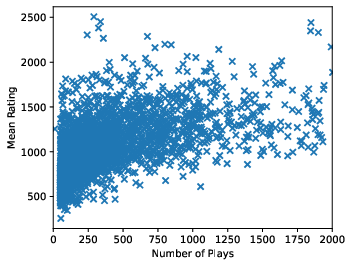
The researchers studied more than 1.5 billion puzzle-solving attempts made by about 3.1 million Chess.com users over one year. The data included around 441,000 different puzzles.
For each attempt, they could see information such as:
- The player’s puzzle rating, also called puzzle Elo
- Whether the player solved the puzzle correctly
- How many moves the player got right
- The puzzle’s difficulty
- The puzzles the player had attempted earlier
The researchers did not use information about players’ ordinary games against other people. They only studied puzzle activity.
Comparing player progress
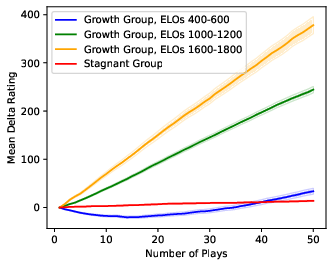
First, the researchers examined how players’ puzzle ratings changed over time. They found that some players improved a lot, while others stayed at about the same rating. They called these groups the growth group and the stagnant group.
This was not a controlled experiment. In other words, the researchers observed what happened naturally, rather than assigning players to special training programs. Therefore, they could find patterns, but they could not prove that solving a particular puzzle caused a player’s rating to improve.
Building the recommendation AI
The AI treated puzzle recommendation like a game with repeated decisions:
- The state was the player’s current situation, including their rating and recent puzzle results.
- The action was choosing one puzzle from the huge collection.
- The reward represented how useful the puzzle seemed to be. Solving a difficult puzzle correctly received a higher reward than solving an easy puzzle. Partial success also received some reward.
- The AI tried to choose puzzles that would lead to high rewards over time.
This is similar to teaching a student: after seeing how well the student did on recent exercises, a teacher chooses the next exercise.
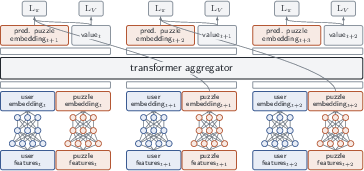
The researchers used a model called a transformer. Transformers are AI systems that can examine a sequence of earlier events and use that history to make a prediction. Here, the model looked at a player’s recent puzzle history and predicted which puzzle should come next.
Each player and puzzle was also changed into a numerical description called an embedding. An embedding is like a list of numbers that summarizes important features. For example, a player’s embedding might represent their skill and recent performance, while a puzzle’s embedding might represent its board position, difficulty, and themes.
The AI compared the player’s description with the descriptions of possible puzzles. Puzzles that seemed to “match” the player received higher scores.
Why the method was called “offline” reinforcement learning
The AI learned from old records instead of interacting with players while it was being trained. This is useful because the researchers could not safely test millions of completely new recommendations on real users.
However, offline learning creates a challenge: the AI might suggest puzzles that were rarely or never tried by similar players. The researchers reduced this risk by encouraging the new AI to stay reasonably close to the old Chess.com recommendation system.
Testing the AI
The researchers used two main forms of evaluation.
First, they used offline policy evaluation. This estimates how well the new system might have performed by comparing its recommendations with past user behavior. One technique they used was importance sampling, which is similar to asking:
“If the new system had chosen this puzzle instead, how valuable might the result have been?”
Because this estimate can become unreliable, the researchers used a simpler one-step version and limited extreme values.
Second, they asked chess experts to judge puzzles. Eight strong chess players rated puzzles on qualities such as:
- How much calculation they required
- Whether they tested recognizable chess patterns
- Whether they were appropriate for the player’s level
- How fun they were
- Their overall quality and informativeness
The researchers also used a LLM, or LLM, to imitate the experts’ ratings on more puzzles. Since the LLM was trained using only a small number of expert judgments, these results were treated as preliminary.
4. What did the researchers find?
The AI helped beginners the most
The new recommendation system performed better than Chess.com’s existing system for players with puzzle ratings between 100 and 1,000.
The biggest difference appeared among the lowest-rated beginners. For players rated 100–600, the estimated average return increased from about 16.9 with the existing system to about 57.4 with the AI system.
For players rated 600–1,000, the estimated return increased from about 19.5 to 39.2.
These numbers are the researchers’ reward estimates, not direct measurements of how many Elo points players gained. They show that the AI tended to recommend puzzles that players were more likely to solve successfully while still being challenged.
The improvement was smaller for stronger players
For players rated above 1,000, the new system had only a small advantage or was about the same as the existing system.
This makes sense because experienced players may be able to learn from many different puzzles. A beginner may need a carefully chosen difficulty level, while a strong player may benefit from a wider range of material.
The AI recommended slightly harder and more enjoyable puzzles
The expert-based evaluation suggested that the AI’s puzzles were:
- Slightly harder for the target player
- Slightly more fun
- A little better at testing calculation and pattern recognition
- Somewhat higher in overall ratings
For example, the AI’s puzzles received a fun score about 4.77 points higher after the researchers converted the ratings to a 100-point scale. The AI also received a higher appropriateness score.
However, these results should be interpreted carefully because the LLM-based judgments were based on a small set of expert examples. They are useful clues, but they are not as strong as a large experiment involving real players.
Some players improved while others stayed stuck
The data showed that players followed different learning patterns. Some players’ puzzle ratings increased with practice, while others remained almost flat.
The AI appeared to help both groups, especially among beginners. This is important because players whose progress has stopped may need recommendations that are better matched to their current abilities.
5. Why is this research important?
The study suggests that online learning systems can use large amounts of everyday activity data to discover which practice materials may be most useful.
Instead of simply giving players random puzzles near their rating, a website could consider:
- What kinds of puzzles the player has already attempted
- Which puzzles they solved or missed
- Whether the player is improving
- Whether the player may need easier practice, more challenge, or new chess patterns
This could make practice feel more like working with a personal coach.
The approach may also work outside chess. Similar systems could recommend:
- Math problems for a student
- Vocabulary exercises for someone learning a language
- Programming challenges for a beginner coder
- Practice questions for other skills
Important limitations
The researchers did not run a real-world experiment in which some players received the AI’s puzzles and others used Chess.com’s normal system. As a result, the study cannot yet prove that the AI causes people to improve their actual chess ability.
The reward was based mainly on whether players solved puzzles and how difficult those puzzles were. Solving a puzzle is not exactly the same as improving at chess over the long term.
Also, the expert evaluation involved only a small number of puzzles, and the larger evaluation depended partly on an LLM imitating expert opinions.
Simple conclusion
This paper shows that AI may be able to improve chess practice by choosing puzzles more carefully for each player. Using billions of past puzzle attempts, the researchers built a system that seemed especially helpful for beginners and players who were struggling to improve.
The results are promising, but they are not final proof. A future experiment with real players would need to test whether the recommendations actually lead to better long-term chess skills.
Knowledge Gaps
The paper leaves the following knowledge gaps, limitations, and open questions unresolved:
- Causal learning impact is not established: The study does not determine whether the learned policy causes greater long-term improvement in chess skill, puzzle Elo, game performance, or retention; its reward measures immediate puzzle-solving outcomes instead.
- No online or randomized evaluation was conducted: The reported gains rely on offline policy evaluation, so it remains unknown whether the policy performs better when deployed and changes users’ future behavior and learning trajectories.
- The one-step importance-sampling estimator is biased: Removing historical importance weights and clipping ratios between $0.1$ and $10$ reduces variance but can substantially distort estimated returns; the magnitude and direction of this bias are not quantified.
- Offline evaluation may suffer from limited action coverage: The behavior policy samples puzzles within rating buckets, meaning many policy recommendations may have little or no reliable support in the historical data. The paper does not report effective sample sizes, overlap diagnostics, or uncertainty for individual recommendations.
- The behavior-policy probabilities may be incompletely specified: The evaluation assumes that Chess.com’s bucketed uniform policy and its adaptation to recent failures fully describe historical serving, but potential undocumented ranking, filtering, freshness, personalization, or platform changes are not examined.
- The reward function is not externally validated: The exponential difficulty adjustment and the selected value are based on internal testing rather than learner outcomes or independent expert validation. It is unclear whether the reward reflects meaningful pedagogical progress.
- Incorrect answers receive zero reward: This design assumes that failure provides no learning benefit, although appropriately challenging errors, feedback, and subsequent correction may contribute substantially to learning.
- The model does not explicitly represent feedback or remediation: The state and reward formulation do not appear to model explanations, repeated attempts, hints, reflection, or whether a learner later masters the targeted motif.
- Puzzle Elo is treated as a difficulty and skill measure without sufficient validation: The relationship between Chess.com puzzle ratings, actual solving difficulty, player strength, and educational value is not independently established.
- User Elo growth is potentially confounded: Observed Elo trajectories may reflect selection effects, changing engagement, prior chess experience, self-study, game play, or rating mechanics rather than the causal effect of solving puzzles.
- The growth and stagnant groups are defined retrospectively: Selecting users from extreme Elo-change percentiles, or defining stagnation as no more than 50 Elo points, may induce selection bias and does not establish stable learner subtypes.
- Player-versus-player chess information is omitted: The analysis cannot determine whether recommended puzzles transfer to practical game performance, strategic understanding, or over-the-board decision making.
- Generalization beyond beginners is weakly supported: Improvements are concentrated among users rated 100–1000, while effects for stronger players are approximately neutral; the reasons for this boundary and the policy’s usefulness at advanced levels remain unexplored.
- The dataset may not represent all chess learners: Users are drawn from one platform and consist of active players who generated interaction histories, limiting conclusions about inactive users, occasional learners, children, users from other platforms, and players with different cultural or instructional backgrounds.
- Temporal and platform generalization are unknown: The data cover March 2021–March 2022, and the paper does not test whether the policy remains effective with newer puzzles, changing user populations, altered rating systems, or shifts in Chess.com’s serving policy.
- The random user split does not test temporal robustness: Randomly partitioning users into training and evaluation sets does not reveal performance under deployment conditions involving future users, future puzzles, or distributional changes over time.
- The action-space approximation is insufficiently evaluated: In-batch negatives comprising 65K puzzles approximate a 441K-puzzle softmax, but the paper does not quantify how this approximation affects probability calibration, ranking quality, policy learning, or offline returns.
- The learned policy’s probability distribution is not validated: The use of continuous embeddings and approximate normalization may produce poorly calibrated probabilities, yet calibration, ranking metrics, candidate-recall rates, and sensitivity to the number of negatives are not reported.
- The architecture and hyperparameters lack ablation studies: The contributions of the transformer, board CNN, puzzle IDs, first-move embeddings, history length, temperature, KL coefficient, expectile parameter, discount factor, and reward scale are not separately investigated.
- The method is compared with only the deployed heuristic: There is no systematic comparison with simpler supervised recommenders, popularity or motif-balanced baselines, contextual bandits, alternative offline RL algorithms, or expert-curated puzzle-selection strategies.
- The policy may recommend repetitive or narrow content: The paper does not evaluate diversity across motifs, openings, tactical themes, board structures, or difficulty levels, nor whether recommendations cause overtraining on easily recognized patterns.
- Pedagogical quality is treated primarily as puzzle-level quality: The study does not assess whether sequences of puzzles form coherent curricula, address individual misconceptions, balance exploration and practice, or support spaced retrieval over longer time scales.
- The expert annotation sample is very small: Only 30 puzzles were annotated, with just 12 shared across all experts, making estimates of inter-rater reliability, subgroup differences, and policy-level quality uncertain.
- The expert sample may not reflect target learners: Annotators were strong chess players, but the paper does not establish that their judgments of fun, appropriateness, informativeness, or quality predict outcomes for beginner and intermediate learners.
- Annotation reliability is not reported in sufficient detail: Agreement statistics, adjudication procedures, rater consistency, and the sensitivity of conclusions to individual experts are not presented.
- The LLM evaluation is weakly independently validated: Each LLM judge is calibrated using only six training examples and six validation examples from one expert, leaving its generalization to new puzzles, users, ratings, and policies uncertain.
- LLM judgments may inherit expert and model biases: The paper does not test whether LLM scores agree with blinded human ratings on a larger independent sample or whether the model exploits superficial board, rating, or prompt cues.
- The human and LLM evaluations are not fully blinded or balanced: The procedures do not clearly establish preregistered sampling, equivalent numbers of recommendations, masking of policy identity, or controls for puzzle overlap and repeated exposure.
- Statistical uncertainty may be underestimated: Student’s -tests are used despite clustered observations from users, repeated recommendations, policy-generated samples, and LLM-generated scores; user-level clustering, multiple comparisons, and dependence are not fully addressed.
- Practical deployment costs are not quantified: Although puzzle embeddings are precomputed, the paper does not report inference latency, memory use, update costs for new puzzles, retraining frequency, or scalability under real-time traffic.
- Safety and learner-experience risks are unexplored: The policy could systematically recommend puzzles that are too difficult, frustrating, redundant, or demotivating, especially for low-rated or stagnant users; these failure modes are not measured.
- Fairness across user subgroups is not assessed: The paper does not examine performance differences by geography, language, age, gender, accessibility needs, device type, or usage intensity.
- The model’s recommendations are not interpretable to learners or instructors: It remains unclear why a particular puzzle is selected, which learner characteristic or motif it targets, and how instructors could audit or override the policy.
- The policy’s interaction with user engagement is unresolved: Higher immediate reward or puzzle fun may increase short-term activity without improving learning, while pedagogically beneficial puzzles could reduce engagement; these competing objectives are not modeled.
- Long-term retention and transfer are unmeasured: The study does not test delayed recall of motifs, performance on novel positions, transfer to games, or whether benefits persist after users stop following the policy.
Practical Applications
Immediate Applications
- Personalized chess-puzzle recommendation for online platforms (Chess and edtech; deployable now with controlled rollout)
- Integrate the offline RL policy into platforms such as Chess.com, Lichess, or coaching applications to select the next puzzle using a player’s recent history, puzzle-solving accuracy, rating, and prior difficulty exposure.
- The strongest immediate target is beginner and lower-intermediate players with puzzle Elo between 100 and 1000, especially users whose ratings have stagnated.
- A practical workflow would retain the existing heuristic as a fallback while ranking candidate puzzles with the transformer-based policy and serving the top-ranked item or a small randomized shortlist.
- Dependencies: The paper’s evidence is based on offline policy evaluation, not a randomized deployment study. A live A/B test is needed to verify actual Elo growth, retention, enjoyment, and fairness.
- Difficulty calibration and adaptive practice sequencing (Chess coaching and educational software)
- Use the reward function, which combines partial correctness with the difference between puzzle and user Elo, to choose puzzles that are challenging without being overwhelmingly difficult.
- Applications include adaptive training modes that gradually increase difficulty after successful attempts and ease difficulty after repeated failures.
- The system could also recommend multi-move puzzles to users who demonstrate stronger calculation ability and pattern-based puzzles to users needing motif recognition practice.
- Dependencies: Puzzle Elo is treated as a reliable difficulty measure, although it may not fully capture pedagogical difficulty, motif complexity, or individual learning needs.
- Filtering and ranking automatically generated puzzles (Chess-content platforms and software engineering)
- Apply the learned value estimates to identify puzzles that are likely to be more informative, enjoyable, calculation-intensive, or appropriate for a player’s level.
- Platforms could use the model as a pre-publication or post-generation quality filter, reducing exposure to automatically generated puzzles with limited instructional value.
- Candidate products include a puzzle-quality scoring API, a content moderation dashboard, and an editorial queue prioritizing puzzles for human review.
- Dependencies: The model’s reward is based mainly on solving behavior and difficulty; it does not directly establish long-term knowledge transfer or strategic improvement.
- Targeted interventions for stagnant learners (Education, learner analytics, and user retention)
- Detect users whose puzzle ratings remain flat and provide a specialized practice path rather than continuing uniform random sampling.
- Such a workflow could combine easier introductory puzzles, explicit motif coverage, spaced repetition, progress feedback, and periodic reassessment.
- This is particularly relevant for beginner retention, because the results show substantial estimated gains for stagnant users in the lowest rating range.
- Dependencies: “Stagnation” is defined observationally and may reflect inconsistent use, disengagement, measurement noise, or factors outside puzzle practice.
- Teacher and coach assistance tools (Academic instruction and professional chess coaching)
- Coaches could upload a student’s puzzle history and receive ranked practice sets, difficulty recommendations, and summaries of strengths and weaknesses.
- A teacher-facing dashboard could display recent accuracy, estimated challenge tolerance, recurring motifs, and recommended next exercises.
- The system would support—not replace—expert judgment by allowing coaches to override recommendations and assign specific instructional themes.
- Dependencies: The current study does not use over-the-board game data, coach annotations, or broader measures of chess understanding, limiting the completeness of learner profiles.
- Automated expert-assisted puzzle review (Content production and human–AI workflows)
- The LLM annotation pipeline can provide preliminary ratings for calculation, pattern recognition, fun, appropriateness, quality, and informativeness.
- A feasible workflow is to use the LLM for triage, flagging unusual or low-confidence puzzles for review by titled players while automatically approving high-confidence items.
- This can reduce the cost of manually reviewing hundreds of thousands of puzzles.
- Dependencies: The LLM judges were calibrated on a small expert-annotation set, so their scores should be treated as screening signals rather than authoritative evaluations. Expert validation and confidence calibration are required.
- Reusable infrastructure for large-action recommendation (Machine learning and recommender systems)
- The combination of continuous action embeddings, inner-product retrieval, in-batch negative sampling, and advantage-weighted learning can be adapted to recommendation systems with hundreds of thousands of discrete items.
- Near-term uses include ranking educational exercises, coding problems, language-learning activities, or game levels from large catalogs.
- A production implementation could precompute item embeddings, retrieve a limited candidate set with approximate nearest-neighbor search, and apply an offline-RL reranker.
- Dependencies: Reliable historical interaction logs, sufficient coverage of candidate items, stable reward definitions, and safeguards against distribution shift are necessary.
Long-Term Applications
- Validated adaptive learning systems beyond chess (Education: mathematics, language learning, and coding)
- The same framework could recommend the next math problem, vocabulary exercise, grammar task, or programming challenge based on a learner’s sequence of successes and failures.
- Potential products include adaptive problem banks, personalized coding-practice paths, and language-learning systems that select exercises by estimated learning benefit rather than completion probability alone.
- The paper explicitly identifies these domains as future applications.
- Dependencies: Each domain requires domain-specific item representations, pedagogically meaningful rewards, reliable skill models, and validation against learning outcomes rather than short-term task performance.
- Curriculum optimization and practice-set generation (Schools, universities, and corporate training)
- Institutions could use offline interaction data to optimize sequences of exercises across a course, balancing skill coverage, difficulty progression, repetition, and learner engagement.
- A curriculum engine could recommend both individual items and complete practice sessions tailored to learner subgroups.
- This could support large-scale formative assessment and personalized remediation.
- Dependencies: Longitudinal student data must be linked to valid outcomes such as assessment scores, transfer tasks, and delayed retention. Ethical review, privacy protection, and safeguards against unequal recommendations are also required.
- Causal measurement of pedagogical value (Academic research and learning sciences)
- The approach could become a tool for estimating which instructional materials produce improvement for specific learner profiles.
- Researchers could compare offline estimates with randomized experiments, delayed post-tests, and transfer assessments to separate genuine learning from temporary familiarity or selection effects.
- This would contribute to data-driven item response modeling and adaptive experimentation.
- Dependencies: The current evaluation is observational and uses one-step importance sampling, which trades lower variance for bias. Strong causal conclusions require randomized or carefully designed quasi-experimental studies.
- Cross-domain learner representations and transfer learning (AI research and educational technology)
- User and item embeddings could be extended to represent multiple skills, misconceptions, cognitive strategies, and learning trajectories across platforms or subjects.
- A shared architecture might transfer knowledge from chess-like sequential decision problems to other practice environments with large item catalogs.
- Such systems could recommend tasks that deliberately train different modes of thinking, such as calculation, pattern recognition, planning, or debugging.
- Dependencies: Transfer is not guaranteed. Domains differ in feedback quality, skill structure, item semantics, and acceptable exploration risk; domain-specific adaptation would be necessary.
- Closed-loop chess coaching with explanations and feedback (Consumer AI, coaching, and robotics-like interactive tutoring)
- A future system could combine puzzle recommendation with explanations, hints, difficulty adjustment, motif diagnosis, and natural-language coaching.
- After each attempt, the tutor could decide whether to provide a hint, repeat a motif, switch to a related puzzle, or increase the challenge.
- Integration with game-analysis engines could connect puzzle practice to weaknesses observed in a player’s actual games, overcoming the current study’s reliance on tactics history alone.
- Dependencies: Explanations must be correct and pedagogically appropriate. Integrating game data raises privacy, consent, and model-interpretability requirements.
- Real-time experimentation and safe policy improvement (Industrial ML and policy learning)
- Once validated, platforms could use contextual bandits or constrained online RL to explore alternative puzzles while limiting risk relative to the established heuristic.
- The system could optimize multiple objectives—learning progress, enjoyment, retention, diversity, and fairness—rather than only the difficulty-weighted correctness reward.
- This could produce continuously improving recommendation policies.
- Dependencies: Online exploration can expose learners to unsuitable content. Deployment requires conservative policy constraints, monitoring, rollback mechanisms, calibrated uncertainty estimates, and explicit product objectives.
- Public-policy tools for scalable personalized education (Education policy and workforce development)
- Education systems could use similar offline-RL pipelines to personalize large banks of publicly funded learning materials, particularly where expert content curation is scarce.
- Applications could include foundational mathematics, literacy, vocational training, and digital-skills programs.
- Policymakers could use aggregate analyses to identify learner groups that benefit less from existing practice sequences and fund targeted content development.
- Dependencies: Public deployment requires representative datasets, interoperability standards, student-data governance, transparency, accessibility, and evidence that recommendations do not systematically disadvantage certain groups.
- Multi-objective and fairness-aware educational recommendation (Long-term responsible AI)
- Future systems could explicitly optimize for learning gains, accessibility, enjoyment, content diversity, and equitable outcomes across novice, stagnant, and advanced learners.
- Models could be audited for whether they over-recommend easy items, neglect minority learning trajectories, or prioritize engagement at the expense of mastery.
- Dependencies: Fairness objectives may conflict with short-term reward maximization, and the paper does not evaluate demographic subgroups or accessibility needs. Additional data, governance rules, and stakeholder-defined metrics are required.
Glossary
- Actor-critic: A reinforcement-learning architecture that combines a policy model (actor) with a value-estimation model (critic). “In actor-critic frameworks, we perform policy evaluation and policy improvement in conjunction to derive an optimal policy”
- Advantage estimation: The process of estimating how much better an action is than the expected value of the current state. “We leverage offline advantage estimation via a parameterized value function”
- Advantage-weighted actor-critic: An actor-critic method that gives greater training weight to actions with higher estimated advantages. “We derive a simple advantage-weighted actor-critic-style objective for offline policy learning”
- Autoregressive transformer: A transformer that predicts each next element based on previously observed elements in a sequence. “teacher forcing during the forward pass of training, which is standard in training autoregressive decoder-only transformers”
- Behavior policy: The policy that generated the historical data used for offline learning. “the behavior policy on the decision process ”
- Bellman update: A recursive update that relates the value of a state or action to immediate reward and future value. “Typically, policy evaluation is performed using iterative application of the Bellman update.”
- Bootstrapped action-value function: An action-value estimate trained partly from previously estimated future values rather than only from complete observed outcomes. “which results in an accumulation of errors from bootstrapped action-value functions”
- Causal transformer: A transformer restricted to using current and past sequence elements when making predictions. “we use a causal transformer architecture as our decision making policy”
- Continuous action embedding: A vector representation of a discrete action that allows it to be compared or modeled in a continuous latent space. “Continuous action embeddings for large discrete action spaces have been shown to be useful in offline policy evaluation”
- Convolutional neural network (CNN): A neural network specialized for extracting spatial or local patterns, commonly from images or grids. “we use a CNN to encode the board position associated with the puzzle”
- Cross-validation: A procedure that evaluates model configurations on held-out portions of data to select settings likely to generalize. “Internally, DSPy performs cross-validation with a random search to find the best subset of expert annotations.”
- Discount factor: A parameter that reduces the contribution of rewards received farther in the future. “ is the discount factor.”
- Discrete action space: A set of separate, countable actions available to an agent. “Our desired action space is the set of all chess puzzles”
- DSPy: A framework for programming and optimizing language-model prompts and pipelines. “DSPy is an LLM library that allows us to specify a set of initial prompts, training data, and a metric.”
- Elo rating: A numerical rating system used to estimate relative skill, here applied to chess puzzles and puzzle solvers. “Both puzzles and users are assigned an Elo score”
- Expectile regression: A regression method that minimizes an asymmetric squared loss, emphasizing one side of the prediction error distribution. “To train the value network, we leverage expectile regression”
- Extrapolation error: Error caused when a learned model estimates outcomes for actions or states outside the distribution represented in its training data. “common pitfalls with traditional actor-critic techniques include extrapolation error by venturing outside of the supported data distribution”
- FEN (Forsyth-Edwards Notation): A standardized textual encoding of a chessboard position. “it can also be conveniently encoded as a FEN (Forsyth-Edwards Notation) string”
- Forced retrieval: A learning technique in which students actively recall information rather than merely rereading it. “students still need to be able to practice what they have learned through forced retrieval and synthesis”
- Importance sampling: An estimation technique that reweights observations generated by one probability distribution to estimate outcomes under another. “we can leverage importance sampling, using the known probability distributions of the behavior policy”
- In-batch negative examples: Non-target items from the same training batch used as contrasting alternatives during model optimization. “we use 65K puzzles as the in-batch negative examples to estimate our policy's probabilities.”
- Kullback–Leibler divergence: A measure of the difference between two probability distributions. “we penalize the statewise Kullback-Leibler divergence”
- Latent representation: A learned vector encoding of information in a lower-dimensional or abstract feature space. “To construct a latent representation of the user”
- L2 normalization: Rescaling a vector so that its Euclidean norm is one. “We normalize the output user embedding to unit norm”
- Markovian policy: A policy whose decision depends only on the current state, not on the full history of prior states and actions. “For our formulation, we consider a non-Markovian policy”
- Motif: A recurring chess tactic or strategic pattern that characterizes the main idea of a puzzle. “A puzzle's motifs describe the primary strategy or skill required to solve the puzzle.”
- Multi-layer perceptron (MLP): A feed-forward neural network composed of multiple fully connected layers. “using a small, two layer multi-layer perceptron (MLP)”
- Non-Markovian policy: A policy whose decisions depend on a sequence of past observations or actions. “we consider a non-Markovian policy based on a transformer architecture”
- Offline policy evaluation: Estimating the performance of a policy using previously collected data without deploying the policy for live interaction. “Through offline policy evaluation on held-out user data”
- Offline reinforcement learning: Reinforcement learning in which an agent learns exclusively from a fixed dataset of past interactions. “Offline reinforcement learning (RL) can learn a policy from a dataset of historical interactions.”
- Off-policy learning: Learning a policy from data generated by a different policy. “In an off-policy policy learning problem, we do not have access to the true transition dynamics”
- Pedagogical value: The extent to which an instructional material supports learning or skill development. “It is also difficult to evaluate the pedagogical value of each learning material”
- Policy improvement: Updating a policy to select actions expected to yield higher returns. “we perform policy evaluation and policy improvement in conjunction”
- Policy evaluation: Estimating the value or expected return of a policy. “In actor-critic frameworks, we perform policy evaluation and policy improvement in conjunction”
- Policy gradient: An optimization method that updates policy parameters in the direction that increases expected return. “we perform policy improvement through gradient updates to the policy ”
- Puzzle serving policy: The rule or model used to select which puzzle is presented to a user. “This policy serves a player's next puzzle by first bucketing all chess puzzles”
- Randomized controlled trial: An experiment in which subjects are randomly assigned to conditions to estimate causal effects. “While it would be ideal to run a randomized controlled trial experiment with the learned policy”
- Reward function: A function assigning a numerical value to an agent’s state-action outcome. “We construct a scalar reward function that attempts to quantify the learning benefit”
- Statewise KL divergence: The divergence between two action distributions conditioned on a particular state. “we penalize the statewise Kullback-Leibler divergence”
- Teacher forcing: Training a sequence model using the true previous item, rather than its own prior prediction, as the next input. “we apply teacher forcing during the forward pass of training”
- Temperature-weighted softmax: A softmax probability distribution whose concentration is controlled by a temperature-related scaling parameter. “Equation~\ref{eqn:final} defines the resulting temperature-weighted softmax policy.”
- Trajectory: A sequence of states, actions, rewards, and transitions generated during interaction with an environment. “denote a dataset of trajectories collected under some policy on ”
- Transition dynamics: The environment’s rules describing how an action changes the current state. “we do not have access to the true transition dynamics ”
- Value function: The expected future discounted return from a state under a policy. “By the definition of the action-value and value function respectively”
- Zero-shot generalization: The ability of a model to perform on situations not directly represented in its training examples. “It has been shown to scale with data and can learn policies that generalize beyond the training distribution”