AgentOPSD: Recursive Self-Distillation for Agentic Reinforcement Learning
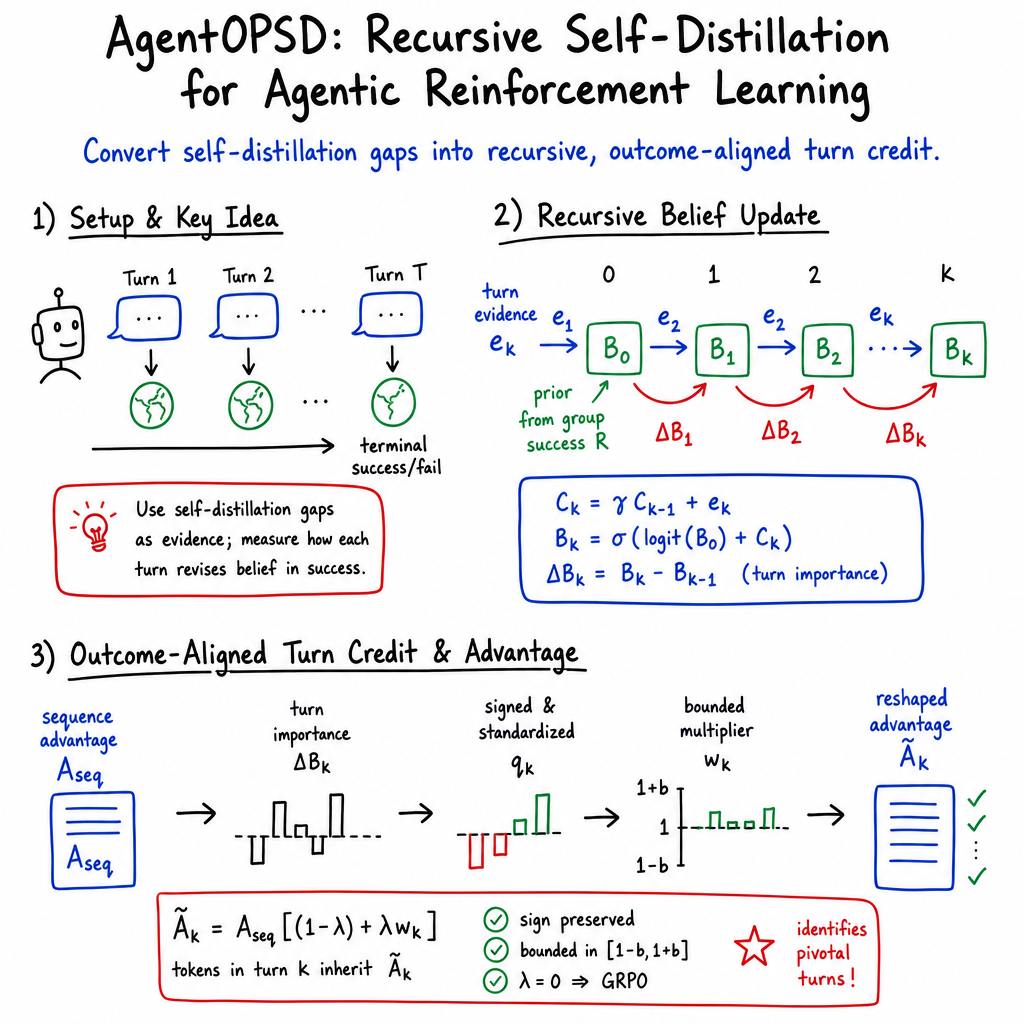
Abstract: Reinforcement learning (RL) with verifiable rewards constructs trajectory-level advantage estimates, yet it often fails to credit the few pivotal decisions that determine outcomes in long-horizon, multi-turn agentic tasks. Recent work introduces privileged self-distillation for credit assignment, providing denser supervision, but it remains unclear how such local signals should represent sequential credit. We propose AgentOPSD, a critic-free, recursive method for turn-level credit assignment in agentic reinforcement learning. AgentOPSD aggregates token-level teacher-student log-probability gaps into turn-level evidence and recursively updates a Bayesian belief state in log-odds space. This yields a principled reweighting scheme that converts sparse outcome supervision into turn-level credit signals and identifies pivotal turns through the marginal belief revision between consecutive states. The method is fully compatible with standard policy optimization and requires neither an additional critic nor extra rollouts. We evaluate AgentOPSD on ALFWorld, WebShop, and Search-QA using Qwen2.5 models at two scales (3B and 7B). AgentOPSD outperforms GRPO and strong self-distillation baselines, achieving 89.1% success on ALFWorld with Qwen2.5-7B. Ablation studies attribute the gains to turn-level aggregation and history-dependent recursive belief updates.
Paper Prompts
Sign up for free to create and run prompts on this paper.
Top Community Prompts
Explain it Like I'm 14
1. What is this paper about?
This paper introduces a new way to train AI agents to make better decisions during long, complicated tasks.
An AI agent might need to complete a task through many steps, such as:
- Finding an object in a virtual house
- Buying the correct product online
- Searching for information to answer a question
The problem is that the agent usually receives only one final score: success or failure. This makes it difficult to know which individual decisions were helpful and which were mistakes.
The paper proposes a method called AgentOPSD. Its goal is to give the AI more detailed feedback about which turns in a long interaction mattered most.
2. What questions are the researchers asking?
The researchers focus on several main questions:
- How can an AI learn which actions were important when it only receives a final success or failure signal?
- Can the AI distinguish an important decision from an ordinary or unnecessary one?
- Can information from earlier turns help the AI judge the importance of later turns?
- Can this be done without training an extra critic model or running many additional simulations?
A simple example is a robot trying to make tea:
- Find a cup.
- Pick up the cup.
- Find a kettle.
- Heat the water.
- Pour the water.
If the task fails, not every step is equally responsible. Perhaps the robot chose the wrong kettle in step 3. AgentOPSD tries to give more learning credit to that important step instead of treating all five steps exactly the same.
3. How does the method work?
The problem with standard training
A common method called GRPO gives an agent a reward after its whole task is finished. It then spreads that reward equally across every word and every turn in the interaction.
This is like a teacher saying:
“You got the whole problem wrong, so every sentence in your solution was equally bad.”
That is often unfair. One decision may have caused the failure, while the other decisions may have been reasonable.
Using a teacher and a student
AgentOPSD uses two versions of the same AI:
- The student is the normal AI making decisions.
- The teacher is given extra information during training, such as a useful strategy or “skill.”
The teacher and student look at the same action. The researchers compare how likely each model thinks that action is.
If the teacher considers an action much more likely than the student does, that action may contain useful information. This difference is called a teacher-student probability gap.
The method first adds up these differences for all the words in one complete turn. This is important because an agent’s decision is usually made across many words, not one word at a time.
Tracking a belief about success
AgentOPSD keeps a running estimate of how likely the whole task is to succeed. This estimate is called a belief state.
For example, the agent’s belief might change like this:
| Turn | What happened | Belief that the task will succeed |
|---|---|---|
| Start | No actions yet | 50% |
| 1 | Found the correct object | 60% |
| 2 | Picked it up successfully | 70% |
| 3 | Took a wrong direction | 40% |
| 4 | Corrected the mistake | 55% |
The important part is not just whether a turn looks good or bad by itself. Instead, AgentOPSD asks:
How much did this turn change the current belief about success?
A turn that increases the belief from 50% to 70% receives strong positive credit. A turn that only changes it from 90% to 91% is less important because success already seemed very likely.
Why use a recursive update?
“Recursive” means that the method remembers earlier evidence and updates its estimate step by step.
For example, suppose an agent has already made several good decisions. A later good decision may be helpful but not especially surprising. However, if the agent has been doing poorly, one excellent decision may be very important because it changes the likely outcome.
The method can also gradually reduce the influence of very old turns, similar to remembering recent events more clearly than events from a long time ago.
Finally, AgentOPSD uses these turn-level scores to adjust the usual reinforcement-learning training signal. It gives more weight to turns that seem important and less weight to routine turns. The adjustment is bounded, meaning it cannot make the learning signal grow without limit or reverse the overall success/failure direction.
4. What did the researchers find?
The researchers tested AgentOPSD on three interactive tasks:
- ALFWorld: completing household tasks in a text-based virtual world
- WebShop: searching for and buying products
- Search-QA: using search tools to answer questions
They used two versions of the Qwen LLM: one with about 3 billion parameters and one with about 7 billion parameters.
Better overall performance
AgentOPSD generally performed better than standard GRPO and several other self-distillation methods.
For example, on ALFWorld with the 7-billion-parameter model:
- Standard GRPO achieved an average success rate of about 81.2%
- AgentOPSD achieved about 89.1%
On the same model, AgentOPSD also achieved:
- About 49.2% average accuracy on Search-QA
- About 90.2% shopping score on WebShop
- About 79.7% shopping accuracy on WebShop
These results suggest that choosing which turns deserve more credit can help agents learn more effectively.
More reliable on long tasks
The method was especially useful when tasks required many turns.
As tasks became longer, standard methods lost performance quickly because they spread the same reward across many decisions. AgentOPSD’s performance decreased much more slowly.
In the ALFWorld experiment, the reported success decline for each extra turn was approximately:
- GRPO: 3.59 percentage points
- AgentOPSD: 0.54 percentage points
This means AgentOPSD was more resistant to the difficulty of long interactions.
The different parts of the method mattered
The researchers removed parts of AgentOPSD to see what happened. On ALFWorld with the 7-billion-parameter model:
| Version | Success rate |
|---|---|
| Full AgentOPSD | 89.1% |
| Using individual tokens instead of whole turns | 85.9% |
| Using only local evidence, without recursive updates | 82.8% |
| Ignoring whether the evidence agreed with the final result | 80.5% |
| Removing the starting success estimate | 78.9% |
These tests show that several design choices were useful:
- Judging complete turns worked better than judging individual words.
- Remembering previous turns worked better than judging each turn separately.
- Knowing whether a change supported the final outcome was important.
- Starting with an estimate based on the group’s success rate helped stabilize training.
5. Why is this research important?
Training an AI agent is similar to coaching a student. If the student receives only a final grade, it may not know which parts of its work need improvement. More detailed feedback can make learning faster and more accurate.
AgentOPSD provides this detailed feedback without requiring:
- A separate critic model
- Many extra attempts or simulations
- A separate distillation-training objective
This could help AI agents perform better in tasks involving websites, computer interfaces, research tools, games, robots, and other environments where decisions happen over many steps.
However, the method also has limitations. Its teacher uses extra information available only during training, and the researchers treat the resulting belief as a useful relative score rather than a perfectly accurate probability. The experiments also cover only three environments and two model sizes, so further testing would be needed.
Overall, the paper’s main idea is simple:
When an AI completes a long task, it should not receive the same amount of credit or blame for every decision. It should learn which turns changed the likely outcome, while remembering what happened earlier.
AgentOPSD is one way to provide that more precise, history-aware feedback.
Knowledge Gaps
Knowledge gaps, limitations, and open questions
- The self-teacher contrast is only theoretically related to the ideal Bayes factor under strong assumptions: the skill-conditioned policy must approximate success-conditional behavior, and the unconditioned policy must be failure-dominated when success is rare. The paper does not empirically test how well these assumptions hold.
- The method uses retrieved skills as a proxy for success-conditioned behavior, but it does not isolate how performance depends on skill quality, retrieval accuracy, coverage, or relevance.
- The paper does not evaluate AgentOPSD with imperfect, noisy, misleading, or automatically generated skills, leaving its robustness to teacher errors unresolved.
- The belief state is explicitly treated as relative support rather than a calibrated probability, but the paper does not measure calibration or determine whether the recursive state correlates with actual conditional success probabilities.
- The empirical group success rate is used to initialize , yet the effects of small group sizes, high-variance group estimates, imbalanced rewards, and all-success or all-failure groups are not systematically analyzed.
- The method’s credit signal is hindsight-based: it evaluates generated actions using a training-only privileged teacher after the trajectory is produced. Whether this signal can identify genuinely causal or counterfactually pivotal turns remains unverified.
- No counterfactual evaluation compares AgentOPSD’s assigned turn credits with the actual effect of removing, replacing, or perturbing individual turns and then continuing the trajectory.
- The claimed interpretation of as turn importance is not validated against human judgments, environment-defined subgoals, causal influence, or independently trained value estimates.
- The decay factor is tested over only a narrow set of values and on a small number of tasks; the paper does not explain how should be selected as a function of horizon, environment dynamics, or observation delay.
- The recursive update assumes that turn-level evidence can be accumulated through a simple geometrically decayed scalar state, but it does not investigate whether multiple types of evidence, correlated turns, branching histories, or non-Markovian dependencies require a richer state representation.
- The Bayesian formulation may double-count correlated evidence across turns, especially when later actions repeat information or depend heavily on earlier generated text. The paper does not quantify or correct for this dependence.
- The approach assumes that environment-aligned turn boundaries are the appropriate temporal unit, but it does not examine tasks with asynchronous feedback, multi-action turns, delayed observations, continuous interaction, or ambiguous action boundaries.
- The method is evaluated only with binary terminal rewards. Its behavior with graded, delayed, deceptive, multi-objective, or partially verifiable rewards is left unexplored.
- The experiments cover three simulated or benchmark environments and only Qwen2.5 3B and 7B models. Generalization to other model families, much larger models, smaller models, multimodal agents, and real-world tools is not established.
- The evaluation does not test robustness to distribution shifts in tasks, environments, tool APIs, website layouts, retrieval corpora, or interaction horizons beyond those represented in training.
- Search-QA is relatively short-horizon, and WebShop results are reported on only 128 fixed validation tasks. The statistical reliability and generality of the reported gains on these settings remain uncertain.
- The paper reports aggregate success and accuracy but does not provide confidence intervals, statistical significance tests, seed variance, or the number of independent training runs.
- Per-category results show substantial variability across ALFWorld subtasks and Search-QA datasets, but the paper does not explain why AgentOPSD helps some categories more than others or when it underperforms competing methods.
- The horizon-robustness analysis relies on an ordinary least-squares slope using the measured mean turns of successful episodes, which may be confounded by task difficulty, selective survival of successful trajectories, and changes in episode length during training.
- The claimed advantage for long-horizon tasks is not tested on systematically controlled environments where horizon, branching factor, distractor density, and location of pivotal decisions can be varied independently.
- The method adds a privileged teacher forward pass, but the paper does not report its wall-clock cost, memory overhead, throughput impact, or energy cost relative to critic-based and additional-rollout methods.
- The paper does not analyze how teacher and student policy drift during training affects the stability or interpretability of the log-probability gap.
- The teacher and student share parameters, but the consequences of parameter sharing, teacher conditioning, teacher detachment, and alternative teacher architectures are not separately evaluated.
- The token gaps are summed across a turn, making the evidence dependent on action length. The paper does not establish whether length normalization, token weighting, or verbosity control would produce more reliable credit.
- The bounded advantage reshaping introduces several interacting hyperparameters, including , the clipping bounds, and the normalization stabilizer. Their joint sensitivity, transferability across environments, and tuning cost are not studied.
- The within-trajectory standardization can become unstable for trajectories with few turns or nearly constant credits; the paper does not characterize these edge cases or compare alternative normalization schemes.
- The method preserves the trajectory-level GRPO update direction by construction, but it remains unclear whether this restriction prevents useful corrections when the terminal reward is noisy, sparse, or inconsistent with intermediate evidence.
- The ablations are primarily reported on ALFWorld with Qwen2.5-7B, so the necessity of each component is not confirmed across model scales, environments, horizons, or random seeds.
- The paper compares against several recent baselines but does not include a learned critic, generalized advantage estimation, counterfactual rollout methods, or stronger causal credit-assignment baselines under matched computational budgets.
- It remains unresolved whether AgentOPSD’s gains arise from recursive credit assignment specifically or from an implicit regularization effect caused by skill-conditioned likelihood contrasts and bounded advantage modulation.
- The method may reinforce stylistic similarity to retrieved skills rather than task-relevant behavior; the paper does not test for spurious skill imitation, reduced behavioral diversity, or dependence on the wording of the skill descriptions.
- The analysis does not investigate failure modes in which the privileged skill is correct but the generated action is contextually inappropriate, or in which a locally skill-consistent action causes long-term failure.
- The paper does not examine whether recursively emphasizing early turns can amplify initial mistakes, especially when later observations would have provided corrective information.
- The relationship between AgentOPSD’s support revision and standard value functions or temporal-difference errors is described conceptually, but no formal equivalence, approximation bound, or convergence analysis is provided.
- The theoretical analysis establishes sign preservation and boundedness of the reshaped advantage, but it does not provide guarantees that the resulting policy update improves expected return or that recursive evidence reduces credit-assignment error.
- The method’s behavior under stochastic environments, stochastic tools, partial observability, and non-deterministic terminal outcomes is not evaluated, despite the Bayesian framing motivating such settings.
- The paper does not study inference-time consequences such as changes in action length, exploration behavior, tool-use frequency, invalid-action rates, recovery from mistakes, or policy entropy beyond a limited training-dynamics plot.
- Reproducibility is limited by the lack of detailed reporting in the main text on random seeds, exact prompts, skill-retrieval failures, task sampling procedures, and implementation choices that may affect the reported results.
Practical Applications
Immediate Applications
- More efficient post-training for long-horizon language agents — software/AI infrastructure. AgentOPSD can be integrated into existing GRPO-style reinforcement-learning pipelines to assign different advantages to interaction turns rather than broadcasting one trajectory-level reward uniformly. This is directly implementable using the released code and requires only a teacher forward pass, not a learned critic or additional environment rollouts. Likely products include training modules for tool-using LLMs, web agents, coding agents, and retrieval-augmented assistants. Dependencies: The environment must provide a verifiable terminal reward; interactions must have clearly defined turn boundaries; GPU memory and the additional teacher inference must be affordable.
- Improved web-shopping and transactional agents — e-commerce. An online retailer could use AgentOPSD to train agents that search catalogs, apply filters, compare products, and complete purchases. The method can emphasize pivotal actions—such as selecting the correct product attribute or recovering from an incorrect page—rather than treating every navigation step equally. The WebShop results provide a direct proof of concept. Dependencies: Reliable success verification is required, such as whether the selected item satisfies the user’s constraints. Deployment should retain confirmation and authorization safeguards before purchases.
- More reliable search and retrieval agents — search, enterprise knowledge management, and customer support. AgentOPSD can train multi-turn agents that issue searches, inspect results, reformulate queries, and synthesize answers. Turn-level credit could identify which query reformulation or evidence-selection step materially improved answer accuracy. This is particularly relevant to multi-hop question answering and enterprise retrieval workflows. Dependencies: Evaluation requires answer verifiers, citation checks, or human-approved correctness labels. The method’s success depends on the privileged skill or teacher branch being meaningfully associated with successful behavior.
- Embodied and household task planning — robotics and smart-home systems. The approach can be applied to text-based or multimodal household agents that plan actions such as locating, cleaning, heating, cooling, and placing objects. The ALFWorld experiments suggest that recursive credit assignment is especially useful as the number of interaction turns increases. A practical workflow would log each observation–action transition, aggregate token-level evidence over the complete action, and use the resulting turn credit during policy training. Dependencies: Real robots require multimodal state representations, safe action execution, simulator-to-real transfer, and verifiable task completion. The paper does not establish performance on physical robots.
- Debugging and training diagnostics for agent trajectories — academia and industry. The belief revision can serve as an interpretable diagnostic indicating which turns most changed the predicted likelihood of success. Researchers and engineers could visualize pivotal decisions, redundant actions, and harmful deviations, supporting prompt design, skill-library refinement, and error analysis. Dependencies: The score is a relative evidential signal rather than a calibrated probability. It should not be treated as definitive causal attribution or as proof that a particular action was necessary.
- Lower-cost reinforcement-learning workflows for smaller models — model development. Because AgentOPSD avoids a learned critic and additional rollouts, it may reduce the engineering and computational burden of training 3B–7B-scale agent models. Organizations with limited compute could use it as a drop-in advantage-reshaping component while preserving the underlying GRPO objective. Dependencies: The extra teacher-conditioned forward pass still incurs cost. The reported gains were obtained on selected benchmarks and may not transfer to arbitrary tasks, model families, or reward structures.
- Curriculum and skill-library analysis — education technology and enterprise automation. Training-only privileged skills can be used to assess which procedural skills help an agent at each stage of a task. For example, an enterprise could identify whether failures arise from search formulation, form completion, tool selection, or final verification, then update its internal skill bank or training curriculum. Dependencies: Skills must be retrieved accurately and must not encode leakage from evaluation data. Since inference in the paper does not use the skills, additional work is needed to determine whether the learned improvements persist across domains.
- Research tooling for comparing credit-assignment methods — academia. The method provides a practical baseline for experiments comparing GRPO, critic-based methods, process rewards, self-distillation, and rollout-based approaches. Its ablations offer concrete tests of turn-level aggregation, recursive history dependence, outcome-aligned sign, and prior anchoring. Dependencies: Further replication is needed across more environments, random seeds, model architectures, and reward types before drawing broad conclusions.
Long-Term Applications
- Safety-critical GUI and workflow automation — healthcare, finance, government, and enterprise software. A future AgentOPSD-based system could train agents to complete multi-step workflows such as insurance claims, clinical scheduling, regulatory forms, or financial operations. Recursive credit could highlight the action that caused a downstream failure and improve recovery behavior over long interfaces. Dependencies: These applications require calibrated uncertainty, audit logs, permission controls, human approval, privacy protection, and robust verifiers. A binary terminal reward is insufficient for safety, legality, fairness, and compliance.
- Autonomous coding and software-maintenance agents — software engineering. AgentOPSD could train coding agents that inspect repositories, formulate plans, edit files, run tests, interpret failures, and revise patches. Turn-level evidence could distinguish pivotal debugging actions from routine tool calls, potentially improving performance on long issue-resolution trajectories. Dependencies: Success verification must combine tests, static analysis, security scanning, code review, and regression evaluation. Real repositories are non-stationary and may contain ambiguous requirements, making the paper’s binary verifier assumption restrictive.
- Long-horizon multimodal and physical robotics — robotics and industrial automation. With further development, the method could assign credit across perception, planning, tool use, and physical manipulation turns in warehouse, laboratory, or service robots. The recursive belief state could help identify when a robot’s observation, grasp choice, or recovery action changed task success probability. Dependencies: The current method is evaluated primarily in text environments. Deployment requires multimodal teacher policies, continuous-action adaptations, delayed physical effects, safety constraints, sensor noise handling, and large-scale real-world data.
- Adaptive educational tutors and instructional agents — education. An educational agent could use recursive credit assignment to learn which explanation, hint, question, or misconception diagnosis most improves a learner’s eventual mastery. This could support personalized tutoring policies rather than optimizing only for immediate answer correctness. Dependencies: Student progress is delayed, noisy, and multidimensional; mastery cannot be reduced safely to a single binary outcome. Ethical use requires privacy safeguards, bias evaluation, teacher oversight, and causal validation with real learners.
- Healthcare decision-support and patient-navigation agents — healthcare. Future systems could train agents that collect symptoms, retrieve medical information, schedule care, and verify follow-up steps. Turn-level credit might help identify information-gathering decisions that materially improve the final recommendation or navigation outcome. Dependencies: The method cannot by itself establish clinical validity or causal safety. Applications require medically validated verifiers, expert supervision, prospective trials, protection of sensitive data, and strict limits on autonomous decision-making.
- Energy and industrial control assistants — energy and manufacturing. Agentic controllers could use recursive credit to learn multi-step procedures for diagnosing equipment, balancing loads, scheduling maintenance, or coordinating industrial operations. The method may be useful where a terminal outcome depends on a long sequence of discrete decisions. Dependencies: Real control systems often have continuous states, partial observability, non-binary objectives, and irreversible failures. Safe deployment would require simulators, constrained or risk-sensitive RL, digital twins, formal verification, and conservative fallback controllers.
- Finance and compliance automation — finance. AgentOPSD could eventually support agents that gather documents, perform multi-step due diligence, reconcile records, and prepare compliance reports. Pivotal-turn attribution could improve training efficiency and help auditors inspect which steps influenced a final classification or report. Dependencies: Financial outcomes are delayed and confounded by external events; verifiable rewards may be difficult to define. Regulatory explainability, data governance, adversarial robustness, and independent human review would be necessary.
- Causal and counterfactual process attribution — policy and operations research. The paper’s belief revisions could inspire tools that estimate which stages of a complex process are most influential, such as public-service applications, supply-chain fulfillment, or incident-response procedures. This could guide resource allocation and process redesign. Dependencies: AgentOPSD uses hindsight-based teacher–student evidence, not true counterfactual intervention. Establishing causal claims would require controlled perturbations, alternative continuations, or additional rollouts.
- Calibrated, risk-sensitive agent control — foundational AI and policy. The recursive belief state could be extended from a relative success-support measure into a calibrated probability or a risk estimate. Such a tool could allow agents to stop, ask for clarification, escalate to a human, or select a safer plan when accumulated evidence becomes unfavorable. Dependencies: The paper explicitly states that is not calibrated. Calibration across tasks, model scales, priors, skill banks, and distribution shifts remains an open research problem.
- Large-scale agent training platforms and standardized benchmarks — AI industry and academia. The method could become a component of agent-training platforms that automatically log turn boundaries, compute teacher–student contrasts, recursively generate credits, and compare horizon robustness across tasks. Standardized benchmarks could evaluate not only final success but also the quality and stability of pivotal-turn attribution. Dependencies: Broader validation is needed beyond ALFWorld, WebShop, and Search-QA. Scaling may expose failure modes involving long contexts, noisy verifiers, teacher bias, skill-retrieval errors, and nonstationary environments.
Glossary
- Advantage estimation: Computing a scalar signal that indicates how much better an action or trajectory performed than a reference baseline. “GRPO assigns Aseq to every token in trajectory i, leaving turn-level credit unresolved.”
- Agentic reinforcement learning: Reinforcement learning in which language-model agents interact with environments through sequences of actions and observations. “We therefore propose AgentOPSD (Recursive Self-Distillation for Agentic Reinforcement Learning), a turn-level credit-assignment method for long-horizon agents.”
- Bayes factor: The ratio of the likelihood of evidence under two competing hypotheses. “The right-hand side is the ideal Bayes factor (Kass & Raftery, 1995) between the success-conditional and failure-conditional likelihoods of ak.”
- Bayesian belief update: Revision of the probability assigned to a hypothesis after incorporating new evidence. “We interpret the per-turn self-distillation gap as new evidence that induces a Bayesian belief update.”
- Belief state: A probability distribution or scalar representation of an agent’s current uncertainty about the underlying situation. “We define the corresponding belief state as the probability that the trajectory will ultimately succeed given the interaction history.”
- Bounded advantage reshaping: Modifying an optimization advantage while constraining the modification to a fixed numerical range. “2.4 BOUNDED ADVANTAGE RESHAPING”
- Calibrated probability: A probability estimate whose numerical value accurately corresponds to the observed frequency of the predicted event. “Since ek is estimated by the self-teacher (§2.2), Bk is treated as relative support rather than a calibrated success probability.”
- Counterfactual contribution: The effect an action would have had if alternative actions or continuations had been taken. “Directly measuring the counterfactual contribution of turn k would require marginalizing the outcome reward over all possible continuations following ak, which is intractable in long-horizon interactions.”
- Critic-free reinforcement learning: Reinforcement learning that does not use a separately learned value or critic network to estimate expected returns. “AgentOPSD restores a per-turn value signal in the critic-free group-relative setting, at the cost of a single teacher forward pass.”
- Credit assignment: Determining which actions or decisions are responsible for an observed reward. “Turn-level credit assignment is therefore essential for identifying the decisions that meaningfully influence the outcome and providing more precise supervision throughout long-horizon interactions.”
- Detached likelihood contrast: A likelihood difference treated as a fixed signal during gradient computation rather than differentiated through. “For token yk,t, define the detached likelihood contrast”
- Discount factor: A coefficient that reduces the influence of older evidence or rewards. “y<1 makes the state recency-weighted, so that evidence from many turns ago no longer pins the support level.”
- Episodic return: The total reward obtained over a complete trajectory or episode. “A K-turn episode forms T = ($1, @1, 01, . . . , SK, ak, OK) and receives a binary outcome reward R(₸).”
- Evidence accumulator: A running quantity that combines evidence across multiple interaction steps. “We therefore maintain a decaying evidence accumulator and measure each turn by how much it revises the current support state”
- Evidence decay: The progressive reduction of the influence of earlier evidence in an accumulated signal. “Turn-level evidence is accumulated with a geometric decay”
- Generalized Advantage Estimation (GAE): A method for estimating policy advantages by exponentially weighting temporal-difference errors. “PPO learns a value function and, via GAE, derives a per-step temporal-difference signals”
- Group-relative policy optimization: Policy optimization that compares sampled trajectories within the same task group to compute relative advantages. “Group-relative policy optimization methods such as GRPO”
- Hindsight-based evidential perspective: An analysis that uses information available after an outcome to estimate the evidential contribution of earlier actions. “We therefore adopt a hindsight-based evidential perspective.”
- Importance ratio: The ratio between the probability of an action under the current policy and under the policy that generated the sampled data. “ri,t is the importance ratio against the rollout policy Teold”
- Intractability: The computational impossibility or impracticality of exactly calculating a quantity at the required scale. “Directly measuring the counterfactual contribution of turn k would require marginalizing the outcome reward over all possible continuations following ak, which is intractable in long-horizon interactions.”
- Log-odds space: A representation of probability using the logarithm of the odds, $\log(p/(1-p))$. “Starting from the average group success rate, it then recursively updates Bayesian belief state at each turn in log-odds space”
- Log-probability gap: The difference between the log probabilities assigned to the same token or action by two policies. “AgentOPSD aggregates token-level teacher-student log-probability gaps into turn-level evidence.”
- Marginal belief revision: The change in a belief state attributable to incorporating one additional step of evidence. “The importance of turn k is its marginal support revision”
- Monte Carlo credit assignment: Estimating intermediate action contributions by sampling and evaluating possible future trajectories. “while process reward models and Monte-Carlo credit methods such as VinePPO estimate intermediate value by additional rollouts or a learned scorer”
- On-policy distillation: Training a policy using trajectories generated by that same policy under the guidance of a teacher. “On-policy distillation trains a policy on its own rollouts under a teacher”
- Partially observable environment: An environment in which the agent cannot directly observe the complete underlying state. “agents must continuously interact with partially observable environments”
- Policy clipping: Restricting policy-update ratios to a specified interval to prevent excessively large optimization updates. “Fixing Elow=0.2 and varying Ehigh € {0.2,0.24, 0.28} (clip-higher (Yu et al., 2025))”
- Policy entropy: A measure of the uncertainty or diversity of a policy’s action distribution. “(c) Policy entropy over training.”
- Privileged information: Information available during training but withheld from the agent during deployment or inference. “its self-distillation variants remove the need for a separate teacher by conditioning the same policy on privileged information available only during training”
- Process reward model: A model that evaluates intermediate reasoning steps or actions rather than only the final outcome. “while process reward models and Monte-Carlo credit methods such as VinePPO estimate intermediate value by additional rollouts or a learned scorer”
- Recursive belief revision: Repeatedly updating a belief state so that each update depends on the state produced by previous updates. “Ablations further confirm the importance of both turn-level signal aggregation and history-dependent belief revision.”
- Sequential credit: Attribution of an outcome to individual decisions while accounting for their order and preceding context. “an isolated self-distillation gap is not, by itself, sequential credit.”
- Sequential testing: Statistical hypothesis testing in which evidence is accumulated as observations arrive over time. “Setting y=1 recovers the undiscounted accumulation of a log-likelihood ratio familiar from sequential testing”
- Self-distillation: Training a model using a version of itself, often conditioned on additional training-only information, as the teacher. “We propose AgentOPSD, a critic-free recursive turn-level credit assignment for agentic reinforcement learning.”
- Sparse terminal reward: A reward provided only at the end of an episode, offering little direct information about intermediate actions. “When rewards are sparse and delayed, return-decomposition methods such as RUDDER redistribute a terminal reward to the steps responsible for it”
- Temporal-difference signal: An estimate of value change based on the difference between successive value predictions and the observed reward. “The belief state plays the role of GAE's value baseline and its per-turn revision the role of the TD signal”
- Teacher-student discrepancy: The difference between the outputs or likelihood assignments of a teacher model and a student model. “they differ primarily in how the skill-induced teacher-student discrepancy enters learning.”
- Trajectory-level advantage: A single advantage value assigned to an entire sampled episode or sequence. “Such uniform credit cannot distinguish a few pivotal decisions from routine operations.”
- Turn-level credit assignment: Assigning learning credit to complete interaction turns rather than to an entire trajectory or individual tokens. “AgentOPSD is a critic-free recursive turn-level credit assignment for agentic reinforcement learning.”
- Verifiable reward: A reward whose correctness can be automatically checked by an environment or outcome verifier. “Reinforcement learning with verifiable rewards has advanced from single-turn reasoning”
- Value baseline: An estimate of expected return used to reduce the variance of policy-gradient updates. “The belief state plays the role of GAE's value baseline and its per-turn revision the role of the TD signal”
- Trust region: A constraint that limits the distance between successive policies during optimization. “indicating that the reshaped objective inherits the trust-region robustness of GRPO.”
Collections
Sign up for free to add this paper to one or more collections.

