What makes prompts a graph: necessary and sufficient conditions for prompt graph engineering
Abstract: Prompts stopped being isolated strings some time ago. In real systems, one model call feeds another, retrieval interleaves with generation, routers branch, and aggregators merge parallel results. Practice converged on a single structure to hold this together: the graph. Frameworks such as LangGraph, DSPy, and Prompt Flow expose it openly, and research systems already optimize it automatically. The vocabulary, however, lags behind. Graph names, variously, a reasoning topology inside one sampling strategy, a multi-agent conversation, or an orchestration artifact, while prompt engineering still evokes writing one good string. What is missing is a reference definition treating prompts as nodes of an explicit, executable, improvable graph. We build that definition through conceptual analysis over sources with persistent identifiers, complemented by primary grey literature. We reconstruct the genealogy of the idea, from dataflow graphs and build systems, through prompt chaining and the thought topologies (chain, tree, graph), to graphs compiled and optimized as artifacts. We then propose a constitutive definition of prompt graph engineering, state its four conditions (explicit structure, separation between structure and prompt content, executable semantics, and the graph as a first-class engineering artifact), and operationalize them as an inclusion and exclusion test. We draw the boundary against six neighboring concepts and apply the test to six real systems (LangGraph, DSPy, Prompt Flow, AutoGen, CrewAI, and Claude Code subagents); it includes and excludes consistently. We close with a research agenda organized along four design tension axes. The contribution is an operational definition and a shared vocabulary for a practice that industry already exercises daily without naming precisely.



Paper Prompts
Sign up for free to create and run prompts on this paper using GPT-5.
Top Community Prompts
Explain it Like I'm 14
Overview
This paper gives a clear, shared definition for how modern AI apps connect many prompts together, not just use one. Instead of a single “magic sentence,” real systems use several steps (like search, plan, route, check) that pass information to each other. The authors call this practice prompt graph engineering: treating those steps as a graph (a map of boxes and arrows) that you can see, run, and improve.
Key Objectives (Research Questions)
The paper sets out to:
- Explain where the “prompt graph” idea came from and how it evolved.
- Give a precise definition with exact conditions for what counts as prompt graph engineering.
- Draw the boundary between this idea and nearby ones (like single‑prompt tricks, chains of thought, agent chats, RAG pipelines, and classic workflow tools).
- Test the definition on real tools and frameworks to see if it cleanly includes or excludes them.
- Suggest a research agenda (open design questions) for the future.
Methods and Approach
To keep things simple: the authors did a careful “concept clean‑up” rather than run new experiments.
Here’s how they worked:
- Genealogy: They traced the idea’s roots from older computing ideas (like dataflow graphs and build systems) to prompt chaining, to “chain/tree/graph of thought,” and finally to today’s practical graph frameworks.
- Concept building: From this history, they distilled a strict definition with four must‑have conditions.
- Inclusion test: They turned that definition into a yes/no checklist.
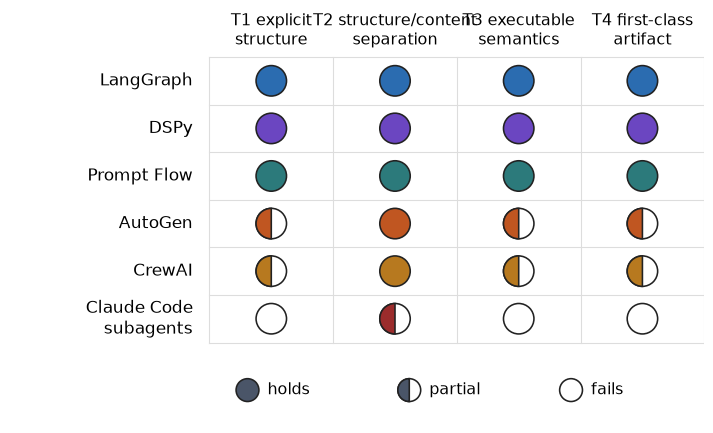
- Case studies: They applied the checklist to six real systems (such as LangGraph, DSPy, Prompt Flow, AutoGen, CrewAI, and Claude Code subagents) to see which ones truly fit.
If “graph” sounds abstract, think of:
- A flowchart for a recipe: multiple steps, some in parallel, some repeated, with arrows showing what feeds into what.
- A subway map: stations (nodes) and tracks (edges) that control where trains can go.
Main Findings and Why They Matter
The paper’s core result is a definition with four conditions. A system is doing prompt graph engineering only if it satisfies all four:
- Explicit structure (G1)
- What it means: The steps are drawn or declared clearly as nodes (like “retrieve info,” “ask the model,” “verify answer”) with arrows showing how data flows.
- Why it matters: You can see the whole plan at once instead of it being hidden in code or chat logs.
- Separation of structure and content (G2)
- What it means: The map (structure) is kept separate from the actual words in each prompt (content). You can change the map without rewriting all prompts, and change a prompt without redrawing the map.
- Why it matters: Reuse and tuning become much easier.
- Executable semantics (G3)
- What it means: The graph actually runs. There’s a runtime that schedules steps, routes outputs, handles branches (if/else), parallel work, and loops.
- Why it matters: It’s not just a picture—it’s a working program that can handle real tasks.
- First‑class artifact (G4)
- What it means: The graph is treated like a real engineering object: you can inspect it, save it, version‑control it, validate it, and optimize it.
- Why it matters: Teams can debug it, compare versions, and even let tools automatically improve it.
Why this is important
- It moves the focus from “write a perfect prompt” to “design a good structure of prompts and tools.”
- It lets people compare different systems fairly and talk the same language.
- It enables better debugging, testing, teamwork, and automation (including auto‑optimizers).
Boundaries: what it is NOT To avoid confusion, the paper shows where to draw the line:
- Not single‑prompt craft: Great wording matters, but one prompt alone is not a graph (fails G1).
- Not “chain/tree/graph of thought” inside one model run: Those are steps the model invents as it thinks; engineers don’t own the nodes (fails G2).
- Not free‑form multi‑agent chats: If the conversation shape just “emerges” without an authored graph, it’s not explicit (fails G1, and often G4).
- Not plain RAG pipelines hidden in code: Hard‑wired steps with no reusable graph object often fail G1/G4. They count only when the flow is an explicit, reusable graph.
- Not classic workflow engines alone: They have graphs, but their nodes aren’t prompt‑parameterized LLM calls with the special behavior that implies.
Applying the test to real systems The authors checked six systems against the four conditions:
- Included (meets all four):
- LangGraph: Strong on running real graphs with state, branches, and loops.
- DSPy: Strong on separating structure and prompt content, plus built‑in optimization.
- Microsoft Prompt Flow: Clear DAGs you can see and run; cycles are limited but core conditions hold.
- Partial (only in some modes):
- AutoGen: When you use GraphFlow (authored graphs), it fits. In free chat mode, it does not.
- CrewAI: Its “Flows” fit; informal crew chats don’t.
- Excluded:
- Claude Code subagents: Subagents are defined, but which one runs when is decided on the fly by the model; there’s no saved, explicit graph to inspect or reuse.
A tiny, concrete example Imagine building a homework helper:
- Step 1 (Retrieve): Search your notes or the web for background.
- Step 2 (Plan): Ask the model to outline how to solve the problem.
- Step 3 (Route): If it’s math, go to the Math Solver; if it’s history, go to the Historian.
- Step 4 (Solve in parallel): Try two different solution paths at the same time.
- Step 5 (Aggregate): Compare the two answers and pick the best one.
- Step 6 (Verify): Check the final answer against rules; if it fails, loop back to Step 3.
That is a graph: nodes for steps, arrows for data/control, possibly a loop for retries.
Implications and Potential Impact
What this means going forward:
- Shared language: Teams can say “this is a prompt graph” and know it meets the four conditions. Less confusion, better design reviews.
- Better engineering: You can version graphs, test them, visualize them, and optimize them—just like other serious software.
- Fair comparisons: Researchers and builders can compare different systems apples‑to‑apples.
- Smarter tools: Optimizers can improve either the wording in nodes or the structure around them because both are explicit.
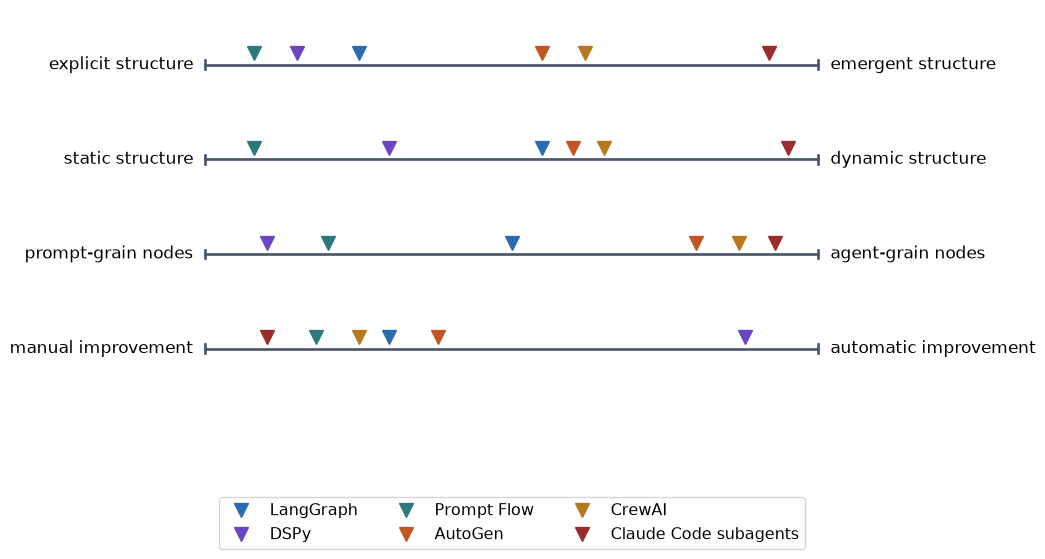
- Research directions: Balance between:
- Explicit vs emergent structure (pre‑planned maps vs flexible, on‑the‑fly flows).
- Static vs dynamic structure (fixed DAGs vs graphs that change per task).
- The paper suggests exploring ways to capture emergent flows and turn them into reusable, optimized graphs.
In short, the paper gives the field a practical test and a shared vocabulary so builders can treat “the graph of prompts” as a real, improvable piece of software—not just a tangle of ad‑hoc calls or chats.
Knowledge Gaps
Knowledge gaps, limitations, and open questions
Below is a consolidated list of concrete gaps and unanswered questions that the paper leaves open for future research to address:
- Empirical validation of the T1–T4 test: conduct inter-rater reliability studies and replication by independent analysts to verify that different raters classify systems consistently using the proposed criteria.
- Quantitative evidence that “graphness” matters: run controlled benchmarks comparing single-prompt, scripted chains, and explicit graphs to quantify effects on quality, latency, cost, robustness, and debuggability across tasks.
- Formal operational semantics for graphs with LLM nodes: define precise execution models (including stochasticity, retries, and side effects), progress/liveness guarantees in cyclic graphs, and conditions for confluence or deadlock-freedom.
- Type systems and static analysis for dynamic graphs: design type/contract systems for data/state carried on edges (including schema for LLM-generated structured/unstructured outputs), with static checks that survive dynamic routing and on-the-fly DAG construction.
- Correctness and validation oracles for text outputs: develop practical, automatable validators beyond exit codes (e.g., semantic equivalence checks, taint analysis for prompt injection, probabilistic guarantees on verifier nodes).
- Reproducibility under stochastic LLM nodes: establish replay semantics (seeding, caching, log-based re-execution) and define what counts as a reproducible run when nodes are inherently non-deterministic.
- From emergent traces to explicit artifacts: methods to capture free-form agent conversations or orchestrator-driven runs into graphs, generalize recurring traces into reusable templates, and close the loop with versioning and optimization.
- Structure learning and synthesis: algorithms that induce both node content and graph topology from demonstrations, telemetry, or weak supervision; define search spaces and priors that make topology induction tractable.
- Joint optimization of structure and prompts: principled multi-objective optimizers that tune graph topology, routing policies, and node prompts simultaneously under quality/latency/cost/risk constraints, with sample-efficiency guarantees.
- Cost and latency models for scheduling: develop predictive models that incorporate rate limits, batching, parallelism limits, and tool latencies to drive cost-aware, deadline-aware schedulers for large graphs.
- Fault tolerance and recovery semantics: define checkpointing, idempotency, and exactly-once/at-least-once guarantees for LLM/tool nodes; specify compensation actions for partial failures in cyclic and parallel regions.
- Standard intermediate representation (IR) and portability: propose a cross-framework IR/serialization (including prompts, routing, state schema, metrics, and provenance) to enable interchange among LangGraph, DSPy, Prompt Flow, and others.
- Benchmark suites for prompt graphs: create shared datasets and task batteries that exercise routing, aggregation, cycles, retrieval, and verification, with standardized metrics for graph-level performance and maintainability.
- Security and safety-by-design: systematic defenses against prompt injection and tool abuse across edges; taint tracking through the graph; privacy-preserving execution (PII handling on edges/state); red-teaming protocols at the graph level.
- Governance and versioning policies: best practices for versioning structure vs node prompts independently, schema migration for state, change-impact analysis, and CI/CD patterns (linting, diffing, canarying) specific to graphs.
- Human-in-the-loop design patterns: guidelines for where to place review/override nodes, how to escalate, and how to operationalize feedback to update prompts or topology; UX for inspecting and editing running graphs safely.
- Evaluation of visual vs code-first authoring: comparative studies on error rates, maintainability, onboarding time, and scalability of changes between canvas-based and programmatic graph authoring.
- Boundary edge cases for the definition: clarify whether model-authored graphs that are serialized before execution satisfy T1–T4; tighten thresholds for “explicit representation” and “artifact status” in borderline systems.
- Integration across layers (graph, harness, loop): formal interfaces between prompt graphs (this paper), agent harnesses, and external loop engineering; proofs of compositionality and contracts across layers.
- Data/state management for LLM outputs: canonical representations, schema evolution, deduplication/caching equivalence under paraphrase, and drift detection for retrieval-heavy graphs.
- Observability and telemetry standards: minimal event schema and metrics (cost, token usage, latency, verifier outcomes) needed for diagnosis and optimization; standard connectors to tracing/eval tools.
- Environmental impact accounting: methods to attribute energy/carbon cost to nodes/edges and to optimize graphs under sustainability constraints alongside accuracy and latency.
- Scalability to very large graphs: distributed execution models, partitioning strategies, and cross-node backpressure for graphs with thousands of nodes and mixed tool/LLM workloads.
- Claims of sufficiency of G1–G4: seek counterexamples or additional necessary conditions (e.g., provenance guarantees) through broader surveys; formalize why no “fifth condition” is required.
- Breadth of application sample: extend the test to serving-layer systems, enterprise orchestrators, and visual builders to stress-test T3 and T4; publish a living registry of classified systems.
- Completion of the research agenda’s four axes: only two axes (explicit vs emergent, static vs dynamic) are articulated in the text provided; specify and analyze the remaining axes and their concrete research questions.
Practical Applications
Immediate Applications
The paper’s constitutive definition (G1–G4) and inclusion test (T1–T4) enable concrete practices you can deploy now, especially where reliability, observability, and compliance matter. Below are actionable use cases, each with sectors, potential tools/workflows, and feasibility notes.
- Governance gate for LLMOps (T1–T4 compliance check in CI/CD)
- Sectors: software, healthcare, finance, public sector
- Tools/workflows: LangGraph/Prompt Flow/DSPy graphs checked in Git; CI steps that fail builds if T1–T4 aren’t met; graph diffs; linting/type checks on node ports
- Assumptions/dependencies: ability to serialize graphs; organizational willingness to treat the graph as a first-class artifact (G4); basic evaluation metrics
- Audit-ready, versioned AI workflows for compliance and risk
- Sectors: healthcare (HIPAA), finance (SOX/GLBA), government (records), EU AI Act readiness
- Tools/workflows: graph registries; LangSmith/Prompt Flow evaluation artifacts; tamper-evident graph manifests; approval workflows for graph changes
- Assumptions/dependencies: graph persistence (G4); secure logging; data retention and privacy policies
- Structure-aware prompt tuning with fixed graphs
- Sectors: customer support, knowledge management, content ops, e-commerce
- Tools/workflows: DSPy-style optimizers (metric-driven prompt compilation); A/B testing prompts per node; per-node success/failure dashboards
- Assumptions/dependencies: measurable task metrics; ability to hold structure fixed while optimizing node prompts (G2)
- Parallelization and cost/latency reduction via explicit dependencies
- Sectors: content generation at scale, analytics reporting, software tooling
- Tools/workflows: LLMCompiler-like schedulers; LangGraph concurrent branches; speculative execution for independent nodes; caching by node
- Assumptions/dependencies: runtime that executes the graph, not ad hoc control flow (G3); safe parallelizable decomposition
- Reusable node and mini-graph libraries (retrieve→generate→verify; route→specialist→aggregate; PII-redact→summarize)
- Sectors: cross-sector; platform teams in enterprises
- Tools/workflows: internal package/index of typed nodes; starter graph templates; code+canvas IDEs
- Assumptions/dependencies: stable node interfaces and typed ports (G1); separation of structure from prompt content (G2)
- Migrate emergent multi-agent chats to explicit flows
- Sectors: software engineering assistants, operations runbooks, sales ops
- Tools/workflows: AutoGen GraphFlow or CrewAI Flows; transcript-to-graph refactoring sessions; “design freeze” of stable flows
- Assumptions/dependencies: ability to reify observed patterns into an authored graph (T1/G4); buy-in to trade some adaptivity for control
- Node-level debugging, tracing, and testability
- Sectors: software, data/ML engineering, education
- Tools/workflows: graph-aware debuggers; node-by-node test harnesses; golden traces for regression tests; failure injection at edges
- Assumptions/dependencies: runtimes that expose graph state and traces (G3/G4)
- RAG modernization: from hardwired code to explicit, optimizable graphs
- Sectors: enterprise search, KM portals, legal/consulting research
- Tools/workflows: retrieve→rerank→generate→verify graphs; adaptive routing; feedback loops for hallucination mitigation
- Assumptions/dependencies: connectors to data sources; evaluation sets for retrieval quality; graph runtime with conditional edges
- Safety-by-design flows with verifiers and human-in-the-loop (HITL) nodes
- Sectors: healthcare, finance, legal, education
- Tools/workflows: toxicity/PII detectors as nodes; voting/aggregation; gated release nodes requiring human sign-off; refusal/rollback nodes
- Assumptions/dependencies: reliable safety classifiers; clear escalation paths; HITL capacity planning
- Product and portfolio management of AI flows
- Sectors: software/SaaS platform teams
- Tools/workflows: catalog of approved graphs; structural A/B tests (router vs. specialist patterns); cost/latency/quality scorecards per graph version
- Assumptions/dependencies: consistent telemetry; ability to run variants side-by-side; governance cadence for retire/upgrade decisions
- Training and assessment for “Prompt Graph Engineer” roles
- Sectors: academia, corporate L&D, hiring
- Tools/workflows: curricula anchored in G1–G4/T1–T4; practical labs (build, execute, optimize, audit a graph); certification rubrics
- Assumptions/dependencies: access to at least one graph-capable framework; sandbox datasets and tasks
- Citizen-developer automations with visual prompt graphs
- Sectors: SMBs, individual knowledge workers
- Tools/workflows: Flowise/Prompt Flow templates for email triage, inbox-to-CRM, travel planning, meeting minutes→action items
- Assumptions/dependencies: safe key management; prebuilt templates; minimal ops burden
Long-Term Applications
The paper’s boundary-setting and test (T1–T4) surface where research can translate into new products, standards, and policies. These require further R&D, scaling, or ecosystem coordination.
- Trace-to-graph compilers (from emergent transcripts to reusable flows)
- Sectors: enterprise software, contact centers, dev tooling
- Tools/products: “conversation-to-graph” compilers; auto-suggested flow refactors; replayable, diffable graphs mined from logs
- Assumptions/dependencies: robust dialogue parsing; privacy-preserving log mining; human confirmation loops
- Interchange standards for prompt graphs (PGML-style schema)
- Sectors: software, cloud platforms, policy/governance
- Tools/products: open schema for nodes/edges/ports/state; provenance and signatures; adapters across LangGraph/Prompt Flow/DSPy
- Assumptions/dependencies: industry consortium; versioning and compatibility policies; security model for signed graphs
- Formal verification and static analysis for prompt graphs
- Sectors: safety-critical domains (health, aviation, gov), finance
- Tools/products: type systems across natural-language payloads; property checks (no PII beyond node X; bounded loops; reachable approvals)
- Assumptions/dependencies: formal semantics for node contracts; annotations of prompts/tools; decidable approximations of NL behaviors
- Automated structure search and multi-objective optimization
- Sectors: platform teams, high-scale operations
- Tools/products: AFlow/GPTSwarm-inspired graph optimizers; search over routers/aggregators/loops; objectives balancing quality, cost, latency, risk
- Assumptions/dependencies: reliable offline metrics or simulators; budgeted exploration; guardrails to prevent unsafe graphs
- SLA-aware runtimes and schedulers for prompt graphs
- Sectors: enterprise SaaS, cloud providers
- Tools/products: cost/latency-aware schedulers; speculative and batched execution; semantic caching keyed by node+prompt+context
- Assumptions/dependencies: fine-grained telemetry; quotas and model policy constraints; cache validity strategies beyond string equality
- Regulatory frameworks that require explicit graphs for high-risk AI
- Sectors: public policy, regulated industries
- Tools/products: “graph audit APIs”; conformity assessment checklists based on T1–T4; audit-ready evidence packages (graphs+traces+evals)
- Assumptions/dependencies: alignment with AI Act/sectoral regs; auditors skilled in graph review; standardized evidence formats
- Certified marketplaces of nodes and graph templates
- Sectors: healthcare, finance, legal, education
- Tools/products: vetted PII redaction nodes, medical summarizers, KYC pipelines; certification labels (accuracy, bias, privacy guarantees)
- Assumptions/dependencies: certifying bodies; monitoring for drift; clear SLAs and indemnities
- Graph-native IDEs with code+canvas, diff/merge, and test coverage
- Sectors: software engineering, education
- Tools/products: structural diffs; node-level coverage/health; property-based tests for graphs; “refactor to subgraph” actions
- Assumptions/dependencies: unified IR for graphs; reproducible test harnesses; UX research for mixed code/visual editing
- Data provenance and reproducibility bundles for research
- Sectors: academia, industrial research
- Tools/products: artifact packages tying graph versions, datasets, model snapshots, evals; “re-run this paper” buttons
- Assumptions/dependencies: long-term artifact storage; model version pinning; license clarity for LLMs/data
- Graph-level security, privacy, and access control
- Sectors: enterprise, government
- Tools/products: RBAC/ABAC at node/edge; policy-as-code for data flows; secrets isolation per node; sandboxing untrusted tools
- Assumptions/dependencies: platform support for isolation; policy engines integrated with runtimes; compliance mappings
- Domain playbooks and skeleton graphs
- Sectors: robotics (plan→act→verify), energy (forecast→optimize→dispatch→monitor), clinical ops (ingest→triage→summarize→HITL→file)
- Tools/products: domain-specific skeletons with pluggable nodes; typed contracts for instruments/EMRs/SCADA
- Assumptions/dependencies: domain expertise; integration adapters; safety cases per domain
- Self-adaptive graphs under constraints (safe autonomy)
- Sectors: operations, robotics, incident response
- Tools/products: graphs that modify routing/structure online within declarative safety constraints; “learning graphs” with rollback
- Assumptions/dependencies: verifiable guardrails; continuous evaluation; robust state management
Notes on Feasibility
- Core dependencies across applications include: availability of graph-capable runtimes (G3), ability to serialize and version graphs (G4), separation of structure/content (G2) to enable reuse and tuning, and explicit node/edge representations (G1) to allow inspection and optimization.
- Organizational adoption hinges on treating graphs as first-class engineering artifacts: code review, version control, testing, and observability must extend to the graph.
- Optimization-centric applications require trustworthy task metrics; safety-centric applications require reliable detectors and clear escalation/approval processes.
- Ecosystem-level advances (standards, regulation, certification) depend on multi-stakeholder coordination and may lag technical readiness.
Glossary
- ADAS: A system for automatically searching and optimizing agent designs expressed in code. "ADAS searched the space of agent designs in code"
- AFlow: A framework that explores and optimizes workflow graphs, often via search methods. "AFlow searched workflow graphs by Monte Carlo tree search"
- acyclicity: The property of a graph having no cycles; noted as not required for prompt graphs. "It does not require acyclicity: cycles with exit conditions are constitutive of reflection and retry loops"
- aggregator: A node that merges multiple outputs, often by voting or consensus. "an aggregator that votes on their outputs"
- agent harness: The runtime layer that equips an LLM with agent capabilities. "the agent harness, the runtime that turns an LLM into an agent"
- agent orchestration: The design and control of how agents interact and coordinate within a system. "agent orchestration, prompt programming, RAG pipelines, and classic workflow engines"
- agentic workflows: Workflows where task execution is driven by agent-like components (often LLM-based). "agentic workflows"
- build systems: Tools that express software builds as dependency graphs to manage reproducible compilation. "from dataflow graphs and build systems"
- chain-of-thought: A prompting technique where the model produces step-by-step intermediate reasoning. "Chain-of-thought made the model produce a linear sequence of intermediate steps within a single generation"
- checkpointing: Persisting execution state so graphs with loops/interruptions can resume reliably. "with cycles, branching, interrupts, and checkpointing"
- conditional edges: Graph edges that route execution based on conditions or state. "including conditional edges"
- compound AI systems: Architectures built from multiple interacting components (retrievers, model calls, tools). "compound AI systems names the broad class of systems that tackle AI tasks with multiple interacting components"
- constitutive definition: A definition that states necessary and sufficient conditions for membership in a concept. "We then propose a constitutive definition of prompt graph engineering"
- DAG (Directed Acyclic Graph): A graph with directed edges and no cycles, commonly used for scheduling computations. "function-call DAGs that schedule in parallel"
- dataflow: A computation model where nodes fire when inputs arrive and edges carry data between nodes. "Dataflow models represented a program as nodes that fire when their inputs arrive"
- declarative pipelines: Workflows specified by what should happen rather than how to execute it, often compiled to runtimes. "declarative pipelines that compile"
- decomposed prompting: An approach that breaks a task into subproblems solved by specialized prompts/handlers. "decomposed prompting made the move architectural"
- Demonstrate-search-predict (DSP): A pattern that composes retrieval and generation into structured pipelines. "Demonstrate-search-predict composed retrieval and generation into declarative pipelines"
- emergent interaction: Behavior or flow that arises dynamically during execution rather than being pre-authored. "the interaction shape emerges turn by turn"
- executable semantics: A well-defined runtime meaning that lets a graph be scheduled, routed, and state-managed. "the graph has executable semantics, a runtime that schedules nodes, routes outputs, and manages shared state"
- explicit structure: A concrete representation of nodes and edges that can be inspected independently of execution. "explicit structure, separation between structure and prompt content"
- first-class engineering artifact: An object that can be inspected, versioned, validated, and optimized independently. "the graph as a first-class engineering artifact"
- flow engineering: A practice naming the shift from single prompts to structured flows of calls (without strict conditions). "flow engineering, coined for the code-generation flow of AlphaCodium"
- genealogy: The historical development and lineage of an idea or practice. "We reconstruct the genealogy of the idea"
- graph-of-thoughts: A reasoning approach where intermediate thoughts form arbitrary graph structures. "graph-of-thoughts generalized the shape to arbitrary graphs where thoughts merge, refine, and loop"
- graph-structured retrieval: Retrieval that leverages graph relationships to supply context to LLMs. "graph-structured retrieval couples the two worlds further"
- grey literature: Practice-oriented sources (e.g., product docs, blogs) outside peer-reviewed venues. "complemented by primary grey literature."
- human-in-the-loop: Involving human decisions or interventions during execution. "human-in-the-loop interrupts"
- inclusion and exclusion test: A concrete decision procedure to determine concept membership. "and operationalize them as an inclusion and exclusion test."
- instruction tuning: Training models to follow instructions reliably across tasks. "instruction tuning made that steering reliable enough to build on"
- least-to-most prompting: Solving a complex task by chaining solutions to simpler subproblems. "Least-to-most prompting solved a hard problem by chaining the solutions of its subproblems"
- LMQL: A language to structure LLM calls and constraints programmatically. "LMQL and PDL made calls and constraints part of a language"
- LLMCompiler: A system that builds/schedules computation over LLM calls as dependency DAGs. "LLMCompiler scheduled function calls as a dependency DAG"
- Make: A classic build tool that encodes builds as dependency graphs among targets. "Make expressed a build as a dependency graph among targets"
- Monte Carlo tree search: A stochastic search algorithm used to explore workflow/design spaces. "by Monte Carlo tree search"
- multi-agent systems: Systems with multiple interacting LLM-based agents collaborating via roles and messages. "Multi-agent systems composed role-played model instances into conversations"
- offloading: Executing parts of a workflow as code/tools rather than model sampling. "Offloading turned nodes heterogeneous: a node could run code rather than sample a model"
- operational definition: A definition oriented toward practical, testable criteria for use. "The contribution is an operational definition"
- optimization lineage: Research stream that treats prompts/workflows as search spaces to be optimized. "And the optimization lineage treats prompts, and lately whole workflows, as search spaces"
- orchestration frameworks: Systems that let engineers author, run, and manage structured LLM workflows. "In orchestration frameworks it names an authored artifact, drawn or coded by an engineer, that a runtime executes."
- orchestrator model: A controlling model that decides delegation/routing at runtime. "decided by the orchestrator model at runtime"
- PDL: A programming language for declaratively composing LLM calls and constraints. "LMQL and PDL made calls and constraints part of a language"
- pre-train, prompt, and predict paradigm: A workflow framing for using pretrained LLMs via prompts to make predictions. "from the pre-train, prompt, and predict paradigm"
- probabilistic cascades: Structured compositions of model calls with probabilistic control/branching. "probabilistic cascades over model calls"
- probabilistic programs: Programs whose execution involves probabilistic choices, here across LLM calls. "framed multi-call compositions as probabilistic programs"
- prompt engineering: The craft of designing effective prompts, often for single-shot use. "prompt engineering still evokes the craft of one good string."
- prompt graph engineering: The practice of representing and executing prompt-mediated computation as explicit graphs. "Prompt graph engineering is the discipline that represents, composes, and executes prompt-mediated LLM computation as an explicit graph"
- prompt-parameterized model invocations: LLM calls whose behavior is controlled by authored prompt content. "prompt-parameterized model invocations or deterministic transforms"
- RAG pipelines: Retrieval-Augmented Generation flows that retrieve context before generation. "RAG pipelines are an instructive partial case"
- retrieval step: The stage that fetches relevant context for subsequent model calls. "There is a retrieval step that fetches context"
- runtime: The executor that schedules nodes, routes data, and manages state for a graph. "a runtime that schedules nodes, routes outputs, and manages shared state"
- scientific workflow systems: Platforms for composing, sharing, and auditing complex computational experiments. "scientific workflow systems scaled the pattern to entire experiments"
- self-consistency: Sampling multiple reasoning chains and aggregating their answers by voting. "self-consistency sampled many chains in parallel and voted"
- separation between structure and prompt content: A design principle keeping graph topology independent from node prompt text. "separation between structure and prompt content"
- scheduler: A component that exploits graph-exposed parallelism to run nodes efficiently. "a scheduler that exploits the parallelism the edges reveal"
- shared state: A mutable representation carried across nodes for coordination and memory. "manages shared state"
- skeleton-first strategies: Methods that build a high-level outline before parallel elaboration. "skeleton-first strategies that parallelize expansion"
- state machine: An explicit control model over states and transitions for task flows. "and explicit state machines"
- thought topologies: Structural patterns (chain, tree, graph) of intermediate reasoning steps. "The taxonomies of thought topologies compare chain, tree, and graph as shapes of intermediate reasoning"
- tree-of-thoughts: A strategy that treats reasoning as a search over branching partial solutions. "tree-of-thoughts turned generation into search over a branching space of partial thoughts"
- type checker: A tool that validates types or interfaces before execution. "nothing to type-check before running it"
- typed ports: Explicit, typed inputs/outputs on nodes to make dependencies checkable. "typed ports that make dependencies checkable"
- versioning: Managing and tracking graph artifacts across revisions. "serialization, visualization, versioning, evaluation, and optimizers"
- visualization: Rendering graph structures for inspection and debugging. "serialization, visualization, versioning, evaluation, and optimizers"
- YAML-declared DAG: A workflow specified as a DAG in YAML configuration files. "A flow is a YAML-declared DAG of prompt nodes and tool nodes"
Collections
Sign up for free to add this paper to one or more collections.

