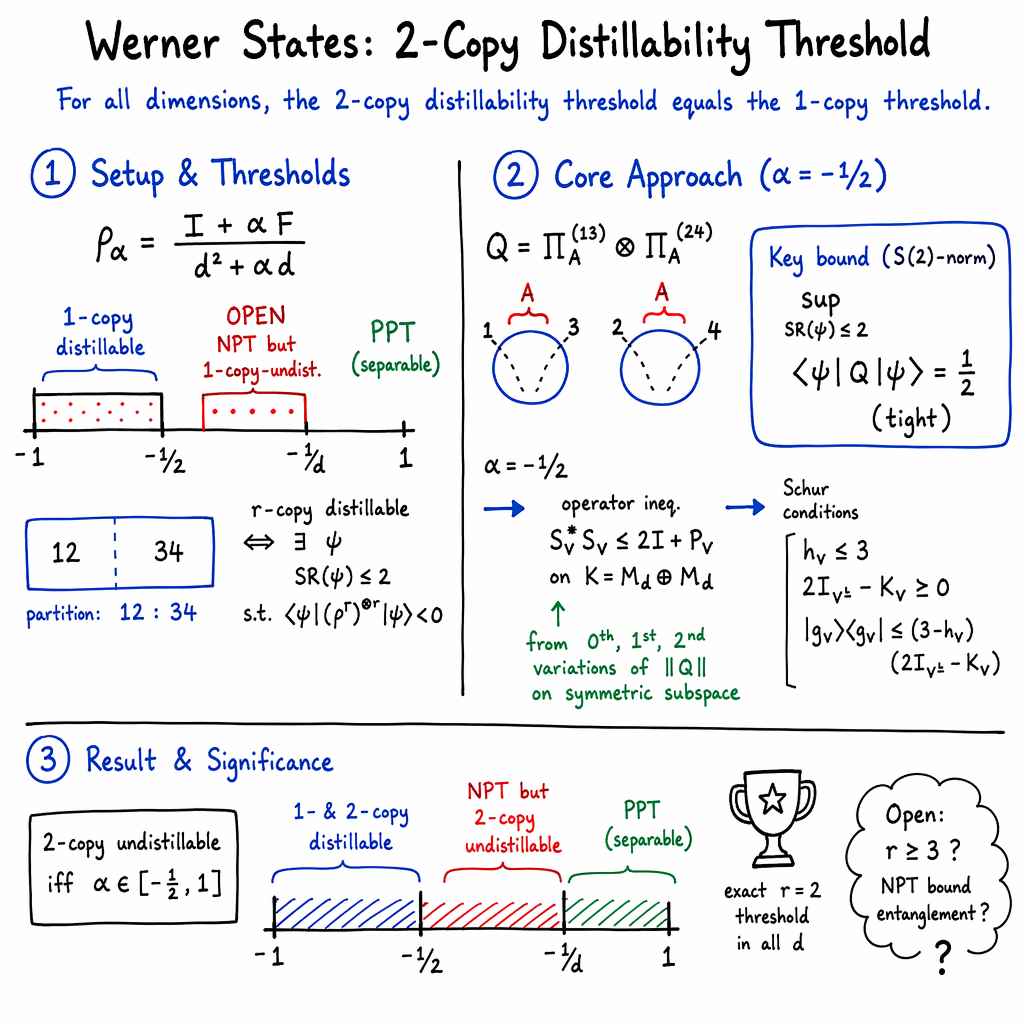
- The paper establishes that for any local dimension d, Werner states are 2-copy distillable if and only if they are 1-copy distillable, with a sharp threshold at α = −1/2.
- It employs a novel analytic approach using sharp operator inequalities derived from the geometry of symmetric and antisymmetric tensor subspaces.
- The work resolves longstanding ambiguity in the distillability of NPT Werner states and sets a new baseline for resource allocation in quantum information protocols.
Exact Solution to 2-Copy Distillability of Werner States
Introduction
The distillability of entangled quantum states, particularly in relation to the Non-Positive Partial Transpose (NPT) condition, constitutes a central question in quantum information theory. Werner states, parameterized by a real α, serve as a canonical testing ground for this problem because the general NPT distillation question can be reduced to their analysis. While the criteria for 1-copy distillability and full separability of Werner states are fully understood, the case of 2-copy distillability—especially in the range where states are NPT but 1-copy undistillable—has resisted analytic resolution for over two decades. This work provides a complete analytic solution, demonstrating that, for any local dimension d, a Werner state is 2-copy distillable if and only if it is 1-copy distillable, uncovering a sharp threshold at α=−1/2.
Distillability and Main Theorem
Entanglement distillation refers to the task of transforming several copies of a noisy entangled state into a smaller number of nearly maximally entangled pairs using only LOCC. A mixed bipartite quantum state ρAB is r-copy distillable if there exists a Schmidt-rank-at-most-two vector ∣ψ⟩ such that
⟨ψ∣(ρABΓ)⊗r∣ψ⟩<0
where Γ denotes the partial transpose.
Werner states are defined as
ρα=d2+αdId2+αFd,α∈[−1,1]
where Fd is the flip operator. For all d0, Werner states are PPT, and hence separable, for d1. They are 1-copy distillable if and only if d2. The previously unresolved regime is the NPT, 1-copy-undistillable interval d3.
This work closes the 2-copy question by proving:
Theorem:
For every d4, the Werner state d5 is 2-copy undistillable if and only if d6. That is, the 2-copy threshold coincides exactly with the 1-copy threshold.
Consequences:
- No NPT Werner state with d7 is 2-copy distillable.
- If distillability exists in this interval, at least three copies are necessary.
Technical Approach and Operator Inequality
The analytic proof hinges on a sharp operator inequality deriving from the geometry of symmetric and antisymmetric tensor subspaces. The crux is the action of the tensor antisymmetric projector
d8
on bipartite vectors of Schmidt rank at most two.
The main estimate is:
d9
This bound is independent of the local dimension α=−1/20 and is achieved by a specific choice of Schmidt-rank-two vector.
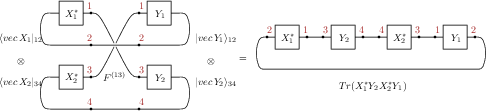
Figure 1: A graphical proof of the key contraction identity involving the flip operators, foundational in the reduction steps for the main operator inequality.
To show that α=−1/21 is 2-copy undistillable, the distillability condition is rephrased as an operator inequality that, after reduction, boils down to a block-matrix Schur complement problem. Each component of this block matrix (diagonal, off-diagonal, transverse) is connected to the value, first, and second variations of the Hilbert–Schmidt norm of the antisymmetric projection restricted to a suitable symmetric subspace. The maximal value of α=−1/22 for the α=−1/23-norm of the projector α=−1/24 is critical in closing the analytic argument.
Implications and Comparison with Previous Work
The analytic determination that the 2-copy threshold matches the 1-copy threshold for all α=−1/25 removes a major ambiguity in the structure of distillable Werner states. Notably, this result tightens or resolves special cases (α=−1/26, α=−1/27) previously approached only by numerics, semidefinite programming, or partial algebraic results.
The proof's geometric reduction, focusing on the interplay between symmetric and antisymmetric tensor subspaces, offers a new perspective on the manipulation of Schmidt-rank constraints and their connection to operator norms, potentially informing further inquiries on α=−1/28-norms, Schmidt-number witnesses, and higher-copy positive maps.
Practically, the result signals that, in LOCC protocols based on finite-copy operations, two copies of a Werner state in the NPT regime with α=−1/29 provide no more power in distillation than one, establishing a new baseline for resource allocation in quantum information protocols.
Open Problems and Future Directions
While this result rules out 2-copy distillation in the crucial range, the question of 3-copy (or higher) distillability for NPT, 1-copy-undistillable Werner states remains open. This directly relates to whether NPT bound entanglement exists for the Werner family, i.e., if there are NPT states that are undistillable for all finite ρAB0. Extensions of the analytic techniques here, perhaps drawing further on geometric or tensor-operator inequalities, may illuminate or eventually solve these higher-copy cases.
Beyond Werner states, the methods introduced—especially the tie between antisymmetric projection norms and operator inequalities—may find application in broader nonlocality and entanglement classification tasks within quantum information theory.
Conclusion
This paper achieves a comprehensive analytic solution to the 2-copy distillability problem for Werner states in all local dimensions, establishing the precise threshold and demonstrating the non-activation of distillability at the second-copy level. The geometric and analytic techniques developed provide new tools for further exploration in the theory of entanglement distillation, operator norms, and the elusive question of NPT bound entanglement. The implications for both theoretical understanding and protocol design in distributed quantum information processing are substantial.