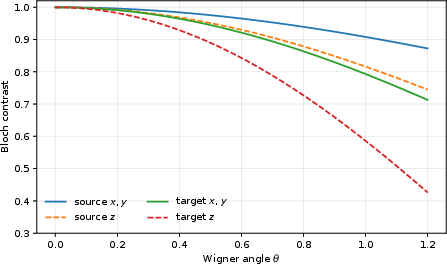
- The paper demonstrates that fixed-boost Wigner noise leads to strict trace-distance contraction between spin channels while violating CPTP degradability.
- The paper analytically parametrizes inversion-symmetric Pauli channels, quantifying deficiencies with an exact diamond-norm measure.
- The paper reveals that observable monotonic decay in trace distance does not imply a full quantum resource ordering, highlighting the need for complete process and Choi analyses.
Fixed-Boost Wigner Noise and the Limits of Trace-Distance Ordering in Quantum Channels
Overview and Context
This paper, "Fixed-Boost Wigner Noise: Strict Trace-Distance Contraction without Quantum Degradability" (2607.12994), investigates the quantum information-theoretic properties of spin decoherence channels generated by Lorentz boosts on massive spin-21 particles. The focus is on the interplay between operational distinguishability of spin states and the structure of quantum channels arising in relativistic scenarios, emphasizing situations where trace-norm contraction does not imply the existence of a post-processing CPTP map (degradability) between reduced channels.
Characterization of Fixed-Boost, Inversion-Symmetric Spin Channels
The framework begins with Lorentz boosts applied to product-prepared spin-momentum states. Utilizing Wigner rotations, the reduced spin dynamics after tracing over uncertain but calibrated momentum distributions are modeled as convex combinations of unitary conjugations. The resulting qubit channels are unital and have Bloch matrix representations explicitly constructed from symmetrized probability distributions on transverse momentum directions, at a fixed Wigner angle.
A central analytical contribution is the full parametrization of the exact convex cone of inversion-symmetric channels obtainable by averaging over fixed-magnitude transverse Wigner rotations. Within this cone, specific analytic families of diagonal channels of the Pauli form are identified:
Mα=diag(1−α,1−α,1−2α),0≤α<21.
This structure, unique to fixed observer boosts and physically relevant pure state momentum preparations, provides the foundation for the subsequent comparison theorems.
Monotonicity without Degradability: Construction and Analysis
The core phenomenon established is the existence, for any 0<α<β<21, of pairs of distinct spin channels Φα and Φβ (both in the above family) such that:
- All binary spin-state trace distances contract strictly more under Φβ than under Φα:
∥Φβ(ρ)−Φβ(σ)∥1<∥Φα(ρ)−Φα(σ)∥1for all ρ=σ.
This result separates “observable monotonicity”—unconditional decay of state distinguishability—from the quantum resource-theoretic Blackwell order, which demands the existence of a physical post-processing channel. Therefore, although every operational binary trace-norm test demonstrates an ordering, the full quantum information structure is not monotonic.
Quantitative Deficiency and Its Operational Meaning
The paper proceeds to derive the exact directed CPTP post-processing deficiency (the diamond-norm optimal error) between Mα=diag(1−α,1−α,1−2α),0≤α<21.1 and Mα=diag(1−α,1−α,1−2α),0≤α<21.2, showing
Mα=diag(1−α,1−α,1−2α),0≤α<21.3
which quantifies by how much the simulated channel falls short when attempting to physically post-process Mα=diag(1−α,1−α,1−2α),0≤α<21.4 into Mα=diag(1−α,1−α,1−2α),0≤α<21.5.
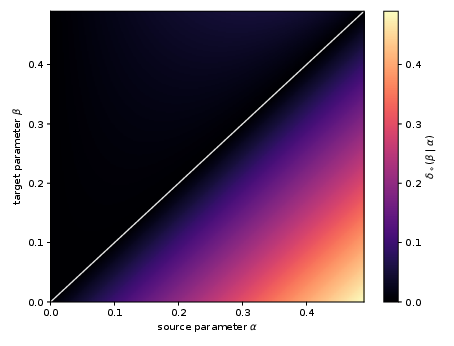
Figure 2: Exact directed CPTP deficiency Mα=diag(1−α,1−α,1−2α),0≤α<21.6 on the Pauli line. The diagonal is the only zero set in the positive-noise interior; the edge Mα=diag(1−α,1−α,1−2α),0≤α<21.7 is also zero because every target is a post-processing of the identity.
This deficiency provides a direct operational meaning via channel discrimination: the excess success probability over random guessing for distinguishing Mα=diag(1−α,1−α,1−2α),0≤α<21.8 from any post-processed Mα=diag(1−α,1−α,1−2α),0≤α<21.9 is exactly 0<α<β<210.
Robustness: Wave Packets, Tomography, and Model Error
Analytic results are shown to persist beyond idealized sharp-momentum preparations. The strict contraction/no-go effect extends to open neighborhoods of the fixed-boost Pauli line under perturbations from finite-width, normalizable wave packets—even under model or tomographic error. Explicit quantitative stability radii are provided. For instance, small confidence intervals on Bloch matrix entries derived from finite-shot process tomography can certify non-degradability if they exclude the Pauli-Markov semigroup region.
Failure of Markovian Semigroup Embedding
A complementary impossibility result is established: none of the nontrivial fixed-boost Pauli channels can be realized as positive-time points in a time-homogeneous, Pauli-diagonal Lindblad semigroup. The necessary Markov-embedding inequality, 0<α<β<211, is violated everywhere except at the identity channel.
Analytic Description of Nondegradability Margin
The negative Choi eigenvalue, which quantifies the margin by which the candidate post-processing map fails to be CPTP, is computed exactly and illustrated throughout the strict interior of the (trace-distance) contraction-ordered region.
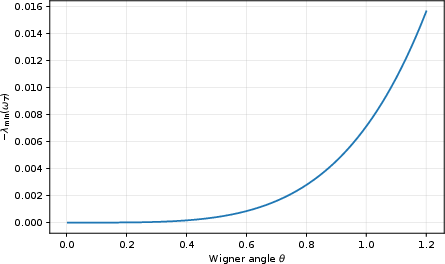
Figure 3: Analytic nondegradability margin from the explicit negative Choi eigenvalue formula; the effect persists for every nonzero Wigner angle and every 0<α<β<212.
Implications and Outlook
This work rigorously demonstrates that, within fixed-relativistic kinematics, total ordering of all pairwise spin-state trace distances does not induce a corresponding CPTP information ordering of the channels. This uncovers a critical and subtle limitation of using observable monotonicity as a surrogate for operational quantum noise ordering, even in natural physical constructions.
Practically, the results imply that experimental or process-tomographic identification of spin-damping in relativistic quantum systems must not infer degradability (and the feasibility of reversed or simulated noise) solely from decay curves or trace-norm comparisons; full process or Choi analyses are essential.
Theoretically, these findings expose the inherent incompleteness of local distinguishability monotones as quantum resource orderings in relativistic noise. Extensions to higher spins, more complex momentum correlations, or different symmetry classes represent meaningful directions for further work.
Conclusion
The paper provides a comprehensive analytic treatment of fixed-boost Wigner spin noise, showing a strict separation between operational monotonicity and quantum degradability. The construction, stability, and certificate results not only generalize known information-theoretic orderings but highlight the necessity for refined quantum resource monotones in relativistic contexts. As such, monotonic decay of all binary spin contrasts does not characterize the information ordering of relativistic quantum channels even under strict physical constraints.