Hilbert Operator for Progressive Encoding (HOPE): A Mathematical Framework for Deconstructing Learned Representations in Deep Networks
Published 23 Jul 2026 in cs.LG, cs.AI, and stat.ML | (2607.21366v1)
Abstract: Deep neural networks encode complex representations, but deconstructing this internal knowledge remains a challenge. Given the link between learning and compression, network compression offers a promising lens to analyze this knowledge. However, standard compression heuristics often suffer from scale symmetries and architectural biases. To resolve these, we introduce Hilbert Operator for Progressive Encoding (HOPE), a mathematical framework to gradually deconstruct the representations in trained network weights. HOPE shifts network compression from the discrete domain into a Hilbert space of continuous functions. By modeling individual neurons as rank-1 Hilbert-Schmidt operators, HOPE unifies pruning and neuron merging as low-rank subspace projection. Extending this formulation, HOPE introduces macro block eviction to encompass multi-layer structures like entire residual pathways under the same unified metric. This unified approach enables unbiased architectural decisions across layers with different types and sizes. HOPE is a data-free and hyperparameter-free framework. We present proof-of-concept experiments in model compression and fine-tuning to highlight the practical potential of our theory.
The paper introduces HOPE, a framework that models neurons as Hilbert-Schmidt operators, enabling progressive encoding for systematic model compression.
It leverages closed-form kernel evaluations and surrogate BN statistics to measure functional capacity, ensuring scale invariance and data-free analysis.
Empirical results on ResNet-50 and cross-domain tasks demonstrate HOPE’s effectiveness in balancing source retention with target accuracy for continual learning.
Hilbert Operator for Progressive Encoding (HOPE): A Mathematical Framework for Deconstructing Learned Representations in Deep Networks
Motivation and Theoretical Framework
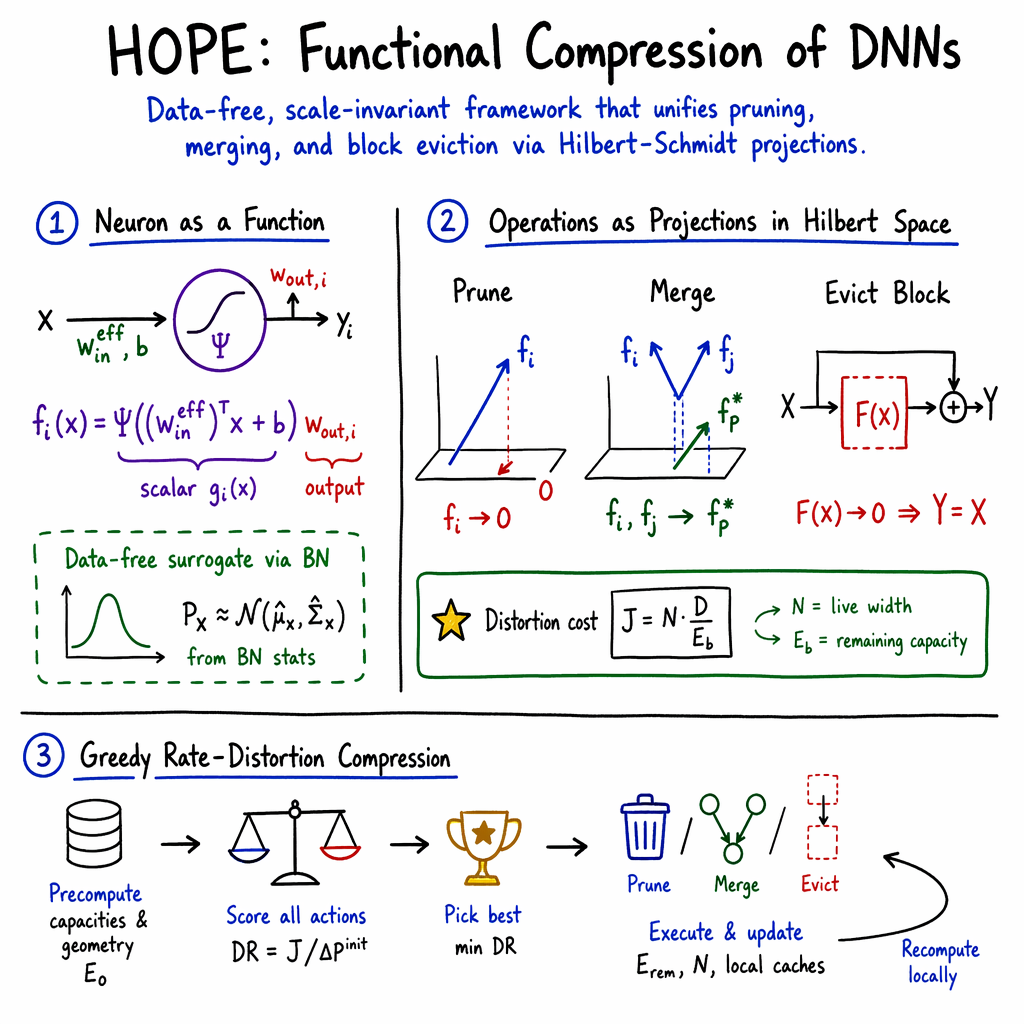
Deep neural networks learn high-dimensional representations, but extracting interpretable and generalizable structure from their trained weights is an unresolved challenge. The paper introduces HOPE, a data-free, hyperparameter-free framework for model compression and representation deconstruction that provides formal invariance to scale symmetries and architectural biases. Central to HOPE is the idea of departing from discrete parameter heuristics and empirical data dependence by embedding neurons as rank-1 Hilbert-Schmidt operators in a functional Hilbert space. This operator-theoretic formulation allows pruning and neuron merging to be cast as optimal low-rank projections, unifying compression actions as geometric transitions in function space. In doing so, HOPE is formulated as progressive encoding: a sequence of architectural reductions that iteratively exposes foundational cores and discards malleable slack, reflecting both the information-theoretic principles of learning-as-compression and the explicit separation of invariants from task-irrelevant redundancy.
Utilizing surrogate data distributions derived from batch normalization (BN) statistics and the Maximum Entropy principle, HOPE analytically evaluates neuronal capacity and cross-correlations without empirical dataset passes. For networks without BN, a lightweight calibration over a small batch is sufficient. The theoretical apparatus exploits Gaussian approximations and the Diaconis-Freedman effect, recognizing that pre-activations in wide networks are effectively Gaussian irrespective of real data manifold complexity. Functional importance and redundancy are thus measured in the ambient Hilbert space, abstracting away from parameter artifacts and empirical sample dependence.
Mathematical Formalism and Compression Operations
Hilbert-Schmidt Operators and Functional Capacity
Each neuron is modeled as a tensor product of its scalar input function and vector output. The ambient space is H=L2(X,PX;Rc), and the capacity of a neuron is defined as the Hilbert-Schmidt norm, ∥fi∥H=∥wout,i∥2K(i,i), where K(i,i) encapsulates functional signal energy over the surrogate distribution. Capacity evaluation is provably invariant to within-neuron scale symmetries and architectural shape: the functional criterion cancels scaling artifacts from BN and cross-layer weight resharding.
Kernel-Based Evaluation of Neuron Interactions
Pruning and merging decisions are governed by closed-form kernel evaluations, leveraging the properties of PH-1 activations and Gaussian inputs. For ReLU neurons, analytic expressions for both self-kernel and cross-kernel are derived, with cross-neuron redundancy measured via a warped correlation. This yields fast, data-free estimation of functional similarity, enabling optimal projection of neuron pairs for merging, or null projections for pruning.
Layer Transition Costs and Action Selection
HOPE introduces a scale-invariant distortion cost J, defined axiomaticaly via a continuous-time relaxation and grounded in information-theoretic and geometric principles. The cost penalizes capacity reduction with a logarithmic barrier preventing total layer extinction, and is bounded above by discrete projection distance normalized against the remaining capacity. This framework supports arbitrary structural reductions—prune, merge, or block eviction—using a single cost criterion, unbiased across layers of heterogeneous shapes and sizes.
Compression actions are selected via a greedy, receding-horizon knapsack optimization. The distortion rate (cost per parameter removed) J/ΔP is minimized globally, with parameter yields computed statically to avoid dynamic bias. This ensures the selection process is fair and DR ordering is preserved, independent of layer type or downstream state.
Block Eviction: Unified Macro Compression
HOPE formalizes macro-level architectural actions by extending the layer state to include parallel identity pathways, as in residual blocks. Eviction forces all internal pathway operators to zero, reducing the block to an identity mapping and avoiding information loss from uncalibrated bias injection. The macro cost is evaluated linearly against the RMS energy of the skip connection, enabling architectural decisions to compete directly against granular pruning/merging in the unified action space, and mitigating infinite penalties from layer extinction.
A direct application of HOPE's capacity measurement is in continual learning and transfer, enabling explicit resolution of the stability-plasticity dilemma. DEFT partitions networks into frozen universal cores and plastic slack by thresholding the Hilbert-Schmidt capacity, and structurally masks connections from plastic to frozen regions. Redundancies in core features are dynamically resolved via tensor merging, releasing parameter vessels for target adaptation. The framework provides bounded guarantees on source representation drift: initialization shock and dynamic decoupling are strictly controlled, ensuring the cumulative degradation cannot compound uncontrollably across layers.
Empirical results demonstrate that DEFT achieves optimal tradeoff in H-Score (harmonic mean of source retention and target accuracy), outperforming standard full fine-tuning, head-only adaptation, BN-tuning, and Fisher-based EWC approaches. This validates both the theoretical partitioning of capacity and the practical utility in mitigating catastrophic forgetting while sustaining high plasticity for new domains.
Experimental Results
Model compression experiments on ResNet-50 using active neuron density as the metric show HOPE yields superior accuracy compared to magnitude-based baselines (L1 norm input/joint pruning, BN scale pruning). HOPE's structured and data-free protocol preserves model fidelity across compression rates, reflecting its functional-aware operator projections.
For cross-domain adaptation (CIFAR-100→SVHN), DEFT outperforms all baselines in H-Score. Full FT achieves maximal target accuracy (∼94%) but minimal source retention (∼7%); Head-Only FT maximizes source retention but severely underperforms on the target. DEFT achieves ∼89.8% target with ∥fi∥H=∥wout,i∥2K(i,i)0 source retention, yielding ∥fi∥H=∥wout,i∥2K(i,i)1 H-Score, demonstrating effectiveness in balancing plasticity and stability.
Implications and Future Directions
HOPE formalizes architectural compression as geometric projections in function space, providing theoretical guarantees of invariance, data-independence, and computational efficiency. Its operator-theoretic perspective bridges structural and functional notions of model capacity, enabling unbiased progressive encoding, representation dissection, and explicit resolution of core-slack dichotomy. The framework lays foundational groundwork for interpretable model reduction, algorithmic transfer, and potentially for automated architecture search and foundation model distillation. Future directions may involve extending operator kernels to more diverse activation structures, non-Gaussian manifolds, or integrating adaptive data-driven surrogates in domains lacking reliable BN statistics. Application in LLMs, multimodal architectures, and unsupervised representation learning poses promising avenues.
Conclusion
The HOPE framework represents a mathematically rigorous, data-free approach for progressive model compression and functional deconstruction of deep networks. By embedding neurons as Hilbert-Schmidt operators and leveraging closed-form kernel metrics from BN statistics, HOPE unifies pruning, merging, and block eviction under a single hyperparameter-free distortion criterion. The resulting progressive encoding exposes foundational invariants, resolves redundancy, and supports scalable, interpretable model reduction and continual learning. Empirical results validate its superiority over parameter-space heuristics and Fisher-based approaches in both compression and cross-domain adaptation tasks. The theoretical apparatus provides clear implications for advancing the interpretability, plasticity, and architectural adaptability of deep learning models.