PoTRE: Test-Time Reasoning inspired by Cognitive Heterogeneity
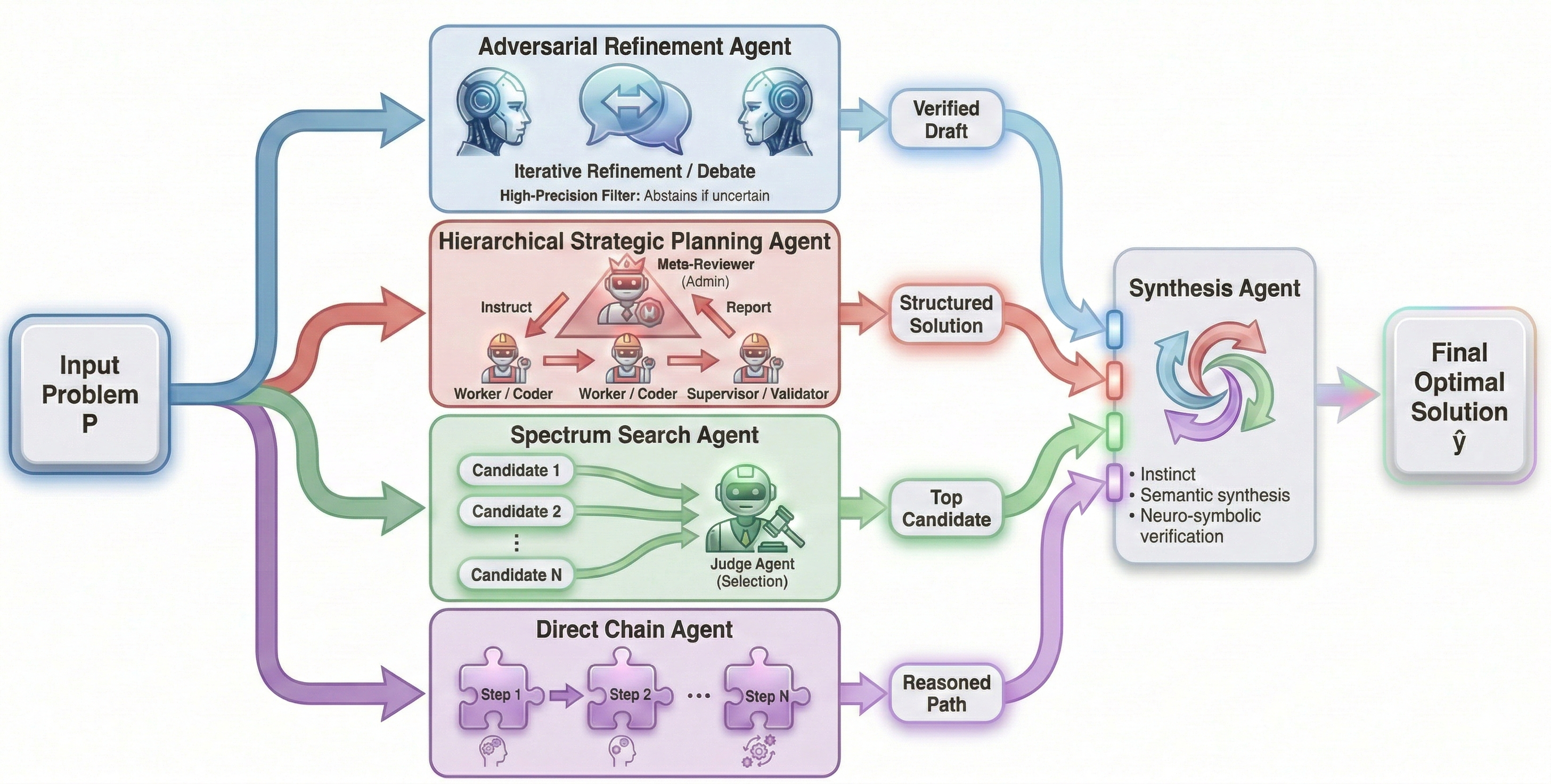
Abstract: While LLMs excel at many tasks, they frequently struggle with complex reasoning that requires long-horizon planning and iterative error correction. Furthermore, standard single-stream prompting proves brittle when models encounter novel abstractions or rigorous domain constraints. We introduce PoTRE (Poly-Topological Reasoning Ensembles), a heterogeneous framework that decouples inference into four agents: (1) Adversarial Refinement Agent, (2) Hierarchical strategic Planning Agent, (3) Spectrum Search Agent, and (4) Direct Chain Agent. A final Task-Adaptive Aggregation Layer dynamically reconciles these perspectives -- via final candidate selection, semantic synthesis, or neuro-symbolic verification -- to produce a robust global solution. We evaluate PoTRE on three frontier benchmarks: ARC-AGI-2, Humanity's Last Exam (HLE), and PRBench Finance. PoTRE achieves state-of-the-art accuracy of 49.92% on HLE, surpassing the previous best official score. We demonstrate that this architectural heterogeneity achieves improved reasoning performance using similar or fewer inference tokens compared to heavily scaled homogeneous baselines.
Paper Prompts
Sign up for free to create and run prompts on this paper using GPT-5.
Top Community Prompts
Explain it Like I'm 14
What this paper is about (in simple terms)
This paper introduces a new way to help AI models think better at test time, especially on hard problems that need planning, checking, and correcting mistakes. The method is called PoTRE (Poly-Topological Reasoning Ensembles). Instead of making one model think in one way, PoTRE acts like a team of different “thinkers,” each with a unique style, and then a smart “editor” combines their best ideas into one final answer.
What questions the researchers asked
The authors wanted to know:
- Can a team of different reasoning styles beat the usual approach where the model thinks in the same way many times?
- Can this “team of thinkers” help smaller, faster models catch up to (or even beat) bigger, more expensive models on tough tests?
- Can we get better accuracy without spending a lot more “thinking time” (compute cost) at test time?
How PoTRE works (the approach, with easy analogies)
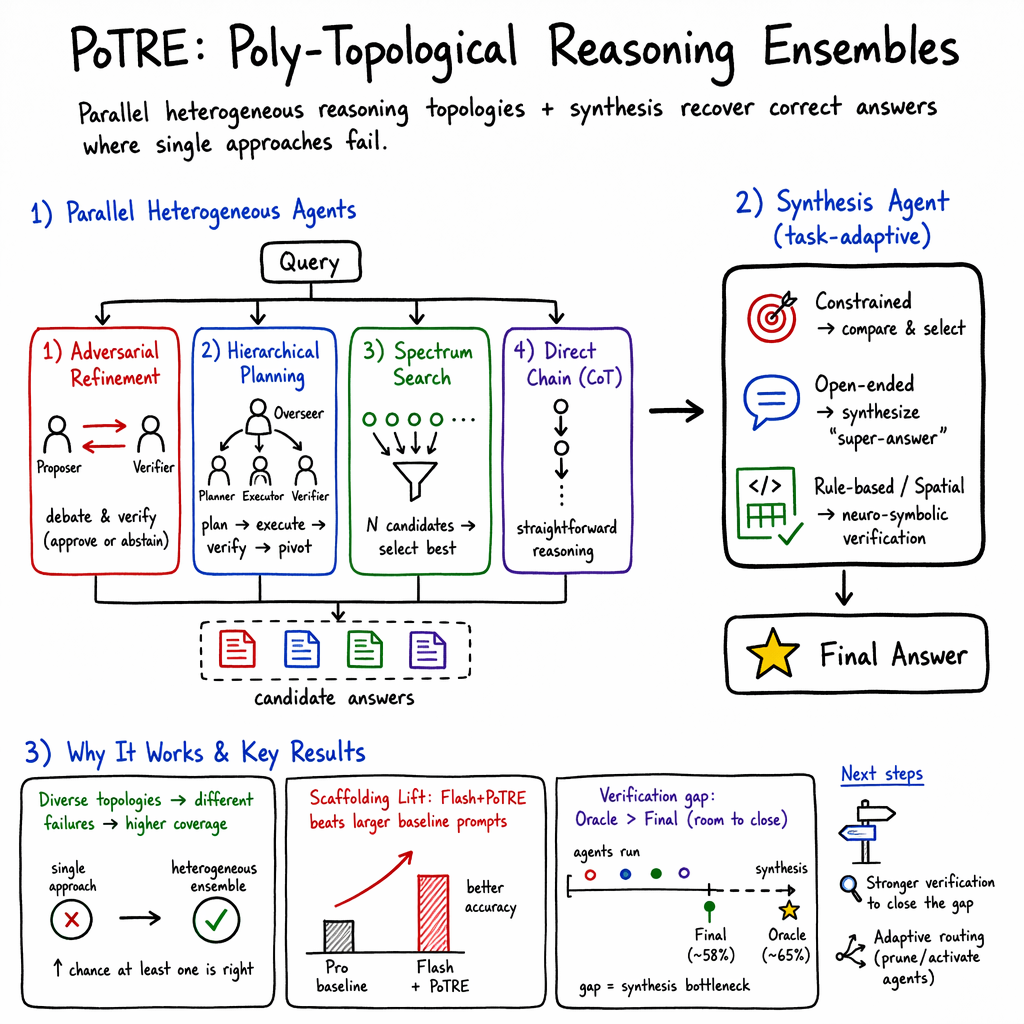
Think of solving a very tricky group project. If everyone thinks the same way, the group repeats the same mistakes—this is “groupthink.” PoTRE avoids groupthink by using four different “agents” (specialized roles), then an “editor” that pulls everything together.
The four agents:
- Adversarial Refinement Agent (the debaters): One proposes an answer, another tries to poke holes in it. They go back and forth up to a few rounds. If the answer still has problems, they reject it and don’t pass it on.
- Hierarchical Strategic Planning Agent (the planner team): A planner breaks the problem into smaller steps, an executor tries the plan, a verifier checks it, and an overseer steps in if they’re stuck and tells them to change strategy.
- Spectrum Search Agent (the brainstormers): Many versions of the model try different ideas in parallel (on purpose, they make them different). For problems with clear rules, they test each idea against those rules and throw away the ones that fail. For open-ended questions, a “judge” picks the best, most consistent answer.
- Direct Chain Agent (the straight shooter): A simple, step-by-step solution—like the standard “show your work” approach.
The final step:
- Synthesis Agent (the editor-in-chief): Looks at all the candidates and:
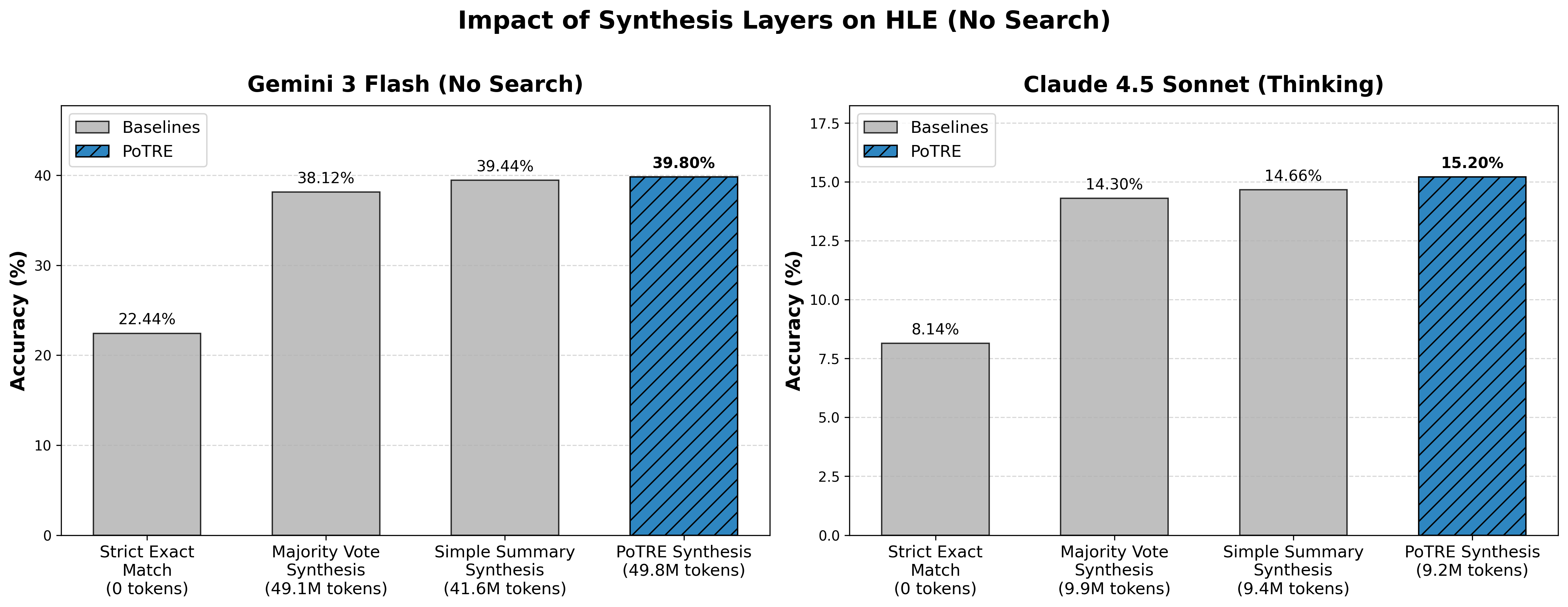
- For short, clear answers (like multiple choice), selects the best one by comparing the reasoning, not just counting votes.
- For open-ended answers (like essays), blends the strongest points into one clear, solid answer.
- For rule-based puzzles, checks candidates with a logic tester (think: “do these rules really fit all the examples?”) before deciding.
Why this helps:
- Different agents make different kinds of mistakes. When their errors aren’t the same, the editor can pick the one that’s right.
- It’s like putting a debater, a planner, a creative brainstormer, and a careful step-by-step solver on the same team—then asking an editor to choose the best parts.
What they tested and how
They tried PoTRE on three very tough benchmarks:
- Humanity’s Last Exam (HLE): Hard, multi-subject questions where simple fact lookup isn’t enough.
- ARC-AGI-2: Pattern and logic puzzles (like visual reasoning) where you must infer rules from examples.
- PRBench Finance (Hard): Professional finance tasks scored by strict rubrics (not just right/wrong words).
How answers were checked:
- For puzzles (ARC-AGI-2): the code had to exactly produce the right output—no partial credit.
- For HLE: a separate judge model checked if the answer matched the meaning of the correct answer.
- For PRBench Finance: a detailed scoring script graded responses using expert rules.
Main results (and why they matter)
- New best score on HLE: PoTRE reached 49.92% accuracy, beating previous best official results.
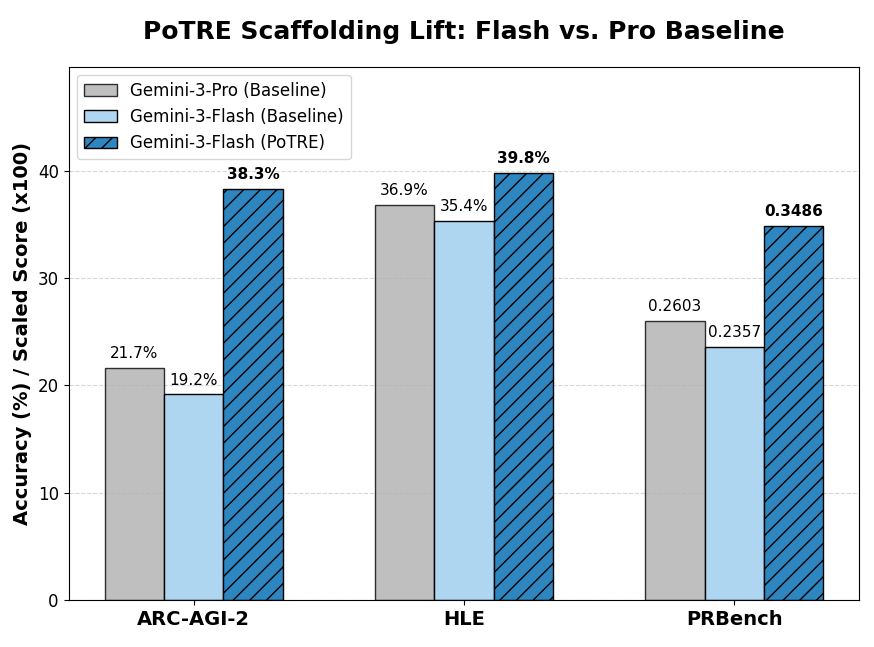
- Big gains on ARC-AGI-2: About 38% accuracy, nearly doubling the basic baseline for the same model.
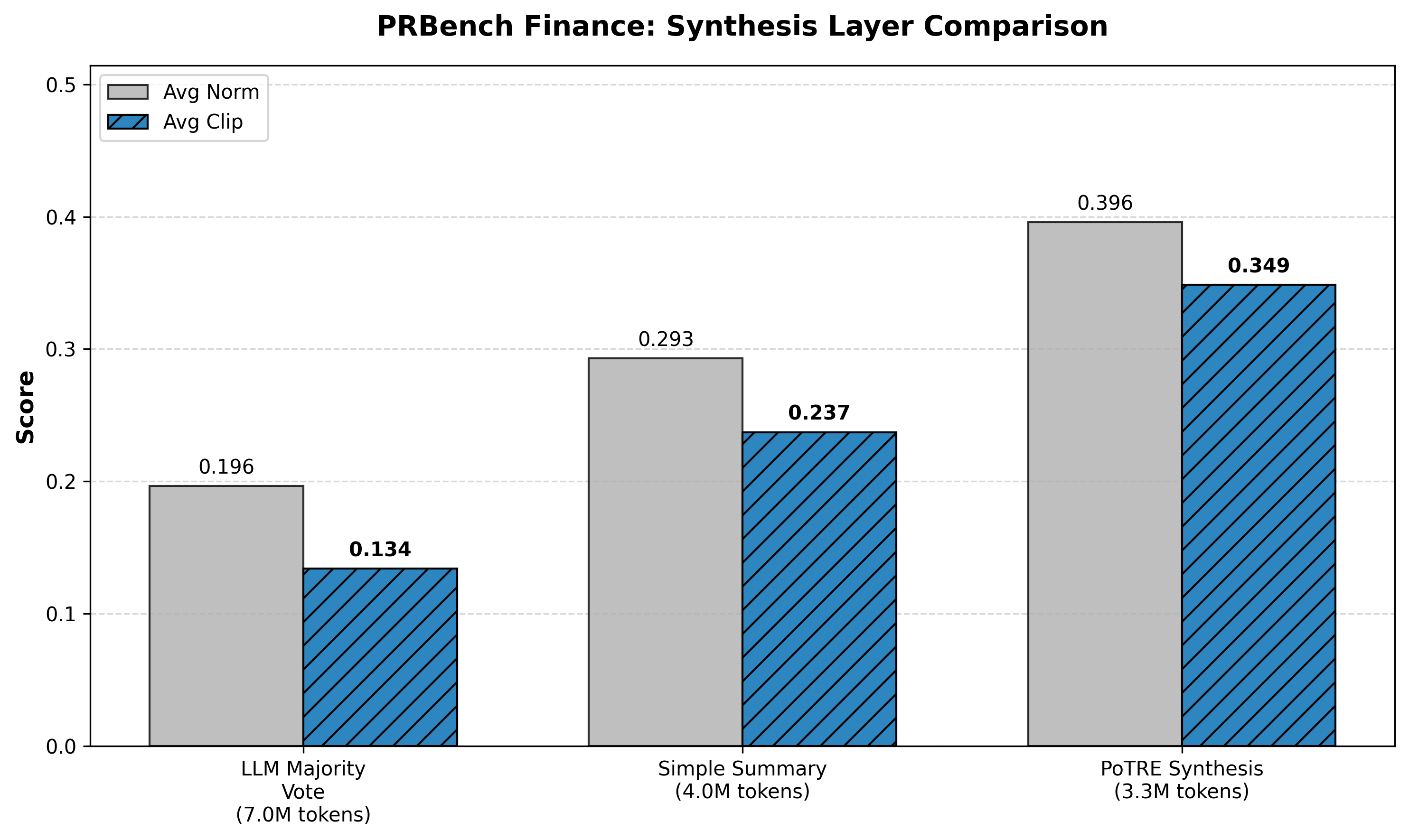
- Strong on PRBench Finance (Hard): The system set a new best on that benchmark in the paper’s setup and also showed that its “team + editor” approach consistently beats doing the same thing many times.
- Smaller model + PoTRE > bigger model alone: A lighter, cheaper model equipped with PoTRE sometimes beat a larger, more expensive model that wasn’t using the PoTRE teamwork.
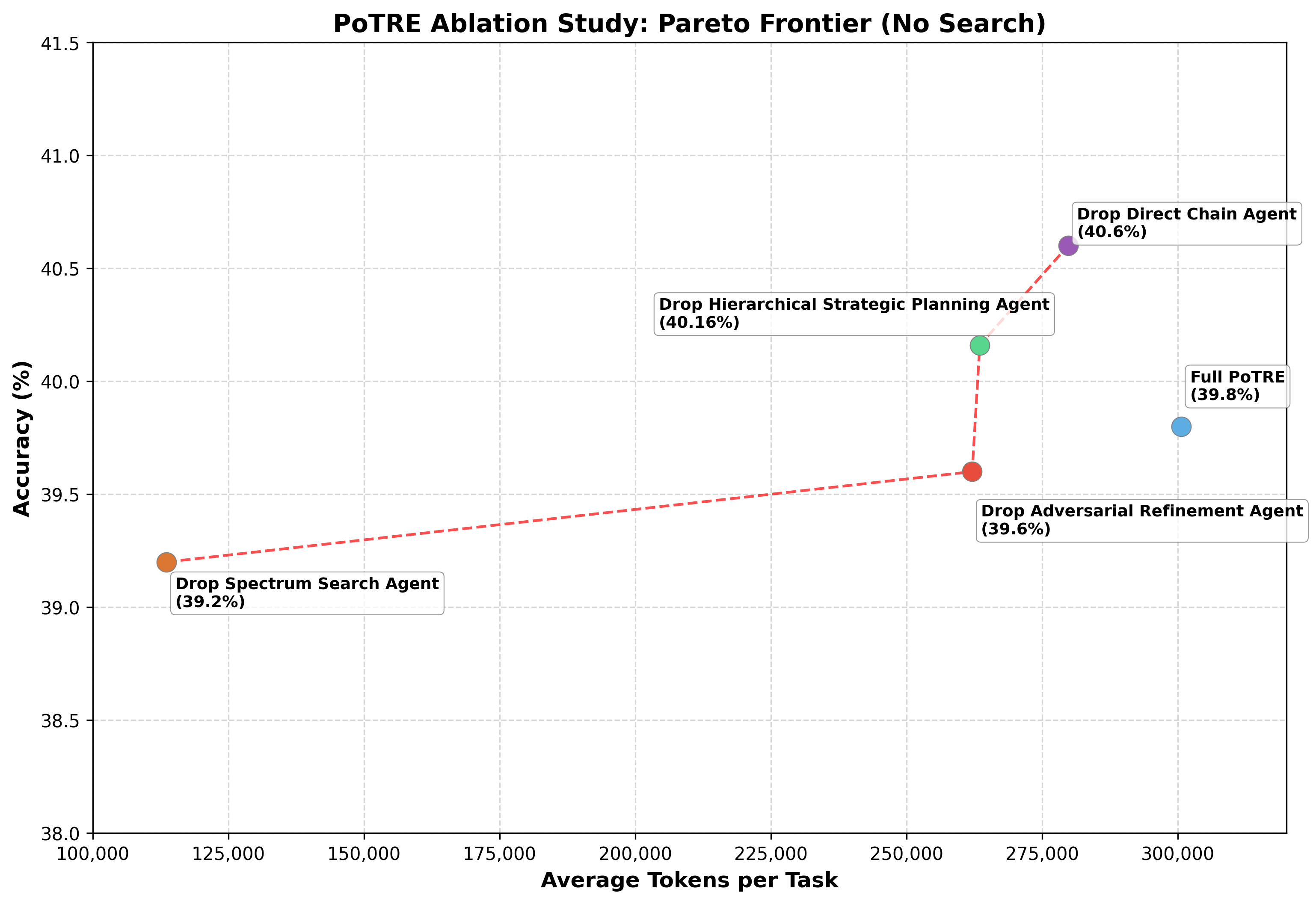
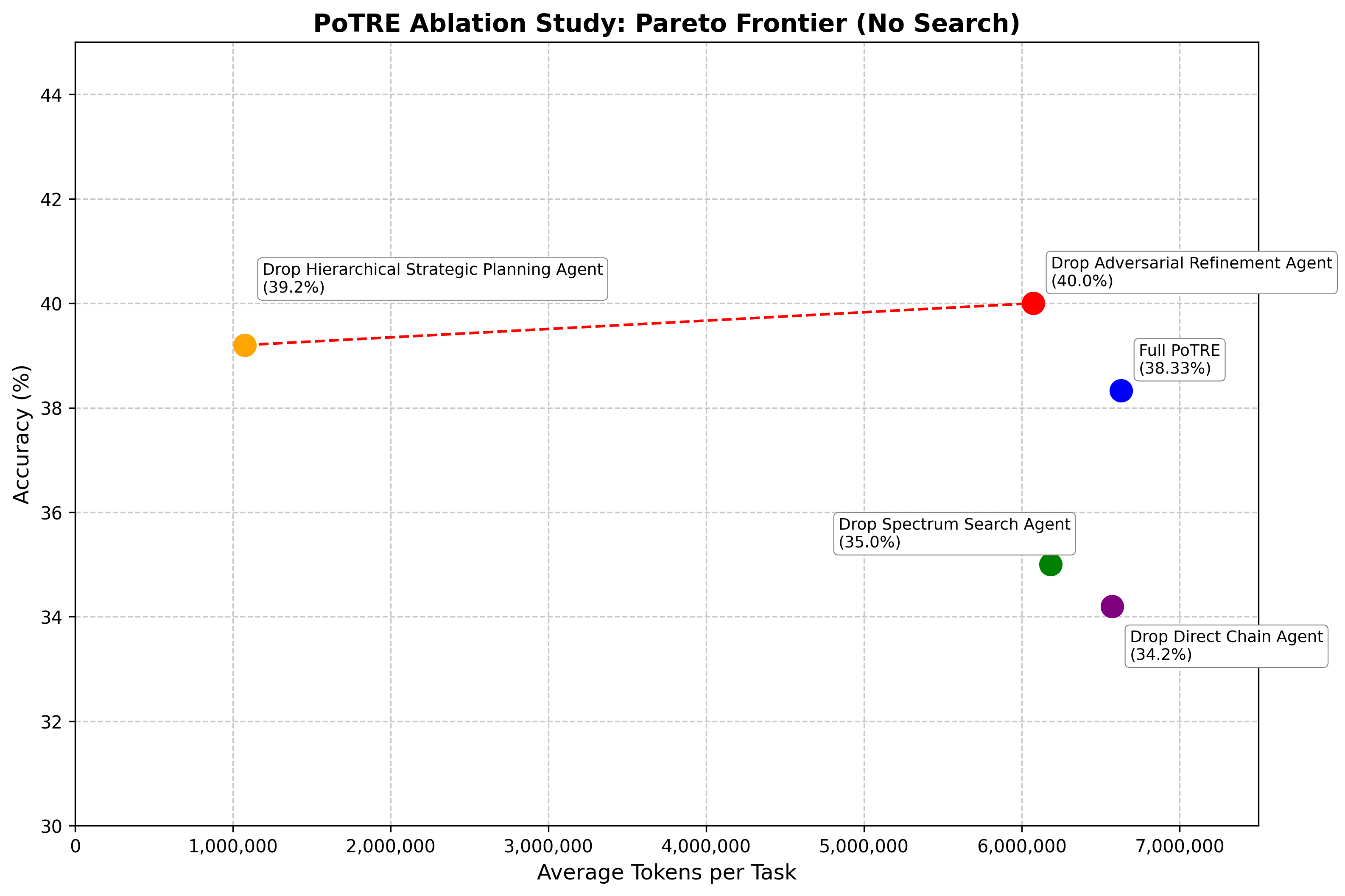
- Efficiency wins: By choosing which agents to run (turning some off when they don’t help a specific domain), they could cut “thinking cost” by up to about 85%—sometimes even improving accuracy because fewer conflicting ideas can make the editor’s job easier.
A cool detail the authors found:
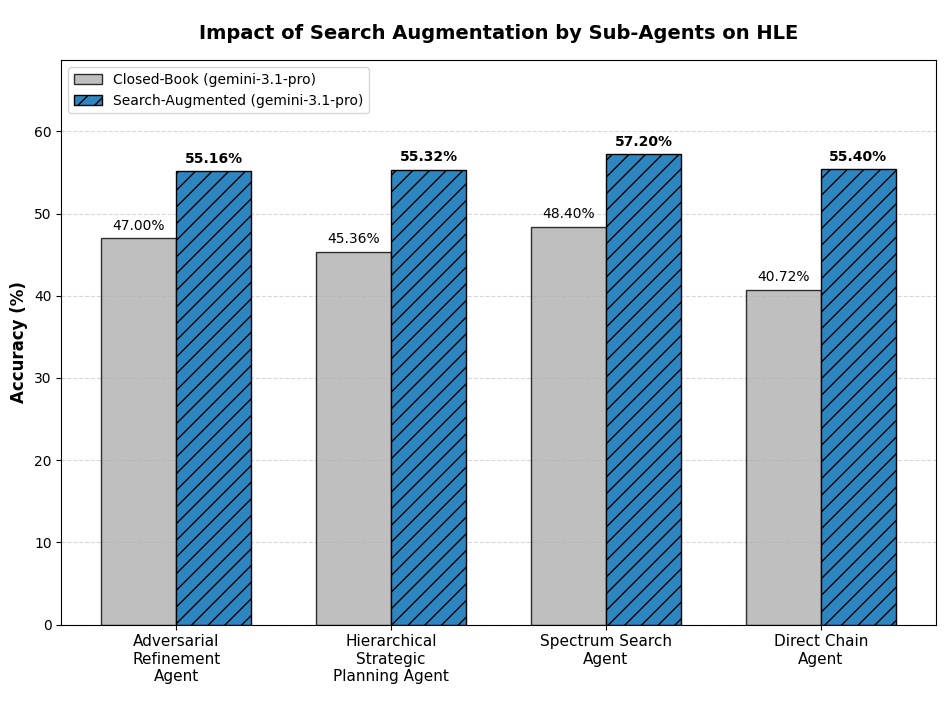
- The “Spectrum Search Agent” (the brainstormer) often solved certain problems that other agents missed. Even if it wasn’t the overall best performer, it uniquely cracked some tough cases—showing the value of diverse thinking.
Why this is important
- Smarter reasoning without bigger models: Instead of only making models larger (which is expensive), we can make them think better at test time by organizing different reasoning styles in parallel and then combining them wisely.
- More reliable answers: The debate, planning, and verification steps help catch mistakes before the final answer is chosen.
- Flexible and cost-aware: You can mix and match the agents depending on the type of problem and how much compute you can spend.
- Real-world impact: This can help AI perform better on complex tasks in areas like science, law, and finance—where careful reasoning matters.
Final takeaway
PoTRE shows that “how an AI thinks” during testing can matter as much as “how big the AI is.” By teaming up different thinking styles (debate, planning, brainstorming, and straightforward reasoning) and using a smart editor to pick or merge the best parts, AI can solve harder problems more accurately and sometimes more cheaply. It’s a practical step toward AI that plans, checks itself, and reasons more like a diverse, well-run human team.
Knowledge Gaps
Knowledge gaps, limitations, and open questions
Below is a single, concrete list of what remains missing, uncertain, or unexplored in the paper, framed so future researchers can act on them.
- Compute normalization and reporting: The paper claims improved performance at comparable or fewer tokens but does not report per-task token counts, wall-clock latency, or cost for each agent and the synthesis step. Future work should publish token/second budgets per agent, seeds, and Pareto curves to enable fair comparisons to Self-Consistency and other baselines.
- Statistical robustness: All results appear to be single-run without confidence intervals, variance across seeds, or repeated trials. Future studies should report mean±std over multiple seeds and assess significance (e.g., bootstrap CIs) for each benchmark and agent configuration.
- LLM-as-judge reliability and bias: HLE and PRBench depend on an LLM judge (from the same family used for generation), but inter-judge agreement, sensitivity to judge choice, and calibration are not reported. Researchers should evaluate with multiple diverse judges, report agreement metrics (e.g., Cohen’s kappa), and perform sensitivity analyses to judge prompts and model families.
- Comparability to official leaderboards: HLE “state-of-the-art” claims are made using an internal LLM-judge pipeline; it is unclear whether the exact official evaluation protocols (including judge versions and prompts) were replicated. A direct submission to official evaluation servers and matched reproduction is needed.
- ARC-AGI-2 dataset mismatch: Evaluation uses the public set while the leaderboard uses a semi-private split; comparability is limited. Future work should assess on the official semi-private set or clearly separate claims and provide cross-split analyses.
- Heterogeneity source verification: All agents use the same base backbone family; the degree of “cognitive heterogeneity” may be limited by shared priors. It remains open whether mixing different base models (or decoding schemes, e.g., nucleus vs. beam) further reduces correlated errors and improves performance.
- Error-correlation quantification: The paper argues topological diversity reduces correlated failures but provides limited quantitative analysis except exclusivity counts on ARC. Researchers should measure inter-agent error correlation, Jaccard overlap of correct/incorrect sets, and mutual information across agents on all benchmarks.
- Selection bottleneck (“Oracle gap”) analysis: The gap between Oracle and realized performance is noted but not systematically analyzed. Future work should benchmark alternative selectors (e.g., learned routers, calibrated confidence, verifier ensembles) to close this gap and report their compute trade-offs.
- Aggregator design transparency: The “Task-Adaptive Aggregation” logic (candidate selection vs. qualitative synthesis vs. neuro-symbolic verification) is described at a high level, but concrete prompts, rules, and failure-handling criteria are not detailed. Publicly releasing aggregation prompts, policies, and ablations would improve reproducibility and enable systematic improvement.
- Automatic task-type detection: The framework requires a task-type input (Constrained/Open-Ended/Rule-Based), but how this is obtained or detected is unspecified. Future work should implement and evaluate automatic task-type classifiers and measure misclassification impacts.
- “Neuro-symbolic” verification specifics: The ARC verifier is described as “neuro-symbolic,” but no formal symbolic engine, constraint solver, or proof system is defined. It remains open whether integrating explicit symbolic verifiers (SAT/SMT, program synthesis, type systems) yields stronger guarantees.
- Spectrum Search hyperparameters: The choice of N, temperature, and sampling strategies are fixed (e.g., N=8) without sensitivity analysis. Future work should explore dynamic N allocation, temperature schedules, and stopping criteria to optimize breadth per-task.
- Adversarial debate stability: The Proposer/Verifier are the same model family; debate may converge to shared blind spots. It is unknown whether using heterogeneous models for debate or asymmetric prompts improves critique quality and reduces false consensus.
- Compute-aware routing: Although the paper notes pruning sub-agents can reduce tokens by up to 85%, it does not describe an algorithmic router to allocate or prune agents per-instance. Designing and evaluating learned (or heuristic) routers that predict which agents to activate per query is an open direction.
- Failure modes and qualitative analysis: The paper lacks systematic error taxonomies or case studies for where PoTRE fails, across benchmarks. Providing categorized failure cases (e.g., arithmetic slips, planning errors, rule overfitting) would guide targeted agent improvements.
- Robustness to adversarial or noisy inputs: No evaluation under distribution shifts, adversarial prompts, or perturbations (e.g., paraphrases, noisy numbers, document length). Future evaluation should quantify robustness and how agent diversity interacts with adversarial resilience.
- Domain and modality generalization: Results cover HLE (text), PRBench Finance (text), and ARC (grid-to-code). It is unclear how PoTRE performs on other modalities (long documents, retrieval-augmented tasks, code generation suites, mathematics, theorem proving, multimodal vision-language tasks). Broadening evaluation would test generality.
- Cross-lingual performance: The pipeline is only evaluated in English. Assessing multilingual robustness and whether agent roles generalize across languages remains open.
- Safety and sandboxing details for ARC: Code execution is done in a “secured sandbox,” but resource limits, syscall restrictions, and injection defenses are unspecified. Publishing sandbox configurations and security tests would support safe replication.
- Fairness of baselines: Baselines use “prior work prompts,” while PoTRE uses bespoke role-conditioned prompts; it’s unclear if prompt quality parity is achieved. Controlled comparisons using shared prompt budgets or cross-prompts would clarify where gains come from structure vs. prompt quality.
- Comparison against stronger structured baselines: The paper compares primarily to Self-Consistency. Direct comparisons against Tree-of-Thoughts, Graph-of-Thoughts, debate frameworks, or recent research agents (with matched compute) are missing. Adding these would contextualize PoTRE’s advantage.
- Sensitivity to agent ordering and interference: The authors mention “synthesis interference” but do not explore how agent ordering, cross-talk, or context leakage affects outcomes. Controlled ablations on orchestration order and isolation could illuminate interference patterns.
- Confidence and abstention policies: Only the adversarial agent can abstain; the final synthesizer’s abstention strategy and calibration are not defined. Research should introduce calibrated confidence estimates and abstention thresholds at the synthesis stage.
- Tool-use and retrieval integration: Despite referencing “Deep Research,” PoTRE does not integrate external tools or retrieval. It remains open whether tool-augmented agents (calculator, search, codex executors) further improve outcomes and how to allocate tool calls across agents.
- Model-family generality: All experiments use Gemini models. Porting to diverse families (e.g., OpenAI, Anthropic, Llama, Qwen) would test whether PoTRE’s gains are backbone-agnostic.
- Reproducibility and assets: Core prompts, code, and appendices (e.g., algorithms and prompts for sub-agents) are referenced but not provided here. Public release of code, prompts, evaluation scripts, and seeds is needed for independent replication.
- Theoretical grounding: There is no formal analysis of why and when topological diversity yields gains (e.g., bias-variance decomposition, error correlation bounds). Developing theoretical frameworks to predict when and how heterogeneity helps would guide principled design.
- Negative result investigation: On ARC with Gemini-3.1-Pro-Preview, SC(N=16) slightly outperforms PoTRE; the causes (e.g., over-synthesis, mis-selection, agent redundancy) are not analyzed. Systematically diagnosing regressions could inform adaptive routing or different aggregation for high-capacity models.
- Ethical and bias considerations: No analysis of whether PoTRE amplifies or mitigates biases across agents or judges, especially in professional domains like finance. Auditing outputs for bias and designing synthesis checks to mitigate it are open tasks.
Practical Applications
Overview
This paper introduces PoTRE, a heterogeneous, multi-agent test-time reasoning framework that coordinates four distinct LLM “agents” (Adversarial Refinement, Hierarchical Strategic Planning, Spectrum Search, and Direct Chain) and a task-adaptive Synthesis layer (candidate selection, qualitative synthesis, neuro-symbolic verification). Empirically, PoTRE improves accuracy and robustness on challenging benchmarks while controlling inference cost via modular pruning. Below are practical applications derived from the methods, results, and engineering patterns in the paper.
Immediate Applications
These can be deployed now with existing LLMs, basic tool integrations (e.g., sandboxed code execution, LLM-as-a-judge), and workflow orchestration.
- Financial analysis co-pilot with multi-perspective reasoning
- Sector: Finance (buy-side/sell-side research, risk, compliance)
- What: Draft investment memos, scenario analyses, and risk assessments; use Spectrum Search to explore diverse theses, Adversarial Refinement to challenge assumptions, and Synthesis to reconcile into a single, audit-ready view; apply neuro-symbolic checks for policy/rule adherence (e.g., rubric or compliance checklists).
- Tools/Products/Workflows: “Reasoning Researcher” workspace in a research platform; integration with spreadsheets, market data, and internal policy engines; final report includes structured rationale and pass/fail checkmarks per constraint.
- Assumptions/Dependencies: LLM reliability for domain details; availability of compliance rule sets in machine-checkable form; human-in-the-loop review for high-stakes outputs.
- Contract and policy review with structured debate and verification
- Sector: Legal, Policy
- What: Multi-agent review of contracts/policies—Spectrum Search suggests interpretations/risks; Hierarchical Planning decomposes analysis (clauses → obligations → risks); Adversarial Refinement probes contradictions; Synthesis integrates findings; basic rule engines check required clauses/forbidden language.
- Tools/Products/Workflows: Contract-review assistant integrated into document management systems; risk annotations and “red/amber/green” flags; exportable compliance checklist.
- Assumptions/Dependencies: Domain rule libraries; LLM-as-judge quality for semantic equivalence of legal language; mandatory human attorney sign-off.
- Multi-agent code review and automated patch proposals in CI/CD
- Sector: Software engineering
- What: Spectrum Search generates multiple patch ideas; Hierarchical Planning decomposes fix steps; neuro-symbolic verification runs unit/integration tests in a sandbox; Synthesis selects the best patch or compounds fixes.
- Tools/Products/Workflows: “PoTRE reviewer” GitHub/GitLab app; PR comments with proposed diffs and test results; policy checks (linting/security rules) as rule-based verifiers.
- Assumptions/Dependencies: Stable sandbox execution; comprehensive tests; safeguards against introducing insecure code; engineering approval workflows.
- Complex customer support triage and resolution
- Sector: Software/SaaS, Telecom, Consumer electronics
- What: Parallel reasoning generates multiple root-cause hypotheses and resolution paths; Synthesis selects the best resolution consistent with KB and policy; abstention if confidence is low; escalation to human.
- Tools/Products/Workflows: Multi-agent ticket solver integrated with CRM; rule-based guardrails for refunds/credits; resolution templates with rationale and steps.
- Assumptions/Dependencies: Clean knowledge base; policy rules encoded for neuro-symbolic checks; latency budget for multi-agent inference.
- Safety-critical drafting assistant for regulated writing
- Sector: Healthcare (non-diagnostic), Finance, Legal, HR
- What: Draft client letters, disclosures, or SOPs; Adversarial Refinement reduces hallucinations; rule-based verification enforces formatting and mandatory statements; Synthesis produces a final, compliant draft.
- Tools/Products/Workflows: Template-aware content assistant; embedded checklists; versioned rationale traces for auditability.
- Assumptions/Dependencies: Up-to-date policy templates; reliable rule-checks; human review for regulated communications.
- Data analysis and business KPI explanation with constraint checks
- Sector: Business analytics, Operations
- What: Hierarchical Planning breaks down analysis; Spectrum Search proposes multiple explanatory narratives; Synthesis reconciles into a single explanation; simple rule checks validate KPI definitions and arithmetic consistency.
- Tools/Products/Workflows: PoTRE-powered BI “explain” button; CSV/Pandas sandbox to validate calculations; dashboards with annotated reasoning.
- Assumptions/Dependencies: Access to data sources; standard KPI definitions; sandbox compute for quick checks.
- Multi-perspective tutoring and solution synthesis
- Sector: Education
- What: Provide multiple solution paths (algebra, geometry, heuristic) via Spectrum Search; Adversarial Refinement ensures rigor; Synthesis presents the clearest path plus alternatives; abstain on uncertainty to avoid confidently wrong guidance.
- Tools/Products/Workflows: LMS plugin; step-by-step solutions with highlighted strategy choices; formative feedback generator.
- Assumptions/Dependencies: Alignment to curriculum; bias/accuracy controls; disable use for graded assignments if prohibited.
- Knowledge-base QA with robust synthesis and abstention
- Sector: Enterprise knowledge management
- What: Multiple agents query and reason over internal docs; Synthesis selects the best answer; neuro-symbolic checks enforce redlines (e.g., PII spills, policy contradictions); abstain if evidence is insufficient.
- Tools/Products/Workflows: Enterprise Q&A portal; evidence-linked answers with confidence scores; built-in escalation.
- Assumptions/Dependencies: Document access control; retrieval quality; well-defined abstention thresholds.
- Cost-aware LLM orchestration service
- Sector: Software/AI platforms
- What: Deploy PoTRE with dynamic sub-agent pruning per task type/domain to hit token/latency budgets, exploiting the paper’s cost-performance Pareto; rule-based router triggers only the agents needed (e.g., skip debate for deterministic tasks).
- Tools/Products/Workflows: API gateway (serverless) with agent routing policies; cost dashboards; per-tenant budgets.
- Assumptions/Dependencies: Accurate task-type detection; token-cost monitoring; SLAs for latency.
- Research ideation and literature synthesis assistant
- Sector: Academia, R&D
- What: Spectrum Search for diverse hypotheses; Adversarial Refinement to critique weaknesses; Synthesis to integrate into a coherent related-work or methods plan; basic rule checks for citation completeness/format.
- Tools/Products/Workflows: Writing plugin (docs/LaTeX); structured outlines with alternative approaches; checklist for reproducibility items.
- Assumptions/Dependencies: Access to safe literature search tools; guardrails to avoid hallucinated citations; human researcher validation.
- Threat model brainstorming and red-teaming aide
- Sector: Security, DevSecOps
- What: Generate diverse attack paths (Spectrum), debate plausibility (Adversarial), hierarchical mitigations plan; verified against policy checklists (e.g., OWASP).
- Tools/Products/Workflows: Secure SDLC assistant; ticket generation for mitigations with priority and evidence.
- Assumptions/Dependencies: Up-to-date security rule sets; human oversight; safe-handling for sensitive info.
- Personal decision support with multiple options and constraints
- Sector: Daily life (personal finance, travel, purchases)
- What: Spectrum Search enumerates options (routes, budgets, products); Synthesis picks per user’s constraints; rule checks enforce budget/time limits.
- Tools/Products/Workflows: Assistant app with “multi-plan” compare-and-choose; downloadable itinerary or budget plan.
- Assumptions/Dependencies: Accurate constraints; data freshness (prices, availability); user privacy.
Long-Term Applications
These require further research, scaling, domain-specific tooling, or regulatory alignment.
- Clinical decision support with verified multi-path reasoning
- Sector: Healthcare
- What: Use hierarchical planning for differential diagnoses, Spectrum Search for rare hypotheses, and adversarial critique to reduce diagnostic anchoring; integrate neuro-symbolic checks with medical guidelines and EHR constraints.
- Tools/Products/Workflows: CDS integrated into EHR with structured explanations and evidence; post-hoc audits.
- Assumptions/Dependencies: Regulatory approval, clinician-in-the-loop, validated medical rule engines, high-precision models.
- Autonomously adaptive agent routing via learned orchestrators
- Sector: AI platforms
- What: Replace rule-based selection with learned routers that dynamically choose which PoTRE agents to invoke under cost/accuracy constraints (RL/meta-learning); personalize per user/task.
- Tools/Products/Workflows: Orchestration policy training pipelines; online learning from outcomes; budget-aware scheduling.
- Assumptions/Dependencies: Training data with outcome labels; safety constraints on exploration; observability.
- Neuro-symbolic verification with domain-grade formal methods
- Sector: Finance, Legal, Safety-critical engineering
- What: Integrate PoTRE with formal verification engines (e.g., model checking, contract logic formalisms) to validate reasoning outputs against machine-readable regulations and specifications.
- Tools/Products/Workflows: Compilers from natural language policy to logic; proof trace viewers; exception workflows.
- Assumptions/Dependencies: High-quality formalizations of rules; explainability for non-experts; ongoing maintenance as rules change.
- Long-horizon autonomous research agents
- Sector: Scientific research, Competitive intelligence
- What: Extend PoTRE with tool-use (search, calculators, simulators) and persistent memory to conduct multi-day research projects, pivoting strategies via the Overseer, and synthesizing results into publication-ready outputs.
- Tools/Products/Workflows: Research OS with task boards, evidence graphs, and progress checkpoints; reproducible notebooks.
- Assumptions/Dependencies: Reliable retrieval; bias and hallucination controls; human editorial oversight.
- Robotics task-and-motion planning with heterogeneous reasoning
- Sector: Robotics, Manufacturing, Logistics
- What: Map the Hierarchical Planning agent to high-level task decomposition and the neuro-symbolic verifier to constraint checking (safety, kinematics); Spectrum Search explores alternative sequences/policies; Synthesis selects feasible plans.
- Tools/Products/Workflows: Integration with motion planners and digital twins; safety-certified execution monitors.
- Assumptions/Dependencies: Real-time constraints; robust perception; certified safety and fail-safes.
- Enterprise-wide “committee of AIs” governance for decisions
- Sector: Enterprise, Public sector
- What: Institutionalize PoTRE-like committees for strategic planning and policy options—each agent embodies a perspective (risk, ethics, finance, operations), with Synthesis producing traceable, auditable recommendations.
- Tools/Products/Workflows: Decision records with agent rationales; governance dashboards; bias/fairness auditing.
- Assumptions/Dependencies: Organizational buy-in; clear accountability; regulatory guidance on AI-assisted decisions.
- Assessment and grading with multi-agent adjudication
- Sector: Education, Professional certification
- What: Use diverse reasoning agents plus an LLM-as-judge to assess open-ended responses; Synthesis reconciles rubric-based evaluations; bias mitigation via heterogeneous rationales.
- Tools/Products/Workflows: LMS-integrated graders; calibrated rubrics; human moderation for edge cases.
- Assumptions/Dependencies: Robustness to style variance; fairness studies; transparency for students.
- Multimodal industrial inspection and reasoning
- Sector: Manufacturing, Energy (grid/plant operations)
- What: Extend PoTRE to vision-language tasks: Spectrum Search proposes defect hypotheses; Planning structures inspection routines; Synthesis decides based on sensor data; rule checks enforce tolerances/specs.
- Tools/Products/Workflows: Edge/IoT deployment; multimodal models; incident tickets with evidence.
- Assumptions/Dependencies: Reliable VLMs; calibrated sensors; on-prem compute for privacy.
- Personalized assistants with privacy-preserving on-device reasoning
- Sector: Consumer tech
- What: Lightweight, pruned PoTRE variants running partially on-device, selectively offloading heavy agents to the cloud; cost-aware orchestration and user-defined privacy budgets.
- Tools/Products/Workflows: Mobile SDKs; federated learning for personalization; per-task agent selection.
- Assumptions/Dependencies: Efficient small models; secure offload; user consent and privacy controls.
- Regulatory-grade audit trails for AI reasoning systems
- Sector: RegTech, Compliance
- What: Standardize storage and review of agent rationales, selection decisions, and verification outcomes; provide regulators/auditors with traceable evidence of how conclusions were reached.
- Tools/Products/Workflows: Immutable logs, provenance graphs, replay capabilities; differential privacy where needed.
- Assumptions/Dependencies: Legal standards for AI traceability; secure data retention; performance/latency trade-offs.
Cross-Cutting Dependencies and Risks
- LLM availability and performance: Access to capable models (or local equivalents) affects quality and latency.
- Verification reliability: LLM-as-judge and simple rule checks work now but may be brittle; domain-grade verifiers improve robustness.
- Safety and oversight: High-stakes domains require human supervision, red-teaming, and conservative abstention thresholds.
- Cost/latency budgets: Multi-agent inference increases compute; pruning and routing policies are vital.
- Data privacy and compliance: Ensure secure handling of sensitive data; sandboxing for code execution; audit trails for accountability.
- Evaluation drift: Continuous monitoring needed as models or domains evolve.
By operationalizing heterogeneous reasoning topologies with task-adaptive synthesis and verification, PoTRE enables more robust applications today and provides a roadmap for higher-assurance systems as verifiers, routers, and domain integrations mature.
Glossary
- Adversarial Refinement Agent: A paired Proposer–Verifier process that iteratively critiques and improves a candidate solution to reduce hallucinations. "Adversarial Refinement Agent via debate,"
- ARC-AGI-2: A benchmark assessing program induction and fluid intelligence via visual abstraction puzzles. "We evaluate PoTRE on three frontier benchmarks: ARC-AGI-2, Humanity's Last Exam (HLE), and PRBench Finance."
- architectural scaffolding: Structural prompting and agent orchestration that enhances model reasoning without changing weights. "the architectural scaffolding of PoTRE enables the efficient model to outperform the frontier model operating with prior work prompts"
- Average Clipped Score: An evaluation metric that averages rubric-weighted binary judgments, clipped at zero to avoid negative penalties. "Evaluation metrics comprise Accuracy for HLE and ARC-AGI 2, and Average Clipped Score for PRBench."
- Chain of thought: Prompting that elicits step-by-step reasoning traces from LLMs. "Chain of thought prompting"
- cognitive heterogeneity: The principle that diverse, complementary reasoning strategies improve complex problem solving. "We draw inspiration from cognitive heterogeneity"
- Deep Research: Long-horizon, autonomous information-seeking systems emphasizing multi-step planning and tool use. "Recent advances in \"Deep Research\" have shifted focus from single-turn QA to long-horizon autonomous information seeking."
- deterministic environment: A fixed, non-stochastic execution setup ensuring repeatable evaluations. "the validation is strictly binary and executed in a deterministic environment."
- Direct Chain Agent: A baseline agent that performs standard step-by-step reasoning (CoT) for a single trajectory. "and (4) a Direct Chain Agent."
- distributional failure modes: Different, topology-induced error patterns that vary across heterogeneous agents. "architecturally diverse agents sometimes possess distributional failure modes."
- dynamic context folding: Mechanism for compressing and reorganizing long contexts to manage extended reasoning horizons. "Yunque employs a hierarchical \"Manager-Worker\" topology with dynamic context folding to handle long horizons"
- end-to-end reinforcement learning: Training approach optimizing policies directly from inputs to actions without intermediate supervision. "while Tongyi utilizes end-to-end reinforcement learning to optimize tool-use trajectories."
- Execution Pruning: Filtering step that discards candidate solutions failing executable checks against constraints. "Execution Pruning: When applicable, the validated hypotheses are translated into an executable format (e.g., programmatic code or formal logic) and evaluated against the known constraints."
- Few-Shot CoT: Chain-of-thought prompting that includes a few input–output examples to guide inductive tasks. "and Few-Shot CoT for inductive tasks where input-output demonstrations are essential for defining the problem space."
- Graph of Thoughts: A non-linear reasoning topology where ideas are explored and aggregated in graph structures. "Graph of Thoughts"
- greedy decoding: Deterministic token selection strategy that can get stuck in local optima. "deterministic greedy decoding strategies"
- Hierarchical Strategic Planning Agent: An agent that decomposes goals, executes plans, verifies results, and pivots strategies via an overseer. "Hierarchical Strategic Planning Agent"
- homogeneous ensembles: Multiple agents sharing the same reasoning style or priors, leading to correlated errors. "standard single-stream prompting—and even homogeneous ensembles—often fail."
- homogeneous sampling: Generating multiple outputs from the same model/topology instead of diversifying reasoning structures. "homogeneous sampling—refining a single model's outputs rather than diversifying the reasoning topology itself."
- Humanity's Last Exam (HLE): A multidisciplinary benchmark designed to defeat heuristic pattern matching and retrieval. "Humanity's Last Exam (HLE)"
- inference-time compute: The computational budget expended during inference (e.g., tokens, steps, agents) rather than training. "we also address the fundamental trade-off of inference-time compute."
- LLM-as-a-Judge: Using a LLM to grade or adjudicate answers for semantic correctness. "we utilize a blind LLM-as-a-Judge (Gemini-3-Flash-Preview) to grade responses."
- majority voting: Ensemble aggregation method selecting the answer with the most votes among candidates. "aggregate results via majority voting."
- Manager-Worker topology: A hierarchical multi-agent structure with a planning manager delegating tasks to workers. "a hierarchical \"Manager-Worker\" topology"
- monotonic improvement: Ensuring performance does not degrade as more agents or steps are added. "optimizing for \"monotonic improvement\" (performance stability)"
- negative constraint check: A preliminary filter validating that a hypothesis does not violate specified rules or boundaries. "a rigorous negative constraint check."
- neuro-symbolic verification: Combining neural reasoning with symbolic checks to validate logical consistency. "neuro-symbolic verification"
- neuro-symbolic verifier: A component that evaluates candidate solutions against formal rules for consistency. "we employ a neuro-symbolic verifier"
- Oracle Upper Bound: The theoretical maximum performance if the best candidate across agents were always selected. "Oracle Upper Bound"
- Pareto frontier: The set of configurations where improving one metric (e.g., accuracy) would worsen another (e.g., cost). "By mapping the cost-performance Pareto frontier of our architecture"
- Pass@1: The probability that the top (first) attempt is correct under a given evaluation protocol. "All reported results denote Pass@1 performance."
- PRBench "Finance Hard": A challenging subset of a professional reasoning benchmark focused on finance, graded by rubrics. "the PRBench \"Finance Hard\" subset"
- Programmatic Validation: Scoring by executing generated programs and checking exact match against ground-truth outputs. "Evaluation is performed using standard Programmatic Validation."
- Qualitative Synthesis: Aggregation method that integrates and reconciles free-form rationales for open-ended tasks. "Qualitative Synthesis for Open-Ended Generation"
- Role-Conditioned Prompting: Assigning specialized system prompts to agents to shape distinct behaviors. "Role-Conditioned Prompting"
- router-based framework: An architecture that routes tasks to specialized agents/tools based on learned policies. "proposes a router-based framework"
- sandboxed environment: A secure, isolated execution setup for running generated code safely. "secured sandboxed environment"
- Scaffolding Lift: Performance gains attributable to the added reasoning structure rather than model size. "Indicates Scaffolding Lift (Flash PoTRE > Gemini-3-Pro-Preview Baseline)."
- Self-Consistency: Ensemble decoding that samples multiple reasoning paths and selects the most consistent answer. "Self-Consistency"
- semantic equivalence: Judge-based assessment that two answers express the same meaning despite formatting differences. "The judge evaluates semantic equivalence between the predicted answer and ground truth"
- semantic synthesis: Combining the strongest logical arguments from multiple candidates into a unified answer. "semantic synthesis"
- Spectrum Search Agent: A breadth-first exploration agent that samples many diverse candidates and selects the best. "Spectrum Search Agent"
- stochastic sampling: Randomized decoding to increase candidate diversity and escape local optima. "This stochastic sampling allows the system to escape local optima"
- Synthesis Agent: The final module that aggregates agent outputs via selection, synthesis, or verification. "The final component of PoTRE is the Synthesis Agent."
- Task-Adaptive Aggregation: Dynamically choosing the combination method (selection, synthesis, verification) based on task type. "Synthesis Agent: Task-Adaptive Aggregation"
- Test-Time Scaling: Improving performance by increasing inference-time exploration (e.g., more samples/agents). "as a form of Test-Time Scaling"
- topological mode collapse: Failure where similar reasoning structures produce correlated errors, reducing ensemble diversity. "they suffer from topological mode collapse"
- Tree of Thoughts: A search-based reasoning framework that explores branching thought sequences. "Tree of Thoughts"
- width-over-depth: Strategy emphasizing parallel diversity of reasoning paths over deeper single-path exploration. "this \"width-over-depth\" approach"
- Zero-Shot CoT: Chain-of-thought prompting without examples, relying solely on the model’s general reasoning ability. "Zero-Shot CoT"
Collections
Sign up for free to add this paper to one or more collections.

