Non-vacuous Generalization Bounds for Reinforcement Learning with Verifiable Rewards
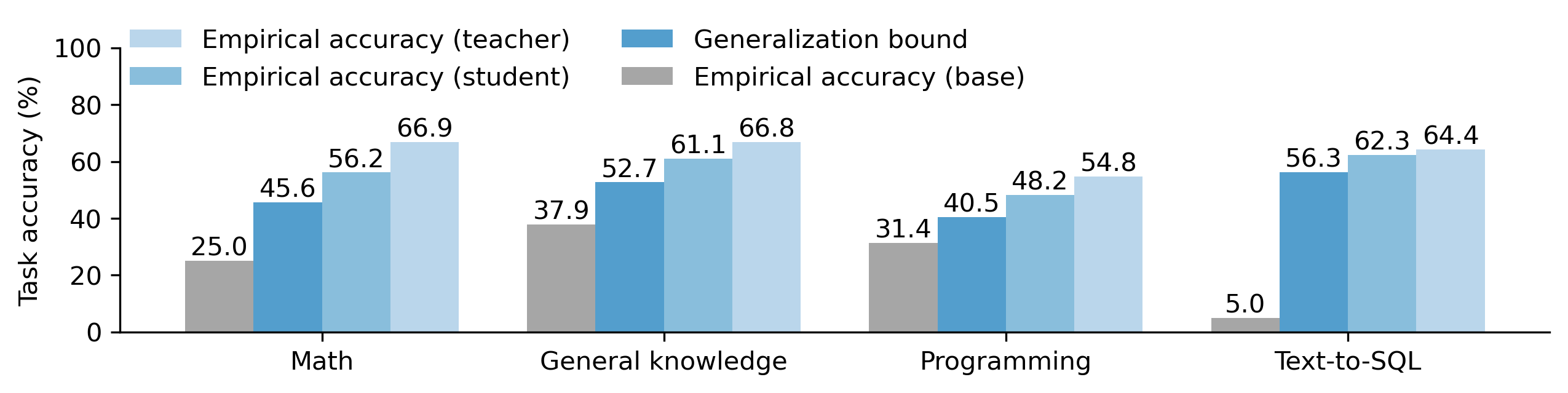
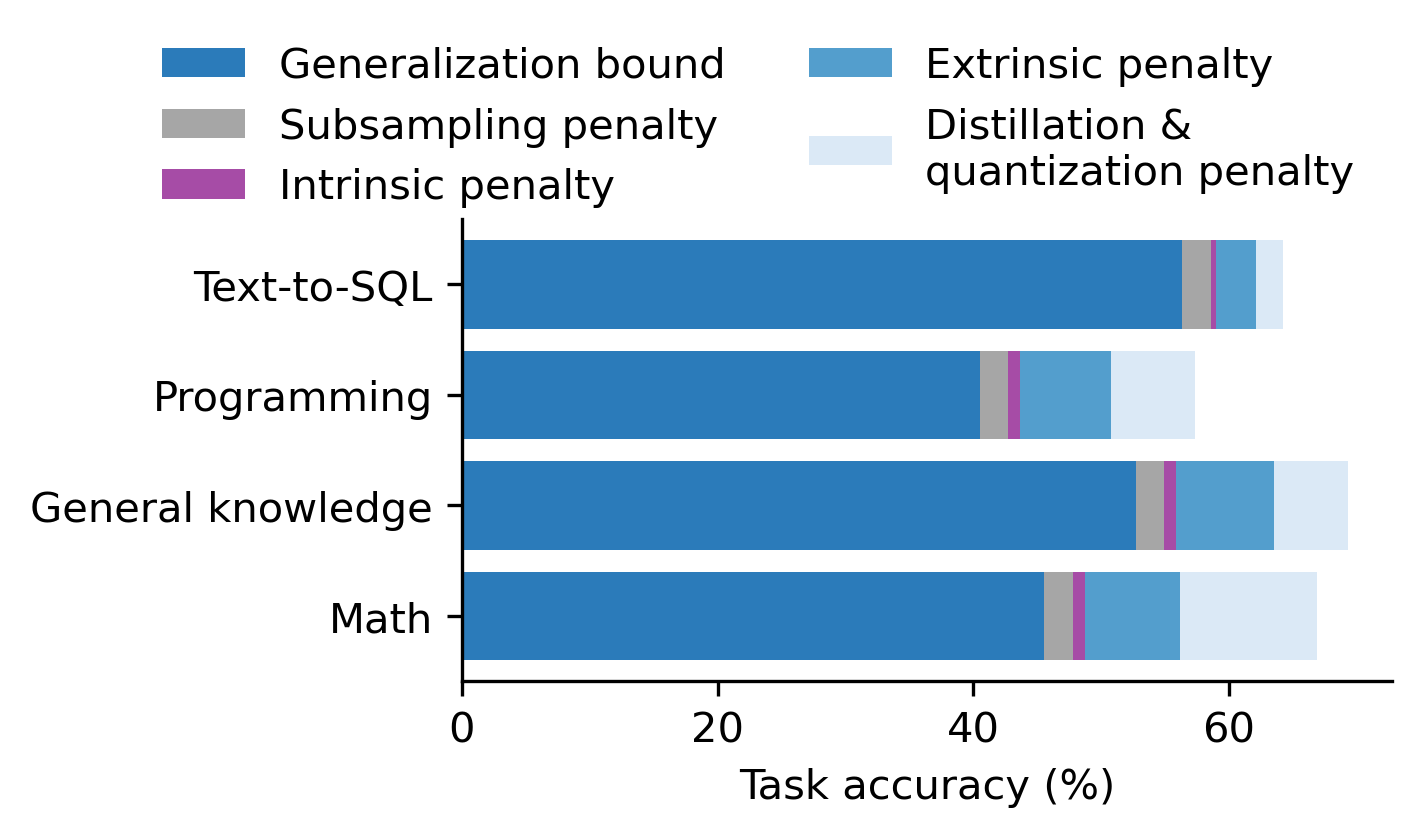
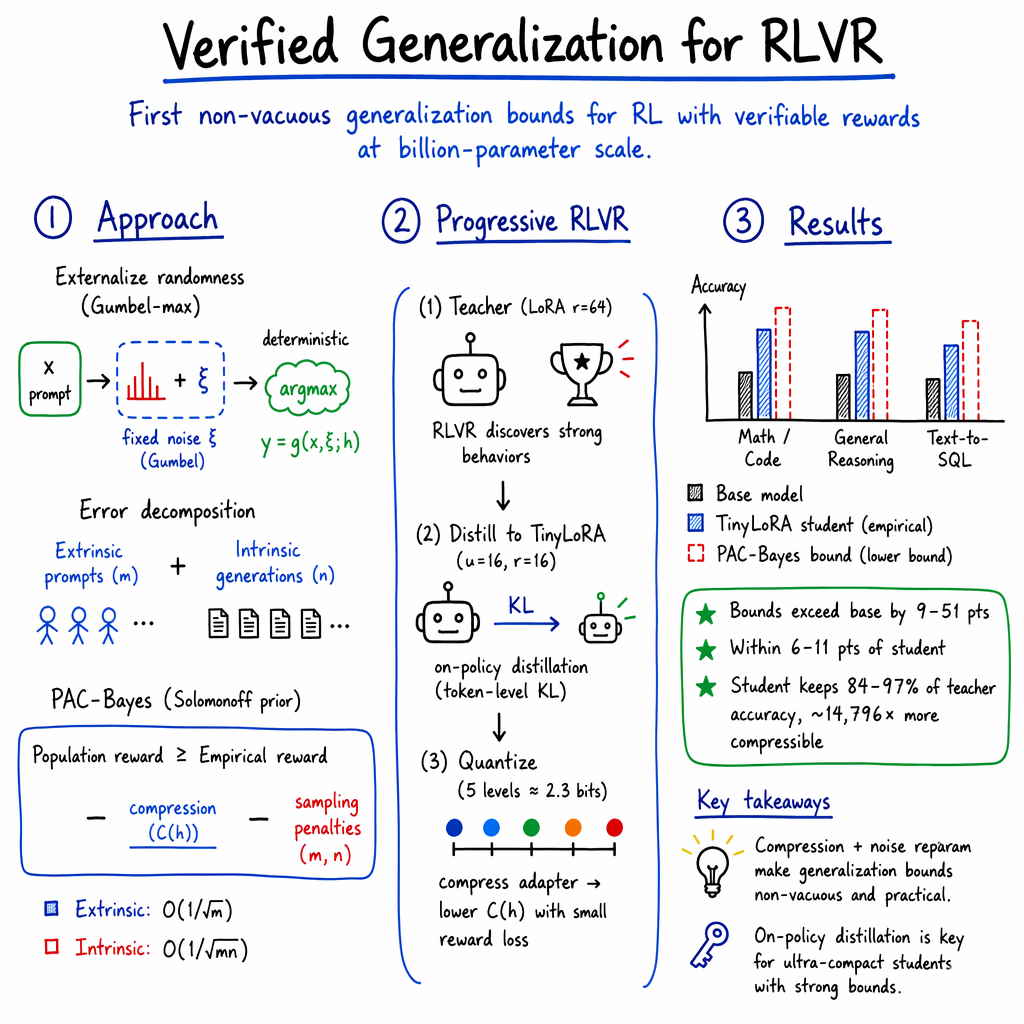
Abstract: While reinforcement learning with verifiable rewards (RLVR) is widely used to improve the reasoning capabilities of LLMs, the generalizability of the resulting models remains poorly understood. In this work, we establish the first non-vacuous generalization bounds for parameter-efficient RLVR fine-tuning at the billion-parameter scale. Our approach adapts PAC-Bayes compression bounds to this setting, and addresses the inherent stochasticity of token generation by applying the Gumbel-max reparameterization trick. To operationalize these bounds, we propose the Progressive RLVR framework, which integrates RLVR with on-policy distillation, TinyLoRA, and model quantization. Progressive RLVR empirically retains 84-97% performance of standard LoRA fine-tuning while producing models that are 14,796x more compressible. We show that this framework yields non-vacuous generalization bounds in four domains: mathematical problem-solving, programming, general-knowledge reasoning, and Text-to-SQL. Our bounds exceed the accuracy of the base model by 9-51% and lie within 6-11% of the accuracy of the fine-tuned models.

Paper Prompts
Sign up for free to create and run prompts on this paper using GPT-5.
Top Community Prompts
Explain it Like I'm 14
What this paper is about (big picture)
This paper asks a simple question: when we train a LLM to solve hard problems using reinforcement learning with verifiable rewards (RLVR)—like checking math answers with a calculator or code with unit tests—how sure can we be that it will also do well on new, similar problems? The authors build the first practical, math-backed guarantees (called “generalization bounds”) for such models, and they show how to train and compress models so these guarantees are actually meaningful rather than useless.
What the authors wanted to find out
In easy terms, they aimed to:
- Create the first non-vacuous (not useless) guarantees for RLVR models—guarantees that say, “on future questions like the ones we trained on, the model will do at least this well.”
- Make those guarantees work for very big models (billions of parameters).
- Handle the messy randomness in how models generate text, in a way that still lets them prove things.
- Build a practical training recipe that keeps the model strong while making it extremely compact, so the guarantees can be tight.
How they did it (methods explained simply)
The authors combine theory and engineering:
- Reinforcement learning with verifiable rewards (RLVR): Think of training a model to “try stuff” and get a clear thumbs-up or thumbs-down. Examples: Is the math answer correct? Does the code pass tests? This avoids fuzzy human ratings.
- Generalization bounds (a promise about future performance): A “generalization bound” is like a safety net: it says, “with high confidence, your model will score at least X on new, similar problems.” A bound is “non-vacuous” if X is actually above random guessing and useful—i.e., not just “≥ 0.”
- PAC-Bayes compression idea (why compression helps guarantees): Imagine you describe the model’s changes after training as a short recipe. The shorter the recipe (fewer bits/parameters to describe the update), the stronger the guarantee you can give. This is like saying, “If I can explain the model’s update very simply, it probably didn’t overfit to the training set.”
- Taming randomness in text generation (Gumbel-max reparameterization): Models pick the next word by sampling probabilities. That randomness makes math proofs hard. The authors use a trick that treats each random choice as if it came from a fixed kind of “dice roll” we control. Then the model’s output becomes a deterministic function of the input, the dice roll, and the model—so you can do clean math and still match real behavior.
- Splitting error into two parts (what can go wrong and how to control it):
- Extrinsic error: how well the model generalizes from the training questions to new questions.
- Intrinsic error: noise from the model sampling different outputs.
- By sampling multiple outputs per question, they make the intrinsic error tiny, so the main issue is the usual generalization to new questions.
- Progressive RLVR (a practical training recipe to make guarantees tight): They introduce a 3-step pipeline that keeps performance high but shrinks the “recipe length” (the model update) a lot: 1) Train a strong teacher model with RLVR (no tight limits on size here). 2) Distill (teach) a smaller student model using on-policy distillation—learning from the teacher’s own examples and decisions at every token, which gives rich, dense supervision. 3) Use TinyLoRA (an ultra-compact way to store model updates, even down to a handful of numbers) and then quantize (store those numbers with very few bits). This combo keeps the model good while making its update tiny, which tightens the theoretical guarantees.
What they found and why it matters
- First non-vacuous RLVR bounds at billion-parameter scale:
- Beat the original base model by about 9–51 percentage points.
- Are close (within about 6–11 points) to the accuracy of the compact student model actually observed on data.
- In other words, the bound isn’t just theoretical—it’s pretty tight.
- The Progressive RLVR pipeline works:
- The student keeps about 84–97% of the teacher’s performance while becoming about 14,800× more compressible. That massive compression makes the guarantees much stronger.
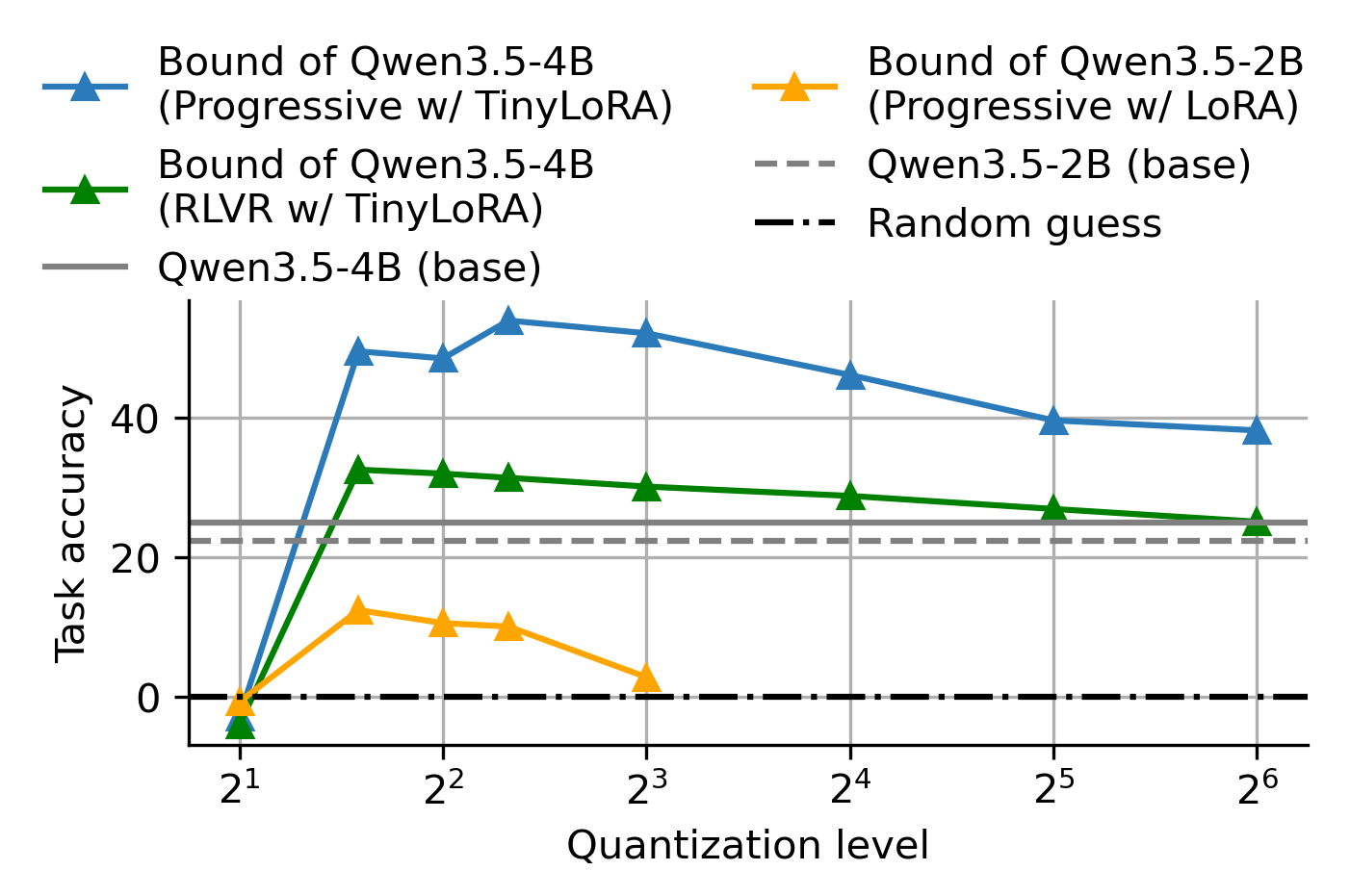
- On-policy distillation (learning from the teacher’s token-by-token behavior) gave about 10% higher training rewards than trying to do RL directly with a tiny adapter.
- Sampling many outputs per prompt made the “intrinsic” randomness error negligible, so the main uncertainty is about new prompts (which is what we care about).
- Flexible and realistic: The approach extends to multi-turn tasks (like interacting with a database), and can also give guarantees on a separate labeled test set (if chosen independently), making it more practical.
Why this matters: If you use RL to specialize a model for a domain (like math or SQL), this paper shows how to both train it and prove a high-confidence lower bound on how well it will do in the future—before you deploy it. That’s a big step toward safer, more reliable AI in real settings.
What this could change (implications)
- Verified specialization: Teams can fine-tune an LLM for a specific domain and then attach a credible “floor” on performance, not just a one-off test score. That’s useful for high-stakes areas like medicine, law, or finance.
- A practical recipe to get guarantees: Train a big teacher → distill to a compact student (TinyLoRA) → quantize. This isn’t just about saving memory or compute; it directly improves the strength of your future-performance guarantees.
- Limitations and future work:
- The guarantees assume future data looks like training data. If your deployment data is very different, you need new tools or extra labeled data to certify performance.
- The experiments focus on ~4B-parameter models. Getting the same level of compression and guarantees for much larger models is a next challenge.
In short: the paper shows how to turn “our model did well on tests” into “we can promise it will do at least this well next time”—and it gives a clear, usable path to make that promise strong.
Knowledge Gaps
Knowledge gaps, limitations, and open questions
Below is a concise list of unresolved issues and concrete research directions opened by the paper.
- Scaling to larger models: Can Progressive RLVR achieve non-vacuous bounds for 7B–70B+ base models without collapsing empirical reward under the required compression budgets? Systematic studies across model sizes and compression levels are needed.
- Dependence on i.i.d. prompts: The bounds assume prompts are i.i.d. from . How do correlations, curriculum sampling, deduplication, or cluster-level dependencies affect validity and tightness? Develop bounds under dependence (e.g., mixing conditions) or de-duplication-aware analyses.
- Decoding mismatch and reparameterization: The bound assumes categorical sampling via softmax with a fixed temperature and uses Gumbel-max reparameterization. How to extend to practical decoding (top-k, nucleus, beam search, greedy)? Derive and validate reparameterizations (e.g., truncated/ordered Gumbel processes) and quantify sensitivity to temperature and decoding strategy changes.
- Deployment decoding policies: The guarantee targets expected reward under single-sample stochastic decoding. Many systems deploy greedy, best-of-N, or majority-vote self-consistency. Provide bounds for these policies (using order statistics or union bounds over samples) and study trade-offs vs. single-sample bounds.
- Multi-turn stochastic/nonstationary environments: The extension requires environment transitions to be reparameterizable and stationary. How to handle non-reparameterizable tools, nonstationary APIs, or live data sources? Explore robust or adaptive PAC-Bayes formulations and stability-based bounds for evolving environments.
- OOD generalization without labeled target data: The OOD bound requires labeled samples from the target distribution and independence from hypothesis selection. Develop bounds for domain shift with unlabeled OOD data (e.g., covariate shift corrections, distributionally robust PAC-Bayes), and quantify selection bias when practitioners “peek” at OOD benchmarks.
- Model/hyperparameter selection effects: The experiments perform hyperparameter sweeps and checkpoint/model selection. Provide bounds that account for selection over learning rates, seeds, checkpoints, and architectures (e.g., via union bounds, luckiness PAC-Bayes, or data-dependent priors), and report δ adjustments.
- Evaluation subsampling and adaptivity: The subsampling corollary assumes the hypothesis is chosen independently of the evaluation subsample. Investigate procedures that permit adaptive evaluation sampling (e.g., multi-armed allocation, active selection) without invalidating the bound, or derive corrected penalties for adaptive subsampling.
- Encoding scheme dependence: The compression term hinges on an encoding scheme. Precisely specify and audit all overhead (adapter placement, TinyLoRA projection rank, seeds for random matrices , quantizer codebooks/scales, indices) and assess how alternative codes (e.g., entropy coding, hierarchical MDL) tighten or loosen bounds. Establish standards for cross-paper comparability.
- Continuous vs. discrete hypothesis spaces: The analysis enforces finiteness via quantization. Can we obtain non-vacuous PAC-Bayes bounds in continuous parameter spaces (e.g., KL to structured priors) without explicit discretization, and how do these compare to compression-based bounds?
- Rate–reward trade-offs: Formulate and optimize the rate–reward frontier (reward per bit) for TinyLoRA and alternatives (sparsity, spectral parameterizations). When does increasing inner dimension or projection rank most improve reward for minimal code length?
- Quantization-aware training: Quantization is applied post hoc. Can quantization-aware Progressive RLVR (during distillation or RLVR) improve reward at fixed bit budgets and further tighten bounds?
- Reward definitions and shaping: Bounds are reported on binary correctness even when training used richer (e.g., tri-level) rewards. Provide tight bounds for shaped/continuous rewards, characterize how reward range influences tightness, and relate shaped bounds to binary task accuracy.
- Variable-length generation: The theory assumes bounded sequence length . Develop bounds accommodating variable-length or unbounded generation with stop criteria, and quantify penalties from truncation or length clipping.
- Intrinsic variance control: The intrinsic error is estimated with generations per prompt. Determine optimal allocation of across prompts (e.g., variance-adaptive sampling), apply control variates or baselines to reduce estimator variance, and assess cost–tightness trade-offs for massive .
- Off-policy reuse and logged data: Computing empirical reward from fresh generations is expensive. Can unbiased reuse of logged rollouts (importance sampling with clipping/regularization) be incorporated without inflating penalties, and how does this interact with the intrinsic error term?
- Extension beyond verifiable rewards: The framework targets deterministic, verifiable rewards. Extend to noisy or human-judged rewards (e.g., RLHF), including label-noise models and robust PAC-Bayes terms, and evaluate how noise inflates penalties.
- Robustness to flaky verifiers: Programming unit tests and SQL execution can be flaky or nondeterministic. Provide bounds that incorporate verifier noise or retry protocols, and quantify the extra penalty required.
- Distribution shift during distillation: On-policy distillation changes the token distribution seen by the student. Analyze when and how distillation-induced distribution shifts degrade bound tightness and whether alternative distillation objectives (e.g., KL constraints) improve bounds.
- Task mixtures and multitask training: Bounds are reported per domain. Develop bounds for mixtures over tasks, per-task conditional bounds under a shared student, and transfer guarantees when jointly training across domains.
- Alternative priors: The prior uses Solomonoff/description-length arguments. Investigate structured/data-dependent priors (e.g., layerwise sparsity, spectral norms, flat minima priors) that may better capture LLM inductive biases and yield tighter bounds at similar compression.
- Fairness and safety metrics: The guarantees address expected accuracy; they do not cover undesirable behaviors (e.g., harmful outputs, bias) or constraint violations. Extend the framework to multi-objective or constrained metrics with verifiable checkers and derive corresponding bounds.
- Empirical reproducibility and generality: Validate Progressive RLVR across more base families (e.g., Llama, Mistral), RLVR variants (GRPO, DAPO, SAPO), languages, and domains to assess generality of tightness and identify failure modes.
- Reporting practices for δ across multiple bounds: Provide guidance for multiple comparisons (across domains and variants), e.g., family-wise or FDR-controlled δ allocations, and report sensitivity to δ choices.
- Public proof and constants: Critical details (proofs, constants, encoding specifics) are deferred to appendices and code. A fully self-contained, peer-audited derivation and a standardized accounting of constants would strengthen verifiability and facilitate independent replication.
Practical Applications
Immediate Applications
The following items describe concrete ways to use this paper’s results and pipeline today, with links to sectors, likely workflows/products, and feasibility notes.
- Verified specialization for domain LLMs
- Sector: healthcare, finance, software, legal, education, business analytics
- What: Use Progressive RLVR (teacher RLVR → on-policy distillation → TinyLoRA → quantization) to train domain-specific adapters and ship them with non-vacuous generalization bounds (accuracy lower bounds) on in-domain tasks (e.g., math, code, Text-to-SQL, knowledge QA).
- Workflow/product:
- Train high-capacity teacher with RLVR on a verifiable dataset (unit tests, verifiers).
- Distill into TinyLoRA student; quantize adapter; compute bound using subsampled reward estimation (Corollary) and report δ (e.g., 5%) and accuracy bound.
- Package adapter + “bound report” as a deployment artifact and publish to an adapter registry.
- Assumptions/dependencies:
- Deployment data matches training distribution (i.i.d.); deterministic/verifiable rewards exist; deterministic environment or reparameterizable stochasticity; acceptable accuracy after TinyLoRA + quantization; encoding scheme to compute description length.
- Bound-aware deployment gating and SLAs
- Sector: enterprise MLOps, regulated industries (healthcare, finance), LLM platforms
- What: Gate promotion of model updates based on certified accuracy lower bounds; define SLAs on minimum accuracy using the PAC-Bayes bound.
- Workflow/product:
- CI/CD step that runs subsampled evaluation (m0 prompts × n generations), computes the bound and blocks releases if bound < threshold.
- “Bound dashboards” showing extrinsic/intrinsic penalties and adapter compression size C(h).
- Assumptions/dependencies:
- Stable, versioned verifiers/test harness; clear bound computation config (δ, m0, n); data governance to ensure no leakage; compute budget for reward estimation.
- Safer Text-to-SQL assistants in BI stacks
- Sector: software, data analytics/BI (e.g., Metabase, Tableau, Hex)
- What: Integrate a Progressive RLVR-trained Text-to-SQL student with an execution-based verifier to achieve a certified lower bound on accuracy for query generation.
- Workflow/product:
- Fine-tune on SynSQL-like corpora; bind the assistant to the database with strict formatting and execution validation.
- Use the bound as a confidence gate: auto-run when bound ≥ threshold, otherwise require human approval.
- Assumptions/dependencies:
- Database schemas in production similar to training; execution environment deterministic; periodic re-verification if schemas drift.
- Verified code assistants for internal repos
- Sector: software development, DevOps
- What: Post-train on unit-tested tasks (e.g., SWE-bench-like or internal tests), deploy a compact code assistant with a certified minimum pass rate.
- Workflow/product:
- RLVR teacher on repo tasks with unit tests → on-policy distill → TinyLoRA + quantize → compute bound on a held training distribution slice or fresh i.i.d. batch.
- Use the bound to permit autonomous patching (e.g., “auto-fix trivial tests”).
- Assumptions/dependencies:
- High-quality, deterministic unit tests; representative test distribution; guardrails for side effects.
- Bounded-accuracy math and tutoring tools
- Sector: education, consumer productivity
- What: On-device/edge math tutor (quantized TinyLoRA adapter) with a certified minimum accuracy on a targeted curriculum.
- Workflow/product:
- Train with verifiable math solvers (sympy, math_verify); ship adapter and bound summary in the app; route uncertain cases to human feedback or larger model.
- Assumptions/dependencies:
- Curriculum alignment to training; proper verifier coverage; on-device compute for quantized adapters.
- Compliance artifacts for audits
- Sector: policy/regulation, risk/compliance, procurement
- What: Provide auditable “Generalization Bound Reports” for domain LLMs as part of model cards, supporting procurement and regulatory filings (e.g., EU AI Act conformity assessments).
- Workflow/product:
- Include bound value, δ, training distribution description, compression size, quantization level, subsampling protocol, and environment determinism statement.
- Assumptions/dependencies:
- Regulator acceptance of PAC-Bayes compression evidence; traceable datasets and verifiers; reproducible bound computation.
- Research benchmarking with non-vacuous bounds
- Sector: academia, industrial research
- What: Use the open-source code/datasets to compare RLVR variants (e.g., clipping schemes, KL penalties, decoding temperatures) under a common bound methodology.
- Workflow/product:
- “Bound-first” benchmarking where new algorithms must show improved bound tightness, not only raw accuracy.
- Assumptions/dependencies:
- Reproducible training; consistent encoding scheme; careful control of teacher capacity vs. student compression.
- Cost-efficient adapter shipping and edge deployment
- Sector: software, devices/edge, startups
- What: Ship tiny, quantized adapters (TinyLoRA) for edge deployments with known minimum accuracy, lowering server costs while maintaining quality thresholds.
- Workflow/product:
- Progressive RLVR to fit adapter within tight memory/bit budgets; serve locally with a small base model.
- Assumptions/dependencies:
- Acceptable performance after extreme compression; device memory/compute constraints met; safe fallback paths.
- Bound-driven dataset planning and training design
- Sector: data engineering, MLOps
- What: Use the extrinsic/intrinsic decomposition to tune m (prompts) and n (generations per prompt) for desired bound tightness before training.
- Workflow/product:
- Pre-training calculator that converts target bound gap into required sample sizes and compression targets.
- Assumptions/dependencies:
- Reasonable estimates of Δ (reward range), compression feasibility, and available data.
- Adapter registries with bound metadata
- Sector: model marketplaces, open-source ecosystems
- What: Add “verified accuracy lower bound” and compression-size fields to adapters on model hubs, enabling customers to filter by verified performance.
- Workflow/product:
- Repository schema update; automated validation scripts that recompute/verify claims on provided subsamples.
- Assumptions/dependencies:
- Community standards for bound declarations; reproducibility; trusted verifier testbeds.
Long-Term Applications
These opportunities require further research, scaling, or ecosystem development before broad deployment.
- Certification of large (tens-to-hundreds of billions) RLVR models
- Sector: foundation models, cloud platforms
- What: Extend Progressive RLVR and compression to much larger backbones while retaining accuracy and non-vacuous bounds.
- Dependencies:
- More aggressive PEFT/quantization techniques; new encoding schemes; efficiency improvements in on-policy distillation; hardware-scaled reward estimation.
- OOD generalization certification and drift-aware verification
- Sector: healthcare, finance, government, enterprise
- What: Formalize and operationalize OOD bounds using independent labeled corpora; integrate drift detection that triggers re-bounding or retraining.
- Dependencies:
- Curated OOD datasets; monitoring of dataset shift; policies for when to re-train and re-certify; incremental bound updates.
- Certifying multi-turn tool-using agents
- Sector: software agents, RPA, customer support, data engineering
- What: Apply the reparameterization approach to stochastic tools/APIs (if reparameterizable) for bounds on agent workflows (retrieval, code execution, API calls).
- Dependencies:
- Reparameterizable tool randomness or stable emulators; deterministic test harnesses; limits on non-stationarity of external APIs.
- Bound-driven active data acquisition and labeling markets
- Sector: data vendors, ML operations
- What: Use bound terms to select prompts that most tighten the extrinsic error; buy/label data where it maximally improves the certified lower bound.
- Dependencies:
- Acquisition cost models; interactive data pipelines; reliable reward verifiers at scale.
- Industry standards and audit frameworks for “verified specialization”
- Sector: policy, standards bodies, insurers
- What: ISO-style specifications for reporting compression size C(h), δ, reward range Δ, subsampling protocol, and environment determinism; insurance products priced on certified bounds.
- Dependencies:
- Consensus on reporting formats; third-party auditors; regulatory alignment; actuarial models.
- Marketplace for “certified adapters”
- Sector: software marketplaces, procurement
- What: Commercial exchange where adapters list verified lower bounds for specific distributions (e.g., cardiology notes, EU tax forms), enabling safe procurement.
- Dependencies:
- Legal frameworks for claims; reproducible verification kits; domain-specific verifiers; license compliance.
- Privacy-preserving and federated bound computation
- Sector: healthcare, finance, public sector
- What: Compute bounds without centralizing sensitive data via secure aggregation or differentially private subsampling, while maintaining non-vacuous guarantees.
- Dependencies:
- DP/federated protocols compatible with PAC-Bayes compression; verifier execution under privacy constraints; acceptable bound degradation.
- Bound-aware routing and orchestration
- Sector: LLMops, agent frameworks
- What: Orchestrators that route tasks to the smallest adapter whose bound exceeds a task-specific threshold, escalating to larger models only as needed.
- Dependencies:
- Per-task bound metadata; reliable task classification and distribution matching; latency/cost models.
- Sector-specific verified pipelines
- Healthcare: clinical coding and billing assistants with verified minimum accuracy on internal claim schemas.
- Finance: KYC form parsing and regulatory reporting with certified lower bounds on extraction accuracy.
- Legal: Contract clause identification and QA with verifiable, deterministic labeling rules.
- Education: Curriculum-aligned tutors with certified minimum accuracy and human-in-the-loop escalation.
- Dependencies:
- Strong domain verifiers; stable input distributions; governance policies for exception handling.
- Tooling ecosystems
- What: Turn this paper’s pipeline into reusable software:
- BoundKit: a library/CLI to compute RLVR PAC-Bayes bounds with subsampling, noise reparameterization, and encoding-size accounting.
- Progressive RLVR Studio: templates for teacher RLVR, on-policy distillation (TinyLoRA), and quantization integrated with existing frameworks (e.g., SkyRL, Tinker).
- AdapterCard+: model cards extended with bound metadata and reproducible scripts.
- Dependencies:
- Community adoption; robust verifier libraries; standardized encoding/quantization reporting.
Notes on feasibility across applications
- Strong assumptions: Deployment distribution ≈ training distribution; availability of deterministic/verifiable rewards; deterministic or reparameterizable environments; independence of the evaluation corpus used for bound computation from hypothesis selection (as required in the OOD setting).
- Practical levers: Increase m (prompts) to shrink extrinsic error; choose n (generations/prompt) to make intrinsic error negligible; optimize TinyLoRA/quantization to reduce C(h) without undue accuracy loss; maintain stable verifiers and test harnesses.
- Limitations to monitor: Domain shift; tool/API non-stationarity; scaling to very large models; regulatory acceptance; possible performance loss from extreme compression.
Glossary
- Autoregressive generation: Sequential token generation where each token is sampled conditional on previously generated tokens. "the autoregressive generation of a sequence"
- Categorical distribution: A probability distribution over discrete categories, used here to sample the next token. "samples a token from the categorical distribution"
- Compression-based PAC-Bayes: A PAC-Bayesian approach where generalization bounds depend on how compressible the learned hypothesis is. "compression-based PAC-Bayesian framework"
- Description length: The number of bits required to encode a hypothesis or parameter update, used as a proxy for compressibility. "description length (compressibility)"
- Extrinsic component: The portion of the generalization error attributable to variability in the input data distribution (prompts). "an extrinsic component over the prompt distribution"
- Generalization gap: The difference between a model’s expected (population) performance and its empirical performance on sampled data. "generalization gap into two components"
- Gumbel distribution: A continuous distribution used to reparameterize categorical sampling via the Gumbel-max trick. "Gumbel(0,1)"
- Gumbel-max reparameterization trick: A technique that converts sampling from a categorical distribution into an argmax over logits perturbed by Gumbel noise. "Gumbel-max reparameterization trick"
- Gumbel-max theorem: The result asserting that sampling the argmax of logits plus Gumbel noise is equivalent to categorical sampling. "The Gumbel-max theorem"
- Hoeffding term: A concentration bound term that scales with the inverse square root of sample size, used in generalization analyses. "only a Hoeffding term of size"
- Hypothesis space: The set of candidate models or parameter updates considered by the learning procedure. "hypothesis space "
- Importance-sampling objective: An RL training objective that reweights samples to correct for distributional differences between behavior and target policies. "a standard importance-sampling objective"
- Intrinsic component: The portion of the generalization error due to stochasticity in the model’s generation process and finite sampling of generations. "an intrinsic component over the model's generation process"
- KL-divergence penalty: A regularizer that penalizes divergence from a reference policy or distribution to stabilize RL training. "KL-divergence penalties"
- Low-Rank Adaptation (LoRA): A parameter-efficient fine-tuning method that injects trainable low-rank matrices into frozen weights. "Low-Rank Adaptation (LoRA)"
- Non-stationary environments: Environments whose transition dynamics change over time or between training and deployment. "Non-stationary environments, such as live tool APIs"
- Non-vacuous generalization bounds: Informative bounds that provide non-trivial guarantees (better than chance or trivial upper bounds) on expected performance. "non-vacuous generalization bounds"
- On-policy distillation: A distillation method where the student learns from data generated by the teacher’s current policy, providing dense token-level supervision. "on-policy distillation"
- Out-of-distribution (OOD) evaluation: Assessing model performance on data drawn from a different distribution than the training set. "out-of-distribution (OOD) evaluation"
- PAC-Bayes framework: The Probably Approximately Correct Bayesian framework that leverages priors/posteriors over hypotheses to bound generalization error. "The PAC-Bayes framework"
- Parameter-efficient fine-tuning (PEFT): Techniques that adapt large models by training only small parameter subsets or adapters rather than all parameters. "parameter-efficient fine-tuning (PEFT) techniques"
- Prefix Kolmogorov complexity: The length of the shortest prefix-free program that outputs a given object; used to define universal priors and description lengths. "prefix Kolmogorov complexity"
- Quantization: Discretizing parameters to a limited set of levels to reduce storage and communication costs, often with minimal accuracy loss. "model quantization"
- Rademacher complexity: A capacity measure capturing how well a hypothesis class can fit random labels, used to derive generalization bounds. "Rademacher complexity"
- Reinforcement learning with verifiable rewards (RLVR): An RL post-training approach where rewards are computed by objective verifiers (e.g., unit tests) rather than human preferences. "reinforcement learning with verifiable rewards (RLVR)"
- Solomonoff prior: A universal prior assigning probabilities proportional to the inverse exponential of Kolmogorov complexity, favoring simpler hypotheses. "Solomonoff prior"
- Text-to-SQL: The task of translating natural language queries into SQL statements executable over databases. "Text-to-SQL"
- TinyLoRA: An extreme LoRA parameterization that replaces trainable matrices with low-dimensional vectors projected through fixed matrices, enabling ultra-compact adapters. "TinyLoRA"
- Truncated singular value decomposition (SVD): An approximation technique that retains only the top singular components of a matrix to achieve dimensionality reduction. "truncated singular value decomposition"
- Vapnik–Chervonenkis (VC) dimension: A measure of the capacity of a hypothesis class based on the largest set it can shatter. "Vapnik-Chervonenkis (VC) dimension"
Collections
Sign up for free to add this paper to one or more collections.

