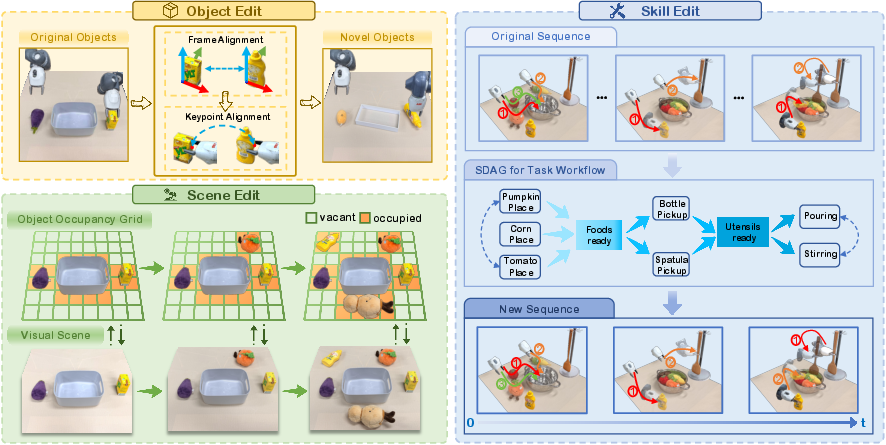
- The paper presents Task-Edit, a novel framework that decomposes tasks into scene, skill, and object components to generate diverse training data.
- It achieves significant performance gains with a mean success rate of 81.3% on real tasks and 93.7% in simulated in-distribution settings.
- The approach reduces manual data collection by enabling flexible editing and recombination, boosting robustness in out-of-distribution scenarios.
Task-Edit: A Task-Centric Framework for Generalizable 3D Visuomotor Policy Learning
Overview and Motivation
This paper introduces Task-Edit, a novel data generation framework for 3D visuomotor policy learning. The motivation stems from the high cost and limited diversity of real-world demonstrations for training policies capable of complex, long-horizon manipulation tasks. Existing demonstration generation methods focus largely on object-centric variations (e.g., changing object poses), with limited ability to synthesize diverse scene-skill-object combinations. Task-Edit addresses this by decomposing tasks into independent scene, skill, and object components, enabling independent, targeted editing and flexible recombination for scalable generation of diverse training trajectories.
Task-Edit Framework
The Task-Edit framework operates through a Real2Sim2Real paradigm and consists of the following key stages:
Experimental Analysis
The efficacy of Task-Edit is demonstrated through extensive experiments involving various robot embodiments (dual-arm, single-arm, humanoid), a suite of single- and dual-arm manipulation tasks, and both real and simulated environments.
Quantitative Results
- Across nine real-world tasks, models trained on Task-Edit-generated trajectories outperform those trained on both DemoGen-generated and human-collected data, with Task-Edit yielding a mean success rate of 0.813 compared to 0.656 for DemoGen and 0.719 for human data, even though Task-Edit builds from a single demonstration per task.
- In simulation, Task-Edit further surpasses baselines, achieving a mean success of 0.937 (in-distribution) and 0.887 (out-of-distribution), with strong results maintained as the number of generated trajectories and object combinations increases.
- Robustness in generalization: Task-Edit-founded policies display enhanced performance in settings with unseen objects or novel skill-object combinations, with the gap widening as data diversity scales.
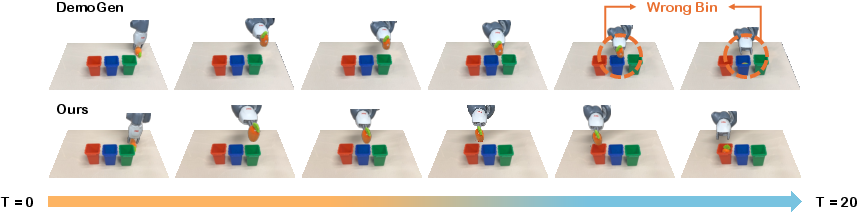
Figure 2: Time-series visualization contrasting the execution process of DP3 trained on DemoGen vs. Task-Edit data on the ABB Sorting task.
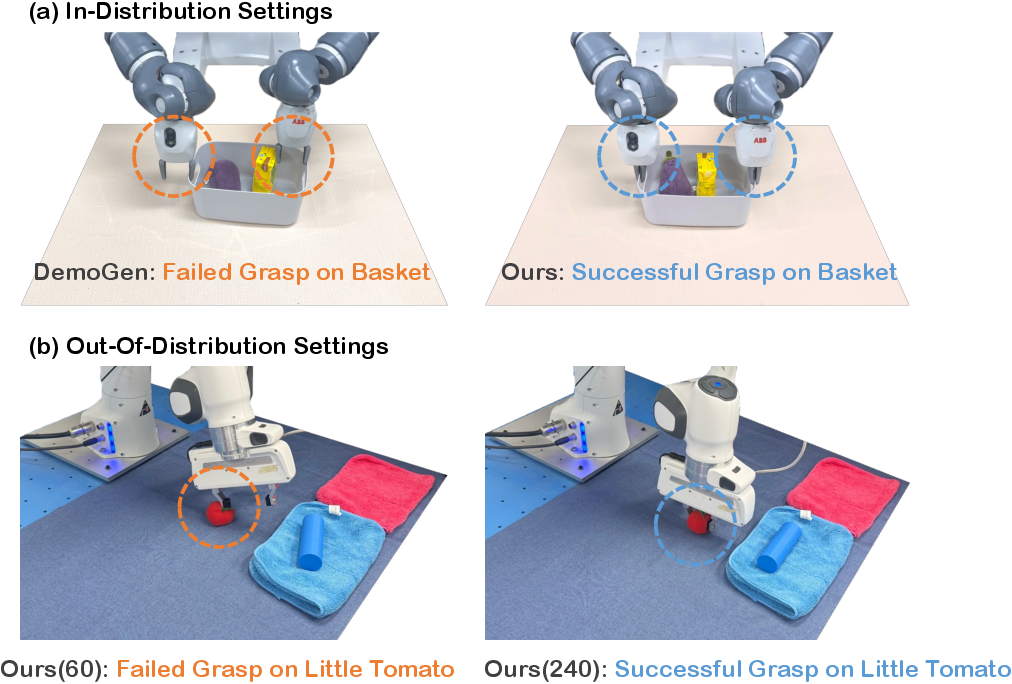
Figure 3: (a) Task-Edit enables stable grasps in in-distribution settings where DemoGen-trained models fail. (b) With greater trajectory diversity, Task-Edit-trained models can grasp unseen small-scale objects.
Qualitative Observations and Ablation
- Qualitative visualizations demonstrate improved policy robustness and stability, particularly for fine-grained manipulations and in the presence of distractors or clutter.
- Ablation studies reveal that the depth restoration module significantly reduces the sim-to-real gap and that Task-Edit remains robust to pose estimation noise.
- Human time cost is sharply reduced: 14.6% of the time required for equivalent manual collection, with a 93.26% improvement in data collection efficiency for long-horizon tasks.
Handling Complex Manipulations
- Skill Sequence Editing: Task-Edit-generated data supports the learning of policies that handle varied and cyclic skill sequences, outperforming DemoGen across both dual-arm/long-horizon and single-arm/short-horizon tasks (mean: 0.895 vs. 0.684).
- Cyclic Manipulation: From a single demonstration, Task-Edit enables successful policy learning for repeated actions (e.g., shaking, stirring) of varying cycle lengths and novel object categories.
Challenging Scenarios
- Task-Edit-generated data enables robust policy deployment in dynamic, cluttered, and obstacle-rich scenarios, where models trained without explicit exposure to such scenarios nearly always fail.
Implications and Future Directions
Task-Edit represents a substantial step toward efficient and scalable demonstration generation for large-scale, generalizable visuomotor policy learning. The explicit decoupling and independent editing of scene, skill, and object attributes allow for richer compositional diversity, which is critical for out-of-distribution robustness and sample complexity reduction.
Practically, Task-Edit provides an avenue to bypass manual enumeration of skill/object/scene configurations, positioning it as a valuable tool for both academic and industrial applications where exhaustive data collection is impractical.
From a theoretical standpoint, Task-Edit reframes the problem of data generation as a compositional, task-level operation, opening future research in automated task synthesis, transfer to non-rigid and articulated objects, and further sim-to-real reduction. Integrating language-conditioned policy learning or generative models for novel task derivation ("task generation") is an anticipated evolution, as is the incorporation of richer object categories and human-in-the-loop adaptation to handle the rare edge cases not captured by current 3D generation methods.
Conclusion
Task-Edit establishes a new protocol for data-efficient, generalizable 3D visuomotor policy learning via systematic task decomposition and component-centric editing. Empirically validated across diverse tasks and robots, it enables state-of-the-art policy performance and generalization from minimal demonstrations, substantially lowering the barrier for deploying robust manipulation policies in complex environments. Task-Edit has clear implications for scaling robotic learning and serves as a foundation for future research on automated, compositional task and skill acquisition.