- The paper introduces falsifiable release gates that enforce machine-checkable safety invariants before integrating new agent capabilities.
- It employs rigorous empirical methods, including adversarial red-teaming and feedback-calibrated learning, to ensure strict safety thresholds.
- The Anta runtime demonstrates robust control via token minting, cryptographic isolation, and hash-chained audits to contain self-improvement.
Falsifiable Release Gates for Self-Improving Systems
Methodological Framework
The paper "Falsifiable Release Gates for Self-Improving Systems" (2607.13070) introduces an engineering discipline for safety in self-improving agent runtimes via a process termed falsifiable release gates. Rather than relying on static audits or self-asserted claims, the methodology mandates that each new agent capability must pass a machine-checkable, pre-declared acceptance suite—termed a "gate"—and maintain a fixed set of standing invariants before its release. These invariants are few by design, focusing the safety argument around mechanical checks rather than manual inspection or informal guarantees. Notably, the invariants include (i) a single, non-bypassable control path for all effectual actions (the token ring), (ii) mandatory monotone tightening (autonomous self-improvement can only make policies stricter; loosening always requires human involvement), (iii) full auditing of all decisions (human and automated), and (iv) governance over content hashes, decoupling safety controls from sensitive payloads.
Each release gate is written and enforced before its associated feature is implemented—reversing the common "test after code" pattern. The acceptance suite accumulates across rungs Figure 1, preserving prior guarantees as new capabilities are integrated.
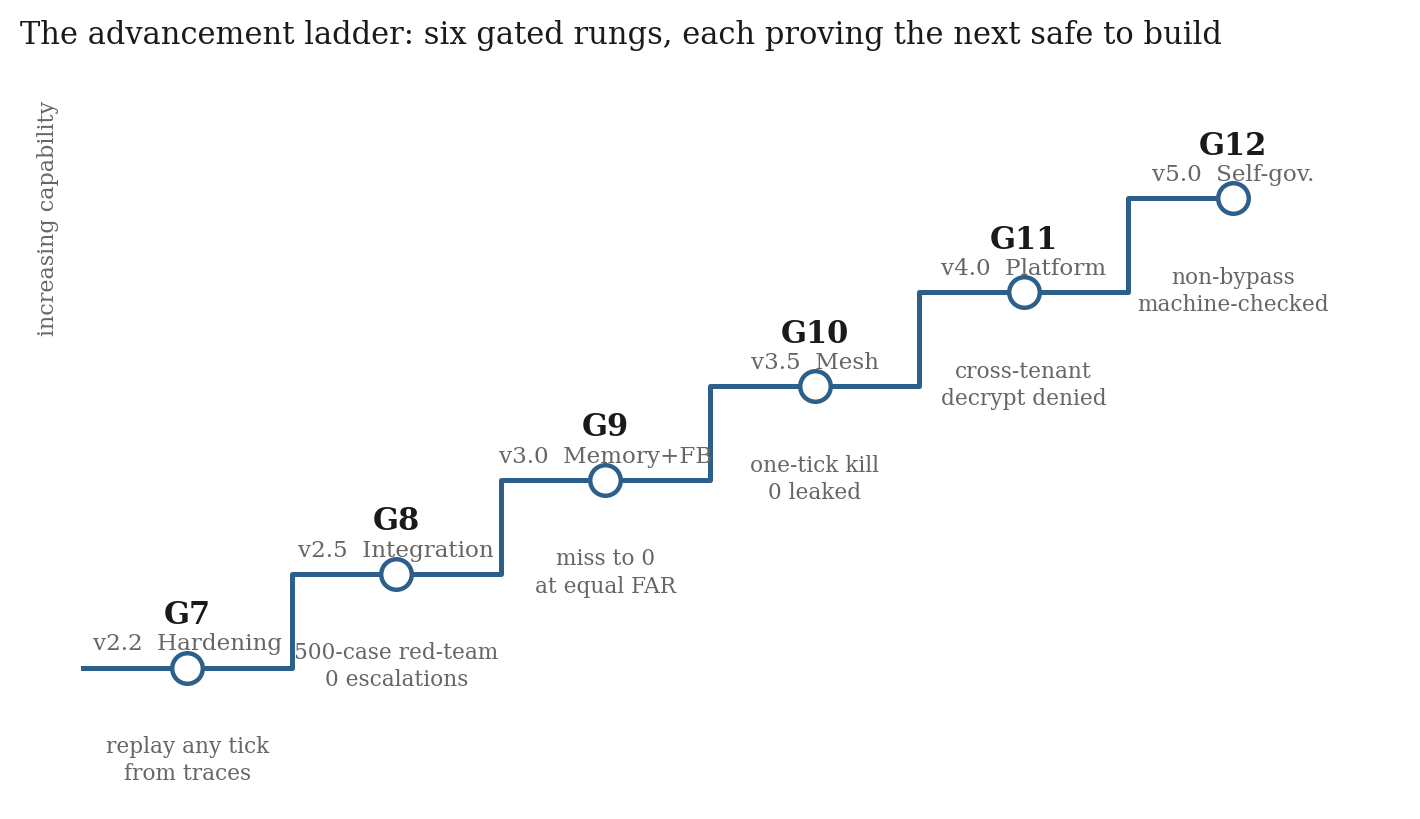
Figure 2: The advancement ladder: six gated rungs (G7 to G12), each proving the next safe to build.
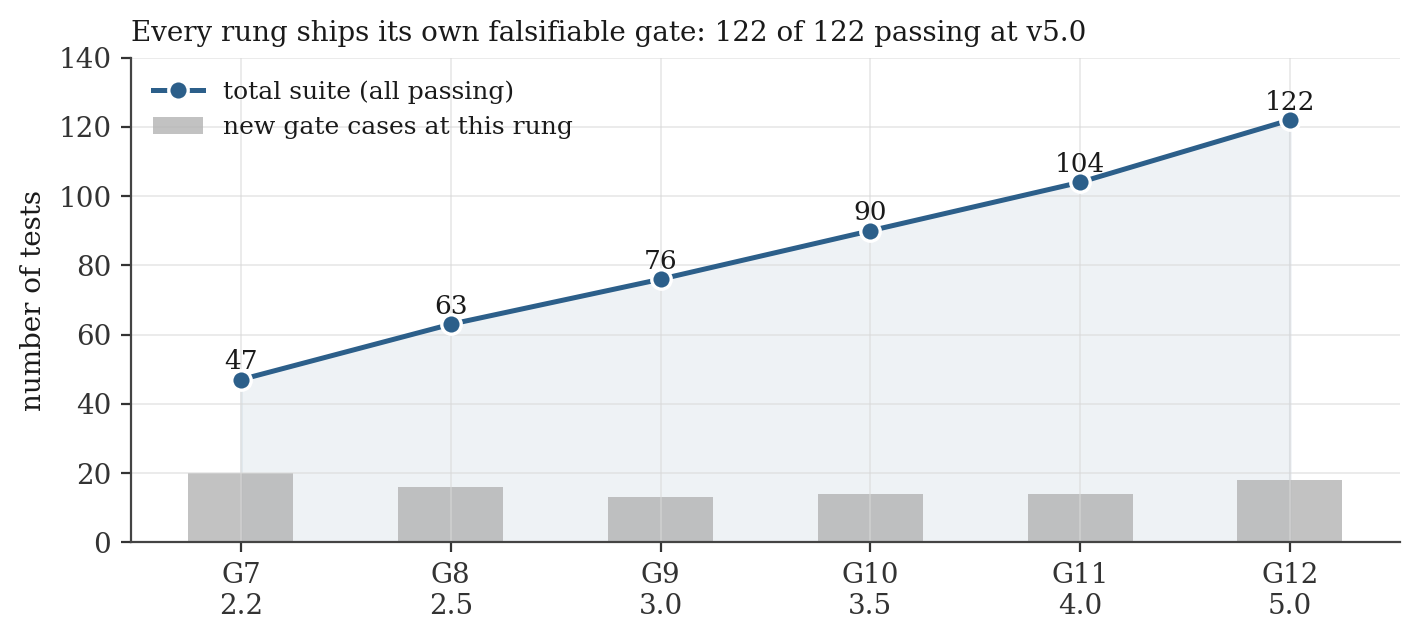
Figure 1: Every rung ships its own falsifiable gate; the acceptance suite grows to 122 tests (95 gate cases), all green at the final version.
System Realization: The Anta Runtime
The Anta runtime provides a concrete, open-source instantiation of the methodology across seven release gates (G7–G12), each forming a prerequisite for the next Figure 2. Architecture is mapped onto the "inner instrument" model from Indian philosophy, decomposing the agent into perception (manas), judgment (buddhi, the control ring), self/boundary management (ahaṃkāra), and memory/audit (citta). This is operationalized with a risk scorer, a token-minting control ring, cryptographically-isolated tenants, and a hash-chained audit log. All real-world actions are contingent on a token minted in response to an allow verdict by the control ring.
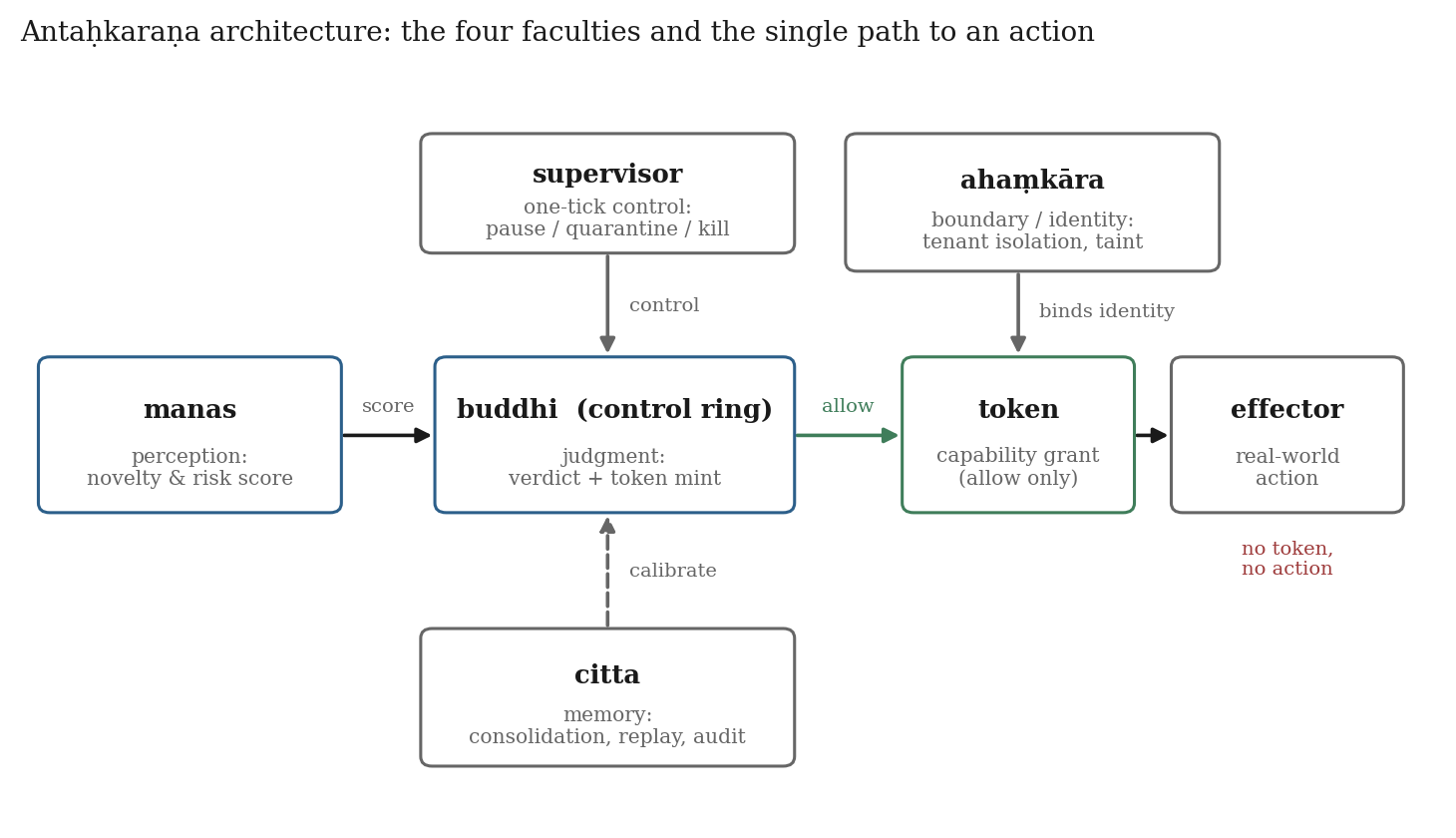
Figure 3: The faculties wired together. Manas scores; buddhi decides and mints a capability token only on an allow verdict; the effector will not move without one.
G8: Adversarial Tool-Use Integration — The runtime is challenged with 432 real prompt-injection attacks (from SOTA corpora) on a 7B frontier model. All 432 attacks are blocked. There are zero policy escalations and zero effectors improperly triggered. This demonstrates effective decoupling of LLM generation and environment actuation, ensuring only the ring holds effect authority.
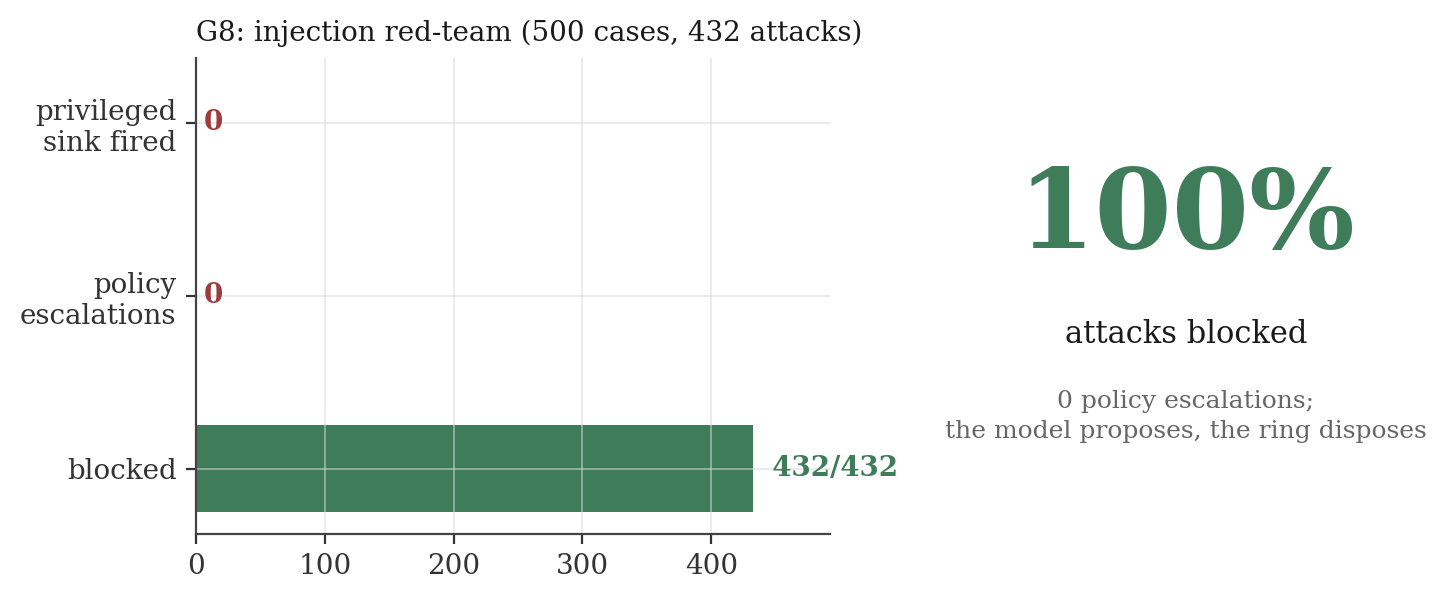
Figure 4: G8 injection red-team: 432 of 432 attacks blocked, 0 policy escalations.
G9: Feedback-Calibrated Learning — The policy updater may only tighten thresholds. On three held-out corpora, the learned gate reduces the missed detection rate from 0.50–0.67 to 0.00 at zero false-alarm rate, indicating that the system becomes strictly more conservative after online calibration—never less.
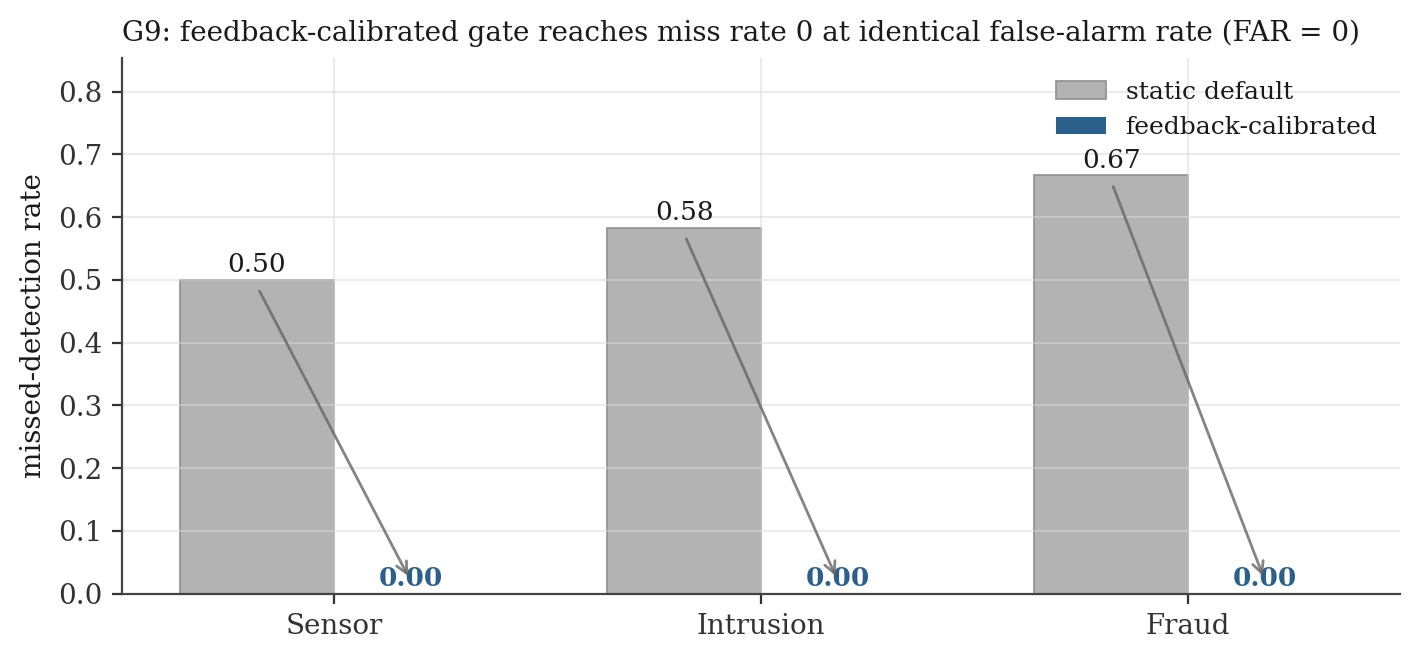
Figure 5: G9 dominance: missed-detection rate falls to zero at an identical (zero) false-alarm rate across three held-out corpora.
G10/G11: Fleet Control and Isolation — The mesh can pause/quarantine/kill any subordinate loop safely in one tick. Attribution precision under correlated drift is 1.00 (no false alarms), and after supervisor intervention, the hundredth-percentile actions leaked is strictly zero. Tenants are cryptographically isolated, with tamper-localized, hash-chained auditing.
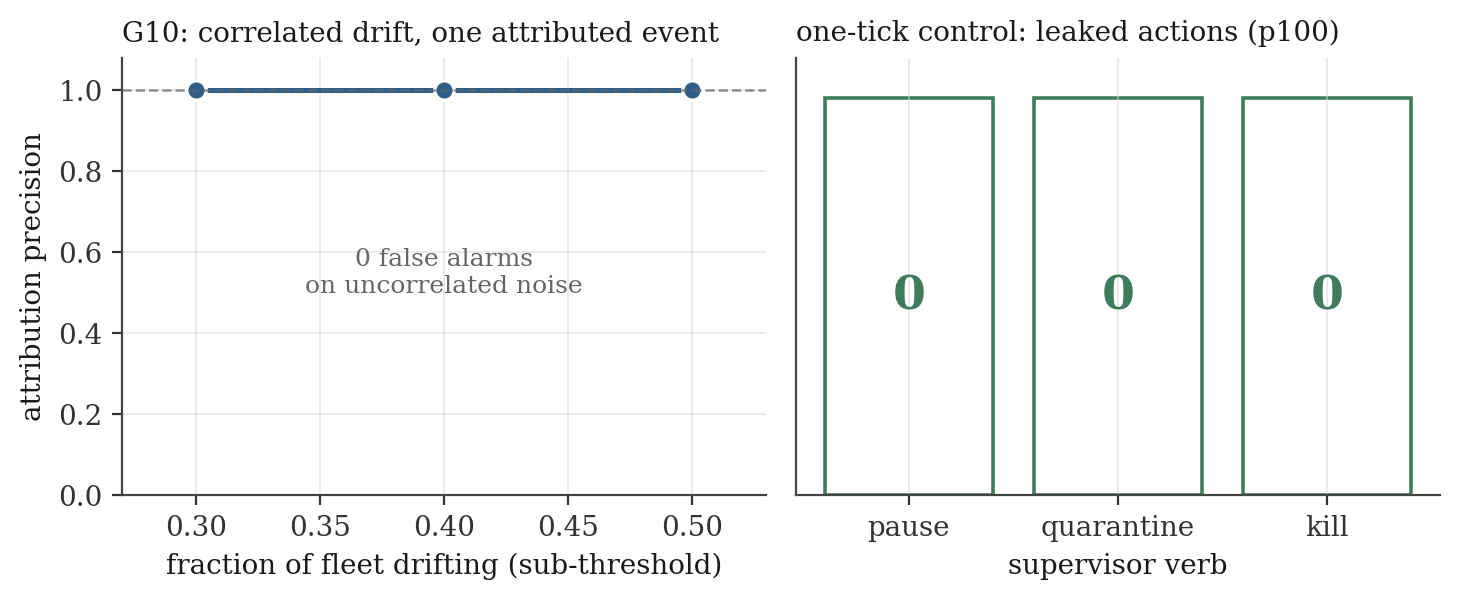
Figure 6: G10 fleet governance: attribution precision 1.00 across drift fractions with zero false alarms (left); zero leaked actions after one-tick control for pause/quarantine/kill (right).
Gate G12: Machine-Checked, Non-Bypassable Core
The safety-critical invariant (INV-1) that no action can reach an effector without a currently minted and unexpired token is subjected to formal, exhaustive machine checking over the complete 291-state reachable space. Additional invariants assure single-tick control and token uniqueness. The exhaustiveness is bounded but covers all discrete coordination logic (excluding the learned components outside this model). Crucially, for each invariant, deliberately broken variants are introduced and the checker must find witnesses, ensuring verification "has teeth" and is not vacuously passing. The checker’s integrity is reinforced by replaying 1M execution traces; any divergence between trace and model causes CI failure, maintaining alignment between abstract specification and implementation.
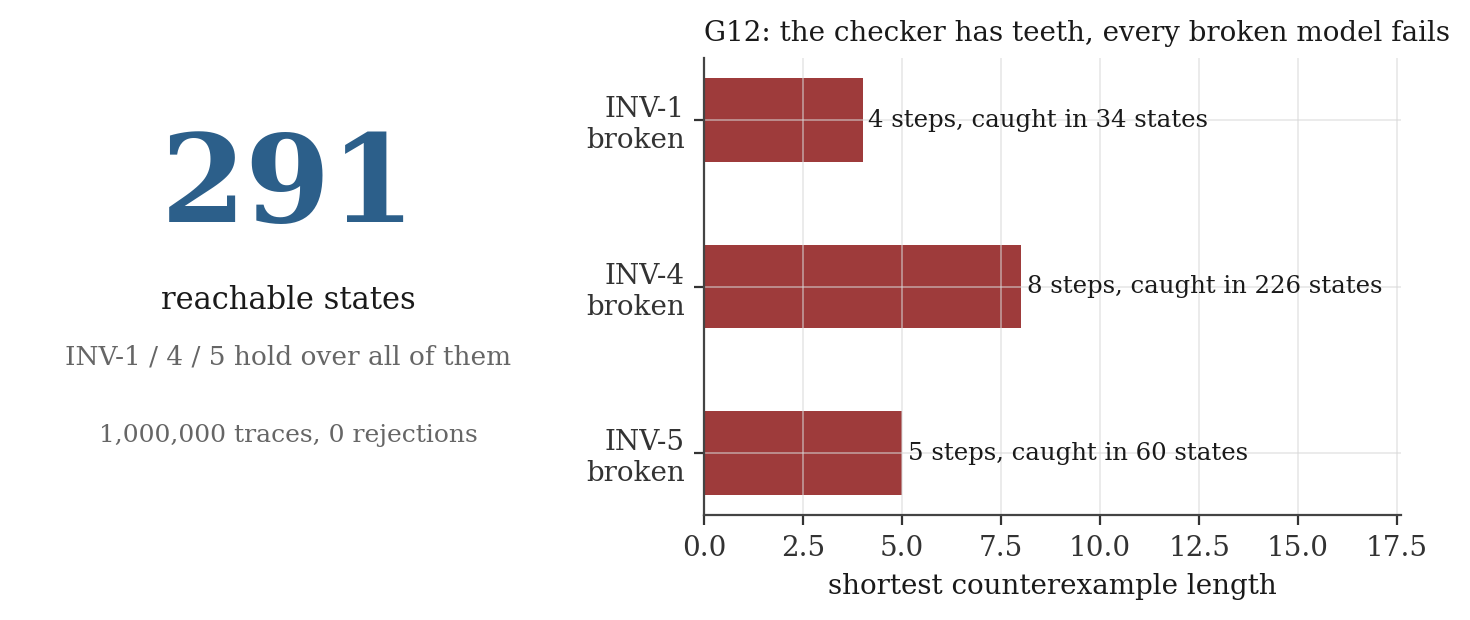
Figure 7: G12 verification: INV-1/4/5 hold over all 291 reachable states (left); every deliberately broken model is caught, with the shortest counterexample (right).
Contained Self-Improvement
Anta's policy self-modification is strictly contained by construction. The automated improver’s write-surface is restricted to policy diffs with no access to code or evaluation mechanisms. The policy lattice enforces auto-adoption only for monotone-tightening diffs; any loosening requires human review and merge. Each proposal predicts its own effect on the replay corpus; mismatches trigger auto-closure. This structure ensures self-improvement cannot escape or redefine its evaluative boundaries. As a demonstration, a machine-proposed tightening of the notify threshold (0.80 → 0.59) is auto-adopted; any loosening would have required explicit human action.
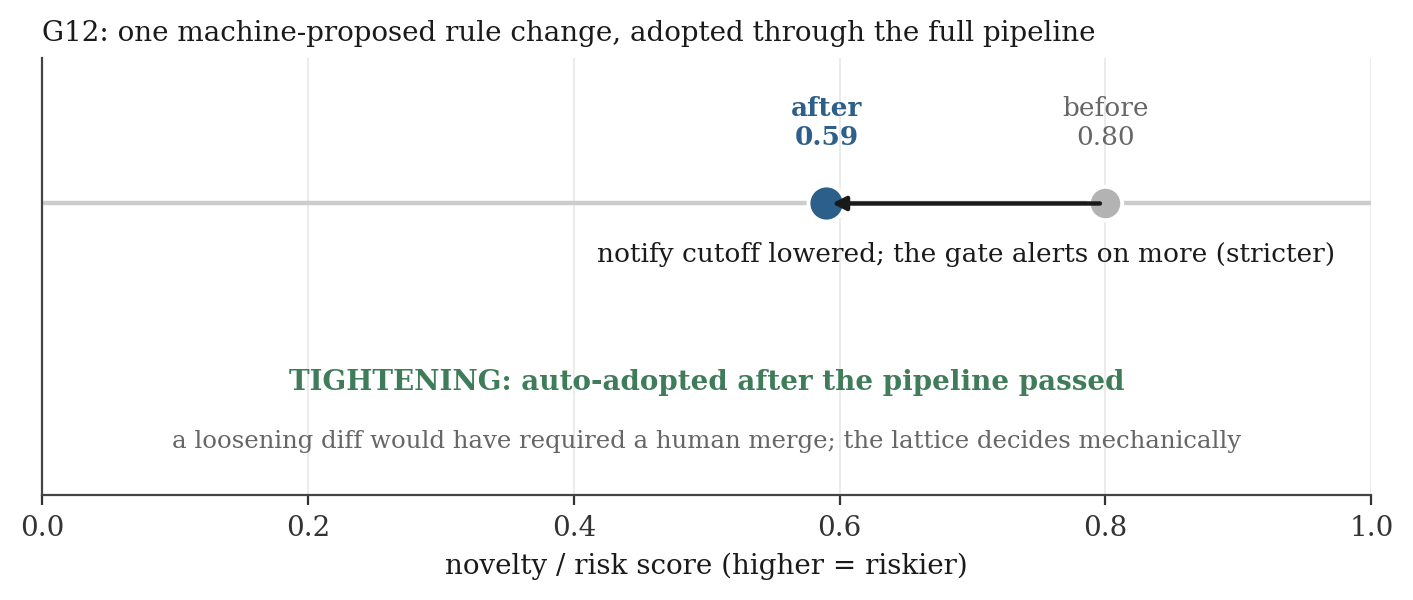
Figure 8: G12 self-improvement: a machine-proposed tightening (notify cutoff 0.80→0.59) adopted through the full pipeline; a loosening change would have required a human merge.
Implications, Limitations, and Future Directions
This work reframes AI agent safety as a versioned, empirical process: the safety argument is built up via compositional, falsifiable gates, not a static audit or single document. By releasing executable test artifacts and a canonical TLA+ core specification, "does your framework pass G9/G12" becomes a reproducible question rather than an assertion. The containment of self-improvement by structural constraints, not dynamic oversight, is a notable architectural stance.
Limitations are explicit: the machine-checked properties are bounded (finite-state symbolic model checking), not inductive or statistical; the learned scoring functions are out of scope of formal guarantees. The operational fit to deployment scenarios is pending long-term, pre-registered threshold reporting and external red-teaming, both in progress. The authors suggest that future advances may yield unbounded inductive proofs for the discrete core and statistical coverage for the learned modules (e.g., conformal prediction for distribution-free calibration), as well as federation and adversarial oversight across mesh topologies.
Conclusion
Falsifiable release gates provide a disciplined pathway for safety assurance in self-improving agent systems by enforcing preservation of critical invariants, enabling exhaustive, machine-checked verification of coordination logic, and ensuring self-improvement is contained structurally rather than by policy. Anta operationalizes this as a testable, open framework, with stringent empirical results at each gate, reproducible acceptance tests, and explicit scope boundaries. The approach establishes a foundation for compositional safety, inviting both adoption and scrutiny across the research and engineering community.

