- The paper introduces a horizon-weighted local projection (HW-LP) criterion that directly targets the precision of dynamic treatment effects across multiple horizons.
- It derives a closed-form solution using an AR(1)-Toeplitz framework to determine optimal assignment persistence for varying temporal reporting targets.
- Empirical calibration and multi-arm extensions validate that the HW-LP design can significantly reduce MSE compared to standard iid assignment designs.
Calibrated Horizon-Weighted Local Projection Designs for Markov Switchbacks
Conceptual Motivation and Horizon-Weighted Design Targeting
The paper introduces a formal criterion for experimental design in dynamic environments where the targeted estimand is a local-projection (LP) functional over multiple horizons, as opposed to a single average treatment effect. This framework is particularly relevant for interventions that induce temporal responses, such as demand-response signals in electricity consumption, platform pricing, or delayed marketing effects.
Traditional switchback experimental design approaches focus primarily on average effects, carryover robustness, or generic MSE minimization. The present paper instead defines a horizon-weighted local projection (HW-LP) criterion, which directly maps the target object—potentially a vector or a functional of dynamic responses—into a precision-optimization problem for the temporal assignment path. The HW-LP risk for a pre-specified contrast c′g is defined as the asymptotic variance of c′g^ under the assignment mechanism, and for general reporting weights the risk is RW(π)=tr{WVπ}, where Vπ is the assignment-dependent estimator covariance.
A focal point is the characterization of binary Markov switchback designs, parameterized by persistence r=2s−1 (s is the probability of staying in the current treatment assignment). The lagged-assignment information matrix is AR(1)-Toeplitz, yielding a tridiagonal inverse and enabling closed-form precision calculations for the HW-LP criterion.
For a given horizon weight vector c, the HW-LP risk as a function of persistence r takes the form:
Rc(r)=4σ21−r2a+br2−2dr
where a, c′g^0, and c′g^1 are functions of the reporting weights. Analytical minimization of this expression reveals that optimal persistence is highly target-dependent:
- Isolated immediate effects (c′g^2, for some c′g^3): optimal persistence c′g^4 (iid assignment).
- Smooth cumulative targets (c′g^5): optimal at boundary, favoring maximal feasible persistence.
- Oscillating/rebound contrasts (sign-changing weights): optimal persistence can be negative or intermediate.
Normalized HW-LP risk curves for various targets clearly demonstrate the distinct variance-minimizing persistence profiles associated with immediate, cumulative, delayed, and rebound effects.
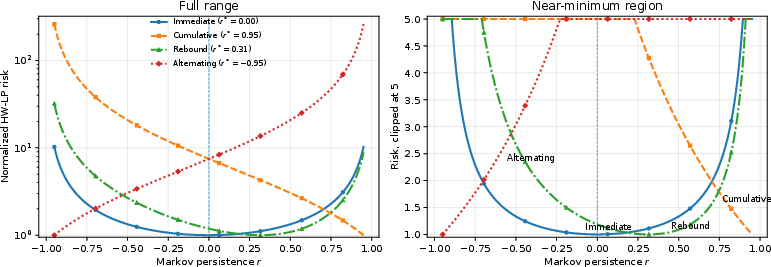
Figure 1: Target-specific risk and variance-minimizing persistence. Normalized HW-LP risk varies with the reporting target: isolated horizons favor iid assignment, smooth cumulative targets favor persistence, and oscillating contrasts can favor alternating designs.
This construct allows explicit operational translation from reporting-object shape to assignment persistence within a constrained Markov class.
Implementation: Calibration, Robustness, and Feasibility
The theoretical closed-form solution serves as a benchmark, but implementation must address field heterogeneity, serial dependence, operational constraints, and carryover misspecification. The authors develop a pilot/calibration framework that selects persistence by minimizing HAC, residual-bootstrap, or realized-schedule risk for the estimator and reporting object. Candidate-specific HAC bandwidth diagnostics are employed to handle high persistence and effective sample size inflation in the presence of serial dependence.
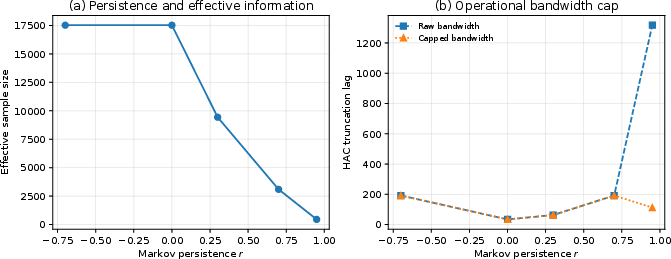
Figure 2: Persistence, effective sample size, and candidate-specific HAC bandwidths for c′g^6 half-hours.
The paper addresses omitted-tail bias by formulating a bias-variance sensitivity criterion that accounts for potential misspecification in the carryover horizon. Analytical results show that buffer horizons in the estimation window can absorb such omitted lag effects, with bias determined strictly by the final reporting weight and carryover parameters.
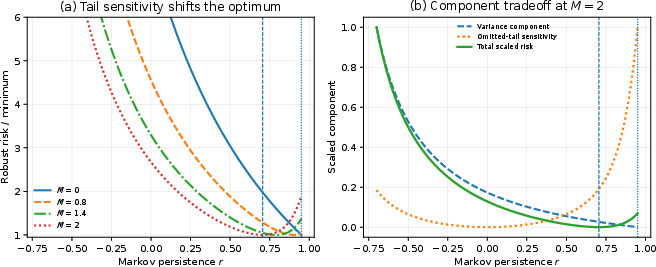
Figure 3: Unknown carryover creates a bias--variance design tradeoff. The left panel shows how increasing the omitted-tail radius shifts the cumulative-target optimum away from the variance-only boundary. The right panel decomposes the scaled components at the reported sensitivity radius; the vertical lines mark the variance-only and bias-augmented optima.
Empirical Calibration and Numerical Evidence
A semi-synthetic evaluation based on the Low Carbon London high-frequency baseline load dynamics and known injected response paths illustrates the risk calculations under realistic load autocovariance and operational constraints. Strong numerical findings include:
- The closed-form HW-LP rule is superior for immediate and persistent targets: for instance, for smooth cumulative targets, the HW-LP design reduces relative target MSE by factors exceeding 3 compared to iid assignment.
- In settings with sparse active-share budgets, the HW-LP rule efficiently allocates information across horizons but cannot compensate for drastically reduced information scale.
- The delayed-reduction scenario exposes limitations of the homoskedastic Markov benchmark—calibrated covariance selection is necessary when empirical covariance departs from theoretical assumptions.
Precision and power implications are directly quantified by minimum detectable effect curves, with the variance-optimal HW-LP design also being MDE-optimal for fixed targets and tests.
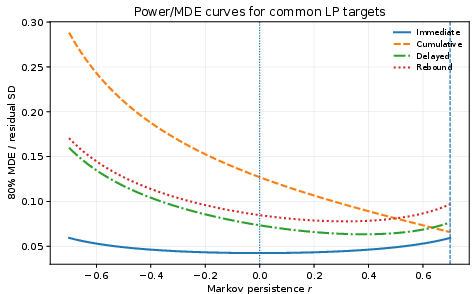
Figure 4: Power curves expressed as 80 percent MDEs in residual-standard-deviation units. The MDE scale is monotone in the square root of the HW-LP risk, so the variance-optimal design is also MDE-optimal for a fixed target and test.
When non-statistical costs (participant burden, persistent-exposure loss, switching effort) must be considered, the HW-LP criterion sits on a Pareto frontier rather than providing a universal recommendation.
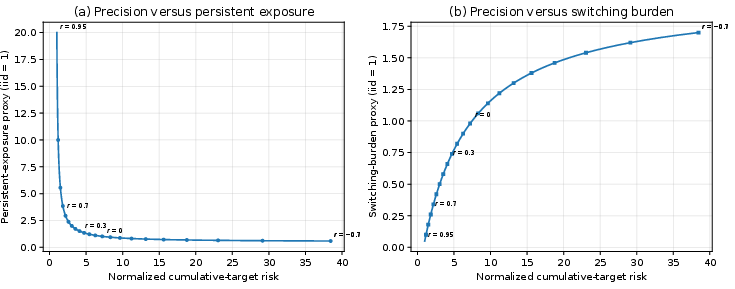
Figure 5: Illustrative Pareto frontier for cumulative-target precision versus non-statistical costs.
Extensions: Multi-arm Designs and Frequency-Domain Diagnostics
The methodology is extended to multi-arm switchback designs, where the information matrix is block Toeplitz and directional chain structure introduces substantial cross-arm interactions. The risk landscape for alternating targets, in particular, is sensitive to directional persistence; imposing symmetric-chain rules incurs substantial penalty relative to directional optima.
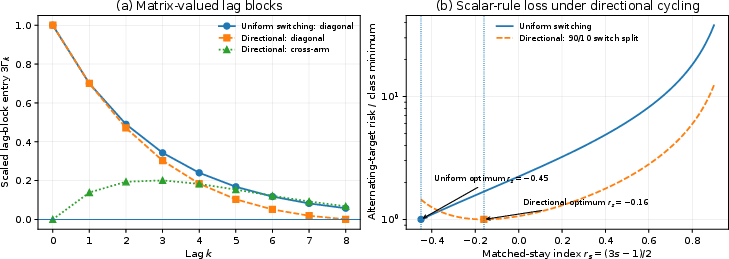
Figure 6: Three-arm block-Toeplitz information diagnostic. Panel (a) plots selected entries of the contrast-coded lag block c′g^7 at matched-stay index c′g^8. Uniform switching yields scalar blocks, whereas c′g^9 induces nonzero cross-arm entries. Panel (b) reports alternating-target risk normalized by the minimum within each design class. Imposing the symmetric rule raises directional-chain risk by 45.1 percent.
Spectral and sampling-frequency analyses demonstrate the design’s sensitivity to assignment autocorrelation and analysis frequency, reinforcing the need for explicit pre-specification of feasible assignment intervals.
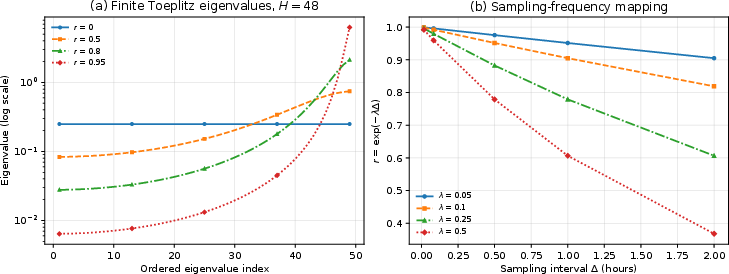
Figure 7: Spectral and sampling-frequency diagnostics. The left panel shows ordered eigenvalues of the AR(1)-Toeplitz information matrix RW(π)=tr{WVπ}0; the right panel illustrates the translation from switching rate to persistence as sampling interval varies.
Implications and Theoretical Contributions
The paper’s central technical contribution is the operational bridge between the targeted reporting object and assignment path design, with a modular implementation layer that robustly accommodates field calibration, bias-variance tradeoff, estimator choice, non-statistical constraints, and inference protocol. Notably, it is rigorously argued that:
- Mismatching design persistence to the reporting object can inflate target MSE by substantial factors.
- Separation of active-share budget (information scale) from assignment persistence (information allocation) is essential in sparse-demand environments.
- The analytical closed-form is a benchmark; calibrated covariance selection must be used in field situations with residual dependence, calendar controls, or heterogeneous environments.
Conclusion
This work advances the experimental design literature by formally delineating how the reporting object should drive assignment persistence in dynamic switchback contexts. The AR(1)-Toeplitz matrix framework provides both analytical tractability and practical interpretability, enabling explicit mapping of reporting weights to assignment strategy. Extensions to multi-arm and frequency-dependent contexts underscore the generalizability of the approach.
For practitioners and theorists, these results demonstrate the necessity of pre-analysis calibration, robust risk estimation, and explicit specification of reporting targets and constraints. Future directions entail expanding calibration to richer multi-arm assignment classes and integrating structural and decision-theoretic criteria into experimental design for complex dynamic systems (2607.11694).