- The paper introduces a design-based framework that leverages design-induced orthogonality conditions to test and estimate exposure mappings in the presence of spillovers.
- It establishes uniform consistency and asymptotic normality for GMM estimators while accounting for spatial and network interference using a rigorous large-sample theory.
- The method is empirically validated with studies on Indian public works and Kenyan cash-transfers, showing refined spillover estimates and improved policy inference.
Design-Based Inference for Spillovers: New Framework, Identification, and Empirical Implications
Introduction and Motivation
Empirically credible evaluation of large-scale policies increasingly confronts the reality of spillovers—instances where intervention effects propagate through space, social networks, or markets, invalidating SUTVA and complicating inference. In "A Design-Based Approach to Testing and Inference in (Quasi-)Experiments with Spillovers" (2607.08640), Yechan Park develops a formal design-based framework for identification, estimation, and specification testing when such spillovers are present, focusing on quasi-experimental and experimental contexts typical of development and spatial economics.
A central problem in empirical analysis with interference is the assignment of an appropriate exposure mapping—that is, a function that reduces the high-dimensional treatment assignment vector to a low-dimensional statistic presumed relevant for each unit's outcome. Existing applied work typically fixes this mapping (e.g., via distance bands, rings, gravity kernels) based on tenuous theoretical priors or informal diagnostics. The paper challenges this convention by allowing the exposure mapping's form and tuning parameters to be disciplined directly by the randomization structure, using moment restrictions implied by the experiment or quasi-experiment.
Theory: Testing and Estimation with Parameterized Exposure Maps
The core theoretical contribution is a set of design-based orthogonality conditions that any well-specified exposure map must satisfy under a known assignment mechanism. For a proposed exposure map g(W;Xi,θ), the exposure sufficiency property entails that, for some θ0, the unit-level potential outcome Yi(w) depends on w only through g(w;Xi,θ0). This has immediate, testable implications:
- For any design function ψ (e.g., aggregating treatment in neighborhoods outside a focal radius), the design-side residual
Ri,θψ(W)=ψ(W)−E[ψ(W)∣g(W;Xi,θ)]
must be orthogonal to all functions of Yi under the design, at the true θ0.
- These orthogonality conditions are operationalized as GMM moments for both estimation (of θ0) and specification testing (overidentification).
Formally, this results in a framework where the experiment’s randomization, or a quasi-experimental shock assignment, directly identifies and tests both the exposure mapping's structure and its tuning parameter.
Large-Sample Properties and Efficiency
The paper rigorously develops the large-sample theory for the resulting design-based GMM estimators, accounting for spatial and network dependence via the affinity-set framework of Chandrasekhar et al. (2023). Significant technical contributions include:
- Uniform consistency and asymptotic normality for the GMM estimator of the exposure parameter under spatial and network interference.
- Characterization of efficient moment conditions, derivation of the optimal unit-level moment within the product-residualized class, and proof that finite dictionaries of such moments can asymptotically attain this bound.
- Practical implementation via design-side simulation and resampling, enabling efficient estimation without reliance on superpopulation or stationarity assumptions.
Empirical Applications: Contrasts and Insights
The framework is empirically validated through two large-scale development economics studies. Each features a different context for spillovers, with distinct implications for exposure mapping and policy evaluation.
Spatial Spillovers in Indian Public Works (NREGS)
Park re-examines the general equilibrium effects of India's NREGS public-works reform, originally analyzed by Muralidharan et al. (2023), where the exposure mapping was implicitly taken as a θ00 km ring in accordance with labor-market institutional priors. Using the design-based framework, the exposure radius is jointly estimated and tested:
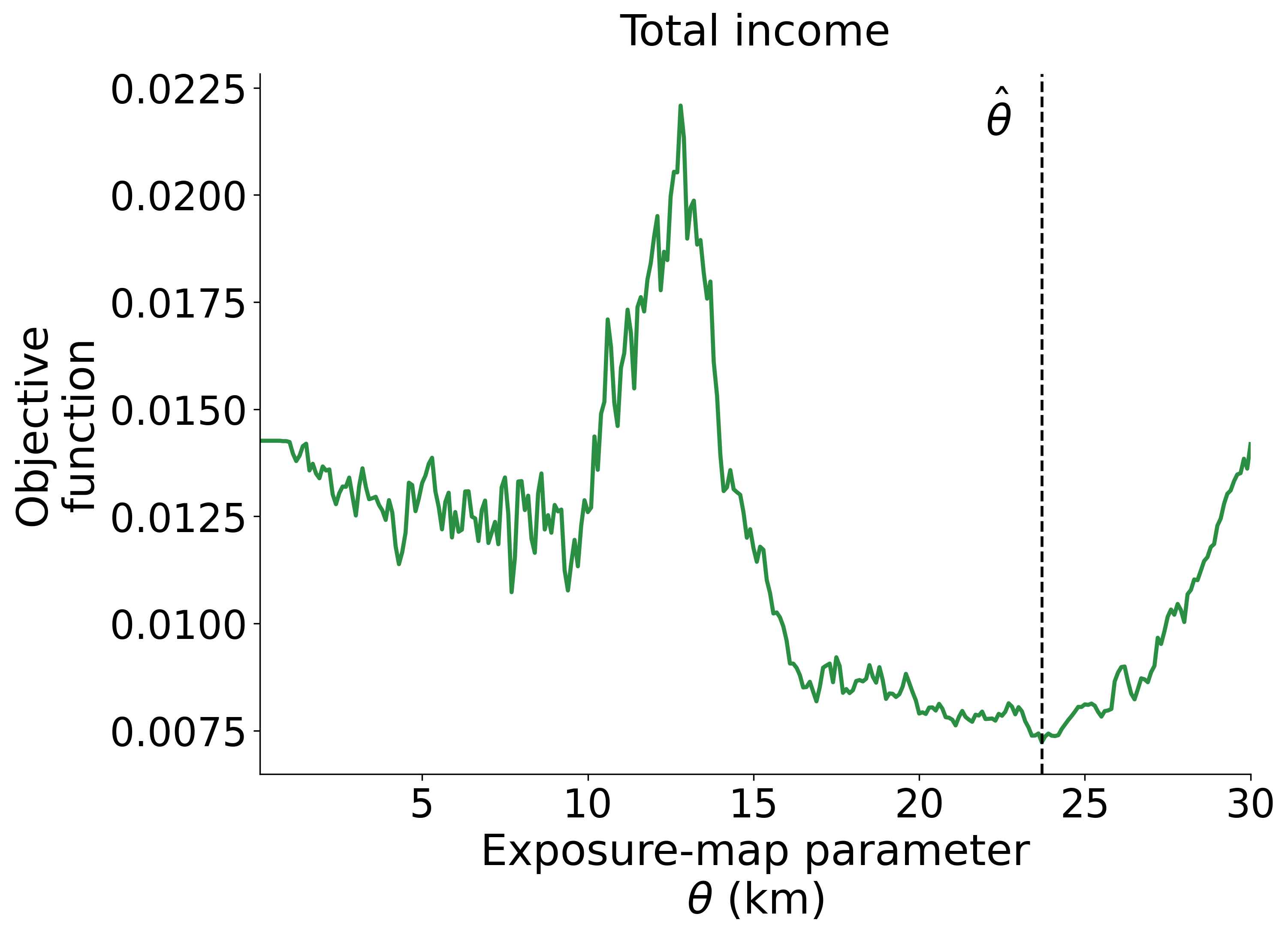
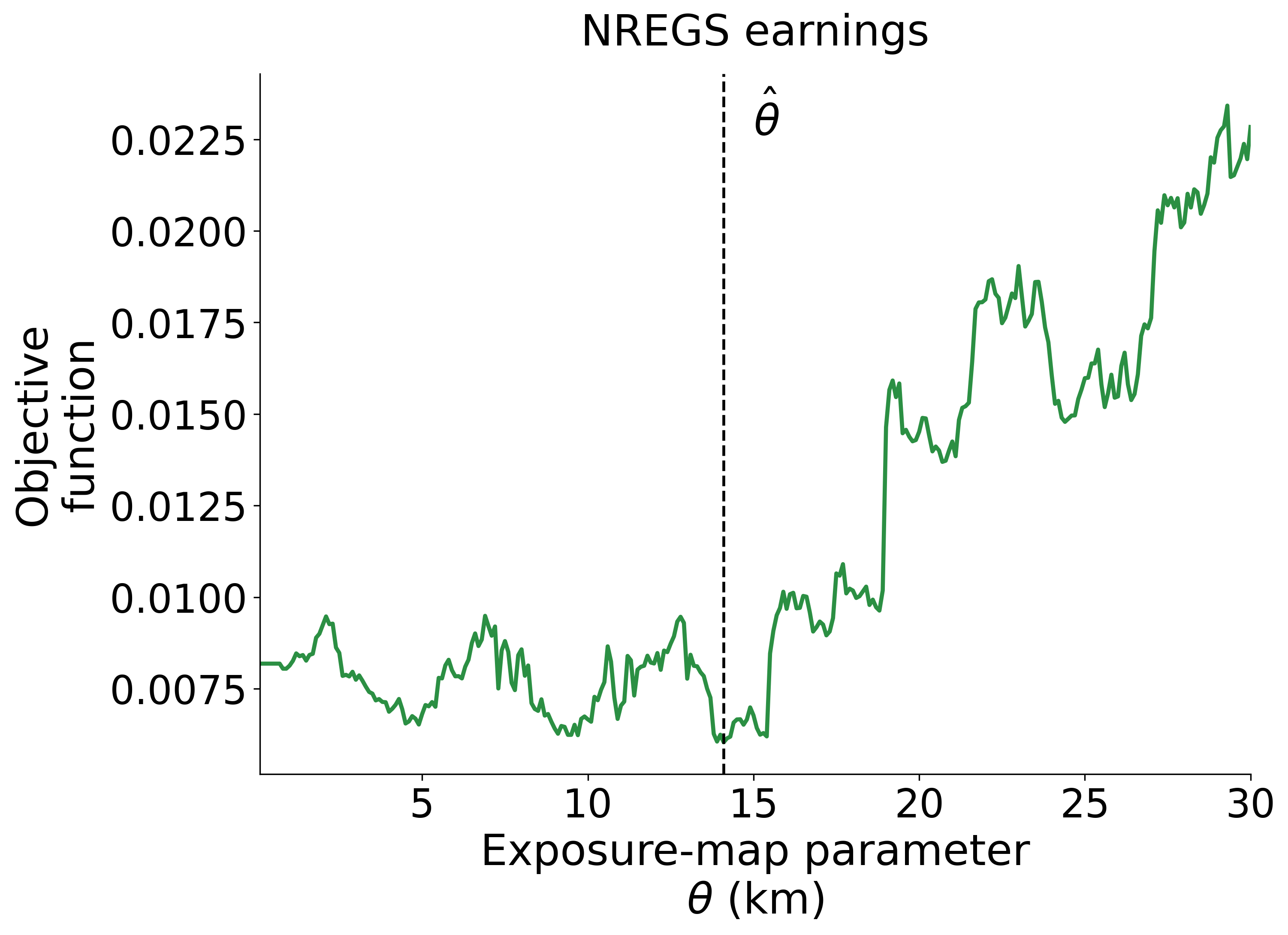
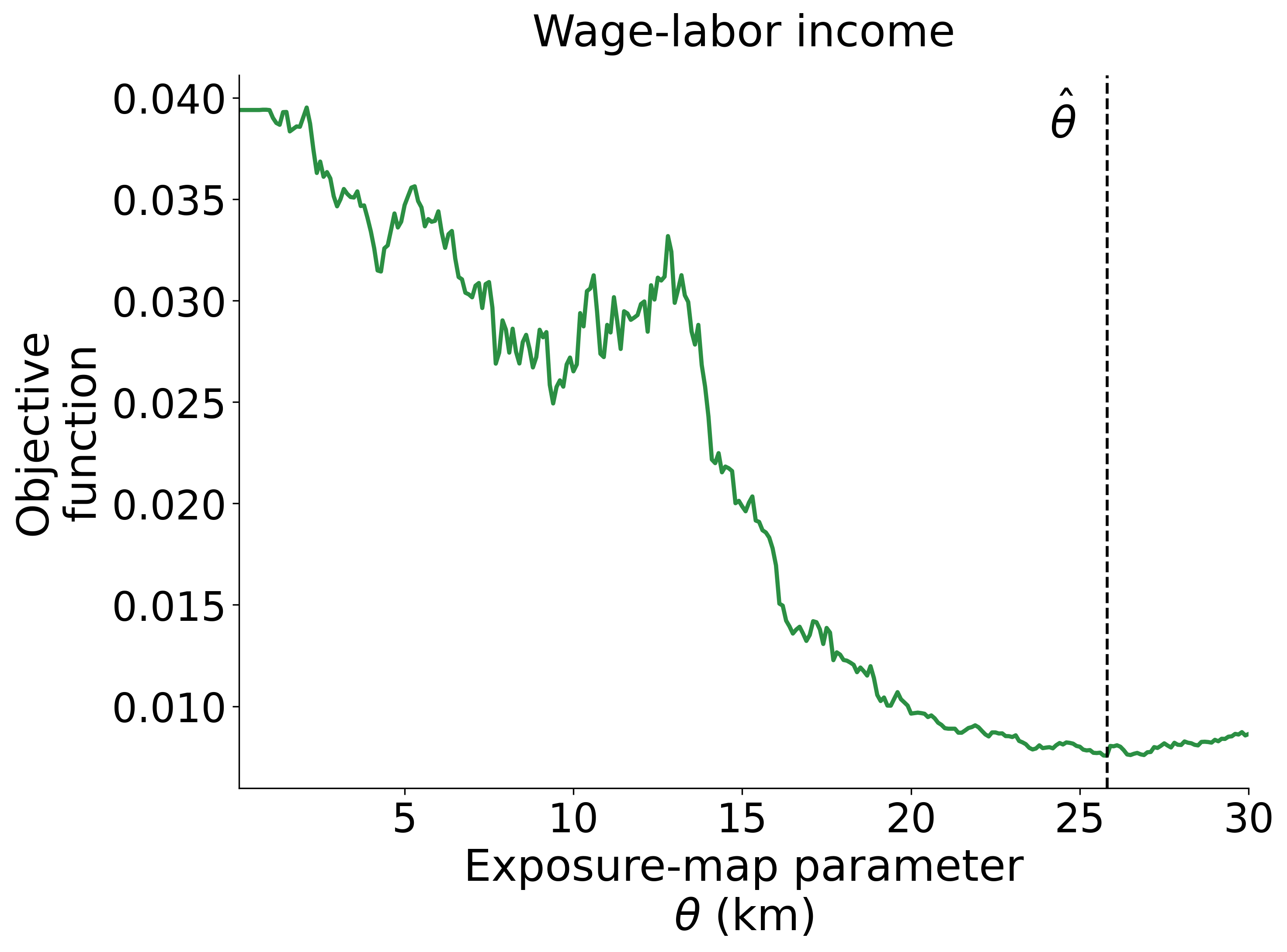
Figure 1: Stage-1 objective functions for total income (top), NREGS earnings (bottom left), and wage-labor income (bottom right).
The objective functions exhibit well-defined minima at or near the original θ01 km radius for total income and wage-labor earnings, with a somewhat tighter radius (θ02 km) for direct program wage effects. The design-based overidentification test does not reject the institutional ring at these scales, and the refined radius assignment preserves the result that over θ03 of beneficiary income gains come from non-program (general equilibrium) wage effects, not from the direct NREGS payments. This empirical support for the original exposure mapping is notable given the method’s flexibility for detecting mis-specification.
Cash-Transfer GE Effects in Kenya
The analysis then turns to the GiveDirectly cash-transfer RCT in rural Kenya (Egger et al., 2022), which had utilized a θ04 km annular exposure despite little ex-ante basis for that scale. The design-based diagnostics yield a starkly different conclusion:
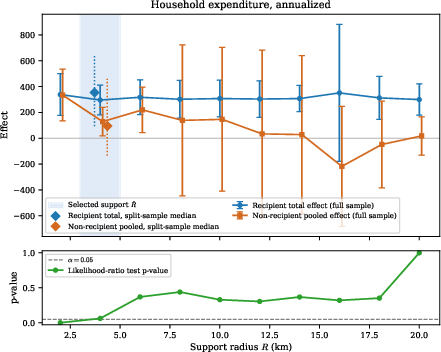
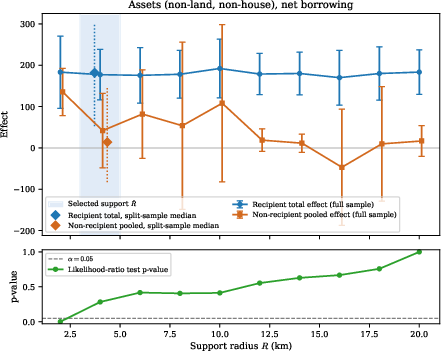
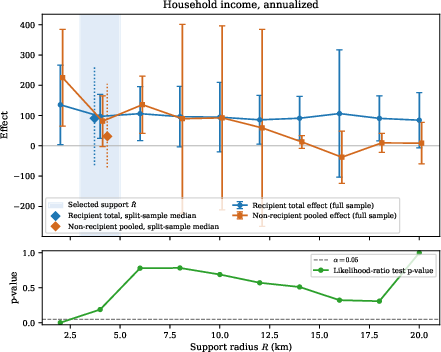
Figure 2: Radius-path diagnostics for the Egger application.
The stage-1 path shows that the overidentification test uniformly rejects the θ05 km support for all core outcomes. The optimal, non-rejected exposure supports are in the θ06–θ07 km range, and the estimated spillover effects attenuate substantially when the correct support is used. Notably, the estimated local transfer multiplier (mean) drops from θ08 to θ09, a result now much more consistent with independent structural modeling from Walker et al. (2024).
Diagnostics for Additional Outcomes
The empirical examination proceeds beyond core outcomes, using further diagnostics and radius-path plots:
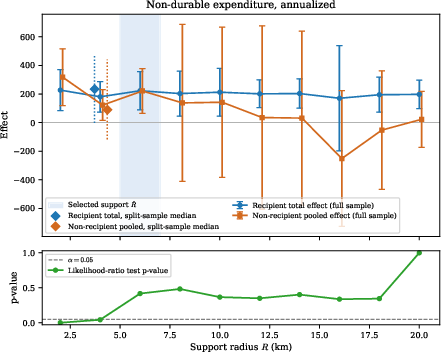
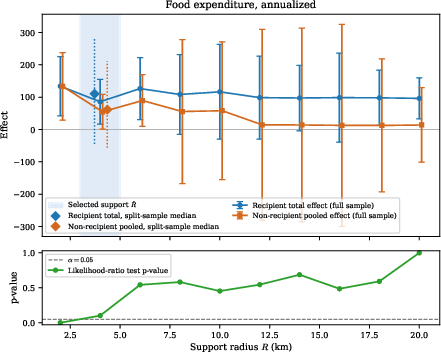
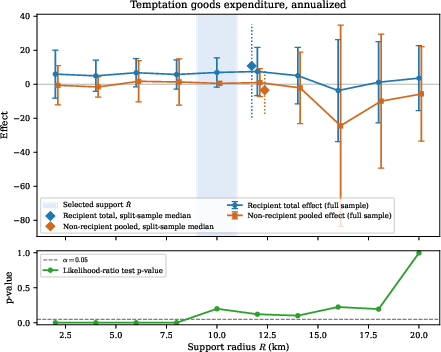
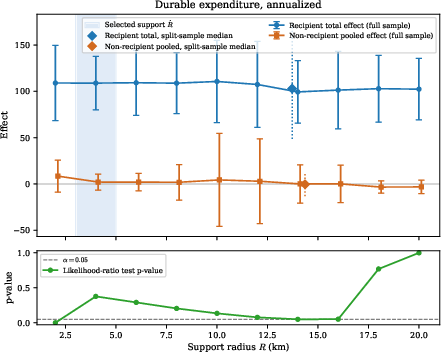
Figure 3: Radius-path diagnostics for expenditure and asset outcomes in the Egger application.
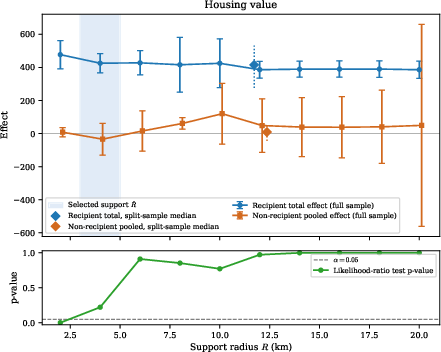
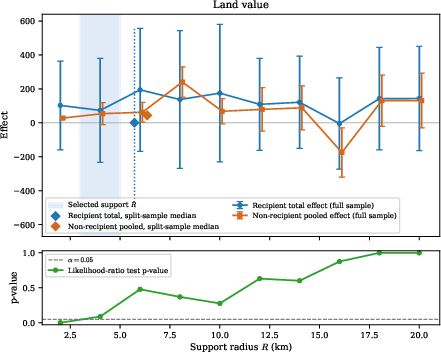
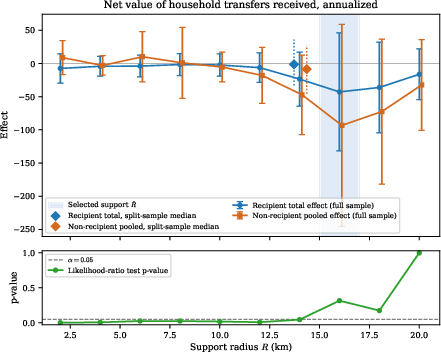
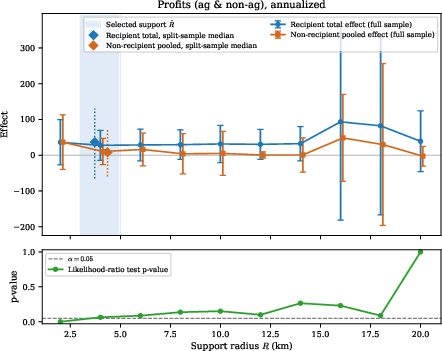
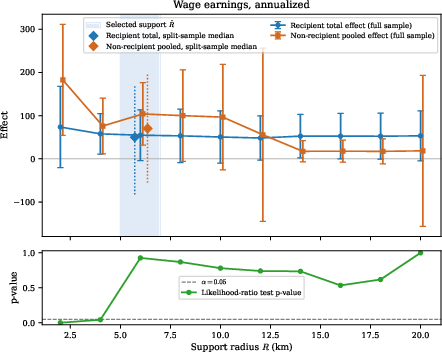
Figure 4: Radius-path diagnostics for wealth, income, and transfer outcomes in the Egger application.
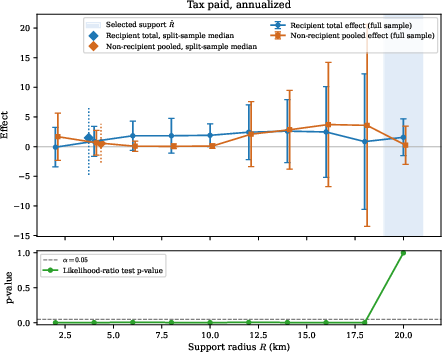
Figure 5: Radius-path diagnostics for taxes paid in the Egger application.
These figures highlight the broad tendency of mis-specified, undersized exposure supports to inflate estimated spillover effects, and empirically diagnose outcomes for which the exposure mapping requires even broader supports.
Specification Testing and Impossibility Results
The paper also addresses the impossibility of uniform-power specification tests for exposure mappings (Gao et al., 2026): no test has power against arbitrary, richer exposure-mapping alternatives. The result here is a pragmatic one: by maintaining a parametric exposure class and focusing on moments implied by the design-induced variation, one can construct specification tests with power against alternatives within, but not beyond, this class.
Practical and Theoretical Implications
The paper's approach provides several principal advances and implications:
- Empirical adoption of exposure mapping and its uncertainty as an object of inference is formalized, avoiding the common pitfall of conditioning the entire estimation, inference, and policy evaluation exercise on an arbitrarily chosen mapping.
- The framework enables robust specification testing and cross-contextual validation of imported exposure parameters, as in the empirical comparison with U.S. railroad elasticities.
- By propagating first-stage exposure uncertainty into downstream policy estimates (e.g., multipliers, general equilibrium spillover decompositions), the method generates more credible confidence intervals, ultimately affecting the substantive economic conclusions.
- The methods are compatible with broad classes of assignment mechanisms and do not require the sparsity or independence assumptions underlying much of the prior literature on interference.
Speculatively, the broader implication for causal inference in AI settings is clear: frameworks that can explicitly discipline functional forms and tuning via observed design-side variation, rather than ad hoc researcher choice, will be necessary as AI systems interact with and evaluate complex, networked environments.
Conclusion
The design-based approach advanced in this paper enables data-driven, theoretically rigorous inference on exposure mappings under interference. It generalizes GMM-based identification to the non-SUTVA regime, establishes efficiency bounds, and illustrates empirical consequences via careful reanalysis of high-profile field experiments. The consequences for both superpopulation and design-based inference are considerable, underscoring the necessity of flexible, testable, and uncertainty-propagating frameworks when evaluating interventions where the reach and decay of spillovers cannot be credibly pinned down a priori.