- The paper develops a design-based inference framework that distinguishes between innovation variance and finite-history drift in time-series GMM.
- It demonstrates that conventional HAC estimators are conservative and shows how regression adjustment with predetermined covariates can tighten variance bounds.
- Monte Carlo simulations and an empirical application on US monetary policy shocks validate the effectiveness of the proposed methodology in macroeconometric models.
Design-Based Inference for Time-Series GMM: Technical Summary
Overview and Motivation
The paper "Design-Based Inference for Time-Series GMM" (2606.31685) develops a unified framework for inference in macroeconometric applications where the object of interest is the finite-history effect of shocks within a single, realized economic episode, and uncertainty is derived solely from randomization of shocks rather than from hypothetical economy draws. This perspective contrasts with the standard long-run asymptotics traditionally used in GMM-based time-series analysis, especially for local projections (LPs), vector autoregressions (VARs), and structural VARs (SVARs). The main contributions are a rigorous variance decomposition for time-series GMM under this design-based view, a formal identification of the conservativeness of HAC-based inference, and an explicit projection-adjusted refinement using predetermined covariates.
Conditioning, Design, and Finite-History Estimands
The design-based approach conditions on an observed economic environment ET—including potential outcome maps, state transitions, sampling windows, and known covariate paths—treating only shock assignments and, potentially, instrument realizations as random. The target estimand θT⋆ minimizes the GMM criterion using the mean design moments over the observed sample:
θT⋆=argθ∈Θmin(T1t=1∑TET[gt(Wt,θ)])⊤A(T1t=1∑TET[gt(Wt,θ)])
The uncertainty of estimators is thus conceptualized in terms of possible alternative shock assignments over the given history, not over hypothetical draws from a stationary superpopulation.
Variance Decomposition and HAC Conservativeness
A central theoretical result is the decomposition of the asymptotic covariance of the observed moments into two components:
ΩR+=ΩR+Ωμ,Ωμ⪰0
- ΩR: Asymptotic design-based variance (“innovation” variance) of the centered moments.
- Ωμ: Long-run variance of the centered date-specific mean path (μT,t(θT⋆)−T−1s=1∑TμT,s(θT⋆)), reflecting nonstationary and state-dependent dynamics.
Conventional HAC estimators and multiplier bootstraps consistently estimate ΩR+, not the design-based variance ΩR. This distinction is the time-series analogue of the finite-population heterogeneity correction in cross-sectional randomized experiments, where the plug-in variance estimator is conservative when treatment effects are heterogeneous.
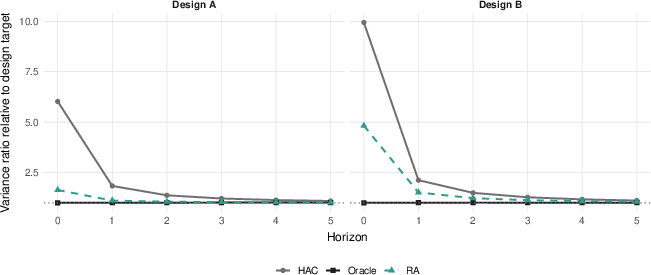
Figure 1: Variance-ratio paths for Designs A and B show that the regular HAC and regression-adjusted HAC variances can substantially exceed the design variance at short horizons, with regression adjustment closing the gap when the adjustment span is well aligned.
The practical implication is that standard HAC-based GMM inference is generically conservative for scalar functions of the finite-history estimand when predictable mean-path drift is present. The extent of conservativeness depends on the magnitude and dynamics of Ωμ, which is tied to time variation in shock effects, state dependence, or structural breaks (e.g., marked in simulation by time-varying θT⋆0).
Projection/Regression Adjustment with Predetermined Covariates
The framework establishes that projection adjustment (regression adjustment) using predetermined covariates θT⋆1—i.e., residualizing the moment functions against observed pre-shock information—can reduce the HAC variance bound in the Loewner sense:
θT⋆2
Where θT⋆3, θT⋆4, and θT⋆5 denote the respective HAC limits for the raw moments, their cross-moments with adjustment covariates, and the adjustment covariates' own moments. This reduction is diagnostic of the degree to which predictable mean-path variation is explained by the chosen covariates.
The inferential conservativeness of the regression-adjusted HAC variance is maintained only under an additional long-run orthogonality condition between the centered innovations and the adjustment span. Absent this, the reduction is a strictly feasible variance reduction and a diagnostic rather than a sharp confidence-interval adjustment.
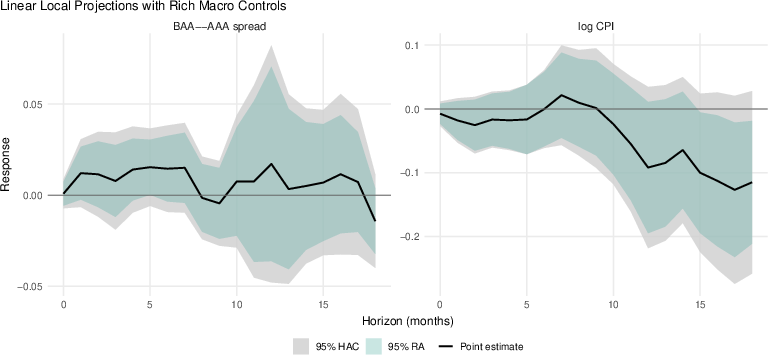
Figure 2: Linear local projections for macro outcomes (e.g., BAA–AAA spread, log CPI) show that standard errors using regression-adjusted HAC with the rich macro covariate set are generally smaller than those from conventional HAC.
Monte Carlo and Diagnostic Results
Monte Carlo simulations validate the theoretical conservative variance distinction under several designs:
- When mean-path drift is aligned with the predetermined adjustment covariate span (Design A), regression adjustment sharply reduces the variance gap relative to the infeasible oracle.
- If the adjustment covariate does not span the drift (Design B), improvement is partial.
- In the absence of mean-path drift, all (HAC and adjusted) estimators coincide with the oracle.
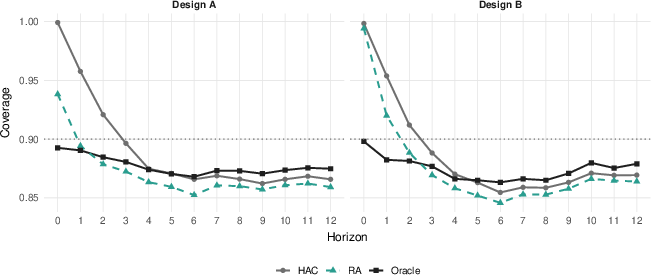
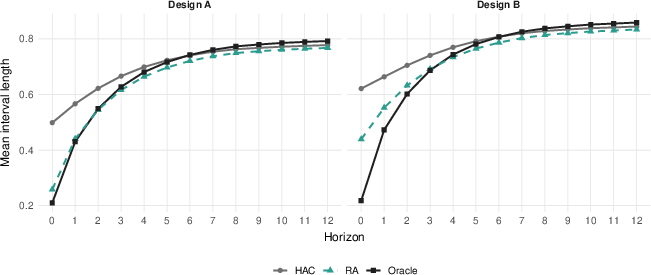
Figure 3: Coverage probability of Wald intervals by horizon, illustrating that HAC-based intervals can be conservative (coverage above nominal), while regression-adjusted intervals better approach nominal coverage when adjustment aligns with mean-path drift.
In misspecified adjustment designs (where adjustment covariates are not aligned with the mean path), regression adjustment provides little to no benefit.
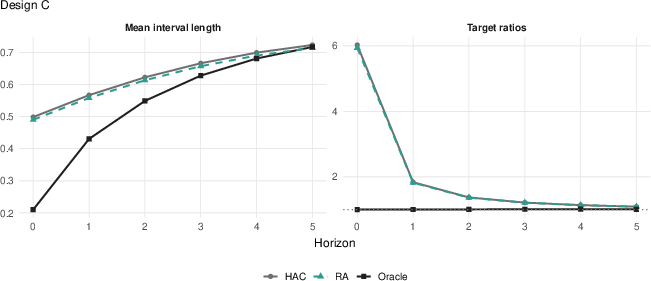
Figure 4: In misspecified adjustment, regression adjustment yields negligible reduction in variance and interval length, confirming that efficacy depends on alignment with predictable mean-path movements.
Empirical Application: US Monetary Policy Shocks
The empirical portion applies the framework to local projections of US macro variables’ responses to Jarociński-Karadi monetary-policy shocks:
- Including richer predetermined macro covariates as adjustment variables (e.g., M2, S&P 500, unemployment, lagged interest rates) yields substantial reductions in regression-adjusted HAC standard errors, up to 32% for the Treasury rate and 22% for the BAA–AAA spread, compared to unadjusted HAC intervals.
- The point estimates are nearly unchanged, while confidence intervals tighten, reflecting absorption of predictable moment variation by macro controls.
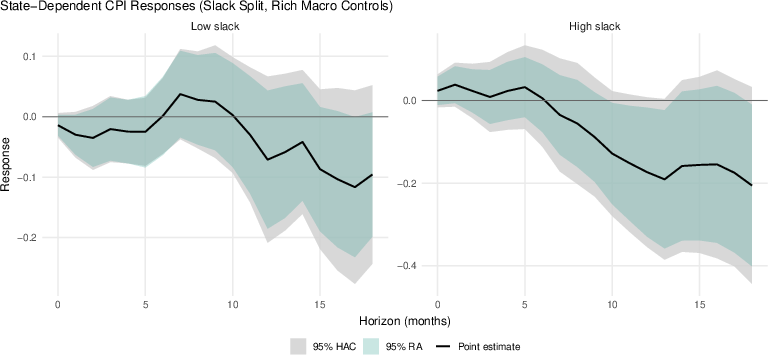
Figure 5: State-dependent CPI responses under a slack/unemployment split, with regression adjustment producing noticeably narrower 95% intervals, especially in high-slack states.
Theoretical and Practical Implications
The results theoretically clarify the target of inference in macro time-series applications: finite-history design-based uncertainty (from shock assignment) is distinct from population uncertainty in standard time-series asymptotics. The implication is that HAC procedures, and correspondingly HAC-based bootstrap methods, are often valid but conservative for this design-based target. Rigorous standard-error tightening via regression adjustment is feasible when pre-shock covariates credibly capture predictable mean-path drift.
From a practical modeling perspective:
- Adjustment should focus on predetermined variables fixed under the design, or require careful assessment of long-run orthogonality.
- Misalignment or feedback between adjustment variables and the shock process can undermine the validity of adjusted standard errors.
- The framework is broad, covering LPs, VARs, event studies, proxy SVARs, and minimum-distance/indirect inference estimators routinely used in applied macroeconomics.
Conclusion
The design-based GMM framework for time-series data (2606.31685) delineates the fundamental variance distinction between innovation uncertainty and fixed mean-path drift, identifies HAC-based inference as conservative for the finite-history estimand, and formalizes the conditions under which regression (projection) adjustment tightens variance bounds. The results and diagnostics are immediately relevant for empirical macroeconomic studies concerned with state dependence, drift, or heterogeneity in shock responses. Future work should extend this framework to high-dimensional adjustment, nonstandard bandwidth regimes, handling of generated instruments, and general overidentified GMM with local misspecification.