Multi-Agent LLMs Fail to Explore Each Other
Abstract: Exploration is essential for reliable autonomy in multi-agent systems, yet it remains unclear whether LLM agents can explore effectively when interacting with one another. We show that modern LLM agents fail to do so, often exhibiting myopic and polarized interaction patterns that lead to suboptimal coordination and increased regret. We formalize this challenge as the Multi-Agent Exploration problem, modeling it as a partially observable stochastic game (POSG) problem in which agents must probe peers to infer their capabilities and identify effective interaction strategies. To address this, we introduce Multi- Agent Contextual Exploration (MACE), a lightweight framework that explicitly promotes exploration through structured peer selection. Across both contextual and parametric diversity settings, MACE substantially improves exploration behavior and downstream task performance. We further show theoretically that the value of exploration increases with agent diversity. Overall, our results highlight a fundamental limitation of current LLM agents and underscore the importance of explicitly guided exploration for reliable multi-agent autonomy. Code will be released in https://github.com/deeplearning-wisc/mace
Paper Prompts
Sign up for free to create and run prompts on this paper using GPT-5.
Top Community Prompts
Explain it Like I'm 14
A kid-friendly guide to “Multi-Agent LLMs Fail to Explore Each Other”
1) What is this paper about?
This paper looks at how AI chatbots (like the ones you talk to online) work together in teams. When several AIs collaborate, they need to figure out which teammates are good at what. That means they must “explore”—try different partners—before deciding who to trust most. The authors show that today’s AI agents often don’t do this well: they pick a teammate too quickly and stick with them, even if that teammate isn’t the best choice. The paper then introduces a simple tool called MACE that helps AI agents explore their teammates more wisely.
2) What questions are the researchers asking?
- Do AI agents naturally explore different teammates when working together, or do they rush to a choice and never look back?
- Can we design a simple method that nudges AI agents to explore better, leading to better teamwork and results?
- When does exploring matter most—especially when teammates are very different from each other?
3) How did they study it? (Methods in everyday language)
Think of a group project at school. You don’t know who’s good at research, writing, or design. If you immediately pick one friend and always rely on them, you might miss someone who’s a perfect fit for the task. Good teamwork needs some testing and learning.
The researchers tested AI agents in two kinds of “team” situations:
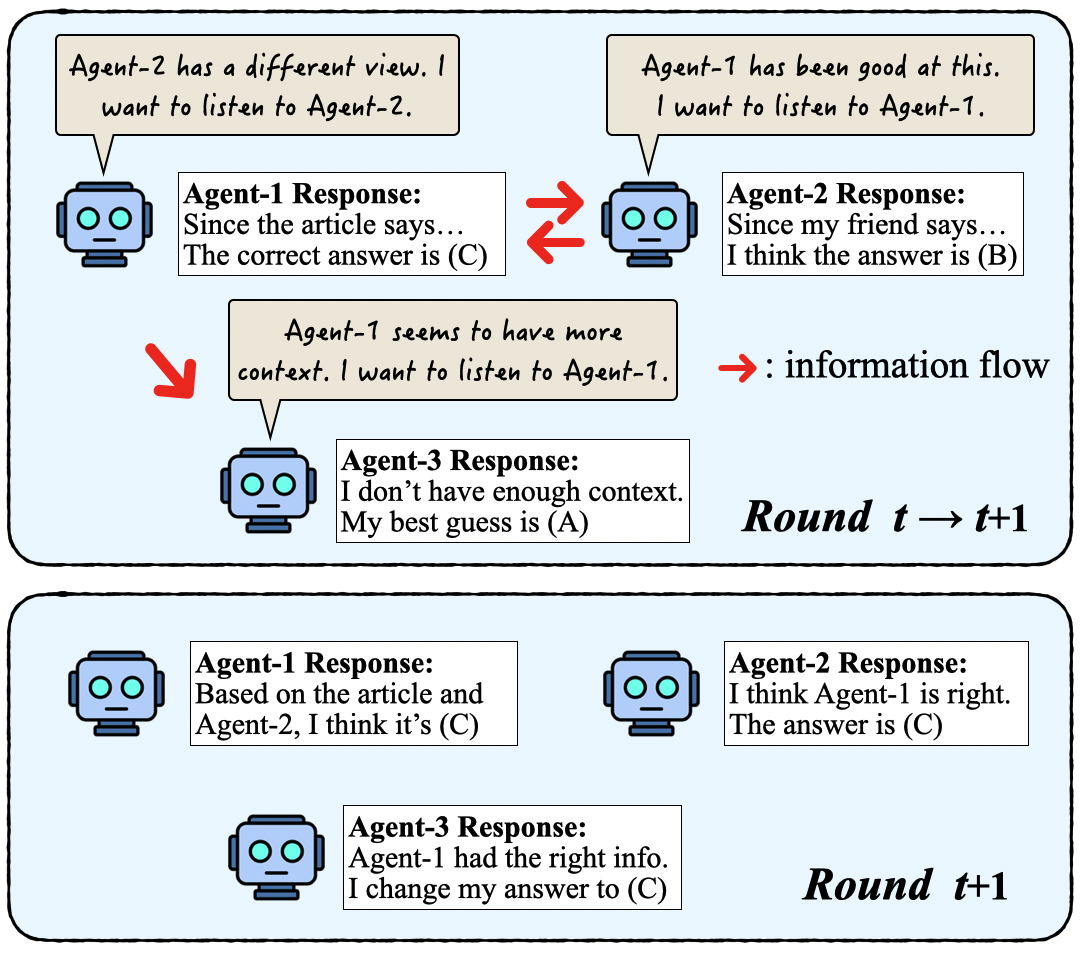
- Contextual diversity: Agents have different pieces of information (some useful, some distracting). The goal is to find the teammate with the right info.
- Parametric diversity: Agents have different skill levels because they’re different models (some stronger, some weaker). The goal is to find the most capable teammate for the task.
They first tried prompting the AIs to “balance exploration and exploitation.” (Exploration = try new teammates; exploitation = keep using the best teammate found so far.) They also compared against random teammate selection and a fixed, pre-set teammate choice.
Then they introduced MACE (Multi-Agent Contextual Exploration). In simple terms, MACE:
- Treats choosing a teammate like choosing a “slot machine” to pull, where the “payout” is how helpful your teammate is.
- Uses clues (called features) about each possible teammate: how different their answer is from yours (which might bring new information), how unique they are compared to others, how well they’ve done before, and what stage of the task you’re in.
- Combines “what we expect” with “how unsure we are” to pick who to try next. That way, it favors trying teammates we don’t know much about early on, and gradually shifts to the ones that have proven themselves. (This is a classic “be optimistic when you’re unsure” idea from decision-making.)
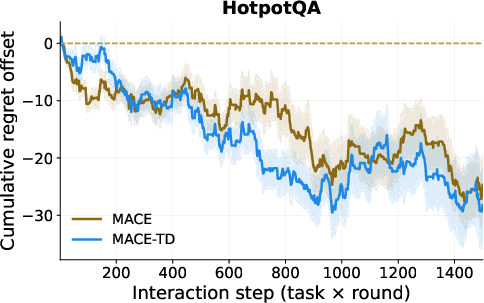
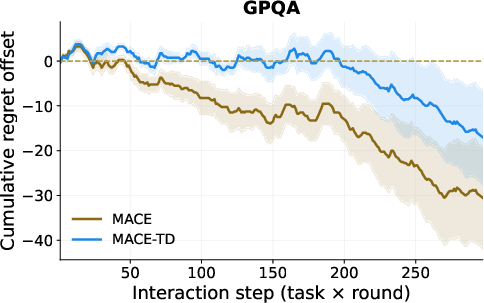
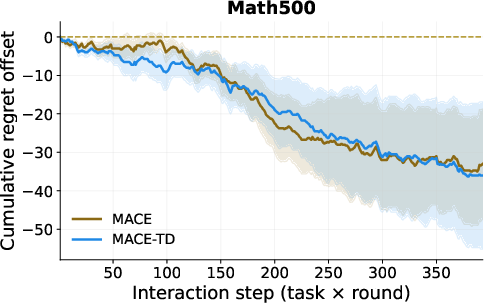
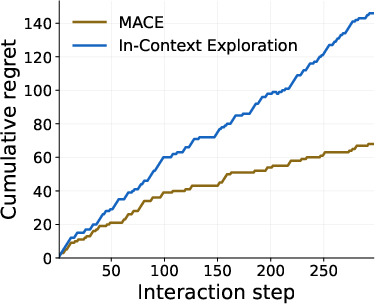
To measure performance, they used “regret,” which you can think of as: how much you wish you had chosen differently, compared to the best teammate you could have picked each time.
4) What did they find, and why is it important?
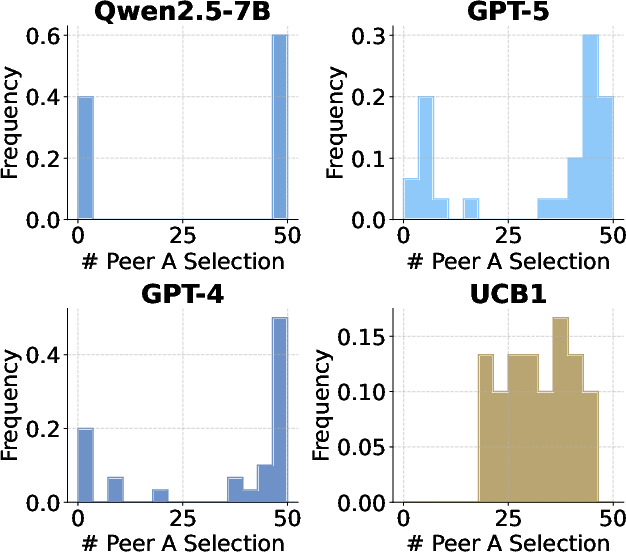
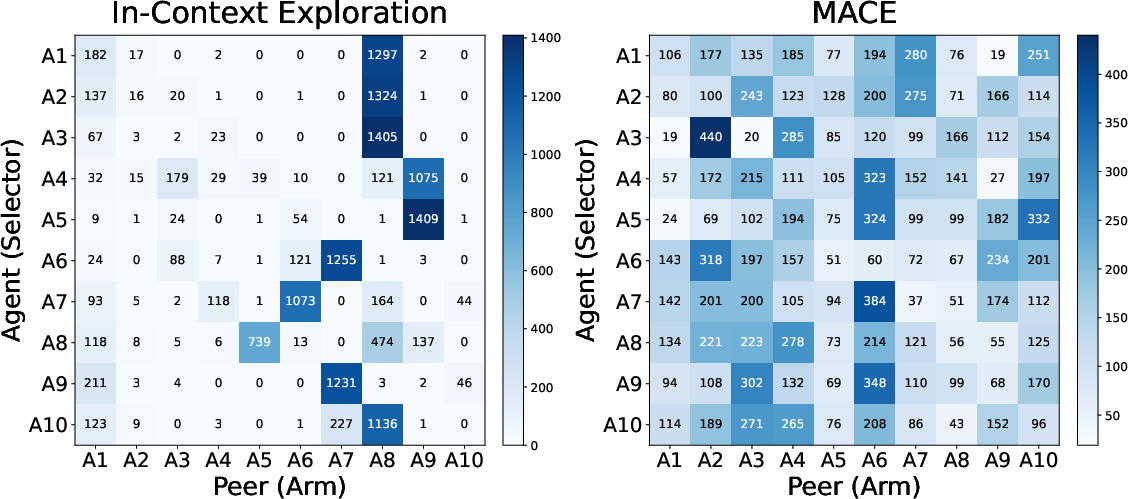
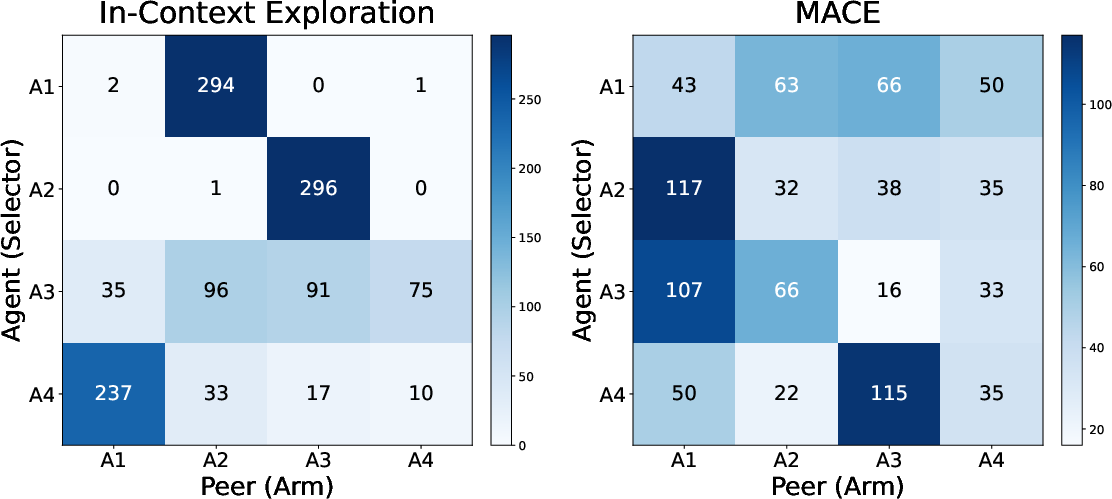
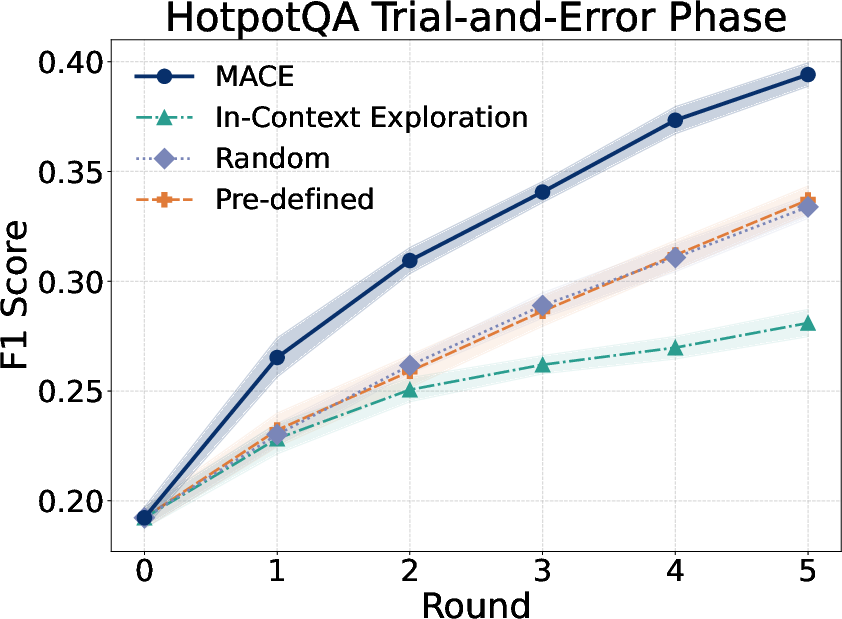
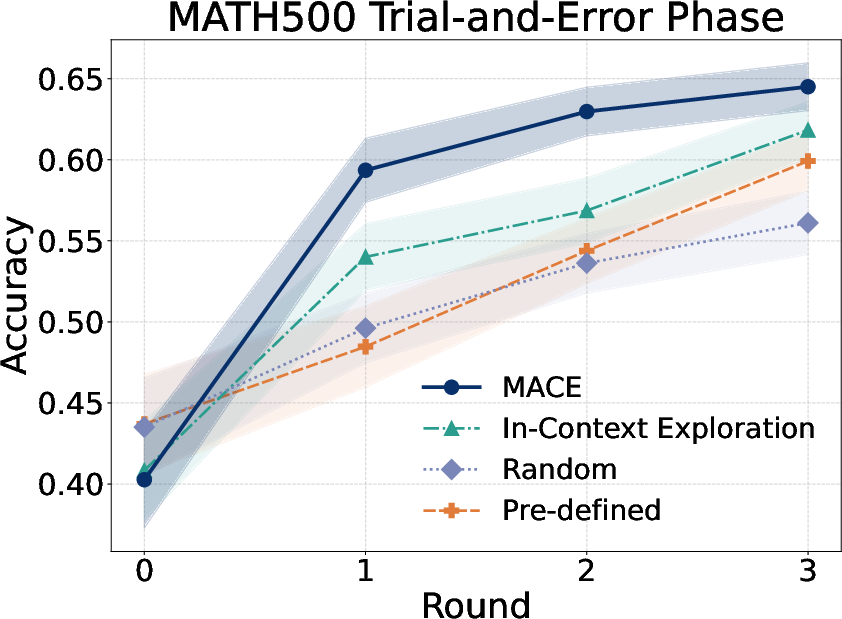
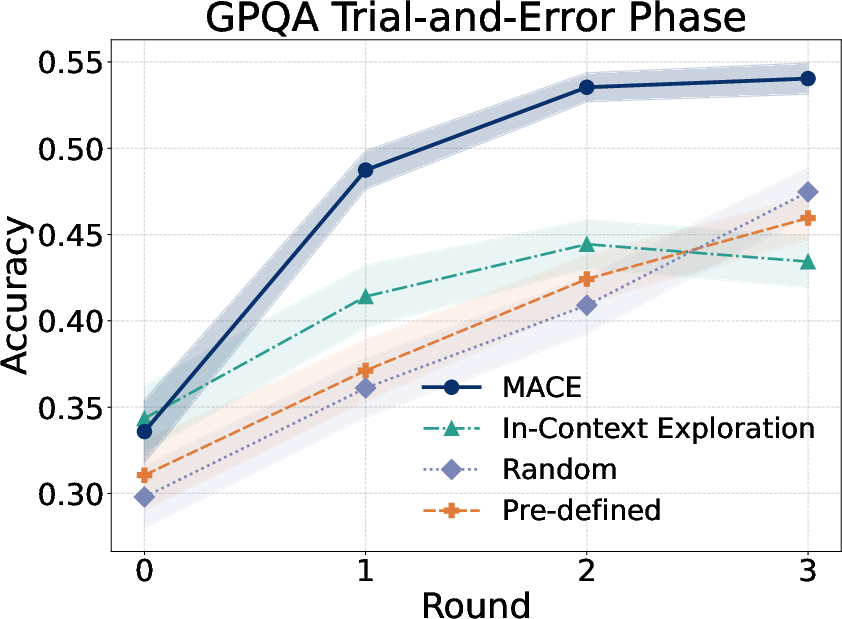
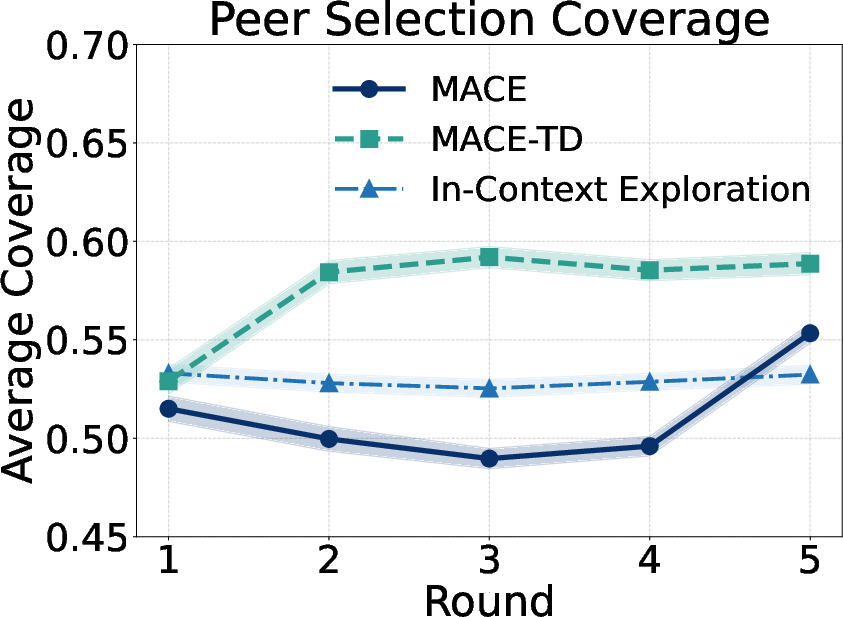
- Many AI agents don’t explore well on their own. They often commit to a teammate very early and stick with them—even when that teammate isn’t the best. In some tests, this “just trust your first pick” behavior did worse than random guessing.
- Simply asking the AIs (via prompts) to “explore” wasn’t enough. Prompting alone didn’t reliably fix the problem.
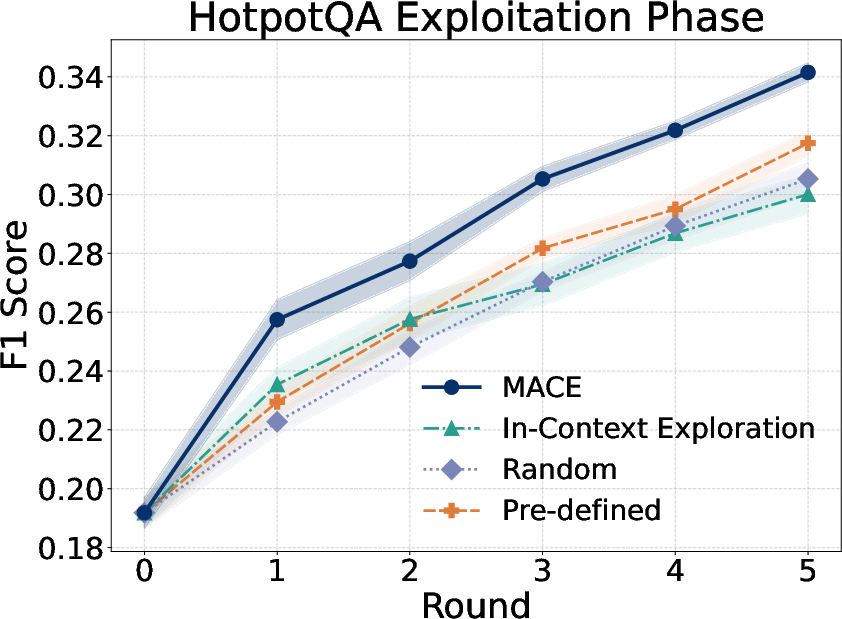
- MACE helped a lot. It encouraged smarter exploration, which led to:
- Better choices of teammates over time
- Lower regret (fewer “should’ve picked someone else” moments)
- Higher task scores (e.g., more correct answers on question-answering and math problems)
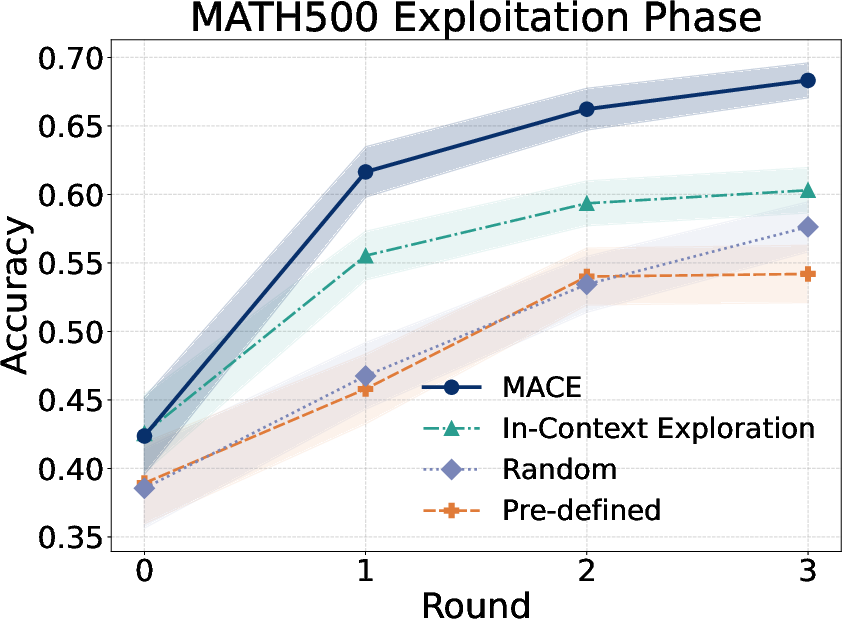
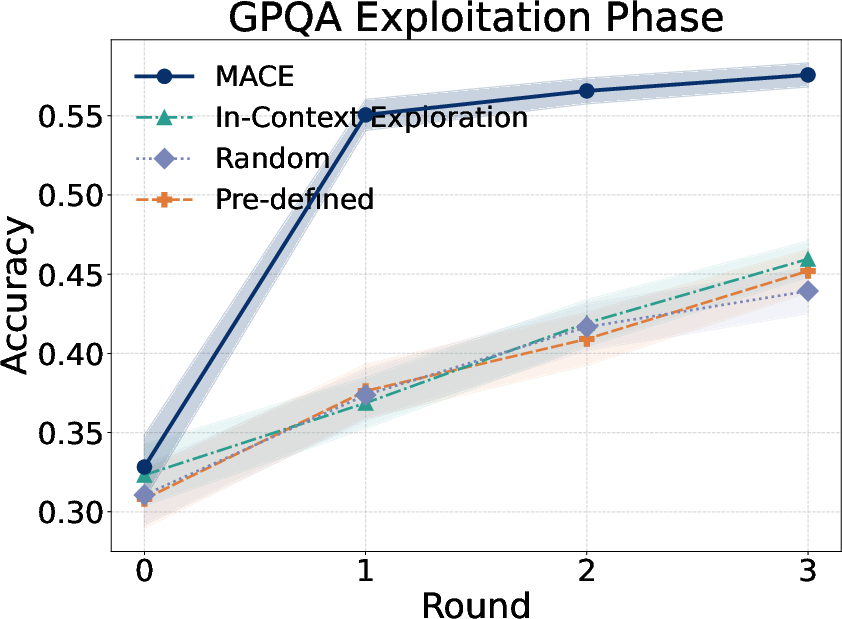
- Benefits that continued even after exploration was turned off (the agents kept using what they learned)
- Transfer to a new dataset they didn’t practice on, showing the strategy was general, not just memorized tricks
- Even very strong AI models benefited from MACE, meaning the exploration problem isn’t just for weaker models—it’s a general issue.
- Theory backed this up. The authors proved that:
- With guided exploration (like MACE), the “regret” grows slowly as tasks continue.
- Without exploration (just greedily picking who seems best right now), regret grows much faster, especially when teammates are very different from each other.
- In short: the more diverse the team, the more valuable exploration becomes.
5) What does this mean for the future?
As AIs increasingly work together—dividing tasks, sharing information, and making decisions—simply “talking more” isn’t enough. They need structured ways to try different teammates and learn from experience. This paper shows that:
- Today’s AI agents often don’t explore teammates well by themselves.
- A lightweight, simple method like MACE can make a big difference.
- Exploration matters most when team members are specialized, which is exactly how many future AI teams will look.
Bottom line: If we want reliable AI teams, we should build in explicit exploration strategies so they can figure out who to partner with, when, and why—leading to better collaboration and better results.
Knowledge Gaps
Below is a concise, actionable list of the paper’s unresolved knowledge gaps, limitations, and open questions to guide future research.
- Assumptions–reality gap in theory: The regret guarantees rely on linear contextual bandit assumptions and (implicitly) stationarity conditions that may not hold with adaptive, co-learning peers; formal guarantees under non-stationary or adversarially adaptive peers are not provided.
- No theoretical analysis of simultaneous learners: Theoretical results treat an individual decision-maker; there is no analysis of system-level dynamics when many agents concurrently run exploration policies (e.g., stability, convergence, or emergent oscillations).
- Strategic/adversarial peers: The framework and experiments do not consider deceptive, collusive, or reward-gaming agents; robustness guarantees and defenses are missing.
- Feedback realism: Rewards use immediate correctness and “improvement” signals; the method is not evaluated with delayed, noisy, proxy, or partial feedback common in real deployments.
- Cost-awareness: Token/latency/compute costs of peer queries are ignored; there is no cost-sensitive objective or evaluation of utility-cost trade-offs.
- Scalability with large populations: MACE maintains per-peer models; computational and memory scaling, and performance for large N (hundreds–thousands of agents), are not analyzed.
- Multi-cast and group interactions: The selection is single-peer per step; scenarios requiring querying multiple peers, aggregating group responses, or top-k exploration are not addressed.
- Asynchronous and streaming settings: The work assumes synchronous, fixed-round interactions; no evaluation under asynchronous, event-driven, or interrupted conversations.
- Protocol learning vs peer selection: The method optimizes whom to query, not how to communicate; learning interaction protocols (e.g., message formats, negotiation, multi-turn role adaptation) remains unexplored.
- Feature engineering dependence: Exploration relies on hand-crafted relational features; ablations, learned representation alternatives (e.g., neural contextual bandits), and robustness to feature misspecification are limited.
- Nonlinear and high-dimensional contexts: The linear reward model may be insufficient for complex interaction structure; comparisons to nonlinear or kernel/neural bandits are missing.
- Non-stationary bandits: There is no comparison to algorithms designed for drift (e.g., sliding-window UCB, discounted TS) despite adaptive peers and evolving contexts.
- Hyperparameter autonomy: The exploration coefficient α requires tuning; methods for online adaptation or meta-learning of α across tasks/agents are not studied.
- Credit assignment and reward shaping: The “improvement-based” reward is heuristic; sensitivity to reward definitions and principled credit assignment in multi-agent chains remain open.
- Partial observability beyond history: Agents only use local interaction histories; mechanisms for belief modeling over hidden peer capabilities (e.g., Bayesian ToM) are not investigated.
- Long-horizon effects: Experiments use short horizons (R ≈ 3–5 rounds); it is unknown how behaviors scale with longer interactions and delayed exploitation benefits.
- Task diversity: Evaluations focus on QA and math; generality to tasks requiring planning, code generation, tool use, embodied control, or safety-critical decisions is untested.
- Retrieval and tool ecosystems: The contextual-diversity setting simulates static evidence splits; integration with real retrieval/tool pipelines and dynamically changing knowledge sources is not assessed.
- Transfer scope: Transfer is shown from HotpotQA to 2Wiki; breadth of cross-domain, cross-modality, and cross-architecture transfer remains unclear.
- Homogeneous/low-diversity regimes: While theory suggests limited benefit when δ ≈ 0, a systematic empirical map of when exploration helps or hurts (phase diagram across δ, noise, horizon) is missing.
- Fairness and exposure bias: Exploration may starve or over-expose certain peers; impact on fairness, diversity of contribution, and long-term ecosystem health is not evaluated.
- Safety and risk-aware exploration: Exploring unreliable peers can amplify harmful content; risk-sensitive or safe exploration mechanisms are not incorporated or tested.
- Robustness to prompt and system changes: Sensitivity to prompt templates, temperatures, system messages, and agent persona variation is not reported.
- Proprietary model reliance: Use of frontier proprietary models (e.g., GPT-5) limits reproducibility; results with only open-source agents at scale are not provided.
- Multi-objective optimization: The method optimizes task reward only; real systems juggle accuracy, cost, latency, safety, and diversity—no multi-objective formulation is explored.
- Coordination outcomes beyond regret: Metrics focus on EM/F1 and regret; effects on global coordination quality (e.g., consensus quality, redundancy reduction, division of labor) are unmeasured.
- Interaction topology design: Pre-defined vs learned communication graphs are only lightly compared; co-optimization of topology and exploration policy is not studied.
- Cold-start and bootstrapping: How to initialize exploration with minimal waste (e.g., priors, few-shot peer summaries) is unresolved.
- Human-in-the-loop integration: No mechanisms for human oversight, overrides, or feedback shaping exploration trajectories are proposed.
Practical Applications
Immediate Applications
Below is a concise set of actionable, sector-linked applications that can be deployed now, leveraging the paper’s findings and the MACE framework. Each item notes key assumptions or dependencies that could impact feasibility.
- Software and AI Orchestration: Exploration-aware router for multi-agent LLM systems
- Description: Integrate MACE as a plug-in in orchestration frameworks (e.g., AutoGen, AgentScope, CAMEL) to select the “right” peer agent at each step using contextual bandit-based LinUCB with relational features (response diversity, peer distinctiveness, historical performance, interaction round).
- Tools/Products/Workflows: “MACE Router SDK,” “Relational Feature Library,” “Exploration Dashboard” (peer selection distribution, regret monitoring).
- Assumptions/Dependencies: Access to interaction logs and simple per-round reward signals (e.g., correctness or improvement), agent diversity present, latency/cost budget for querying multiple agents.
- Customer Support and Contact Centers: Multi-bot triage and escalation
- Description: Route tickets across specialized bots (billing, technical, policy) using MACE to avoid premature commitment and reduce misrouting, with human-in-the-loop fallback.
- Tools/Products/Workflows: Exploration-aware triage microservice, agent capability profiles, real-time regret monitoring.
- Assumptions/Dependencies: Clear success metrics per interaction (resolution, CSAT), privacy/compliance controls for sharing customer data among agents.
- Information Retrieval and QA Pipelines: Context-aware peer selection under distractors
- Description: Use MACE to select among agents holding heterogeneous context (e.g., different retrieved documents) to reduce susceptibility to distractors and improve EM/F1.
- Tools/Products/Workflows: Context feature generator (response divergence scoring), evidence aggregation workflow.
- Assumptions/Dependencies: Reliable correctness labels or proxy rewards, indexed content with quality signals, retriever/tool diversity.
- Enterprise Knowledge Management: Cross-department AI “who-to-ask” routing
- Description: Exploration-guided referral among knowledge agents (legal, compliance, engineering) to avoid echo-chambers and find complementary expertise.
- Tools/Products/Workflows: Peer distinctiveness metric (semantic distance among agents), exploration policy embedded in helpdesk assistants.
- Assumptions/Dependencies: Identity and capability metadata, audit trails, access control and data governance.
- Software Engineering (Dev/QA): Agentic coding teams that choose specialized tools
- Description: MACE selects among static analyzers, test generators, fuzzers, and code-review agents to maximize bug discovery and test coverage.
- Tools/Products/Workflows: CI/CD plug-in that logs per-tool rewards (tests passed, defects found) and adapts routing; regret dashboards.
- Assumptions/Dependencies: Objective reward signals tied to build/test outcomes, minimal orchestration overhead, tool heterogeneity.
- Academia (Research Workflows): Collaborative research assistants
- Description: Orchestrate specialized agents (mathematics, literature review, writing) and use MACE to explore collaborators before converging on the best contributor.
- Tools/Products/Workflows: Research assistant pool with role descriptors; round-wise exploration logs for reproducibility.
- Assumptions/Dependencies: Benchmarkable subtasks (e.g., Math500/GPQA-like problems), light-touch reward design (accuracy, evidence quality), dataset curation.
- Education (Tutoring Systems): Adaptive module selection
- Description: Tutors explore which skill module (algebra, geometry, reading comprehension) or content source helps a learner most before exploiting the best fit.
- Tools/Products/Workflows: Exploration-aware lesson planner; per-module performance tracking; student profile features.
- Assumptions/Dependencies: Alignment with pedagogy objectives, student privacy, robust per-round assessment signals.
- Finance and Knowledge Work: Research desk summarization and cross-checking
- Description: Use MACE to select the most reliable analysis/summary agent under noisy or incomplete sources, with explicit exploration to mitigate over-commitment.
- Tools/Products/Workflows: Source-trust features, discrepancy detectors (response diversity), audit-ready logs.
- Assumptions/Dependencies: Compliance controls, documented reward criteria (factuality, coverage), agent diversity in domain expertise.
- Safety and Reliability Engineering: Exploration health monitors
- Description: Detect lock-in and polarization in peer selection (bimodal distributions) and trigger “explore resets” or uncertainty bonuses in production multi-agent systems.
- Tools/Products/Workflows: Selection distribution monitors, regret alerts, policy toggles (exploration coefficient α).
- Assumptions/Dependencies: Monitoring/observability stack, safety playbooks, clear thresholds for intervention.
- Policy and Procurement (Governance of AI Systems): Exploration-readiness evaluation
- Description: Add “premature commitment” and “exploration efficacy” checks to vendor assessments (LLM multi-agent deployments), using regret-vs-random baselines and selection concentration metrics.
- Tools/Products/Workflows: Standardized test harnesses modeled after the paper’s setups (contextual and parametric diversity); reporting templates.
- Assumptions/Dependencies: Access to evaluation data, acceptance of exploration metrics in procurement criteria, reproducible tests.
- Personal Productivity (Daily Life): Assistant aggregator for task routing
- Description: A personal assistant that explores specialized bots (travel planning, budgeting, calendar wrangling) before committing to the best one for a task context.
- Tools/Products/Workflows: Lightweight client-side bandit policy; per-tool performance memory; privacy-preserving logging.
- Assumptions/Dependencies: Usable per-task feedback signals (e.g., itinerary quality), data-sharing consent, cost awareness.
- Agent Marketplaces and Tool Hubs: Exploration-aware agent selection
- Description: Add MACE-based routers that try multiple providers/tools initially, then exploit the currently best based on explicit in-app reward signals.
- Tools/Products/Workflows: Marketplace SDK with LinUCB routing, provider diversity score, exploration telemetry.
- Assumptions/Dependencies: Provider APIs, standardized result scoring, cost controls for multi-query exploration.
Long-Term Applications
Below are applications that benefit from further research, scaling, integration, or regulatory/compliance development before broad deployment.
- Open-World Agent Ecosystems: Autonomous exploration at scale
- Description: Large, heterogeneous populations of agents that continually probe peers to identify collaborators and strategies, using exploration policies tuned to capability diversity.
- Tools/Products/Workflows: Exploration-as-a-Service layer, global capability diversity (δ) estimators, cost-aware orchestration.
- Assumptions/Dependencies: Scalable POSG-inspired coordination, robust reward shaping across tasks, identity and trust management.
- Multi-Robot Teams (Robotics): Capability-aware teammate selection
- Description: Robots explore sensor/actuator teammates to select the best collaborator per context (terrain, task), with explicit exploration to avoid brittle coordination.
- Tools/Products/Workflows: Simulation-to-real exploration policies, sensor-response diversity metrics, safety constraints.
- Assumptions/Dependencies: Real-time guarantees, safe exploration in physical environments, rigorous validation.
- Clinical Decision Support (Healthcare): Exploration-guided specialist and model routing
- Description: Systems that explore evidence sources, guideline agents, and subspecialty models to identify optimal collaborators; exploit once reliability is established.
- Tools/Products/Workflows: Clinical reward/utility functions, provenance tracking, human oversight pathways.
- Assumptions/Dependencies: Regulatory approval, robust validation (bias, fairness, safety), strict privacy and audit trails.
- Autonomous Scientific Discovery: Multi-agent exploration of hypotheses and tools
- Description: Agents explore models, methods, datasets, and instruments to design experiments and converge on promising hypotheses.
- Tools/Products/Workflows: Hypothesis exploration metrics, reproducibility pipelines, provenance registries.
- Assumptions/Dependencies: High-quality domain agents, standardized rewards (novelty, correctness), cross-institution data sharing.
- Smart Grid and Energy Operations: Exploration across forecasting and control agents
- Description: Explore heterogeneous forecasting/control strategies before exploitation to improve stability, demand response, and fault handling.
- Tools/Products/Workflows: Real-time regret monitoring, safety throttles, scenario simulators.
- Assumptions/Dependencies: Integration with critical infrastructure, high reliability thresholds, robust model validation.
- Algorithmic Trading and Risk Management (Finance): Strategy exploration under constraints
- Description: Explore heterogeneous trading models or signal generators, then exploit under risk-aware policies.
- Tools/Products/Workflows: Cost/risk-aware exploration (transaction, slippage), counterfactual evaluation.
- Assumptions/Dependencies: Regulatory compliance, strong guardrails, high-fidelity simulations, extensive backtesting.
- Population-Scale Education Platforms: Class-level agent ecosystems
- Description: Exploration-driven selection among pedagogy agents for diverse learner populations, then exploitation with personalization.
- Tools/Products/Workflows: Learner modeling, privacy-preserving telemetry, exploration fairness controls.
- Assumptions/Dependencies: Ethical data use, bias mitigation, institutional buy-in.
- Standardization and Certification (Policy): Exploration metrics in compliance regimes
- Description: Mandate exploration-readiness tests (e.g., regret vs random, selection concentration, lock-in detection) in audits and certifications for multi-agent AI systems.
- Tools/Products/Workflows: Conformance test suites, standardized reporting, sector-specific thresholds.
- Assumptions/Dependencies: Regulatory consensus, measurable and comparable benchmarks, transparency requirements.
- Capability Diversity Measurement: δ as a sector-wide reporting standard
- Description: Define and adopt standardized ways to measure agent capability diversity (δ) and relate it to expected exploration benefit.
- Tools/Products/Workflows: Diversity calculators, public benchmarks, capability descriptors.
- Assumptions/Dependencies: Agreement on capability taxonomies, vendor cooperation, dynamic capability tracking.
- Human–Agent Teaming: UX patterns for exploration without fatigue
- Description: Design interfaces and workflows that make exploration transparent and acceptable to users (e.g., staged probing of alternatives before committing).
- Tools/Products/Workflows: Exploration rationales, adjustable exploration coefficient (α), consent and cost controls.
- Assumptions/Dependencies: HCI research, user education, organizational adoption.
- Self-Evolving Agent Groups: Combine MACE with group evolution and role design
- Description: Agents autonomously design roles and workflows while running exploration-driven coordination to discover productive configurations.
- Tools/Products/Workflows: Role evolution engines, exploration-aware orchestration, continual learning pipelines.
- Assumptions/Dependencies: Stability and safety guarantees, lifecycle governance, monitoring.
- Security and Red-Teaming: Exploration to surface hidden vulnerabilities
- Description: Orchestrate adversarial/red-team agent pools that explore diverse attack strategies before converging on the most effective test vectors.
- Tools/Products/Workflows: Sandbox environments, exploit detection rewards, escalation policies.
- Assumptions/Dependencies: Isolation and safety controls, legal and ethical frameworks, robust logging.
- Echo-Chamber and Bias Mitigation (Governance): Exploration to ensure viewpoint diversity
- Description: Use peer distinctiveness and response diversity features to enforce exposure to diverse reasoning and sources before consensus.
- Tools/Products/Workflows: Diversity quotas in routing, bias-aware exploration metrics.
- Assumptions/Dependencies: Measurable distinctiveness signals, governance buy-in, monitoring for unintended effects.
Cross-Cutting Assumptions and Dependencies
- Reward design matters: The effectiveness of MACE depends on informative, low-latency per-round rewards (e.g., correctness, improvement). Poor or delayed rewards can reduce gains.
- Diversity drives value: Exploration benefits scale with agent capability diversity (δ). Homogeneous agent pools yield smaller gains; assess diversity before deploying exploration-heavy policies.
- Observability and logging: Systems must capture interaction features and outcomes to compute exploration bonuses and monitor regret.
- Cost, latency, and privacy: Exploring multiple agents increases cost/latency and can raise privacy concerns; budget and compliance controls are needed.
- Safety and governance: In sensitive domains (healthcare, finance, energy), exploration must be bounded by guardrails, auditability, and human oversight.
Glossary
- Capability diversity: A measure of how different agents’ abilities are across tasks or domains; higher diversity means agents are more specialized. "where is the capability diversity of the agent pool."
- Contextual multi-armed bandit: A bandit setting where each decision (arm pull) is made using observed context features, enabling context-sensitive exploration and exploitation. "MACE models multi-agent interaction as a contextual multi-armed bandit problem, where each agent independently learns which peer to query at each round."
- Cumulative regret: The total performance loss over time compared to always choosing the best possible action in hindsight. "minimize the cumulative regret over rounds with respect to the best peer in hindsight:"
- Design matrix: In linear models, the matrix accumulating feature vectors used to estimate parameters (e.g., in ridge regression). "we maintain a design matrix "
- Distractor configuration: A dataset setup that includes irrelevant information (distractors) alongside relevant evidence to stress retrieval and reasoning. "we adopt the distractor configuration of HotpotQA~\citep{yang2018hotpotqa}, which contains 10 disjoint contexts: 2 relevant evidence passages and 8 irrelevant distractors."
- Exploration–exploitation trade-off: The dilemma of whether to try new options to gain information (exploration) or choose the current best option to maximize reward (exploitation). "A central challenge in this setting is the exploration-exploitation trade-off under partial observability and agent heterogeneity."
- Joint action: The vector of all agents’ simultaneous actions at a timestep, capturing the system-level interaction choice. "The joint action captures the system-level interaction structure at round ."
- Latent state: The hidden state of the environment that includes task information and agents’ unknown capabilities, not directly observable to agents. "Here, latent state encodes all task-relevant information together with the unknown capabilities of every agent in the system."
- LinUCB: A linear contextual bandit algorithm that selects actions using an upper confidence bound computed from a linear model. "agent selects a peer according to the LinUCB~\citep{li2010contextual} rule:"
- NEXP-hard: A complexity-theoretic classification indicating problems at least as hard as the hardest problems in nondeterministic exponential time; extremely intractable. "solving the finite-horizon POSG problem is NEXP-hard."
- Non-stationarity: The property that the reward-generating process or dynamics change over time, violating the stationarity assumption. "where the non-stationarity of multi-agent interactions is encoded into a novel structural feature representation."
- Observation function: In a POSG, the mapping from latent state and joint action to a distribution over agents’ observations. "agent receives an observation drawn from the observation function "
- Optimism-under-uncertainty principle: An exploration strategy that acts as if uncertain options are better than currently estimated, incentivizing information gathering. "This optimism-under-uncertainty principle naturally drives exploration toward under-tested peers while transitioning to exploitation as evidence accumulates."
- Partially Observable Stochastic Game (POSG): A multi-agent generalization of POMDPs where agents act with partial observations and stochastic transitions. "modeling it as a partially observable stochastic game~(POSG) problem in which agents must probe peers to infer their capabilities and identify effective interaction strategies."
- Regularization parameter: A coefficient (e.g., λ in ridge regression) that penalizes model complexity to prevent overfitting. "where is a regularization parameter."
- Ridge regression: A linear regression technique with L2 regularization used to estimate parameters in the presence of multicollinearity or limited data. "These statistics yield a ridge-regression estimate of the expected reward model weights:"
- Sufficient statistics: Aggregated quantities that summarize past data needed to update model parameters without storing all past observations. "The sufficient statistics are then updated as"
- Transition function: In a POSG, the mapping from current state and joint action to a probability distribution over next states. "The transition function governs how information propagates through the system as a consequence of "
- Two-armed bandit: A bandit problem with exactly two options (arms), used to study exploration vs. exploitation behavior. "a controlled two-armed bandit experiment, where an LLM agent must repeatedly choose between two peers"
- Uncertainty bonus: An additional term added to estimated rewards that accounts for uncertainty, encouraging sampling of less-certain options. "the second term is an uncertainty bonus that encourages exploration"
- Upper Confidence Bound (UCB): A bandit algorithm that selects the option with the highest upper confidence bound on reward, balancing exploration and exploitation. "We include a classical exploration algorithm as {behavioral reference}: Upper Confidence Bound (UCB)~\citep{auer2002finite}."
Collections
Sign up for free to add this paper to one or more collections.

