- The paper introduces a parameter transfer map that projects classical weights onto subspace-restricted quantum circuits via Lie-algebraic techniques.
- It establishes strict error bounds and uses analytic initialization to mitigate the barren plateau problem with robust gradient signals.
- Empirical validation on superconducting hardware demonstrates near-lossless zero-shot compilation and effective quantum model fusion.
Lie-Algebraic Subspace Quantization for Zero-Shot Quantum Learning and Barren-Plateau Mitigation
Overview
The paper "Lie-Algebraic Subspace Quantization for Zero-Shot Quantum Learning and Barren-Plateau Mitigation" (2607.11174) presents a mathematically rigorous, analytic framework for mapping classical neural network weights directly onto subspace-restricted quantum circuit evolutions. The central technical innovation is a parameter transfer map that projects arbitrary square classical weights into a k-dimensional quantum evolution via Stiefel frame selection, nearest-unitary polar projection, and Hermitian generator extraction. A main focus is providing formal error bounds and favorable trainability guarantees, addressing the exponential barren plateau obstacle in parameterized quantum circuits (PQCs) initialization. The approach supports zero-shot (training-free) quantum model compilation and generalizable model fusion on the quantum Lie algebra, validated by both simulation and experiment on large-scale superconducting quantum hardware.
Lie-Algebraic Subspace Construction and Theoretical Guarantees
The framework explicitly defines the hybrid operator as O(Q,H)=Qe−iHQ†, where Q is a k-frame from the complex Stiefel manifold and H is a Hermitian generator in u(k). This operator effects unitary dynamics restricted to the subspace span(Q). Gauge redundancy in the choice of Q and H is formalized via an associated principal bundle structure, ensuring physical invariance under local basis transforms in U(k). The paper demonstrates that the dynamical Lie-algebraic structure of this ansatz sharply reduces the required parameterization, enabling compact and precise classical-to-quantum transfer.
The subspace quantization procedure is formalized as:
- SVD-based Subspace Identification: Extract leading O(Q,H)=Qe−iHQ†0 singular vectors from a classical weight O(Q,H)=Qe−iHQ†1 to define O(Q,H)=Qe−iHQ†2.
- Subspace Compression: Project O(Q,H)=Qe−iHQ†3 to a O(Q,H)=Qe−iHQ†4 block O(Q,H)=Qe−iHQ†5.
- Nearest Unitary Projection: Obtain unitary part O(Q,H)=Qe−iHQ†6 from the polar decomposition O(Q,H)=Qe−iHQ†7.
- Generator Extraction: Form O(Q,H)=Qe−iHQ†8 as the quantum generator.
The Subspace Quantization Theorem provides a strict upper bound for the reconstruction error between the classical operator O(Q,H)=Qe−iHQ†9 and its quantum realization Q0:
Q1
The first term is SVD truncation error, and the second term quantifies non-unitarity (the departure of the compressed operator from the unitary group). Near-unitary, residual-style weights yield exponential suppression of the non-unitarity term, making the quantum compilation essentially lossless in practical cases.
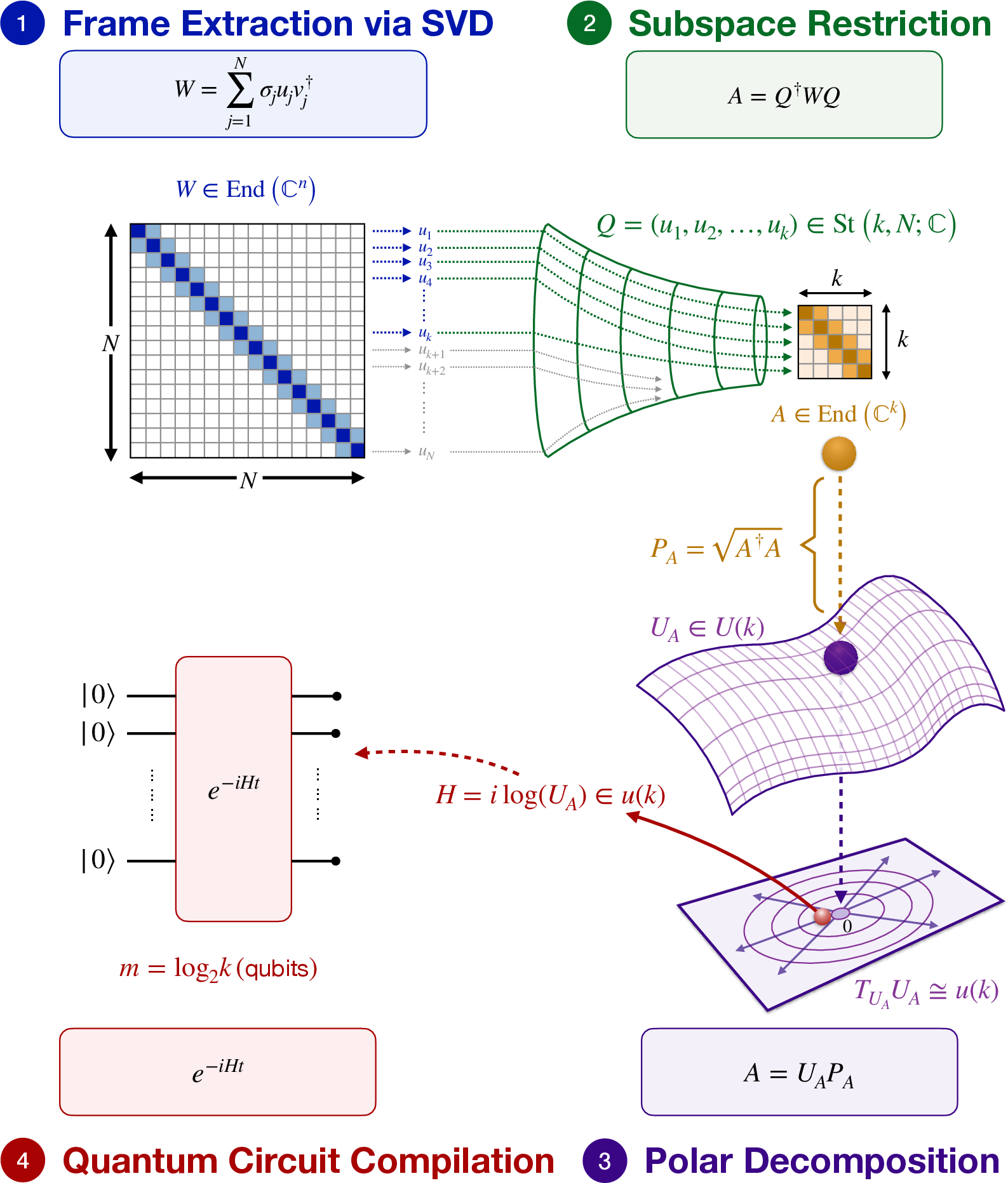
Figure 1: The algebraic and geometric steps of the quantum parameter transfer map, visualizing SVD truncation, unitary polar projection, and Hermitian generator extraction.
Barren Plateau Mitigation via Analytic Initialization
A significant limitation in deep PQC training is the barren plateau phenomenon: for generic initializations, gradient variance collapses exponentially in the number of qubits, making optimization intractable. The developed analytic initialization procedure confines trainable parameters to a Q2-dimensional subspace derived from classically meaningful weights (typically residual layers near the identity). The analysis, using Weingarten calculus over Q3, shows that gradient variance at initialization is Q4, independent of the total qubit register size.
The constructive insight is that subspace initialization near the identity avoids the Haar-random regime responsible for exponential gradient decay. Therefore, warm-started quantum layers exhibit robust, polynomially lower-bounded gradient signals even up to Q5 qubits, as demonstrated both in simulation and experiment.
Empirical Validation: Resource Compression, Manifold Merging, and Device-Scale Experiments
Zero-Shot Quantum Compilation
On minimal models (e.g., Q6 residual layers), the constructed quantum circuits (e.g., 4 active qubits, Q7) recover classical test accuracy to within Q8 without any quantum-side optimization. This validates the SVD-based frame as extracting the information-maximal sector from the classical model, with efficient resource compression and negligible expressivity loss.
Subspace Rank Error Decomposition
The scaling properties of truncation and non-unitarity errors as a function of retained subspace dimension Q9 match the theoretical predictions precisely. At full rank (k0), total error matches the irreducible non-unitarity floor, and phase error contributions vanish, demonstrating accuracy of the analytic quantum embedding.
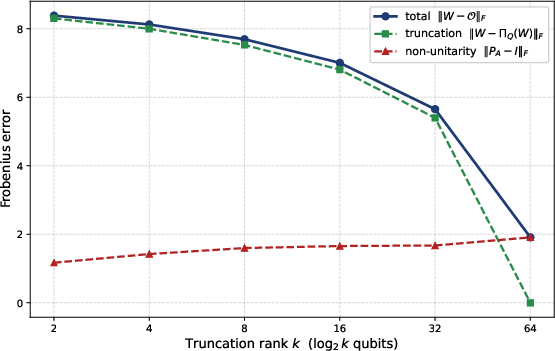
Figure 2: Quantization error decomposition as a function of subspace dimension k1; truncation error vanishes with increasing k2, leaving only non-unitarity error.
Quantum Generator-Space Model Fusion
The framework permits merging independently-trained classical or quantum models by lifting generators to a shared covering frame on the Stiefel manifold, averaging in the Lie algebra, and exponentiating back to the circuit layer. This method captures the dominant modes from all source models and incurs only a second-order error in generator separation, supporting explicit error accounting for quantum model composition and transfer learning.
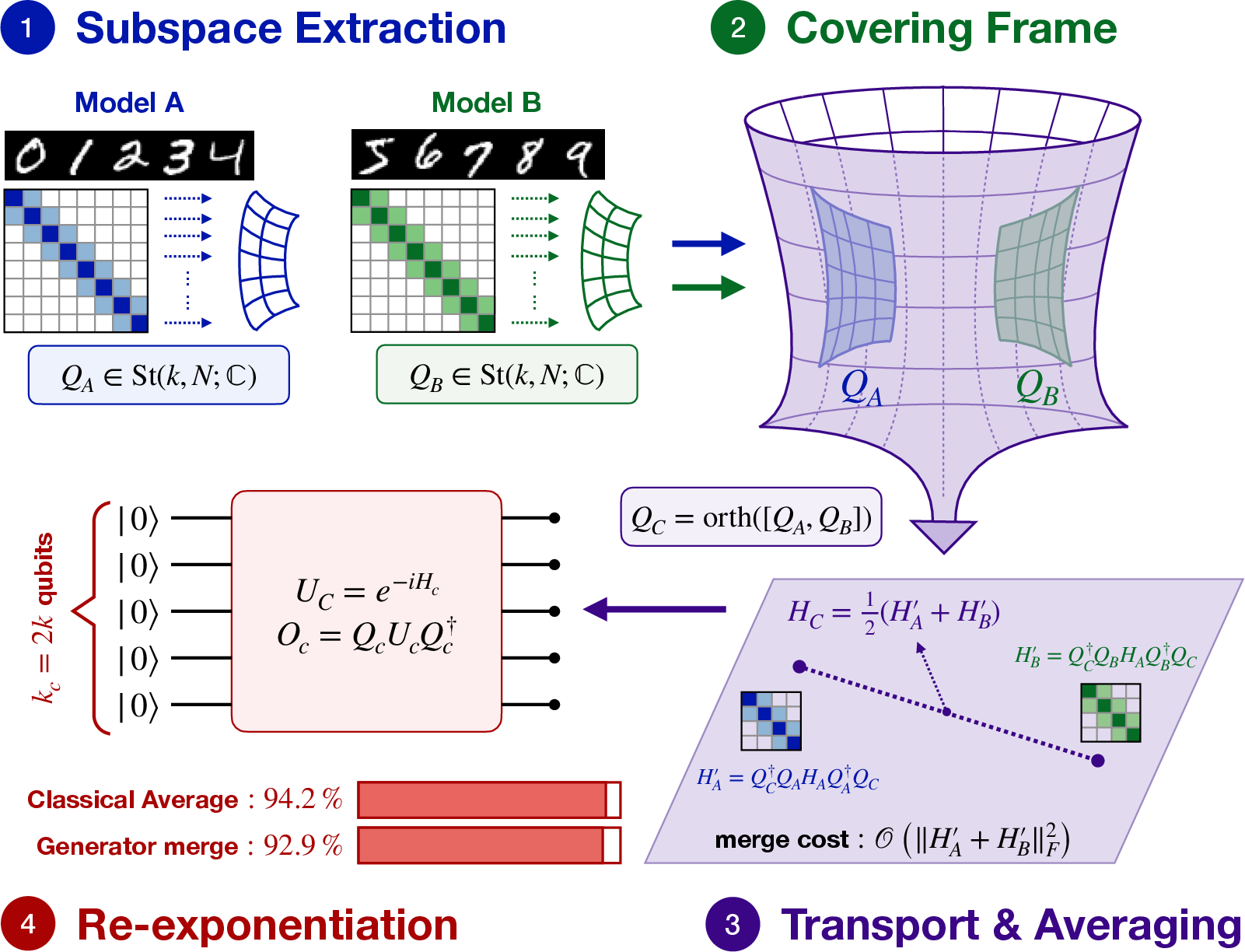
Figure 3: Illustration of covering-frame generator merging: frame expansion, generator transport, and averaging in the common local Lie algebra.
Scaling on Superconducting Quantum Hardware
Experiments on the 156-qubit IBM Heron processor (ibm_kobe) confirm that subspace-compiled quantum circuits faithfully execute zero-shot compiled models, tracking the ideal output distributions with high Hellinger fidelity (k3 at k4, k5 at k6) and demonstrate robust, non-vanishing gradient variance up to 128 qubits—–orders of magnitude above the hardware noise floor.
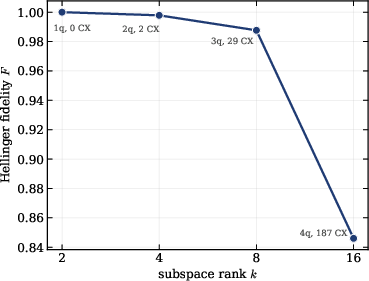
Figure 4: Hellinger fidelity vs. subspace rank k7 for quantum hardware execution, confirming preservation of compiled model output up to practical qubit numbers.
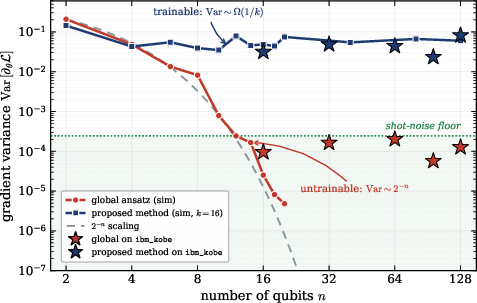
Figure 5: Gradient variance vs. total qubits; the subspace-restricted ansatz maintains k8 variance, immune to the exponential decay of global hardware-efficient circuits.
Expressivity per Gate: Hardware-Efficient Versus Lie-Algebraic Ansatz
To disambiguate improved trainability from trivial expressivity loss, effective dimension (based on Fisher information) is measured as a function of the two-qubit gate budget on real hardware. The Lie-algebraic ansatz with trainable entanglers demonstrates strictly expanding effective dimension, easily surpassing the saturation plateau observed for hardware-efficient PQCs using fixed CZ gates. This confirms that barren plateau avoidance is not achieved at the expense of expressive underspecification.
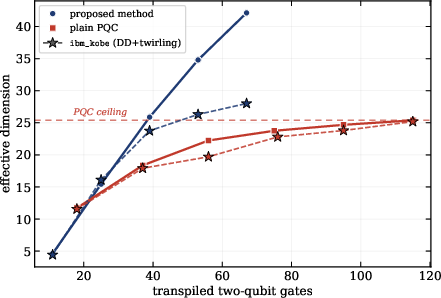
Figure 6: Effective dimension (Fisher information geometry) as a function of transpiled native two-qubit gates; Lie-algebraic circuits scale linearly, hardware-efficient saturate.
Implications and Future Directions
The analytic parameter transfer map and associated subspace quantization theorem provide a rigorous and practical bridge between classical deep learning and PQCs, completely circumventing expensive quantum-side gradient-based fitting for initialization and model fusion. The approach leverages Lie-theoretic and manifold geometry to optimize expressivity-per-resource tradeoffs, with immediate application to noise-resilient NISQ-era device deployment.
Key theoretical implications include:
- Demonstration that classical-to-quantum mappings with near-identity priors and Lie-algebraic quantization mitigate exponential barren plateau scaling at initialization.
- Establishment of rigorous, micro-local error budgets in parameter transfer and model fusion, enabling controlled accuracy guarantees for hybrid and transferred models.
- A formal link between the information geometry of classical models and resource-aware quantum circuit construction.
Future work will need to address analytic mappings for non-square or non-unitary classical layers, extensions to higher-order fine-tuning regimes, and systematic device-level error mitigation for deep subspace quantum circuits at larger width.
Conclusion
This work establishes the first strictly analytic, training-free classical-to-quantum parameter mapping with a provable, dimension-reduced error bound and gradient floor, supporting scalable, generalizable quantum learning architectures and compositionality on realistic hardware. The approach admits direct integration of high-capacity classical models with quantum back-ends, with strong guarantees for initialization-time trainability and resource utilization, opening new possibilities for large-scale, hybrid, and compositional quantum machine learning.