- The paper establishes a no-go theorem demonstrating that minimal symmetry-protected scalar and Yukawa portals cannot simultaneously achieve technical naturalness and effective S8 suppression.
- It reveals that trilinear, quartic, derivative, and fermionic couplings face severe constraints due to the extreme mass hierarchy between dark matter and ultralight dark energy.
- The analysis shows that even multi-field extensions like clockwork mechanisms do not resolve the fundamental incompatibility between naturalness requirements and cosmological structure suppression.
No-Go Theorem for Symmetry-Protected Scalar Portals in Interacting Dark Energy
Introduction
The S8 tension, reflecting a persistent ∼5--10% deficit in the amplitude of late-time matter fluctuations relative to CMB-inferred σ8, has motivated the consideration of non-gravitational interactions between dark matter (DM) and dark energy (DE). Interacting Dark Energy (IDE) frameworks postulate additional energy or momentum exchange in the dark sector, with the potential to suppress late-time structure growth. Embedding such scenarios in a technically natural, ultraviolet-complete particle physics framework, however, encounters substantial obstacles due to the extreme mass hierarchy between weak-scale dark matter and ultralight dark energy (mϕ∼H0). This work provides a systematic no-go result for scalar-mediated portal couplings that respect symmetry protection, demonstrating that all minimal single-mediator scenarios necessarily violate technical naturalness or fail phenomenologically to resolve the S8 tension.
Theoretical Framework and Portal Structures
The construction is built upon the Z2-symmetric Inert Doublet plus Complex Singlet Model (IDSM), extending the Standard Model with a Z2-odd inert scalar doublet for DM (χ) and a complex singlet hosting a pseudo-Nambu-Goldstone boson (pNGB) for DE (ϕ), stabilized by a softly broken global U(1)S symmetry. This setup ensures both DM stability and radiative isolation for the ultralight DE field.
After integrating out heavy degrees of freedom, the following symmetry-protected scalar portals, and their minimal fermionic analog, comprehensively parametrize all gauge- and ∼0-invariant single-mediator couplings:
- Trilinear Portal (∼1): Generates field-dependent DM masses, directly sourcing energy transfer and a fifth-force with constant coupling parameter ∼2.
- Quartic Portal (∼3): Yields a nonlinear fifth-force depending on ∼4 with suppressed background energy transfer, and a stronger UV sensitivity.
- Derivative (Drag) Portal (∼5): Induces pure momentum exchange without altering the background expansion or ultralight field mass, reflecting exact pNGB shift symmetry protection.
- Fermionic Yukawa Portal (∼6): Realizes direct DM--DE coupling for Majorana or Dirac dark matter, with phenomenology that tracks the scalar trilinear portal.
Each portal's phenomenological efficacy is subject to technical naturalness constraints arising from quantum corrections, directly tied to the hierarchy between ∼7 and ∼8, and UV sensitivity enforced by the radiative stability requirement.
Trilinear and Fermionic Portals: Phenomenology vs. Naturalness
Cosmologically, the trilinear and Yukawa portals present the canonical structure for coupled quintessence. Implementing these couplings in a Boltzmann code (CLASS), the analysis finds that achieving the observed ∼9 suppression necessitates an effective fifth-force parameter σ80, corresponding to σ81 GeV for σ82 GeV, and similarly σ83 for fermionic DM.
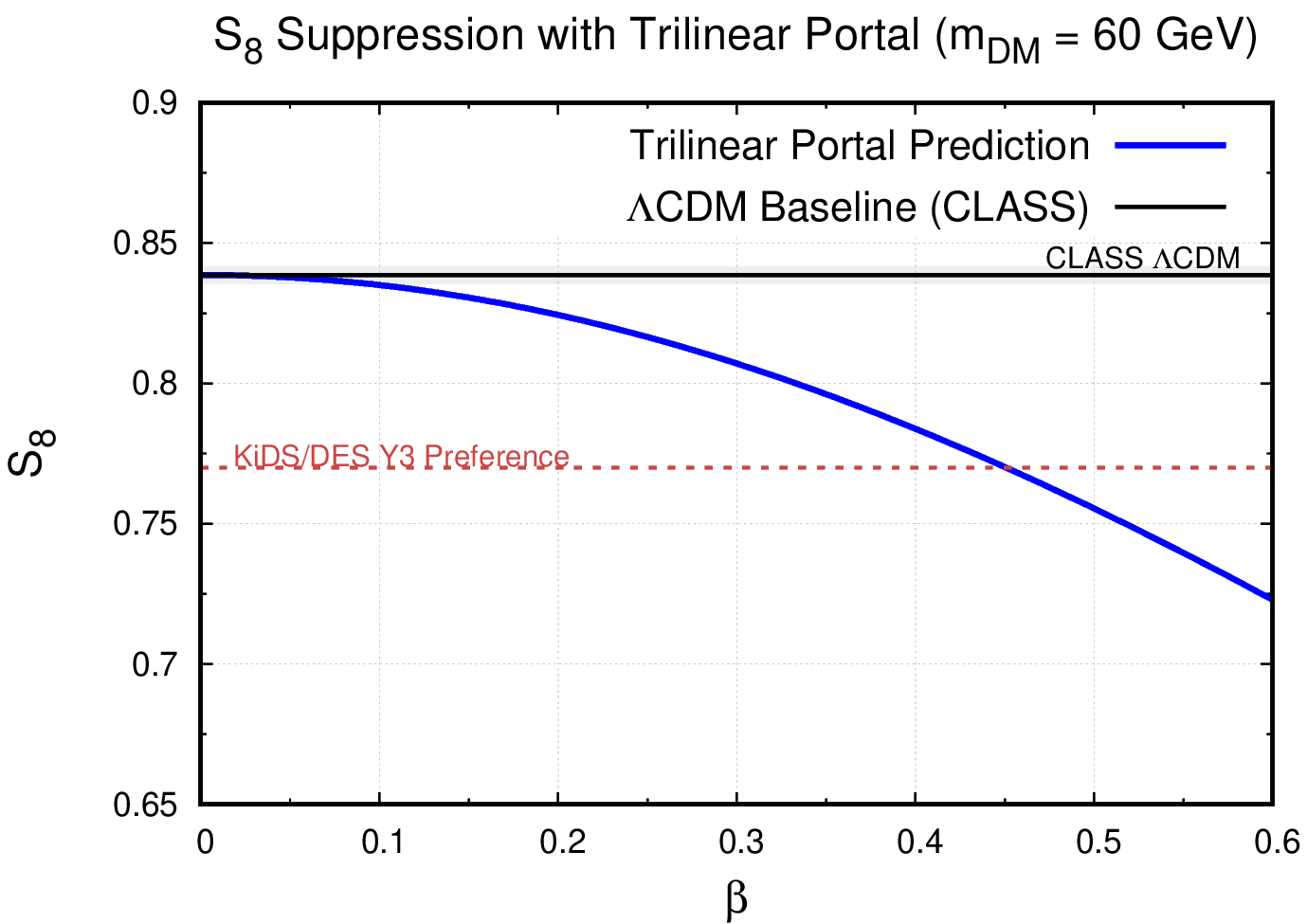
Figure 1: σ84 suppression as a function of σ85 for the trilinear portal, benchmarking the phenomenological requirement against the naturalness bound.
Quantum corrections (Coleman-Weinberg potential) yield, for the trilinear or Yukawa portals,
σ86
Naturalness (requiring σ87) restricts σ88 GeV and σ89, creating a catastrophic fine-tuning tension (mϕ∼H00) between the couplings necessary for mϕ∼H01-suppression and radiative stability. Supersymmetric completions only mildly alleviate this, yielding a floor mϕ∼H02 due to the residual soft-breaking scale.
Quartic Portal: Enhanced Instability
The quartic portal introduces an even more severe instability. Cosmological suppression of mϕ∼H03 by mϕ∼H04--mϕ∼H05 requires mϕ∼H06--10 for sub-Planckian field evolutions, as determined by CLASS numerics. However, the quadratic divergence of the radiative correction,
mϕ∼H07
mandates mϕ∼H08 for the heavy mass scale mϕ∼H09, causing a fine-tuning catastrophe (S80). The structural dependence of S81 on the product S82 cannot circumvent the naturalness floor, even for extreme initial displacements.
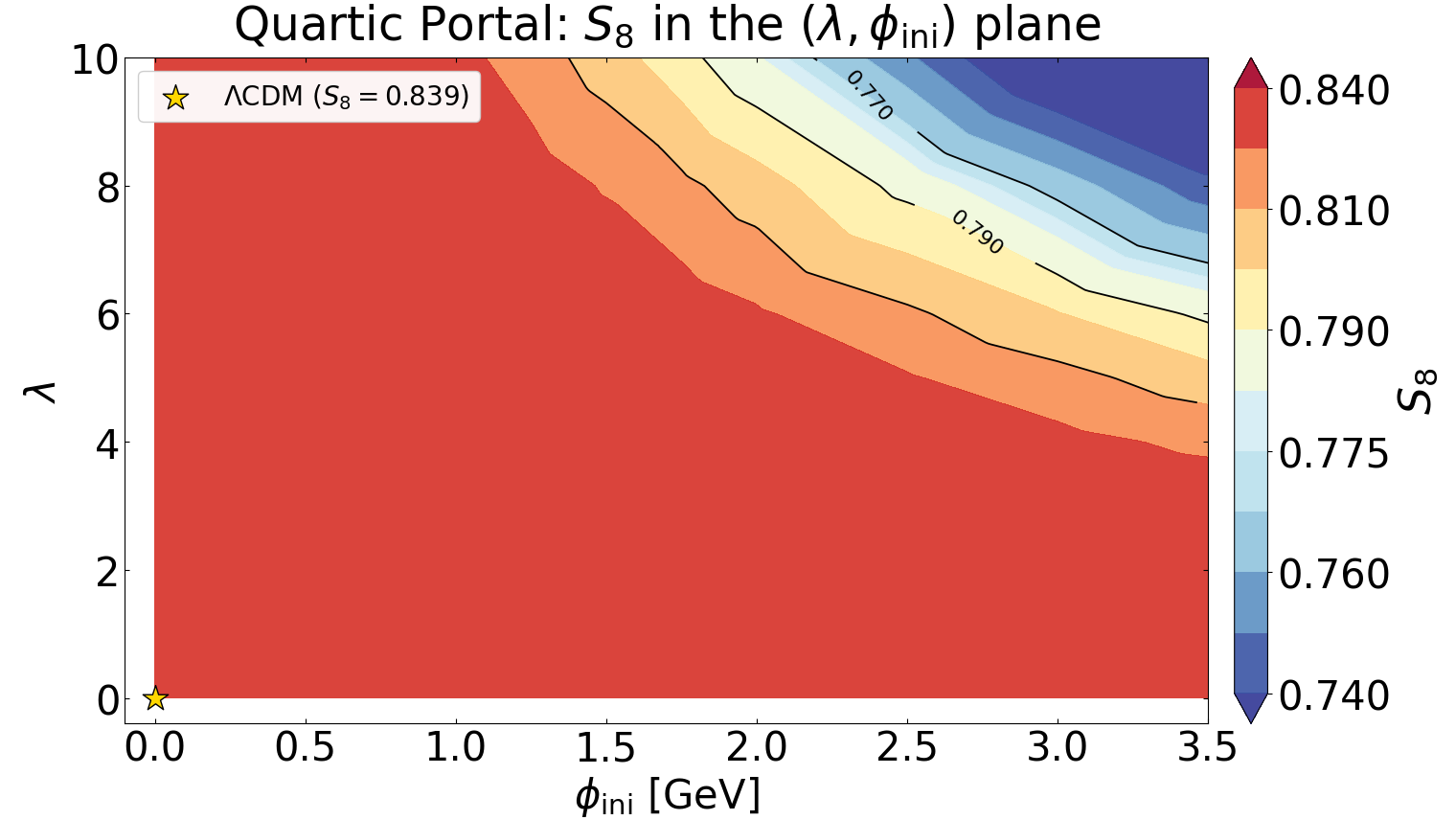
Figure 2: Contours of constant S83 in the S84 plane for the quartic portal, displaying the incompatibility between naturalness and required coupling strength.
Derivative (Drag) Portal: Saturation Phenomenon
The derivative portal, shielded by the shift symmetry, remains technically natural for all permitted values of S85, but is limited dynamically. The suppression of structure growth saturates as the momentum-exchange rate S86 approaches S87, bringing DM and DE fluids to velocity equilibrium. This caps S88 suppression at S89, insufficient to reconcile the observed Z20 deficit, regardless of coupling strength.
Multi-Field Mechanisms and Clockwork: Catastrophic Tuning Persists
The clockwork mechanism is scrutinized as an archetypal multi-field UV completion. While the clockwork chain can suppress the effective coupling at the Lagrangian level, radiative corrections to the ultralight zero-mode mass inherit the same functional dependence as the single-field scenario, and the tuning floor (Z21) remains unaffected. Furthermore, scenarios where all clockwork gears are pNGBs cannot achieve phenomenological coupling strengths without violating the naturalness bound. Thus, multi-field structures do not alter the fundamental impossible triangle.
Implications and Future Directions
This analysis delineates a sharp structural boundary for portal-induced IDE models: Within the class of ZZ22-protected scalar portals (trilinear, quartic, derivative) and minimal fermionic Yukawa couplings, no single-mediator model simultaneously preserves technical naturalness and produces the structure suppression required by current cosmological data. Relaxing these requirements necessitates adopting catastrophic fine-tuning, explicit symmetry-breaking, or invoking fundamentally new hidden-sector mechanisms.
Theoretical implications of the no-go result include the necessity to:
- Abandon technical naturalness, accepting extreme fine-tuning in the dark energy sector,
- Construct multi-sector or multi-mediator models with explicit symmetry violation or non-perturbative effect (not considered here),
- Explore beyond the scalar-mediated framework, e.g., vector-mediated portals, alternative screening mechanisms, or modifications of gravity.
On the phenomenological side, the result quantifies the precise price of each model's contribution to Z23, enabling future studies to benchmark alternative proposals against a transparent fine-tuning standard. The naturalness bounds derived are robust to order-one variations in UV parameters within weakly coupled effective field theory.
Conclusion
A comprehensive no-go theorem has been established for symmetry-protected scalar and minimal Yukawa portals mediating non-gravitational interactions between DM and pNGB ultralight DE. All single-mediator scenarios confront a mutually exclusive choice between radiative stability and cosmologically significant structure suppression. The clockwork mechanism and other multi-field completions do not ameliorate this limit, as the radiative corrections to the ultralight zero mode depend solely on the required phenomenological coupling. Extensions beyond the considered frameworks—including nonperturbative, non-scalar, or multi-sector strategies—remain as potential avenues but will have to confront the same level of quantitative scrutiny to evaluate their naturalness and efficacy.