- The paper introduces an asymmetric two-component scalar FIMP dark matter model that employs freeze-in production to generate the relic density.
- It uses a heavy scalar mediator and soft U(1) breaking to induce a primordial asymmetry, linking dark matter production with CP-violation.
- Numerical Boltzmann analysis demonstrates quadratic sensitivity to portal couplings and linear dependence on asymmetry, consistent with Planck data.
Asymmetric Two-Component Scalar FIMP Dark Matter: Model, Dynamics, and Phenomenology
Model Construction and Theoretical Motivation
This work introduces a scalar FIMP (Feebly Interacting Massive Particle) dark matter (DM) framework incorporating two real singlet scalar fields, ϕ1 and ϕ2, along with a heavy real scalar mediator S, all uncharged under the Standard Model (SM) gauge group and stabilized by a Z2×Z2′ symmetry. The symmetry assignment ensures the absolute stability of both DM components, as each is odd under a distinct Z2 factor, while all SM fields and S remain even.
The model is further endowed with a soft breaking of a global U(1) dark number via a trilinear term μ12Sϕ12, enabling the decay of S to produce a primordial asymmetry in ϕ1 through CP-violating decays, a characteristic aligning this setup with asymmetric DM scenarios. Quartic scalar couplings facilitate the partial transfer of this asymmetry to ϕ20. Notably, all portal couplings linking the dark and visible sectors are chosen extremely small (ϕ21), ensuring that both DM candidates are produced dominantly via the freeze-in mechanism, never attaining equilibrium with the cosmic plasma.
Freeze-In Production and Boltzmann Analysis
The freeze-in mechanism underpins the relic density generation for both ϕ22 and ϕ23. Production is dominated by decays of the SM Higgs boson ϕ24, given the small DM masses (ϕ25 GeV, ϕ26 GeV) considered in the parameter scan. The portal couplings control the overall production rate, and the characteristic yield from freeze-in scales as ϕ27.
Asymmetric production is implemented via a nonzero initial asymmetry parameter ϕ28, injected at a high initial temperature, and preserved since symmetric processes are negligible due to feeble couplings. The Boltzmann equations tracking both particle and antiparticle yields for each DM component are numerically integrated from an initial temperature (ϕ29 GeV) to the present day, incorporating all source and dilution effects.
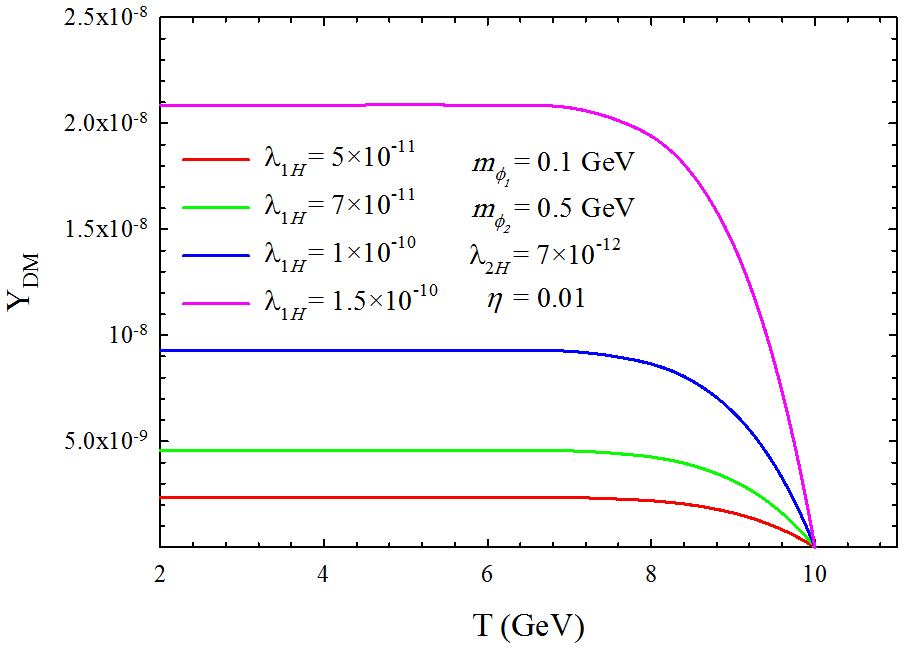
Figure 1: Total DM abundance S0 as a function of temperature S1 for various Higgs portal couplings S2. Freeze-in production is Higgs-dominated and controlled by S3.
The parametric dependence, as visualized in Figure 1, confirms that the build-up of DM abundance freezes in as the temperature drops below S4 GeV, corresponding to the decoupling regime of the parent (Higgs) abundance.
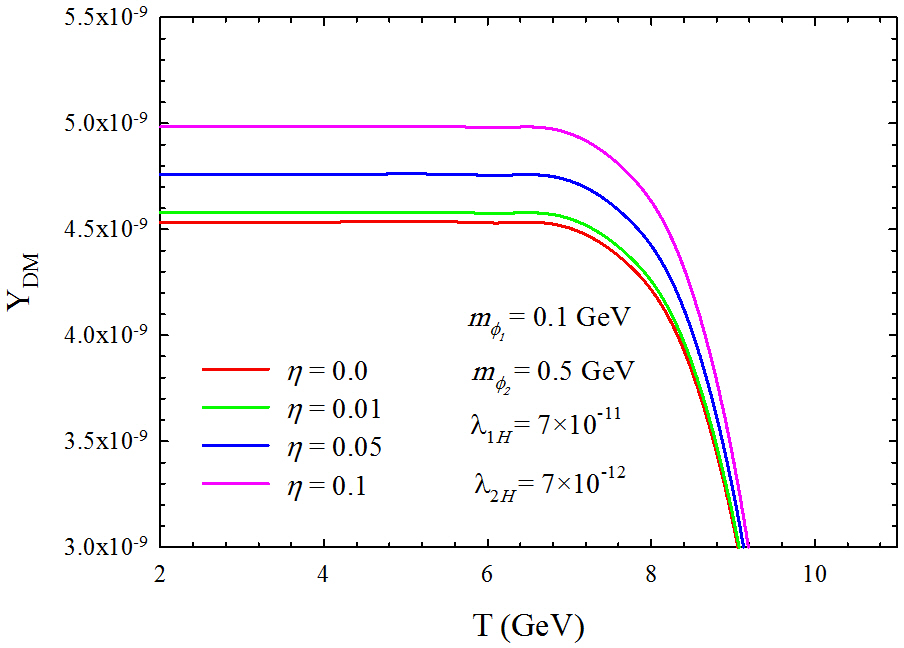
Figure 2: Total DM abundance S5 for varying initial asymmetry S6. Larger asymmetry results in higher freeze-in yields, manifesting as a linear scaling of final abundance with S7.
The impact of S8 is transparent: the asymmetric component augments the total DM abundance linearly, thereby providing a tunable mechanism to match the observed relic density for smaller portal couplings.
Relic Density Results and Parameter Dependencies
The numerical scan reveals that the total DM relic density, S9, is a sum of individual contributions from Z2×Z2′0 and Z2×Z2′1, with the first component dominant under the chosen benchmarks. The observed cosmological density, Z2×Z2′2 (Planck), can be precisely accommodated for Z2×Z2′3 and Z2×Z2′4, with Z2×Z2′5 contributing only Z2×Z2′6.
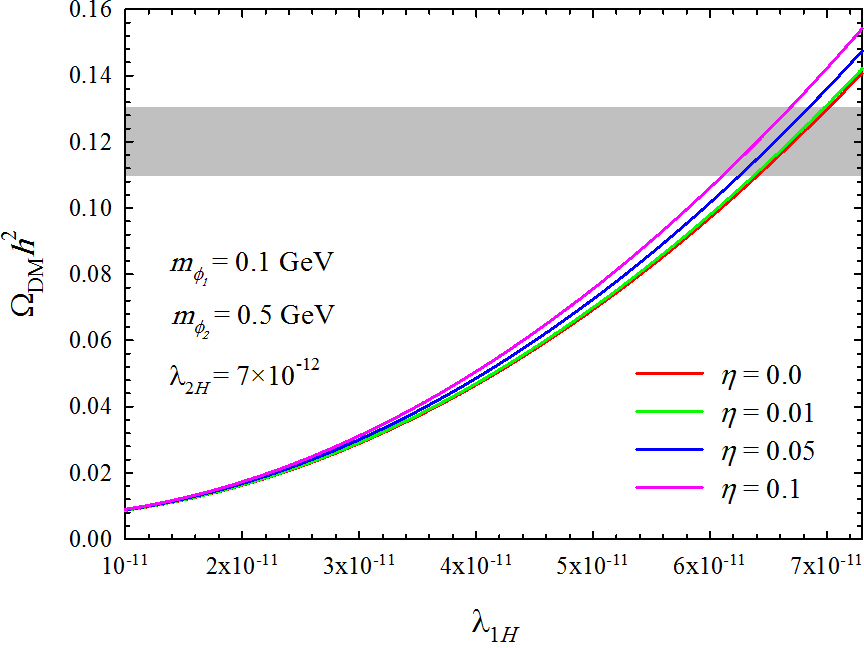
Figure 3: Relic density Z2×Z2′7 as a function of portal coupling Z2×Z2′8 for different values of the asymmetry Z2×Z2′9. The Planck value is indicated by a gray band.
These results Figure 3 illustrate the quadratic sensitivity of the relic density to portal couplings, and its linear scaling with asymmetry, allowing the model to evade under- and over-production issues across a broad parameter swath.
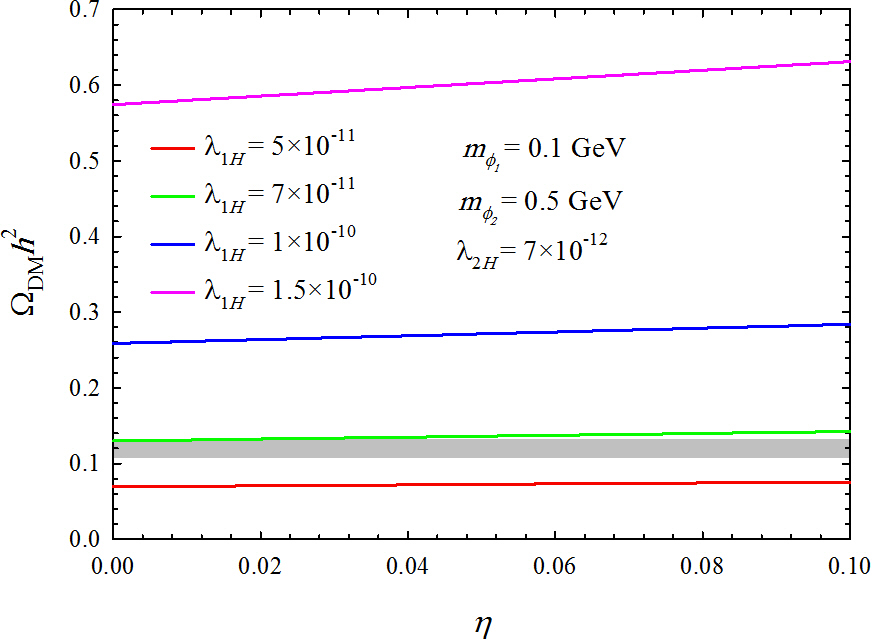
Figure 4: Relic density Z20 as a function of the initial asymmetry parameter Z21, for several portal couplings Z22. Only a narrow stripe—constrained in both Z23 and Z24—reproduces the Planck relic density.
Phenomenological Constraints
Self-Interactions
Scalar self-couplings Z25 and Z26 lead to quartic contact interactions. The model's predicted DM self-interaction cross sections per unit mass are orders of magnitude below observational upper limits from merging clusters. Concretely, for benchmark points even at maximal (Z27) perturbative values, Z28 cmZ29/g, easily satisfying the Bullet Cluster (S0 cmS1/g) and double radio relic (S2 cmS3/g) constraints.
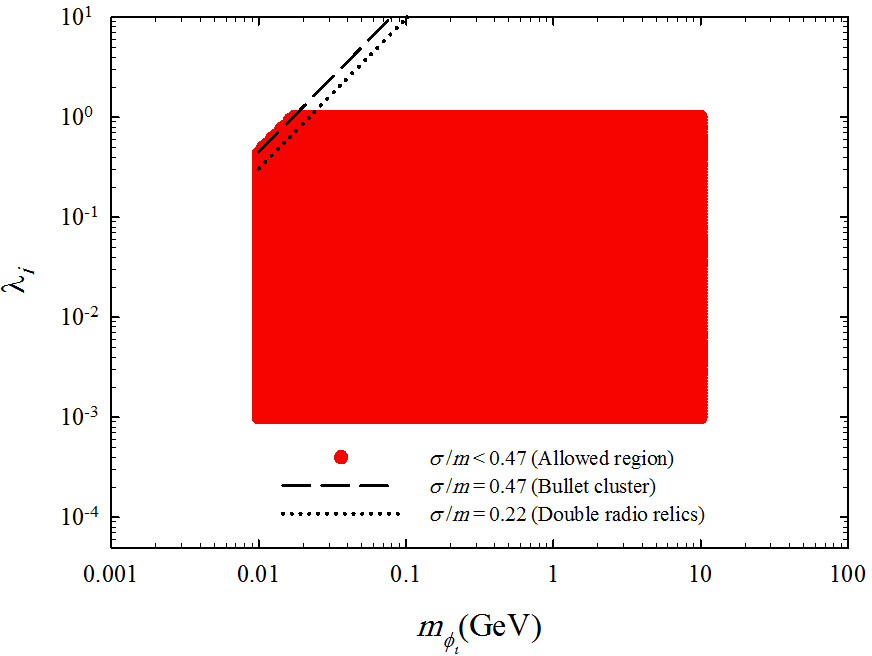
Figure 5: Allowed parameter region in the S4 plane under self-interaction constraints from the Bullet Cluster and double radio relic observations.
Invisible Higgs Decay and Direct Detection
The Higgs portal-mediated invisible decay widths for S5 are exceedingly suppressed, yielding branching ratios S6—vastly below experimental sensitivities of ATLAS and CMS. Likewise, DM-nucleon elastic scattering, being proportional to S7, is also far below the detection thresholds of current and foreseeable direct detection experiments (LUX-ZEPLIN, XENONnT).
Implications and Outlook
The interplay of asymmetry and multiple FIMP components enables the polymorphic matching of the DM abundance, decoupled from the usual annihilation cross section constraints of thermal WIMPs. The asymmetric double-scalar FIMP scenario here not only conforms to all astrophysical and collider constraints, but also offers a dynamical route to linking DM and baryon asymmetries in the freeze-in paradigm—previously explored primarily in WIMP-ADM settings.
The model's flexibility in accommodating the observed relic abundance, while naturally suppressing dangerous signals in invisible Higgs decay and direct detection channels, represents an essential feature. Given the sub-GeV DM masses, attention to cosmological and astrophysical probes (e.g., structure formation, cosmic microwave background) is warranted in future studies. The framework also motivates further exploration of multi-scalar freeze-in models, transfer mechanisms of asymmetry, and possible connections to baryogenesis.
Conclusion
This two-component asymmetric FIMP model, stabilized by discrete symmetries and producing relic abundance through freeze-in, satisfies the cosmological dark matter density while evading all direct, indirect, and collider constraints. The model’s combination of a heavy asymmetric mediator, rich phenomenology, and decoupling from thermal equilibrium dynamics opens further lines of theoretical investigation, particularly in understanding the linkage between dark and visible sector relics and the signatures of non-thermal multi-scalar dark sectors.

