- The paper introduces a minimal fermion-portal scalar dark matter model with charged vector-like fermions that is consistent with current theoretical and experimental constraints.
- It employs detailed relic density and direct-detection analyses using micrOMEGAs and SARAH/SPheno to identify viable parameter spaces driven by t-channel and co-annihilation processes.
- The study demonstrates that future high-energy muon colliders can robustly probe dark matter signatures, achieving superior discovery reach compared to HL-LHC projections.
Probing Fermion-Portal Scalar Dark Matter via Charged Vector-Like Fermions at Future Muon Colliders
Model Construction and Constraints
The analyzed scenario extends the Standard Model (SM) by a real singlet scalar S and new electroweak vector-like fermions—one SU(2) doublet, one singlet—a minimal "Z2-odd" dark sector framework. The dark matter (DM) candidate is the lightest neutral singlet scalar, stabilized by discrete symmetry. In addition to canonical scalar-Higgs portal couplings, the model introduces new Yukawa interactions connecting the dark scalar, the charged vector-like fermions, and SM leptons.
The scalar potential and Yukawa terms are engineered to ensure vacuum stability and perturbative unitarity up to high scales, as rigorously analyzed through renormalization group equations and boundedness-from-below criteria. Constraints from collider Higgs data, anomalous magnetic moments, and lepton flavor violation (μ→eγ) are implemented, showing that the parameter space is only consistent if second-generation Yukawas are strongly suppressed, permitting first-generation portals while evading μ-channel LFV and (g−2)μ exclusion.
Dark Matter Relic Density and Direct-Detection Phenomenology
The DM phenomenology is computed via relic density calculations encompassing s-, t-, and u-channel processes, with co-annihilation channels notable for large Yukawa couplings and small mass splittings to higher-mass Z2-odd fermions. Numerical analysis with micrOMEGAs and SARAH/SPheno demonstrates that the canonical Higgs portal scenario is strongly excluded by the latest LUX-ZEPLIN and XENON constraints except near the Higgs-funnel region.
The allowed relic density is achieved predominantly through t-channel Yukawa-driven annihilations (ss→νℓνℓ), with co-annihilation contributions becoming significant in the multi-TeV regime. The viable parameter space for Yf∼0.35−0.45, and small portal coupling κ, covers a DM mass range of ∼10 GeV up to unitarity bounds, while maintaining direct-detection cross sections well below experimental limits.
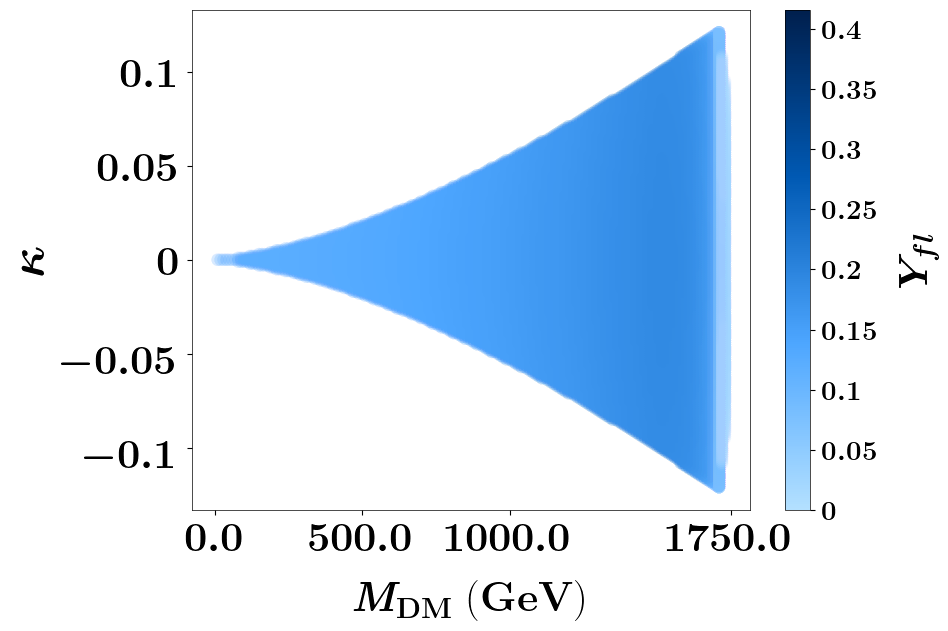
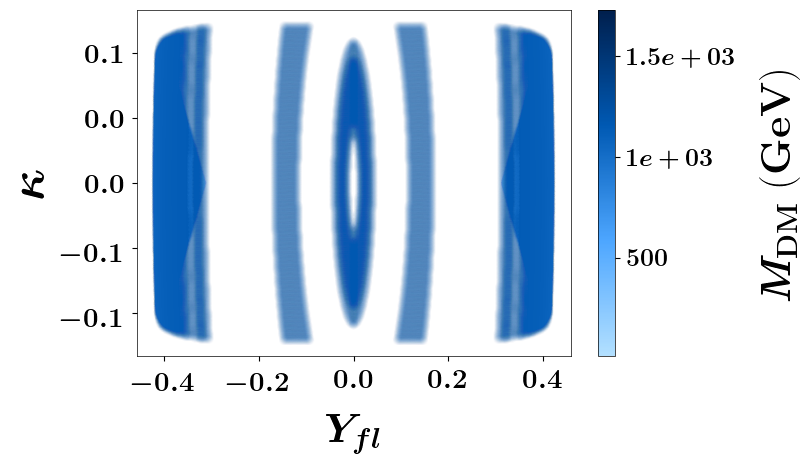
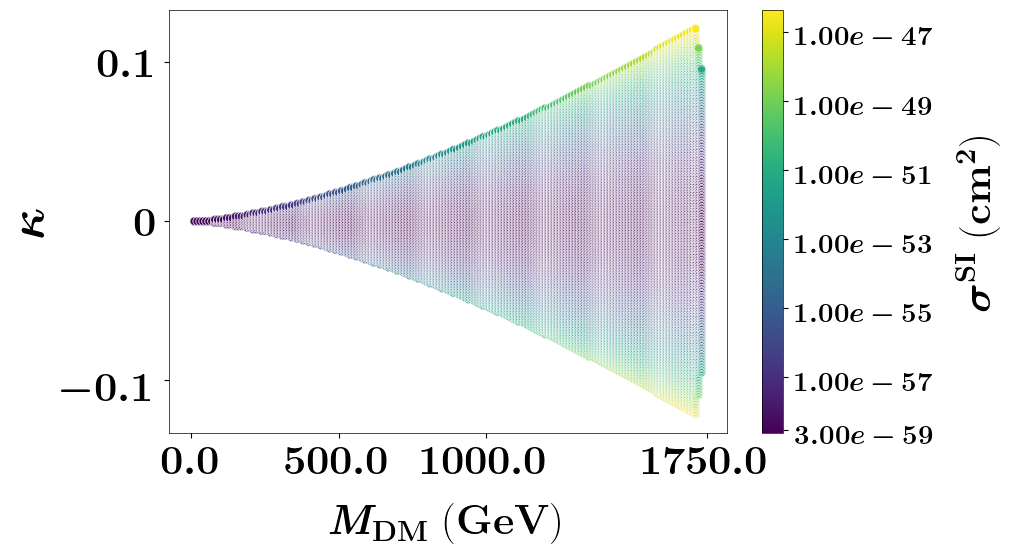
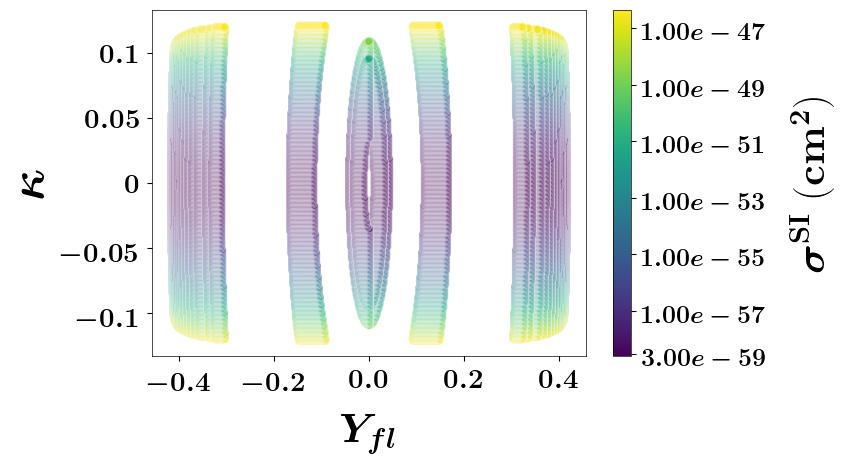
Figure 1: The colored band represents the relic density within the Z20 interval, Z21, in the Z22–Z23 and Z24–Z25 parameter planes.
Robustness against vacuum stability, leptonic constraints, electroweak precision data, and perturbativity is demonstrated throughout the parameter space scan, confirming that the allowed regions are not fine-tuned or anomalous under current theoretical or experimental uncertainties.
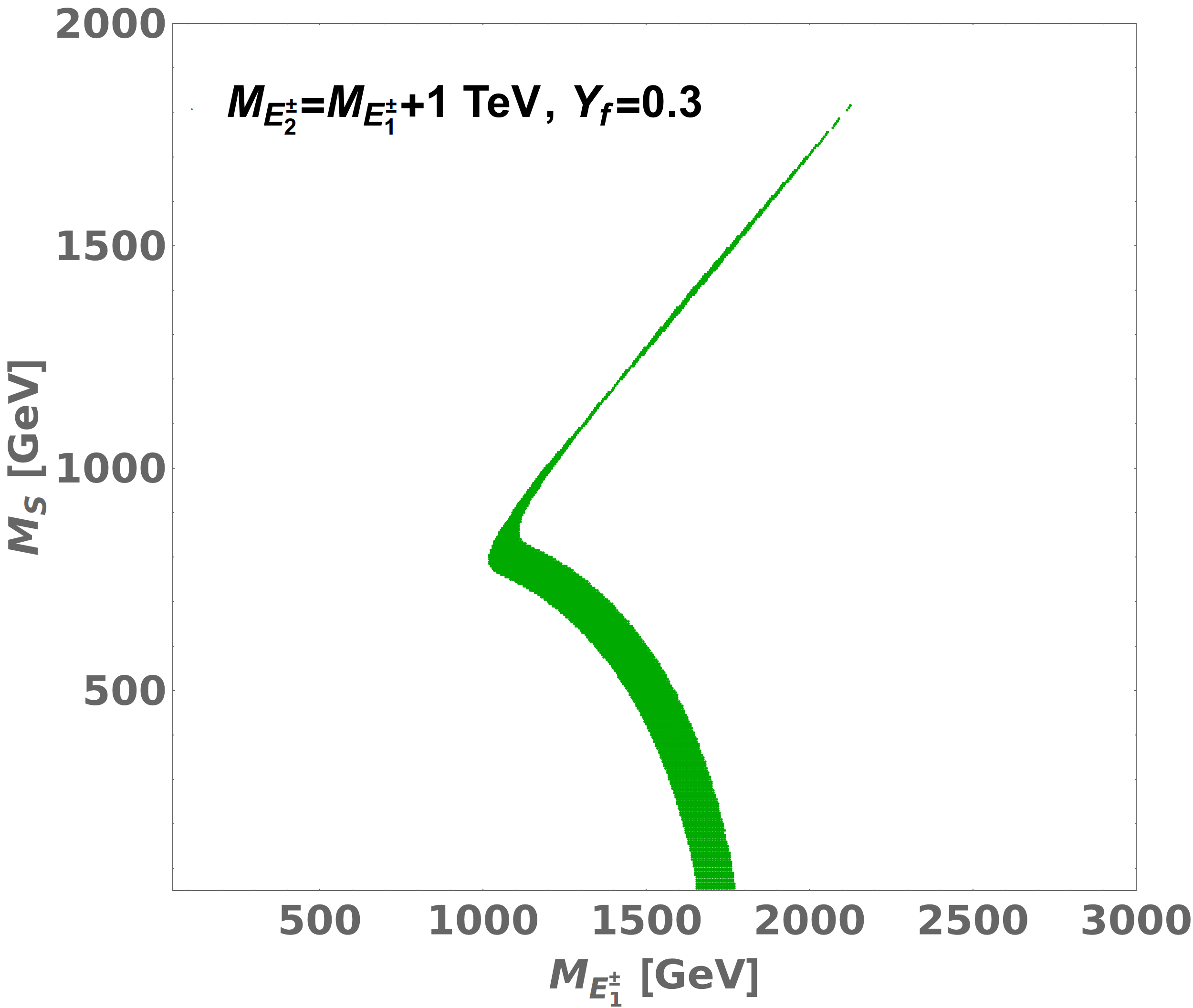
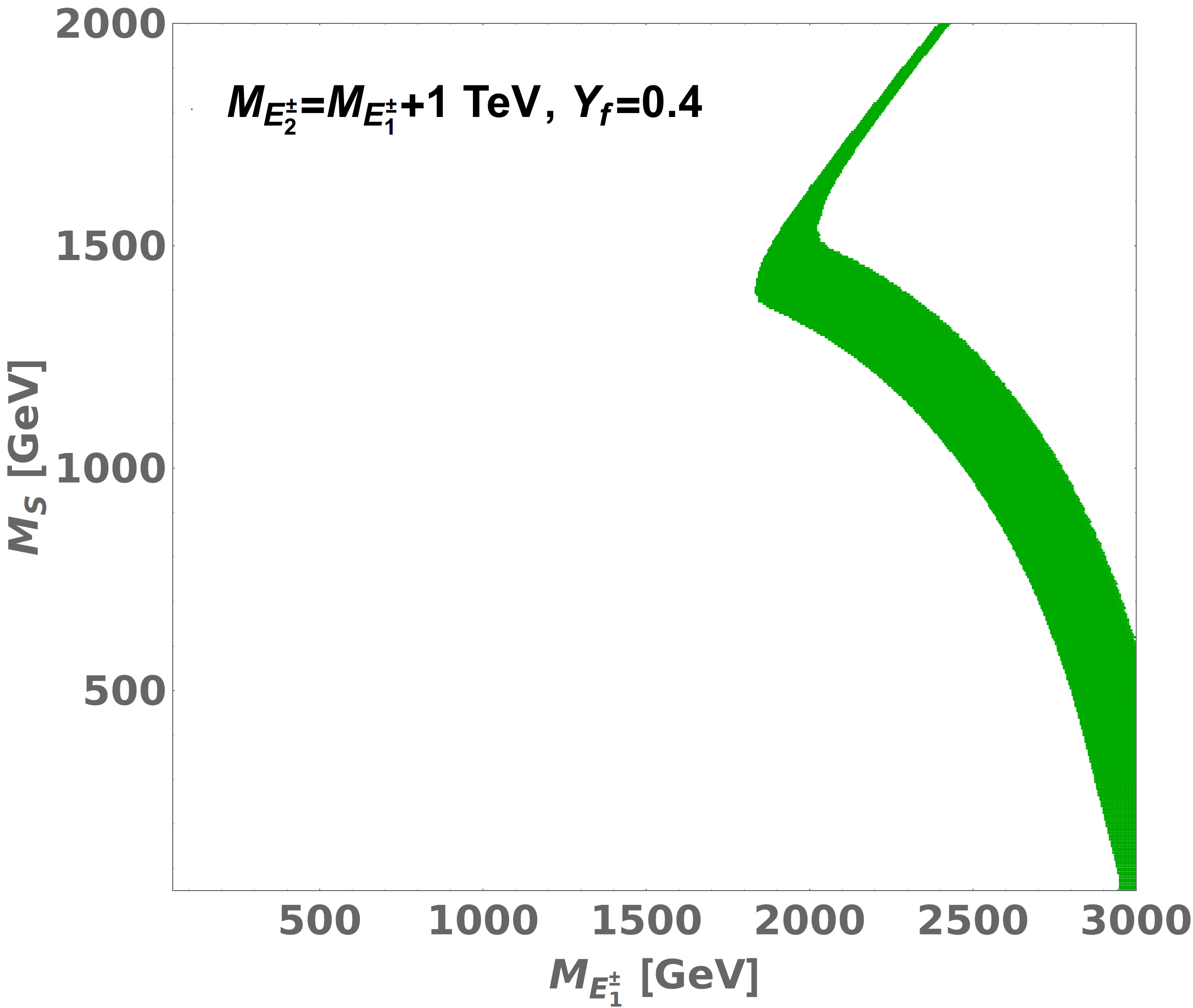
Figure 2: The colored band indicates the relic density within the Z26 range, with dark matter mass varied against charged vector-like fermion masses, highlighting the impact of co-annihilations on viable parameter space.
Collider Phenomenology at Future Muon Colliders
The principal collider signature is the pair production of the lightest charged vector-like fermions (Z27), followed by Z28, yielding a final state with an Z29 pair and substantial missing transverse energy. Both s- and t-channel contributions are present, with cross section dependence on both μ→eγ0 and μ→eγ1.
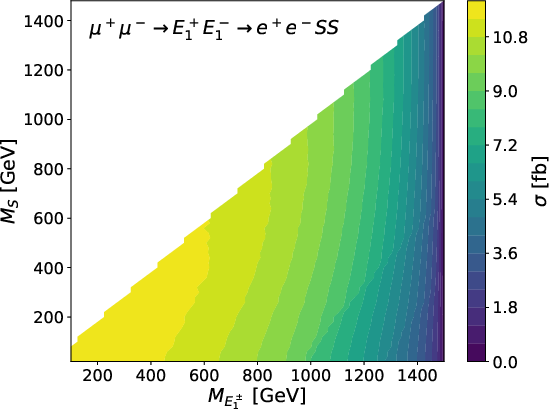
Figure 3: Contour plot of the signal cross section for μ→eγ2 at μ→eγ3 TeV across μ→eγ4 space.
The analysis includes realistic SM backgrounds, with irreducible sources from μ→eγ5 dominating. The kinematic optimization makes use of lepton μ→eγ6 and μ→eγ7 distributions.
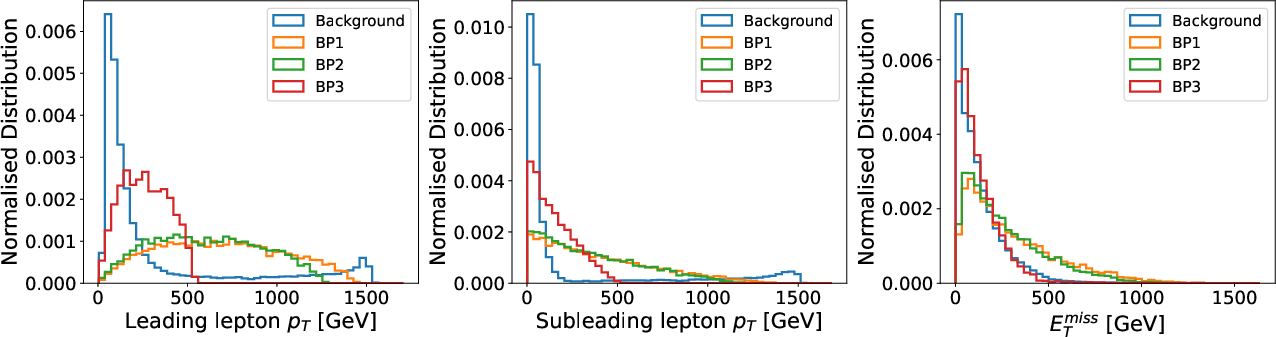
Figure 4: Normalized distributions of leading/subleading electron μ→eγ8 and missing transverse energy μ→eγ9, demonstrating strong discrimination between signal and backgrounds after selection cuts.
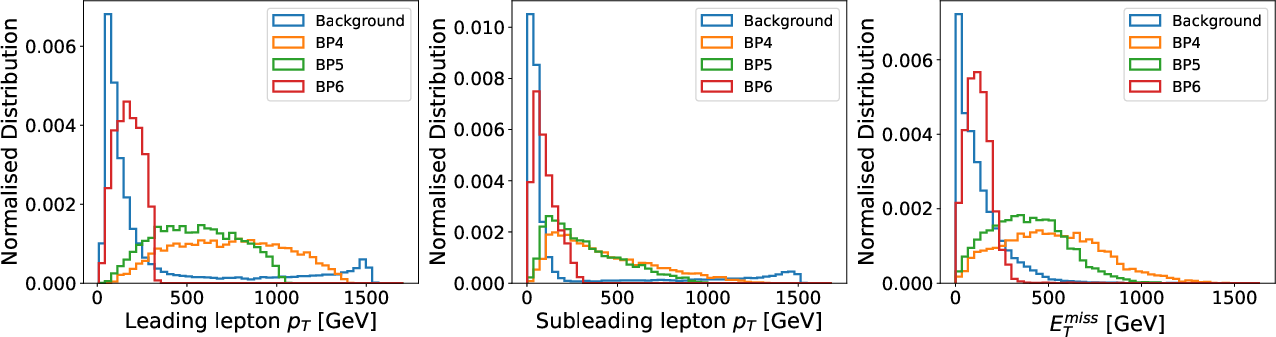
Figure 5: Kinematic distributions at μ0, illustrating the separation of signal from backgrounds as the mass spectrum becomes less compressed.
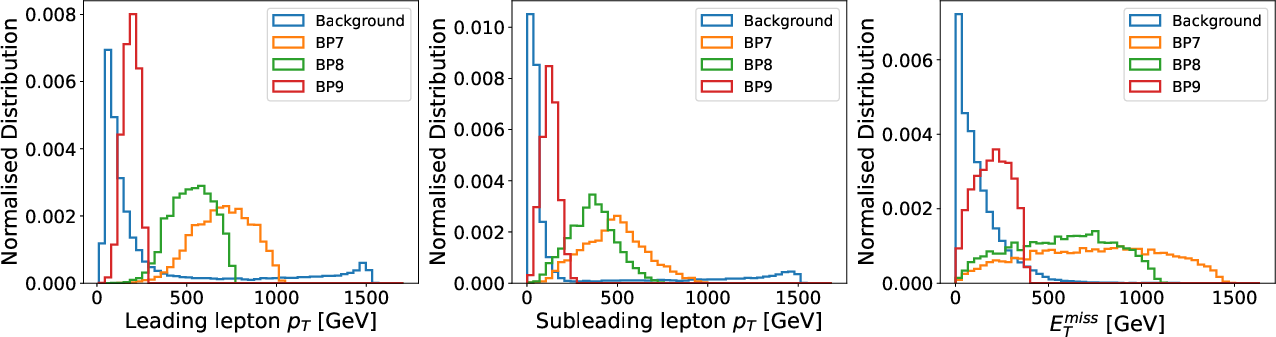
Figure 6: Comparable distributions at μ1, demonstrating that signal retains hard μ2 and μ3 far above SM backgrounds up to multi-TeV scales.
Signal significance is computed using a Poisson–log-likelihood approach, including 10% systematics. The projected μ4 discovery reach at μ5 (1 abμ6) is μ7 for large mass splittings, while μ8 (10 abμ9) extends the reach to (g−2)μ0. Critical overlap with DM-favored regions is achieved, contrasting HL-LHC projections which are limited to (g−2)μ1.
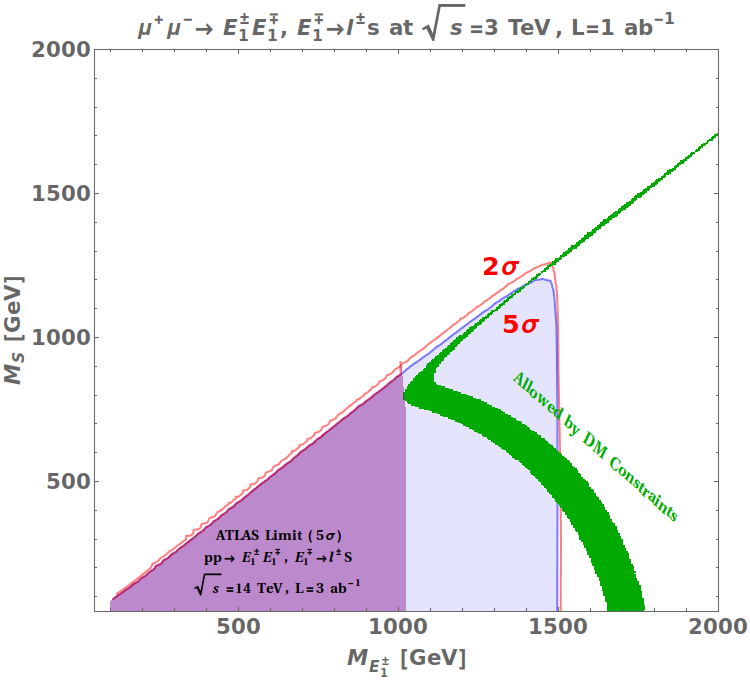
Figure 7: Projected (g−2)μ2 exclusion (red) and (g−2)μ3 discovery (blue) reach at (g−2)μ4 TeV in the (g−2)μ5 plane, with the HL-LHC and DM-favored regions for comparison.
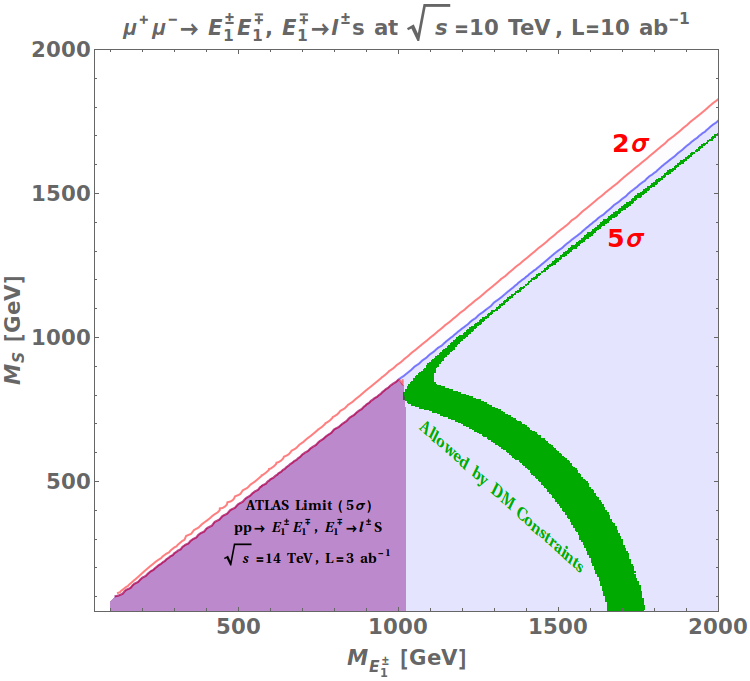
Figure 8: Same as Figure 7 but for (g−2)μ6 TeV, showing substantial expansion of the accessible mass range and near-total coverage of the cosmologically allowed parameter space.
Implications and Outlook
This analysis demonstrates that, in the minimal setup coupling scalar DM to the SM via fermion-portal mechanisms, the sterile scalar and heavy charged fermions can maintain phenomenological viability even under stringent direct-detection and flavor constraints. The continued relevance of t- and u-channel processes, and the enlarged allowed Yukawas, mean the fermion-portal region cannot be entirely excluded by non-collider experiments, unlike the pure Higgs-portal scenario.
Future high-energy muon colliders stand out for their ability to directly exclude or discover nearly the entire cosmologically and theoretically viable region of this model, in stark contrast to HL-LHC coverage. A non-observation would close this class of minimal scalar–vector-fermion DM scenarios over the relevant mass range. Conversely, discovery of dilepton plus missing energy signatures with electroweak quantum numbers would tightly correlate with possible dark matter observations, providing a concrete experimental link between terrestrial collider and astrophysical/cosmological data.
Conclusion
The minimal fermion-portal scalar dark matter model, supplemented by vector-like charged fermions, fully accommodates current theoretical and experimental constraints when Yukawa-driven annihilations and co-annihilations are included. The allowed parameter space is broad and robust against current constraints, but will be exhaustively probed by next-generation muon colliders. Theoretical implications include the necessity of extending Higgs-portal scalar DM theories to include alternative portals for relic generation, while phenomenologically, the synergy between collider and direct/indirect detection experiments offers a uniquely over-constraining scenario—critical for the future of dark matter searches.
Reference: "Probing Fermion-Portal Scalar Dark Matter through Charged Vector-Like Fermions at Future Muon Colliders" (2607.03775)

