Top Trading Cycles in Large Markets: The Asymptotic Irrelevance of Priorities
Abstract: Top Trading Cycles (TTC) is Pareto efficient and strategy-proof and explicitly uses agents' priorities. Although TTC favors higher-priority agents in each round, we show that this priority advantage vanishes as the market grows large under a canonical random model of preferences and priorities. In the limit, TTC produces assignments with virtually the same incidence of justified envy as Random Serial Dictatorship (RSD) -- a mechanism entirely blind to priorities. This stark asymptotic equivalence implies that TTC effectively fails to satisfy standard fairness criteria in large markets, casting significant doubt on its practical appeal for balancing efficiency and fairness.


Paper Prompts
Sign up for free to create and run prompts on this paper.
Top Community Prompts
Explain it Like I'm 14
Plain-English Guide to “Top Trading Cycles in Large Markets: The Asymptotic Irrelevance of Priorities”
What is this paper about?
This paper studies two ways to fairly give out indivisible things (like school seats) to people who want them. One way, called Top Trading Cycles (TTC), tries to be efficient and also respect “priorities” (for example, a student who lives close to a school might have higher priority for that school). Another way, Random Serial Dictatorship (RSD), ignores priorities and just picks a random order of people and lets them choose their favorite remaining option.
The main message: when the market is very large (lots of people and lots of seats), TTC ends up respecting priorities about as little as RSD does. In other words, TTC’s fairness advantage fades away as the market grows.
What questions are the authors asking?
- Does TTC actually do a much better job than RSD at respecting priorities and avoiding “justified envy” when the market is large?
- How does TTC use priorities round by round, and what happens to this use as the number of participants grows?
- Can we describe TTC’s behavior with a simple rule that helps us understand what happens in each round?
“Justified envy” here means: a person misses out on a seat even though they have a higher priority for that seat than the person who got it. That’s a standard way of measuring fairness in these settings.
How did they study it? (Methods made simple)
- Random large markets: Imagine many people and many seats. Everyone has a random ranking of which seats they like best, and each seat has a random priority order over people. This is a common way to test how systems behave “on average” when the market is big.
- Comparing two mechanisms:
- TTC: In each round, every person points to their favorite remaining seat, and every seat points to the highest-priority person still left. Whenever a loop (a cycle) forms—like A wants Seat 1, Seat 1 wants A—they make that trade and leave the market. This repeats until no one is left.
- RSD: Randomly order the people. The first person picks their top choice, then the second, and so on.
- Short vs. long cycles: A “short cycle” is a 2-step loop (a seat points to a person, and that person points right back to that seat). Short cycles force the seat to go to the highest-priority person—great for fairness. A “long cycle” is a loop with 3 or more steps (A uses priority at Seat 1 to get Seat 2, B uses priority at Seat 2 to get Seat 3, …). Long cycles don’t guarantee the final seat goes to someone with high priority for that particular seat—so they can create justified envy, much like RSD.
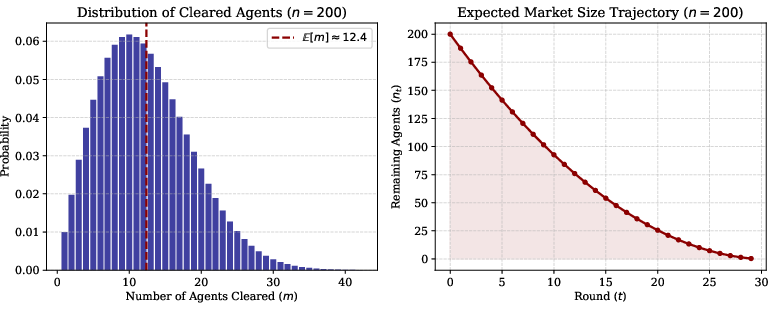
- A simple dynamic (Markov) description: The authors prove a “Markov property” for TTC. Think of it like this: in each round, the number of matches you make depends only on how many people and seats are left right now, not on the detailed past. This helps them calculate how many rounds TTC takes and how many short vs. long cycles happen as the market grows.
What did they find, and why is it important?
- In big markets, TTC mostly makes matches through long cycles, not short ones. The fraction of short cycles shrinks to zero.
- Because short cycles are the only times TTC truly enforces priorities for a seat, the fading of short cycles means TTC stops delivering extra fairness. It behaves more and more like RSD in terms of who gets seats relative to their priority.
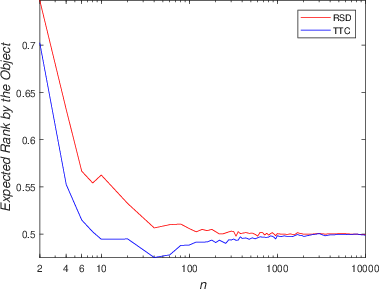
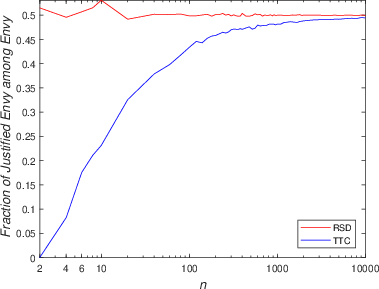
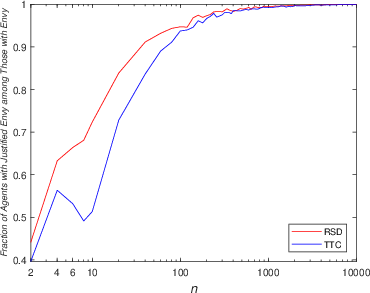
- Specifically, the share of “justified envy” under TTC becomes almost the same as under RSD when the market is large. Also, the “priority ranks” of the winners (how high they were in a seat’s priority list) look basically the same under TTC and RSD.
- The authors also show TTC finishes in fewer than “linear” rounds as the market grows (it doesn’t take proportionally more rounds) and that the expected number of short (2-step) cycles per round never exceeds two. Put together, that’s why the share of short cycles—and thus TTC’s fairness edge—vanishes.
- Policy takeaway: If you are assigning thousands of students to schools, using TTC won’t significantly reduce justified envy compared to RSD. TTC is still efficient and strategy-proof, but it won’t give you much extra fairness when the market is large.
What does this mean in the real world?
- School choice and similar systems often care about both efficiency (don’t waste seats) and fairness (respect priorities). TTC was attractive because it uses priorities in each round. But this paper shows that in large markets, TTC’s fairness edge is tiny or nonexistent compared to RSD.
- RSD is simpler and has an “obviously strategy-proof” version (people just pick in turn), which can be easier for families to understand. If TTC doesn’t add fairness in big markets, its practical advantage gets weaker.
- Important nuance: In smaller markets, TTC can still beat RSD on fairness. Also, in settings with many seats of the same type (for example, a few schools each with many identical seats) or with special patterns in preferences, TTC may do better than it does under the paper’s random model. So the result is strongest for large, “random-like” markets with many distinct seats and people.
In simple terms: TTC is great in theory because it uses priorities. But as the crowd gets big, the way TTC actually matches people makes those priorities matter less and less—so much so that TTC’s fairness looks a lot like RSD’s.