- The paper develops the Sequential Equilibrium Mechanism (SEM) that uses random prices in online matching to guide allocations, achieving greedy and asymptotically ordinal efficient results.
- SEM employs a two-stage design that integrates endogenous market equilibrium pricing and token-budgeted lotteries, ensuring equal-type envy-freeness and strategyproofness in large markets.
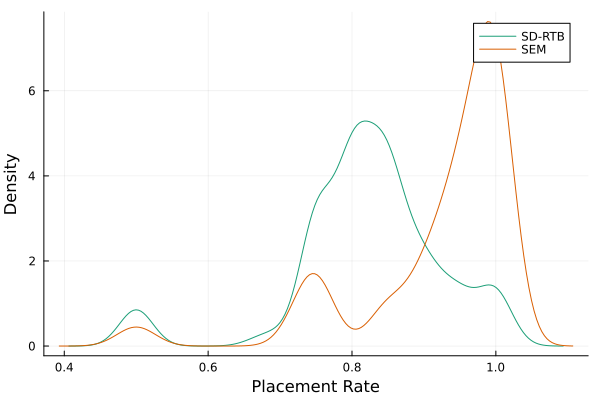
- Empirical evaluations show SEM improves agent placement by approximately 10% over baseline methods, while reducing allocation variance in dynamic, large-scale settings.
Efficient Online Matching with Prices: A Technical Essay on "How to Use Prices for Efficient Online Matching"
Problem Setting and Constraints
The paper "How to Use Prices for Efficient Online Matching" (2604.12181) studies a dynamic matching market where arrivals—agents needing to be matched—occur stochastically and must be allocated to objects immediately upon arrival (a greedy allocation constraint). Typical applications include allocating children to foster homes, patients to hospital rooms, or homeless individuals to shelters. The setting is further complicated by the assumption that agents have ordinal preferences (possibly with indifference) rather than cardinal utilities. These preferences are revealed upon arrival.
A critical impossibility result is highlighted early: no online matching mechanism can generically be both greedy (i.e., make an immediate optimal assignment given current information) and ordinally efficient in finite markets with indifferences. Thus, any reasonable mechanism must focus on approximate or asymptotic guarantees rather than pointwise optimality.
The Sequential Equilibrium Mechanism (SEM)
The core technical accomplishment is the development and analysis of the Sequential Equilibrium Mechanism (SEM), a randomized online matching algorithm leveraging large-market competitive equilibria to guide allocation, notably by computing and using random prices as rationing/priority signals.
Two-Stage Design
- Market Equilibrium Calculation: Each arriving cohort faces an endogenous, period-specific spot market, defined by the realized arrivals and the expected future demand profile. Prices are perturbed randomly to smooth out demand in the case of indifferences; agents are endowed with token budgets (which can be made asymmetric to prioritize earlier arrivals).
- Spot Market Resolution: SEM computes a random price vector, solves for a competitive equilibrium with token budgets, and determines allocations in the form of lotteries (i.e., agents receive probabilities over objects). Realized allocations (ex-post lotteries) are enacted immediately.
This mechanism maintains greediness by giving each agent a non-dominated lottery over their currently maximal (among available) objects, preserves equal-type envy-freeness (no envy among agents with the same arrival period), and is strategyproof in the large (incentives to misreport vanish as market size grows).
Existence and Efficiency of Equilibria
A nontrivial technical challenge is proving the existence of market-clearing prices in the presence of coarse preferences and indifferences. Individual demand correspondences become discontinuous at budget thresholds. By introducing random perturbations to prices (with suitable bounded, continuous noise), demand becomes upper hemicontinuous almost everywhere, allowing the use of Aumann integration and Kakutani’s fixed point theorem to guarantee the existence of price equilibria with the following properties:
- Greedy allocations: By scaling token budgets to prioritize earlier arrivals, one ensures that agents always exhaust their favorite objects before later agents can access them.
- Ordinal efficiency (asymptotically): Under certain assumptions—specifically, appropriate calibration of the tie-breaking noise—random prices remove the possibility of wasteful allocation, and lotteries converge to ordinally efficient outcomes in large markets.
This sensitivity to tie-breaking mechanisms is formalized: if price perturbations are perfectly correlated, there are no tie reversals; if noise is strong and independent, tie-breaking can be randomized without destroying efficiency, provided equilibrium prices are separated by more than twice the noise radius.
Asymptotic Properties and Theoretical Guarantees
SEM is proven to be asymptotically efficient and strategyproof with probability one as market size grows:
- Ordinal Efficiency: The ex-post allocation converges to an ordinally efficient assignment as the number of agents per period goes to infinity. This is shown by embedding the online problem in a sequence of replica markets and invoking the law of large numbers.
- Strategyproofness in the Large: An agent's influence on prices vanishes as the market grows, eliminating any incentive to misreport preferences strategically.
- Equal-Type Envy-Freeness: Within an arrival batch (type), no agent prefers another's lottery, although envy between cohorts can occur because of the greedy priority structure.
Moreover, these properties hold even as the model is extended to allow for fully online environments in which both objects and agents arrive stochastically, with the solution generalized via time-indexed Lindahl equilibria.
Empirical Evaluation
To evaluate the practical performance of SEM, the paper conducts controlled simulations motivated by a real-world child placement nonprofit. The current fielded mechanism resembles Serial Dictatorship with Random Tie Breaking (SD-RTB), which is used as a baseline.
SEM demonstrates robust improvement in empirical placement rates across a range of market sizes:
These improvements are attributed to the superior global rationing and anticipation of future arrivals embedded in SEM’s equilibrium-based allocation rules, as opposed to the myopic, tie-breaking randomness inherent in SD-RTB.
Positioning Relative to the Mechanism Design Literature
SEM advances the literature on pseudomarkets and online matching in three ways:
- Integration of pseudomarket techniques in an online (dynamic) allocation context with greedy constraints.
- Welfare evaluation under stochastic dominance (ordinal efficiency), rather than utilitarian or binary objectives.
- Construction of a mechanism satisfying greediness, asymptotic efficiency, equal-type envy-freeness, and strategyproofness for general ordinal preferences (including indifferences).
Notably, SEM generalizes and in some respects improves upon mechanisms such as Extended Probabilistic Serial (EPS), Approximate Competitive Equilibrium from Equal Incomes (ACEEI), and Competitive Equilibrium from Random Incomes (CERI), particularly by allowing for online implementation, dynamic arrival, and a broader preference domain.
Practical and Theoretical Implications
On the practical side, SEM is well-positioned for real-world deployment in high-stakes, immediate-allocation settings where agents have only ordinal information (with possible indifferences), and the scale of the market supports the large-market assumptions. Numerical results indicate potential for substantial welfare gains even outside of the asymptotic regime.
Theoretically, the existence proofs underpinning SEM suggest broad applicability of competitive equilibrium concepts—even under nonclassical preferences—to complex, online, and stochastic allocation environments. Additionally, the precise characterization of tie-breaking and regularity conditions invites further research into the relationship between market structure, algorithmic implementation, and allocation optimality. Open questions include equivalences between classes of pseudomarket and ordinal mechanisms (particularly with indifferences) and potential extensions to other types of dynamic matching settings.
Conclusion
This work rigorously develops and analyzes a Sequential Equilibrium Mechanism that harnesses random prices to achieve efficient, greedy, and fair online matching for agents with general ordinal preferences. The contribution bridges gaps between online matching algorithms and competitive equilibrium analysis, yielding a mechanism with favorable theoretical properties and encouraging simulated performance. The approach offers a compelling path forward for the design and deployment of allocation procedures where immediacy and fairness are critical and where preferences are naturally coarse or indeterminate.