FlowDAgger: Human-in-the-Loop Adaptation of Generative Robot Policies in Latent Space
Abstract: Pretrained generative robot policies based on flow matching and diffusion have achieved impressive results across a wide range of manipulation tasks. Yet real-world deployments routinely expose failure modes outside the pretraining distribution. Closing these gaps typically requires large-scale data collection or online reinforcement learning on physical hardware, which is impractical for rapid and safe adaptation. We present FlowDAgger, a sample- and compute-efficient method for adapting frozen generative robot policies from human interventions in latent space. Our key idea is action inversion: each human expert action is mapped to the noise that would have produced it under the frozen base policy, using reverse-time integration followed by local refinement. The resulting inverted noise provides supervision for a lightweight latent policy that steers the base model at deployment time, enabling rapid skill acquisition while preserving its behavioral priors. We evaluate FlowDAgger in simulation and on real-world bimanual and single-arm manipulation, adapting both action-head VLAs and world-action models from a handful of interventions. FlowDAgger outperforms supervised fine-tuning and latent-space RL baselines and preserves pretrained skills on held-out tasks, offering a practical path for adapting robot foundation models in the real world. Website: https://microsoft.github.io/FlowDAgger
Paper Prompts
Sign up for free to create and run prompts on this paper using GPT-5.
Top Community Prompts
Explain it Like I'm 14
FlowDAgger: A simple explanation for teens
1. What is this paper about?
Robots learn to do things like pick up objects or press buttons by watching lots of examples. Modern robot “brains” often use a special kind of generator that starts with random noise and turns it into an action, a bit like turning a random seed into a full image. These work well most of the time, but in the real world robots still fail on unusual objects or tricky situations.
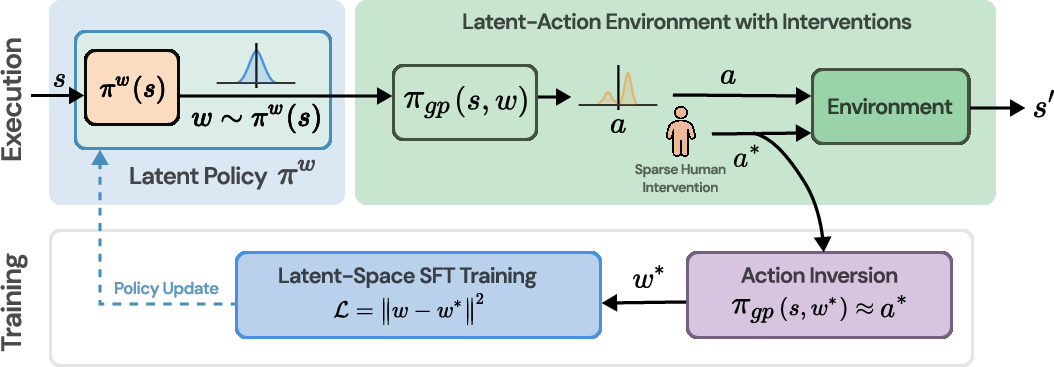
This paper introduces FlowDAgger, a way to quickly teach a robot new skills while it’s working, using small corrections from a human. The key trick: instead of changing the robot’s big, complex brain, FlowDAgger learns to “steer” it by choosing better noise inputs. It figures out which noise would have produced the human’s expert action, then trains a small helper to produce that kind of noise next time.
2. What questions are the researchers asking?
- How can we fix a robot’s mistakes in the real world quickly and safely, without retraining its huge model?
- Can we learn from a few human corrections instead of collecting tons of new data?
- Can we adapt the robot without breaking skills it already has?
- Will this work across different kinds of robot models and on real robots, not just in simulation?
3. How does FlowDAgger work? (Everyday explanation)
Think of the robot’s action maker like a recipe:
- It starts with a random “noise” vector (like rolling a bunch of dice).
- It follows a learned process that turns that noise into a movement (the action).
FlowDAgger adds two ideas.
- Action inversion: “Rewinding the recipe”
- When a human steps in and shows the correct action (say, the right arm motion), FlowDAgger tries to figure out which dice roll (noise vector) would have produced that action under the robot’s current process.
- It does this by carefully “rewinding” the steps the model normally uses to go from noise to action, fixing small mismatches at each step until the rewind lines up. You can think of it like retracing your route on a map backward, checking each turn so you end up at the exact starting point.
- The result is a matched pair: current situation (what the robot sees) and the “just-right” noise that would create the expert action.
- A tiny helper policy: “A smart noise picker”
- FlowDAgger trains a small and fast helper model that, given what the robot sees, predicts a good noise vector.
- At run time, instead of using random noise, the robot uses this predicted noise to steer the big model toward better actions—without changing the big model’s weights.
Why this is clever:
- Changing the big model is slow and can ruin other skills (like overwriting a game save). Steering it with better inputs keeps its original knowledge intact.
- Learning in “noise space” is lightweight and fast.
Works across model types:
- Some robot models create just actions (“action-head” models).
- Others generate both actions and future world frames together (“world-action models,” like predicting a short “video” of what will happen).
- FlowDAgger handles both by inverting the right kind of process: just the action part for action-head models, and the joint “video” process for world-action models, adjusting only what needs to change.
Practical training loop:
- The robot runs and a human only intervenes when needed.
- Each intervention is inverted to the right noise.
- The helper model learns from these pairs.
- Training mixes “good on its own” runs (to preserve old skills) with corrected runs (to learn new ones).
4. What did they find?
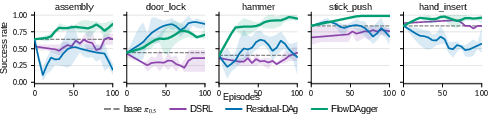
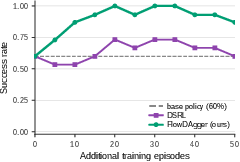
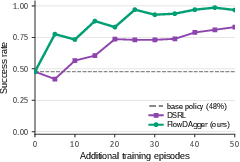
- Fewer corrections needed: FlowDAgger reached high success with only a handful of human interventions (often 5–20 episodes), both in simulation and on real robots.
- Better than common alternatives:
- It beat standard fine-tuning (which retrains the big model and can erase old skills).
- It beat “residual” fixes that add corrections directly to actions (those can push the robot into weird, unsafe actions).
- It beat a related method that learns in noise space using rewards only (no human corrections), because reward-only exploration can be slow and uncertain.
- Keeps old skills: Because the base model stays frozen and is only steered, the robot preserved strong abilities on tasks it already did well.
- Real-world wins: On tasks like Glassware Stacking, Wire Pull, and Toolbox Packing, FlowDAgger boosted success a lot. For example, Toolbox Packing jumped from 13% to 80% success with just 10 intervention episodes.
- Efficient to run: Training the small helper fits on a single consumer (gaming) GPU, making it practical outside big server farms.
- Works across model families: It helped both action-head models (like vision-language-action models) and world-action models that generate actions and future states together.
5. Why does this matter?
- Safer, faster updates: In the real world, robots face surprises all the time. FlowDAgger lets you fix them quickly without risky or expensive full retraining.
- Preserves “common sense”: It keeps the robot’s broad, useful skills while adding new ones, like updating a GPS route without deleting the map.
- Scales to many robots: Since it’s lightweight and only needs small bursts of human help, it’s practical for robot fleets in homes, factories, or hospitals.
- A new way to think about learning: Instead of rewriting a huge model, steer it smartly from the outside. This can make future robot “foundation models” easier to adapt, reuse, and trust.
In short, FlowDAgger shows that teaching robots can be more like guiding a skilled driver with a better steering signal than rebuilding the engine every time something new appears on the road.
Knowledge Gaps
Knowledge gaps, limitations, and open questions
Below is a concise list of concrete gaps and unresolved questions that future work could address to strengthen, generalize, or systematize FlowDAgger.
- Theory for inversion: Provide convergence guarantees and error bounds for the per-step fixed-point inversion under realistic assumptions (unknown Lipschitz constants, finite precision, non-smooth denoisers), and characterize non-uniqueness of solutions when multiple latents map to similar actions.
- WAM inversion analysis: Derive guarantees for the EDM-style joint inversion (including the terminal Adam solve), quantify its bias, and establish conditions under which the action-frame delta produces temporally consistent world predictions.
- Detecting out-of-support corrections: Develop diagnostics (e.g., inversion residuals, denoiser scores) that reliably flag when a human-provided action lies outside the base model’s support and should trigger alternate adaptation (e.g., weight-space fine-tuning or data collection).
- Multimodal action distributions: Design inversion and supervision strategies robust to multi-modality (e.g., selecting among multiple valid latents, maintaining action diversity, avoiding mode collapse in the noise policy).
- High-dimensional WAM steering: Systematically study basis design for joint-noise control (PCA vs learned dictionaries vs low-rank adapters), how to choose k, when to update the basis online, and the trade-off between expressivity and stability.
- Human intervention quality and coverage: Quantify and optimize the amount, timing, and form of expert input (latency, duration, precision) needed for reliable adaptation; incorporate trust weighting, de-noising of noisy corrections, and aggregation across multiple experts.
- Safety during adaptation and deployment: Integrate safety constraints (e.g., control barrier functions, action filters) with latent steering, and define certified procedures for safe learning when inversions are imperfect.
- Partial and delayed corrections: Handle corrections that cover only subparts of an action chunk or arrive with time delay; develop alignment procedures to map sparse or asynchronous interventions to appropriate latent targets.
- Perception/domain shift: Enable adaptation when observation encoders are miscalibrated or the visual domain changes (new cameras, lighting); study feature-level adapters or joint encoder–noise-policy updates without corrupting base skills.
- Long-horizon and language-conditioned tasks: Evaluate and augment FlowDAgger on tasks requiring memory, planning, or multi-step language following, including how to align corrections with instruction tokens and temporal abstractions.
- Non-ODE/black-box policies: Extend to generative policies that do not expose a velocity field (e.g., purely autoregressive transformers) or are accessible only via sampling APIs; investigate finite-difference, score-matching, or surrogate inversion methods.
- Real-time latency and usability: Measure end-to-end human-in-the-loop latency during intervention and inversion, characterize operator workload, and optimize batching or streaming mechanisms to meet tight control loops.
- Autonomous vs intervention buffer mixing: Provide principled schedules/weights for mixing autonomous and corrected samples, study their effect on prior preservation vs adaptation speed, and design curriculum strategies.
- Deterministic vs stochastic noise policies: Explore stochastic or uncertainty-aware noise policies to improve robustness and enable principled help-request policies (when to query a human).
- Hybrid supervision with rewards: Combine FlowDAgger with latent-space RL (e.g., DSRL) to refine between interventions; study switching criteria, off-policy reuse of inverted samples, and stability of joint objectives.
- Continual and multi-task adaptation: Address interference when aggregating corrections across many tasks over time; devise replay/buffer management and regularizers that preserve the prior while enabling continual improvement.
- Broader embodiment and task coverage: Test on higher-DOF hands, deformables, dynamic manipulation, force/impedance control, and unstructured environments to probe limits of latent steering.
- Evaluation fairness and breadth: Normalize comparisons by human time/effort (not just episode counts), include preference-based RL/RLHF and conservative action-space steering baselines, and expand seeds and tasks for stronger statistical confidence.
- Reliability/abstention signals: Use inversion errors or denoiser/score magnitudes as uncertainty estimates to trigger human takeover or conservative fallbacks; calibrate thresholds and measure false alarms.
- Non-stationarity and drift: Detect environment or task drift, decide when to retire outdated corrections, and design buffer pruning or weighting schemes that maintain relevance over time.
- Coordinated multi-arm control: Formalize noise-policy architectures and constraints for coupled arms, ensuring coordination and collision avoidance; define inversion targets that capture inter-arm dependencies.
- Discrete or hybrid action spaces: Extend inversion and steering to discrete skills/options and mixed discrete–continuous actions, including credit assignment across categorical decisions.
- Privacy/IP and deployment constraints: Enable adaptation when the base model is proprietary (limited introspection) or must remain on-robot (federated/edge settings); study communication-efficient inversion/learning.
- Reproducibility and benchmarks: Release standardized human-in-the-loop adaptation benchmarks (with logged interventions and timing) and code to facilitate systematic comparison across methods and model families.
Practical Applications
Immediate Applications
The following opportunities can be deployed now using the paper’s method, results, and tooling direction. Each item names a concrete use case, sector, plausible tools/workflows, and key dependencies or assumptions.
Manufacturing and Assembly
- Rapid line changeover adaptation for robot arms when SKUs or fixtures change mid-shift
- Sector: Manufacturing
- Tools/Workflows: FlowDAgger adapter wrapped around a frozen VLA/WAM; human operator provides a handful of in-situ corrections via a teach pendant or teleop UI; on-device training of a small noise policy on a consumer GPU; rollout buffer with intervention + autonomous noise logs
- Assumptions/Dependencies: Base policy is diffusion/flow ODE-accessible; access to vθ forward passes; intervention UI; safety interlocks; changes are within base policy’s behavioral support
- Recovering from long-tail failures (e.g., tolerance stack-ups, part variance, tool wear) without retraining the foundation model
- Sector: Manufacturing
- Tools/Workflows: DAgger-like human-in-the-loop loop with latent inversion; versioned latent adapters per workstation; A/B testing harness for prior-preservation checks on held-out tasks
- Assumptions/Dependencies: Local GPU (~8–10 GB VRAM) available; telemetry and rollback; curated held-out regression suite
Warehousing and Logistics
- Adapting grasp-and-place policies to new packaging, dunnage, or pallet configurations in minutes
- Sector: Logistics
- Tools/Workflows: Fleet-wide deployment of a “latent adapter” artifact per site; ROS 2/MoveIt wrapper that swaps Gaussian noise for πw(s); operator-triggered interventions during low-confidence events
- Assumptions/Dependencies: Access to base model I/O; stable cameras; feasible latency budget for online inversion (K·M forward passes)
- Seasonal SKU onboarding with minimal demonstrations
- Sector: Retail fulfillment
- Tools/Workflows: Cloud catalog of adapters keyed by SKU/facility; auto-anchoring of πw using autonomous buffer to preserve prior skills
- Assumptions/Dependencies: SKU differences are not far outside pretrained manifold; governance for sharing adapters across facilities
Field Service, Inspection, and Utilities
- On-site adaptation to new panel layouts, valves, or gauges during commissioning
- Sector: Energy, Utilities
- Tools/Workflows: Tablet-based intervention UI; offline safety validation via held-out tasks; per-task adapters that can be hot-swapped
- Assumptions/Dependencies: Reliable observation stack; safety case requires unchanged base weights plus audit logs of interventions
- Remote teleoperation “assist mode” where a few corrective actions teach repeatable routines
- Sector: Infrastructure inspection, Offshore
- Tools/Workflows: Shared autonomy mode with intervention gating; latent-policy regression on inverted corrections; bandwidth-friendly since base weights stay frozen
- Assumptions/Dependencies: Latency tolerant tasks; secure teleop link; operator skill
Healthcare and Hospitals
- Service robots adapting to new carts, room clutter, or ward-specific layouts with clinician corrections
- Sector: Healthcare
- Tools/Workflows: Clinician-facing minimal UI for corrective nudge actions; prior-preservation checks on safety-critical maneuvers; on-device training for PHI minimization
- Assumptions/Dependencies: Strict safety gating; privacy-preserving logging; tasks remain within base behavioral prior
Hospitality and Retail
- Back-of-house manipulation (dishware, utensils) adaptation across venues without costly re-training
- Sector: Hospitality, QSR
- Tools/Workflows: Venue-specific latent adapters; operator-led short calibration sessions; centralized monitoring of adapter drift
- Assumptions/Dependencies: Stable sensing; adapter version control; union with existing HRI protocols
Robotics Vendors, Integrators, and Software Platforms
- OEM “adapter SDK” for customers to customize foundation policies without fine-tuning
- Sector: Robotics software, OEMs
- Tools/Workflows: SDK exposing action inversion APIs for supported models (flow/diffusion ODEs and WAMs); ROS 2 package; Isaac Sim/Gazebo plugin to collect corrections in sim and deploy on real
- Assumptions/Dependencies: Vendor exposes sampler velocity field; licensing allows adapter distribution; model-card guidance on supported regimes
- Fleet orchestration with adapter lifecycle management
- Sector: Cloud robotics
- Tools/Workflows: CI/CD for latent adapters; automated prior-preservation tests; telemetry dashboards for intervention rates and success KPIs
- Assumptions/Dependencies: MLOps for artifact tracking; standardized eval suites; rollback mechanisms
Academia and Research
- Sample-efficient adaptation benchmark suites and ablations on latent-space learning vs action/weight-space
- Sector: Academia
- Tools/Workflows: Open-source implementations of per-step fixed-point inversion; datasets of (s, w*) pairs; reproducible HW footprint experiments
- Assumptions/Dependencies: Access to base checkpoints; standardized tasks (MetaWorld, LIBERO, RoboMimic)
- Studying human correction strategies and UI design under latent-space supervision
- Sector: HRI research
- Tools/Workflows: Intervention UIs with timing, effort, and outcome logging; trust-weighted sampling to balance intervention and autonomous buffers
- Assumptions/Dependencies: IRB-approved user studies; consistent expert policies
Policy, Governance, and Compliance
- Safer adaptation pathways that preserve pretrained capabilities and simplify recertification
- Sector: Policy, Safety engineering
- Tools/Workflows: Change-control processes documenting that only a small noise policy changed; audit trails of interventions and held-out regressions
- Assumptions/Dependencies: Regulators accept “frozen base + adapter” safety argumentation; robust logging
Daily Life and Assistive Tech
- Home robots quickly learning user-specific placements or appliances with a few corrective nudges
- Sector: Consumer robotics, Assistive devices
- Tools/Workflows: Mobile app for corrections; on-device adapter training on consumer GPU/NPU; parental controls and safety caps on action space
- Assumptions/Dependencies: Household variance within base model support; low-latency local compute; accessible UI
Long-Term Applications
These opportunities require further research, scaling, integration, or standardization before broad deployment.
Cross-Embodiment and Cross-Domain Transfer
- Adapter portability across robot types by learning embodiment-conditioned πw(s, e)
- Sectors: Robotics OEMs, Integrators
- Tools/Workflows: Embodiment descriptors; meta-learning over adapters; shared adapter marketplaces
- Assumptions/Dependencies: Consistent observation/action abstractions; diverse multi-robot pretraining
Crowdsourced and Federated Adaptation
- Privacy-preserving federated learning of latent adapters from many sites
- Sectors: Logistics, Healthcare, Manufacturing
- Tools/Workflows: Secure aggregation of adapter gradients or PCA-basis coefficients; bias and drift detection
- Assumptions/Dependencies: Legal frameworks for data sharing; robustness to heterogeneous corrections
Safety Alignment and Multi-Modal Supervision
- Combining latent corrections with reward shaping, preferences, or language/gesture guidance
- Sectors: Safety-critical robotics, HRI
- Tools/Workflows: RLHF-style pipelines for robotics where inverted (s, w*) pairs seed exploration; multi-modal correction fusion (voice, gaze, VR cues)
- Assumptions/Dependencies: Reliable preference signal; methods to reconcile conflicting modalities
Standards and Certification for Latent-Space Control
- Industry standards for exposing a “latent control interface” on robot foundation models
- Sectors: Standards bodies, Regulators
- Tools/Workflows: API specifications for noise-space steering and inversion hooks; compliance tests for prior preservation
- Assumptions/Dependencies: Vendor cooperation; consensus on safety metrics and test suites
Simulation-to-Real and Synthetic Experts
- Pre-generating adapters in high-fidelity simulation via scripted or optimal-control “experts”
- Sectors: Robotics platforms, Defense, Space
- Tools/Workflows: Sim-native action inversion; domain randomization; automatic adapter selection on deployment
- Assumptions/Dependencies: High sim2real fidelity; coverage of real-world edge cases
Autonomous Intervention Triggers and Self-Healing
- On-policy detectors that trigger minimal human corrections and update adapters online
- Sectors: Industrial robotics, Field robotics
- Tools/Workflows: Uncertainty estimators and anomaly detection tied to adapter update cadence; safety envelopes around latent outputs
- Assumptions/Dependencies: Reliable uncertainty calibration; safe fallback behaviors
World-Action Model Extensions at Scale
- Joint-latent steering for long-horizon planning and multi-agent settings
- Sectors: Warehousing (multi-robot), Construction, Agriculture
- Tools/Workflows: Basis or low-rank parameterizations for high-D joint latents; structured priors; multi-robot coordination via shared latent goals
- Assumptions/Dependencies: Efficient inversion for large WAMs; communication protocols
Hardware and Edge Acceleration
- On-robot accelerators and compilers for inversion and adapter training
- Sectors: Edge AI, Robotics hardware
- Tools/Workflows: Kernel-level optimizations for per-step fixed-point inversion; quantized denoisers; NPU offload
- Assumptions/Dependencies: Vendor toolchains; acceptable accuracy under quantization
Governance, Liability, and Workforce Enablement
- Certification frameworks and workforce upskilling for “adapter engineers”
- Sectors: Policy, Education
- Tools/Workflows: Curricula for safe human-in-the-loop adaptation; liability models distinguishing base vs adapter changes
- Assumptions/Dependencies: Regulatory clarity; standardized documentation and audit norms
Notes on Feasibility and Dependencies
- Model requirements: Base policy must be a generative flow/diffusion policy exposing an ODE or equivalent probability-flow with accessible velocity field; WAMs require joint-process inversion support.
- Coverage limits: Adaptation capacity is bounded by base model support; behaviors far outside the pretrained manifold may require weight-space fine-tuning or new data.
- Human factors: Quality and consistency of interventions matter; UIs and safety gates are critical for usable workflows.
- Compute and latency: Consumer GPU suffices for typical action-head VLAs; high-D WAMs may need basis parameterization and occasional autograd at terminal denoise.
- IP, licensing, and privacy: Adapter distribution may be constrained by model licenses; healthcare/consumer settings require privacy-preserving logging and on-device training.
- Safety and validation: Prior preservation should be continuously verified on held-out tasks; maintain rollback plans and detailed audit logs of interventions and adapter versions.
Glossary
- Action inversion: A procedure that maps a corrective action back to the latent noise that would produce it under a frozen generative policy. "Our key idea is action inversion: each human expert action is mapped to the noise that would have produced it under the frozen base policy, using reverse-time integration followed by local refinement."
- Action manifold: The set of actions the pretrained model can represent or reliably produce. "if a desired behavior lies far outside the policy's action manifold"
- Behavioral priors: Learned regularities and tendencies encoded by a pretrained model that guide its behavior across tasks. "these policies encode broad behavioral priors that transfer surprisingly well across embodiments and tasks."
- Bimanual manipulation: Robotic manipulation involving two arms cooperating on a task. "real-world bimanual and single-arm manipulation"
- Classifier-free guidance: A diffusion-model technique that adjusts generation without an explicit classifier by modulating conditioning strength. "null-text inversion~\citep{mokady2023nulltext} improves fidelity under classifier-free guidance;"
- Covariate shift: A mismatch between the training distribution and the states induced by the deployed policy, leading to errors at test time. "DAgger~\citep{ross2011dagger} introduced on-policy corrective supervision to address covariate shift in behavioral cloning"
- DAgger: An on-policy imitation learning algorithm that aggregates expert corrections collected during deployment to combat covariate shift. "DAgger~\citep{ross2011dagger} introduced on-policy corrective supervision to address covariate shift in behavioral cloning"
- DDIM inversion: A method for recovering the initial latent that deterministically generates a sample under DDIM sampling. "DDIM inversion~\citep{song2021ddim} recovers the deterministic latent for a diffusion sample;"
- DCT-II polynomial basis: A compact trajectory parameterization using Discrete Cosine Transform type II basis functions. "we project noise onto a DCT-II polynomial basis (-dimensional effective action space)."
- Denoiser: The neural network in diffusion models that maps noisy latents toward cleaner (less noisy) latents at a given noise level. "The forward sampler decodes this whole tensor with a shared denoiser,"
- EDM-style schedule: A diffusion noise scheduling scheme from Elucidated Diffusion Models that uses sigma levels, often ending at nonzero noise. "Cosmos-Policy uses an EDM-style schedule rather than a flow-matching ODE;"
- Euler discretization: A numerical method that approximates ODE integration by stepping forward using the current derivative value. "In practice, the map is evaluated with a -step Euler discretization of step size ."
- Fixed-point iteration: An iterative method to solve equations of the form x = f(x) by repeatedly applying f until convergence. "which we solve by fixed-point iteration:"
- Flow matching: A generative modeling approach that learns a continuous-time velocity field to transport noise to data via an ODE. "Flow matching~\citep{lipman2023flow}, a closely related approach, underlies recent VLAs"
- Foundation models: Large, broadly trained models whose capabilities transfer across tasks and settings. "Foundation models for robot manipulation have achieved impressive results"
- Generative robot policies: Policies that synthesize actions by transforming random noise through a learned generative process conditioned on observations. "Pretrained generative robot policies based on flow matching and diffusion have achieved impressive results"
- Human-in-the-loop: A setting where a human provides interventions or supervision during deployment or learning. "Human-in-the-Loop"
- Latent-space reinforcement learning: RL that learns control signals in a model’s latent/noise space rather than directly in the action space. "Latent-space reinforcement learning, exemplified by DSRL~\citep{wagenmaker2025dsrl}, instead trains a lightweight controller in the policy's noise space."
- Latent video sequence: A temporal latent representation that decodes into a sequence of future states and actions (e.g., in world-action models). "as slices of a single latent video sequence"
- Lipschitz constant: A bound L such that a function’s output does not change faster than L times the change in input; used to guarantee contraction. "( the Lipschitz constant of in its first argument)"
- Noise policy: A learned module that outputs latent noise vectors to steer a frozen generative base policy at inference time. "FlowDAgger adapts the base policy through a small noise policy "
- Null-text inversion: An inversion method for diffusion models that accounts for classifier-free guidance by using a null (empty) text condition. "null-text inversion~\citep{mokady2023nulltext} improves fidelity under classifier-free guidance;"
- Probability-flow ODE: The deterministic ODE whose trajectories correspond to the diffusion model’s marginals, enabling ODE-based sampling. "the latter's reverse process admits an equivalent probability-flow ODE."
- Residual policy learning: Learning an additive correction on top of a base policy to refine behavior without replacing the base. "Building on residual policy learning~\citep{silver2018residual, johannink2018residualreinforcementlearningrobot}, residual DAgger~\citep{xu2025crdagger, jiang2024transic} keeps the base policy frozen and learns an additive action-space correction"
- Reverse-time integration: Running the generative dynamics backward in time to infer the latent that would generate a given sample. "using reverse-time integration followed by local refinement."
- Shared autonomy: A deployment mode where control is blended between autonomous policy and human operator. "extend this paradigm with shared-autonomy deployment"
- Vision-language-action (VLA) model: A model that conditions on visual and language inputs to generate robot actions. "vision-language-action (VLA) models~\citep{intelligence2025pi05, nvidia2025groot}"
- Visuomotor diffusion policy: A diffusion-based policy that maps visual observations to motor action sequences. "Building on the visuomotor diffusion policy~\citep{chi2023diffusion}"
- World-action model (WAM): A model that jointly generates future world states and actions within a single latent process. "world-action models (WAM)~\citep{kim2026cosmospolicy, ye2026dreamzero,hou2026world}"
Collections
Sign up for free to add this paper to one or more collections.