- The paper introduces a novel all-optical phase shifter that utilizes optomechanical gradient forces in suspended subwavelength-grating slot waveguides.
- Experimental results report π phase shifts with pump powers as low as 60 μW, an insertion loss of ≈1.4 dB, and a device length of 178.6 μm.
- The design eliminates the need for electrical contacts, supports broadband operation, and is compatible with scalable quantum and reconfigurable photonic systems.
Broadband All-Optical Silicon Photonic Phase Shifters Driven by Gradient Optical Forces
Introduction and Background
The manuscript "Broadband silicon photonic phase shifters driven by gradient optical forces" (2607.08558) introduces and experimentally validates a new architecture for broadband all-optical phase shifters in silicon photonics. Distinct from prevailing strategies based on thermo-optic, free-carrier, or MEMS actuation, the demonstrated approach employs optomechanical gradient forces arising from guided optical modes in suspended subwavelength-grating slot waveguides (SWGSWs). This enables phase shifts without electrical access to the active region, no Kramers–Kronig absorption penalty, and minimal static power dissipation. The integration is inherently compatible with cryogenic quantum platforms, as there are no local electrical heaters or contacts which form parasitic thermal paths.
Reconfigurability in silicon photonics underpins applications such as programmable interferometric meshes, photonic neuromorphic networks, quantum photonic circuits, and multiplexed sensors. Most current systems rely on electronically controlled phase shifters, which induce complexity in scaling, energy dissipation, thermal crosstalk, bandwidth bottlenecks, and incompatibility with low-temperature operation. All-optical phase shifting can remove these constraints, but prior routes suffer from large static or dynamic power demands, nonlinear or absorption-induced losses, or narrow resonant bandwidths.
Device Design: Suspended Subwavelength-Grating Slot Waveguide Architecture
The core innovation is the suspended SWGSW, attached on both sides by a distributed array of guided folded cantilever springs (GFCSs) that provide independent control of the total in-plane mechanical spring constant k and the device length L. The slot width s0 between waveguide halves is a critical geometric parameter: it sets the optical field confinement, optomechanical force, and propagation loss.
When light propagates in the SWGSW, evanescent field overlap between the two silicon rails generates strong gradient forces, exponentially sensitive to s0. The guided optical power P thus results in transverse mechanical motion that reduces s, increasing the effective refractive index neff and imparting a phase shift Δφ on any co-propagating signal. The device supports broadband operation, as the actuation is geometric and does not rely on narrow-band resonances.
The device comprises a sequence of (i) rectangular-to-slot waveguide adiabatic couplers, (ii) slot waveguide-to-SWGSW transitions, and (iii) a central slot-guided, SWGSW section bounded by periodic tethers. This architecture removes the need for fragile discrete tethers and allows for simultaneous mechanical compliance, low loss, and robust fabrication.
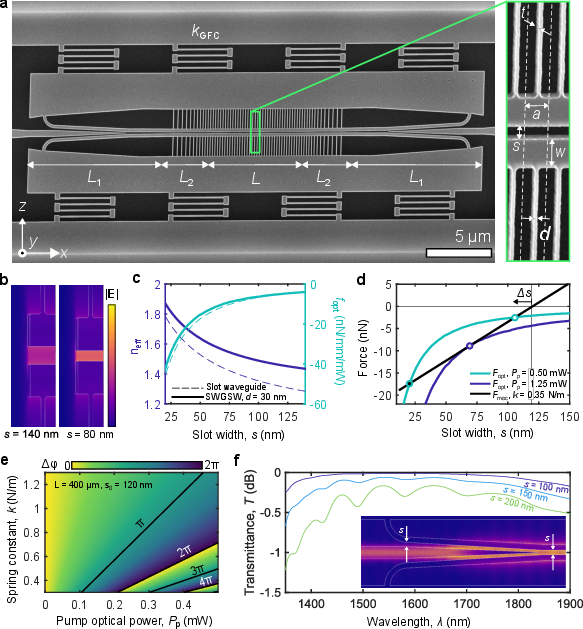
Figure 1: Optomechanical phase shifter based on a suspended subwavelength-grating slot waveguide with integrated adiabatic couplers and distributed mechanical springs.
A lumped force-equilibrium model is developed, exploiting the decoupling of device length L and spring constant k permitted by the GFCS architecture. For a given pump optical power L0, slot width L1, and spring constant L2, the equilibrium displacement and the resulting phase shift L3 are found by solving:
L4
Here, L5 is the gradient force per unit length and power, numerically obtained via Maxwell stress tensor integration, scaling biexponentially with decreasing L6. The half-wave power L7 required to achieve a L8 phase shift is, thus, an explicit function of L9, s00, s01, and the propagation loss s02.
Key findings:
- Experimental s03 values as low as 60 μW for a 178.6 μm-long device, with insertion loss of ≈1.4 dB.
- The power–length product s04 depends primarily on s05, not s06, provided s07 is held fixed—implying highly efficient scaling to short devices.
- The smallest fabricable s08 sets the ultimate limit, constrained by collapse during release and surface forces (e.g., Casimir, capillarity, electrostatics).
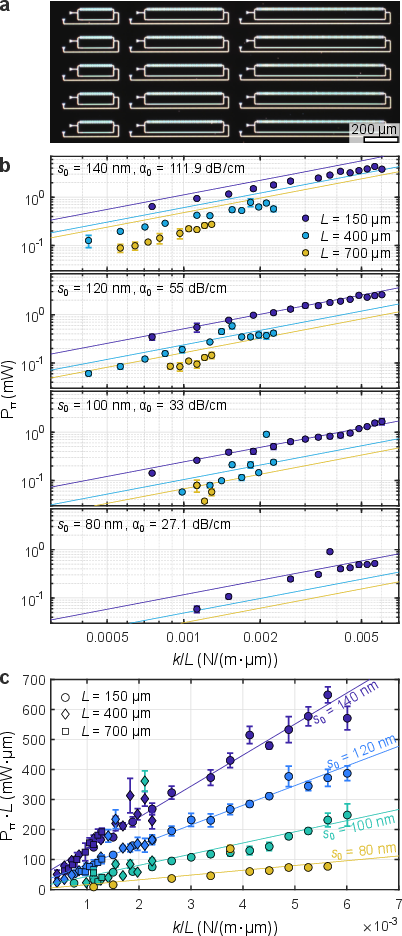
Figure 2: Measured s09 as a function of s00, s01, and s02. Theoretical fits (solid lines) demonstrate excellent agreement across the parameter space.
Optical Characterization
Characterization employed chip-scale unbalanced Mach-Zehnder interferometers (UMZI) with the SWGSW phase shifter in one arm, using cross-polarized grating couplers for input/output and broadband illumination. The optical response is monitored spectroscopically as a function of pump power and wavelength. The phase shift is extracted from fringe movement and fitted to the model, allowing the determination of s03 directly at the SWGSW input.
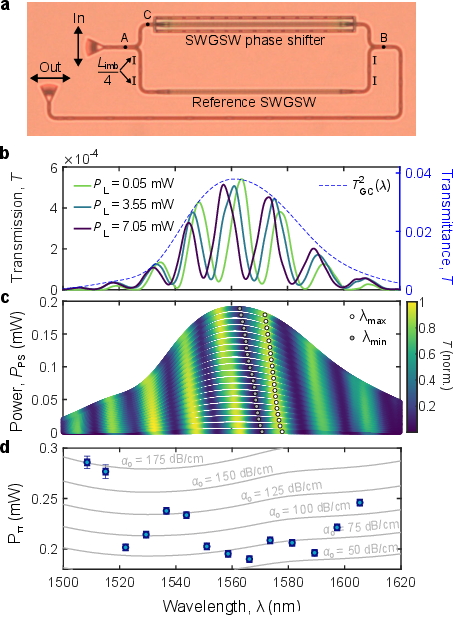
Figure 3: UMZI implementation with SWGSW in one arm; measured transmission spectra show clear power-dependent phase shifts and match model predictions under various loss assumptions.
Pump-Probe and Dynamic Response
Pump-probe experiments demonstrate independent phase control: a strong pump at 1560 nm modulates the refractive index profile, shifting the phase accrued by a weaker co-propagating signal at a distinct wavelength. The measured s04 in probe measurements matches that for the pump-only case, affirming broadband and wavelength-scale invariance of the underlying mechanism.
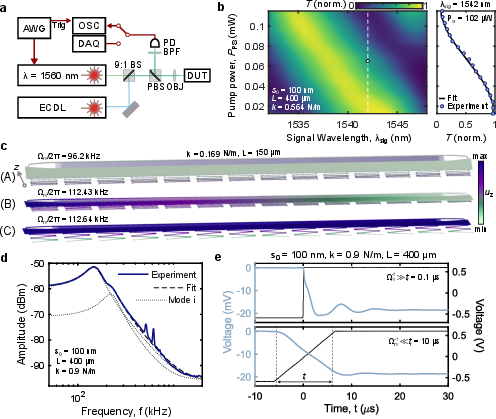
Figure 4: Schematic of pump-probe set-up and normalized probe transmittance as a function of probe wavelength and on-chip pump power, showing clear phase modulation validity for multi-wavelength co-propagation.
Dynamically, the switching speed is set by the mechanical resonance (s05 kHz, s06 at ambient), leading to microsecond-scale response. The measured ringdown times and frequency agree with FEM and lumped-mass predictions within 5–10% (accounting for reduced Young's modulus in thin silicon). In vacuum or at cryogenic temperatures, ringing increases; deterministic switching then requires adiabatic drive profiles matching the higher Q.
Theoretical and Practical Implications
This work delivers a compelling optomechanical alternative to conventional electrically controlled or nonlinear phase shifters. Notably:
- No electrical contacts: Eliminates parasitic optical absorption, RC limitations, and thermal crosstalk, benefiting both high-density classical circuits and quantum circuits where thermal load is critical.
- Ultra-low static power consumption: Static actuation is virtually passive; only optical pump dissipation remains, which is in the tens of microwatts regime.
- Intrinsic broadband operation: Limiting bandwidth in practice arises only from auxiliary coupler losses, not from the phase shifter itself; no wavelength/phase locking or cavity resonance tuning is required.
- Scalability: Optical demultiplexing allows for large arrays with minimal routing overhead—a major challenge for electrical approaches. WDM concepts can be realized all-optically within the same platform.
- Material transferability: Since actuation is geometric, the mechanism translates to other platforms (e.g., SiN, GaAs, diamond) without requiring specific electro-optic or thermo-optic coefficients.
Comparison to Alternative Approaches and Future Directions
While state-of-the-art MEMS/NEMS phase shifters still achieve marginally lower insertion loss (<0.3 dB [edinger_silicon_2021]), the demonstrated optomechanical shifters now approach these figures, with simulations indicating that further improvements in coupler design and slot/tether width should enable similar or better performance.
Potential future research avenues include:
- Mechanical engineering: Adopting truss or perforated platforms for higher mechanical resonance frequencies and reduced mass, targeting sub-microsecond switching for applications in photonic FPGAs and neural accelerators.
- Integration with quantum photonics: Implementation in cryogenic environments for deterministic quantum state routing [gritsch_optical_2025]. Compatibility with low-loss quantum photonic architectures is uniquely advantageous due to the total absence of local heaters or doped regions.
- Higher-order/cascaded devices: Integration in dense meshes for universal linear optics (ONNs, programmable processors) and multi-degree-of-freedom control.
- All-optical scaling: WDM schemes for many-way control using shared optical fibers and on-chip demux systems, as well as support for entangled photon operations and routing.
- Robust fabrication: Pushing the collapse boundary to smaller feature sizes for even lower s07 and propagation losses, possibly assisted by new post-fabrication self-assembly or stabilization strategies [babar_self-assembled_2023].
Conclusion
This work establishes a novel paradigm for all-optical broadband phase shifting in silicon photonics, using suspended SWGSWs actuated by gradient optical forces. The experimentally validated performance—sub-100 μW s08, <1.5 dB insertion loss, broadband operation—coupled with clear scalability and material generality, positions this approach as competitive or superior to the mainstream electro-optic and MEMS-based counterparts for a large range of applications, from classical reconfigurable photonics to quantum information processing. The elimination of electrical routing and the scaling of all-optical control to large arrays without added overhead constitute particularly significant advantages for future high-density programmable and quantum photonic systems.

