Who Needs DRAM? We Have Fiber
Abstract: The rising pressure on DRAM availability and contract pricing reflects generative AI's massive high-performance memory requirements. This pressure is heavily compounded by hyperscale data center expansion, which now consumes a significant portion of global DRAM output. In this work, we propose a new architecture: Fiber Memory, which reimagines the role of optical fiber in a hyperscale data center, deploying it as an active, recirculating delay-line memory for immutable data, such as LLM weights. We present a data-parallel optical broadcast delay-line memory architecture that accounts for fiber's physical realities. By incorporating space-division multiplexed multi-core fibers (MCFs), passive optical tap-and-amplify interfaces, co-packaged optics (CPO), and regional all-optical regeneration, our case study evaluation demonstrates that Fiber Memory can eliminate redundant weight storage across 10,000 AI accelerators and reduce weight-delivery energy by over 70% compared to traditional HBM3e configurations.

Paper Prompts
Sign up for free to create and run prompts on this paper using GPT-5.
Top Community Prompts
Explain it Like I'm 14
What this paper is about
This paper proposes a bold idea for speeding up and saving energy in big data centers that run LLMs, like the ones behind chatbots. Instead of storing the same huge set of model “weights” (the fixed numbers the model uses to think) on every computer’s local memory chips (DRAM/HBM), the authors suggest using the data center’s fiber-optic cables as a kind of moving memory. Think of it like putting the model’s weights on a high-speed “data conveyor belt” made of light. Every computer can take the pieces it needs as they flow by, so you don’t have to make thousands of copies of the same data.
The paper’s main goals
To make the idea easy to follow, here are the authors’ key objectives explained simply:
- Show that fiber-optic cables already in data centers can act like fast, looping storage for the model’s fixed weights.
- Design an optical network that can broadcast those weights to many machines at once, without constantly converting light to electricity and back.
- Explain how to format and time the data so AI chips can use it directly, and compare the energy, speed, and delays to today’s memory systems.
How the approach works (in everyday terms)
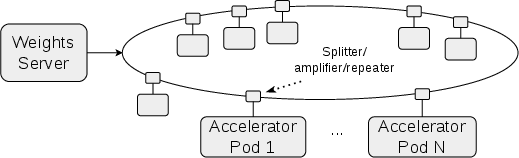
Picture a theme-park ride that loops around and around. Now imagine the model’s weights are riding that loop as pulses of light inside fiber-optic cables. This loop is called a “delay-line memory” because the data is stored while it’s traveling; it comes back around if you missed it.
Here are the main pieces of the system and simple analogies:
- The fiber loop: A very long coil of fiber (about 1,000 km in the example) acts like a moving sidewalk for data. Light travels through fiber at roughly two-thirds the speed of light in a vacuum, so it takes a few milliseconds to go around the loop. That “in-flight” time is enough to hold a lot of data at once.
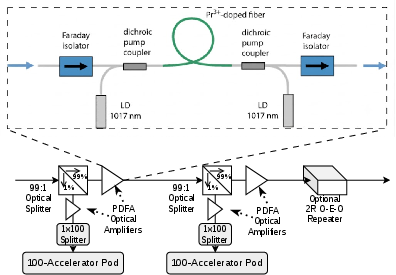
- Broadcast and tap: Instead of sending separate copies to every machine, the system broadcasts one stream that passes by all of them. Each machine uses a tiny “tap” (like taking a sip from a passing water pipe) to grab a small portion of the light and read the data, while most of the signal keeps flowing down the line.
- Multi-core fiber: These are fiber cables with many parallel “lanes” inside one jacket. It’s like a multi-lane highway that carries more streams side by side, without needing lots of separate cables.
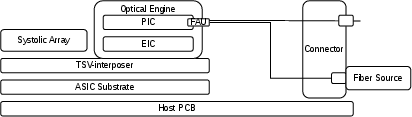
- Co-packaged optics: The light-reading parts are placed right next to the computing chips, so the weights can go straight into the chip’s math units without stopping in regular memory. Think of the data stepping off the moving sidewalk directly into the factory machines.
- Data packets and timing: The weights are sent as well-organized packets that include a short “preamble” (to help the receiver lock onto the signal), a small header (what layer it belongs to and scaling information), the weight numbers themselves, and a check for errors. The system also leaves small empty gaps in the stream—like spaces between train cars—so computers can catch up if they’re briefly busy and don’t miss the next packet.
- Amplifiers and regenerators: As light travels, it weakens and picks up noise. Special optical amplifiers strengthen the signal without turning it into electrical signals first. Occasional “regenerators” clean up the shape of the signal so it stays readable around the loop.
What they tested and found
To make the idea concrete, the authors analyze a case where a 70-billion-parameter LLM (Llama‑3‑70B) is used by 10,000 AI accelerators (special chips for AI math).
The following list summarizes the key results and why they matter:
- Fiber as moving storage: A 1,000 km fiber loop running many parallel channels can hold about 128 GB of data “in flight” at any moment. That’s enough to carry the 70 GB of model weights plus extra room for timing gaps or duplicates.
- Speed into each chip: Each accelerator can receive about 3.2 TB/s of weight data directly from the fiber. That’s on par with top-end GPU memory bandwidth, so the chips won’t be starved waiting for weights.
- No need to copy weights everywhere: Instead of storing the same 70 GB on every machine’s local DRAM/HBM, the weights are streamed once and shared by all. This removes a huge amount of duplicated storage and the energy used to fetch it.
- Big energy savings: Compared to a traditional setup where each machine fetches weights from HBM, the fiber-memory approach reduces the energy used to deliver weights by about 72% (roughly 285 kW vs. 1,024 kW in their 10,000-accelerator cluster example). That’s a major cut in power and heat.
- Fits how LLMs run: During inference (when the model generates answers), the fixed weights dominate the data traffic—often 90–99% of it—while the smaller, changing data (like the “KV cache”) can stay in a small local memory. So streaming weights makes a lot of sense.
Why this could matter
- Less strain on the global memory supply: High-performance DRAM/HBM is expensive, power-hungry, and in short supply. Streaming shared weights from fiber means you need far fewer memory chips, cutting cost and easing supply issues.
- Lower energy and cooling needs: Using light to move data is efficient. Tapping a shared stream avoids thousands of identical fetches from hot local memory chips, reducing data center power and cooling demands.
- Simpler scaling: If models get bigger, you can add more fiber segments and amplifiers to increase how much data is on the loop, rather than buying and powering lots more local memory.
Important details and challenges (kept simple)
- Only for fixed data: This works for “immutable” data—like model weights—that don’t change while you’re serving users. The changing data (activations and caches) still lives locally on each accelerator.
- Signal health: Light fades and gets noisy over long distances. The design uses O-band transmission (a sweet spot where fiber is less distorted), careful spacing of wavelengths (like colored lanes that don’t blur into each other), amplifiers, and occasional clean-up stations to keep the signal sharp.
- Timing and reliability: The system includes small gaps and repeats of key packets so machines can stay in sync. Error-correction codes catch and fix most tiny mistakes, and AI models are usually fine with a few harmless bit flips in the raw weights.
- Practical hardware: The lasers that generate light are placed in cooler, replaceable modules away from the hot chips. Tiny on-chip devices (micro-ring resonators) pick off the right “color” of light and feed it to the math units.
Final takeaway
The paper is a first step toward using the data center’s fiber network not just to connect machines, but as a giant, shared, moving memory for LLM weights. If this approach works in practice, it could:
- Cut energy use for delivering model weights by more than 70%.
- Reduce the need to buy and power huge amounts of local DRAM/HBM.
- Make it easier to serve big models to many users at once.
It’s not a finished product yet—more research is needed on scheduling, synchronization, and prototype building—but it offers a fresh way to think about memory for AI: who needs tons of DRAM, if you can ride the fiber?
Knowledge Gaps
The following items summarize the unresolved knowledge gaps, limitations, and open questions that future researchers could address to validate and mature the proposed Fiber Memory architecture.
- End-to-end feasibility and cost of installing and operating 14 cables × 20 spools × 50 km (≈1,000 km) recirculating loops inside a datacenter: physical footprint, routing, bend-radius compliance, splicing plans, redundancy, and bill of materials.
- Supply-chain maturity for O-band Praseodymium-doped fiber amplifiers (PDFAs) and 19-core multi-core fibers (MCFs) at the required scale; component availability, MTBF, qualification status, and vendor diversity.
- Quantitative OSNR budget across the full topology (trunk amplifiers, pod amplifiers, taps, connectors, splices), including gain tilt, ASE accumulation, and per-wavelength power equalization; validated models and measurement plans.
- Polarization-mode dispersion (PMD) and inter-core crosstalk assessment for 50 Gbaud PAM4 over 1,000 km MCF loops; worst-case BER and mitigation (polarization scrambling, trench-assisted designs).
- Receiver energy realism at 100 Gb/s PAM4 per channel: measured pJ/bit including TIA, CDR, equalization, and FEC for short-reach IM-DD; reconciliation with the cited 0.7 pJ/bit figure (which is reported at lower data rates).
- Thermal stability and tuning power of 256 micro-ring resonators (MRRs) per accelerator: heater power per channel, thermal control loops, calibration time, drift under realistic chassis heat and airflow.
- Fault tolerance and fast protection switching: ring breaks, spool or amplifier failures, laser dropouts, and device hot-swap procedures; recovery times, state consistency, and service continuity guarantees.
- Security of broadcast weights: encryption for IM-DD streams, key distribution/rotation, integrity/authentication, and the power/latency overhead of secure optics; physical access control to taps.
- Multi-model and multi-tenant operation: wavelength/core partitioning strategies, admission control, isolation between tenants, and OSNR impacts when adding/removing models dynamically.
- Versioning and hot updates: procedures for rolling model updates, A/B tests, and rollbacks without stream disruption; insertion strategies to maintain consistency across 10,000 accelerators.
- Token-level scheduling and slack provisioning: queueing analysis to size slack spaces and interleaving under realistic variability (batch size, context length, KV lookup times); probability of misses and tail-latency impacts.
- Applicability to mixture-of-experts (MoE) and adapter-based inference: mechanisms to stream only active experts/adapters to avoid broadcasting dense weights; coordination of expert selection with the optical stream.
- Activation/KV memory capacity and energy for long contexts (e.g., 32k–128k tokens): concrete per-accelerator sizing, bandwidth, and energy numbers; feasibility when KV dominates memory footprint.
- Compiler/runtime design for stream-consumed weights: APIs, synchronization primitives, kernel transformations, handling fused operations and layer reordering, and porting effort for existing inference stacks.
- Backpressure and stall recovery with no local buffering: resynchronization protocols beyond waiting one loop delay (τ ≈ 5 ms), predictive pacing, and minimal micro-buffer requirements if unavoidable.
- Empirical error-tolerance curves for quantized weights: accuracy vs BER for INT8/FP16 across layers and components; identification of fields requiring stronger FEC (e.g., scaling factors, layer norms) and acceptable payload BER targets.
- Gain-flattening and per-channel power control for O-band PDFAs: required equalization hardware, control algorithms, and impact on power budgets and OSNR across DWDM channels.
- Clock/data recovery (CDR) behavior at scale: lock times, drift across 10,000 receivers, frequency offsets, global timing references, and effects of temperature-induced delay changes on synchronization.
- Comprehensive energy and cost accounting: inclusion of cooling, control-plane electronics, heaters, 2R regenerators, monitoring, splices, and management overhead; sensitivity analysis to laser wall-plug efficiency and receiver pJ/bit assumptions.
- Performance comparison beyond energy: end-to-end token latency, throughput per accelerator, and tail latency under variability; benchmarking against HBM-based systems across diverse workloads.
- Physical installation planning: rack/tray layouts, spool dimensions, minimum bend radii for MCF, connector density, maintenance access, seismic/vibration considerations, and safety procedures.
- Reliability/lifetime models: MTBF for lasers, PDFAs, MRRs, connectors; preventive maintenance intervals, sparing strategies, and impact on service availability and TCO.
- End-to-end data integrity verification: checksum strategies for the full model image, detection of silent corruption, periodic re-insertion/scrubbing policies, and monitoring at pod/accelerator granularity.
- Coexistence with conventional network traffic: feasibility of using the ring for control/user traffic, isolation mechanisms, failure-domain interactions, and modulation-format compatibility.
- Scalability limits for >1 TB models: fiber length and amplifier count growth, regeneration spacing constraints, OSNR ceilings, and the practical upper bound before diminishing returns in power and complexity.
- Manufacturing yield and test strategy: yield for packages terminating 32 cores and integrating 256 MRRs, optical alignment tolerances, rework rates, and their impact on cost/schedule.
- Environmental and safety considerations: laser safety in racks, handling/aging of fluoride fibers, embodied carbon comparison vs DRAM/HBM, and regulatory compliance.
- Tap ratio optimization: analysis of
1:99vs alternative ratios given receiver sensitivity and downstream power budgets; potential for adaptive tap control. - Start-up and steady-state orchestration: time to load/replicate model images, aligning preambles across pods, initial synchronization procedures, and automated health checks.
- Inter-core coupling and trench design in 19-core MCF: quantitative limits at proposed data rates and core spacing; required fiber specifications and acceptance tests.
- Dispersion management edge cases: variability in zero-dispersion wavelength across spools and with temperature; per-link characterization and trimming needs.
- Extension beyond LLM weights: suitability for immutable datasets with different access patterns (embedding tables, RAG corpora) and required packetization/scheduling changes.
- Applicability to training/fine-tuning: potential roles (broadcasting checkpoints, static tensors), constraints due to mutability, and hybrid designs combining optical streaming with local updates.
- Economic analysis: multi-year TCO vs DRAM/HBM (capex/opex, maintenance, energy), sensitivity to DRAM pricing cycles, and payback period under realistic utilization.
Practical Applications
Immediate Applications
The following applications can be piloted with current photonics components, existing accelerator platforms, and modest software changes. They focus on immutable data (e.g., LLM weights) and leverage pod/rack-scale deployments rather than full campus-wide recirculating loops.
- Pod-scale optical broadcast of LLM weights to many accelerators
- Sector: cloud/AI inference, software, data center operations
- What it is: Replace per-GPU weight fetches with a local optical broadcast bus in a single pod (e.g., 8–10 chassis), using asymmetric passive taps and a small number of O-band amplifiers to stream weights from a “weight server” into co-located accelerators.
- Tools/products/workflows: Weight server appliance; passive 1:99 splitters; O-band IM-DD pluggables or CPO-ready PICs; PDFA booster/pre-amps per pod; SWP (Streamed Weight Packet) packager to pre-format layer weights; telemetry for OSNR/FEC/BER.
- Assumptions/dependencies: Immutable weights for inference; availability of O-band components and splitters; sufficient receiver sensitivity with direct-detection PAM4; local accelerator runtime can consume streamed weights with minimal buffering; physical security of the optical plant.
- SWP-aware compiler/runtime to enable compute-from-stream
- Sector: software/tools, AI systems
- What it is: Introduce a compiler and runtime pass that unrolls layer weights into SWPs, inserts slack, and schedules systolic array consumption in lockstep with the stream.
- Tools/products/workflows: SWP formatter; layer-tiling and interleaving planner; receiver-side lightweight FEC and CRC; hooks in inference servers (Triton-like) for stream alignment and layer pacing.
- Assumptions/dependencies: Deterministic layer ordering; minor hardware support for preamble lock and CDR; negligible overhead from FEC/CRC in latency-critical paths.
- Intra-pod energy/cost reduction pilots for LLM inference
- Sector: energy/finance, cloud operations
- What it is: Use the paper’s energy model to quantify capex/opex savings by eliminating replicated VRAM/HBM weight fetches within a pod, targeting >50% reduction in weight-delivery power.
- Tools/products/workflows: Power metering on NICs/GPUs; ROI calculators; capacity planning integrating “bytes-in-flight” as a resource; sustainability reporting (bytes/Wh for weight delivery).
- Assumptions/dependencies: Accurate workload characterization (batch sizes, KV-cache behavior); continuous streaming utilization to amortize optical overhead; existing cooling budget for a handful of PDFAs per pod.
- Recommender system embedding broadcast
- Sector: ads/e-commerce, AI inference
- What it is: Broadcast large, mostly-static embedding tables over a local optical bus to avoid per-node DRAM replication during inference or feature lookup.
- Tools/products/workflows: Embedding-table SWP packager; receiver-side table-slice mapping; lightweight error-protection for index/scaling metadata.
- Assumptions/dependencies: Embeddings updated on a schedule (not per-query); acceptable consistency model (e.g., periodic swaps); integration with feature stores.
- Firmware/image multicast and config distribution inside a data center
- Sector: IT operations, DevOps
- What it is: Use the same passive tap tree (without tight compute coupling) to continuously circulate golden firmware images, container layers, and configs for rapid, low-CPU distribution.
- Tools/products/workflows: Image-to-SWP packaging with strong FEC for headers; pod-level optical monitoring; maintenance workflows to “catch” frames on schedule.
- Assumptions/dependencies: Immutable payload windows with periodic refresh; security controls (keying/encryption) for sensitive images.
- External laser shelves and thermal management practices
- Sector: hardware/manufacturing, data center design
- What it is: Adopt external laser sources and temperature-stabilized PIC practices now to de-risk future CPO deployments and ring-based memory.
- Tools/products/workflows: Laser shelves; MRR tuning controllers; PIC thermal design reviews; field-replaceable optics procedures.
- Assumptions/dependencies: Vendor support for external-laser CPO; rack-space allocation; staff training for optical safety and maintenance.
- Academic/lab-scale fiber-delay testbeds
- Sector: academia/education
- What it is: 1–10 chassis testbed with 10–50 km spools, 2–4 wavelengths per core, to study OSNR, SWP formats, slack scheduling, and ML robustness to bit errors.
- Tools/products/workflows: Bench PDFAs; BER testers; FPGA/PIC receiver cards; open-source SWP toolchain; curriculum modules on compute-from-light.
- Assumptions/dependencies: Access to multi-core fiber or multiple strands; campus safety protocols; small accelerator cluster or FPGA emulation.
- Security and governance patterns for model broadcast
- Sector: policy/compliance, cloud/AI
- What it is: Establish encryption/authentication for SWPs, key management, audit logging, and access control on optical broadcast media.
- Tools/products/workflows: In-flight encryption of SWP headers/metadata; model watermarking; physical-layer security baselines for optical paths.
- Assumptions/dependencies: Cryptographic overhead does not break tight timing; secure key distribution; regulator acceptance for shared optical media.
- Early vendor offerings: “Weight Server” and “Tap-and-Amplify Pod Kit”
- Sector: hardware/software ecosystem
- What it is: Commercialize a kit bundling weight server software, passive splitters, PDFA pair, external laser module, and PIC receiver reference designs for one pod.
- Tools/products/workflows: Reference designs and BOM; installation guides; monitoring dashboards; SWP SDKs.
- Assumptions/dependencies: Interoperability across accelerator vendors; service contracts for optical components; supply availability of O-band PDFAs.
- Data center capacity planning with “bytes-in-flight” as a resource
- Sector: cloud economics, planning
- What it is: Add fiber BDP (bandwidth-delay product) and optical ring capacity to schedulers (alongside GPU/CPU/memory), enabling admission control for streaming jobs.
- Tools/products/workflows: Scheduler plugins; telemetry from OSNR/FEC; SLAs that include stream head-of-line delay and replication factor.
- Assumptions/dependencies: Reliable measurement of ring occupancy; fair sharing across tenants; backoff and re-try strategies for missed frames.
Long-Term Applications
These applications depend on maturing co-packaged optics, multi-core fiber availability, large-scale PDFA deployments, new accelerator interfaces, and compiler/hardware co-design. They target full data center integration and cross-domain use.
- Campus-scale Fiber Memory rings for LLM inference at hyperscale
- Sector: cloud/AI inference, energy
- What it is: Recirculating, multi-cable MCF rings storing entire model catalogs in flight, feeding 10,000+ accelerators, eliminating redundant HBM-stored weights and cutting weight-delivery energy by ~70%.
- Tools/products/workflows: Multi-ring catalog (per model/wavelength set); regional 2R regenerators; ring health and OSNR orchestration; automated interleaving/slack tuning per workload.
- Assumptions/dependencies: Proven reliability of 1000+ km spools and 100s of PDFAs; robust CPO/PIC integration; accelerator microarchitectures that compute directly from streamed weights; operational model immutability during inference windows.
- Multi-tenant “model radio” service: wavelength-addressable model catalogs
- Sector: cloud platforms, MLOps
- What it is: Host multiple models concurrently by assigning wavelength groups; tenants subscribe to wavelengths and tap frames when needed; quick model swaps without reprovisioning DRAM.
- Tools/products/workflows: Model-to-wavelength allocator; tenant isolation and encryption; quota and metering per wavelength; API to “tune” to a model.
- Assumptions/dependencies: Dense DWDM stability in O-band; secure multiplexing; scheduler-aware compilation to avoid contention.
- Accelerator co-design for zero-buffer compute-from-light
- Sector: semiconductors, hardware design
- What it is: Systolic arrays with streaming-first data paths, minimal DRAM dependency for weights, deep integration with PIC receivers, and FEC-on-PIC.
- Tools/products/workflows: New on-chip interposers for CPO; receiver-aligned register files; flow-control protocols for late/early frames; power/thermal co-optimization.
- Assumptions/dependencies: Foundry PDKs supporting dense PICs; stable MRR tuning; industry-standardized electrical/optical packaging.
- Inter-datacenter and metro rings for model sharing
- Sector: telecom, cloud
- What it is: Regional rings circulate model catalogs across campuses to reduce replication and warm-up time, supporting disaster recovery and elastic capacity shifts.
- Tools/products/workflows: Metro DWDM planning; trusted links; cross-region orchestration; latency-aware scheduling for 5–20 ms loops.
- Assumptions/dependencies: Carrier-grade O-band amplification/2R; cross-domain security; workload tolerance for added loop latency.
- Streaming-friendly model architectures and compilers
- Sector: AI research, software/tools
- What it is: Transform variants and training procedures that maximize streaming locality, reorder layers/blocks for better interleaving, and tolerate controlled bit errors.
- Tools/products/workflows: Compiler passes for SWP packing; slack insertion optimized to KV/cache stalls; quantization schemes robust to payload bit flips; header/scaling factor hardening.
- Assumptions/dependencies: Verified accuracy with approximate payloads; standardized SWP metadata formats; community benchmarks for streamability.
- Broadcaster for large static data in HPC and scientific computing
- Sector: HPC, academia
- What it is: Optical rings to distribute large read-only constants, meshes, or lookup tables to many nodes for simulations, avoiding per-node DRAM replication.
- Tools/products/workflows: Domain-specific SWP formats (e.g., finite-element matrices); synchronization libraries; performance-portable receiver APIs.
- Assumptions/dependencies: Workloads with high read-only constants and predictable access; node runtimes that can synchronize to streams.
- Factory/robotics fiber loops for shared ML models and firmware
- Sector: robotics/manufacturing, industrial IoT
- What it is: Localized loops (shorter spools) to broadcast robot model weights/firmware across a facility for consistent updates and low-latency inference feeds.
- Tools/products/workflows: Ruggedized PIC receivers; industrial PDFA modules; maintenance windows to roll SWP updates; safety certification.
- Assumptions/dependencies: EMI immunity requirements; adherence to industrial optical safety; tight integration with real-time control.
- Healthcare on-prem AI with low thermal/energy footprint
- Sector: healthcare IT
- What it is: Hospital data centers serving imaging/NLP models via optical rings to many inference endpoints (e.g., modalities, stations) while minimizing heat and DRAM reliance.
- Tools/products/workflows: HIPAA-compliant encryption for SWPs; per-department wavelength policies; audit trails; scheduled model rotations.
- Assumptions/dependencies: Strong data governance; reliability SLAs; medically acceptable latency budgets.
- Policy/standards for optical recirculating memory networks
- Sector: policy, standards bodies, sustainability
- What it is: Define metrics (bytes-in-flight, weight-delivery pJ/bit), safety standards for high-density optics, and incentives for energy-efficient inference.
- Tools/products/workflows: Reporting templates; compliance audits; procurement guidelines prioritizing compute-from-stream compatibility.
- Assumptions/dependencies: Cross-industry coordination (cloud, optics, chip vendors); verified lifecycle energy reductions; certification programs.
- Resilient operation with approximate memory and graceful degradation
- Sector: AI safety/reliability
- What it is: Operate at lower OSNR with stronger protection of headers/scales while allowing minor payload errors, trading tiny accuracy loss for energy/coverage gains.
- Tools/products/workflows: Adaptive FEC levels; online quality monitors mapping BER to accuracy; fallback to higher-gain modes under drift.
- Assumptions/dependencies: Proven model robustness envelopes; guardrails for critical applications; user-visible quality SLAs.
Cross-cutting assumptions and dependencies
Across most applications, feasibility hinges on:
- Immutable or slowly changing payloads (LLM inference, embeddings, static assets).
- Availability and reliability of O-band PDFAs, multi-core fibers, and CPO/PIC integration at scale.
- Receiver-side capabilities: clock/data recovery, lightweight FEC, CRC, and thermal stabilization of MRRs.
- Compiler/runtime support for SWP formatting, interleaving, and slack management.
- Operational readiness: OSNR monitoring, amplifier maintenance, and security (encryption/key management).
- Physical plant constraints: space and power for spools/amplifiers; fiber management; serviceability.
- Business acceptance: ROI vs. HBM/DDR alternatives; supply chain risks; vendor ecosystem support.
Glossary
- All-optical 2R regeneration: Purely optical signal regeneration that re-amplifies and re-shapes a degraded optical signal without converting to electronics. "All-optical 2R regeneration (Re-amplification and Re-shaping) is deployed regionally to suppress noise accumulation without electrical conversion"
- Amplified Spontaneous Emission (ASE): Noise generated by spontaneous emission within optical amplifiers that degrades signal quality. "Optical amplifiers introduce Amplified Spontaneous Emission (ASE) noise"
- Bandwidth-delay product (BDP): The product of a link’s bandwidth and its propagation delay; quantifies how much data can be “in flight” on the medium. "The capacity of an optical fiber to store data ``in flight'' is governed by the bandwidth-delay product (BDP)."
- Bit Error Rate (BER): The fraction of received bits that are erroneous; a key reliability metric for communication links. "raw input Bit Error Rates as high as "
- Chromatic dispersion: Wavelength-dependent propagation speed in fiber causing pulse broadening and inter-symbol interference. "To eliminate excessive chromatic dispersion, our architecture localizes operations within the O-band's zero-dispersion regime."
- Clock and Data Recovery (CDR): Circuits that recover timing and data from a serial bitstream at the receiver. "allows the receiver's clock and data recovery (CDR) circuits to lock onto the incoming data phase."
- Co-packaged optics (CPO): Integration of optical I/O within the same package as compute silicon to reduce electrical reach and power. "co-packaged optics (CPO) which places silicon photonics engines directly onto the processor substrate"
- Coherent DSPs: Digital signal processing used in coherent optical transceivers for phase/amplitude recovery; powerful but power-hungry. "To eliminate the need for power-hungry coherent DSPs"
- Cross-gain modulation (XGM): Nonlinear effect where amplifier gain variations couple intensity between wavelength channels. "inter-channel cross-gain modulation (XGM)"
- Cross-phase modulation (XPM): Nonlinear effect where the phase of one optical signal is modulated by the intensity of another. "configured for cross-phase modulation"
- Cyclic Redundancy Check (CRC): Error-detection checksum appended to frames/packets to detect corruption. "Cyclic Redundancy Check field used for final packet boundary verification."
- Dense Wavelength Division Multiplexing (DWDM): Packing many tightly spaced wavelengths on a fiber to multiply capacity. "Dense Wavelength Division Multiplexing (DWDM) using tight "
- Delay-line memory: Memory that stores data as propagating signals in a medium with fixed delay. "we can turn fiber into a Delay-line Memory"
- Direct detection (IM-DD): Intensity modulation with direct detection; receivers measure optical power without coherent phase recovery. "IM-DD PIC Receivers"
- Distributed Feedback (DFB) laser: Single-frequency semiconductor laser using a built-in grating for narrow-linewidth emission. "Distributed Feedback (DFB) laser wall-plug efficiency"
- External laser sources: Architecture that places lasers off-chip/rack and routes light into packages via fiber for reliability and thermal control. "we utilize External Laser Sources."
- Forward Error Correction (FEC): Coding that adds redundancy to correct bit errors at the receiver. "we utilize high-throughput Forward Error Correction integrated directly into the accelerator's PIC receiver."
- GPUDirect RDMA: Mechanism to move data directly between NICs/storage and GPU memory, bypassing the CPU. "using GPUDirect RDMA"
- High-Bandwidth Memory (HBM3e): Advanced 3D-stacked DRAM providing very high memory bandwidth for accelerators. "HBM3e local memory fetches"
- Highly Non-Linear Fiber: Fiber engineered for strong nonlinear effects used in all-optical processing/regeneration. "or Highly Non-Linear Fiber to transfer data cleanly onto a fresh optical probe beam"
- Inter-Symbol Interference (ISI): Overlap between adjacent symbols due to channel dispersion or bandwidth limits, causing errors. "To prevent Inter-Symbol Interference (ISI) across the run"
- Key-Value (KV) cache: Cached attention keys and values stored during transformer inference to speed subsequent token generation. "the Key-Value (KV) cache for preceding tokens."
- Micro-ring resonators (MRRs): Compact resonant photonic filters used for wavelength (de)multiplexing on silicon photonics. "silicon micro-ring resonators (MRRs) demultiplexes only 8 wavelengths per core."
- Multi-Core Fiber (MCF): Optical fiber containing multiple independent cores in one cladding for space-division multiplexing. "Multi-Core Fibers (MCFs)"
- NVNetIO SmartNIC: NVIDIA SmartNIC designed to stream data directly into GPUs with minimal overhead. "NVIDIA's NVNetIO SmartNIC receives the incoming network packets"
- O-band: Optical band around 1310 nm with near-zero dispersion in silica fiber, favored for short-reach links. "in the O-band ()"
- Optical-electrical-optical (O-E-O) conversion: Converting signals from optical to electrical and back to optical, adding power and latency. "This O-E-O cycle is highly energy-intensive"
- Optical Signal-to-Noise Ratio (OSNR): Ratio of optical signal power to noise power within a reference bandwidth. "degrades the Optical Signal-to-Noise Ratio (OSNR)"
- PAM4: Four-level Pulse Amplitude Modulation that doubles bit rate per symbol over intensity-modulated links. "50 Gbaud PAM4 ( per wavelength)"
- Photonic Integrated Circuit (PIC): Chip integrating optical components like waveguides, modulators, filters, and detectors. "The Photonic Integrated Circuits (PICs) are positioned on the same interposer as the compute silicon."
- Praseodymium-Doped Fiber Amplifier (PDFA): O-band optical amplifier using praseodymium-doped fluoride fiber to provide gain. "we employ Praseodymium-Doped Fiber Amplifiers (PDFAs)."
- Semiconductor Optical Amplifier (SOA): Semiconductor device that amplifies light via stimulated emission; used in optical networks and regenerators. "fast gain saturation that plagues Semiconductor Optical Amplifiers (SOAs) in multi-wavelength setups"
- Space-division multiplexing (SDM): Increasing capacity by transmitting in multiple spatial channels (cores/modes) simultaneously. "space-division multiplexed multi-core fibers (MCFs)"
- Streamed Weight Packets (SWPs): Framed weight packets with preamble, header, payload, and CRC for deterministic streaming to compute. "weights are packaged into Streamed Weight Packets (SWPs)"
- Systolic array: Regular grid of processing elements optimized for matrix multiplications in accelerators. "feed raw weight parameters directly to the systolic array registers."
- Tap-and-Amplify: Passive interface that taps a small fraction of optical power for local use while most continues downstream, with regional amplification. "uses passive, highly asymmetric \"Tap-and-Amplify\" interfaces."
- Wavelength Division Multiplexing (WDM): Multiplexing multiple optical carrier wavelengths on a single fiber. "multi-wavelength WDM streams"
- Wall-plug efficiency: Ratio of useful optical output power to total electrical input power for a laser/system. "wall-plug efficiency of "
- Zero-dispersion wavelength: Wavelength at which the fiber’s chromatic dispersion is approximately zero. "centering it precisely at the fiber's zero-dispersion wavelength"
Collections
Sign up for free to add this paper to one or more collections.

