- The paper introduces ScoreBED, a framework that decouples the double intractability in Bayesian experimental design by isolating score matching from policy training.
- It employs a two-stage approach: first, training an amortized score network via marginal score matching, then using this network for efficient policy optimization.
- Empirical results show ScoreBED achieves superior EIG performance and faster, lower-variance convergence across high-dimensional and dynamical system benchmarks.
Bayesian Experimental Design via Score Matching: Technical Analysis
Introduction
"Bayesian Experimental Design via Score Matching" (2607.08335) addresses the longstanding computational challenges in policy-based Bayesian Experimental Design (BED), where the primary objective is to maximize the expected information gain (EIG) for adaptive experiment planning. The difficulty arises from the so-called double intractability of EIG, which requires nested expectations over the model parameters and the data. Traditional methods amortize both design and inference but pay multiplicative costs in likelihood evaluations, limiting practical scalability, especially in high-dimensional regimes and challenging design spaces. The paper proposes ScoreBED, a new framework that isolates the double intractability through a two-stage approach: first, a policy-agnostic marginal score matching phase, then efficient policy training via a singly intractable stochastic gradient estimator using the learned score network. This decoupling enables dramatic computational advantages and enhances empirical performance by enabling extensive policy search and retraining within fixed computational budgets.
Methodological Framework
Policy-Based EIG Optimization and Double Intractability
In adaptive BED, a policy network πϕ is trained to output the next experiment design ξt based on the evolving experimental history, with the global objective being to maximize EIG across all rounds. EIG can be formally written as:
IT(ϕ)=Epϕ(y1:T,ξ1:T){IGθ(y1:T,ξ1:T)},
where the inner information gain is the change in Shannon entropy between the prior and posterior:
IGθ(y1:T,ξ1:T)=H[p(θ)]−H[p(θ∣y1:T,ξ1:T)].
Computing even the gradients of this objective is doubly intractable due to the nested nonlinear dependence on posterior and marginal distributions, substantially hampering gradient-based policy training except through highly expensive nested sampling or variational approximations.
Reparameterized EIG Gradient and Score Decomposition
The key technical contribution is an exact, reparameterized EIG gradient expression that exposes the isolation of double intractability onto two terms: the Stein score ∇ylogp(y1:T∣ξ1:T) and the Fisher score ∇ξlogp(y1:T∣ξ1:T) of the marginal likelihood, both fully independent of the policy parameters except through the argument values. For static (batch) designs, the Fisher term vanishes, reducing the estimator variance and bias. This critical insight enables constructing a strictly policy-agnostic, amortized score approximation.
Marginal Score Matching (MSM) Objective
The marginal score matching (MSM) objective is formulated as:
JMSM(ψ)=Eξ,y,θ∥sψ(y,ξ)−∇y,ξlogp(y∣ξ,θ)∥2,
where sψ is a neural network approximator for the marginal scores. The target—∇y,ξlogp(y∣ξ)—is available up to posterior expectations over θ and can be unbiasedly estimated by sampling ξt0 from the posterior given observed ξt1. This MSM approach directly targets the scores critical to the EIG gradient, decoupling score network training from the downstream policy and avoiding the variance and expressiveness limitations of variational density models.
Two-Stage Training Procedure
The full ScoreBED methodology comprises:
- Score Network Training: Solve the MSM objective on samples from a design distribution ξt2 covering the relevant design space, obtaining ξt3.
- Policy Training: Use ξt4 to obtain singly-intractable stochastic EIG gradients, supporting cheap and efficient policy optimization and enabling repeated retraining, restarts, and architecture/hyperparameter search without re-solving the score matching problem.
This transforms a nested, multiplicative computational cost into a sum of two singly intractable terms, allowing all downstream policy training to reuse the same amortized score approximator.
Empirical Evaluation
The authors conduct extensive benchmarking on four canonical adaptive BED tasks: source location finding in low (ξt5=2, ξt6=2) and high (ξt7=3, ξt8=10) dimensional regimes, and three dynamical systems (stochastic pendulum, cart-pole, double link) with Markovian and non-Markovian structure. Baselines include PCE [foster_unified_2020], various pre-trained and co-trained variational posterior and marginal models, and IO-SMCξt9 [iqbal_nesting_2024].
Notable aspects of the evaluation:
- All methods are strictly normalized for the number of likelihood evaluations (NLE), ensuring fair computational cost comparisons.
- Both single-policy (IT(ϕ)=Epϕ(y1:T,ξ1:T){IGθ(y1:T,ξ1:T)},0) and best-of-IT(ϕ)=Epϕ(y1:T,ξ1:T){IGθ(y1:T,ξ1:T)},1-restart protocols are considered, testing the ability to leverage cheap retraining, with ScoreBED enabling dramatically more restarts than multiplicative-cost baselines.
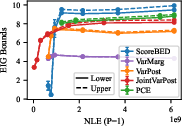
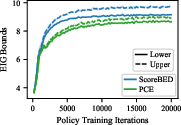
Figure 1: Left: EIG versus NLE for all methods on the high-dimensional location finding task (IT(ϕ)=Epϕ(y1:T,ξ1:T){IGθ(y1:T,ξ1:T)},2). Right: Policy learning curves for ScoreBED and PCE.
Numerical Findings
- High-dimensional location finding (IT(ϕ)=Epϕ(y1:T,ξ1:T){IGθ(y1:T,ξ1:T)},3):
- ScoreBED achieves the highest EIG lower bounds and outperforms all other methods (see Figure 1, left), particularly as parameter space dimensionality increases.
- The ability to amortize the score network enables ScoreBED to maintain (or improve) performance when moving from IT(ϕ)=Epϕ(y1:T,ξ1:T){IGθ(y1:T,ξ1:T)},4 to IT(ϕ)=Epϕ(y1:T,ξ1:T){IGθ(y1:T,ξ1:T)},5 restarts under a fixed computational budget, whereas baselines degrade due to dividing resources.
- Policy Training Dynamics:
- ScoreBED demonstrates lower-variance, faster per-iteration convergence compared to PCE (see Figure 1, right).
- Dynamical systems:
- On the stochastic pendulum and cart-pole, ScoreBED performs on par with variational posterior and PCE baselines, with all outperforming other approaches.
- For the more complex double link system, all adaptive, amortized methods (ScoreBED, variational posterior/joint) are highly competitive.
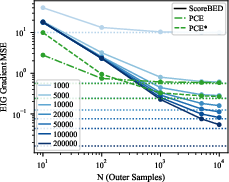
Figure 2: EIG gradient MSE versus inner sample count IT(ϕ)=Epϕ(y1:T,ξ1:T){IGθ(y1:T,ξ1:T)},6 for PCE and ScoreBED. Horizontal lines indicate squared bias asymptotes.
Score Error Analysis and Gradient Bias
The authors analyze gradient mean-squared error (MSE) and show clear bias-variance trade-offs: at large sample counts IT(ϕ)=Epϕ(y1:T,ξ1:T){IGθ(y1:T,ξ1:T)},7, bias dominates, and ScoreBED's MSE gracefully plateaus at the score approximation error Figure 2. Empirically, higher EIG gradient bias is directly correlated with inferior downstream EIG attained by the policy, indicating gradient estimator bias is the dominant determinant of final policy quality.
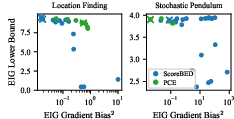
Figure 3: EIG lower bound versus EIG gradient squared-bias for ScoreBED and PCE, demonstrating strong correlation between gradient bias and final policy efficacy.
Architectural and Algorithmic Insights
- The amortized score network is implemented as a self-attentive transformer architecture with permutation equivariance for i.i.d. designs and explicit positional encodings for Markovian tasks.
- Conservative property is enforced by constructing the score as the gradient of a neural scalar potential.
- For Markovian dynamics, prediction heads are provided with local context to leverage conditional independence structure.
- Design-space sampling during MSM can be flexible; empirically, simple uniform or marginal distributions suffice, and additional studies (see appendix in the paper) demonstrate robustness to the choice of design sampler.
Theoretical and Practical Implications
Theoretical Implications
- The policy independence of the EIG intractabilities, and the fact that the posterior over parameters for given observed data is policy-agnostic, justifies amortization and suggests cross-compatibility with other variational/objective approximations.
- Score matching, being independent of normalization constants and directly targeting the relevant score function, is provably preferable to density/variational approximation for the gradient-based training of policies, especially in high-dimensional design settings.
- The authors derive error bounds showing that EIG gradient estimation error is Lipschitz-bounded by the mean error of the score matching phase, confirming the chief determinant of estimator quality is the score network's fitting budget and capacity.
Practical Implications
- By shifting all expensive, likelihood-bound computation to a single up-front amortized phase, ScoreBED makes full use of simulation/model budgets, dramatically increasing practical flexibility for real-time experimentation, model selection, and policy search.
- Substantial reduction in wall-clock time and computational cost for policy optimization should enable broader adoption of fully non-myopic, adaptive experimental design even in computationally intensive or high-throughput scenarios (e.g., active learning, sequential survey design, complex scientific experiments).
- The framework naturally extends to complex dynamical systems and non-Markovian trajectories due to its first-principles construction.
- The policy-agnostic nature of score learning suggests possible integration as a drop-in component for future architectures and downstream optimization objectives.
Contradictory or Surprising Outcomes
- Unlike existing literature, the variational marginal approach underperforms for high-dimensional location finding, even though its theoretical properties closely mirror ScoreBED in terms of marginal approximation. This highlights the limitations and empirical fragility of density-based deep variational approximations in practice.
- Empirical evaluation shows practical optimization with pre-trained variance-bounded or bias-minimized scores (as in ScoreBED) is more critical for downstream EIG than tighter variational bounds alone. This reinforces the necessity to directly minimize gradient bias, rather than focusing exclusively on the quality of the EIG surrogate.
Future Directions
- Extending ScoreBED to implicit models and simulation-based inference settings, possibly leveraging sliced score matching or denoising score matching, to handle likelihood-free contexts.
- Joint training or meta-learning the policy and score network in non-stationary or continual design scenarios.
- Investigating online adaptation of the design-sampling distribution for score matching, potentially using past policy rollouts or active exploration.
- Exploring the use of higher-order score-based objectives and control variate approaches to further reduce EIG gradient variance and control estimator bias.
- Applications in settings where the cost of retraining policies is prohibitive and/or there are strong incentives for extensive policy model search, such as clinical trial design, adaptive survey design, or autonomous scientific discovery.
Conclusion
This work demonstrates that decoupling the double intractability of EIG via amortized, policy-independent score matching—ScoreBED—leads to substantial computational and empirical gains in sequential, policy-based Bayesian experimental design. By translating the nested expectation problem into two tractable analytic and stochastic subproblems (score estimation and policy optimization), ScoreBED enables extensive exploration of policy architectures and hyperparameters and consistently achieves or exceeds state-of-the-art performance on a spectrum of established benchmarks. These advances not only close critical gaps in the literature but provide a clear path toward efficient, scalable, and adaptive optimal experiment design in increasingly complex domains.