- The paper introduces a novel Laplacian decoupled feature enhancement block that separates global and local features for improved RGB-IR fusion.
- The paper incorporates GS²E and LC²E modules with targeted denoising and fine-detail extraction, achieving significant improvements in mAP and efficiency.
- The paper demonstrates enhanced robustness and reduced latency across six benchmarks, underpinning its effectiveness in real-time, dual-stream object detection.
LDFE: Laplacian Decoupled Feature Enhancement Block for Dual-Stream CNN-based RGB-IR Object Detection
Introduction
The paper presents LDFE, a Laplacian Decoupled Feature Enhancement block, integrated within dual-stream CNN architectures for RGB-IR object detection. Identifying the complementary nature of RGB (detail, texture) and IR (contour, robustness to illumination) modalities, the paper highlights critical fusion limitations in existing architectures: CNNs excel in local feature extraction but lack global context, whereas Transformers and Mamba achieve global modeling with inferior fine-grained detail sensitivity. The proposed LDFE explicitly decomposes feature maps into global and local components using a Laplacian Pyramid, then applies modality-aware denoising and fusion strategies via tailored modules – Global State Space Enhancement (GS2E) and Local Convolutional Correlation Enhancement (LC2E) – followed by reconstruction. This design achieves significant gains in detection accuracy, runtime efficiency, and parameter compactness across six benchmark datasets.
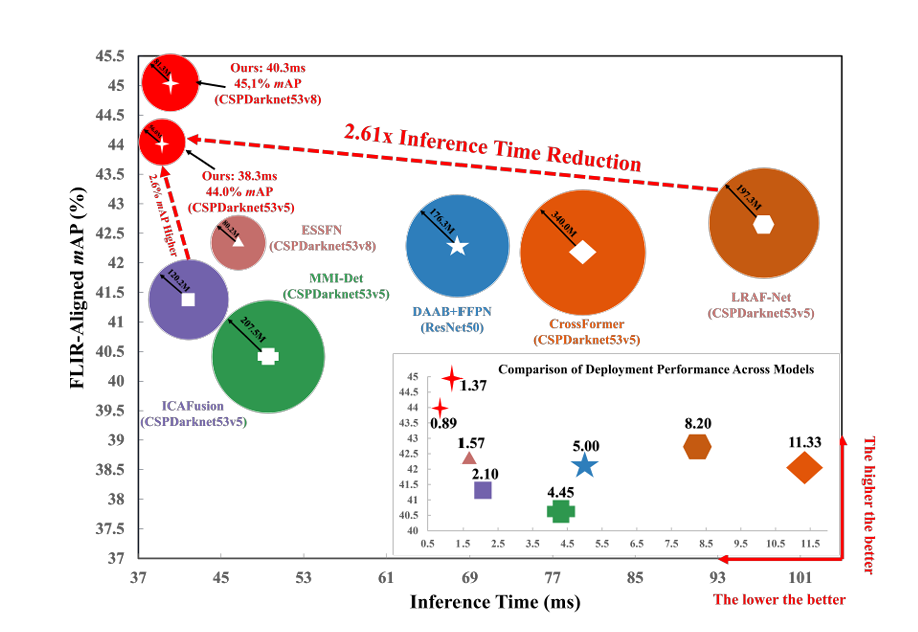
Figure 1: Deployment efficacy of LDFE versus competing multimodal detection models on FLIR-Aligned, showing superior mAP and resource efficiency.
Architecture: Laplacian Feature Decomposition and Fusion Paradigm
The backbone follows a dual-stream CNN, where paired RGB and IR images are processed independently. Outputs from selected backbone stages (2, 3, 5) are routed through the LDFE block:
- Laplacian Pyramid Decomposition: Features at each stage are separated into global (low-frequency, Gaussian-smoothed) and local (high-frequency, difference) components.
- Global State Space Enhancement (GS2E): Swapped channels from both modalities are utilized to generate cross-modal attention for dynamic noise suppression. Subsequently, state space modeling (Mamba) encodes long-range contextual dependencies, alternating the main/auxiliary modality roles.
- Local Convolutional Correlation Enhancement (LC2E): L1 normalization removes modal-specific local noise. Softmax Fusion integrates modality information. Spatial and channel attention combined with convolutional correlation extraction focus on fine-grained details.
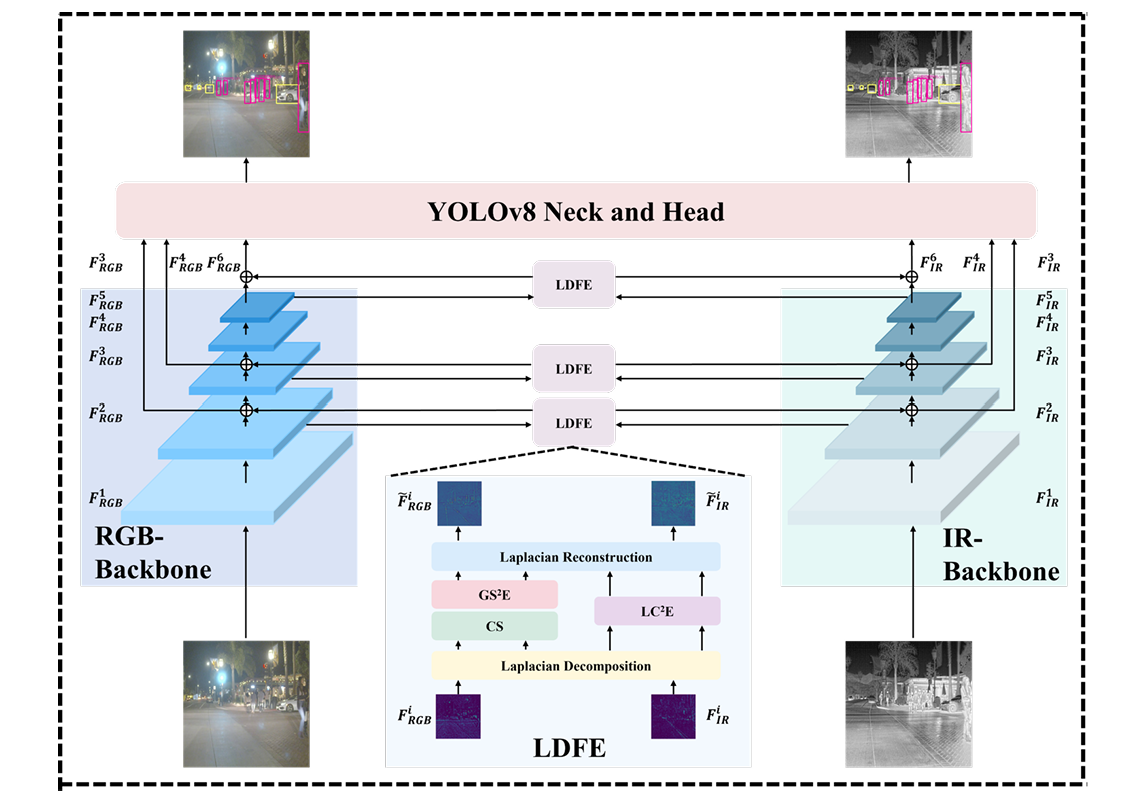
Figure 2: Schematic overview of the dual-stream CNN with LDFE blocks at backbone layers 2, 3, and 5.
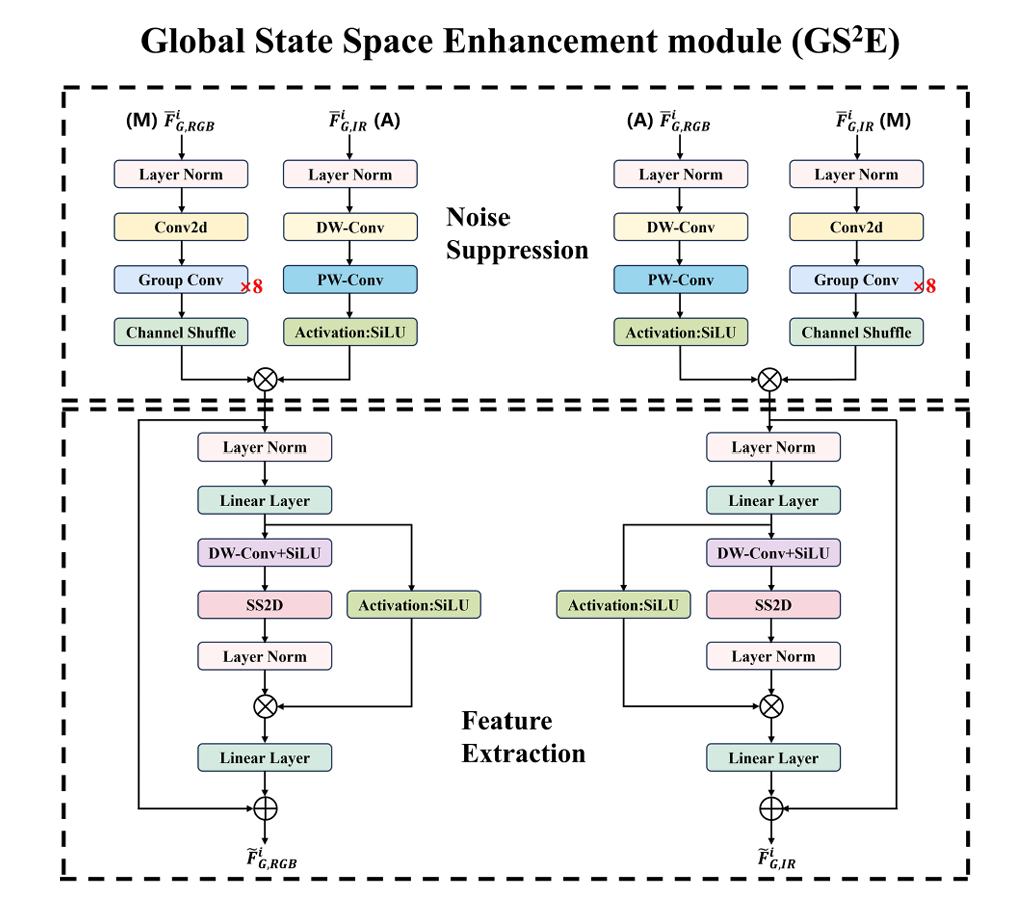
Figure 3: Internal structure of GS2E module, highlighting branch alternation and cross-modal noise suppression.
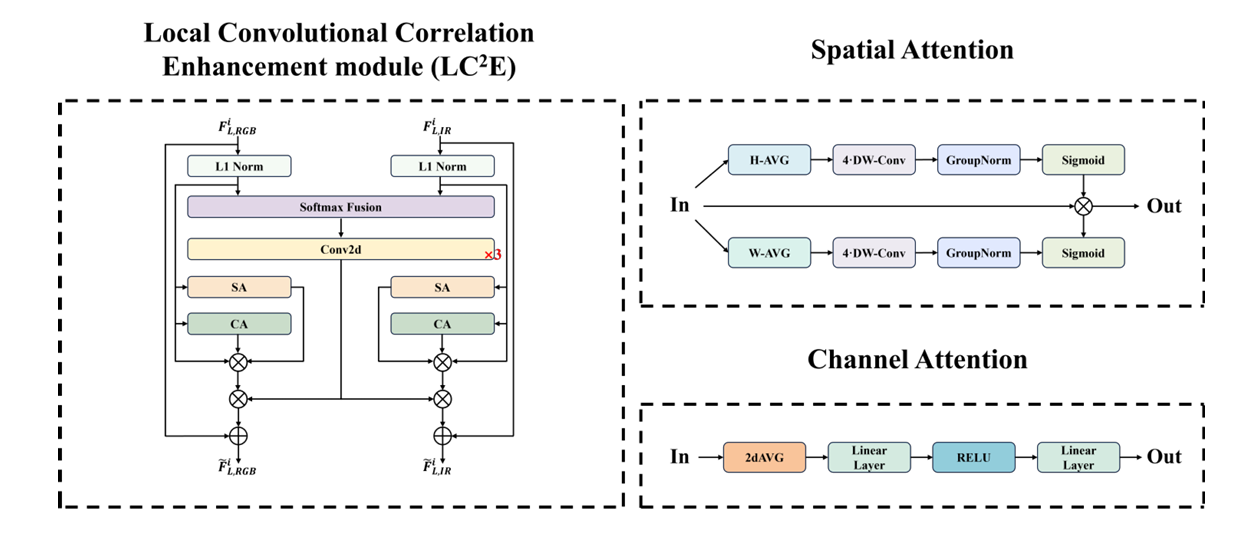
Figure 4: LC2E, demonstrating denoising, attention mechanisms, and correlated convolution for local feature enhancement.
The reconstructed features (global + local fusion) at each stage are aggregated and forwarded to the YOLOv8 neck and head.
Experimental Evaluation
LDFE is extensively evaluated on M3FD, DroneVehicle, LLVIP, FLIR-Aligned, KAIST, and VEDAI datasets, utilizing three standard CNN backbones (ResNet50, CSPDarknet53v5/v8). Results consistently demonstrate:
- M3FD: LDFE achieves mAP improvements of 6.2% over SOTA with CSPDarknet53v8.
- DroneVehicle: Superior classification in categories with high confusion (Truck, Freight-car, Van), ascribed to robust local fusion.
- LLVIP: Gains up to 4.7% mAP, outperforming methods relying solely on pixel-level or global fusion.
- FLIR-Aligned: LDFE not only delivers highest mAP, precision, recall, and F1, but also minimizes parameters and inference latency for real-time deployment.
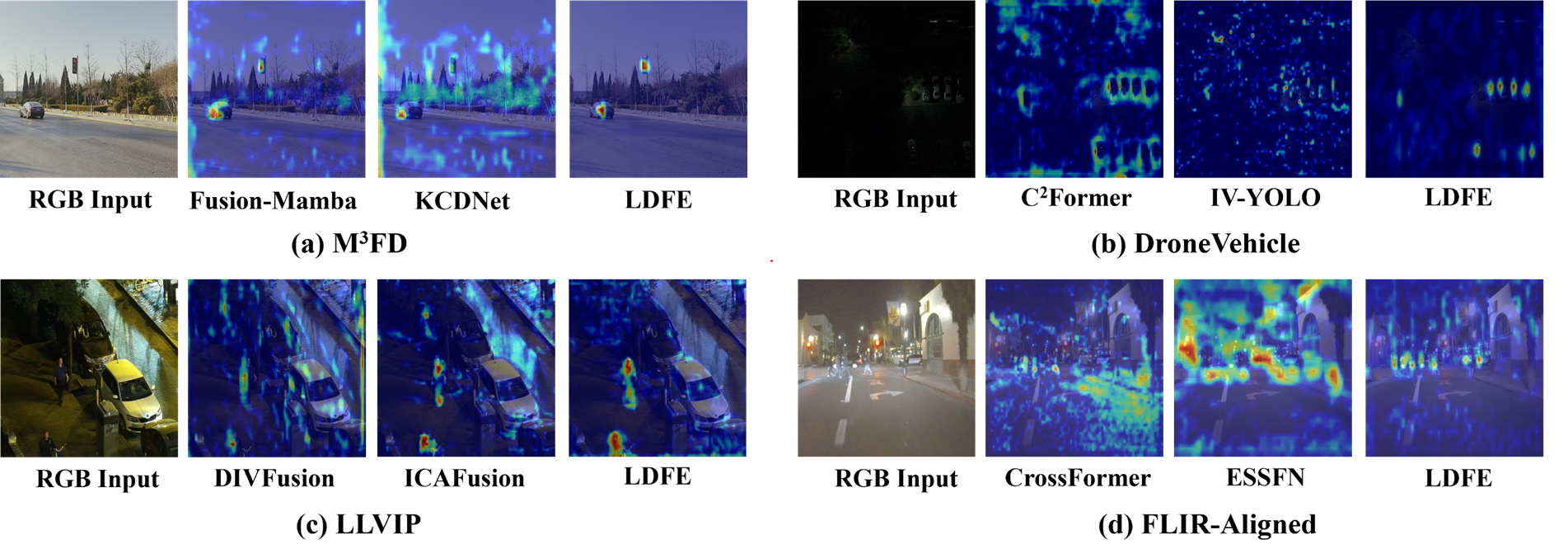
Figure 5: Grad-CAM heatmaps showing LDFE's focus on target regions versus competitor methods on M3FD, DroneVehicle, LLVIP, FLIR-Aligned.
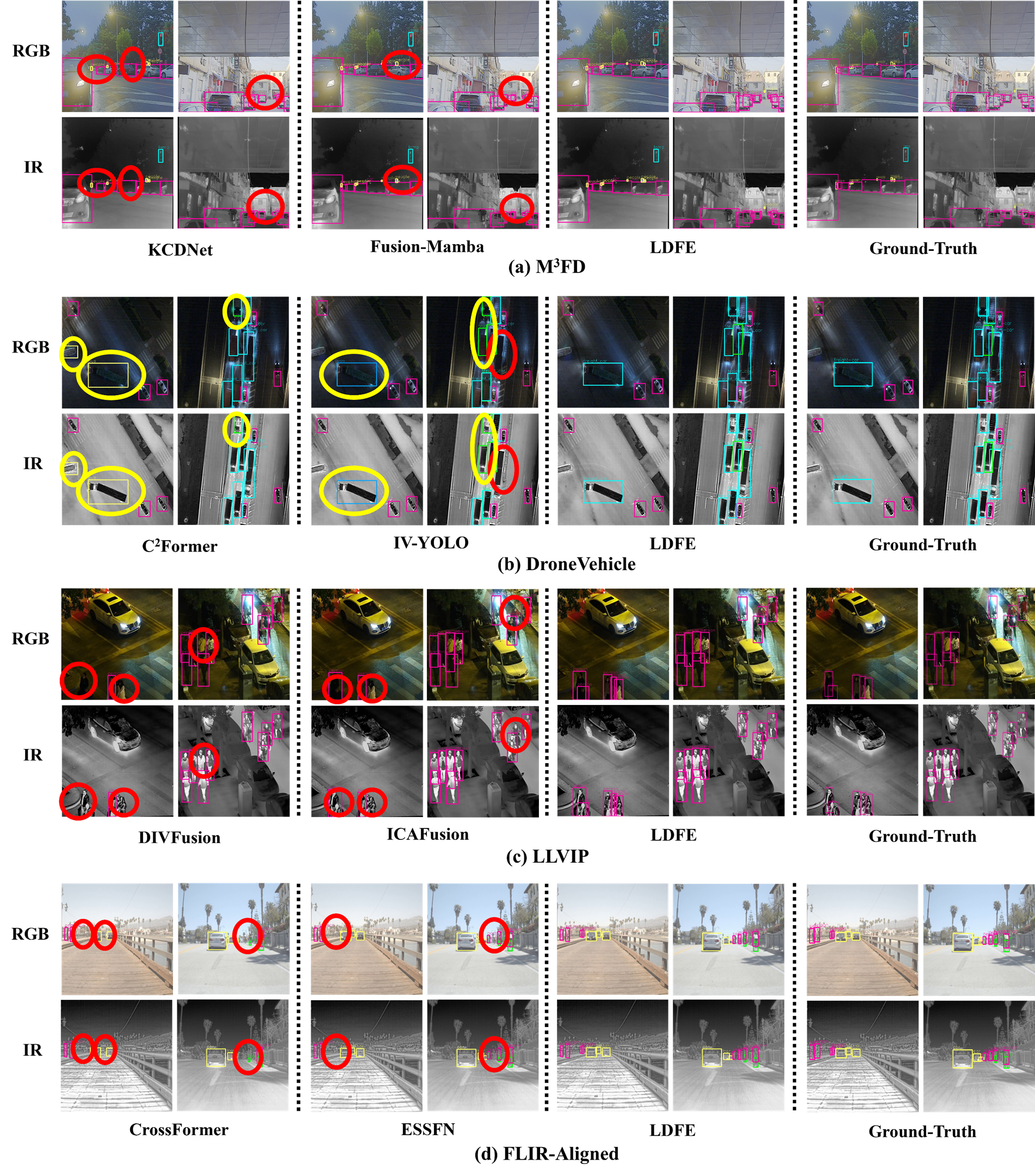
Figure 6: Detection outputs across several RGB-IR benchmarks; LDFE reduces missed and false detections under occlusion and adverse scenarios.
Comprehensive ablations reveal the necessity of channel swapping, GS20E/LC21E modules, optimal fusion block placement, and denoising. Substituting Mamba-like SSM with Transformer for global features reduces accuracy and increases computational burden.
Robustness and Generalization
Tests on M22FD partitioned by scene (day, night, overcast, challenge) and FLIR-Aligned with synthetic overexposure show LDFE's resilience. Performance degrades minimally compared to non-adaptive architectures, indicating effective suppression of modality-specific noise and adaptability across diverse environments and illumination shifts.
Practical and Theoretical Implications
LDFE advances explicit separation and targeted enhancement of modality-specific global and local features within multimodal detection pipelines. The approach demonstrates:
- Deployment Scalability: Parameter and runtime reductions make LDFE noteworthy for embedded/mobile inference.
- Fusion Algorithm Design: Using Laplacian decomposition enables modular global/local fusion, adaptable to other vision tasks (e.g., segmentation, image fusion).
- State Space Modeling: Integrating dynamic state space modeling (Mamba) in global fusion surpasses Transformer approaches for multimodal context aggregation.
- Noise Robustness: Alternating cross-modal attention for denoising enhances stability against input perturbations and environmental variation.
Future work should explore domain adaptation for dense/small object scenarios and leverage LDFE in broader spectrum fusion applications.
Conclusion
The LDFE block delivers modality-aware, structurally decoupled feature fusion for dual-stream CNN-based RGB-IR object detection. Utilizing Laplacian decomposition, tailored denoising, state space global fusion, and local convolutional attention, LDFE achieves state-of-the-art accuracy and efficiency on multiple benchmarks. Its explicit global/local modeling paradigm sets a foundation for scalable multimodal fusion, with promising extension to other vision tasks and architectures.