- The paper presents an extended-coordinate mode-sum technique to compute the renormalized vacuum polarization and stress-energy tensor for spherical thin shells.
- It rigorously matches Minkowski and Schwarzschild modes at the shell boundary, revealing divergent behavior near the shell and finite Casimir effects at the center.
- The results underscore implications for semiclassical backreaction, challenging classical compactness limits and highlighting persistent quantum hair effects.
Vacuum Polarization and Renormalized Stress-Energy Tensor of Spherical Thin Shells
Overview and Motivation
This work presents a detailed and systematic analysis of the Boulware vacuum for massless scalar quantum fields in the spacetime of a spherically symmetric, static thin shell enclosing a Minkowski interior with a Schwarzschild exterior. The central focus is on computing the renormalized vacuum polarization (RVP) and renormalized stress-energy tensor (RSET) for quantum fields in such configurations. The authors employ the extended-coordinate mode-sum prescription to obtain these quantities, paying particular attention to the singularity structure near the shell’s surface, the behavior at the center, and the approach to the black hole limit. The analysis is motivated by fundamental questions regarding the universality of the semiclassical vacuum in highly compact horizonless objects, the nature of divergences induced by sharp boundaries, and the implications for semiclassical gravitational backreaction.
Technical Framework: Extended-Coordinate Prescription
Renormalized expectation values of quadratic quantum field observables in nontrivial spacetimes require point-splitting and subtracting the Hadamard parametrix to regularize short-distance singularities. In this study, the extended-coordinate mode-sum prescription, recently generalized to Boulware states (2607.07583), is deployed:
- The Euclidean Green function GB(x,x′) is expanded in spherical harmonics and Fourier modes, yielding a double sum-integral over frequency and angular momentum of radial Green functions gωl(r,r′).
- The Hadamard parametrix is recast as an analogous sum by expanding in "extended coordinates," enabling analytic or semi-analytic subtraction mode-by-mode, which gives rapidly convergent expressions for both ⟨ϕ^2⟩ren and RSET components.
- For the thin shell problem, the radial modes are constructed by matching Minkowski solutions in the interior to Schwarzschild solutions in the exterior at r=r0, using distributional matching conditions dictated by Israel-Darmois-Lanczos formalism.
This prescription is crucial for correctly isolating and analyzing boundary-induced divergences and non-local, Casimir-type contributions.
Thin Shell Geometry and Mode Construction
The authors detail the construction of the spherically symmetric thin shell:
- Geometry: Minkowski interior joined with Schwarzschild exterior at r=r0; the shell is mathematically infinitesimal (distributional stress-energy supported at the shell).
- Junction Conditions: Israel-Darmois conditions ensure metric continuity and specify jumps in the extrinsic curvature that give the shell’s surface energy and pressure.
- Mode Matching: The radial quantum field modes are continuous, but their derivatives jump due to the Ricci scalar’s delta function at the shell. The matching yields the necessary mode bases for both interior (Minkowski) and exterior (Schwarzschild) regions.
The explicit analytical and numerical construction of modes enables high-precision evaluation of quantum expectation values everywhere except arbitrarily close to the shell surface, where standard convergence is lost due to boundary-induced divergences.
Surface Divergences and Analytical Control
The presence of the sharp shell leads to singular behavior of the RVP and RSET near r=r0:
- Divergence Structure: Leading divergences in the RSET scale as ε−3 or ε−2, with ε the proper distance to the shell, mirroring known results for quantum fields near boundaries [PhysRevD.20.3063]. For the RVP, the leading term is ∼ε−1, proportional to the shell’s surface stress tensor.
- Computation: Leading terms are computed using a WKB expansion for high-frequency/large-gωl(r,r′)0 modes. For weak-field (small compactness) shells, nonlocal quantum corrections are computed using covariant perturbation theory, and shown to match the WKB results in the appropriate limit.
- Interior vs. Exterior: The divergence coefficients are identical on both sides of the shell, a key consistency check for the formalism.
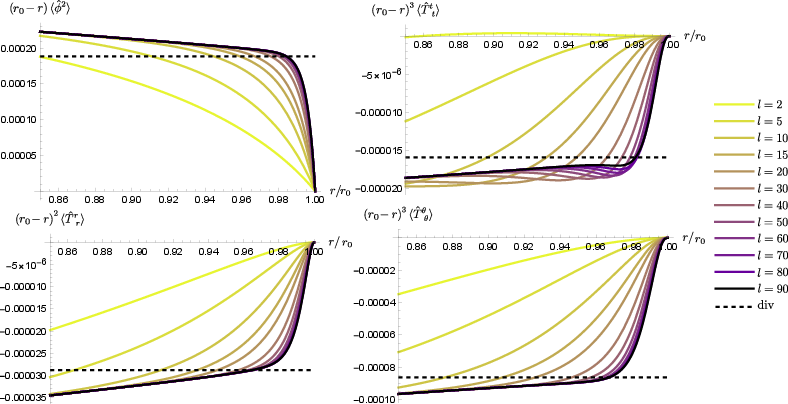
Figure 1: Renormalized vacuum polarization and stress-energy tensor inside a thin shell; the data confirm the predicted near-surface divergence structure.
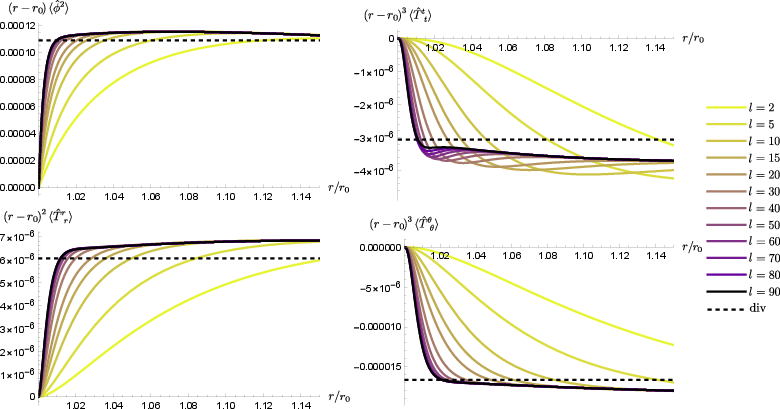
Figure 2: Exterior renormalized vacuum polarization and stress-energy tensor, confirming the analytic divergence as gωl(r,r′)1.
Non-local Casimir Effects at the Center
A crucial result concerns the behavior at the center gωl(r,r′)2:
- Casimir-Like Contribution: The RVP and RSET remain finite at the origin in the strictly thin-shell model, with their magnitude set by integrals over gωl(r,r′)3 shell modes. These reflect non-local quantum vacuum effects—that is, the "echo" of the shell’s presence at arbitrarily large distances, analogous to the classic Casimir effect in flat-space cavities but with transparent boundaries.
- Black Hole Limit: As gωl(r,r′)4 (black hole limit), all central quantities remain finite, indicating that boundary-induced divergences do not "propagate" to the center in the original Boulware state. This is a robust and nontrivial finding.
Full Numerical Results: Bulk Behavior, Compactness Dependence, and Far Field
Comprehensive numerical results illustrate the behavior of the quantum stress tensor throughout the spacetime:
- Convergence Tests: The extended coordinate prescription is validated by explicit convergence analysis of mode sums, with divergence arising only pointwise at the shell.
- Bulk Profiles: For gωl(r,r′)5 away from the shell, the RVP and RSET are robustly computed; their sign and magnitude depend both on shell compactness and Ricci coupling gωl(r,r′)6.
- Compactness Dependence: As the shell approaches the Schwarzschild radius, the RVP and individual RSET components at the center remain finite, but significant quantitative changes occur throughout the bulk, with nonlocal effects growing substantially (Figures 7, 8, 9).
- Far-Field Universality: For the exterior region at sufficient gωl(r,r′)7, the RVP and RSET rapidly approach those for the Schwarzschild Boulware vacuum for minimal coupling (gωl(r,r′)8), confirming prior universality arguments [Anderson:2006gu]. Non-minimal coupling introduces persistent quantum hair effects.
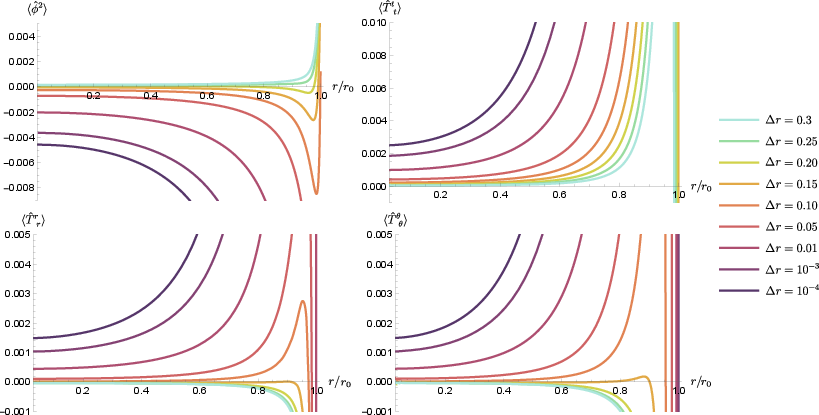
Figure 3: Interior profiles for RVP and RSET for a range of shell radii; the central value increases dramatically as the shell approaches the black hole limit.
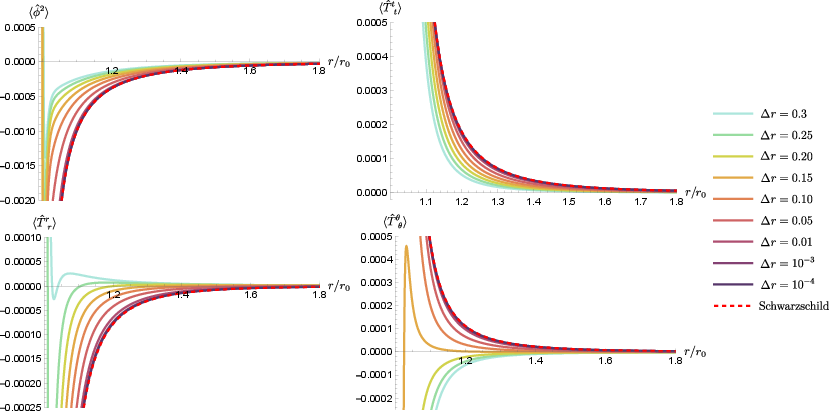
Figure 4: Exterior profiles for RVP and RSET for the same sequence of increasingly compact shells.
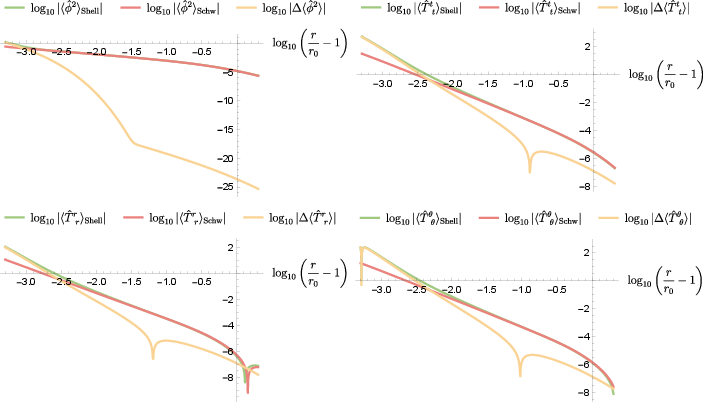
Figure 5: Direct comparison of exterior RVP and RSET between a near-horizon shell and Schwarzschild black hole, showing rapid convergence at large radius.
Backreaction and Implications for Semi-Classical Gravity
The paper addresses gravitational backreaction due to vacuum polarization:
- Near Shell: The divergent RSET near the shell leads, at linear order in gωl(r,r′)9, to a curvature singularity at the shell in the strictly thin-shell model. Thus, the semiclassical equations are only physically meaningful in smooth (or at least non-singular) shell models; the divergence would be regulated in realistic models with finite shell thickness or quantum fluctuation.
- At Center: At ⟨ϕ^2⟩ren0, the quantum-corrected metric receives a finite, computable, and potentially large correction for highly compact shells, but no singularity.
- Relaxation of Compactness Bounds: The presence of large, negative RSET contributions for highly compact configurations supports mechanisms for relaxing classical Buchdahl-type limits and provides insight into the physics of horizonless ultracompact objects.
Broader Context and Future Directions
The study’s results have both practical and theoretical import:
- Technical Demonstration: The extended coordinate prescription is shown to be a robust and general tool, applicable to arbitrary spherically symmetric distributions, especially when nonlocal contributions dominate.
- Universality and Quantum Hair: The findings reinforce the notion that, for nonminimal coupling, the semiclassical vacuum outside ultracompact objects may exhibit persistent quantum "memory" of interior structure, with potential observational consequences.
- Model-Building Extensions: The approach is relevant for models of ECOs/gravastars with thick shells or alternative interiors, and directly applicable to order-reduced semiclassical gravity studies.
- Boundary Pathologies: Singular RSET at sharp boundaries underscores the need for physical models to avoid idealized, infinitely thin matter distributions, motivating studies of quantum effects in more realistic, smooth transition layers.
Conclusion
This work delivers a comprehensive, technically precise account of vacuum polarization and quantum stress tensor phenomena in spherically symmetric thin-shell geometries. By blending advanced analytical and numerical methods, the authors clarify the singularity structure due to boundaries, elucidate Casimir-like non-local contributions even in Ricci-flat interiors, and demonstrate rapid universality in the black hole limit for minimal coupling. The study sets the stage for investigations of horizon-scale quantum hair, semiclassical backreaction on horizonless compact objects, and the development of more realistic models avoiding sharp boundaries while retaining analytic control.

